“You’ll never be my pride,” Dad sneered in court, suing to take my house. I sat alone while his lawyer mocked me. I silently gave the judge my file. The judge froze, dropped her pen, and glared at Dad. “S-sir… do you know what your daughter is?”
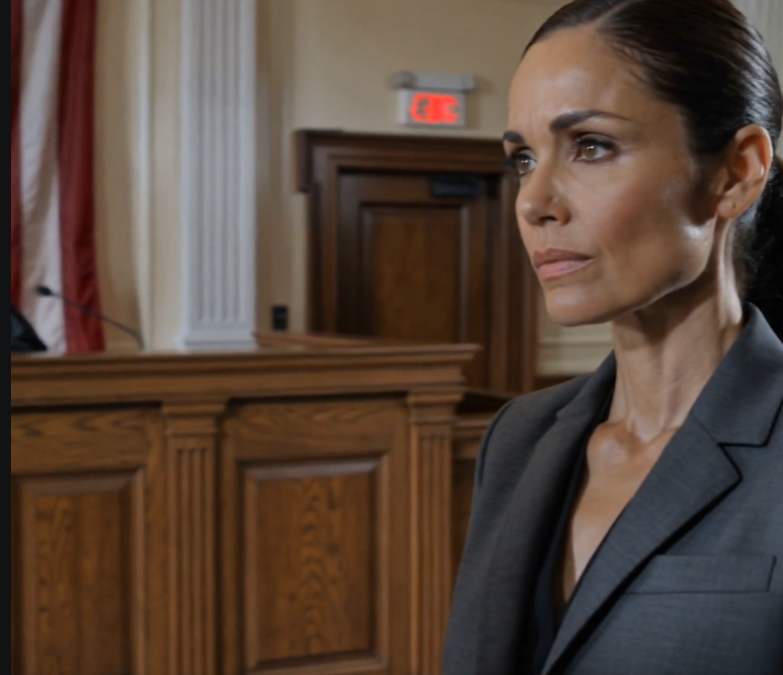
“You will never be my pride. What right does a lowly grunt like you have to demand this family’s estate? Sign the papers returning the house before I crush what little cheap dignity you have left, right here.”
My dad hissed the words through his teeth, leaning heavily on the plaintiff’s table. He thrust his supposedly distinguished yet utterly ruthless face toward me, right in the middle of the federal courtroom. Beside him, his expensive lawyers sneered with absolute contempt. They fully believed that today they would strip me of everything.
I did not blink. I did not frown. Acting on the silent instinct of an officer trained to stare down the barrel of a gun, I offered no retort. I simply stood up, cold and deliberate, and smoothed the lapels of my charcoal suit, exactly the way I adjusted my uniform before a combat briefing.
The judge’s gavel cracked against the wood. The trial began.
My dad leaned back in his chair, crossing his arms smugly, waiting for the destruction of the daughter he considered trash. He had no idea I had not come here to take a beating. I bypassed the useless opening argument, silently sliding my single counterattack file, stamped with the blood-red seal of the Pentagon, across the judge’s bench.
Two minutes later, the air in the courtroom violently fractured. The judge froze. Her eyes widened in absolute shock. She dropped her pen with a sharp clack onto the oak desk, ignoring every standard protocol. She locked her burning eyes onto my dad’s smug face and gritted out, “Sir, do you know what your daughter is?”
Before I tell you what happened, take a second to like and subscribe, but only if this story hits close to home. And let me know in the comments where you’re watching from and what time it is there right now.
To understand how I ended up in that courtroom, you need to understand the man sitting across from me.
My dad did not just demand respect. He manufactured it.
After my mother died when I was nine, he repainted himself as the ultimate tragic hero: a self-made businessman who sacrificed everything to raise two daughters alone. The relatives bought every word. The neighbors bought every word. The country club bought every word. Behind the closed oak doors of our house, however, he ran a dictatorship. The family was a chessboard, and he controlled every piece.
I watched him groom my older sister, Lauren, into his perfect little pawn from the time she was twelve. She was soft, easily bent, financially dependent on every dollar he slid across the table. She became the expensive accessory he paraded at country club dinners, the beautiful, obedient daughter who laughed at his jokes and never challenged a single decision.
He rewarded her for it. Cars, credit cards, public praise at family gatherings where he would raise his glass and call her his greatest accomplishment.
I was the stubborn rock in his shoe.
He spent my entire childhood isolating me. At Thanksgiving dinners, he whispered to aunts and uncles that I was cold, ungrateful, and difficult to love. He told his golf partners I had behavioral problems. He told our church pastor I was going through a rebellious phase that he was bravely managing alone. When a cousin asked why I never came to Sunday dinners, he shrugged and said I preferred being alone.
A calculated lie that ensured no one ever checked on me.
The isolation was surgical. He removed every potential witness and every potential ally from my orbit, one relationship at a time, until I was standing in the middle of a family of thirty people and completely invisible.
Lauren received birthday parties with catered food, new dresses every Easter, and a cherry-red convertible on her seventeenth birthday. I received itemized bills for my groceries.
Not a metaphor. Not an exaggeration.
Actual paper invoices, printed on his company letterhead, slid under my bedroom door every Sunday night. He tallied the cost of cereal, milk, bread, and toothpaste down to the cent. He included tax.
When I turned sixteen and got a part-time job bussing tables at a diner off Route 9—four-hour shifts after school, grease burns on my forearms, minimum wage minus the tips I had to split with the dishwasher—he started charging me rent for my bedroom. Thirty dollars a week.
He deducted it from the household budget and wrote my name next to the line item in red ink. He called it a lesson in responsibility.
Lauren, four years older and living under the same roof, paid nothing. She ate steak while I ate cereal I had already been billed for.
At Christmas, he handed Lauren a jewelry box in front of the entire family. He handed me an envelope. Inside was a photocopy of my quarterly grocery invoice with a Post-it note.
Merry Christmas. Balance due.
Every time I achieved something—honor roll, a track meet trophy, acceptance into the ROTC program—my dad did one of two things. He either credited his own parenting in front of relatives, or he simply ignored it. The trophy went into a drawer. The report card stayed on the counter, unsigned.
When I secured my military contract at eighteen, he scoffed at the dinner table, swirling his wineglass with a bored flick of his wrist. He had already convinced the entire extended family that I chose the military because I was too incompetent to survive in the corporate world.
In his telling, I was just a lowly grunt, a lackey, someone who emptied garbage cans on a base somewhere and answered phones.
The graduation ceremony happened on a dirt parade ground at Fort Benning when I was twenty-two. The sun hammered down on five hundred starched uniforms standing in razor-straight formation. I stood in the third row, securing my commission as a second lieutenant.
A brass band played behind us, the same march they had played for sixty years of graduating classes. Around me, my squadmates broke ranks to hug their crying mothers and salute their proud fathers. Families poured onto the field carrying flowers, cameras, and homemade signs.
A private two rows ahead of me lifted his six-year-old son onto his shoulders, and the boy grabbed his dad’s new officer’s cap and put it on his own head, laughing.
I scanned the crowd and spotted my dad arriving late, wearing a custom navy suit that cost more than my first three months of military pay. He looked completely out of place and visibly annoyed that he had been forced to stand on unpaved ground. His Italian leather shoes were already coated in red Georgia dust.
Lauren stood beside him, scrolling through her phone, looking bored.
He did not come to congratulate me. He came to ensure I knew my place.
Standing directly in front of my new commanding officers—a lieutenant colonel, a company commander, and two senior NCOs who had trained me for four years and watched me earn every stripe through blood, sweat, and sleepless nights—he let out a dry, condescending laugh that cut through the celebratory noise like a blade.
He pointed at my boots, still caked with parade-ground dust, and sneered loud enough for everyone within fifteen feet to hear.
“She joined the Army because, in the real world, a brainless fool would starve.”
The words hit the air like a slap.
The officers around me fell dead silent. My company commander’s jaw tightened so hard I could see the muscle jumping beneath his skin. A lieutenant colonel exchanged a sharp, disbelieving glance with the battalion executive officer.
The senior NCO, a sergeant major with thirty years of service and three combat deployments, took a single step forward before the XO stopped him with a hand on his shoulder.
These were men and women who had watched me crawl through mud, run until I vomited, and study law until my eyes bled. And they had just watched my father try to demolish me in front of them for sport.
I tasted copper in my mouth where I had bitten through the inside of my cheek. The blood pooled against my tongue, warm and metallic. I swallowed it.
I did not cry.
I locked my knees, snapped a razor-sharp salute at the reviewing stand, and stared straight through my dad’s forehead as if he were a pane of dirty glass.
I learned my first true survival lesson on that dirt field. Strip away all expectations of love from your enemy. Never reveal your real weapons.
I turned on my heel and marched toward my barracks without looking back.
In the suffocating heat of my first deployment, there was only one tether keeping my sanity from snapping.
Gran.
My grandmother on my dad’s side lived on a massive estate in Winston-Salem, North Carolina, completely immune to my dad’s toxic orbit. She had watched him transform from a grieving widower into a calculating narcissist, and she never bought a single performance.
She saw through the silk suits and recognized what was underneath my combat gear. Not a fool, not a grunt, but a diamond-hard piece of grit that the family had tried to grind into dust.
On the morning I boarded a C-130 into an active combat zone, my satellite phone beeped with a single encrypted text.
I read the glowing green screen while crouched behind a concrete barrier, the rotor wash from a Black Hawk blowing sand into my teeth.
Three words from Gran.
You are ready. Come back.
I survived.
I finished my specialized training at the Military Law Center and joined the JAG Corps, the Judge Advocate General’s Corps, the legal arm of the United States Army.
I became a federal military prosecutor.
My dad did not call. He did not send a card. He did not ask what JAG meant.
Gran drove four hours by herself, leaning heavily on her oak cane, and walked into the military auditorium for my insignia ceremony. When they pinned the new rank on my lapel, she wiped tears off her cheeks with the back of her hand.
She gripped both of my hands, her skin paper-thin but her grip like iron rebar, and looked at my rank insignia.
“I see you, Mary,” she whispered.
Fourteen months later, Gran passed away.
We sat in a sterile lawyer’s office in Winston-Salem. The overhead fluorescent lights hummed at a frequency that pressed against your temples. The conference table was polished mahogany, the kind of wood Gran would have appreciated.
My dad checked his Rolex twice in the first thirty seconds, bored and shifting in his chair with the restless energy of a man who had already mentally divided the estate into investment portfolios.
He expected what he had always expected: that the massive property, the land, the house, everything, would fall into his lap because he was the only surviving son.
That was the natural order of his universe.
Money flows to power. Power flows to him.
Lauren sat beside him in a black dress, dabbing her eyes with a tissue she had prefolded in her purse. Performative grief, executed on schedule.
The lawyer, a gray-haired woman with reading glasses on a chain around her neck and the patient, unimpressed demeanor of someone who had watched families cannibalize each other over property for thirty years, opened a folder and cleared her throat.
Then she broke the silence.
Gran had left the entire property—the house, the land, every square foot of the Winston-Salem estate—strictly and exclusively in my name.
My dad and Lauren received minor cash sums. Modest amounts, deliberate amounts, the kind of amounts that sent a very specific message.
I see you clearly, and this is what you are worth.
The will had been drafted, witnessed, and notarized with ironclad legal precision. It included a clause explicitly stating that Gran was of sound mind at the time of execution, witnessed by an independent physician and a government inspector.
She had built a fortress around her final wishes because she knew exactly what her son would do the moment she was gone.
The room went completely silent.
The lawyer stopped reading. She placed the folder flat on the table and waited.
A predator does not bark when it hunts.
My dad did not yell. He did not slam the table. He did not stand up. He casually picked up the lawyer’s courtesy cup of Earl Grey tea, took a slow, deliberate sip, and let his eyes drag over me like a razor blade being drawn across exposed skin.
He set the cup down on the saucer without a sound, a small, controlled motion that communicated more menace than a shout.
He smirked.
“Your grandmother always had a foolish soft spot when she was senile. You think you can keep it, little soldier?”
I sat perfectly still, my posture straight, my hands resting flat on the mahogany table, fingers spread, pressure even, the way I centered myself before a cross-examination.
I looked him dead in the eye.
“It is a legal decision. It must be respected.”
My dad slowly lowered the teacup to the saucer. A chilling, dead-eyed smile crept across his face, the kind of smile that freezes blood and makes the small hairs on your arms stand straight up.
He leaned forward and whispered, “We will see.”
It was not a petty threat from an angry old man. It was the official launch of a scorched-earth campaign.
I returned to my unit and buried myself in the work. I pinned on the oak leaf of a major in a small ceremony attended by my commanding officer, two fellow prosecutors, and a row of empty folding chairs where family should have been sitting.
I became a senior prosecutor for the Federal Military Justice Office, specializing in dismantling complex federal fraud.
I falsely believed that a thousand miles of distance would make my dad abandon his obsession with the estate.
That was my fatal tactical error.
He did not just file a standard civil suit to void the will. He wove a brilliant, terrifying legal snare designed to destroy me on two fronts simultaneously.
He hired Gerald Foss, a local attorney whose business card might as well have read Scorched-Earth Litigation.
Foss was not just an aggressive lawyer. He was a guy who specialized in hitting below the belt, a courtroom bully who thrived on intimidation, procedural dirty tricks, and the sheer exhaustion of opponents who could not afford to fight back.
He had zero experience in federal jurisdiction. He had never set foot in a military courtroom. He did not know the difference between a JAG officer and a janitor.
And my dad picked him specifically because Foss did not care about the truth.
He cared about winning.
Their angle was savage. They claimed I had used advanced military interrogation tactics to manipulate a dementia-riddled old woman into signing over her estate.
The phrase interrogation tactics was Foss’s invention, vague enough to terrify a civilian jury, specific enough to sound like it came from a classified manual.
It was a lie built on the assumption that no one in the courtroom would know enough about the military to challenge it.
The pure evil of the strategy was how he weaponized my sister.
He dragged Lauren into his office on a Tuesday afternoon, sat her down across from his desk, and laid out her options with the cold efficiency of a man explaining a foreclosure.
If she cooperated, the money kept flowing. If she resisted, the money stopped.
Her mortgage. Her children’s tuition. Her credit cards. Her entire existence.
Lauren had no savings, no income, and no skills that functioned outside the life our dad had constructed for her.
She signed.
Under oath, my own sister put her name on a fabricated affidavit, declaring that I had physically barred the entire family from visiting Gran during her final years.
But the lawsuit was only the visible blade.
My dad used his local political connections—business partners, a city councilman he golfed with, a retired judge who owed him a favor—to orchestrate a shadow strike.
He mailed a series of anonymous letters, typed on plain paper, unsigned, and sent from different post offices to avoid pattern detection, directly to my base commander.
The letters accused me of elder abuse and financial exploitation of a vulnerable senior citizen.
The accusations were specific, detailed, and engineered with enough insider knowledge of military culture to trigger an immediate investigation.
The fallout was instant.
I was pulled out of a classified briefing by two military police officers who positioned themselves on either side of me like escort guards.
The room full of prosecutors watched me leave without a word.
No one said anything. No one had to.
Being pulled from a secure briefing by MPs carries exactly one message in the military: you are under investigation, and your career may already be over.
The Criminal Investigation Division, CID, opened a formal internal review. My security clearance was frozen. My access to every active case file was revoked. My computer login was disabled.
My office door, the one with the nameplate reading Major M. White, Senior Prosecutor, was locked from the outside by the Provost Marshal’s Office while I stood in the hallway and watched.
A junior officer I had mentored for two years walked past me carrying a stack of my reassigned case files.
He did not look at me.
He could not afford to.
My position as a federal prosecutor hung by a single fraying thread.
The base commander, a full colonel I had served under for three years, a man who had personally written my last two outstanding performance evaluations, called me into his office the following morning.
The room smelled of burnt coffee and floor wax. He sat behind his government-issued desk with his hands folded on the blotter, his West Point ring catching the fluorescent light.
He looked at me the way you look at someone whose career obituary you are already composing in your head.
He did not offer me a seat.
He slid the anonymous letters across the desk, four of them, each printed on plain white paper, each containing specific allegations of elder abuse, financial exploitation, and manipulation of a cognitively impaired senior citizen.
Each one was written with enough operational detail to suggest inside knowledge of my family.
He waited.
I read them standing up.
I recognized my dad’s vocabulary in every paragraph. The syntax, the emphasis, the weaponized precision of a man who ran his family like a hostile acquisition.
I was trapped in a lethal crossfire with no clear exit.
If I lost the civil suit, I lost Gran’s legacy, the only remaining proof that someone in my bloodline had loved me enough to fight for me from beyond the grave.
If the CID investigation found even a shadow of merit in those poisoned letters, I would be stripped of my rank, my security clearance, my law license, and expelled from the Army with a discharge code that would follow me into every job interview, every background check, and every relationship for the rest of my life.
My own father had engineered a precision kill box, a simultaneous two-front assault designed to collapse my professional world and my personal inheritance at the same moment.
He wanted to shatter my mind before we ever reached a courtroom, so that by the time I stood in front of a judge, I would be too broken to fight.
I paced the floor of my officer’s quarters until three in the morning. The old floorboards groaned under my boots like they were in pain.
The countdown on his bomb had started.
I needed a counteroffensive.
Three months before the federal hearing, an invitation arrived in my mailbox. Cream-colored cardstock, gold-embossed lettering, a birthday party for Lauren’s youngest daughter.
I knew exactly what this was.
Not a family gathering. A reconnaissance mission by the enemy.
My dad needed to see me, to read my face, to gauge whether his anonymous letters had broken me.
But an officer’s code does not permit cowardly evasion.
I drove to my dad’s sprawling suburban house in a rented sedan, arriving as quiet and still as a frozen lake.
The party was a masterpiece of suburban theater. Forty guests packed into a backyard strung with fairy lights, a bouncy castle for the kids, a catering company serving shrimp cocktails on silver trays, and at the center of it all, my dad playing the benevolent grandfather.
He laughed too loud. He poured expensive Merlot for relatives who worshiped him. He put his arm around Lauren for a photograph, squeezing her shoulder like she was a prop, and she smiled on command, a trained reflex.
I stood near the fence with a glass of water I never drank.
I counted heads. I cataloged exits. I noted which relatives avoided my eyes and which ones had clearly been briefed on my dad’s version of reality.
When the crowd migrated to the patio for the cake cutting, I stepped into the kitchen for a refill.
The door swung shut behind me.
My dad was standing there alone.
The benevolent grandfather mask had already melted off his face. What was left underneath was something cold and reptilian.
He stepped into my personal space, backing me against the marble counter. The cold edge of the stone pressed into my lower back.
He was close enough that I could see the tiny blood vessels in the whites of his eyes and smell the Merlot on his breath mixing with that suffocating cologne he had worn for thirty years.
The same cologne I smelled every time he slid an invoice under my bedroom door. Every time he told a relative I was difficult to love. Every time he reminded me that I was the defective product in his family lineup.
He lowered his voice into a venomous whisper that crawled into my ear like a snake sliding across warm stone.
“Has your commander received my letters yet? Sign the paper giving up the house, and I’ll withdraw the complaint. If not, I’ll have you court-martialed. Where is a lowly grunt like you going to get the money to fight me?”
He let the last question hang.
He wanted me to calculate. He wanted me to realize that his legal budget exceeded my entire annual salary. He wanted me to feel small, outgunned, cornered.
He wanted me to feel exactly the way I felt when I was twelve years old, sitting at the dinner table while he handed Lauren a jewelry box and handed me a bill.
My eyes tracked the unnatural stiffness of his suit jacket. The fabric bunched wrong at the chest, too rigid for silk, too square for a pocket handkerchief.
The faint rectangular outline pressing against the inner breast pocket.
A recording device.
He was wearing a wire.
He had come to this birthday party, his own granddaughter’s birthday party, wired for sound.
He wanted to provoke me into an explosion—screaming, threatening, any outburst that would give him audio evidence of an unstable, violent daughter to play for a judge.
This was not a kitchen conversation.
This was an interrogation, and the cake and fairy lights were the camouflage.
My heart felt like it was being fed through a stone grinder, one slow crank at a time.
This man, my father, would rather destroy his own daughter’s career, her honor, her entire life, just to steal a piece of property and feed his ego.
He stood there breathing vanilla cake and expensive cologne, waiting for me to break, waiting for the explosion he had engineered with the patience and precision of a man who understood that the most effective weapons are the ones you build slowly.
I looked straight into his dark, calculating eyes. I swallowed the disgust down to the pit of my stomach, where it could rot quietly.
I let a freezing, razor-sharp smile touch the corners of my mouth.
The kind of smile that does not reach the eyes. The kind that makes a predator pull back because it does not understand what it is facing.
I issued a short tactical reply.
“Thank you for the advice, Mr. White.”
Not Dad.
Mr. White.
The designation stripped him of every shred of familial authority.
I saw the flicker in his eyes, the microsecond of confusion, the momentary fracture in his control.
He had not expected that.
I turned my back on him and walked through the kitchen door without breaking stride.
I crossed the patio without stopping. I passed Lauren, who was cutting cake with a plastic knife, her smile locked in place like a mask nailed to her skull.
I walked past the bouncy castle and the catering tables and the relatives who had all been briefed to believe I was a cold, ungrateful thief.
That night, I collapsed my forehead against the steering wheel of my truck in the driveway of my rented apartment.
Eleven minutes.
I timed it on the dashboard clock.
The hard plastic of the wheel pressed into my skull until it left a ridge in my skin.
I could survive incoming fire in a combat zone on the other side of the world. I could process an ambush, return fire, and stabilize a wounded soldier without my hands shaking.
But this knife in the back from my own blood was a different kind of weapon.
It did not kill fast. It dissolved you from the inside, one molecule at a time, until you woke up one morning and discovered you had been hollowed out.
I took a deep breath, counted to four, held, and released for eight.
The tactical breathing pattern they drill into you at survival school.
The same technique that keeps your hands steady when the world is exploding around you.
Emotion died.
Now was the time for iron discipline.
The morning of the trial, I walked into the federal courthouse at 7:15 a.m., forty-five minutes before the session began.
I wore a perfectly tailored charcoal suit, civilian clothes cut to military precision. I carried a single leather briefcase.
Inside it sat every piece of ammunition I had spent three months assembling in absolute secrecy.
Judge Patricia Okafor took the bench at exactly eight o’clock. She was legendary among federal attorneys for her zero-tolerance policy on courtroom theatrics.
She had sent three lawyers to contempt hearings in the past year alone. Her reputation was a scalpel: precise, cold, and merciless toward anyone who wasted her time.
Across the aisle, my dad and Gerald Foss settled into the plaintiff’s table like two men reserving front-row seats at an execution.
They wore matching expressions, arrogant, pitying looks of hunters who had already counted the meat before firing the shot.
My dad adjusted his cufflinks. Foss arranged his stack of forged documents with theatrical care.
They were putting on a show, and they fully expected the audience to applaud.
The battle commenced, and my dad launched his lethal strikes immediately.
Foss strutted to the center of the floor with the swagger of a man who had never lost in his own ZIP code.
He adjusted his tie, paused for effect, and presented a thick stack of medical records to the judge, each page flagged with color-coded yellow tabs.
He had cleverly altered documents sourced through my dad’s personal physician, a local doctor who owed my dad three decades of country club favors and patient referral fees.
The records highlighted a diagnosis of mild cognitive impairment for Gran during her final two years.
Foss held the papers up, turning them slowly for the gallery.
He painted a tragic, manipulative picture: a confused, helpless elderly woman being strong-armed by a greedy, power-hungry granddaughter who exploited her military training to isolate and control a defenseless senior.
He lingered on phrases like undue influence, predatory behavior, and systematic elder exploitation, letting each word drip with manufactured sympathy, each pause calculated to let the poison settle into the judge’s assessment.
Judge Okafor frowned.
She picked up the medical records and studied them, her reading glasses low on the bridge of her nose. She flipped through three pages, then four, each one bearing official-looking stamps and physician signatures.
The documents looked legitimate. The clinical language was convincing. The narrative was coherent.
My dad’s bomb was working exactly as designed.
Then Foss called Lauren to the stand.
My sister walked up from the gallery on legs that barely held her. Her heels clicked against the hardwood floor in an uneven, stumbling rhythm.
Her hands trembled visibly, not from guilt, but from the suffocating terror of the man sitting at the plaintiff’s table behind her.
She could feel our dad’s glare drilling into the base of her skull like a heated nail.
She had been coached, rehearsed. Every word she was about to say had been scripted by Foss and approved by our dad during sessions in his home office, where the door was locked and Lauren’s husband was told to wait in the car.
Disobedience was not an option.
She had no income of her own, no savings, no professional skills that existed outside the ecosystem our dad had built and controlled.
She was a marionette, and the strings were made of money.
Lauren placed her hand on the Bible and swore to tell the truth.
She looked at the judge. She forced tears down her cheeks, tears she had practiced in a bathroom mirror. Tears that came easily because the only thing she feared more than lying under oath was losing the financial lifeline that kept her children fed and her mortgage current.
She pointed a shaking finger at me, her voice cracking in all the right rehearsed places, and cried, “She isolated Gran. She explicitly threatened me, telling me if I ever visited the house, she would use her military connections to ruin my husband’s business.”
The lie hung in the air like smoke from a controlled demolition.
It expanded. It filled the room. It poisoned every molecule of oxygen between me and the bench.
I sat perfectly still at the defense table. I did not shake my head. I did not sigh. I did not look at my sister with hurt or betrayal.
I watched her sell her soul for our father’s approval with the same cold, clinical focus I used to observe a hostile witness contradicting their own deposition.
The judge’s expression darkened as she glanced over at me, clearly troubled by the devastating testimony.
My dad leaned back in his chair, the wood creaking under his shifting weight. He shot me a triumphant smirk, the kind a cat gives a cornered mouse right before the killing bite.
He thought his bomb had detonated perfectly.
Every charge had landed.
The medical records, the sister’s testimony, the fabricated picture of a predatory soldier exploiting a dying old woman.
I calmly opened my briefcase.
The latch clicked once in the silence.
I slid a heavy stack of papers from inside and placed it flat on the table without a sound.
If you have ever had to sit in silence while toxic family members assassinated your character with lies, please like this video. Subscribe to the channel and share your survival story in the comments. The truth always outlasts the manipulation.
It was my turn.
I stood up, buttoned my suit jacket with a single motion, and walked to the clerk’s desk.
My heels struck the hardwood floor at a measured cadence, the same pace I used when approaching the bench in a military tribunal.
I submitted a bound folder of encrypted satellite communication logs, SATCOM records pulled directly from the Department of Defense archives.
Each entry was timestamped down to the second, verified by military encryption protocols that could not be fabricated outside of a secure government facility, and cross-referenced against deployment orders that confirmed my exact geographic location at the time of every single transmission.
I turned to face Judge Okafor and spoke with the measured, controlled tone of a prosecutor presenting evidence in a capital case.
I did not raise my voice. I did not add inflection.
I let the data speak.
I explained that these logs proved beyond any margin of doubt that I had maintained weekly verified contact with my grandmother, even while deployed in hostile combat zones on the other side of the world.
Every call was logged. Every encrypted text was archived. Every welfare check I had routed through military channels was documented and countersigned by my communications officer.
The record stretched back four years.
Four years of consistent, verifiable contact that formed an unbreakable chain of evidence.
They obliterated the lie that I had isolated Gran from anyone. They proved the opposite.
I was the only family member who maintained regular contact with her. The only one who called. The only one who showed up.
I placed the final page on the clerk’s desk and returned to my seat.
The timestamped data dismantled Foss’s narrative like a wrecking ball through drywall, but my dad absolutely refused to yield.
He could not.
A narcissist does not retreat when cornered. A narcissist escalates. It is a biological reflex as involuntary as breathing.
The moment Judge Okafor picked up my SATCOM logs and began reading, something broke behind my dad’s eyes.
The mask slipped.
The furnace he kept buried under silk suits and country club smiles, the narcissistic rage that powered every manipulation, every whispered lie, every anonymous letter, bypassed every safety valve Gerald Foss had installed.
Foss saw it coming.
He reached for my dad’s arm with both hands. My dad shook him off like a dog shedding water.
He slammed both palms flat on the plaintiff’s table with a crack that echoed off the courtroom’s vaulted ceiling like a rifle shot.
He shot up from his chair, knocking it backward into the wooden railing behind him. The chair hit the floor with a bang that made the court reporter jump.
He put on the mask.
Not the silk-suited patriarch mask. The other one.
The agonizing, theatrical mask of a betrayed, heartbroken father.
He had rehearsed this one, too.
His chin trembled on command. His eyes glistened with manufactured tears. He pointed a shaking finger directly at my chest, aiming it like the barrel of a weapon.
His voice filled the courtroom, bouncing off the high walls, the marble floor, the vaulted ceiling.
“Your Honor, she is lying! She is just a lowly grunt who mans a switchboard. She stole the unit’s seal to forge these satellite papers. She is deceiving the military to steal my mother’s money!”
Foss, lacking even a passing familiarity with federal military jurisdiction, immediately jumped on the sinking ship.
He straightened his tie, stepped forward, and formally requested that Judge Okafor dismiss all of my evidence due to, in his exact words, “clear signs of forged military documentation.”
My dad looked at me.
A vicious, triumphant sneer twisted his lips upward.
He firmly believed he had done it.
He had used my own military service, the career he had mocked since the day I signed my first contract, to tie a noose around my neck.
In his mind, I was a switchboard operator, a lowly grunt, a nobody playing soldier, a brainless fool who could only forge papers, never earn them.
The entire courtroom held its collective breath.
Spectators in the gallery sat frozen. The court reporter’s fingers hovered above the keys. Even Foss went still, his bluster draining into the silence.
The snare had pulled tight.
I did not look at my dad. I did not acknowledge his performance.
I turned my eyes to the bench, reached into my briefcase one final time, and lifted a red-sealed manila folder.
I walked it to the judge’s bench and placed it on the oak surface with a soft, decisive thud.
That was the moment I launched the final strike.
I spoke with the resonant, unshakable authority of a prosecutor who had spent a decade putting criminals behind bars.
“Your Honor, the plaintiff has just accused me of forging federal documents. I request that the court verify my military identification code on page two.”
I stepped back.
My hands rested at my sides. My breathing was controlled. My face was granite.
Judge Okafor opened the folder.
The air in the courtroom fractured like a pane of glass struck by a hammer.
She froze.
Her fingers stopped mid-page. Her eyes widened as they tracked across the crimson ink stamped by the Department of Defense: seals, authorization codes, and classification markers that no civilian, no local attorney, and certainly no switchboard operator could ever obtain or replicate.
Her pen slipped from her fingers and hit the desk with a sharp clack that sounded like a bone breaking in the silence.
She abandoned protocol.
She snapped her head up, her eyes blazing with a terrifying judicial fury that I had seen her reserve only for the most egregious offenders, and pierced straight through my dad’s face like a bayonet.
She gritted her teeth.
“Sir, you just accused the defendant of forging documents to commit fraud.”
My dad puffed out his chest.
He was still riding the adrenaline of his performance, still trapped inside the narcissistic delusion that he controlled the room.
He nodded sharply.
“Yes, Your Honor. She is a deceitful liar.”
Silence.
The judge’s gavel struck the wood like a gunshot.
The sound detonated through the courtroom.
A woman in the gallery flinched. Foss physically recoiled, his face draining of color in real time, going from arrogant pink to the chalky white of a man who had just realized he was standing on the wrong side of a landmine.
Judge Okafor leaned over the bench.
Her voice dropped into a register that could have ground steel into powder. She spoke slowly, deliberately, carving each word into the record and into my dad’s twenty-three-year-old illusion of superiority.
“Do you know what your daughter is?”
My dad blinked.
For the first time in the entire proceeding, the sneer vanished.
Something flickered behind his eyes.
Not guilt. Not remorse.
But the primal animal terror of a predator who had just discovered he was trapped in a cage with something far more dangerous than himself.
Judge Okafor did not wait for his answer.
“The defendant is not a switchboard operator. She is Major Mary White, senior prosecutor for the United States Federal Military Justice Office. These satellite documents carry the classified authorization of the commanding general of the Army. And you, sir, have just committed perjury and slandered a federal officer right in my courtroom.”
The words hit the room like a series of controlled demolition charges.
Each sentence collapsed another floor of the building my dad had spent two decades constructing.
Major. Senior prosecutor. Federal Military Justice Office. Classified authorization. Commanding general of the Army. Perjury. Slandered a federal officer.
Each phrase was a structural charge placed at load-bearing points, and they detonated in sequence.
His mouth opened.
Nothing came out.
His hands, the same hands that had gripped the plaintiff’s table with such entitled confidence ten minutes earlier, the same hands that had slid grocery invoices under my bedroom door and patted Lauren on the shoulder like a trained pet, dropped to his sides and hung there uselessly.
Foss stumbled backward from the plaintiff’s table as if the wood itself had caught fire.
His legal pad fell from his hands and hit the floor, scattering loose pages across the aisle.
The gallery erupted in whispers. The court reporter typed in a blur.
A U.S. marshal standing near the rear door shifted his weight and put his hand on his belt, instinctively preparing for the possibility that my dad might try to flee.
I took a single step forward.
I let the full, suffocating presence of a major, a senior prosecutor who had dismantled federal fraud networks, cross-examined witnesses in military tribunals, and stood in courtrooms where the stakes were measured in decades of prison time and millions of dollars, flood every inch of that room.
There was no noise in that step. No drama.
Just the quiet, absolute authority of someone who had earned her rank in places my dad could not find on a map.
My dad shrank.
Physically shrank.
His shoulders caved inward. His spine bent.
His custom suit suddenly looked two sizes too big, as if the man inside it had deflated, as if the silk and the stitching had been holding together nothing but hot air and ego this entire time.
I withdrew a second document from the folder.
Gran’s handwritten letter.
Her cursive was shaky, the penmanship of a woman whose body was failing but whose mind remained a fortress, clear and uncompromising until the end.
The paper was thin, slightly yellowed. It smelled faintly of Earl Grey and the lavender she kept in her dresser drawers.
I read every word into the record, my voice clear, steady, and unyielding, carrying the weight of a woman who had loved me enough to anticipate the war and arm me for it from beyond the grave.
“I know my son will use every despicable tactic to strip this property. Therefore, this letter was drafted before a government inspector. I leave this land to Mary, my officer of justice, because in this family, only she has the strength to shatter her father’s hypocrisy.”
The words settled over the courtroom like a verdict delivered from another world.
Gran had known.
She had always known.
She knew her son would weaponize the legal system. She knew he would forge documents and suborn perjury and send anonymous letters designed to destroy.
She knew all of it, and she had prepared her counterattack before her body gave out.
I placed the letter down on the bench.
Checkmate.
Foss shrank back from the plaintiff’s table like a cockroach scrambling from a spotlight.
He practically tripped over his own briefcase, grabbing it with both hands and clutching it to his chest like a shield.
He knew with the crystal clarity of a man watching his career disintegrate in real time that if he backed my dad for one more second, he would lose his law license for suborning federal perjury.
He was done.
He was out.
He would not even look at the judge.
My dad, backed into a corner with his manufactured reality shattered around his feet like broken glass, lost every remaining shred of composure.
The silk-suited patriarch, the country club king, the self-appointed family dictator.
All of it evaporated.
The beast broke through.
He pointed at me with a finger that shook so violently it looked like a branch in a storm, and he screamed in wild, uncontrolled panic.
“You! You trapped me! You hid your identity to humiliate me! You are an ungrateful child!”
His voice cracked on the last word.
The sound bounced off the marble walls and came back to him thin and pathetic.
Judge Okafor did not hesitate. She did not pause. She did not indulge him with a single additional second of oxygen.
“Enough. All claims are dismissed with prejudice. Furthermore, I am forwarding the transcript of today’s proceedings to the U.S. Attorney’s Office to review Mr. White for federal perjury charges. Any anonymous letters you sent to the military will now become evidence against you.”
The gavel came down one final time.
Court was adjourned.
I calmly packed my files.
My desk was perfectly squared, every document aligned, every pen capped and placed in its designated slot inside my briefcase.
The latch clicked shut with a cold, clean finality.
Around me, the courtroom descended into chaos.
Foss scrambled to shove his forged medical records into his bag, his hands shaking so badly that half the papers slid off the table and fanned across the floor.
He dropped to one knee to pick them up, fumbled his reading glasses off his face, and knocked over a glass of water that sent a stream cascading off the plaintiff’s table onto his leather shoes.
He did not retrieve the glass. He did not pick up all the papers.
He grabbed what he could carry, shoved it into his briefcase without closing the clasp, and headed for the exit without looking at my dad, at the judge, or at me.
A man evacuating a building that was already on fire.
I turned around.
My dad stood paralyzed in the middle of the aisle.
The mask of dignity was gone, not just cracked, but disintegrated, reduced to rubble at his feet.
What was left was the raw, exposed terror of a man who had just lost his pride, his money, his reputation, and potentially his freedom, all in the span of eight minutes.
His mouth moved, but the words had abandoned him.
His hands hung at his sides, opening and closing around air, grasping at an authority that no longer existed.
The tailored suit that had made him look like a king when he walked in now hung off his shoulders like a costume from a play that had been canceled mid-performance.
Lauren was in the gallery, openly weeping into her hands.
Not for me.
Not for Gran.
For herself.
She was crying because the man who controlled her checkbook, her housing, her children’s school tuition, and her entire identity had just been publicly gutted by the sister he had trained her to despise.
She could feel the financial ground crumbling beneath her designer shoes.
Everything she had traded her integrity for—the comfort, the safety, the illusion of family loyalty—had just been exposed as worthless currency in a courtroom that dealt in truth.
My dad took one trembling step toward me.
He reached out, not with authority, not with the commanding grip of a patriarch, but with the desperate, grasping reach of a man drowning in water he had poisoned himself.
He tried the victim mask one last time.
His voice came out weak, fractured, stripped of every weapon he had ever wielded, almost unrecognizable.
“Mary, why didn’t you ever tell me you were a major? If I had known, I wouldn’t have…”
He could not finish the sentence because we both knew how it ended.
If he had known I outranked his bluff, he would have chosen a different strategy.
Not a different relationship.
Not a different way to love his daughter.
A different strategy.
That was the core of who he was.
Every human interaction was a transaction. Every relationship was a leverage point.
And he had just discovered that the asset he had valued at zero was worth more than everything in his portfolio.
I locked eyes with him.
My gaze was the edge of a blade being driven slowly, deliberately, through the center of his pathetic, collapsing ego.
I delivered the final blow with the same precision I used to close a prosecution.
No excess words. No wasted emotion. No mercy dressed up as compassion.
“Because you never asked. You were too busy calculating how to destroy me.”
I walked past him.
My shoulder did not brush his. I did not slow down. I did not look back.
My heels struck the marble corridor in a steady, measured rhythm that echoed behind me like a heartbeat.
That afternoon, I drove to Gran’s estate.
The gravel popped under my tires as I rolled up the long driveway, lined with old oak trees she had planted forty years ago. The branches reached across the road and touched above it, forming a tunnel of green.
My dad’s lawyer had spent the previous two hours begging me for mercy, first by phone, then in person, standing in the courthouse parking lot with his tie loosened and sweat running down his temples.
Drop the criminal perjury push.
Let the old man keep his business license.
Let the family maintain whatever scraps of public dignity they had left.
Foss was not begging for my dad.
He was begging for himself.
The state bar had already been notified. His name was already on a list.
I parked the truck and walked around the back of the main house to Gran’s old wooden shed.
The door hinges groaned when I pushed it open.
The space smelled of damp pine and motor oil and decades of quiet, honest, invisible work, the kind of work that never made it onto a country club résumé.
Rakes hung on the wall in a neat row, arranged by size, each handle worn smooth by her grip.
A pair of her gardening gloves sat on the workbench, stiff with dried dirt, the fingers curled inward as if they were still holding something.
Exactly where she had left them the last time she walked out of this shed under her own power.
I pressed my palm flat against the rough-hewn pine wall and felt the grain of the wood bite into my skin.
I stood there in the silence and let myself feel the weight of everything that had happened.
Not the rage.
Not the satisfaction.
But the cost.
The twenty-three-year cost of surviving a family that treated love like a zero-sum game.
I remembered her final written words, the ones from the letter I had read into the record, but also the ones she had whispered when she gripped my hands at the insignia ceremony, her paper-thin skin stretched over iron.
And the three words she had sent through a satellite when I was crouched behind a concrete barrier on the other side of the world, sand in my teeth, rotor wash shaking the air above me.
And one more line.
Written on the back of the letter in pencil, in handwriting so faint and shaky that the lawyers had overlooked it entirely.
A private message.
A final order from the only commanding officer who ever loved me.
“You do not need to forgive them because they deserve it. But leave a space for forgiveness so you can walk forward in peace, my soldier.”
I pulled out my phone and called my JAG team.
I ordered them to drop the criminal perjury push against my dad.
The order came out steady, deliberate, final.
Not because he deserved mercy.
Not because I felt sympathy for the man who had tried to destroy me.
Because Gran asked me to.
Because the last act of my campaign would not be vengeance. It would be obedience to the one person who had earned the right to command me.
But I mandated a permanent, ironclad restraining order barring him from the property forever.
He would never set foot on Gran’s land again.
He would never touch the house, the trees, the shed, or the dirt she had walked on.
That ground was mine, and it was sacred.
A new order had been established, not through negotiation, not through compromise, but through absolute, overwhelming force deployed with surgical precision.
My dad never dared to use a condescending tone with me again.
The anonymous letters stopped. The legal threats evaporated.
He dissolved his partnership with Gerald Foss within a week. Foss had quietly been informed by the state bar that his conduct was under review.
My dad was reduced to what he had always been underneath the silk suits and the manufactured charisma.
A coward.
He communicated through timid text messages, short, cautious, stripped of every ounce of the venom he had carried for twenty-three years.
A man carefully sweeping a minefield with his bare hands.
The monster who used to dictate my worth was now terrified of my shadow.
Six weeks after the trial, I was sitting on the porch of the estate.
The sun was dropping behind the tree line, and I heard the creak of the old boards under my boots.
My phone vibrated against the armrest.
A text from him.
I am thinking about you today. Thank you for showing mercy. I hope you are doing well at your unit.
I stared at the glowing screen.
The letters blurred for a moment, then sharpened.
I read the message twice.
I felt the weight of it, not the words.
The words were hollow, performative, carefully constructed to test the fence without touching the wire.
The weight was in what was missing.
No apology. No acknowledgment of what he had done. No admission that he had spent twenty-three years systematically trying to erase me.
Just a cautious, self-serving probe disguised as warmth.
The twelve-year-old child who used to sit at the dinner table silently craving a single word of approval from the man at the head of it had died a long time ago.
She died on a dirt parade ground in Georgia. She was buried in a combat zone overseas. She was cremated in a kitchen that smelled like vanilla cake.
In her place sat Major Mary White, hardened by the elements, forged in courtrooms and conflict zones, the woman who had crushed the most vicious campaign her own father could engineer.
I did not feel anger.
I did not feel sadness.
I felt the cool, detached satisfaction of a commander who had successfully neutralized a hostile threat and secured the perimeter.
I typed back six words, as brief and cold as a military dispatch.
I am well. Everything is settled.
I hit send.
I placed the phone in my pocket. I did not wait for a reply.
I shifted my truck into gear and drove down the quiet paved road leading away from the estate toward my military base.
The April wind carried the scent of the pine forest through the open window and into the cabin.
I kept both hands on the wheel.
I checked the rearview mirror once.
The house, the oaks, the land, all of it shrinking into a steady, permanent distance behind me.
I had built the defensive perimeter of my life. I had crushed the most cowardly attack my own blood could mount. I had honored the only person in my family who had ever earned the word.
The ground beneath my boots was finally silent, and it was entirely mine.
Family is supposed to be your safe haven, but sometimes you have to become your own fortress to survive them.
If this story resonated with you, please like the video, subscribe, and share your thoughts in the comments.
Your peace is worth fighting for, no matter who is on the other side of the battlefield.








