After an argument, my husband abandoned me on the highway at night: “Find your own way home!” A black SUV suddenly stopped and offered me a ride. The next morning, his friend called: “Have you seen the news?” My husband opened the news and froze in shock…
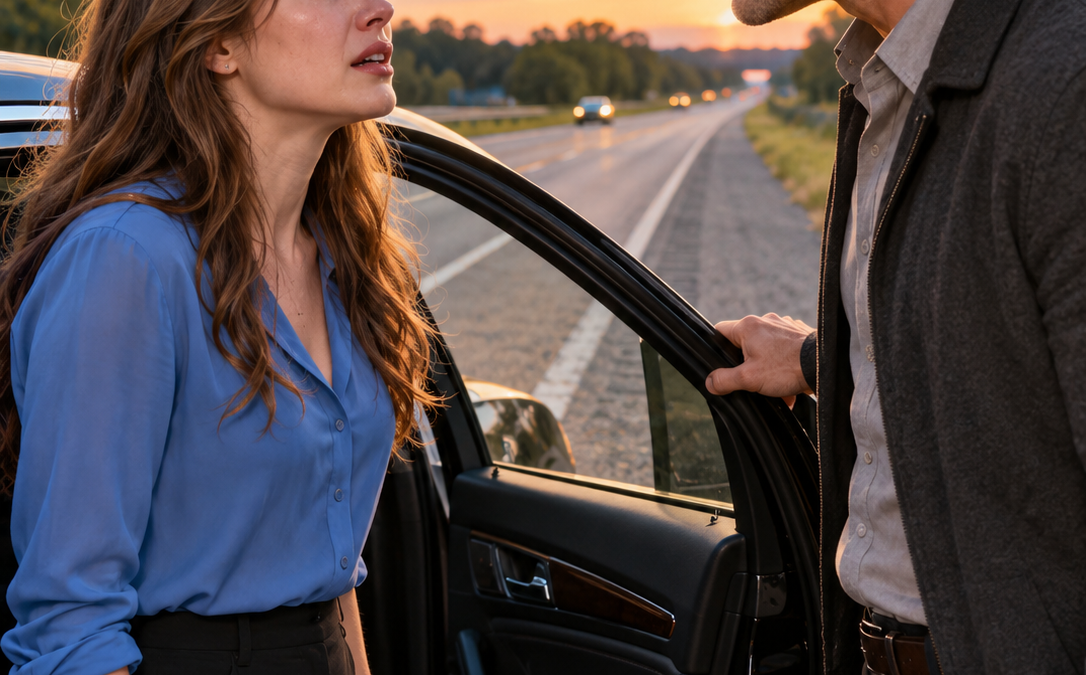
“Stop the car,” Harper said quietly.
Trenton heard her. His fingers tightened around the steering wheel, and he shot her a look of disbelief.
“What?”
“Stop the car. If you’re going to lecture me again about how I should live my life, I’d rather walk.”
The interstate stretched ahead beneath the fading evening light. Dark fields bordered both sides of the highway, giving way to a distant line of pine trees. The city limits were still twelve miles away, and Harper knew perfectly well she couldn’t make it home on foot. But at that moment, the thought of spending another minute trapped in the passenger seat beside him felt almost unbearable.
Trenton glared at her. “Do you even hear yourself?”
“I do. I want to go to my doctor’s appointment tomorrow by myself.”
“We already discussed this.”
“No. You said I couldn’t go alone. That isn’t a discussion.”
“Dr. Carmichael warned me about stress.”
“A year has passed, Trenton.”
“And?”
“And I can ask her myself what’s bad for me and what isn’t.”
He pressed harder on the accelerator, his expression darkening. “Here we go again.”
“What exactly are we doing again?”
“Your fantasies about independence.”
Harper turned toward the window. For the past few weeks, nearly every conversation had ended this way. Trenton had taken away her smartphone, claiming that using it caused excessive stress. He had forbidden her from working because of her migraines. He wouldn’t let her go into town alone, constantly reminding her of those terrible first months after the hospital.
At first, she’d mistaken his behavior for care. She had been frightened, confused, and almost entirely disconnected from her own past. Having someone make decisions for her had seemed like a relief.
But gradually, his protection had become a prison.
“I don’t remember my life,” she said, struggling to keep her voice steady. “But that doesn’t mean I have to spend the rest of it living according to someone else’s decisions.”
“Someone else’s?” Trenton laughed.
That laugh made her feel sicker than his shouting ever had.
“I’m your husband, Harper. Even if you don’t remember it.”
“According to my driver’s license. The same license you always hide because you claim I almost threw my wallet away with the trash.”
“That happened right after the hospital. I have a perfectly valid reason for keeping your documents safe.”
Harper fell silent.
She could picture the laminated card clearly enough. Her photograph. Her first and middle names. Harper Jane Vance.
Trenton kept her identification locked away, along with nearly every other document that might tell her something about herself. Whenever she became frightened by the enormous emptiness in her memory, he would bring out their family photo album.
There were pictures of them on a beach in Florida, celebrating New Year’s Eve, and vacationing at a rented cabin. He would sit beside her, patiently explaining the circumstances surrounding each photograph, while she searched the familiar-looking face in the pictures for some trace of recognition.
She had tried desperately to feel something.
But in an entire year, love had never returned.
“Trenton,” she said at last, “I can’t do this anymore.”
His eyes narrowed. “What are you talking about?”
“How can we keep pretending to be a family?”
He eased his foot off the accelerator. “What have you come up with this time?”
“Nothing. I just…” She swallowed. “I don’t love you.”
The color drained from his face.
“I tried,” she continued. “I really did. I looked at the photographs. I listened to your stories. I waited for something inside me to finally click into place. But it never happened.”
“Your emotional center was damaged by the trauma.”
“Maybe it was. But every time I’m around you, I feel guilty.”
“Because you act completely ungrateful.”
Harper turned to face him. “What exactly am I supposed to be grateful for?”
“For everything!” His voice rose sharply. “For the hospital bills, the doctors, the house. For the fact that I’ve spent an entire year walking on eggshells around you. Do you have any idea how much I gave up to return you to a normal life?”
Harper flinched.
“Return me?”
He went quiet.
“What?”
“You said return. Not help me recover. Not get my life back. You said return.”
“I meant restore. Don’t start playing with words.”
“No. You said it differently.”
Trenton jerked one shoulder in irritation. “What difference does it make?”
“A big one. Sometimes you talk as though you were waiting for me before the crash ever happened.”
He kept his eyes fixed on the road. “You’re starting this again.”
“I want to know who I was.”
“You’re my wife. Other than that, you have amnesia. And that isn’t my fault.”
“Then give me my phone.”
“No.”
“Why?”
“Because you’ll start searching for God knows what, read a bunch of garbage online, and have another breakdown.”
“Then give me my ID.”
“What for?”
“Because it belongs to me. I want to carry it.”
“It’s at home in the safe, where important documents belong.”
“My documents, Trenton.”
He jerked the steering wheel toward the shoulder so abruptly that Harper’s seat belt dug painfully into her collarbone.
The car came to a hard stop.
Trenton turned toward her, his face tight with anger. “You’ve done nothing but doubt me this entire year.”
“And I’ve spent this entire year trying to understand why the man everyone calls my husband feels like a complete stranger.”
“I’ve proved everything to you with the photographs.”
“Then why does it look as though we were photographed separately in some of them?”
For a fraction of a second, fear flickered across his face.
Then it was gone.
“You’re scared right now,” he snapped. “And I’m sick of your paranoia.”
“I’m going to see Dr. Carmichael alone tomorrow.”
“No.”
“Yes.”
“And what are you going to tell her? That your husband has been holding you hostage for a year?”
Harper stared at him. Trenton opened his mouth, but for once, no immediate answer followed his own accusation.
“If I were keeping you hostage,” he said finally, “you wouldn’t be sitting next to me right now.”
“I’m sitting next to you because I don’t know where else to go.”
The words landed harder than anything else she had said.
Trenton stared at her for a moment. Then he unbuckled his seat belt, climbed out, and slammed the driver’s door.
Harper watched him walk around the hood. Before she could understand what he intended, he yanked open the passenger door.
“Then go.”
She stared at him in confusion.
“You want to be independent? Be my guest.”
“Trenton, it’s getting dark.”
“I don’t care.”
“You can’t seriously expect me to walk home.”
“You don’t have a phone. Figure out how to get back on your own.”
Harper searched his face, waiting for the anger to subside, for him to recognize how dangerous and ridiculous this was.
“Are you serious?”
“Absolutely. It’s a long walk home. Think about things on the way. Maybe you’ll get smarter.”
She remained motionless for another moment. Then, slowly, she released her seat belt and stepped onto the shoulder.
Trenton slammed the passenger door behind her.
“When you calm down, you’ll find a way back.”
“How?”
He gave her a cold smile. “You’re an independent woman, aren’t you? You wanted freedom. Take it.”
He got back behind the wheel.
“Trenton!”
The engine roared. Tires squealed against the asphalt, and the car sped away.
Harper stood alone beside the interstate.
For several seconds, she couldn’t move. She watched the red taillights shrink into the distance until they vanished around a bend.
Then the silence settled around her.
Somewhere in the roadside brush, insects chirped. An occasional car rushed past, but none slowed. The fields on either side of the highway were disappearing into darkness, and the line of trees beyond them looked increasingly distant.
Harper started walking along the shoulder.
At first, anger kept her moving. She was furious that Trenton had abandoned her, furious that he had expected her to beg him to let her back into the car.
But as the minutes passed, fear began to replace the anger.
She couldn’t remember his phone number.
She knew their home address only vaguely. A street name. A white fence. A right turn just past a pharmacy.
For the past year, Trenton had arranged every delivery, called every rideshare, and driven her everywhere she needed to go. She hadn’t returned home alone even once.
The realization frightened her more than the darkness itself.
She had spent an entire year living in a house she didn’t know how to find.
She kept walking.
Approximately twenty minutes later, the road had become almost completely deserted. An exit sign emerged from the darkness ahead, pointing toward a fork in the road. Harper approached it hopefully, only to realize that she had no idea where either direction led.
She stood near the sign, trying to decide what to do.
Then headlights appeared behind her.
She stepped farther from the pavement as an expensive black SUV swept past.
A moment later, its brake lights flared bright red.
The vehicle slowed, stopped roughly a hundred feet ahead, and began reversing toward her.
Harper’s stomach tightened.
The driver’s window rolled down.
Behind the wheel sat a man who looked about thirty-five. He stared at her with such intensity that she instinctively took another step backward.
“Harper?”
Her breath caught.
“Do you know me?”
The man didn’t answer immediately. His expression changed completely, shifting from disbelief to something that looked almost like pain.
“Dear God.”
“Who are you?” Harper demanded.
“My name is Nolan. Nolan Hayes Sterling.”
The name meant absolutely nothing to her.
He seemed to be waiting for some kind of reaction. When none came, he swallowed and asked, “Do you need help?”
“I need to get into the city.”
“I can give you a ride.”
Harper hesitated, glancing at the empty highway and then at the stranger’s vehicle.
Nolan noticed.
“I won’t get out of the SUV,” he said carefully. “If you’re frightened, you can stay right where you are. But it looks like you don’t have a phone.”
“How do you know that?”
“You’re alone on an interstate after dark, and you aren’t calling anyone.”
Harper hesitated before answering.
“My husband kicked me out of the car.”
Nolan went completely still.
“Your husband?”
“We had a fight.”
“What’s his name?”
“Trenton.”
His expression tightened. “Last name?”
“Vance.”
Nolan stared at her for another moment.
“Please get in.”
“Do you know Trenton?”
“The name sounds familiar. But right now, the most important thing is getting you off this road.”
Harper approached the SUV cautiously and opened the rear passenger door.
“The front passenger seat would be more comfortable,” Nolan offered. “I’m not going to hurt you.”
“I’d feel safer in the back.”
“All right.”
He didn’t argue.
Harper climbed inside and closed the door. As she settled against the seat, she noticed a manila folder lying on the front passenger seat.
A photograph protruded from the folder.
The woman in the picture looked astonishingly like her.
“What is that?”
Nolan met her gaze in the rearview mirror.
“First, I need to ask you something. Do you remember this past year?”
“Yes. But almost everything before that is blank.”
His fingers began trembling against the steering wheel.
“Since the car crash?”
Harper leaned forward. “How do you know about the crash?”
Nolan switched off the engine.
“Because I’ve been looking for you for a year.”
For a moment, she forgot how to breathe.
“What?”
“I know how insane that sounds. But I can show you.”
He moved slowly, making sure she could see everything he was doing, then picked up his smartphone and opened the photo gallery.
The first picture was a wedding photograph.
Harper stared at the screen.
She was wearing a white gown. Her hair was arranged for a wedding. Her expression was radiant.
And standing beside her, dressed as the groom, was Nolan.
“Is this Photoshopped?”
“No.”
“I have other pictures with Trenton.”
Nolan released a bitter breath. “Yes. I’m sure you do. Can you show me even one of them?”
“I don’t have my phone.”
He swiped to the next photograph.
Harper and Nolan standing beside a Christmas tree.
Another photograph showed Harper in a kitchen, holding a cake.
Then another appeared.
The three of them walking together.
Harper leaned closer.
“Who’s the child?”
Nolan looked directly into her eyes.
“Our daughter.”
She recoiled against the seat.
“No.”
“Her name is Maisie. She’s four years old now.”
“No,” Harper repeated, shaking her head.
“Harper—”
“Don’t call me that.”
He stopped immediately. “Okay.”
“Trenton told me we didn’t have children.”
“Trenton isn’t your husband.”
“My driver’s license says Vance.”
Nolan closed his eyes briefly.
“Your real identification says Sterling.”
“Stop it.”
“I understand that this is overwhelming.”
“You don’t understand anything!”
“Then watch one video,” he said quietly. “Just one. After that, I’ll take you wherever you want to go. Even the police station.”
Harper didn’t answer.
Nolan pressed play.
On the screen, a little girl in a pink cardigan sat on a rug surrounded by colorful building blocks.
A woman’s voice came from somewhere behind the camera.
“Maisie, please pick up your blocks.”
Harper’s entire body stiffened.
She recognized that voice.
It was hers.
The little girl looked up from the carpet.
“Mommy, later.”
“Now, Mommy.”
Something flickered in Harper’s mind.
A living room.
A yellow ceramic mug resting on a coffee table.
A small, warm hand pressing against her cheek.
She squeezed her eyes shut.
“Maisie.”
The name escaped before she could stop it.
Nolan turned his face toward the window.
Harper opened her eyes and stared at the screen again.
The little girl was laughing.
Then another image flashed through her mind. Nolan was carrying a toddler on his shoulders while Harper called out for him to be careful.
It wasn’t a photograph.
She could almost hear her own voice. She could almost feel the fear of watching the child lean too far to one side, followed by the easy laughter that belonged to people who trusted one another.
She raised her eyes.
“Nolan?”
He turned toward her immediately.
“Yes?”
Harper covered her mouth.
“You’re my husband.”
The words broke something open inside her.
She began to cry.
Nolan’s composure crumbled too. His eyes filled with tears, but he didn’t reach into the back seat or try to hold her.
Instead, he asked, “Can I sit next to you?”
Harper nodded.
He climbed into the back, deliberately leaving space between them.
“I thought you were dead,” he whispered.
Harper stared at the phone still resting in his hand.
“I have a daughter.”
“You do.”
“She’s real?”
“She’s at home with my mom. She remembers you every single day.”
Harper’s sobs grew harder.
“Why didn’t you find me?”
Nolan turned pale.
“I searched the whole time. But Trenton…” He stopped himself. “I don’t know what he said or what he did. We’ll figure it out later.”
She reached for his phone.
“Show me more.”
He reopened the gallery.
In one photograph, Maisie was three years old. In another, taken later, she was four.
Harper traced the outline of the child’s face with one trembling finger.
“She grew up.”
“Yes.”
“And I missed it.”
Nolan’s voice broke. “The important thing is that you’re alive.”
A sudden image flashed through Harper’s mind.
A highway at night.
A dark vehicle behind her.
A violent impact against the side of her car.
Then a familiar face looking through shattered glass.
The image vanished almost as quickly as it had appeared.
Harper groaned and pressed a hand to her forehead.
Nolan leaned toward her without touching her.
“What happened?”
“What kind of car was it?” she whispered.
“What?”
“I don’t know.”
Nolan didn’t push her.
“We’re going to a doctor right now.”
“I want to see my daughter first.”
“You get checked out, and then we go home.”
“No, Nolan, please.”
For the first time since finding her, he smiled through his tears.
“You always used to argue exactly like that.”
Half an hour later, they pulled into the nearest emergency room.
While Harper was being evaluated, Nolan called his parents and told them that he had found her alive.
Arthur Sterling could barely believe what he was hearing. Nolan had to repeat the news several times before his father could begin to accept it.
The emergency room staff determined that Harper didn’t require immediate acute care. They documented her neurological condition in light of her previous head injury, and Harper answered the medical questions herself.
When the attending physician asked for her last name, she answered automatically.
“Vance.”
Then she looked toward Nolan.
“No,” she corrected herself. “Sterling.”
It was the first decision in an entire year that felt completely her own.
Late that night, Nolan drove her into their hometown.
Some of the streets seemed utterly foreign. Others stirred sensations Harper couldn’t explain.
Near one intersection, she suddenly recognized a pharmacy.
She remembered buying cough syrup there for her daughter.
The memory was small, but it belonged to her.
Arthur and Beatrice Sterling were waiting on the porch when Nolan pulled into the driveway.
Beatrice was crying. Yet when Harper stepped out of the SUV, the older woman didn’t rush forward or overwhelm her.
She approached slowly.
“Harper, honey. Can I hug you?”
Harper nodded.
Beatrice wrapped her arms around her daughter-in-law, holding her close.
“You came back.”
Harper’s throat tightened.
“I’m sorry. I don’t remember everything.”
“You don’t need to remember anything tonight.”
A faint rustling sound came from the hallway.
Harper looked toward the house.
Standing in the doorway near the nursery was a little girl wearing pajamas.
The child stared at her with wide, astonished eyes.
Nobody spoke.
Then Maisie took one hesitant step forward.
“Mommy?”
Harper’s breath caught.
The yellow mug flashed through her mind again. Tiny hands. The unmistakable scent of baby shampoo.
“Maisie.”
The little girl ran toward her.
Harper dropped to her knees and gathered her daughter into her arms, holding her so tightly that she could barely breathe.
Tears streamed down her face.
But for the first time in a year, the place inside her that had always felt empty was no longer completely hollow.
Maisie sniffled against her shoulder.
“Where were you?”
Harper closed her eyes.
“I didn’t know how to get back.”
And suddenly another memory ignited.
A dark road.
The heavy impact of a collision.
Trenton standing beside her crushed car.
His voice, cold and certain.
“Everything will be exactly how it should be now.”
Harper opened her eyes.
For the first time, she remembered who had been with her on the day of the crash.
Across the distance, in the house where he had kept her for an entire year, Trenton was beginning to realize that Harper wasn’t coming back.
At five o’clock the following morning, he stepped into his front yard and stared at the empty road beyond the driveway.
He had left the porch lights burning nearly all night.
At first, he had been absolutely certain Harper would find her way to a gas station, borrow a telephone, and call him.
Later, he had convinced himself that some passing driver would offer her a ride home.
By midnight, his irritation had turned into panic.
But he had stubbornly refused to go looking for her.
He kept telling himself that spending a frightening night alone would teach Harper a lesson about the consequences of her own stubbornness.
Now dawn was breaking.
The gate stood open.
There was still no sign of her.
Trenton returned to the kitchen and stared at his phone.
No missed calls.
No messages.
An hour later, just as he was reaching for his keys to search the interstate, his phone rang.
The caller ID displayed a name he hadn’t seen in years.
Declan Rossi.
Trenton and Declan had belonged to the same social circle long before Harper got married. They had barely spoken since.
“Yeah?” Trenton answered.
“Trenton, man, have you checked the news today?” Declan spoke rapidly, almost breathless with excitement. “The whole town is losing its mind. They found Harper Sterling alive.”
Trenton went silent.
“Can you believe it? Nolan brought her home last night. A whole year later. I’m calling some of the old friends who helped with the search parties. I still can’t wrap my head around it.”
Trenton’s fingers tightened around his phone.
“Where did they find her?” he forced out.
“Not many details yet. The important thing is she’s alive.”
Trenton ended the call.
For several seconds, he stood motionless in the middle of his kitchen.
Then he opened the local news website.
The photograph appeared almost immediately.
Harper was leaving a medical clinic.
Nolan Sterling stood beside her.
The headline announced that a local woman who had gone missing after a severe car crash a year earlier had been found alive.
Her family had requested privacy and urged the public not to circulate unverified information.
Trenton read the article three times.
Nolan.
Of all the people who could have found her on that highway, it had been Nolan.
Trenton rushed into the bedroom and tore open a storage box.
The photo album Harper had examined dozens of times lay on top.
He flipped through the pages. The pictures supposedly showed the two of them vacationing in Florida, celebrating New Year’s Eve, and sitting together in coffee shops.
He began frantically pulling photographs from their plastic sleeves.
Then he stopped.
Even if he burned the entire album, the digital files would still exist.
So would the printed documents, the fake identification cards, the hospital bills, the neighbors who had seen Harper living with him, and the security cameras near the medical facility.
An entire year couldn’t be erased in a single morning.
In the garage, hidden inside a fireproof safe beside his backup documents, were Harper’s forged Social Security card and driver’s license.
Every piece of evidence reminded Trenton how thoroughly he had tied himself to the woman who had just escaped his control.
Meanwhile, at the Sterling household, nobody was paying attention to the morning news.
Harper sat at the kitchen island wearing one of her old oversized fleece robes.
Maisie perched on a stool beside her, refusing to release her mother’s hand.
“Are you staying today?” the little girl asked.
Harper looked at her.
“I’m staying today, and tomorrow, and the day after that.”
Maisie appeared to consider the answer carefully.
Nolan started to say something, but Harper shook her head.
“I’m never leaving you again. Ever.”
Her daughter nodded with satisfaction and returned to her oatmeal.
Beatrice turned back toward the stove.
Arthur placed a mug of hot tea in front of Harper.
Nobody demanded to know what she had endured over the past year. Nobody pressed her to explain how she had disappeared or why she hadn’t found her way home sooner.
Harper was profoundly grateful for their silence.
The kitchen itself stirred strange sensations.
The white coffee mug seemed familiar in a way she couldn’t explain. A crayon drawing hung on one wall, and as she looked at it, she suddenly knew that something else had occupied that space before.
“There used to be a clock right there,” she said.
Beatrice turned around.
“There was. It broke last winter.”
Nolan looked at his wife but said nothing.
“Sometimes a random detail just appears,” Harper explained. “Then it fades again.”
“Don’t force it,” Arthur said gently.
She nodded.
A minute later, she looked toward Nolan.
“Can you show me my identification?”
He immediately went into his home office and returned carrying a clear plastic file folder.
Harper opened it.
The driver’s license showed her own photograph.
Harper Jane Sterling.
Her birth date matched the one she knew.
Her birthplace matched.
She and Nolan had been married for four years at the time of the crash.
For a long moment, she studied the card.
“Trenton showed me completely different paperwork. Everything said my name was Vance.”
The kitchen fell silent.
Arthur looked toward his son.
“Were Harper’s real documents at home on the day of the accident?”
“Yes,” Nolan answered. “She normally carried them in her purse, but she left her purse at home that day.”
Harper lifted her eyes.
“Which means Trenton forged the other ones.”
“Exactly.”
She traced a fingertip over the laminated plastic.
Nolan took out their marriage certificate and placed it beside the license.
“We got married on June fifth.”
The date stirred a vague sensation of warmth. Summer heat. Something comfortable and familiar, though she couldn’t yet attach it to a complete memory.
Beside the marriage certificate lay Maisie’s birth certificate.
Mother: Harper Jane Sterling.
Father: Nolan Hayes Sterling.
Harper stared at the names.
“Trenton never had documents like these,” she said. “Just a driver’s license in the name Vance. And photographs.”
“Did he ever show you his own license?” Arthur asked.
“Yes. He said I took his last name when we got married.”
Beatrice offered to put the documents away, but Harper shook her head.
“The hardest part is realizing how much time I spent surrounded by forgeries. I remember that fake license perfectly. My face, my first name, my middle name. But the last name was Vance.”
She looked toward Nolan again.
“Where would he keep everything?”
Harper answered her own question almost immediately.
“Trenton kept all his important documents in a heavy safe in the garage.”
Arthur frowned deeply.
“We absolutely need to report this.”
Harper nodded, then asked Nolan, “Do the police know I’m back?”
“Yes. Detective Marcus Callahan is coming here.”
“The detective from the missing-person case?”
“He worked on your case last year. But nobody is going to sit you down and interrogate you for hours.”
“I want to tell them about Trenton,” Harper said. “As much as I can handle.”
Nolan watched her carefully.
“I remembered seeing him near my wrecked car.”
His posture changed.
“Are you sure?”
“Positive. I saw his face through broken glass. That’s all I have right now.”
Beatrice spoke softly.
“That means he was there.”
“It’s crucial information,” Arthur said. “But we’ll need concrete evidence to support it.”
Before anyone could continue, Maisie tugged at her mother’s sleeve.
“Mommy, come on. I want to show you my room.”
Harper let her daughter lead her down the hallway.
A large stuffed badger sat on the bed in the nursery.
Harper stopped in the doorway.
“I know him.”
Maisie’s face brightened.
“That’s Barnaby! You gave him to me.”
A memory materialized.
A brightly lit toy store.
A high shelf.
A determined little girl pointing insistently at a gray stuffed badger, refusing to consider any other toy.
Harper laughed through her tears.
“You wouldn’t take anything else,” she told Maisie. “Because Barnaby was the best.”
Her daughter beamed.
Later that morning, Nolan came to the nursery and gently asked Harper to join him in the living room.
Detective Marcus Callahan had arrived.
A federal agent was with him.
Because the kidnapping had crossed state lines, the FBI was now sharing responsibility for the investigation.
The two investigators didn’t spread enormous case files across the coffee table or immediately fire off a barrage of questions. Instead, Callahan sat down and opened a notebook.
“Right now,” he explained, “I only need to hear what you remember on your own.”
He made no attempt to fill the gaps in Harper’s memory with theories or suggestions.
Harper began telling them about her life in Trenton’s house.
She described the strict prohibition against owning a smartphone, the restrictions on working, and Trenton’s refusal to let her drive or travel anywhere by herself. She explained how he had used her migraines and memory loss to justify nearly every rule in the house.
She told Callahan about the Vance driver’s license, the family photo albums, and the argument that had ended with Trenton abandoning her on the interstate the previous evening.
“Were you ever allowed to go outside alone?” the detective asked.
“Almost never. During the first few months, I felt physically awful. But later, when I asked to go somewhere, Trenton always came up with an excuse to drive me himself.”
“Did he ever threaten you?”
Harper considered the question carefully.
“Not directly. He used to say that if something happened to me, nobody out there would even know who I was. At the time, I thought he was being protective.”
Callahan wrote something in his notebook.
“Do you remember how you ended up in the emergency room after the accident?”
“No.”
“Who told the hospital staff that Mr. Vance was your husband?”
“He did. He had documents to prove it.”
“Do you remember the name of the physician who treated you?”
“Dr. Evelyn Carmichael.”
Callahan closed his notebook.
“If another memory comes back, write down exactly what you see or hear in your mind. Don’t try to reconstruct the rest logically. It’s important that we distinguish what you actually remember from what you later learn.”
Harper agreed.
After the detective and federal agent left, Maisie announced that she wanted to watch cartoons.
Beatrice picked up the remote control, then stopped.
“Harper, have you realized you haven’t watched television in an entire year?”
Harper looked at the screen.
“Trenton told me I wasn’t allowed to.”
“Who forbade it?” Nolan asked.
“According to him, Dr. Carmichael.”
Harper held out her hand for the remote.
Beatrice gave it to her.
She turned on the television herself.
A children’s channel appeared, and Maisie settled onto the rug in front of the screen.
Nothing happened.
No dizziness. No sudden headache. No strange physical reaction.
Harper sat watching the colorful images for several minutes, waiting for the consequences Trenton had warned her about.
“He claimed even watching the news could trigger a seizure,” she said eventually.
Nolan turned toward her. “Did you ever have seizures?”
“No. I had terrible migraines and fatigue right after the hospital, but those symptoms gradually improved.”
“Did you ever ask Dr. Carmichael about the restrictions yourself?”
“Trenton stopped taking me to her clinic after about three months. He said rest was the only treatment I needed from then on.”
Harper lowered her eyes.
“I believed him.”
Nolan sat beside her.
“You had suffered a massive brain injury. You trusted the man you were told was your husband.”
A short while later, Nolan’s phone buzzed.
Detective Callahan had sent a message. Dr. Evelyn Carmichael had seen the morning news about her former patient and urgently wanted to speak with Harper.
Nolan called her and put the phone on speaker.
“Harper Jane?” The doctor’s voice carried unmistakable disbelief. “I saw the reports this morning, and at first I assumed it must be another woman. How are you feeling?”
“Much better,” Harper answered. “Can I ask you the most important question right away?”
“Of course.”
“Did you ever strictly forbid me from using a cell phone, going on the internet, watching television, working, or going outside alone?”
“No.”
The answer came without hesitation.
“During the first few weeks, I strongly recommended quiet rest, avoiding strenuous activity, and following a consistent sleep schedule. I also suggested limiting screen time if it made your headaches worse. But there was never a blanket prohibition against any of those activities.”
Harper closed her eyes.
“And later?”
“Later, I stopped seeing you as a patient. Your husband informed our office that you were relocating out of state and would continue neurological therapy there.”
“He isn’t my husband.”
Silence followed.
“I know that now,” Dr. Carmichael said quietly. “And I’m terribly sorry. He presented matching identification documents, introduced himself as your spouse, and almost never left your side. You remembered very little about yourself at the time. I believed he was your husband, too.”
Harper gripped the phone.
“People would ask who he was,” the doctor continued, “and once they saw the documents, they accepted his explanation. We all did.”
“I understand.”
“One more thing, Harper. Please don’t force yourself to remember. After a traumatic brain injury of that severity, memories can return in fragmented, episodic flashes. Trying to force them into a complete narrative can make things more confusing.”
When the call ended, Harper continued holding the phone.
For an entire year, Trenton had used a doctor’s name as a weapon, inventing medical prohibitions that had never existed.
She remembered asking him for a laptop and watching him become furious.
Later, when she wanted to apply for remote work, he refused.
Eventually, he began insisting that television screens emitted dangerous frequencies.
Every restriction she had accepted as a necessary part of her recovery now looked entirely different.
Harper placed the phone on the table.
“Nolan, show me the articles they wrote about me after I disappeared.”
He hesitated.
“Are you sure?”
“Yes. I spent a year knowing nothing because Trenton decided what I was allowed to know. That ends today.”
Nolan opened his laptop.
An old digital newspaper article appeared on the screen.
It reported that a young woman had disappeared following a severe traffic collision.
There was a photograph of Harper, a description of the clothing she had been wearing, and a number for the police tip line.
Below the article were images of search-and-rescue crews examining riverbanks, volunteers distributing flyers, and emergency responders combing the surrounding terrain.
In one photograph, Nolan stood beside Declan Rossi.
In another, Beatrice held a missing-person poster bearing Harper’s photograph.
Then Harper noticed the publication date of another article.
It was Maisie’s birthday.
The story mentioned that the missing woman’s family had been forced to celebrate the child’s birthday without her mother.
Harper reread that sentence several times.
“On that exact day,” she said slowly, “Trenton bought me an expensive bottle of perfume.”
Nolan looked at her.
“He told me it was the anniversary of our first date.”
“Harper, you don’t have to keep reading if it’s hurting you.”
“Now I understand why I cried uncontrollably that whole day, even though I didn’t know why.”
Across the room, Maisie sat sorting her crayons by color, completely unaware of the conversation.
Harper watched her daughter.
Her conscious memory had been silent, yet some part of her had apparently understood that the date was connected to an enormous loss.
She covered her mouth.
“You all kept searching for me?”
“Yes,” Nolan said.
“And he told me I had absolutely nobody in the world.”
Maisie looked up from her cartoons.
“You have me.”
Harper reached for her daughter and pulled her into a tight embrace.
Later, before going to bed, Harper walked through the house by herself.
In the bathroom, her hand automatically reached for the top shelf where fresh towels were kept.
In the kitchen, she opened the correct drawer for forks and spoons without having to search.
The movements were so instinctive that she barely noticed them until after they happened.
These tiny details meant more to her than any photograph.
Her past had existed in the ordinary routines of this house. It wasn’t something that could be proved or disproved by a collection of images.
Nolan had prepared the guest bedroom for her. He made it clear that she didn’t need to sleep beside him simply because they were married.
Later that evening, he brought a plastic storage bin into the room and set it beside the armchair.
“Some of your old things,” he explained. “You don’t have to look through them tonight.”
“I want to.”
Harper sat down and began examining the contents.
There was a concert ticket stub, an old greeting card, and a small keychain shaped like a house.
She picked up the keychain.
Suddenly, a parking lot materialized in her mind.
Her own car.
The afternoon of the accident.
A text message glowing on her phone screen.
We need to talk. This is the last time.
The message was from Trenton.
Harper remembered deleting it before driving away.
Then a dark vehicle appeared in her rearview mirror.
It followed her for miles.
As she approached a sharp bend, the vehicle accelerated violently.
Impact.
Her car spun.
Her head struck the side pillar with terrible force.
Then came disconnected flashes.
A door being pulled open.
Trenton leaning over her.
“Harper? Can you hear me?”
She tightened her grip on the miniature house until her knuckles turned white.
“Nolan.”
He stepped toward her immediately.
“What is it?”
Harper raised her eyes.
“Trenton was following me in his car before the crash.”
Nolan’s expression hardened.
“Are you absolutely certain?”
“Yes. I saw his face again. He was looking through my shattered window.”
For the first time, Harper began to understand something far more frightening than the lies Trenton had told after her hospitalization.
He hadn’t simply appeared after she lost her memory and taken advantage of her condition.
He had been there before her life was shattered.
He had been involved from the beginning.
The next morning, Harper unlocked her bedroom door from the inside.
No one had ordered her to lock it. Nobody had forbidden her from doing so.
The simple click of the lock brought an unexpected wave of peace.
For a year, every enclosed space had belonged to Trenton.
His house. His vehicle. His safe. His rules.
Here, she could decide for herself when a door opened and when it stayed closed.
Nolan and Maisie were already in the kitchen. Beatrice was making pancakes, and Arthur was taking a work call in his office.
Harper paused by the kitchen window.
A familiar wooden bench stood on the patio.
A memory flickered across her mind: Maisie falling from her scooter beside the bench and scraping her knee.
Harper allowed the image to pass without trying to hold on to it.
During breakfast, Nolan placed a spiral notebook beside her coffee cup.
“What’s this for?” she asked.
“You mentioned wanting to write down the memories when they come back.”
Harper touched the cover.
“Thank you.”
Maisie leaned across the table.
“Can I draw in it, too?”
“I’ll save the very last page for you.”
The little girl considered this a fair arrangement and returned to breakfast.
Harper smiled.
When Maisie ran off to the playroom, Harper opened the notebook.
“I need to know everything about Trenton,” she told Nolan. “But only the verifiable facts.”
He set his mug down.
“You told me about him when we first started dating. You two had been together for about two years.”
“And I broke up with him?”
“Yes.”
“Why?”
“You said he was extremely jealous of everyone you spoke to. He constantly tried to dictate who you could spend time with. Eventually, he started showing up at your office without warning.”
Harper frowned.
“Did he threaten me?”
“After the breakup, he sent some very aggressive emails. Then he completely disappeared from your life.”
Nolan hesitated.
“But a few weeks before your accident, you mentioned that he’d resurfaced.”
“What did you say?”
“I offered to handle the situation myself. You refused. You said you didn’t want to turn ancient history into a huge drama.”
Harper wrote a few words in the notebook.
“Did I tell you why he came back?”
“He claimed he wanted to meet and officially apologize.”
“Had I seen him at any point after our wedding?”
“Once, from across a parking lot. You brushed it off as a coincidence.”
Harper drew a thick line beneath her notes.
“On the day of the crash, he sent me a message. It said, ‘We need to talk. This is the last time.’”
Nolan’s jaw tightened.
“You remember those exact words?”
“Yes.”
He didn’t press her for more.
“Did the police ever find my old phone?” she asked.
“No. At the time, they thought it had either been destroyed in the wreck or thrown out near the ravine.”
“And now?”
“Now I’m not going to assume anything.”
Harper looked at him.
She was beginning to understand how carefully Nolan avoided presenting guesses as facts. Even when he was visibly angry, he didn’t try to tell her what she must have experienced.
After a year with Trenton, that restraint meant more than Nolan could possibly know.
By noon, Beatrice had taken Maisie to the park.
Arthur returned to his own house, promising to come back for dinner.
For the first time since Harper’s return, she and Nolan were alone in the house.
She asked him to show her digital photographs from their life before the crash, but not the carefully posed holiday pictures.
She wanted ordinary moments.
Nolan opened an old folder.
One photograph showed Harper painting the nursery walls.
Another captured Nolan standing in the kitchen with a baking dish containing a spectacularly burned barbecue brisket.
Harper studied the picture.
“You tried to smoke that brisket by yourself once.”
Nolan winced.
“One attempt was enough for this family.”
Harper laughed aloud.
Then she remembered Trenton’s photographs.
Every image in his album had been glossy and meticulously arranged. There were no ruined dinners, no messy kitchens, no accidental snapshots of ordinary life.
Everything looked perfect.
And none of it had ever felt real.
“Nolan, where are my old clothes?”
“Most of them are still here. Mom refused to let me donate anything.”
“What about my car?”
His expression changed.
“Harper…”
“Show me where they found it. Please.”
“Are you sure it isn’t too soon?”
“I need to see it.”
Nolan opened another old news article.
“These photographs were taken after the fire was put out,” he warned her.
Harper nodded.
The screen displayed a steep embankment littered with damp rocks. At the bottom lay the scorched metal frame of a car.
A river ran beside it.
Harper leaned forward and enlarged the image.
“The car didn’t go into the water.”
“No. It landed near the bank.”
“Then why did everyone think I might have been washed away?”
“The driver’s door was wide open when they found it. You weren’t inside. The search crews dragged the river and searched the entire cliffside.”
Harper stared at the blackened wreck.
“But by then, I was already with Trenton.”
Nolan gently closed the laptop.
“That’s enough for today.”
“No. I need to understand what happened to me.”
After lunch, Dr. Evelyn Carmichael called again.
The neurologist sounded troubled. There was a detail in Harper’s original medical records that had been bothering her since their previous conversation.
“Harper, I went back through your initial admission logs,” she explained. “You were brought in unconscious.”
Harper sat up straighter.
“Trenton drove you to the emergency room himself. He presented identification documents to the triage nurse immediately.”
“On the same day as the crash?”
“Yes. The reason the surname Vance stayed in my memory is that it was entered into our system during your emergency intake.”
Harper’s mouth went dry.
“Which means he already had the forged IDs ready.”
“I can’t confirm that conclusion,” Dr. Carmichael cautioned. “The authorities are investigating. But the documents were presented immediately, not a week later and not after we discovered the extent of your memory impairment.”
Harper thanked her and ended the call.
Nolan was standing near the window.
“What happened?”
She looked at him.
“The fake IDs existed before Trenton even knew I had amnesia.”
Nolan slowly sat across from her.
“If Dr. Carmichael remembers the sequence correctly, yes.”
“Then he planned it.”
“Possibly.”
Harper stared at him.
“What do you mean, possibly?”
“I don’t want my anger becoming your memory. I don’t want you to accept my conclusions as something you personally remember.”
She closed the notebook.
“First the fake ID. Then the crash. He set it up.”
Nolan remained silent.
The possibility was almost too frightening to comprehend.
If Trenton had forged her identity before the collision, he had planned to force her into the life of Harper Vance before their vehicles ever collided.
But how could he possibly have known that she would wake up without remembering Nolan and Maisie?
There was no logical answer.
Two counties away, Trenton opened the heavy steel safe in his garage.
Inside were two driver’s licenses, several stacks of photographs, and a hard drive.
He pulled out the identification card he had made for Harper.
The photograph was genuine.
Everything surrounding it had been fabricated.
He studied the card for a long moment.
Destroying the evidence now seemed dangerously suspicious. Keeping it felt even worse.
His phone buzzed.
Declan Rossi.
Trenton let it ring several times before answering.
“Yeah, man?”
“You acted so weird this morning,” Declan said.
“Everything’s fine. I was just shocked by the news.”
“You dated Harper a long time ago, right?”
“A long time ago.”
“Nolan told me she barely remembers anything.”
Trenton tightened his grip on the phone.
“I don’t know much about it. The family is keeping things quiet.”
“Do you know where she was for the entire year?”
Trenton’s voice sharpened.
“How would I know?”
A pause followed.
“Trenton, why are you asking so many questions?”
“I’m just curious. The whole town is talking about it.”
“Then read the news.”
Declan hung up.
Trenton continued holding the phone against his ear for several seconds.
He realized he couldn’t keep questioning people without drawing attention to himself.
Back at the Sterling house, Harper asked Nolan to tell her exactly what the police had known about the crash before she reappeared.
“No theories,” she emphasized. “Just the evidence.”
“All right.”
He sat down across from her.
“A truck driver passing through the area saw a glow at the bottom of the ravine and called 911. Your car was completely destroyed, and you were missing.”
“Were there any other vehicles at the scene?”
“None that the investigators found.”
“When the paramedics arrived, did they see evidence that another car had hit mine?”
Nolan shook his head.
“I don’t have the forensic engineering reports. At the time, investigators told me your car had probably lost control on the wet pavement.”
“Which means nobody saw Trenton.”
“We didn’t even know he was involved.”
Harper rose and began pacing the living room.
“I remember the impact on my driver’s side. His SUV was behind me, and then he accelerated and clipped my car.”
“Write it down.”
She opened the notebook.
Dark SUV. Trenton behind the wheel. Side impact.
Her hand trembled as she wrote.
Then another fragment struck her.
The acrid smell of a deployed airbag.
The metallic taste of blood in her mouth.
Hands dragging her roughly through the passenger-side door.
Harper froze.
“He pulled me out.”
Nolan stood but didn’t touch her.
“What exactly did you see?”
“I was slumped sideways. The driver’s door was jammed. Trenton was right there.”
She pressed her fingers against her forehead.
“He kept saying, ‘Quiet. Don’t move.’”
“Anything else?”
Harper waited, searching for another image.
But nothing came.
“That’s all.”
That evening, Beatrice returned from the park with Maisie.
The little girl proudly presented her mother with a drawing of three people standing in front of a red brick house.
A mommy, a daddy, and a little girl.
“You’re back here now,” Maisie announced.
Harper kissed the top of her head.
For a few minutes, the terror surrounding her returning memories faded.
After dinner, Arthur mentioned that Declan Rossi had called him.
“Declan sounded unsettled,” he explained. “Apparently, Trenton has been asking unusually specific questions about Harper’s memory and where she’s been staying.”
Harper looked up sharply.
“What did you tell him?”
“Nothing.”
“Does Trenton know I remember seeing him at the crash scene?”
“Not from us.”
At that exact moment, Nolan’s phone vibrated on the table.
An unknown number appeared on the screen.
He stared at it.
“Who is it?” Harper asked.
“No caller ID.”
A horrible certainty settled in her stomach.
“Give it to me.”
Nolan hesitated.
“If it’s Trenton,” she said, “I need to hear what he has to say myself.”
Nolan switched on the speakerphone but kept the device in his hand.
“Hello?”
Several seconds of silence followed.
Then a horribly familiar voice came through the speaker.
“Put Harper on.”
Her shoulders went rigid.
“I’m right here,” she answered.
“We need to talk.”
“We have absolutely nothing left to discuss.”
“You’re only listening to their side of the story.”
Harper stared at the phone.
“I was forced to listen to your side for an entire year.”
Trenton began speaking faster.
“I saved your life. You were covered in blood. I pulled you out of the wreckage and drove you straight to the emergency room.”
The entire living room went silent.
Harper stared at the glowing screen.
“So you admit you were at the crash site.”
A pause.
“I never denied it.”
“You denied it to me. You claimed you didn’t know anything about my past. You told me I had a blank slate.”
Trenton said nothing.
“Nolan and the police had no idea you were there.”
“I panicked.”
“About what?”
“Everything. You were completely unconscious. The car was destroyed.”
“Then why didn’t you call 911 from the road?”
“There was no cell service out there.”
“Why didn’t you take me to the closest trauma center?”
“I did what was best.”
“Best for whom?”
“For you!” Trenton shouted. “You have no idea what would have happened if I’d just left you there.”
Harper’s voice remained steady.
“What would have happened, Trenton?”
He went silent again.
His heavy breathing filled the room.
Harper leaned closer to the phone.
“Why did you have a forged driver’s license with the last name Vance ready on the exact day I crashed?”
No answer.
“Trenton?”
The line went dead.
Nolan immediately silenced the phone.
“We don’t answer him again,” he said.
Harper nodded.
But the pieces of the puzzle were beginning to fit together.
Trenton had just admitted during a recorded call that he had removed her from the accident scene and taken her to the hospital himself.
Whatever else he might deny, he could no longer pretend that he had simply entered her life after the crash.
Later that night, Detective Callahan called with a warning.
“If Mr. Vance attempts to contact you again, don’t engage with him. Document the time of the call and let us know.”
“Understood,” Harper answered.
The detective didn’t share any details about the search warrants being prepared or the direction of the investigation, and Harper was relieved.
Her own returning memories were overwhelming enough without having to imagine every possible discovery the police might make.
The following morning, a local tow truck operator named Wyatt Hensley saw a television report about Harper’s return.
The broadcast triggered a memory from the previous year.
Near the dangerous bend overlooking the ravine, Wyatt had watched a dark SUV race past his truck, swerving so violently that it had nearly sideswiped his rig.
A short time later, he had seen fire engines speeding toward the same location.
The incident hadn’t seemed especially significant at the time. But when Wyatt saw Trenton’s face on the news, he remembered the driver of that SUV.
He couldn’t be absolutely certain it was the same man.
Still, he called the police tip line and reported what he had witnessed.
That afternoon, Harper stayed home alone with Maisie while Nolan went to his office for a few hours.
The little girl was sitting on the floor, stacking colorful plastic building blocks.
Harper was nearby when one of the blocks slipped from Maisie’s hand and struck the hardwood floor with a sharp clack.
The sound triggered a violent flashback.
She wasn’t in the playroom anymore.
She was lying across the back seat of an unfamiliar SUV.
Her consciousness drifted in and out, leaving the world distorted and blurry.
Through the window, she saw Trenton standing outside beside her damaged sedan.
He climbed into the driver’s seat of her car.
A moment later, he jumped out again, leaving the door wide open, and hurried back toward his SUV.
Then came a heavy metallic scraping sound.
Her crushed sedan began to move.
Slowly, it rolled toward the edge of the ravine.
And then it disappeared.
At the time, Harper hadn’t understood what she was seeing.
Now she did.
She stood so abruptly that Maisie startled.
“Mommy?”
Harper forced herself to crouch beside her daughter.
“Everything’s fine, sweetheart. I just remembered something important.”
She stayed with Maisie until Nolan returned, trying to hold herself together.
The moment he walked through the door, he took one look at her face.
“What happened?”
Harper told him about the memory.
“I was in Trenton’s SUV. He had already taken me out of my car. I remember watching him go back to the wreck.”
Nolan listened without interrupting.
“He climbed into my sedan, got out again, and left the door open. Then there was this awful scraping sound. I remember the car moving. I felt a heavy jolt.”
“Did you physically see him push the car over the cliff?”
“No. I remember his SUV accelerating into it, and then he immediately got back behind the wheel beside me.”
Nolan remained completely silent.
Half an hour later, Harper wrote down the entire sequence in her notebook, carefully separating what she had seen from what she had only felt or heard.
That night, she could barely sleep.
The following morning, Detective Callahan called.
“Mrs. Sterling, I’m contacting you specifically about your physical safety.”
Harper sat upright.
“Trenton Blake Vance was taken into federal custody by the FBI two hours ago. He won’t be able to approach or contact you.”
Harper closed her eyes.
“Thank you.”
After the call, she walked to the glass patio doors.
Outside, Nolan was running alongside Maisie as she pedaled her small bicycle across the patio.
The little girl had begged her father to show Mommy how she could ride without training wheels.
Harper watched her husband jogging beside their daughter, his hand hovering near the bicycle’s seat in case she lost her balance.
Then another phrase surfaced from the darkness of her memory.
Trenton had spoken it in the SUV immediately after the crash, apparently believing Harper was completely unconscious.
“The car is gone now. Nobody will ever find you either.”
Harper stepped away from the glass.
Until that moment, some part of her had continued wondering whether Trenton had merely taken advantage of an accident.
Now the remaining doubt disappeared.
The collision wasn’t an unfortunate event that had created an opportunity for him.
It had been the beginning of his plan.
Three days later, Harper spent an hour alone in the Sterling house.
Nolan had taken Maisie to a speech therapy appointment. Beatrice was picking up groceries, and Arthur was running errands.
Before leaving, Nolan paused near the front door.
“Are you absolutely sure you’ll be okay by yourself?”
“If I start panicking, I’ll call you.”
“I won’t be far.”
“Nolan, go!”
He smiled, nodded, and left without arguing.
When the deadbolt clicked shut, Harper stood in the quiet house for a moment.
The silence no longer felt like the suffocating stillness she remembered from Trenton’s home.
Nobody would burst into the room without warning.
Nobody would monitor what she watched on television, confiscate her phone, or interrogate her for standing beside a window too long.
She walked into the kitchen, poured herself a glass of iced tea, and turned on the radio.
Then, without warning, she began to cry.
Before the accident, these tiny freedoms had been so ordinary that she’d hardly noticed them.
At Trenton’s house, every one of them had been treated like a privilege he could grant or withdraw.
As she walked through the living room, Harper noticed a framed family portrait on one of the shelves.
It showed her, Nolan, and three-year-old Maisie sitting beside a local lake.
Something about the image seemed extraordinarily familiar.
She stepped closer.
She had seen that exact photograph before.
At Trenton’s house.
Except that in his version, Trenton had been the man standing beside her.
Harper hurried to the hallway closet, pulled down several heavy storage boxes, and began searching through the old family photo albums.
She found the original photograph.
There she was, standing near the water.
Nolan’s hand rested on her shoulder.
Maisie sat happily in her father’s arms.
Harper stared at the picture.
In Trenton’s album, Maisie had been erased entirely.
Nolan had been removed and replaced.
“Oh my God,” Harper whispered.
She began turning pages frantically.
Christmas Day.
The same string lights.
The same beige sofa.
The same arrangement of people.
In the real photograph, Nolan sat beside Harper while Maisie reached toward a glass ornament.
In Trenton’s altered version, the little girl didn’t exist.
Harper pressed her palm against the glossy page.
Trenton hadn’t merely invented a fictional past.
He had stolen her actual life.
He had taken the photographs of her real marriage, erased her husband and daughter, and inserted himself into the spaces they had occupied.
Every time Harper had sat beside him studying those albums, she had been looking at pieces of her own stolen history.
The memories had seemed distant because the people who belonged in them were missing.
When Nolan returned home, he found Harper sitting on the living room carpet surrounded by open albums.
“What’s wrong?”
She silently handed him the photograph from the lake.
“I looked at this picture almost every day at Trenton’s house,” she said. “But you weren’t in it.”
Nolan knelt beside her.
“Are you sure?”
“Yes. The Christmas photograph, too.”
He examined the original.
Harper looked around at the scattered pictures.
“He stole our photographs from my social media accounts.”
Maisie wandered into the room and peered down at the album.
“That’s me when I was a baby.”
Harper looked at her daughter.
“Yes, it is.”
“Why are you crying?”
“Because I found something very important.”
Maisie reached out and patted her mother’s shoulder.
“Don’t cry. We’re right here.”
Nolan said nothing.
His quiet presence steadied Harper more effectively than any frantic reassurance could have.
That night, they opened the laptop and began examining their digital photograph archives.
Several of Trenton’s pictures were almost identical to the originals.
In some, Nolan had simply been replaced through digital editing.
In others, Maisie had been cropped out entirely.
Harper stared at the screen.
“My social media profiles were public before I disappeared.”
“Yeah,” Nolan said. “We locked everything down a few days after you went missing.”
“Then he must have downloaded the photographs before the crash.”
“That’s what the timeline suggests.”
Harper considered the evidence.
“He did.”
She closed the laptop.
For a moment, neither of them spoke.
Then she looked toward Nolan.
“Thank you for not forcing your assumptions on me as facts.”
He seemed surprised.
“I spent far too long having a man dictate what my reality was,” she explained.
Nolan lowered his eyes.
“I still feel like I failed to protect you.”
“Don’t start.”
“I think about it all the time.”
Harper reached across the space between them and touched his hand.
It was the first time since her return that she had initiated physical contact with him.
“Trenton made a calculated choice,” she said. “You aren’t responsible for what a psychopath decided to do.”
Nolan stared at her fingers resting against his hand, looking almost afraid that moving too quickly might frighten her away.
Harper suddenly understood how deeply Trenton’s behavior had conditioned her.
For an entire year, almost every physical gesture from him had carried an expectation of compliance.
A hand on her shoulder meant she was supposed to stay quiet.
A hand around her arm meant she was supposed to follow.
Even an embrace could become another way to remind her of the affection she was expected to feel.
With Nolan, nothing was being demanded.
That night, Harper decided she wanted to sleep in the master bedroom.
Nolan stood in the doorway.
“I can take the couch.”
Harper looked at him.
“Why are you leaving?”
“So you can actually sleep.”
“This is your bedroom, too.”
“Legally, yes.”
“Don’t say that.”
He stopped.
“I don’t want you to feel obligated to act like my wife just because of legal documents and old photographs.”
The words struck her with painful familiarity.
Trenton had used a forged identification card to insist that she belonged to him.
Nolan was looking at genuine documents and refusing to use them as a claim on her.
Harper sat on the edge of the mattress.
“Stay. Just no questions.”
“All right.”
Nolan lay down on the far side of the bed, leaving a comfortable distance between them.
For several minutes, they remained silent.
Then Harper spoke into the darkness.
“Did we fight a lot before?”
“Sometimes.”
“About what?”
“Mostly stupid household stuff.”
“Like?”
“You claimed I left my socks everywhere. I claimed you bought way too many coffee mugs.”
Harper laughed softly.
“How many mugs did we actually own?”
“Twenty-three.”
She turned her head toward him.
“Twenty-three?”
“Which is an insane number of coffee mugs.”
“See? Nothing has changed.”
Nolan chuckled.
Harper smiled into the darkness.
A moment later, his elbow accidentally brushed against hers.
Her entire body went rigid.
Nolan pulled away immediately.
“I’m sorry.”
“You didn’t do anything wrong,” she whispered. “It just happens.”
He remained still.
Several minutes passed before Harper spoke again.
“It terrifies me how quickly my body expects something bad to happen.”
“Then we’ll give it plenty of time to remember the good.”
She rolled over to face him.
“Did you always talk this smoothly?”
“No. I used to say incredibly stupid things.”
She laughed again.
They fell asleep side by side that night.
Not touching.
But together.
The following morning, Maisie climbed into bed between them.
“You guys are sleeping together again!”
Nolan groaned.
“Maisie Jane, you’re supposed to knock.”
“I did knock!”
Harper wrapped her arms around her daughter.
For the first time in a year, she had awakened without the feeling that she was being held inside a stranger’s house.
A few days later, Dr. Evelyn Carmichael traveled to the city for a neurology seminar and asked Harper whether she felt ready to meet in person.
They arranged to sit down at a quiet café near the medical center.
“Is your memory returning?” the doctor asked.
“In fragments. I’m only writing down what comes back naturally.”
“That’s the right approach.”
Harper opened her notebook.
“There’s something else I need to ask you.”
“Of course.”
“When I was in the hospital, did Trenton hover over me nearly twenty-four hours a day?”
The doctor considered the question.
“He was present a great deal of the time, yes.”
“Did I ever ask you to make him leave?”
Dr. Carmichael thought back carefully.
“Once. You told me you didn’t recognize him at all, and you asked to speak to me privately. I requested that Mr. Vance step into the hallway.”
Harper tightened her grip on her pen.
“And then?”
“You asked whether he was actually your husband.”
A heavy sensation settled in Harper’s chest.
“What did you tell me?”
“I explained that, according to the legal identification presented at admission, he was.”
Harper looked down.
“So I knew something was wrong from the very beginning.”
“You sensed that something didn’t fit. But you were suffering profound retrograde amnesia. You couldn’t recognize your own reflection in the bathroom mirror. You couldn’t remember your ZIP code, and you sometimes confused the years.”
The doctor paused.
“Later, Trenton told me that you’d finally accepted him.”
“No,” Harper whispered.
She closed her notebook.
“I spent an entire year convinced that I was fundamentally broken. That something inside me was incapable of loving the man I was supposed to love.”
Dr. Carmichael sighed.
“After a severe blunt-force head injury, feelings of detachment can occur. But absolutely nobody had the right to use your medical condition as an excuse to keep you isolated.”
Harper looked directly at her.
“Then why did you discharge me into his care?”
The doctor didn’t look away.
“At that time, there were no clear indications that he was an impostor. His documents appeared authentic. He even had an out-of-state health insurance policy that passed through our billing department without triggering a Social Security number mismatch.”
Harper listened closely.
“You were a legally competent adult,” Dr. Carmichael continued. “You agreed to leave with the man you believed was your spouse. Looking back, it’s horrifying, because we didn’t know the criminal circumstances surrounding your admission.”
Harper nodded slowly.
She had needed to hear the factual medical explanation, not another emotional attempt to assign blame.
Trenton had constructed an elaborate deception. The people at the hospital had believed the evidence he presented, just as she eventually had.
After the meeting, Harper went for a walk with Nolan.
“I feel lighter,” she admitted.
“After talking to Dr. Carmichael?”
“Yeah. I kept obsessing over why nobody rescued me while I was lying in that hospital bed. But how could they have known? Trenton had the documents, and I had no memory to contradict him.”
“You don’t have to excuse everyone’s blind spots.”
“I know. But I also don’t want to spend the rest of my life furiously blaming everyone.”
They stopped near a municipal playground.
Harper watched the swings moving in the breeze.
Suddenly, she remembered standing in that exact spot, waiting for Nolan to finish work.
Maisie had only recently started speaking.
She couldn’t pronounce the word swings properly and had called them singings instead.
“We used to come here almost every Saturday morning,” Harper said.
Nolan turned toward her.
“Maisie used to yell ‘singings’ every time she saw the playground.”
His face softened.
“Yeah. You remembered.”
He didn’t turn the moment into a major event or insist that she describe every detail.
When Harper reached for his hand, he simply took it.
By that evening, Beatrice had brought over a cardboard box filled with Maisie’s kindergarten art projects.
“She insisted I show you everything she colored while you were away.”
Harper sat down beside the box.
“She asked about me a lot, didn’t she?”
“Every single day for the first few months,” Beatrice answered. “Then a little less often.”
“What did you tell her?”
“That Mommy got lost and we were looking everywhere for you.”
Harper looked up.
“You never told her I was dead?”
“No. Even when people urged us to prepare for the worst, I refused to tell a toddler that her mother was gone forever without any proof.”
Harper began sorting through the drawings.
On one piece of construction paper, Maisie had drawn three stick figures beside a red brick house.
Another showed only a tall man and a little girl.
Far off in one corner, beside a tree, stood a third figure.
Maisie pointed toward it.
“That’s you.”
Harper looked at the isolated figure.
“You were lost,” her daughter explained.
Harper pressed the drawing against her chest.
“When did you make this?”
“When I was a little baby.”
Harper smiled.
“Are you a little baby now?”
Maisie straightened proudly.
“No. I’m four.”
Everyone in the room laughed.
Later that night, Detective Callahan and the FBI case agent stopped by the house briefly.
They didn’t reveal the details of the ongoing investigation, but they had a few questions.
“I can’t discuss the prosecutor’s strategy,” Callahan explained. “But I need to verify one particular detail concerning your memories.”
Harper nodded.
“Did you regularly look through the fabricated family photo album while you were living at Mr. Vance’s residence?”
“Yes. He showed it to me constantly.”
“If you were asked to identify that specific album in court, would you be able to recognize it without hesitation?”
“Yes.”
Callahan closed his notebook.
“That’s all I need to know.”
Harper didn’t ask what the search warrants had uncovered at Trenton’s property.
As the investigators prepared to leave, however, she stopped the detective.
“Is he still claiming I stayed at his house completely voluntarily?”
The FBI agent looked at her steadily.
“I’m not permitted to discuss the suspect’s statements.”
“I understand.”
“But there’s something you should know,” the agent continued. “The fact that you were physically capable of walking through his front door after your hospital discharge doesn’t automatically negate the evidence that you were abducted, deceived, and placed in a state of dependency. A federal jury will consider the total circumstances.”
Harper listened without interrupting.
Trenton had often mocked her by claiming she could leave his house whenever she wanted.
Only now did she fully understand the cruelty hidden inside that statement.
An unlocked door didn’t make someone free when the entire world beyond it had been deliberately constructed around a lie.
After the investigators left, Nolan found her standing near the window.
“Why did you want to know what Trenton’s defense was?”
Harper thought for a moment.
“I guess I wanted to know whether he felt any remorse.”
She looked back toward the living room.
“But it doesn’t matter anymore.”
The following afternoon, Harper left the house entirely on her own.
She planned to walk three blocks to a neighborhood grocery store.
Nolan offered to accompany her.
“No, I’m good.”
He nodded, then smiled slightly.
“You aren’t offended that I offered, are you?”
“Why would I be?”
“Trenton would have claimed I was recklessly endangering myself,” she said. “You just offered to walk with me.”
“I might be a little anxious,” Nolan admitted. “But I’m not going to make your decisions for you.”
Harper put her new smartphone in her purse, along with her newly issued debit card and genuine driver’s license.
Then she walked outside.
The neighborhood seemed almost aggressively loud.
Cars passed.
Neighbors talked from their porches.
Neon signs hummed above storefronts.
And nobody was monitoring her every step.
Inside the grocery store, Harper wandered into the toiletries aisle.
She spent nearly ten minutes staring at ordinary shampoo bottles.
For the past year, Trenton had purchased every personal-care product she used. He had even dictated what she was supposed to smell like.
Harper spotted the familiar brand on the shelf.
She pushed it toward the back.
Then she picked up something completely different.
It was such a small, almost ridiculous decision that she wanted to laugh out loud.
On her way home, she caught her reflection in a storefront window and stopped.
A year earlier, she had looked at herself in mirrors without recognizing the woman staring back.
Now she knew who she was.
Not exactly the same person she had been before the crash.
Not yet entirely comfortable with everything she had endured.
But she belonged to herself.
A week later, Harper received clearance to attend a preliminary deposition at the district attorney’s office.
She didn’t share the exhausting details of the session with her family.
When she returned home, she gave Nolan only a brief update.
“They found the photo album.”
He stopped moving.
“The exact one?”
“Yes. I identified it on the record.”
“And the fake driver’s license?”
Harper looked at him.
Nolan understood and nodded.
“Got it. I won’t ask anything else.”
She squeezed his shoulder gratefully.
That evening, Maisie emerged from her room carrying an old drawing she’d discovered in her toy chest.
“This is for you.”
Three figures stood holding hands on the paper.
Above the smallest one, the word me had been written in jagged, uneven letters.
Beside the woman was a crooked capital M.
Harper stared at the letters.
Then a memory crashed over her with astonishing clarity.
Maisie sitting at the kitchen island, her tongue sticking out in concentration as she tried to write.
“Mommy, the letter is all wobbly because you’re rushing me. I want to make it look pretty.”
“Then go slower, sweetheart.”
The memory didn’t stop.
Nolan came through the front door carrying grocery bags.
Harper showed him the drawing.
He came up behind her, wrapped his arms around her waist, and whispered, “Looks like we have a regular Picasso on our hands.”
Harper laughed.
“As long as she doesn’t inherit your barbecue skills.”
And the memory kept going.
Nolan slicing a baguette.
Maisie begging for apple juice.
Harper complaining about crumbs scattered across the granite counter.
Nothing extraordinary happened.
It was a perfectly ordinary Tuesday evening, full of the small domestic moments that made up a real family.
For once, the memory didn’t flicker or dissolve.
It stayed.
Harper lifted her eyes.
Nolan stood in the doorway.
“What is it?”
She walked straight toward him.
“I just remembered the evening she drew this.”
“Which one?”
Harper didn’t answer.
She threw her arms around his neck.
Nolan went completely rigid with surprise.
Then, very slowly, he wrapped his arms around her back.
Harper held him tighter.
For the first time since her rescue, being held by a man didn’t trigger a panic response.
And inside that unexpected feeling of safety, another memory unlocked.
A few weeks before the accident, she had been standing beside the same living room window.
Her phone was in her hand.
A message from Trenton glowed on the screen.
If you won’t fix your mistake yourself, I’ll have to fix it for you.
Harper pulled back slightly.
“Nolan.”
“What?”
“He sent me another message before the crash.”
Nolan’s expression changed.
“What kind of message?”
“Something bad.”
“What exactly did he say?”
Harper repeated the words precisely as she remembered them.
The color drained from Nolan’s face.
Harper looked down at Maisie’s drawing, still resting on the nearby table.
She hadn’t merely reclaimed her husband, her daughter, or the small routines of her former life.
She had recovered the exact warning sent by the man who had tried to steal everything from her.
Four months later, Harper spent an entire Saturday alone with Maisie.
Nolan had gone into the office to catch up on paperwork, and Beatrice had offered to come over and help.
Harper politely declined.
“We can handle it.”
Maisie overheard the conversation and immediately agreed.
“Obviously. I’m basically a grown-up.”
By one o’clock that afternoon, the kitchen sink was overflowing with dirty plates. The playroom floor had become an obstacle course of scattered markers and toys, and a T-shirt stained with spilled apple juice hung over the edge of the bathtub.
Harper stood in the middle of the kitchen, surveying the chaos.
Then she smiled.
At Trenton’s house, everything had been immaculate, clinical, and sterile.
He hated clutter, loud noises, and unexpected interruptions. Every hour had been carefully controlled. Every activity was expected to happen according to his schedule.
Here, life constantly disrupted even the simplest plans.
There were dishes to wash, toys to put away, and a little girl who could transform a perfectly clean room into a disaster in less than ten minutes.
And Harper loved every bit of it.
The disorder filled her with a deep, grounding sense of peace.
After lunch, Maisie dragged a heavy family photo album into the living room.
“Can you show me pictures from when I was a tiny baby?”
Harper settled onto the couch and opened the thick cover.
For the first time, she could look at photographs of her real life without feeling the agonizing pressure to recover every single missing moment.
Some memories returned in vivid color.
Others existed only through the pictures and Nolan’s stories.
And she was learning to accept that both kinds of memories could belong to her.
Dr. Carmichael had given her some valuable advice several weeks earlier.
“Don’t make it your mission to achieve one hundred percent memory recovery. Sometimes the brain returns entire chapters. Sometimes it leaves permanent blank spaces. Your life isn’t any less real because those gaps exist.”
Harper was finally beginning to understand.
Maisie pressed a sticky finger against one of the photographs.
“Where are we here? At the lake? Why am I wearing that ugly winter hat?”
“Because the wind was freezing.”
The answer escaped Harper before she even thought about it.
Maisie’s eyes widened.
“You remembered!”
Harper searched the memory.
The lake.
Freezing sand.
Nolan muttering curses as he struggled to light a cheap charcoal grill.
Maisie throwing a tantrum because she wanted to take off her knitted hat.
Harper refusing because the wind was too cold.
She smiled.
“I did. Just a little bit.”
“And Daddy burned the hot dogs.”
A familiar voice came from the hallway.
“I heard that.”
Maisie squealed and raced out to tackle her father.
Harper laughed and gently closed the album.
She no longer needed to search frantically for proof that she belonged in this house.
That evening, Nolan mentioned that he’d spoken with the prosecutor’s office.
“The criminal trial is scheduled for next month.”
Harper knew exactly what that meant.
“I’ll have to go.”
“They’ll explain everything to you beforehand. You may not have to testify unless it’s absolutely necessary.”
He sat across from her.
“Are you sure you’re ready for that?”
“Yes. I refuse to hide from Trenton for the rest of my life.”
“Nobody expects you to be a superhero.”
“Which is exactly why I get to make the decision.”
Nolan nodded.
Over the previous few months, Harper had gradually stopped asking her husband for permission to make basic choices.
Nolan, in turn, had stopped hovering over her and offering help she hadn’t requested.
Their marriage was rebuilding itself through a process neither of them could have anticipated.
Legally, they had been married for years.
They had shared a home, raised a child, and known each other’s smallest habits and deepest quirks.
Yet in many ways, they were learning how to live together all over again.
Harper was discovering the man she’d once loved, while Nolan was learning to know the woman she had become.
Neither of them tried to pretend that the missing year hadn’t happened.
And neither demanded that the other return to who they had been before.
One evening, Harper made a suggestion.
“We should go out.”
Nolan raised an eyebrow.
“Like a date?”
“Why not? We’re married.”
“Technically.”
She smiled.
“Which makes it even more scandalous.”
They booked a table at a small downtown bistro where they had celebrated their first wedding anniversary.
Harper didn’t remember that particular evening.
Nolan deliberately avoided giving her a guided historical tour of their anniversary dinner. He didn’t explain what they had ordered, which booth they had occupied, or what they had said to one another.
Halfway through dinner, Harper noticed his unusual quietness.
“Why aren’t you telling me about the last time we were here?”
He smiled.
“Because you specifically told me to stop treating every restaurant like a museum exhibit of your own life.”
Harper laughed.
They ordered steaks.
For the first time in what felt like an eternity, their conversation focused on the future rather than Trenton, the accident, or Harper’s neurological recovery.
Nolan wanted to take a road trip along the Oregon coast that summer.
Harper agreed immediately.
“But we’re splitting the driving.”
He looked at her cautiously.
“Seriously?”
“I want to drive again.”
“Then you’re taking refresher lessons with a certified instructor first.”
Harper raised an eyebrow.
“Look at you, giving orders.”
Nolan started to answer, but she smiled.
“Fine. That actually sounds reasonable.”
A few weeks later, Harper slid behind the wheel of a dual-control student car.
Her first driving lesson was brutal.
When a heavy pickup truck merged too aggressively into her lane, she slammed on the brakes and began hyperventilating.
The instructor calmly put the vehicle in park.
He didn’t scold her or insist that she continue before she was ready.
They sat quietly until her breathing slowed and her heart rate settled.
“We’ll proceed when you’re ready,” he said.
Harper stared at the asphalt ahead.
For a moment, she could almost feel the terrifying impact of the old crash.
Then she placed both hands firmly on the steering wheel.
“Let’s proceed.”
After the lesson, she called Nolan from the parking lot.
“I drove in actual traffic for almost an hour,” she announced. “It was horrifying.”
“Are you going to quit?”
“Hell no.”
He laughed.
Nolan didn’t explicitly say he was proud of her, but Harper could hear the enormous relief and pride in his voice.
The trial began several months later.
Harper refused to attend every day of the proceedings.
She had no desire to turn her recovery into a daily vigil while attorneys publicly dissected the worst year of her life.
When subpoenas required her presence, she entered the courthouse accompanied by her legal advocate.
Nolan always waited just outside the courtroom’s double doors.
One afternoon, Harper saw Trenton for the first time since he’d abandoned her on the highway.
He sat at the defense table.
He looked almost exactly as he had during the year she’d spent under his control.
The same tailored jacket.
The same neatly styled hair.
The same arrogant tilt of his chin.
But something fundamental had changed.
He no longer had any power over her.
Trenton tried to catch her eye.
Harper didn’t even acknowledge him.
She turned her attention toward the judge.
During the trial, prosecutors presented a timeline supported by physical and digital evidence.
Forensic analysis established that Trenton had obtained the forged identification documents bearing the name Harper Vance months before the crash.
He had also manipulated photographs taken from Harper’s social media accounts, digitally removing Nolan and Maisie before inserting himself into images of her real life.
Investigators discovered that after Harper ended their relationship, Trenton had continued stalking her online for years.
His harassment had intensified in the weeks leading up to the collision.
On the day of the accident, Trenton had followed Harper aggressively along a winding coastal highway.
Accident-reconstruction specialists testified that the collision hadn’t been caused by a loss of traction on wet pavement.
It was a deliberate maneuver intended to force her car out of control.
After Harper lost consciousness, Trenton dragged her bleeding body into his SUV.
He then placed her damaged sedan in neutral and pushed it over the embankment, creating the appearance of a fatal accident.
From there, he drove Harper hundreds of miles across state lines.
He admitted her to an independent private medical clinic whose records weren’t actively connected to the regional police and hospital systems being checked during the missing-person investigation.
At that clinic, he presented the fabricated Vance identity and convinced the staff that he was her husband.
The prosecution also established another critical fact.
Trenton couldn’t possibly have predicted that Harper would suffer such profound retrograde amnesia.
Her loss of memory had been a devastating complication of the injury.
Once he realized how severely her recollection had been affected, he ruthlessly exploited it.
That detail disturbed Harper more than almost anything else revealed during the trial.
Trenton had planned to kidnap her while assuming that she would remember Nolan and Maisie.
He hadn’t known the crash would erase so much of her past.
What he might have intended to do if she had awakened with her memories intact was a psychological nightmare Harper refused to explore.
She no longer needed to imagine every possible version of his cruelty.
The evidence was enough.
The year of manipulation hadn’t been a panicked attempt to cover up a terrible mistake.
It had been the execution of a premeditated obsession.
The forged documents, altered photographs, lies told to medical professionals, and systematic isolation all supported the prosecution’s case.
When Trenton was given the opportunity to speak for himself, he tried to portray the entire crime as a tragic romance.
“I just wanted to be with her,” he told the court. “Yes, I made catastrophic errors in judgment, but I never intended to cause her permanent physical harm.”
He continued without showing any real understanding of what he’d done.
“I protected her for a year. She lacked nothing in my home.”
Harper sat in the gallery listening.
For the first time, she felt neither fear nor the urge to scream at him.
Instead, she leaned toward her legal advocate.
“He still genuinely believes you can buy another human being’s obedience with organic groceries and paid utility bills.”
The defense argued that after recovering physically, Harper had retained the ability to walk out of Trenton’s front door.
But the judge and jury considered the totality of the circumstances.
She had suffered a severe traumatic brain injury.
She had been transported across state lines while unconscious.
Her identity had been falsified.
The investigation into her disappearance had been deliberately obstructed.
And her dependence on Trenton had been systematically manufactured through deception and coercive control.
Weeks later, the verdict was delivered.
Trenton Blake Vance was found guilty of aggravated kidnapping, reckless endangerment, criminal forgery, and multiple federal offenses connected to the fabricated identity.
The judge imposed a lengthy sentence in federal prison.
Trenton hadn’t achieved the romantic reunion he’d spent years obsessing over.
Nor had he managed to punish Harper for choosing someone else.
He had finally confronted the consequences of his own actions.
As Harper descended the courthouse steps afterward, a local news reporter pushed a microphone toward her.
“Mrs. Sterling, do you have any comment? Do you forgive your captor?”
Harper stopped walking.
“I have absolutely no interest in discussing him.”
The reporter persisted.
“How are you going to put your life back together?”
Harper glanced toward Nolan, who was waiting beside their SUV.
Then she looked back at the reporter.
“I build my own life now.”
She offered nothing more.
A few days later, the trial coverage faded from local television broadcasts.
The media gradually lost interest.
Harper couldn’t have been happier.
She refused to let her permanent public identity become the woman held hostage in a fake marriage.
That was something terrible that had happened to her.
It wasn’t who she was.
When spring arrived, Maisie participated in a singing recital at her kindergarten.
Harper and Nolan sat together in the third row of the gymnasium, their shoulders touching.
When Maisie marched onto the risers with the other children, she immediately spotted her parents.
She began waving so enthusiastically that her music teacher struggled to draw her attention back to the performance.
Then Maisie announced in a stage whisper loud enough for half the gymnasium to hear, “My mommy came to see me!”
Harper laughed through her tears and wiped her cheeks.
Nolan quietly moved his hand across his knee.
Without hesitation, Harper threaded her fingers through his.
After the chaotic performance, Maisie talked endlessly about the song and the dance movements.
“I messed up one of the hand motions,” she admitted. “But I sang the last line louder than anybody else!”
She looked between her parents.
“Did you hear me?”
“We heard you,” Harper promised.
“The absolute loudest,” Nolan confirmed.
Maisie nodded, entirely satisfied with her own greatness.
In early summer, the Sterlings packed their SUV for a weekend road trip to the coast.
Nolan had mapped out a different route from the one they had traveled during Harper’s ordeal.
But while they were driving, Harper noticed a familiar green highway sign.
She looked more closely at the road.
They were traveling parallel to the interstate where Nolan had found her that night.
“Take the next exit,” she said.
Nolan glanced at her with concern.
“Are you absolutely sure?”
“Yes.”
He followed her directions.
Ten minutes later, they were traveling along the rural highway where Trenton had abandoned her in the darkness.
Harper recognized the sharp curve.
The empty shoulder.
The stretch of road that had seemed endless when she’d been walking alone without a phone or any idea of where to go.
Nolan eased off the accelerator.
“Do you want me to pull over?”
Harper considered it.
For a moment, she remembered standing beside that highway, watching Trenton’s taillights disappear.
She remembered the fear of realizing she couldn’t even find her way home.
Then she looked at Nolan.
“No. Just keep driving.”
From her booster seat in the back, Maisie chimed in.
“Where are we going, anyway?”
Harper turned around.
“Forward.”
Maisie appeared to find that a perfectly acceptable answer.
She returned to dressing her plastic doll.
A few miles farther down the road, an old-fashioned diner appeared on the horizon.
They pulled into the gravel parking lot to buy iced coffees and a vanilla ice cream cone for Maisie.
When they returned to the SUV, Nolan paused beside the driver’s door.
He dangled the keys in front of Harper.
“Want to drive the rest of the way?”
She snatched them from his hand.
“Absolutely.”
As Harper slid into the driver’s seat, a tiny flash of memory crossed her mind.
A dark road.
A crushed sedan.
Trenton’s suffocating voice.
For a fraction of a second, the old terror threatened to return.
Then the memory faded into the warm summer air.
Harper put the key into the ignition.
The engine roared to life.
Nolan fastened his seat belt beside her.
In the back, Maisie was telling a wildly complicated story about a child in her class, jumping from one event to another without any apparent concern for chronology.
Harper listened with a smile.
She knew that not every memory had returned.
Some parts of her past might remain blank forever.
There would always be moments she could recall only through photographs, stories, or the people who had shared them with her.
But the gaps no longer frightened her the way they once had.
She didn’t need to recover every lost second to prove that her life had been real.
She had a genuine past that couldn’t be rewritten with Photoshop or stolen by a forged identity.
She had a present filled with people who loved her without demanding that she surrender herself in return.
And beyond the windshield, an open road stretched toward the horizon.
For the first time in a very long time, Harper wasn’t sitting in the passenger seat while somebody else decided where her life would go.
She was behind the wheel.
And she was the one pressing the accelerator.