My CEO husband brought his mistress to replace me. I quit, and he approved it in a heartbeat. The next day, the company was paralyzed. He called 59 times, begging on his knees for me to return!
The next day, the company collapsed. He called 59 times, begging me to come back. The moment the system blue-screened, the lights throughout the corporate tower flickered out.
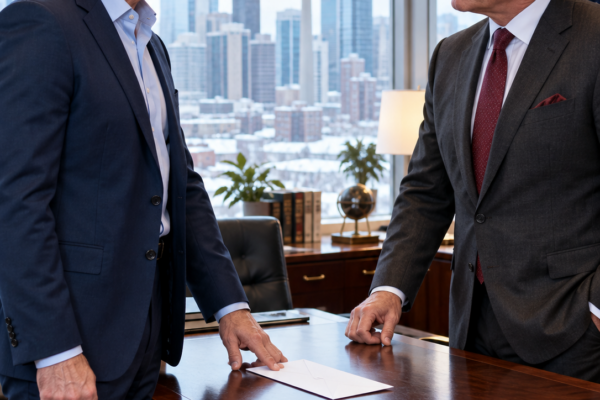
When Jane Sterling placed her resignation letter on William Vance’s mahogany desk, her fingers did not tremble.
The letter was printed on the company’s standard letter-size paper. It wasn’t even in an envelope, just folded into exact thirds, clean and efficient. She had left two inches of blank space at the bottom for a handover summary covering her two years of work. Every item was clearly annotated, right down to the physical location of the master server passwords.
“Are you sure about this?”
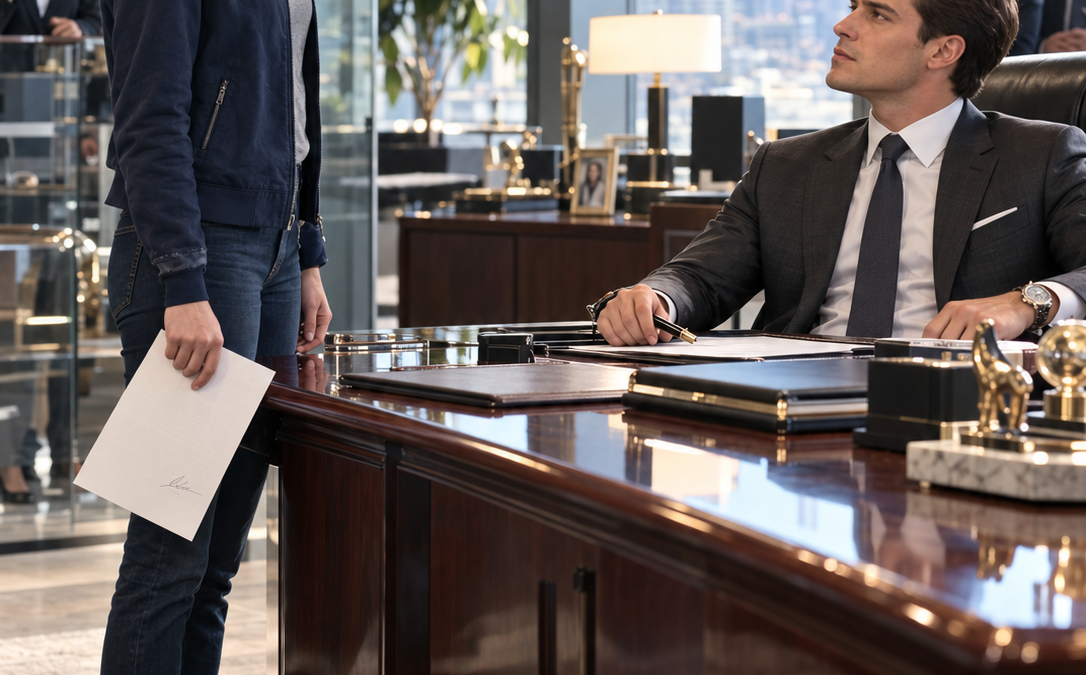
William sat behind his desk looking sharp in an $8,000 bespoke suit. His luxury watch reflected the harsh, cold light of the fluorescent panels overhead. He glanced at the paper but did not pick it up.
His gaze moved from the letter to Jane’s face. His expression was as flat as if he were looking at a completely irrelevant procurement request.
“I’m sure,” Jane said.
For two years, from the very first day Apex Commerce was founded, she had been the sole system architect in the IT department. Later, when the department expanded to twelve people, she became the director of engineering.
Her base salary was $10,000 a month. No equity. No annual bonuses.
Last month, the company closed its Series B funding round, and its valuation quadrupled.
At the celebration banquet, William raised his glass and thanked the venture capitalists, thanked his co-founders, and thanked the entire staff.
He completely omitted her name.
She stood at the very edge of the crowd, quietly finished her glass of orange juice, and said nothing.
William picked up his fountain pen and signed his name at the bottom right corner of the resignation letter. His strokes were fast, almost as if he were afraid she might change her mind.
“I’ll have Human Resources tell Finance to cut your final check today,” he said. “Your unused paid time off will be cashed out and included.”
Jane nodded, turned around, and walked toward the door.
Just as her hand touched the doorknob, she heard William speak from behind her.
“Khloe Carter is starting her first day today. Before you leave, hand over the system administrative permissions to her.”
Jane froze.
Khloe Carter.
She had first heard that name three months ago.
William had returned from a business trip, and the collar of his white dress shirt had a faint smudge of dusty rose lipstick on it.
She pretended not to notice.
When she ironed his shirts, she quietly sprayed stain remover on the collar twice. The next day, she hung the perfectly pressed shirt in his walk-in closet without asking a single question.
The second time she heard the name was late at night, a month ago.
William was on the balcony taking a call, his voice lowered to a whisper. Jane had gotten up to get a glass of water and heard him say through the glass door, “Chloe, be a good girl.”
She retreated to the master bedroom with her water and lay awake until three in the morning, listening to him tiptoe back into bed and waiting until his breathing grew deep and even.
The third time was just last week.
The company had created a brand-new position.
The title was Strategic Development Consultant.
The salary was $25,000 a month.
Brenda, the director of finance, privately tipped her off.
“Miss Carter was personally interviewed by the CEO. Her résumé shows her last job was working as a social media manager for an influencer agency in Los Angeles. It has absolutely nothing to do with system architecture.”
Brenda stopped there, her eyes full of pity.
Jane had simply smiled and said, “I understand, Brenda. Thank you.”
And now William was telling her to hand over the core system permissions to Khloe Carter.
“Understood.”
Jane turned around. Her tone was steady, as though she were giving a routine status report.
“Top-level server admin privileges, database root access, and firewall policy configurations. These three items will take twenty-four hours to fully transition. I’ll draft a checklist shortly. Please review and confirm it.”
William apparently hadn’t expected her to agree so readily. He paused for a second before speaking.
“It doesn’t need to be that complicated. Just give her the passwords.”
“I can’t do that,” Jane said. “According to Article Seven of the company’s information security policy, the transfer of top-level access must undergo a complete permission audit and operational log verification. Otherwise, if a security breach occurs, accountability cannot be traced.”
She looked at him.
“You were the one who signed off on that policy last year.”
Her tone carried no emotion, as if she were reciting the execution logic of a block of code.
William stared at her for a moment.
There was something indescribable in his eyes, surprise mixed with a slight, uncomfortable irritation. But he quickly averted his gaze, looking down at the documents on his desk.
“Suit yourself. Just get it done today.”
When Jane pushed the door open and walked out, she ran into Brenda in the hallway.
Brenda was holding a stack of expense reports and heading toward the finance office. The moment she saw the signed resignation letter in Jane’s hand, she stopped dead on the carpet.
At forty-seven, Brenda had been in corporate finance for twenty years. She had seen it all.
But right now, she opened her mouth and took a long time to get a single sentence out.
“Jane, are you really leaving?”
Jane nodded.
Brenda’s eyes instantly turned red.
She slammed the stack of reports onto a nearby windowsill, grabbed Jane’s wrist, and lowered her voice.
“That Chloe girl is already here. She did her onboarding on the eighth floor. Do you even know who she is?”
“I know,” Jane said.
“You know, and you still—”
Brenda didn’t finish her sentence.
She shut her mouth because she read everything in Jane’s eyes.
That look was not the look of a wronged, heartbroken wife.
It was calm, painfully sober, like she was looking at a system vulnerability that had already been completely analyzed and debugged.
Brenda took a deep breath, let go of her wrist, and patted the back of her hand.
“All right. I won’t try to talk you out of it. With your skills, anywhere you go will be better than this place.”
Jane smiled.
This time, it was a genuine smile.
By the time Jane returned to her desk, the news had already spread through the engineering department.
The eleven developers under her were sitting in their cubicles. Nobody spoke, but every pair of eyes followed her.
Tyler, the lead front-end developer, took off his headphones.
Marcus, the senior back-end architect, placed his insulated thermos heavily on his desk.
Sarah, from the QA team, stood straight up, her mouth opening and closing like a robot whose pause button had been hit.
“Sit down, everyone.”
Jane placed a photocopy of her resignation letter on her desk.
“I’ll finish my handover this afternoon and leave. If anyone has pending technical questions, come ask me now.”
Nobody moved.
After about five seconds, Marcus walked over holding his thermos.
This forty-two-year-old veteran had been at the company for almost two years. Jane had personally interviewed and hired him. His coding skills were bulletproof, and his temper was just as hard.
He was the only guy who dared to slam his hands on the table and yell at William during meetings.
He stood next to Jane’s desk and set his thermos down with a sharp thud.
It wasn’t particularly loud, but everyone in the open office heard it.
“Jane, if you walk, I walk.”
Jane looked up at him.
“Have you paid off your mortgage yet?”
Marcus choked.
“Did you finish paying for your kids’ college funds?”
Marcus’s mouth twitched.
“Go sit back down,” Jane said. “There are still three memory leak bugs in your latest commit. I flagged them last Friday. Did you fix them?”
Marcus opened his mouth, ultimately said nothing, and sulked back to his cubicle with his thermos.
Tyler couldn’t help letting out a snort of laughter.
But after laughing, his expression turned serious.
He walked over and dropped a thick stack of printed documentation on Jane’s desk.
It was the complete API documentation for all the front-end modules he was responsible for. Every page had the critical points highlighted in neon yellow.
He didn’t say a word. He simply left it there and returned to his seat.
Jane flipped through the thick stack and found a sticky note attached to the very last page.
On it was Tyler’s messy handwriting.
Jane, I’ll remember everything you taught me for the rest of my life.
She carefully straightened the sticky note and slipped it into her pocket.
At two o’clock that afternoon, Khloe Carter arrived.
Jane waited for her by the eighth-floor elevator bank.
When the doors opened, the first thing she saw was a pair of gradient-sequined Jimmy Choo stilettos stepping onto the gray floor tiles.
Every step carried a loud, entitled clicking echo.
Above the shoes, Khloe wore black wide-leg trousers, a white silk blouse, and a Hermès Mini Kelly slung over her forearm.
Her hair was styled into perfect, voluminous waves. Her makeup was so flawless that the angle of every single eyelash looked mathematically calculated.
Khloe walked out of the elevator, swept her gaze over the floor directory, and then let her eyes land on Jane.
“Hi there. Could you tell me where the IT department is?”
When she smiled, a shallow dimple appeared at the corner of her mouth.
Her voice had that deliberately trained, breathy softness, the ends of her words pitching up slightly to project a perfectly calculated sense of intimacy.
“Hello. You must be Khloe Carter. I’m the director of engineering, Jane Sterling,” Jane said. “William asked me to hand over the system permissions to you.”
Khloe’s smile didn’t change.
But her eyes did.
The shift was microscopic, like a camera lens snapping from blurry to sharp focus.
Jane had instantly transitioned from an irrelevant bystander to a target requiring serious evaluation.
Khloe’s gaze traveled from Jane’s face down to her jacket.
It was a navy-blue Everlane basic zip-up, the cuffs slightly frayed and whitened from wear.
Then she looked at Jane’s makeup-free face, her hair casually tied into a low ponytail, and the pair of white Converse sneakers she had worn for two years.
The evaluation lasted about two seconds.
Khloe’s smile deepened just a fraction.
There was a subtle relaxation in her expression, like a competitor watching her opponent warm up and confirming she was definitely going to win.
“Nice to meet you, Jane,” she said. “Thanks so much for your help.”
Jane didn’t correct her overly familiar tone.
She simply turned and led her toward the engineering bullpen.
The handover process went more smoothly than Jane had anticipated, mostly because Khloe understood absolutely nothing.
When Jane opened the server back-end terminal, pointed to the command-line interface, and explained the usage protocols for root access, Khloe tilted her head, stared at the screen for a moment, and pulled out her iPhone to take a picture.
She said she needed to keep it for reference.
Jane didn’t stop her.
She only added after the flash went off, “Don’t share screenshots of this interface externally. It contains our corporate server security configurations.”
Khloe gave a dismissive hum and deleted the photo right in front of Jane.
Then she accidentally opened her text messages.
Jane saw that her top pinned contact had a profile picture saved under the name Mr. Vance.
The last message had been sent at 11:03 that morning.
Are you done with onboarding? Let’s get lunch.
Jane shifted her gaze back to the monitor and continued explaining the next permission module.
By the time she finished everything, it was 5:30 in the evening.
Jane printed two copies of the handover confirmation receipt.
She signed her name first, then handed the pen to Khloe.
Khloe took the pen and signed her name on the paper. Her handwriting was round and soft, exactly like her voice.
“Thank you so much, Jane.”
Khloe handed the pen back, smiling brightly.
“Let me buy you dinner sometime.”
“No need. As long as the handover is clear, we’re good.”
Jane picked up her copy of the receipt and left Khloe’s copy on the desk.
“I’m heading out now. Goodbye.”
She didn’t go to say goodbye to William.
She simply returned to her cubicle, reformatted and factory-reset the company laptop she had used for two years, packed it into its bag, and left it on the desk.
She wiped down the keyboard and mouse twice with alcohol wipes and arranged them perfectly parallel.
She didn’t have many personal belongings in her drawers.
A coffee mug, a box of Earl Grey tea bags, a tube of hand cream, and a Bluetooth speaker she had won at last year’s holiday party.
She put everything into her canvas tote bag.
Marcus, Tyler, Sarah, and a few other developers stood in the aisle watching her pack.
Nobody said a word.
Jane hoisted the tote bag onto her shoulder and smiled at them.
“Keep up the good work. Fix those bugs.”
As she stepped into the elevator, Marcus ran out into the hall and shouted, “Jane!”
The elevator doors closed.
William didn’t get home until 8:30 that night.
Jane was in the kitchen making spaghetti.
She sautéed diced tomatoes into a rich sauce, boiled the water, dropped in a handful of pasta, cracked two eggs into a separate pan, and sprinkled some basil over everything.
Right before plating, she drizzled a little olive oil on top.
This was the dinner she had cooked for two years.
Simple, fast, and delicious.
William usually ate two bowls.
She heard the front door unlock, followed by the sound of leather dress shoes stepping onto the hardwood floor of the entryway.
“Dinner’s ready,” she said without turning around.
William walked into the kitchen and leaned against the doorframe, watching her plate the pasta.
He had changed into loungewear, a dark gray cotton T-shirt she had bought for him on sale online last year.
He was tall, with broad shoulders, making anything he wore look like it belonged on a catalog model.
But he never cared about that stuff himself.
He just wore whatever Jane bought him.
“What are your plans now?” he asked.
“I’m going to take a few days off.”
Jane placed the two bowls of pasta on the dining table, pushing one toward him and keeping the other on her side.
The bamboo chopsticks they used were two years old, worn smooth and shiny.
William sat down, picked up his fork, but didn’t eat.
He looked at her.
“If you want to go to another tech firm, I know a few headhunters.”
“No need.”
Jane twirled some pasta and blew on it.
“I can find my own job.”
The answer made William fall silent for a few seconds.
He lowered his head and started eating.
After two bites, as if remembering something, he put his fork down, pulled his phone out of his pocket, and tapped the screen a few times.
A second later, Jane’s phone buzzed.
She picked it up.
It was an alert from her bank.
The deposit amount was $32,500.
Two months’ salary plus cashed-out PTO.
Accurate down to the cent.
“Received,” she said, putting her phone down and continuing to eat.
William stared at her a while longer.
He looked like he wanted to say something, but ultimately kept his mouth shut.
He picked his fork back up and cleared his bowl completely.
Then he pushed the empty bowl aside and muttered, “I have a virtual board meeting.”
He got up and went to his study.
Jane washed the dishes, wiped down the counters, tied up the kitchen trash bag, and set it by the front door.
She returned to the master bedroom, opened the bottom drawer of the dresser, and pulled out a manila folder.
Inside were the things she had started preparing two months ago.
A new apartment lease.
A new bank card.
A certificate of deposit for $50,000.
Her passport.
Her college degree.
And a stack of printed evidentiary documents.
She checked everything one by one.
Once she confirmed nothing was missing, she slid the folder into the inner compartment of her canvas tote.
Then she changed into a clean T-shirt, lay down on the bed, and stared at the ceiling.
The house was William’s premarital property.
Only his name was on the deed.
In their three years of marriage, she had never spent a single ounce of energy trying to claim it.
She never demanded that her name be added to the mortgage. She never got involved in the renovations, and even the furniture was picked out by William’s mother.
His mother had said she was stupid.
Jane had said she preferred the peace of mind.
Looking back now, that peace of mind meant that when she left, she wouldn’t have a single large piece of furniture to pack.
Her phone screen lit up.
It was a text from Brenda.
Jane, did you get home okay? There’s something I think I need to tell you.
After you left today, Chloe moved into your old cubicle. William personally helped her carry her boxes over.
Jane stared at the message.
Her thumb hovered over the screen for two seconds before she typed two words.
Got it.
She locked her phone, rolled over, and closed her eyes.
The move happened the next morning.
She had booked a local moving van in advance.
Three cardboard boxes, two duffel bags, and a small cargo van were all she needed.
When the mover was hauling the last load, the door to the apartment across the hall cracked open.
A gray-haired woman peeked her head out, looked around, and quickly pulled back inside.
Jane knew this was Mrs. Higgins.
She had lived in the building for over a decade and was about the same age as Jane’s mother.
Every time they ran into each other in the hall, she would ask, “Jane, honey, when are you two having kids?”
As Jane walked to the door to put on her shoes, she saw a spare set of William’s keys sitting on the shoe cabinet.
The keychain was a little fabric armadillo they had bought during a trip to Austin.
Its ears were worn and faded.
She picked it up, looked at it, and put it right back exactly where she had found it.
William was at the office.
He had no idea she was moving out that day.
She had no intention of telling him, either.
As the cargo van pulled out of the gated community, Jane looked in the rearview mirror at the building she had lived in for three years.
Tan stucco exterior. Seventeen floors.
She had lived on the twelfth.
Out on the balcony, two pieces of laundry she had washed the day before yesterday were still hanging on the drying rack.
She had forgotten to bring them in.
Whatever.
Her new apartment was on the south side.
It was a fifth-floor walk-up in an older brick building.
No elevator. One bedroom. One living room.
Rent was $1,800 a month.
The place was small, but the natural light was incredible.
The bedroom faced south, and the ten o’clock morning sunlight spilled across the original hardwood floors.
Jane stacked her boxes in the corner.
She didn’t rush to unpack.
Instead, she opened the windows to let the fresh air in, boiled a kettle of water, and brewed herself a cup of Earl Grey tea.
Her phone chimed.
It was a message from Tyler.
Jane, the company is exploding today.
Immediately afterward came a message from Marcus.
Jane, guess what’s happening right now?
Then Sarah.
Jane, look at the company Slack.
Jane sat down in a chair by the window, holding her mug, and opened the corporate Slack channels she had muted all day yesterday.
The unread notifications were well past nine hundred.
She scrolled up and quickly pieced together what was happening.
At 9:00 a.m., the company’s enterprise systems had booted up normally.
Everything looked fine.
But by 9:17 a.m., the finance department’s reimbursement portal had thrown a 404 error.
Immediately afterward, the sales team’s CRM system went into an infinite loading loop.
Then the HR attendance software completely flatlined.
The IT support guy rebooted the servers three times.
After every reboot, the systems worked for about five minutes before throwing errors again.
And every time, the error popped up in a different module.
It was as if something were randomly kicking over tables deep in the system’s back end.
By 11:00 a.m., the catastrophe had gone full scale.
The company’s core business system, the massive e-commerce platform supporting three million daily active users, failed to load its product listings.
Checkout API calls timed out.
User authentication requests all returned critical error codes.
The engineering department scrambled for two straight hours.
They tore through every log file and traced every single API call record.
Finally, they hit a brick wall nobody could bypass.
The highest-level root access for the core database belonged to only one person.
Jane.
Jane had built this security architecture two years ago.
Back then, she was the only person in the IT department.
She centralized all root access under her own credentials so she could locate and patch bugs at lightning speed during a crisis.
As the team expanded, she suggested decentralizing the access rights several times.
But William always said, “No rush. Wait until things are perfectly stable.”
That wait lasted two years.
Now she was gone.
Yesterday afternoon, she had handed those permissions over to Khloe Carter.
But Khloe couldn’t even read a command line, let alone operate an enterprise database.
Worse yet, during the handover, Jane had strictly followed corporate security compliance protocols and reset all the authentication keys for root access.
The old keys automatically expired.
The new keys could only be invoked through Khloe’s account.
And Khloe hadn’t even shown up for work that day.
Her onboarding was complete. Her account existed in the system, but the woman herself had called in sick.
Her excuse was that she was feeling under the weather.
Marcus posted a single word in the engineering Slack channel.
Spectacular.
Nobody knew whether Jane had done this on purpose or simply followed the rules.
In reality, she had executed the most standard, legally compliant permission transfer according to the company’s own information security policy.
Resetting keys.
Generating new authenticators.
Revoking legacy access.
Every step was logged.
Every step was perfectly legal.
Every step was signed off on the handover receipt by both parties.
The only problem was that the person catching the ball had completely dropped it.
At 12:30 p.m., William’s phone call came in.
Jane watched the caller ID flash across the screen.
She let it ring five times before answering.
“Jane.”
William’s voice was lowered, practically squeezed through his teeth, but she could hear the sheer panic simmering underneath.
“Where are you right now?”
“At home.”
Jane took a sip of her tea.
Her voice was perfectly calm.
“You moved out.”
William paused.
He had clearly deduced it from the ambient noise in the background, but he spent only half a second on that thought before snapping back to the emergency.
“The company’s core systems suffered a catastrophic failure today. Engineering has been debugging all morning. They said the authentication keys for the database root access were reset during your handover. The new keys are only under Khloe’s account, but she didn’t come to work today. Can you remote in and—”
Jane cut him off.
“If the keys are under Khloe’s account, just have her log in remotely and grant authorization.”
“She doesn’t know how.”
William spoke those words with obvious, agonizing humiliation.
“She hasn’t even activated her account yet.”
Jane was silent for two seconds.
“Can’t the engineering guys figure it out?” she asked.
“They tried.”
William took a deep breath.
“Marcus said he could try to bypass the permission verification, but the risk is massive. It could cause permanent data loss. I can’t take that risk.”
“Yeah, that bypass method is extremely risky. I don’t recommend you try it.”
Jane spoke in a purely professional, transactional tone.
“I wrote it very clearly in the handover checklist I gave Khloe. She needed to activate her admin account and complete the initial authentication ping by 10:00 a.m. today. Otherwise, the system automatically locks down the core modules to prevent a breach. Did she not read the handover document?”
Dead silence filled the other end of the line for five whole seconds.
“Where are you?” William said.
This time, it wasn’t a question.
It was a statement.
There was a new layer in his voice that Jane had never heard before.
It took her a moment to recognize it as total helplessness.
“Send me your south-side address. I’m coming to pick you up.”
“Don’t bother coming.”
Jane placed her teacup on the windowsill, watching the sunlight pierce through the amber liquid and cast a golden glow.
“The company’s system failure is no longer within my scope of responsibility. I’ve resigned.”
“Jane!”
William’s voice spiked half an octave before he forcibly suppressed it.
“This whole mess was my oversight. I apologize to you, but the situation is critical right now. The platform has been down for two and a half hours. We’re bleeding money by the minute. You know exactly how valuable this system is.”
“I know exactly how valuable it is,” Jane said.
“I built it.”
More silence came from the other side.
She could hear someone shouting, “Mr. Vance!” in the background, yelling that the server hosting providers were calling the front desk.
Then came hurried footsteps and the sound of a door slamming shut.
“Name your terms,” William said.
“You want my terms?”
Jane picked up her cup and took another sip.
It was just cheap Earl Grey she had bought in bulk at the supermarket.
Nothing fancy.
But it was hot.
She didn’t rush to speak, letting the hot tea rest on her tongue for a second.
“Three terms,” she finally said.
Her pacing was deliberate, every word articulated clearly.
“Name them.”
“First, I’m now an external contractor. To resolve this outage, we need to sign a B2B technical services agreement. The fee will be market rate. For emergency core database recovery, the industry standard is $1,500 an hour, billed for actual hours worked, starting the second I log into the remote terminal.”
No sound came from the phone.
The price meant absolutely nothing to William.
It was less than what the platform lost in a single minute of downtime.
But the implication was massive.
She was no longer his employee.
She was not even his wife in any meaningful sense anymore.
She was an external vendor with a strict price tag.
“Second,” Jane continued, “the engineering department must create a new position: Chief Information Security Officer. They’ll be responsible for tiered permission management and security audits. This role will report directly to the board of directors, not to you.”
“What are you trying to say?”
William’s voice turned ice-cold.
“I’m saying the company can’t afford to have a second Khloe Carter holding the master keys without knowing how to use them,” Jane said.
Her tone was steady, as though she were pointing out a documented bug.
“This is an architectural flaw, not a personal attack.”
Her phrasing was airtight, but everyone involved knew that Khloe Carter was the entire problem.
William obviously understood that, too.
But he said nothing.
“Third.”
Jane’s gaze drifted to the branches of an old oak tree outside the window, where a few sparrows were hopping around.
“Our divorce will be uncontested. I’ve drafted the paperwork. You just need to sign it. The house is yours. I don’t want alimony. We split the liquid cash savings fifty-fifty. No other financial disputes.”
This time, the silence on the other end lasted the longest.
So long that Jane thought the call had dropped.
She pulled the phone away from her ear to check the screen.
The call timer was still ticking.
“Are you serious?” William finally asked.
His voice suddenly sounded foreign, like all his corporate armor had been stripped away, leaving only his raw vocal cords.
“When have I ever not been serious?” Jane said.
Another bout of silence followed.
Then she heard William take a deep, rattling breath.
The sound was magnified through the receiver, carrying a slight tremor.
“Draft the contract. I’ll sign it. Create the CISO role. I’ll approve it,” he said, pausing. “As for the divorce, we can talk about it when you get here.”
“I’ll email the consulting agreement in ten minutes,” Jane said. “Sign it and send it back. Once I receive the signed copy, I’ll begin remote operations.”
She hung up.
The tea in her cup had gone cold.
She stood up, walked to the window, and pushed it open, letting the outside breeze blow in.
The September wind carried the faint smell of exhaust mixed with the distinct scents of laundry detergent and cooking oil from the old apartment complex.
It wasn’t a beautiful smell.
But it was real.
Her phone buzzed again.
It was Marcus.
“Jane!”
Marcus’s voice was a mixture of intense excitement and forced restraint, like he was yelling in a whisper.
“William just barged into the IT bullpen, his face as black as thunder. He kicked everyone out of his office and locked himself in to make a phone call. Was he calling you? What did he say?”
“He’s signing a consulting contract and paying my hourly rate. I’ll fix it remotely,” Jane said concisely.
Marcus let out a muffled laugh on the other end.
It was the laugh of someone who had fully expected exactly this outcome.
“That Chloe girl hasn’t shown her face all day. Her phone is off. William’s assistant, Kevin, called her seven or eight times. Straight to voicemail. I heard a rumor that she went to some crazy influencer party in LA last night and got totally wasted. Probably still passed out.”
Jane didn’t acknowledge the gossip.
She simply said, “I’m going to remote in shortly. Go to the server room and keep an eye on the physical racks for me.”
“You got it,” Marcus said.
Then he hesitated for a second.
“Jane, are you holding up okay?”
“I’m doing great,” Jane said.
And this time, she really was.
Fifteen minutes later, William’s signature appeared on the contract she had emailed him.
The scan was crystal clear.
His signature was as aggressively scrawled as ever, the loops connecting forcefully, clearly rushed.
She zoomed in on the PDF and noticed a small warped mark right next to the signature.
It wasn’t big, but she recognized the stain.
It was a drop of sweat that had blurred the ink.
She opened her laptop and remotely connected to the company’s back-end servers.
The remote repair took two and a half hours.
Jane didn’t intentionally drag it out, nor did she rush.
She meticulously followed standard operating procedures to troubleshoot, authenticate, and restore the systems.
Every single keystroke was logged in the system records.
Marcus coordinated with her flawlessly from the server room.
The two of them worked with exactly the same rhythm they had during every emergency patch over the last two years.
The only difference was that this time, Jane had a digital stopwatch running on her desk.
$1,500 an hour.
Accurate to the minute.
At 4:03 p.m., the core systems were fully restored.
The product listings on the homepage loaded perfectly.
The checkout API response times dropped back under three hundred milliseconds.
User login authentication worked without a hitch.
Jane ran one final full-stack stress test.
After confirming all modules were stable, she applied her cryptographic signature to the action log.
The stopwatch read two hours and twenty-one minutes.
She billed him for two and a half hours, $5,000 even.
She emailed the invoice to William’s inbox, then closed her laptop.
The sunlight outside had shifted into that lazy golden afternoon hue, painting the oak tree’s leaves diagonally.
Jane stood up and stretched.
Her spine popped twice.
She realized she hadn’t shifted her posture in two and a half hours. Her neck and shoulders were stiff.
Her phone screen lit up.
A bank notification.
She picked it up and froze.
It wasn’t $5,000.
It was a wire transfer for $50,000.
The attached memo note contained only three words.
More to come.
Jane stared at those three words for a long time.
Then she let out a soft laugh.
She could pretty much guess what was going to happen next.
The company’s system architecture had exposed a fatal flaw the moment she left.
It was too reliant on her.
Not just reliant on her raw coding skills, but on her intimate, line-by-line familiarity with the entire codebase, from the bare metal to the front end.
Over the last two years, the business had grown by thirty percent month over month, but the technical documentation had lagged far behind.
The operational logic of several critical modules existed solely in her brain.
Nobody else knew the full picture.
Today’s crash was just the tip of the iceberg.
The database root access issue was solved, but the upcoming software iterations, architecture migrations, and security patches would all hit the exact same bottleneck.
William wasn’t an idiot.
He had seen with his own eyes exactly how fragile his empire became the second Jane walked out the door.
So he wired her $50,000 and told her there was more to come.
She went to the kitchen and made a quick grilled cheese sandwich, pairing it with a bowl of canned tomato soup.
Simple, but warm.
While eating, she turned on the television and flipped to a random reality show.
A bunch of young people were doing silly challenges on screen, laughing loudly.
She chuckled along a few times.
She wasn’t sure whether she actually found it funny or whether the apartment was simply too quiet.
Halfway through her meal, she suddenly put her fork down, went to her canvas tote, and pulled out the manila folder.
She took out the printed uncontested divorce agreement.
She read it from top to bottom, picked up a pen, and added a line under the asset division section.
The $50,000 cash balance currently held in Party B’s account is hereby classified as sole and separate property, representing independent contractor fees voluntarily paid by Party A. Both parties agree there are no further joint assets subject to division.
After writing that, she slipped the papers back into the folder and returned to her food.
Just as she finished the last bite, her phone rang again.
This time, it wasn’t William.
It was an unknown number.
She answered.
A crisp, fast-paced female voice came through the speaker, carrying a kind of relentless enthusiasm.
“Hi, is this Jane Sterling? This is Emily from Human Resources at Nexus Tech. We found you through an open-source project you posted on a developer forum. Our CTO looked at your GitHub commits and was absolutely blown away. He really wants to bring you in for a chat. Are you available sometime soon?”
Jane was stunned for a second.
That open-source project was a distributed microservices framework she had built in her spare time a year ago.
She had uploaded it to GitHub and completely forgotten about it.
She never expected anyone to track her down through it.
“I’m available,” she said. “Does tomorrow afternoon work?”
“Absolutely!”
Emily’s voice spiked with excitement.
“I’ll text you the address and time right now. Do you mind if I add you on LinkedIn and text you?”
“This number is fine.”
After hanging up, Jane sat on the couch in a daze for a minute.
Then she stood up, walked to the window, and looked down at the courtyard of the old apartment complex.
A few kids were chasing an orange tabby cat.
Their high-pitched laughter pierced through five floors of empty air, carrying a kind of mindless, pure joy.
The corners of her mouth curled upward.
She opened her phone and accepted Emily’s contact request.
Emily’s texting style was exactly like her phone voice.
Overwhelmingly enthusiastic and efficient.
Jane, so great to connect! Tomorrow at 2 p.m. at our office in the Innovation Tower, TechHub District. You’ll be interviewing with our CTO, Luke Henderson. He told me to tell you that he deployed your microservices framework across three of our core projects, and the results were insane. He’s dying to meet you in person.
Jane replied with a simple message.
Sounds great. See you tomorrow.
Then she tapped on Emily’s social media profile.
The most recent post was from lunch that day.
A picture of an office spread.
A bunch of young developers crowded around a long table covered in cold brew coffees and gourmet donuts.
The caption read:
Weekly Wednesday treats. So much sugar.
In the photo, everyone was laughing.
It didn’t look like the forced, dead-eyed smiles of mandatory corporate team-building.
It looked genuinely fun.
She scrolled down and saw more glimpses of the startup’s daily life.
The CTO cooking late-night tacos for the team during crunch time.
The whole squad going to a karaoke bar until three in the morning after a major product launch.
The office dog having puppies and everyone fighting to adopt them.
The comments under every post were full of coworkers roasting each other and joking around.
It looked chaotic, loud, and like a real family.
Jane finished looking through Emily’s page.
When she backed out, she saw a message from Marcus.
Jane, you’ll never guess. Khloe Carter showed up to the office at 4:30 p.m. Huge dark circles under her eyes, makeup completely smeared. Looked extremely hungover. William pulled her into his office for twenty minutes. When she came out, she was pale as a ghost, packed up her desk, and bolted. I heard a rumor William told HR to freeze her onboarding indefinitely.
Jane read the message and didn’t reply.
She simply locked her phone screen, walked out onto the balcony, and watched the distant sunset slowly sink behind the city skyline.
The sky faded from fiery orange into deep indigo.
The evening wind was getting chilly.
She pulled her cardigan tighter around her shoulders.
She suddenly realized it had been a very long time since she had quietly watched a sunset like this.
When was the last time?
She couldn’t remember.
For three years of marriage, almost all her time and energy had been drained by two things.
The company and William.
She had built the company’s systems with her own two hands. From the very first line of code to the current million-line architecture, every module was burned into her brain.
She managed William’s entire life, from cooking dinner every night to rotating his seasonal wardrobe, paying the utility bills, and buying birthday gifts for his parents.
She acted exactly like a flawless system administrator, keeping everything running with zero downtime.
But the system administrator never gets mentioned in the victory speech because everyone assumes a perfectly running system is simply a law of nature.
They only remember you when the servers crash.
Her phone vibrated in her pocket.
William had sent a text.
Are you free tomorrow? I want to talk in person.
Jane stared at the message for a long time.
Then she typed:
We’ll see.
She switched her phone to silent, walked back into the bedroom, pulled fresh sheets from her box, and made the bed.
The new sheets were light blue cotton.
They felt crisp and comfortable.
She made the bed meticulously, tucking the corners into perfect hospital folds, as if drawing a neat geometric period at the end of the last two years of her life.
When she lay down, the mattress felt a little stiff.
It wasn’t as plush as the memory foam bed at the house, but she decided it didn’t matter.
Sometimes things being a little hard just made you feel grounded.
The next afternoon, Jane arrived precisely on time at the sixteenth floor of the Innovation Tower.
She wore a crisp white blouse with a light gray blazer thrown over it. She hadn’t tied her hair back into her usual ponytail. Instead, she let it down, pinning it neatly behind her ears.
She had even applied a little makeup, a dusty rose YSL lip stain Brenda had given her for her birthday last year.
She almost never wore it.
That morning, looking in the mirror, she realized she was out of practice. It took her two tries to get it even.
Nexus Tech’s office was the polar opposite of William’s company.
Instead of cold, sterile, black-and-white minimalist decor, the space was dominated by warm tones: orange sofas, massive potted plants, and natural wood bookshelves. The walls were plastered with Polaroid photos of the team and hand-drawn whiteboard charts tracking project milestones.
There was an actual dog bed by the reception desk, where a fat golden retriever was currently snoring, its belly rising and falling.
“Jane!”
Emily practically bounced out of her chair to greet her.
She was a round-faced young woman with her hair in a messy bun and deep dimples.
“You look even better than your profile picture! Let me tell you, Luke has been losing his mind waiting for you. He came out here five times this morning asking if you were here yet. I swear I was about to buy him a countdown timer.”
Jane was a little overwhelmed by her immediate, bubbly familiarity, but she quickly relaxed.
Emily led her through the open-plan office. Jane noticed there were no cubicle walls here. Everyone’s monitors faced outward, and a few young engineers were arguing loudly in front of a whiteboard.
It was noisy, but the atmosphere was electric, like a college robotics club.
“Luke, Jane’s here!”
Emily pushed open the frosted glass door of a conference room.
Inside sat a guy in a navy-blue hoodie.
He looked to be in his early thirties, wearing thick black-rimmed glasses, his hair looking like he had just run his hands through it a hundred times while debugging.
His desk was buried under a laptop and an open notebook covered in chaotic architecture diagrams that only a madman could decipher.
When he saw Jane, his eyes practically lit up.
He stood so fast that his ergonomic chair shot backward and slammed into the whiteboard behind him.
“Jane!”
He reached out his hand, then immediately pulled it back, wiped it vigorously on his jeans, and extended it again.
“Sorry, sorry. I was deep in a staging server issue and got sweaty palms. I’m Luke Henderson. I spent three months studying your microservices framework. It is absolute genius!”
He barely paused for breath.
“Seriously, how did you come up with that load-balancing algorithm? When I read that block of code, I literally jumped out of my chair. Scared the hell out of my wife. She thought I got electrocuted.”
He talked a mile a minute, like his brain was overflowing with words and he had finally found someone who spoke his language.
Jane shook his hand.
His palm was indeed a little clammy, but his grip was firm.
The strength wasn’t fake corporate networking confidence. It was genuine, raw excitement.
“Thank you,” she said. “I actually came up with that algorithm back in college. I just refined it a bit during some real-world deployments.”
“Refined it a bit?”
Luke’s eyes went wide.
“You call that refining it? That algorithm optimizes resource utilization by at least thirty percent. We plugged it into three projects, and the results were unreal, especially the automated failover module. Last month, our primary server crashed at two in the morning. Your logic automatically switched the traffic in 0.3 seconds. The on-call guy didn’t even wake up, and the users noticed absolutely nothing.”
Listening to his relentless praise, the corners of Jane’s mouth involuntarily curled upward.
It had been so long since anyone had complimented her work.
At her old company, everything she did was treated as a baseline expectation.
If the system stayed up, it was her job.
If it went down, it was her fault.
She had never once heard William say, “Good work.”
Not a single time.
Luke seemed to realize he was rambling and awkwardly rubbed the back of his neck. He pulled his chair back up and pointed to the seat across from him.
“Please sit down. Listen, I won’t beat around the bush. We have three massive core projects right now, and our user base is exploding, but our current architecture is buckling under the weight. We need a real heavyweight architect to lead a total infrastructure overhaul.”
He leaned forward, his enthusiasm giving way to a more serious expression.
“We’re incredibly impressed by your technical depth and engineering experience. The title is Chief Architect. We can negotiate base salary, and we can negotiate equity.”
As he spoke, he pulled a manila folder from under the desk and slid it across to Jane.
“Here’s the company prospectus, project details, and a preliminary compensation package. Take a look.”
Jane took the folder and read it thoroughly.
She took her time, pausing for a few seconds over specific metrics.
Luke sat quietly across from her, his hands folded on the table, looking exactly like a student waiting for his professor to grade his final exam.
Five minutes later, Jane closed the folder.
“I don’t have any major issues with the compensation package,” she said. “But I have two questions.”
“Shoot.”
Luke sat up straight.
“First, if I join, do I have absolute hiring and restructuring authority over the engineering team?”
“Of course you do. You’d be the head of engineering. You have the final say on all technical hires and adjustments. Hell, you can even override my technical decisions.”
Luke answered without a second of hesitation.
“Since day one, this company has banned the whole suits-dictating-engineering culture. Tech decisions are made by tech leaders.”
Jane nodded.
She liked the way this guy talked.
He wasn’t feeding her corporate buzzwords. Every word felt grounded and real.
“Second,” she said, pausing. “If I need to poach a few key developers from my previous company to bring with me, is that a problem?”
Luke froze for a second, then grinned.
“Are you kidding? That’s the dream! Anyone good enough for you to bring over is a guaranteed rock star in my book.”
Jane leaned back in her chair, looking at the row of potted succulents lining the conference room windowsill.
They were fat, glossy, and clearly well cared for.
It was a tiny detail, but it told her this place treated living things well.
“I need three days to think it over,” she said.
“Take your time.”
Luke stood up and offered his hand again.
“Three days, a week. We’ll wait for you.”
Jane shook his hand.
This time, his palm was dry and warm, his grip rock-solid.
When Jane walked out of the Innovation Tower, she stood on the sidewalk for a moment.
The September sun felt great.
Not too hot, just a gentle warmth on her skin.
She pulled out her phone and saw three missed calls, all from William.
She opened her contacts and scrolled down, her thumb hovering over William’s name for a second.
Then she kept scrolling, found Marcus’s number, and dialed.
“Jane.”
Marcus picked up instantly.
“Marcus.” Jane leaned against the metal railing by the street, watching traffic roll past. “I need your advice on something. I’m talking to a tech firm about a head of engineering role. I need to build out a team. Do you want to come over?”
The line went dead silent for about two seconds.
“Jane.”
Marcus’s voice suddenly sounded a little raspy.
“Do you have any idea how long I’ve been waiting for this phone call?”
Jane didn’t speak, but her eyes felt hot.
“And it’s not just me,” Marcus added, his voice thick. “Tyler was whining about you during lunch today. Said without you reviewing his PRs, he doesn’t even feel confident pushing code. Sarah, too. She wrote a bunch of test cases and kept saying they felt wrong but didn’t know why.”
He paused.
“You’ve only been gone one day, and the rest of us feel like we lost our spine.”
“Then come over together,” Jane said.
Her voice was steady, but her knuckles were white from gripping the phone.
“I’ll negotiate the terms. I’ll get you all the best possible packages.”
“Done,” Marcus said. “Just for saying that, I’ll follow you into hell.”
After hanging up, Jane stood by the road for a long time.
The sunlight filtered through the leaves of the elm trees, casting warm, dappled shadows over her.
It smelled like dry leaves and pavement.
She took a deep breath.
Her chest felt incredibly light.
It was as though a massive weight that had been crushing her for years had suddenly been lifted.
Then she made her last phone call of the day.
When the person answered, the background noise was chaotic.
Typing, phones ringing, people talking over one another.
“Brenda,” Jane said. “Are you free tonight? Let’s grab dinner.”
Brenda picked an authentic Cajun seafood boil joint hidden deep in an older neighborhood.
The storefront was tiny, its neon sign buzzing and half burned out, but inside, the place was packed.
The sounds of crab legs cracking, shrimp sizzling in butter, and loud chatter drifted from the kitchen.
The air was thick with the smell of Old Bay, garlic, and cayenne pepper.
One breath of it made you hungry.
Brenda was already sitting in a corner booth.
She had two bottles of beer on the table. One was open, half poured into a frosty glass.
She had ditched her corporate blazer for a dark red knit sweater and let her hair down.
She looked ten years younger than she did at the office.
Seeing Jane walk in, she raised her glass.
The foam slid slowly down the side.
“Sit.”
Brenda pushed the unopened beer toward Jane.
“Drink first, talk later.”
Jane sat down, poured herself a full glass, and downed a third of it in one go.
The freezing liquid burned down her throat, bitter but refreshing.
She set the glass down and let out a long sigh.
“Hits the spot, right?” Brenda grinned.
“Hits the spot.”
Jane smiled back.
The food arrived quickly.
Spicy crawfish, blackened catfish, garlic-butter shrimp, and dirty rice.
Everything was heavily seasoned and perfectly greasy.
They both loaded their plates and ate in total silence for a solid ten minutes.
Brenda was eating twice as fast as usual, tearing into crab legs with an aggression that suggested she was working out some serious stress.
“Guess what happened at the office today?”
Brenda finally dropped a crawfish shell, wiped her hands on a napkin, and chugged her beer.
“Khloe Carter didn’t show up at all?” Jane guessed, scooping up some dirty rice.
“Worse!”
Brenda leaned over the table, lowering her voice as though she were sharing classified intelligence.
“Three people showed up at the office this morning.”
“Who?”
“Khloe’s mother, for one. The woman looked about fifty, very well maintained, wearing a full Chanel suit and walking in like she owned the place. Clearly old money.”
Jane’s fork paused.
She knew exactly who Brenda was talking about.
Khloe’s mother.
She had seen her once on William’s phone.
It was a photo taken at a high-end country club, showing a heavily Botoxed woman sitting next to Khloe, with William and his mother sitting across from them.
All four of them were laughing, looking like one big happy family.
William’s mother had texted the photo to him.
Jane had accidentally glanced over his shoulder.
William immediately locked his phone and put it facedown.
She hadn’t asked a single question then.
“What were they doing there?” Jane asked, slowly picking the meat off a shrimp.
Brenda’s expression turned glorious.
She looked like she was trying not to laugh but physically couldn’t hold it in.
Her shoulders shook.
“Your mother-in-law—well, William’s mother—came to throw down.”
Jane put her fork down.
“So, here’s what happened.”
Brenda took another swig of beer to clear her throat.
“You know William froze Khloe’s onboarding yesterday, right? Well, Khloe’s mom dragged her daughter into the office first thing this morning and stormed right into the CEO’s glass office. William’s mom must have gotten tipped off because she showed up ten minutes later. The two mothers collided head-on in the executive suite.”
Brenda paused for dramatic effect.
“The scene was, man…”
She watched Jane’s reaction.
Jane’s face remained perfectly blank.
She picked up her beer and took a sip.
“Khloe’s mom fired the first shot. She got incredibly nasty. Basically said, ‘Your son recruits my daughter to work here, then throws her out on the street? My daughter quit a lucrative career for this! What the hell do you think my daughter is?’”
Brenda mimicked a high-pitched, snooty country-club accent perfectly, making the corner of Jane’s mouth twitch into a smile.
“And then, and then your mother-in-law—let me tell you, she treated you like dirt, but she went to war today!”
Brenda gave a thumbs-up.
“She looked right at Khloe’s mother and said, ‘Your daughter came to work for one day and crashed our entire enterprise server infrastructure. She cost this company millions, and you have the nerve to demand answers? What the hell is on her résumé, anyway? Influencer management? Does she even know how to code? Does she know how to manage a database? What exactly entitles her to a $300,000 salary? The fact that she’s sleeping with my—’”
Brenda stopped herself, glancing around the restaurant before whispering.
“She didn’t say the word, but she looked right at William.”
“How did William react?” Jane asked, her face completely white.
“Just sat in his chair and didn’t say a word.”
Brenda chewed on a piece of blackened fish.
“Then Khloe’s mom completely lost it. She started screaming about how William begged her daughter to be with him, said all the right things, and now he was throwing her under the bus. Screaming about how the Vance family had no honor.”
The two older women had been yelling so loudly that the entire floor could hear them through the glass.
Half the office pretended they needed to walk past the CEO suite just to eavesdrop.
“I saw Kevin carry the same empty manila folder back and forth four times,” Brenda added.
Jane could vividly picture the scene.
William sitting in his $8,000 ergonomic chair, facing two screaming wealthy matriarchs, completely paralyzed.
He had always hated public scenes.
Both his mother and Khloe’s mother were aggressive, domineering women.
In the boardroom, he was a ruthless operator.
In this situation, he was a deer caught in headlights.
“How did it end?” Jane asked.
“Your father-in-law stepped in.”
Brenda’s expression grew complicated.
“The old man came alone. He didn’t even tell his wife he was coming. When he walked in, he pulled William out into the hallway. The two of them talked at the end of the hall for about twenty minutes. Nobody knows what was said, but when William came back, his eyes were totally red.”
Jane stayed quiet.
William’s relationship with his father had always been strained.
His father was an old-school intellectual, a tenured university professor, proud and stoic, who hated the slippery, calculating nature of the tech business world.
When William first launched the startup, his father was the only one in the family who aggressively opposed it, saying William was being corrupted by greed.
Even after the company became a massive success, his father’s attitude never really changed.
He rarely visited the office and never asked about the business.
The fact that he had shown up today meant things had escalated to a point where he felt morally obligated to intervene.
“What about Khloe and her mom?”
“Your father-in-law handled them,” Brenda said.
“He walked back in and said something to Khloe’s mom quietly. I couldn’t hear what it was, but her face completely dropped. She grabbed Khloe by the arm and dragged her out. They walked out so fast, they didn’t even wait for the elevator. They took the stairs.”
Brenda picked up her glass and took a massive gulp of beer.
She looked at Jane, her eyes suddenly turning dead serious.
“Jane, I’m not telling you all this to make you feel bad for him or to make you go soft. I just think you deserve to know the truth. I know exactly how much crap you put up with in that marriage, but I also saw that his parents, especially his dad, knew you were the real deal.”
Jane said nothing.
She looked down, using her fork to push the remaining dirty rice around her plate.
She picked up a single grain and chewed it slowly.
She thought about William’s father, the quiet old professor who spent all day reading in his study.
Whenever she went over for dinner, he would quietly make sure her favorite pecan pie was on the table.
He never handed out compliments, but once she had overheard him tell William’s mother, “Jane is a rock. She has more integrity in her pinky than William has in his whole body.”
That was the only validation she had ever heard from the Vance family in three years.
“Brenda.”
Jane scraped her plate clean and put her fork down.
“Do you know why I really quit?”
Brenda looked at her, waiting.
“It wasn’t because of Khloe Carter,” Jane said. “Khloe was just a symptom, not the disease.”
She paused.
“The disease was that I spent two years pouring every drop of my technical skill, my time, and my sanity into that company. And at the end of the day, my value wasn’t recognized. It was just expected.”
Her voice remained steady, but she no longer tried to soften her words.
“My architecture kept that company breathing, but my name wasn’t in the banquet speech. My security permissions held the life and death of the platform, but nobody thought I deserved equity. I was like a background daemon process running quietly on a server. As long as I didn’t throw an error code, nobody even remembered I existed.”
She paused again, staring at the cold, greasy crawfish shells piled on the table.
“This marriage was the exact same thing. For three years, I reduced myself to a feature set. The supportive wife feature. The forgiving feature. The understanding feature.”
Jane looked up and met Brenda’s eyes.
“I was a utility, not a human being.”
Her expression didn’t change.
“I’m done being a utility.”
Brenda’s eyes immediately welled with tears.
She reached across the table and grabbed Jane’s hand, squeezing it so hard that her knuckles turned white.
They sat there, separated by the messy remains of dinner, without saying another word.
All around them, the restaurant roared with laughter, clinking glasses, and the clatter of plates.
But their little corner booth was as quiet as an island.
Finally, Brenda broke the silence.
She grabbed a napkin, dabbed at her eyes, cleared her throat, and forced her usual brash tone back into her voice.
“All right, enough of this depressing crap. Let’s drink to that. To you not being a utility.”
Jane raised her glass and clinked it against Brenda’s.
The sharp chime of glass sounded like the starting bell of a new era.
“Oh, right.”
Brenda remembered something halfway through her beer.
“What are you going to do now?”
Jane briefly explained the interview at Nexus Tech.
Brenda’s eyes widened to the size of saucers.
She slammed her hand on the table so hard the plates rattled.
“Chief Architect with equity, and you get to build your own team? What the hell are you waiting for? Take it!”
“I want to bring Marcus, Tyler, and Sarah with me,” Jane said. “But I don’t want them taking a massive risk. I’m going to lock down the exact offer first, then let them decide.”
Brenda looked at her and suddenly grinned.
A deep, knowing grin.
“Jane, do you know what your actual superpower is?”
Jane looked at her.
“It’s not your coding. It’s not your brain. It’s the fact that after taking all this absolute garbage from the world, you still give a damn about other people.”
Brenda leaned closer.
“Your ex-husband treats you like dirt, and you still leave him a perfectly documented handover file. Marcus and the kids are your team, and even as you’re walking out the door, you’re paving a runway for them. People like you are destined to win.”
Jane actually blushed a little.
She lifted her beer glass to hide her face.
When they walked out of the restaurant, it was pitch-black outside.
The September night air was officially crisp.
The streetlights stretched their shadows long across the pavement.
Brenda had drunk too much to drive, so Jane called an Uber for her.
While they waited on the curb, Brenda leaned her head on Jane’s shoulder and randomly mumbled, “Jane, what are we all even killing ourselves for in this life?”
Jane thought about it.
“To breathe easy,” she said.
Brenda was quiet for a second, then gave a soft, “Yeah.”
She didn’t say anything else.
When Jane got back to her walk-up apartment, she noticed the motion-sensor light between the third and fourth floors was broken.
The stairwell was pitch-black.
She gripped the handrail and walked up step by step.
Her footsteps echoed hollowly in the narrow concrete shaft, making her feel incredibly isolated.
When she reached the fifth-floor landing, she pulled her keys out of her purse.
Just as she slid the key into the deadbolt, she saw a shadow standing next to her door out of the corner of her eye.
She jumped, almost yanking the key out to use as a weapon.
Then the motion-sensor light clicked on.
She saw who it was.
William.
He was leaning against the peeling plaster wall of the hallway.
His suit jacket was draped over his arm. His tie was pulled loose, the top buttons of his white dress shirt were undone, and his sleeves were rolled up to his elbows.
He looked like he had driven straight there after a brutal day at the office.
His hair was a mess.
A rough layer of stubble shadowed his jawline.
Dark, heavy bags hung beneath his eyes.
He looked like he hadn’t slept in days.
“How did you know I lived here?”
Jane pulled her key out of the door, turned around, and faced him.
Her voice wasn’t shocked.
It wasn’t angry.
She simply asked a flat question.
“I asked Mrs. Higgins across the hall from the old place,” William said, his voice raspy. “She said you mentioned moving to the south side. It wasn’t hard to figure out. I paid a background-check service online to trace your new lease registration. Found the address.”
Jane said nothing.
If he had done something like this in the past, tracking her down through payroll records, she would have been furious.
But now she simply realized that William’s logic was operating exactly as it always had.
If he wanted data, he acquired the data.
It had nothing to do with whether he loved someone or not.
It was just his protocol.
“Why are you here?” she asked.
“To talk.”
William stood up straight, but he swayed slightly.
Jane smelled the distinct, sharp scent of whiskey.
It wasn’t overpowering, but it was enough to tell her he had been drinking heavily that night.
William’s alcohol tolerance was legendary.
For him to actually smell like booze meant he had downed a lot of it.
“You’re drunk,” Jane said. “Don’t try to talk business when you’re drunk. We can talk tomorrow.”
She turned to unlock the door.
William reached out and slammed his hand flat against the door panel.
His arm boxed her in against the doorframe.
He didn’t touch her, but he trapped her in a suffocatingly small space.
Jane didn’t flinch.
She didn’t look back.
She kept her spine perfectly straight, her shoulders level, and her breathing steady.
“Jane.”
William’s voice came from right behind her ear, deep and gravelly, carrying a bone-deep exhaustion she had never heard from him before.
“My dad came to the office today.”
“I know,” Jane said.
William went silent for a second, as if processing the fact that she already knew.
Then he continued, his voice dropping lower.
“He told me a lot of things. He said that back in the day, my mom was just like you. She quit her career to stay home and take care of him and me. She did it for twenty years. Once he got his tenure professorship, she wanted to go back to work. He wouldn’t let her.”
His voice grew quieter.
“He said the house needed someone to manage it, so she never worked again.”
Jane remained still.
“Two years ago, when my mom was hospitalized with pneumonia, he stayed in her room overnight. She had a high fever and started hallucinating. She started talking in her sleep. She wasn’t talking about him or me or the house.”
William swallowed.
“She was reciting the data from the lab research she had done twenty years ago. The grant proposals she wrote. The grad students she mentored.”
He paused.
The motion-sensor light timed out and plunged the hallway into darkness.
William stomped his foot heavily.
The light flickered back on.
The harsh yellow bulb cast deep shadows over his face.
Jane finally looked at him and saw a completely blank, devastated expression she had never seen on William Vance’s face before.
“My dad told me…”
William took a ragged breath.
“He said that sitting by her hospital bed, listening to her talk about things he knew absolutely nothing about, he realized he had trapped a brilliant, extraordinary woman between a kitchen and a living room for forty years.”
William looked directly at Jane.
“He told me that what happened with you was entirely my fault from day one. He said I treated you like a module in my business plan, a tool to keep my life operational, not a person.”
His jaw tightened.
“He said I was exactly the same bastard he was when he was young.”
The hallway was dead silent.
The only sound was the faint hum of a refrigerator compressor through the walls.
“And then he asked me a question.”
William’s voice choked.
“He asked me, ‘If you were in a hospital bed with a fever, hallucinating in your sleep, what would you talk about? Would you talk about system architecture and load balancers, or would you talk about the days we spent together?’”
Jane closed her eyes.
Her hand was still gripping her apartment key.
The cold brass dug into her palm.
She took a deep breath, turned around, and faced him.
They were so close.
Close enough that she could see the jagged red veins in the whites of his eyes.
Close enough to smell the whiskey and stale coffee radiating off him.
This man, whom she had loved for five years, was standing in front of her looking like a skyscraper whose internal steel supports had just been vaporized.
The glass exterior was still there.
But the whole thing was ready to collapse.
“Your father is a very smart man,” Jane said.
Her voice was crystal clear, unshaken.
“But he figured it out too late, and he warned you too late.”
William looked like he had been physically struck.
He recoiled slightly.
“Jane, whatever happened with Khloe—”
Jane raised her hand and cut him off.
“I don’t want to hear about Khloe Carter. I didn’t leave you because of her. Do you understand that?”
She looked him dead in the eyes.
Her gaze was completely transparent and immovable.
“I left you because you never once viewed me as an equal partner. You viewed me as a utility function. Highly efficient, incredibly stable, zero downtime.”
She continued, her voice never rising.
“You needed a domestic wife, so I ran the domestic wife protocol. You needed a bulletproof head of engineering, so I ran the engineering protocol. But you never once stopped to ask me what the hell I actually wanted.”
William’s lips parted, but no sound came out.
“I wanted to be seen,” Jane said.
She wasn’t yelling, but every word hit like a hammer.
“I wanted my talent to be seen. I wanted my sacrifices to be seen. I wanted my feelings to be seen. Did you do that? No.”
Her eyes stayed locked on his.
“To you, everything I did was just the baseline. The server staying online was the baseline. The house being spotless was the baseline. Me spending a month picking out the perfect gift for your mother was the baseline. Me waiting up for you until three in the morning while you were out networking was the baseline.”
She didn’t raise her voice.
She wasn’t crying.
There was no hysteria.
But that absolute, clinical calmness was what drained the last drop of color from William’s face.
Because she was simply reading the logs, presenting irrefutable data.
“I went and interviewed at a new tech firm today,” Jane continued. “The CTO there said something to me that I think is very true.”
She paused, recalling his words.
“He said the ultimate value of a great system architect isn’t just writing god-tier code. It’s designing a system that can run perfectly even when the architect isn’t in the room. A flawless system should never rely on a single point of failure. It shouldn’t rely on one person.”
She stared right through him.
“You can do it. Your company can run without me. You just didn’t know it before. Now you do.”
The hallway light clicked off again.
This time, neither of them stomped to turn it back on.
In the pitch-black darkness, Jane heard William take a long, shuddering breath.
Then his voice cut through the dark, carrying a fragility she had never heard in her life.
“What if…”
He stopped.
“What if I want you in the system?”
Jane stood in the dark for a moment.
“Then file an official request ticket through proper channels,” she said.
She turned, felt for the lock in the darkness, and pushed the door open.
The warm light from her apartment spilled out, illuminating the hallway.
Jane stepped over the threshold, turned around, and looked at William standing in the dark.
The light from inside outlined his silhouette, making him look blurry and washed out, like an overexposed photograph from a long time ago.
“You drank too much. Call an Uber to get home,” she said. “Text me when you get back so your mother doesn’t panic.”
She shut the door.
The moment the deadbolt clicked, she leaned her back against it.
She could hear her own heartbeat.
Thump. Thump. Thump.
Loud, but incredibly steady.
She thought she was going to cry.
But the tears never came.
She simply stood there for a long time, listening to the heavy footsteps outside slowly walk away.
They echoed down the concrete stairwell until there was nothing but silence.
She walked into her bedroom, opened her laptop, and started drafting an email to Nexus Tech.
The subject line was Follow-Up on Offer and Counterproposal.
She wrote two full pages.
She laid out her exact demands in bullet points: total authority over the engineering team buildout, the timeline for the architecture overhaul, resource allocation, and the proposed titles and salary bands for the three senior engineers she was bringing over.
Every point was phrased impeccably.
Pure logic.
Zero emotion.
When she finished, she proofread it twice, tweaked a few action verbs to make them more assertive, and typed Luke Henderson’s email into the recipient line.
But she didn’t hit send.
She closed the laptop and went to the bathroom to wash her face.
The woman looking back in the mirror looked different from the one she had seen that morning.
The slight tension around her mouth was gone.
She didn’t have to force a neutral expression anymore.
She dried her face with a towel and smiled at her bare reflection.
She remembered what Brenda had said at dinner.
People like you are destined to win.
Maybe.
Maybe she was.
Jane handed the divorce papers to William on a Saturday afternoon.
She didn’t go to his office.
She didn’t go to his house.
She picked a coffee shop right next to the county courthouse.
There was zero sentimental value to the location. She had chosen it purely for logistical efficiency. Once he signed, they could literally walk next door to the clerk’s office, file the paperwork, and get it stamped.
No need to schedule a second meeting.
William arrived fifteen minutes early.
When Jane pushed the glass door of the café open, he was already sitting at a window booth.
A black iced Americano sat untouched in front of him.
He wore a crisp white dress shirt, buttoned all the way up to the collar. He had gotten a haircut and was clean-shaven.
He looked infinitely more put together than he had that night in her hallway.
But his eyes gave him away.
That razor-sharp, aggressive corporate confidence was completely gone.
It had been replaced by a hollow, heavy quietness.
He looked like someone whose fever had finally broken after a long, exhausting sickness.
Jane sat across from him, pulled a manila envelope from her bag, and slid it across the table.
“I updated the agreement. Review it.”
William took the envelope, pulled out the printed pages, and read them from top to bottom.
He read slowly, much more slowly than Jane expected.
He would linger on a single line of text for a long time, as though he had to translate the English into another language to understand it.
When he reached the asset division section, his eyes locked onto one particular line.
The $50,000 cash balance representing independent contractor fees.
He stared at it for a full thirty seconds.
“You didn’t need to put this in here,” he finally said.
His voice was flat.
“That was a consulting fee, not marital property.”
“Legally, any income generated before the divorce is finalized is marital property,” Jane said mechanically. “Putting it in writing prevents liability issues later.”
William went silent.
He pulled a pen from his breast pocket and signed his name at the bottom right corner of every page.
When he finished the last page, he didn’t close the packet.
He flipped back to the front and stared at it again, as if he were desperately looking for a loophole.
“I want to add one clause,” he said, looking up at Jane.
She waited.
“If I ever need help with anything, you won’t refuse my call.”
He didn’t look her in the eye when he said it.
He stared at his iced coffee, his voice incredibly low.
“This doesn’t have to be legally binding. Just your word.”
Jane didn’t say yes or no.
She reached across the table, took his pen, and wrote two lines in the additional stipulations section at the back.
Then she turned the paper around and slid it toward him.
Jane Sterling agrees that in the event of a catastrophic system failure at Party A’s company, if Party A submits a formal B2B request, Jane Sterling will provide emergency technical consulting at fair market value.
William stared at the ink, his lips pressed into a thin, bloodless line.
It was humiliating.
She had phrased it with perfect corporate courtesy, but the boundary was brutally clear.
She would help him, but only if he submitted a ticket and paid the invoice.
She was no longer his on-call domestic IT support.
But he didn’t argue.
He simply stared at those two lines in silence, then picked up the pen and initialed next to her handwriting.
“Fine,” he said.
They walked out of the coffee shop and down the sidewalk toward the county courthouse.
The late September sun was bright.
The leaves on the elm trees were beginning to turn yellow. A few had fallen, crunching softly beneath their shoes.
They walked side by side, keeping exactly two feet of distance between them.
Neither of them spoke.
A young couple on rented electric scooters zipped between them. The girl was riding on the back of the boy’s scooter, holding his waist and laughing so loudly that it sounded like wind chimes.
Jane watched the scooters disappear down the block, then looked straight ahead.
The county clerk’s office wasn’t too crowded for a Saturday.
They took a number and waited on the wooden benches.
Ahead of them was a young couple getting their marriage license.
The girl was wearing a white sundress and holding a small bouquet of grocery-store roses.
The guy’s shirt was buttoned wrong.
They were both sweating through their clothes with nerves.
As they filled out the forms, the guy whispered, “Wait, is your middle name spelled with an E or an A?”
The clerk behind the glass laughed.
“Deep breaths, kids. Take your time.”
Jane watched them.
The corner of her mouth ticked upward.
When their number was called, the clerk took their paperwork.
She flipped through the pages, looking up at them over her reading glasses.
It was the standard bureaucratic gaze of someone confirming that these two people actually wanted to sever their lives permanently.
Once satisfied, she started typing into her terminal.
Clack. Clack. Clack.
The mechanical sound of the keyboard felt like a countdown timer.
She took a heavy rubber stamp and slammed it onto their filing documents.
Thud.
The sound was louder than Jane expected.
“All right, your petition is officially filed,” the clerk said, sliding their stamped receipts under the glass. “The mandatory waiting period is sixty days. Once the judge reviews and signs the final decree, we’ll mail it to your respective addresses.”
The receipts weighed practically nothing.
When they walked out of the courthouse, the afternoon was still young.
They stood on the steps for a moment.
It felt like they should say something profound to wrap up a marriage, but neither of them knew what to say.
Jane broke the silence.
“I told Marcus to compile the full architecture documentation for your system by next week,” she said, her tone identical to a project manager giving a status update. “The handover checklist I left before was too high-level. There are a lot of back-end dependencies he needs to map out. Have Kevin follow up with Marcus on Monday.”
William nodded once.
Then he asked, “Is the new job going well?”
“I start Monday. Head of Engineering. Building my own team,” Jane said.
William fell quiet.
Jane couldn’t read his mind, but she saw a violently complex mixture of emotions cross his face.
For a second, he looked utterly defeated.
Then, a moment later, he looked relieved.
“Congratulations,” he said.
It was quiet, but it was real.
“Thank you.”
Jane folded her copy of the paperwork, zipped it into her purse, and gave him a casual little wave.
The exact same wave she used to give him when they were just coworkers heading to different meetings.
“See you.”
She turned and walked down the steps toward the subway station.
She had taken about twenty steps when William called out her name.
“Jane.”
She stopped, but didn’t turn around.
The silence stretched for three seconds.
Then William said something she had absolutely never expected to hear from him.
“The system you built. It really is the best I’ve ever seen.”
Jane stood perfectly still.
She looked up at the yellowing elm branches arching over the street.
Golden sunlight poured through the leaves, washing over her face.
It felt incredibly warm.
She closed her eyes, took a deep breath of the crisp autumn air, and turned her head slightly to look back at him.
She smiled.
“I know,” she said.
Then she turned around and kept walking.
She didn’t look back again.
Her footsteps were steady.
Her spine was straight.
The sound of her Converse sneakers hitting the concrete was light, fast, and completely unstoppable.
On Monday morning, at exactly 9:00 a.m., Jane walked into the Nexus Tech office.
She wore a dark navy silk button-down, black tailored trousers, and her hair tied in a sleek, low ponytail.
Luke Henderson was waiting for her right at the front door.
Behind him stood Emily and the entire twelve-person engineering team, lined up in two rows.
They were holding up a massive piece of butcher paper with terrible hand-drawn marker lettering that read:
Welcome, Head Nerd Jane Sterling, to Nexus!
The ink was clearly still wet.
The handwriting was a chaotic mixture of all caps, cursive, and a few letters that had definitely been drawn by someone left-handed.
Jane looked at the banner, then at the twelve completely different sets of handwriting.
Her mouth twitched.
She wanted to laugh, but her eyes stung.
She had sat in hundreds of boardrooms.
She had pitched technical specifications to rooms of three hundred people.
But she had never, ever been welcomed by a handmade butcher-paper banner.
“All right, all right.”
She cleared her throat, her voice slightly thick.
“Break it up. Everyone in the main conference room at 10:00 a.m. for a full sprint-planning meeting.”
The team cheered and scattered back to their desks.
Luke walked her over to her workstation.
It wasn’t a closed-off corner office.
It was a massive desk right in the open engineering bullpen, beside the biggest window.
The desk was equipped with dual twenty-seven-inch curved monitors.
Next to the monitors sat a freshly watered pothos plant and a brand-new mechanical keyboard with Cherry MX Blue switches.
During her interview, she had casually mentioned that she liked the loud, tactile click of blue switches.
Someone had actually written it down.
Jane reached out and tapped the space bar twice.
Click. Clack.
The sharp, satisfying sound exploded beneath her fingertips.
Perfect.
She sat down, booted up the machine, and started configuring her development environment.
It was her first day.
She had ten thousand things to do.
Map the legacy architecture, audit the technical debt, draft the version-two migration plan, and start interviewing candidates.
She opened the GitHub repository Luke had invited her to and started reading the codebase page by page.
On the third page, Emily walked over with a mug of black coffee, set it gently on her desk, and whispered, “Jane, there are a few guys out front looking for you.”
Jane looked up.
Three incredibly familiar figures were standing in the reception area.
Marcus was standing in front, wearing the same gray fleece vest he had worn for the last eight hundred years, clutching an incredibly beat-up Yeti thermos.
Tyler stood behind him, wearing a backpack stuffed so full it looked like a parachute, grinning nervously.
Sarah was in the back, holding a tiny potted succulent that looked like a housewarming gift.
Jane stood up.
Marcus took one step forward, cleared his throat, and used his absolute sternest, boardroom-ready voice.
“Jane, I quit. I still have twenty years on my mortgage. The kids need tuition money next month, so I require employment. Figure it out.”
Jane looked at him.
She looked at his aggressively serious face and the giant dent in his thermos.
She couldn’t help it.
She burst out laughing.
“What about you?”
She looked at Tyler.
“I fixed all eight bugs before I left,” Tyler said earnestly, as though reporting a critical mission update. “All three memory leaks are patched. The code is merged into the main branch.”
Jane nodded, shifting her gaze to Sarah.
Sarah shoved the potted succulent forward, her face beet-red.
“For your desk,” she said. “And I quit, too.”
Jane took the little plant.
It was a Haworthia succulent, perfectly plump and translucent, with two tiny new shoots growing out of its side.
She placed it right next to her pothos plant beneath the monitors.
“All right.”
She looked up at the three of them.
Her voice was as solid as bedrock.
“I’ll go tell Luke to set up the interview loop. We follow standard HR protocols. No nepotism. You get in on your own merit.”
“Obviously.”
Marcus unscrewed his Yeti and took a sip of hot water.
“When have we ever needed a handout?”
Jane turned and walked toward Luke’s office.
After a few steps, she stopped and looked back at the three of them standing by the door.
They were all watching her.
Sarah gave her a massive thumbs-up.
Tyler grinned so widely that his eyes disappeared.
Marcus raised his Yeti in a silent toast.
She turned back around and kept walking.
Her steps were even lighter than when she had walked in.
Three months later, Nexus Tech successfully deployed its massive architecture overhaul.
The distributed-system migration led by Jane launched two weeks ahead of schedule.
API latency dropped by sixty percent.
The platform’s total uptime went from 99.5 percent to 99.99 percent.
When Luke announced the metrics at the all-hands meeting, the entire engineering floor screamed for a solid minute.
Tyler got so excited that he accidentally slapped his keyboard right off his desk.
Sarah had tears in her eyes, yelling, “That is the cleanest test environment I have ever seen!”
Jane sat in the front row of the conference room.
She looked perfectly calm.
But Brenda, whom Jane had recruited to become Nexus Tech’s CFO in her second week, snapped a photo of her from the side.
In the photo, the corner of Jane’s mouth was curving upward in a smile she had clearly been trying to suppress for far too long.
That night, Jane stayed at the office until nine.
She was the last one to leave.
She powered down her monitors, wiped her desk, and watered her pothos and Haworthia.
There was a third succulent next to them now, a tiny ghost plant with pink-tinged leaves that Emily had bought her from the florist downstairs.
When Jane walked out of the lobby of the Innovation Tower, she saw someone standing on the sidewalk.
William.
He was wearing a dark wool overcoat and a cashmere scarf Jane had bought him years ago.
He stood directly beneath a streetlight.
The December wind was biting.
His ears were red from the cold.
It looked as though he had been standing there for a while.
Jane stopped beside the revolving doors.
She looked at him.
She didn’t walk toward him, but she didn’t turn away.
“Why are you here?” she asked.
Her tone wasn’t cold, but it wasn’t warm, either.
It sounded like she had run into an old coworker she hadn’t seen in years.
“Just passing by,” William said.
He clearly realized how stupid that sounded the second it left his mouth.
He looked away, staring at the bare branches of the oak trees lining the street.
“I heard your big project launched today. Massive success. Congratulations.”
“Word travels fast.”
Jane buried her hands deep in her coat pockets.
“Did Marcus tell you?”
William nodded.
Then he fell silent.
His breath plumed in white clouds beneath the streetlight, some kind of silent Morse code.
“Jane.”
He finally spoke.
The wind carried half his voice away, but it was loud enough for her to hear.
“I’ve spent the last three months thinking about a lot of things. I know saying this now is probably completely pointless, but I need to say it out loud.”
Jane didn’t interrupt him.
“My dad was right.”
He brought his gaze back to her face.
“I always treated you as a function, a utility module that kept my life running. It wasn’t until you completely unplugged that I realized you were never a function. You were the only thing giving the system any purpose.”
He swallowed hard.
“I see it now. I see what every single line of comments you left in the codebase actually meant. I see that you writing out that handover checklist in agonizing detail wasn’t just corporate protocol. You did it because you cared.”
He paused, gathering himself.
“I realized that everything you said to me in that dark hallway was one hundred percent true.”
His voice wasn’t shaking, but every word sounded like it was being dragged out of a deep, hollow place.
“I understand everything now. It’s too late.”
Jane looked at him.
She looked at the harsh shadows the streetlight cast over his face.
For the first time, she noticed a few gray hairs at his temples.
He was only thirty-two.
She took a deep breath, walked two steps forward, and stopped just out of arm’s reach.
“William,” she said.
Her voice wasn’t loud, but it cut clearly through the freezing night.
“Thank you for telling me that. But do you know what I’m thinking about right now?”
William looked at her.
There was something shattered in his eyes, like a man waiting for a judge to read the verdict.
“I’m thinking about how much I love my job right now.”
Jane’s expression softened.
“My team is incredible. My coworkers buy me donuts on Wednesdays. The office dog had puppies last week, and Emily said I have first dibs on adopting one.”
She smiled.
“My life is finally not a background process in someone else’s machine. I am my own main executable.”
She looked him directly in the eyes, her expression utterly sincere.
“So, I’m sorry. I’m not coming back.”
William didn’t break down.
He didn’t get angry.
He stood in absolute silence for a long time and then slowly, heavily nodded his head.
The nod was slight but solemn, as if he were logging every single word she said as absolute truth.
“I know,” he said.
“I knew you weren’t coming back. I just needed to say it. Not to win you back, just so you knew that you were never, ever a baseline utility.”
His voice grew quieter.
“It just took me three years of being a complete idiot to figure it out.”
He pulled his hand out of his coat pocket and extended it toward her.
It was hesitant, tentative, ready to be pulled back at any second.
Jane looked at his hand.
She paused.
Then she stepped forward and briefly grasped his fingers.
His hand was freezing.
His joints were stiff from the cold.
But the second her palm touched his, his fingers tightened almost imperceptibly.
She held his hand for exactly two seconds.
Then she let go.
“It’s freezing. Go home,” she said.
Then she turned and walked toward the subway station.
She didn’t look back.
There were no footsteps chasing after her.
As she swiped her card at the turnstile, her phone vibrated in her pocket.
She pulled it out.
It was a screenshot from Marcus.
The screenshot showed a group chat titled The Apex Exiles.
William had just texted the group.
She’s not coming back.
Brenda immediately replied:
Good.
Tyler replied:
Don’t be sad, Mr. Vance. At least you still pay us to fix your servers.
Sarah had simply posted a facepalm emoji.
Marcus had replied:
All right, wrap it up, folks. Jane is a Chief Architect now. If you want to talk business, Mr. Vance, submit a Jira ticket.
Jane stared at the screenshot, standing in the cold draft of the subway entrance.
She shook her head, laughed out loud, and walked down the stairs to the platform.
As she rode the escalator down, the intercom chimed, announcing an arriving train.
A rush of wind blew up from the tunnels, carrying that distinct metallic, rubbery subway smell.
She quickened her pace and stepped into the train car right before the doors slid shut.
The car was mostly empty.
She sat down, pulled out her AirPods, and hit shuffle.
Fleetwood Mac’s “Landslide” started playing.
When the acoustic guitar kicked in, she blinked, then leaned her head back against the window.
Her screen lit up again.
An email from Luke Henderson.
The subject line read:
Next Week’s Tech Conference Keynote Run of Show.
Attached was the outline for her presentation.
At the very bottom, in his chaotic handwriting, Luke had scribbled a note.
Jane, you’re headlining the main stage on day one. 1,200 people in the audience. Don’t sweat it. Just go up there and tell them exactly what you tell our team every day. Can’t wait.
Jane read the note twice.
She closed her email, locked her phone, and closed her eyes.
The train rocketed through the dark tunnels, swaying gently like a massive steel cradle.
The lights from the tunnel walls flashed across her eyelids in a rapid, rhythmic strobe.
The tech summit took place the following March at the downtown convention center.
Jane stood in the wings of the main stage, peering through the gap in the heavy black curtains.
The auditorium was massive.
Twelve hundred seats.
Completely sold out.
The front rows were packed with industry heavyweights, venture capital investors, and tech journalists.
The back of the room was standing-room-only, crowded with engineers in hoodies and backpacks who had clearly hopped off trains from their offices.
She took a deep breath.
She could feel her heart hammering against her ribs.
Thump. Thump. Thump.
But it wasn’t panic.
It was pure adrenaline.
“Please welcome the Chief Architect of Nexus Tech, Jane Sterling, to the stage. She’ll be presenting From Zero to Ten Million Users: The Evolution of a Distributed Architecture.”
The announcer read her name.
The crowd erupted into applause.
It was polite, standard conference applause mixed with genuine curiosity.
Jane walked out from the wings.
She wore a sharp black blazer over a deep burgundy silk blouse.
She had cut her hair into a sleek lob that brushed her shoulders.
Clean. Professional. Lethal.
She walked to the podium, adjusted the microphone down an inch, and looked out at the sea of people.
The stage lights were blinding.
She couldn’t even see the faces in the front row, but she could feel the weight of twelve hundred pairs of eyes locked onto her.
She didn’t feel nervous.
She simply remembered something.
Three years ago, she had stood behind William in a cramped boardroom as he pitched to angel investors.
Back then, she had felt like a shadow, permanently stationed just outside the spotlight.
Now the spotlight was entirely hers.
“Hello, everyone. I’m Jane Sterling.”
Her voice boomed through the line-array speakers, filling the massive hall.
It was crystal clear, perfectly paced, carrying her signature, unshakable rhythm.
“Today, I’m not here to pitch you a flawless theoretical architecture model. I’m here to tell you a true story. A story about how a system evolved from a single server, one engineer, and zero lines of code into an infrastructure supporting ten million daily active users.”
The room went dead silent.
It wasn’t polite silence.
It was twelve hundred people simultaneously holding their breath.
She had them hooked in thirty seconds because she was promising them blood and guts from the trenches, not a corporate sales pitch.
Jane clicked the presenter remote.
The massive LED screen behind her didn’t show a clean AWS topology map.
It showed a photograph.
“This was my first production server,” Jane said. “And it was my previous company’s entire IT infrastructure.”
She looked at the image behind her.
“We didn’t have the budget for a server rack. This machine just sat in the corner of the office next to the finance department’s printer. Every time the printer jammed, someone would accidentally kick the table, and the entire database would crash.”
A wave of laughter rolled through the auditorium.
It was the laughter of deep, painful empathy.
Every single engineer in that room had lived through a nightmare exactly like that.
“We eventually bought a rack.”
Jane clicked to the next slide.
“But the problems didn’t stop. Business growth completely outpaced our architectural evolution. Every time our user base doubled, the system hit a completely new, terrifying bottleneck.”
She began walking the audience through the technical history.
“For two years, I fought a daily war against edge cases, database connection pool exhaustion, cache avalanches, message queue pileups, and distributed transaction timeouts. Every single outage was the system screaming at me, ‘Your design isn’t good enough anymore.’”
She clicked through slide after slide.
Every page featured a brutal real-world failure and the exact architectural pivot used to solve it.
She showed raw server logs from actual outages.
She didn’t sugarcoat anything.
She didn’t hide her failures.
She talked about a configuration error that had taken the site down for forty minutes.
She talked about a database deadlock bug that forced her to stay awake coding for forty straight hours.
She talked about the time the platform hit one hundred thousand concurrent users for the first time, when she had sat alone in the server room, so stressed that she was physically throwing up into a trash can.
Nobody in the crowd was looking at their phones.
Twelve hundred people were completely captivated, riding the roller coaster of scaling a startup from zero to ten million users.
“A lot of people ask me…”
Jane clicked to the final slide.
The screen showed a photo of her team.
Marcus, Tyler, Sarah, and the rest of the Nexus Tech engineering crew were crammed together beneath the elm trees outside their office, laughing like maniacs.
“Can one person build a system like this?”
Jane paused, looking back at the photo.
Her lips curved into a smile.
“The answer is yes. But I highly recommend you never try.”
A few people in the front rows leaned forward.
“Because a truly great system should never rely on one person. Its strength doesn’t come from a single genius architect. Its strength comes from empowering every single engineer touching the codebase to deliver their absolute best work.”
She looked back at the audience, speaking her final words with absolute conviction.
“The ultimate mission of a system architect is not to make themselves irreplaceable. It is to build a system that no longer needs them.”
The hall was silent for two seconds.
Then the applause erupted.
It wasn’t polite golf clapping.
It started in the back rows and swept forward like a tidal wave.
It was deafening.
People were whistling and shouting.
Jane stood at the podium, surrounded by the absolute roar of the crowd.
Her eyes suddenly felt hot.
She glanced toward the stage wings.
Luke Henderson was standing there, clapping so hard his hands were probably bruised, looking like a proud older brother.
He was screaming, “I told you so!”
Emily was next to him, recording the whole thing on her iPhone and jumping up and down.
Marcus and Tyler were tucked into the back corner of the wings.
Marcus looked stoic, but he had slammed his Yeti thermos onto a tech crate so hard that water spilled everywhere.
He didn’t even notice.
Tyler’s eyes were completely red.
Sarah shoved his shoulder, and he wiped his face aggressively, shouting something that got drowned out by the applause.
It looked a lot like, “That’s my boss!”
Jane took a deep breath, slid the microphone back into its stand, stepped out from behind the podium, and took a deep bow.
She stood up, smiled brightly, and walked off the stage.
Brenda was waiting for her at the backstage exit.
At forty-seven, Brenda was wearing a stunning burgundy wrap dress, her hair perfectly styled.
She didn’t say a single word.
She just stepped forward and wrapped Jane in a crushing hug.
She hugged her so tightly that Jane could feel her shaking.
“You did it,” Brenda whispered in her ear, her voice cracking. “You stood out there. Twelve hundred people listening to every word you said.”
Her embrace tightened.
“You went from the IT girl nobody thanked at the banquet to the keynote speaker. Jane, you actually did it.”
Jane buried her face in Brenda’s shoulder, closed her eyes for a second, then pulled back and laughed.
“Brenda,” she said, “you got your lipstick on my silk collar.”
Brenda froze.
She looked down at the dark red smudge on Jane’s shoulder and snorted.
She grabbed a tissue and started frantically dabbing at it, laughing so hard she was crying.
The two of them stood in the backstage hallway, laughing until they couldn’t breathe.
After the conference wrapped up, Jane didn’t go back to the office with the team.
She said she wanted to walk for a bit.
The late March evening was still chilly, but the wind had softened.
It smelled like wet earth and the approaching spring.
She walked along the paved path circling the massive artificial lake behind the convention center.
The water was perfectly still, reflecting the dying neon-orange embers of the sunset.
A few mallard ducks paddled lazily across the surface, leaving long V-shaped ripples behind them.
Jane stopped by the water and pulled her phone out of her coat pocket.
She had one unread text message.
The sender was William.
The message had arrived twenty minutes ago, right when she was onstage.
I watched the livestream. You were incredible. Seeing you up there, I felt incredibly proud. Not as an ex-husband, just as a human being watching another brilliant human being do something amazing.
Jane stared at the text.
She typed three words and hit send.
Thank you.
She slipped the phone back into her pocket, looked out across the lake, and let the wind blow her hair back.
It tickled her cheeks.
She tucked a strand behind her ear and took a massive, lung-filling breath of the cool, lake-scented air.
She remembered Brenda asking her that night at the Cajun restaurant, “What are we all even killing ourselves for in this life?”
Her answer then had been simple.
To breathe easy.
Standing by the lake now, she realized she could add something to that.
To breathe easy, and to know she was worth it.
To be seen and valued.
To stand on a stage that belonged entirely to her.
To be trusted and followed by a team of people who shared her fire.
To survive every ounce of absolute garbage the world threw at her, stand back up, and walk taller than she ever had before.
Her phone buzzed again.
The Apex Exiles group chat was blowing up.
Marcus had sent a screenshot of the livestream catching Jane right in the middle of her speech.
He captioned it:
I vote we print this out, frame it, and hang it in the lobby. Mandatory three-minute staring session for all new hires.
Tyler replied:
Way ahead of you. It’s already my desktop wallpaper.
Sarah sent a string of crying emojis.
Jane, you’re the greatest! I was watching the stream at my desk, and when you bowed, I started full-on sobbing. The marketing guys thought I was having a breakdown.
Brenda sent a voice memo.
Jane tapped play.
Brenda’s voice was thick with emotion, but still loud and cocky.
“Jane, let me tell you. I was sitting next to two VC partners in the front row. They spent the whole time asking me, ‘Who the hell is this Jane Sterling?’ I told them, ‘You’re looking at my best friend.’ They literally said they wanted in on our Series A just to back you. You see what your market cap is now?”
A flood of memes hit the chat.
Someone had taken a screenshot of Jane pointing at the audience and photoshopped the text:
REFACTOR YOUR CODE OR DIE.
Jane stood by the lake and laughed out loud.
Her laughter echoed across the quiet water, bright and incredibly clear.
She opened her contacts, found Marcus’s name, and hit call.
“Marcus,” she said when he answered. “Next Monday’s all-hands. I want to pitch a new architecture project.”
“What project?”
Marcus’s voice instantly spiked with the thrill of a new challenge.
“Something I thought of while I was onstage.”
Jane’s eyes tracked the last sliver of the sun disappearing over the horizon.
“An open-source architecture governance platform. Something that lets tiny startups run enterprise-grade distributed systems without needing a massive team.”
She continued, her voice filling with excitement.
“We’re going to build it, open-source it, and let the community run it.”
Marcus was silent for exactly two seconds.
Then he laughed, a deep, chest-rumbling laugh.
“I knew it. You just physically cannot stop working, can you?”
“It’s not work,” Jane said.
She smiled.
“It’s what I love.”
She hung up the phone, turned around, and walked back toward the city.
The streetlamps flickered on, casting a warm orange glow down the path.
She walked into the light.
Her steps were light.
Her shadows stretched long behind her, bouncing to the rhythm of her confident stride.
She had a lot of work to do, a lot of people to meet, and millions of lines of code to write.
She was incredibly busy.
But she loved exactly who she was right now.
Because for the first time in her life, she was finally running her own system.