“Why are you quitting?” my boss asked. I silently handed her my last paycheck. She stared at the number, then checked it twice. Her face changed. Without saying a word, she picked up the phone. “HR? I need you in my office—now.”
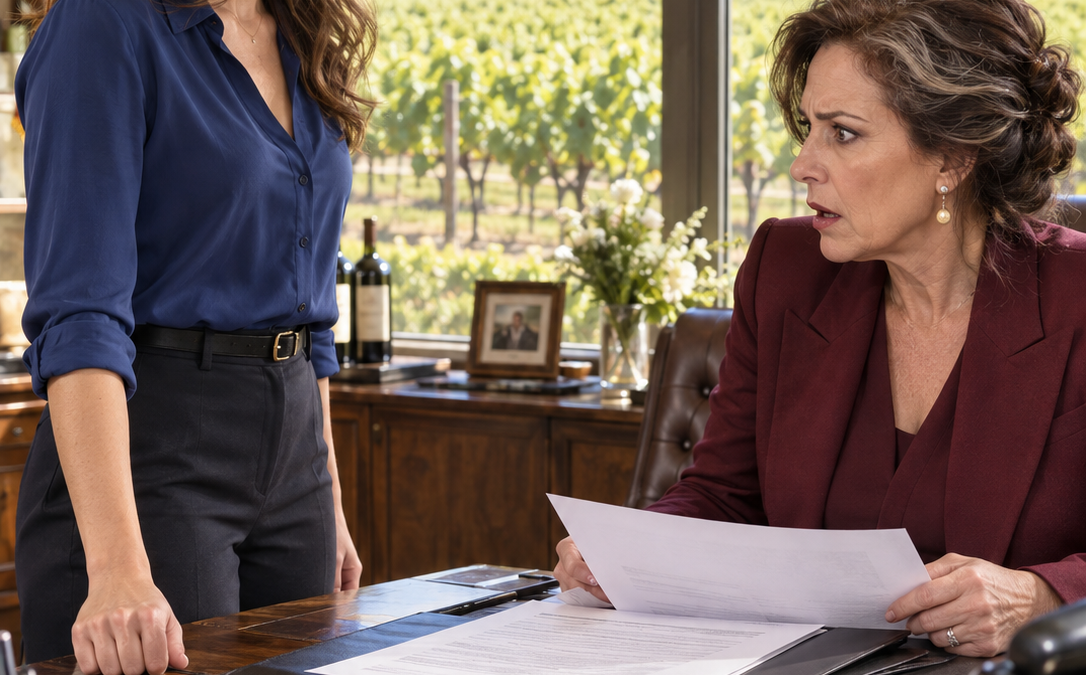
The room went quiet the moment I placed the paycheck on her desk. My aunt looked at it, then looked at me.
“Why are you quitting?” she asked, her voice sharp, almost amused, as though she already believed she had won.
I didn’t answer. I just watched her eyes drop to the folder underneath the check. She opened it, and her face changed in a way I will never forget. The color drained from her cheeks, and her hand began trembling against the edge of the desk. Without saying another word, she reached for the phone.
“HR, I need you in my office. Now.”
She thought she was calling for help. She had no idea she was calling for the beginning of her own downfall, because what was inside that folder wasn’t a resignation letter. It was proof. And in less than one week, everything she had built on a lie was going to collapse in front of everyone she had ever tried to impress.
My name is Elena Ashworth. I am 29 years old, and for most of my life, the person I trusted most in this world was my aunt, Margaret Ashworth. Everyone called her Margot.
I grew up on 40 acres of hillside land in the Willamette Valley in Oregon, where my father planted his first row of grapevines the year I was born. He named the vineyard Ashworth Hollow. He used to tell me the soil there was stubborn but honest, hard to work with, but it never lied about what it gave you.
My father died in a car accident when I was 11. My mother had passed away two years before that from an illness. So it was Margot, my father’s older sister, who raised me. She moved into the farmhouse, kept the vineyard running, and sat with me through every school event, every broken heart, and every late-night panic before exams. I loved her the way you love someone who steps into a hole in your life and never once makes you feel like a burden for needing her.
When I turned 24, I came back to Ashworth Hollow with a business degree and a plan. I wanted to take my father’s small local vineyard and turn it into something bigger, something that could survive beyond just the two of us. Margot gave me a title: Director of Operations. She gave me a desk next to hers. And for five years, I believed we were building something together, side by side, as family.
Before I go any further, I want you to understand something about the kind of person I was before all of this happened. I wasn’t someone who looked for conflict. I was the kind of person who double-checked contracts three times before sending them, who remembered every client’s birthday, and who believed that if you simply worked hard enough and stayed honest enough, people would treat you the same way in return.
That belief is exactly what made the next part of my story possible, and exactly what made it hurt as much as it did. I was wrong about one very important thing. I believed loyalty was something Margot valued as much as I did. I was about to learn that, for her, loyalty had a price tag, and when the number got high enough, she was willing to sell mine.
By the time I was 28, Ashworth Hollow was no longer just a small family vineyard. I had built an export program that shipped our wine to restaurants in Chicago, New York, and even a small distributor in London. I had spent three years learning the paperwork, the tastings, and the relationships with buyers who didn’t care about our name unless the wine in the glass was good enough to remember.
Margot handled the land and the harvest. I handled the growth. It felt balanced. For a long time, it felt like the kind of partnership my father would have been proud of.
There was one detail I never thought twice about: my father’s original ownership papers. When he died, his 40% stake in Ashworth Hollow was placed in a trust for me, to be released fully into my name on my 30th birthday. Margot held 40% herself, and the remaining 20% belonged to a silent family friend named Walter Kim, an old business partner of my father’s who had mostly stepped back from the vineyard’s daily life but still checked in twice a year.
I trusted the arrangement completely. I never asked to see the trust documents again after I turned 18. Why would I? Margot was the one who had explained it to me in the first place. She was the one who sat me down when I was 15 and told me, “One day, half of this hillside will have your name on it, sweetheart. Your father made sure of that.”
There was a small ritual we had every October on the anniversary of my father’s death. Margot and I would walk to the east field together at sunset, to the same row he had planted first, and she would pour two small glasses from whatever vintage we were proudest of that year. We never said much during those walks. We didn’t need to. For a long time, it was the clearest proof I had that she loved this land and loved me for the same simple reason: because it was ours, and because it was his.
I had no reason to doubt her. Not yet.
But there is a particular kind of danger in trusting someone so completely that you stop checking anything they tell you. I was about to learn that the people closest to us are not dangerous because they hate us. They are dangerous because we hand them the keys and never ask for them back.
The first sign came eight months before my 30th birthday, and at the time, I didn’t understand what I was looking at. Margot started taking meetings without me. Small ones at first. A phone call behind her closed office door. A lunch in town with people I didn’t recognize. When I asked, she waved it off.
“Just old suppliers,” she’d say. “Nothing that involves your side of things.”
Then the harvest budget started shrinking in strange places. Equipment repairs that should have cost $4,000 were logged at $11,000. A new tasting room renovation kept getting delayed, even though the money for it had clearly been spent somewhere.
I brought it up carefully, the way you do with someone you love and don’t want to accuse.
“Margot, the numbers on the east field repairs don’t match the invoices I saw.”
She smiled at me the way she used to when I was a teenager asking too many questions.
“You worry about exports, Elena. Let me worry about the land.”
I let it go. That was my mistake. I told myself that after everything she had done for me, the least I owed her was trust.
A few weeks after that, our longtime harvest foreman, a steady, quiet man named Orin, who had worked the east field since before I was born, mentioned something odd to me while we were checking on the new trellis posts.
“Your aunt asked me last week how many years it would take to replant this whole section with a different varietal,” he told me. “She said something faster-growing, more commercial. I told her it didn’t make sense, not with vines this healthy. She just said, ‘Just curious,’ and walked off.”
I remember laughing it off at the time, telling him Margot was probably just thinking out loud. Looking back, I understand now that she wasn’t merely thinking about replanting. She was trying to picture what the land would look like once it belonged to someone who didn’t care about the story behind it, only the profit it could produce.
Then came the moment that finally cracked something open in me.
Walter Kim, the silent partner, called me directly for the first time in almost two years. His voice was careful, almost apologetic.
“Elena,” he said, “I got a document in the mail asking me to approve a change in the vineyard’s ownership structure. It has your signature on it, but I don’t remember you ever discussing this with me.”
I told him I hadn’t signed anything. There was a long pause on the line.
“Then someone needs to explain why your name is on this,” he said quietly. “Because if this goes through, your father’s shares get diluted down to almost nothing.”
That night, I sat alone at my father’s old desk in the farmhouse, staring at the wall, feeling something I had never felt toward Margot before.
Suspicion.
I didn’t confront Margot right away. Something in me, maybe instinct, maybe the years of watching her handle problems quietly, told me that if I asked her directly, whatever she was hiding would simply disappear before I could prove it. So instead, I did something that felt like a betrayal in itself.
I started digging.
I asked our longtime bookkeeper, a soft-spoken woman named Priya, who had worked for my father before Margot ever took over, if she could pull the full ownership records from the county filing office. It took her four days. When she finally handed me the folder, her hands were shaking slightly.
“Elena,” she said, “I think you should sit down before you open this.”
Inside was a restructuring agreement dated six weeks earlier. It listed a new majority stakeholder: Chapman Vintners Group, a large wine conglomerate known for buying up small family vineyards, stripping away their identity, and turning them into mass-produced label brands.
According to the document, Margot had agreed to sell 55% of Ashworth Hollow to Chapman, a percentage that only became possible if my father’s original 40% stake was first reduced to almost nothing. And there, on the page authorizing that reduction, was my signature.
A signature I had never written.
I sat with that folder for almost an hour without moving. I thought about every dinner Margot had cooked for me, every school play she had shown up to, and every time she had told me this land would one day be mine. And I thought about the fact that she had apparently decided, at some point in the last year, that a payout from a corporate wine company mattered more to her than any of it.
Priya told me gently that she had overheard something months earlier that she hadn’t understood at the time. Margot had been on the phone, sounding stressed, talking about “covering the expansion loss before anyone finds out.”
I hadn’t known about any expansion loss.
It turned out Margot had secretly invested a large portion of the vineyard’s reserve funds into a failed real estate deal two years earlier, trying to build a second property in Napa Valley. When it collapsed, she was left with debt she couldn’t explain to anyone, including me.
Rather than admit the mistake, she chose a much colder solution: sell the vineyard’s future, forge my signature, blame my poor export performance if anyone ever asked why the numbers didn’t add up, and walk away with enough money to disappear from the consequences entirely.
I finally understood the meetings, the strange budget numbers, and the sudden distance. It wasn’t paranoia. It was preparation. Hers, not mine.
I remember sitting there afterward, replaying a conversation from a few months earlier, back when Margot had first started mentioning, almost casually, that my export numbers weren’t quite what the board expected. At the time, I had brushed it off, assuming she meant our small group of local advisers.
Now I understood exactly who she meant.
She had been quietly preparing a story to tell Chapman Vintners and eventually anyone else who asked. A story in which I was the reason the vineyard needed new ownership, not her hidden debts. She wasn’t just stealing my father’s shares. She was rewriting my reputation to make the theft look reasonable.
I want to be honest about something. My first instinct was not revenge. My first instinct was grief. I grieved the version of Margot I thought I knew.
I sat in my car outside the farmhouse for almost two hours one night, unable to go inside because I didn’t know how to look at her without seeing the folder in my mind. But grief, I learned, can turn into something useful if you let it settle instead of explode.
I made a decision that night that shaped everything that followed. I was not going to scream. I was not going to confront her in the kitchen and let her talk her way out of it the way she had talked her way out of every hard conversation for 15 years.
I was going to be quiet, careful, and exact. If Margot wanted to play the long game with forged paperwork and hidden phone calls, then I was going to play a longer one, with something she never expected from the niece she had raised to be polite and grateful.
Precision.
The first thing I did was call Walter Kim back, this time with the real documents in hand. He was stunned, then angry, then focused. As the only other legal shareholder, his voice mattered. He agreed to stay quiet and let me build the case fully before we moved.
The second thing I did was call a lawyer named Denise Okafor, a family law and corporate fraud attorney recommended by Priya’s cousin. Denise looked at the forged signature, the restructuring papers, and the financial trail Priya had helped me pull. Then she said something that steadied me more than anything else could have.
“This isn’t just a family dispute, Elena. This is fraud. And fraud leaves a paper trail that doesn’t care how much someone loves you.”
The third thing I did, the hardest one, was keep showing up to work every single day beside Margot, smiling, answering emails, and acting as if nothing had changed while quietly gathering every piece of evidence I would need.
I learned that revenge built on anger burns out fast. Revenge built on patience simply waits for the right door to open.
There was one evening during that first week that tested me more than any other. Margot made dinner, roast chicken, the same recipe she’d made every Sunday since I was 12, and asked me, completely relaxed, how the export numbers for the London distributor were coming along.
I answered her normally. I even laughed at one of her jokes about a supplier who kept mispronouncing our vineyard’s name. Afterward, sitting alone in my room, I cried for almost 20 minutes. Not because I regretted staying calm, but because some stubborn, hopeful part of me still wanted her to be the woman at that dinner table and not the woman in the folder.
I let myself grieve that night. Then, in the morning, I got back to work.
For the next five weeks, I lived two lives. In one life, I was Elena, the operations director, attending harvest meetings, replying to export clients, sitting across from Margot at dinner, and asking about her day. In the other life, I was Elena, the daughter of a man whose name was being erased from his own land, working late into the night with Denise to build an airtight case.
Denise helped me understand something crucial. The restructuring deal with Chapman Vintners wasn’t finalized yet. It was scheduled to close at the Pacific Northwest Vintners’ Gala, a large industry event held every autumn, where Chapman’s executives planned to publicly announce their newest acquisition, Ashworth Hollow, in front of buyers, journalists, and half the wine industry on the West Coast.
Margot had chosen that event deliberately. She wanted the sale to look triumphant, not desperate. A celebration, not a cover-up.
That gave me a deadline. And it gave me a stage.
Walter Kim, once he saw the full financial trail, agreed to do something that changed everything. As a shareholder, he had the legal right to freeze any ownership transfer if fraud could be demonstrated before a sale was finalized. But he wanted to wait until exactly the right moment. Not early enough for Margot to quietly settle it behind closed doors, and not late enough for the deal to legally close.
Denise filed the fraud documentation quietly with the state authorities, timed to become active exactly three days before the gala.
I also reached out carefully and privately to someone from my own past, a childhood friend named Marcus Reyes, who had grown up two farms over from us and had gone on to become a small but respected investor in independent vineyards up and down the coast.
I didn’t ask him for a favor out of desperation. I asked him because I trusted his judgment, and because if Chapman’s deal collapsed, Ashworth Hollow would need a real buyer who actually cared about keeping it a family vineyard, not another corporation waiting to strip it down.
Marcus read through everything I sent him. Then he said the words that gave me the last piece of my plan.
“If what you’re building is true, Elena, I’m not just interested in investing. I’m interested in making sure it stays exactly what your father built it to be.”
There was one part of the plan I insisted on myself, against Denise’s cautious advice. I wanted Margot to hear the truth from me directly, face-to-face, before any lawyer’s letter or estate filing ever reached her.
Not because I owed her gentleness, but because I owed my father the honesty of looking his sister in the eye and letting her see exactly what she had tried to take from him, one last time before the consequences took over from there.
Denise agreed reluctantly, as long as I said nothing that could later be twisted into a threat.
“Hand her the facts,” she told me. “Let the facts do the rest.”
Every piece was now in place. All that was left was the final workday before the gala, the day I would place my last paycheck on Margot’s desk and let her see, for the first time, what I had actually been carrying with me for five weeks.
The morning I quit, I woke up early and sat on the porch of the farmhouse, watching the mist settle over the vineyard rows my father had planted almost 30 years earlier. I remember thinking that whatever happened next, I wanted my last calm moment to belong to him, not to Margot.
I walked into the office at 9:00, the same as always. Margot was at her desk, going over shipping numbers for the gala announcement, humming quietly to herself, completely unaware that in less than an hour, her plan was about to unravel in front of her.
I placed my final paycheck on her desk without a word. She looked up, confused, then almost annoyed.
“What is this?”
“My resignation,” I said. “Effective today.”
She actually laughed, a short, disbelieving sound.
“Why are you quitting? We have the gala in three days. You can’t just—”
I placed the folder beside the check.
The same folder Priya had first handed me five weeks earlier, now thickened with copies of the forged signature, the financial trail from the failed Napa investment, and a formal letter from Denise Okafor’s office.
Margot opened it slowly. I watched her eyes move across the first page, then the second. I watched the color drain from her face exactly the way I had imagined it would during all those long nights of preparation.
Except somehow, seeing it happen in real life felt heavier than I expected.
Some small part of me still hoped, foolishly, that she would look up and say something that made this all make sense in a way that wasn’t a betrayal.
Instead, her hand shook as she reached for the phone.
“HR, I need you in my office. Now.”
She thought she still had control. She thought this was a problem she could smooth over with the right phone call, the way she had smoothed over every hard moment for the last 15 years.
She had no idea that Denise’s filing had already reached the state authorities that morning. She had no idea Walter Kim had already signed the shareholder freeze request. She had no idea that three days from now, at the gala she had built her entire escape plan around, the truth would not be revealed by me standing in a corner whispering to a reporter.
It would be revealed on a stage, in front of everyone she had ever wanted to impress.
Word moves fast in a small industry, and faster still when fear is involved. By the time HR arrived in Margot’s office that morning, she had already started making frantic calls. First to her lawyer, then, according to Priya, to someone at Chapman Vintners, trying to push the closing date of the sale earlier to beat the shareholder freeze.
It didn’t work. Legal filings don’t bend to panic.
Walter Kim’s freeze request was already active by the next afternoon, halting any transfer of ownership shares until the fraud investigation was resolved. Chapman’s legal team, unwilling to touch a deal now flagged for potential fraud, quietly began distancing themselves. Their gala announcement, the one meant to celebrate their newest acquisition, suddenly had nothing to announce.
Margot tried calling me three times that first evening. I didn’t answer, not out of cruelty, but because Denise had advised me clearly. Any direct conversation now without a lawyer present could be twisted later into a claim that I had pressured or coerced her.
I wasn’t going to hand her a single excuse.
On the third day, the day of the gala, Margot showed up anyway. I think some part of her still believed that if she stood in that room and smiled wide enough, the story everyone had heard would somehow rearrange itself back in her favor.
She had spent her whole life smoothing over hard truths with charm. She didn’t yet understand that this particular truth wasn’t hers to smooth over anymore.
I understood something, too, standing backstage that night, straightening the sleeve of my dress, feeling my heartbeat everywhere at once. This wasn’t really about punishing Margot. It was about making sure the truth got to stand in the light for once, instead of staying locked in a filing cabinet where only she controlled the story.
Priya told me later that on the morning of the gala, Margot had called the office asking whether the paperwork issue had been resolved yet, as if it were a clerical delay rather than a fraud investigation. When Priya gently reminded her that the state had already opened a formal case, Margot reportedly went silent on the line for almost 30 seconds before hanging up without another word.
It was, Priya said, the first time in 15 years she had ever heard Margot run out of something to say.
The Pacific Northwest Vintners’ Gala was held in a restored old grain warehouse turned event hall, its wooden beams strung with warm lights, its floor filled with buyers, journalists, and vineyard owners from three states. Chapman Vintners had a reserved section near the stage where their executives sat with tight, uncertain smiles, clearly aware that something had shifted but unsure how publicly it would unfold.
I hadn’t planned to make a scene. Denise had actually advised strongly against anything dramatic. The legal case, she said, would speak for itself in the coming weeks, regardless of what happened that night.
But Marcus Reyes had one small request that I agreed to. As part of stepping in as the vineyard’s new investor, he had been given a short slot to speak about supporting independent, family-run vineyards in the region.
He asked if I would stand beside him.
When Marcus took the small stage, he spoke simply, without pointing fingers, without naming anyone directly. He talked about the difference between vineyards that get bought and hollowed out and vineyards that get supported and preserved.
Then he said something that made the entire room go still.
“Tonight, I’m proud to announce a new partnership with Ashworth Hollow, a vineyard that will remain exactly what its founder intended it to be: family-owned and run by the person who has spent the last five years proving she knows how to grow it the right way. Elena Ashworth.”
A wave of quiet murmurs moved through the crowd. Cameras turned. I saw Margot near the back of the room, her face frozen as several nearby vineyard owners, who had clearly already heard whispers about the fraud investigation, began turning to look at her instead of me.
She didn’t scream. She didn’t create a scene. She simply stood, gathered her coat, and walked out through the side doors alone into the parking lot, while the Chapman executives quietly slipped away from their reserved table not long after.
There was no shouting, no dramatic confrontation. Just a slow public understanding settling over a room full of people who had once respected her. The understanding that the story they thought they knew about the ambitious niece who couldn’t hack it in the family business had been, from the very beginning, exactly backward.
I stayed on that small stage a moment longer than I needed to, long enough to find Orin in the crowd, standing near the back with his arms crossed and a small, proud nod on his face. The same nod he used to give me as a teenager whenever I helped him prune a difficult row correctly on the first try.
It was a strange thing to notice in the middle of everything else happening that night, but it was the detail I remembered most clearly afterward. Not the murmurs, not the cameras, just an old foreman quietly telling me, without a single word, that he had known the truth about who really cared for that land all along.
In the weeks that followed, the full weight of what Margot had done finally became public record. The state fraud investigation confirmed the forged signature. The failed Napa Valley investment came to light, along with the debts she had hidden from everyone, including her own accountant. Chapman Vintners formally withdrew from the deal, unwilling to be associated with a fraud case, and quietly moved on to buy a different vineyard two counties over.
Margot was not sent away in handcuffs. And I want to be honest about that, because this isn’t that kind of story.
What happened to her was, in some ways, harder to watch. She lost the vineyard entirely. Under the settlement Denise negotiated, her remaining shares were bought out at a fair but modest price, just enough to help her pay down part of her hidden debt. She lost her standing in the local wine community, where word of the forged documents spread quickly among people who once respected her. She lost the version of herself that had spent 15 years being known as Margot Ashworth of Ashworth Hollow.
I didn’t celebrate that loss. I won’t pretend I felt nothing but relief, either. Mostly, I felt tired, the way you feel after finally putting down something heavy you didn’t realize you had been carrying for months.
There was a moment about a month after the gala when Denise called to tell me the settlement had been finalized and asked if I wanted to be there in person to sign the last of the ownership papers. I almost said no. Part of me worried that seeing Margot’s signature next to mine one final time would reopen something I had only just started to close.
But I went anyway, because I wanted my father’s name to be the last thing written into that file, not fear.
Margot and I sat across a small conference table from each other, Denise between us, and signed without speaking. When it was done, she looked at me for a long moment and said quietly, “He would have hated watching us end up here.”
I told her the truth.
“No. He would have hated watching you get here alone and take me down with you.”
She didn’t argue. She just nodded, gathered her coat, and left.
With Marcus Reyes as a silent investing partner and Walter Kim’s shares fully restored to their rightful percentage, I became the majority owner of Ashworth Hollow, exactly as my father’s trust had always intended before Margot tried to rewrite it.
Priya stayed on as our head bookkeeper, this time with full transparency built into every account. I hired a small, dedicated export team to grow the program I had spent years building on my own.
Six months later, I stood in the same tasting room Margot had once delayed renovating, now finally finished, pouring a glass of our newest vintage for a group of visiting buyers from Chicago.
On the wall behind the counter, I hung a small photo of my father standing in the east field the year he planted his first vines. Underneath it, I added a simple plaque: “Ashworth Hollow. On his soil since the beginning.”
I saw Margot only once more after that, months later at a small farmers market two towns over. She looked older than I remembered, quieter. We didn’t speak. She simply nodded once, and I nodded back.
It wasn’t forgiveness. It wasn’t hatred, either. It was just two people who had once shared a family, now standing on opposite sides of a truth that couldn’t be undone.
I think about that folder often, the one Priya handed me with shaking hands, the one that changed everything I believed about the person who raised me. For a long time, I believed loyalty meant never questioning the people you love. I have since learned something different.
Real loyalty can survive questions. It can survive audits, hard conversations, and uncomfortable truths. What it cannot survive is being used as a shield for someone else’s dishonesty.
Margot taught me, without meaning to, the most important lesson of my adult life. Love someone with your whole heart if you choose to, but never hand over your name, your signature, or your future without checking every single time that the story you’re being told matches the paper trail underneath it.
I don’t regret staying quiet those five weeks while I built my case instead of screaming the moment I found out. Patience wasn’t weakness. It was the only thing that turned my father’s stolen legacy back into something real, standing on solid ground, exactly where it belonged.
If there is one thing I hope you take from my story, it’s this: betrayal from someone you trust completely will always hurt more than betrayal from a stranger. But the way you come back from it doesn’t have to be loud, bitter, or cruel. Sometimes the strongest revenge isn’t revenge at all. It’s simply refusing to disappear and building something honest enough that the truth ends up defending itself.
These days, when buyers visit Ashworth Hollow and ask about the story behind the name on the label, I tell them the simple version. A father who planted the first row. A daughter who kept it growing.
I don’t usually mention Margot at all, and I’ve come to realize that isn’t bitterness. It’s just the truth settling into its proper place, the same way good soil settles after a hard season, quietly, without needing anyone’s permission to be honest again.
If you ever find yourself standing where I once stood, holding proof of a betrayal from someone you love, I hope you remember this: you don’t have to shout to be heard. Sometimes you only have to hand someone the truth, step back, and let it speak for itself.








