While camping, my son left me in the middle of the dense Alaskan forest and said, “Bye, go meet a grizzly bear!” When he returned home, I was already there. I told him, “I have a surprise for you.” True life story.
I didn’t know it then, but letting Dalton back into that house set a precedent that would take me years to undo. He stayed for three months. Fine. Then six months. Still fine, I told myself. Then a year. Then two years. He was working, at least, at a marketing job downtown that he said was going places, a job he said a lot of things about while simultaneously never leaving our house, never paying rent, never once offering to pick up groceries or cover the electric bill.
Eleanor covered for him constantly.
“He’s saving up, William.”
“He’s figuring things out, William.”
“He’s still young, William.”
The boy was 26 years old, and I was still mowing the lawn he walked across every morning on his way to his job that was supposedly going places. But here’s the thing about fatherly patience: It has a bottom, and I hadn’t found mine yet.
It was Dalton’s idea. I want to make sure that is absolutely clear. I did not suggest, plan, or in any way initiate the camping trip to Alaska. That was entirely Dalton’s production, start to finish, and I walked into it the way a man walks into a screen door. Not because he’s stupid, but because he simply didn’t see it coming.
“Dad,” he said one evening in March, leaning against the kitchen doorway with that easy grin of his. “I’m thinking we do a father-son trip. Alaska. Real wilderness camping. Just us.”
Eleanor looked up from the counter, where she was chopping vegetables, and gave me a smile that could have powered a small city. She loved the idea. She loved the idea of Dalton and me bonding, of repairing whatever tension had quietly accumulated between us like sediment in a pipe. She turned back to her vegetables, and I could practically hear her thinking, My boys are going to be okay.
I looked at my son. He had that open, earnest expression he’d perfected since childhood, the one that had talked me into a puppy at age nine and a car at age 17, and approximately 400 other things I’d initially said no to. I felt the familiar warmth that never quite left, no matter what. Father-son trip. Real wilderness. Just us.
“Alaska?” I said.
“Alaska,” he confirmed. “Miles wants to come too, if that’s okay. And Wallace.”
And there it was. The asterisk. The fine print. Just us apparently now included his two best friends since college. Miles, 29, who worked in tech and owned three pairs of the same expensive sneakers, and Wallace, 32, whom Eleanor had always described as spirited, in the way people describe weather when they mean dangerous.
I’d known Miles and Wallace for years. They were Dalton’s people, not mine, but I’d grilled steaks for them at enough backyard barbecues to feel like I knew them. Miles was harmless, a little soft, a little too fond of his phone, but decent enough. Wallace was the one who’d always given me pause. There was something behind his eyes that I couldn’t name. A calculation that sat behind the jokes. A grin that arrived half a second before the laughter, like he was running the room before he relaxed into it.
I said yes because I was a fool.
No, that’s not fair. I said yes because Dalton was my son. And no matter how many times the boy had disappointed me in the small, accumulating ways that a grown child disappoints a parent, I still believed, down in the marrow of whatever optimism fatherhood had left me, that he was capable of being better. That maybe a week in the wilderness together, just men and mountains and the kind of silence that forces honesty, might strip away the ease and the excuses and give me back some version of the son I’d raised.
I didn’t know it yet, but I wasn’t going to Alaska to bond with my son. I was going to Alaska to get a master class in who Dalton Crawford had actually become.
We left on a Friday morning in late May. Eleanor packed me enough beef jerky to survive a small apocalypse and made me promise to call whenever I had a signal. She stood in the driveway in her bathrobe, her hair still flattened from the pillow, watching us load the truck. Not my truck. Dalton’s. A newer-model SUV he’d bought on a payment plan with money I suspected had come from his still-theoretical savings.
I remember thinking that Eleanor looked small standing there. Smaller than usual. Like she knew something I didn’t.
“Come back in one piece,” she said.
She kissed me on the cheek and held on an extra second.
“Always do,” I told her.
The drive to the airport was easy enough. Miles talked about a podcast he’d been listening to. Wallace made jokes that landed about 60 percent of the time and smirked through the other 40. Dalton drove with one hand on the wheel and one elbow out the window, easy and relaxed. I sat in the back, watched my son from behind, and tried to find the little boy in him.
I found traces. The way he laughed too loudly, then seemed embarrassed by it. The way he drummed his fingers on the steering wheel when a good song came on. The way he caught my eye in the rearview mirror once and nodded. Just nodded. The way men acknowledge each other when words would be too much. I held on to those traces like lifelines.
The flight to Anchorage was four hours. We camped outside a town called Cooper Landing the first two nights. Beautiful country, brutal mosquitoes, and a campfire big enough to qualify as a small wildfire. Miles burned two hot dogs and didn’t notice. Wallace told a story about a trip to New Orleans that I’m fairly certain was 90 percent fabricated.
Dalton and I stayed up after the other two went to sleep, just the two of us, and talked. Really talked, for the first time in what felt like years. He asked me about the port job. I told him about a contract we’d landed with a shipping company out of South Korea, the logistics of it, the puzzle of managing 40 vehicles across three shifts. He listened. Actually listened. Not the polite half-listening he’d given me at dinners when his phone was in his hand.
Out there in the dark, with the fire burning low and the Alaskan sky doing things that San Francisco skies don’t know how to do, my son listened to me talk about my work. He asked follow-up questions. He laughed at the right moments. And I thought, genuinely thought, Here he is. There’s my boy.
I didn’t know it yet, but I was being set up.
On day three, we packed up from Cooper Landing and drove farther north into the kind of country that doesn’t appear on tourist maps because tourists aren’t supposed to be there. Wallace had done the route planning, a fact that should have set every alarm bell I owned ringing. He’d picked a trail that wound about four miles into dense spruce forest before opening into a clearing near a river where he claimed the fishing was extraordinary.
I’ll give him this. He wasn’t wrong about the fishing.
We hiked in with full packs. Four miles isn’t nothing at 58, but I’m not a man who quits. I’ve got the knees of a 65-year-old and the stubbornness of a 20-year-old, and between the two of them, I’ve managed to keep moving through most things life has thrown at me. Miles complained about his boots. Wallace told him to walk it off. Dalton stayed close to me for most of the hike, pointing things out. A hawk overhead. A moose print in the mud near the river. And it felt good. Natural. Like we’d found a rhythm.
We set up camp. Two tents, a shared cooking kit, and enough food for four days. That night, we ate actual trout that Wallace had caught and Miles had cleaned with surprising competence. The four of us sat around the fire, and I thought, This was worth it. This was exactly worth it.
Day four is when things shifted.
I noticed it in pieces. Dalton, Miles, and Wallace were quieter in the morning, the easy joking replaced by a low-frequency energy that I mistook for tiredness. They kept exchanging looks, quick sidelong things over coffee and breakfast. Miles laughed at something once, a short, bright burst, then covered it with a cough. Wallace was watching me with that grin that arrived too early, and I told myself I was being paranoid, that I was reading conspiracy into camping-trip boredom.
I was not being paranoid.
After breakfast, Dalton suggested we take a trail that looped around the east side of the forest, about a two-mile walk, to look for a waterfall he’d spotted on the map. Miles and Wallace, he said, would stay behind to break down some of the camp gear and start packing. Reasonable. Normal. I put on my boots.
We walked for about 40 minutes. The forest was dense and extraordinary, the kind of green that doesn’t exist in California. Spruce trees pressed in close, the undergrowth was soft underfoot, and the air tasted like cold water. Dalton talked easily and loosely, telling me about a woman he’d been seeing. Clara, he called her. A teacher from the Richmond District whom he’d been out with twice and liked a lot. I was genuinely happy hearing it. I asked questions. I meant them.
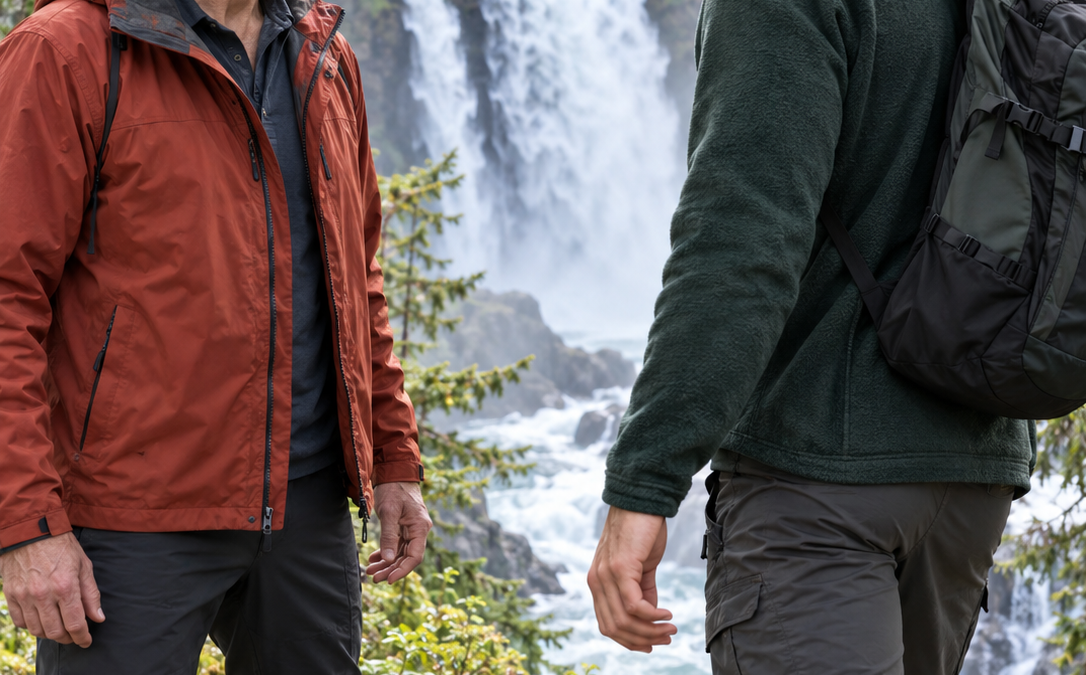
We found the waterfall. It was exactly what a waterfall in an Alaskan forest should be: loud and cold and beautiful and completely indifferent to human beings. We stood there for a few minutes.
Then Dalton looked at me, and the grin he gave me was not his grin.
It was Wallace’s grin. That half-second-early grin. And something cold that had nothing to do with the mist settled into my chest.
“Hey, Dad,” he said. “This is where I leave you.”
I thought he meant the waterfall, that he was heading back and I could stay.
“Bye,” he said. “Go meet a grizzly bear.”
He turned and walked back into the forest.
I stood there for a moment. The waterfall was very loud. A bird called somewhere in the trees. I turned and looked in the direction Dalton had disappeared and waited for him to come back, to laugh, to say gotcha, to do anything that would reframe what had just happened as something a father could recover from.
He didn’t come back.
Now, I want to be precise here, because this is the part people always want to exaggerate, and it doesn’t need exaggeration. I was four miles from the main road. I had my phone, which had one bar of signal and a battery at 42 percent. I had a bottle of water, a protein bar, and a pocketknife that I carry out of habit. I did not have my pack, which was back at camp.
I was wearing good boots. Thank God for that, because Eleanor had insisted on good boots, and Eleanor is almost always right about things that matter. I was not technically in mortal danger. Alaska in late May gives you long daylight. I knew which direction the road was. I had enough sense to stay on the trail, move steadily, and not do anything stupid.
But I was a 58-year-old man alone in the Alaskan wilderness because my son had walked away from me and told me to go find a grizzly bear.
I stood there for exactly 60 seconds. I know because I counted from one to 60, slow and deliberate, the way my own father taught me to count when anger rose up in me as a boy.
“Count to 60, William, and see if it still feels the same at 60 as it does at one.”
It felt worse at 60.
Then I started walking.
The walk out took me two hours and 14 minutes. I know because I checked my phone at the start and again when I hit the road. The timestamp doesn’t lie, even when your pride wants it to. Two hours and 14 minutes is a long time to be alone with your own thoughts in a forest. Longer than it sounds. Long enough to cycle through every emotion available to a human being and come out the other side in a place so quiet and cold and absolutely certain that it almost felt like peace.
I was angry. Obviously. The kind of anger that sits behind your sternum like a hot coal and makes your jaw ache from clenching. I was humiliated. A pride thing, a father thing, the thing a man feels when his child treats him like a prop in a joke. I was hurt in a way I hadn’t been hurt in years, a deep-tissue hurt that had nothing to do with the hiking.
But mostly, somewhere around the two-mile mark, when I’d worked through the anger and the humiliation and the hurt and come out the other side, I was something else entirely.
I was decided.
There is a particular kind of clarity that comes when you finally run out of excuses for another person. When you’ve given someone every opportunity and every benefit of every doubt, and spent years telling yourself they’ll come around, they’ll grow up, they’ll figure it out, and then you’re standing in an Alaskan forest alone at 58 because they thought it would be funny.
And the excuses simply stop.
There’s no more material. The well is dry.
Dalton wasn’t a kid who’d made a thoughtless mistake. Dalton was a 31-year-old man who had planned this, who had recruited his friends, plotted a trail, created a false moment of closeness at the waterfall, and walked away.
This wasn’t impulsive.
This was intentional.
And intention changes everything.
I reached the road at 2:47 in the afternoon. My phone had 12 percent battery. I used eight percent of it to call Eleanor. She answered on the second ring.
“William, is everything okay?”
“I need you to listen to me carefully,” I said. “And I need you not to panic, because everything is fine. I’m on the road outside the trail, and I need you to do exactly what I tell you.”
A pause. I could hear Eleanor processing. She has always been one of the coolest heads I’ve ever known in a crisis.
“Tell me.”
I told her. Not everything. Not the long trek back. Not the anger. Not the deep-tissue hurt. Just the facts. Dalton had left me on the trail. I’d walked out. I was fine. I needed her to call a specific charter service number I gave her and arrange a ride. And I needed her to have the locks changed before I got home.
Another pause. Longer this time.
“The locks?” Eleanor repeated.
“All of them.”
“William.”
“Eleanor.”
My voice was even. Quiet. The way a decision is quiet when you’re completely sure of it.
“All of them. Please.”
She heard it. Thirty-two years of marriage, and she heard it in two words.
“Okay,” she said. “I’ll call right now.”
I sat on a rock at the side of the road and waited for my ride. The Alaskan sky was doing something tremendous overhead, clouds moving fast and the sun coming through in these long golden shafts. I thought about my life with a detachment that almost surprised me. The port job. Eleanor. The house in the Sunset District with the leaky gutter I’d been meaning to fix since November. Dalton.
I thought about all the dinner tables, all the ball games, all the times I’d stayed up waiting for headlights in the driveway when he was 17. All the tuition payments. All the years I’d kept a spare key under the third flowerpot on the left. A key that was as much symbolic as practical.
This is always your home, son. You can always come back.
Except now I knew he wouldn’t. Not to this version of it.
I kept thinking about the miles Eleanor and I had been saving for our trip to Portugal, miles I would soon use for the flight back to SFO. I’d initially felt a sharp, bitter wave of isolation, wondering if I’d end up taking that trip entirely alone. But out there on the road, watching the vast northern horizon, I realized the isolation wasn’t mine. The circle was just shrinking back to the two people who had actually built it.
A spruce branch moved in the wind. A raven landed on a rock 20 yards away and looked at me with the specific assessment of something that has seen many things and is not impressed.
“Yeah,” I said to the raven. “I know.”
The charter van arrived 40 minutes later.
I was already making calls.
Here is what Dalton did not account for. I know people. Not the networking-luncheon kind of knowing people. Not the I’ll have my people call your people variety. I mean the real kind, the kind built over 30 years of working-class San Francisco, of keeping your word and showing up when it mattered and buying coffee for the right people at the right moments.
I had a locksmith who owed me a favor from when I’d diagnosed his fleet van at cost because his kid was sick and the bill would have broken him. I had a lawyer, a real one, a sharp one, whose office was three blocks from our house and who had handled our estate planning two years ago. She answered my call on the first ring.
I had a plan.
The charter van got me to Anchorage by six in the evening. I was on a direct flight to SFO by eight. First class. I used those saved Portugal miles, determined to reallocate our assets before my son could cost me another dime.
It would be 14 hours before Dalton, Miles, and Wallace would attempt to break down their camp, hike four miles out, and drive back to Anchorage for their scheduled flight home.
Fourteen hours is a long time when you know how to use it.
I slept on the plane. Real sleep, the kind that comes when your body has been through something and your mind has made its peace with what comes next. I ate the meal they brought, watched 40 minutes of a documentary about the ocean, and went back to sleep. The woman in the seat across the aisle from me had a small dog in a carrier under the seat in front of her, and the dog watched me for most of the flight with the same steady, unblinking interest as the Alaskan raven. I found it oddly comforting.
I landed at SFO at 7:15 the next morning, Pacific time. The fog was in. The real fog, the kind that makes San Francisco feel like a private city wrapped in its own secret. I stepped out of the terminal, breathed it in, and felt something loosen in my chest that I hadn’t realized had been tight since the waterfall.
Eleanor was waiting at the curb. Not in the car. Standing outside, arms crossed against the morning chill, wearing the gray wool coat I’d given her three Christmases ago. Her dark hair was pinned back, her face doing that thing it does when she’s feeling more than she’s showing.
We looked at each other.
“The locks?” I said.
“Changed last night,” she said. “New deadbolts on the front and back. The locksmith left new keys on the kitchen counter.”
I nodded.
“William.”
She stepped forward and put both hands on my face. A thing she did sometimes, a thing that had always undone me slightly, this gesture of claiming. She looked at me the way she looked at me when she wanted to be sure I was real and present.
“Are you okay?”
“I’m better than okay,” I said. “I’m clear.”
She studied me for another moment. Then she nodded once, dropped her hands, and got back in the car. I got in beside her.
We drove home through the morning fog without saying much, and that was fine, because Eleanor and I have always understood that the things worth saying can wait until you’re sure of them.
She made coffee when we got home. I changed my clothes. Then I sat at the kitchen table with my coffee, my phone, and my list, and I got started.
Let me be specific about the house, because this becomes important.
It was purchased in 2001. Eleanor and I bought it together. Both names on the deed. A three-bedroom in the Sunset District that cost us $340,000 and was now worth, according to a recent appraisal we’d had done for insurance purposes, just under two million dollars. We’d refinanced once in 2012 and had been mortgage-free since 2019.
This house was ours.
Dalton did not own any part of this house. He had no legal claim to it, no tenancy agreement, no formal arrangement of any kind. He lived here the way water lives in a glass, present because no one had moved to remove it.
I called my lawyer that morning. She answered on the second ring, listened to a five-minute summary, and said, “I’ll have the formal notice drafted by noon. Do you want to serve it before or after he gets home?”
“After,” I said. “I want him to find the locks first.”
A pause.
“That’s bold.”
“He left me in an Alaskan forest and told me to find a grizzly bear.”
Another pause.
“I’ll have it drafted by ten.”
Next call. Our financial adviser.
This took longer, because financial matters always take longer, but the substance of it was straightforward. Dalton had no accounts in my name, no financial instruments we shared, no beneficiary designations I hadn’t already been meaning to update. Eleanor and I reviewed them together right there at the kitchen table, her reading over my shoulder, and we made decisions.
I want to be clear that Eleanor was not a passive observer in any of this. People sometimes assume that a woman who keeps the peace is a woman without a spine, and Eleanor has always defied that assumption in ways that make me love her more with every passing year.
She had her own grief about Dalton. I could see it in the set of her shoulders, in the careful steadiness of her voice. But she’d heard my account of what happened in that forest, and something had shifted in her too. Quietly. Decisively. The way bedrock shifts.
“He planned it,” she said at one point, not as a question.
“Yes.”
She was quiet for a moment.
“He asked Wallace to help plan it.”
“I think so.”
She nodded and set down her coffee cup.
“What do you need me to do?”
I looked at my wife. Thirty-two years. Two miscarriages and one miracle baby. Thirty-two years of a life I had never once regretted, not even in the hard parts. And she was sitting across from me in the gray wool coat she hadn’t taken off yet, asking me what I needed.
“I need you to trust me,” I said.
“I always have,” she said. “Tell me the rest of the plan.”
Ruby was a real estate attorney. I had met her three years ago through Eleanor’s firm, where she’d handled a property matter for one of Eleanor’s colleagues. She was 44, sharp as a surgical instrument, and possessed of a directness that I’d always respected.
I called her at ten in the morning.
“I need to understand the process for formally establishing that a person living in my home has no legal tenancy rights,” I said.
Ruby did not hesitate.
“Does he pay rent?”
“No.”
“Has he ever paid rent in any form? Cash, check, Venmo, anything that could be characterized as payment for residency?”
“No.”
“Has there been any written or verbal agreement that could be construed as a lease?”
“No.”
“Then in California, after 30 days of residence, he qualifies as a tenant at will, which means you need to provide a 30-day notice to vacate before any formal eviction proceedings. However…”
She paused, and I could hear her thinking.
“There are nuances. Has he received mail there?”
“Yes.”
“Has he listed that address as his residence for any legal or financial purpose?”
“I don’t know for certain.”
“Find out,” she said. “It matters. But the core of it is that he has no lease, he pays no rent, and the house is titled entirely to you and your wife.”
“Correct.”
“Then you’re in a strong position, William. Give the 30-day notice. If he doesn’t vacate, we proceed from there. But I’ll tell you, most people, when they see the formal notice and understand what the alternative looks like, they leave.”
I thought about my son. About the waterfall. About the raven on the rock.
“He’ll leave,” I said. “That’s not the part I’m worried about.”
“What part are you worried about?”
“I’m worried about doing this right. I don’t want him to have a single angle.”
Ruby made a sound that was almost a laugh.
“Then let’s make it airtight.”
The other call I made that morning was to Josephine.
She was 56, almost exactly my age, and she’d been Eleanor’s best friend since they’d worked together at the law firm 17 years ago. More importantly, she was one of the most connected women in our circle of San Francisco life. She knew everyone, remembered everything, and had a gift for the kind of strategic discretion that is more valuable than most people understand.
I called Josephine because I needed a witness. Not a legal witness. An observational one. Someone who would be present when Dalton came home. Someone whose presence would remind him, without a word being said, that this was not a private matter between a father and his son. That there were people watching. That the world beyond our front door was paying attention.
“I need you to come over tonight,” I told her. “Around seven.”
“Of course,” she said, without asking why.
This is why Eleanor had kept this woman as her best friend for 17 years.
“Bring your normal self,” I said. “Just be here.”
“William.” Her voice was warm and careful. “I heard something happened.”
“Eleanor told you?”
“Eleanor called me last night. She was very calm about it, which worried me more than if she’d been upset.”
“She’s fine. We’re both fine.”
I paused.
“We’re better than fine.”
A beat of silence.
“Should I bring wine?”
“Bring wine,” I said.
I spent the afternoon the way I sometimes spend afternoons when I need to think without thinking: doing physical things. I checked the gutters. I fixed the latch on the back gate that had been loose since February. I repotted the basil plant on the kitchen windowsill that Eleanor loved and that I had been neglecting.
I made a list on paper, in my actual handwriting, of every practical thing Dalton had benefited from by living in this house. Utilities. Internet. The streaming services on the shared account. The parking spot in the driveway. The storage unit in the garage where he kept two bicycles and several boxes of things he described as important.
I wrote it all down. I assigned conservative dollar values. I added it up. The number was substantial enough that I had to sit with it for a moment. Then I folded the paper and put it in my jacket pocket.
Evidence isn’t useful until it’s needed, but when it’s needed, you want it in your pocket.
The flight from Anchorage was scheduled to land at SFO at 6:15. I knew this because I’d looked it up. I also knew that with baggage claim and the drive back into the city through evening traffic, Dalton wouldn’t arrive at the house before 7:30.
At six, Eleanor made dinner. Pasta with the good olive oil, the kind she kept in the back of the cabinet for occasions. We ate at the kitchen table, just the two of us, and talked about things that had nothing to do with Dalton. A book Eleanor was reading. A colleague of mine who’d just retired. The Portugal trip that we now agreed we’d take in September, just us, with no obligation to anyone.
At 6:45, Josephine arrived with a bottle of Sonoma Pinot Noir and the easy warmth she carried everywhere. She kissed Eleanor on both cheeks and gave me a look across Eleanor’s shoulder that said, I see you. I’m here. We’ve got this.
The three of us sat in the living room with wine and the quiet understanding of people who have known each other long enough not to need to perform.
At 7:38, we heard a car in the driveway.
At 7:42, we heard the front door.
I should tell you what it sounded like.
He tried the key first. Of course he did. It’s what anyone does when they come home. The key turned in the lock, but the bolt didn’t move. There was a pause. Then the key again, harder this time, followed by another pause, longer than the first.
I could picture him standing on the front porch, working through the math of it. The way the mind refuses for a moment to accept what the evidence is clearly saying.
Then he knocked.
My son knocked on the door of my house.
I set down my wine. I stood up. Eleanor and Josephine both remained seated, which was right, exactly the arrangement we’d agreed on without fully discussing it. They stayed. I went, because this was mine to deliver.
I walked to the front door and opened it.
Dalton stood on the porch. He was still in his camping clothes, a green fleece and hiking pants. His hair was flat from the hat he’d been wearing, and he had that look on his face, slightly off balance, a little sheepish, reaching for the grin but not quite finding it.
He had a duffel bag over one shoulder. Behind him, through the evening fog, I could see a rideshare disappearing down the street. Miles and Wallace apparently had not accompanied him home.
Smart boys.
“Dad,” he said. “Hey, the key…”
“I know,” I said.
A pause.
He looked at me. I looked at him.
“Did something happen with the lock?”
I looked at him standing there in the damp evening fog before I answered. I took my time with the words.
I had counted to 60 in an Alaskan forest and walked two hours and 14 minutes. I’d flown home in first class, slept a full night, made my calls, fixed the back gate latch, and repotted Eleanor’s basil plant. I had used up every single emotion on the way to this moment, and what remained was something my father would have recognized.
A man who has made up his mind.
“Come inside,” I said. “I have a surprise for you.”
He came in.
I stepped back to let him pass, and he moved through the doorway and into the hall. He stopped when he saw Eleanor on the couch and Josephine beside her.
The sheepishness clicked up a notch.
He looked at his mother, the way children always look at the parent they assume will protect them. Eleanor looked back at him with the careful steadiness I’d seen that morning, and he found nothing there to hold on to.
“Hey, Mom,” he said. “Hey, Josephine.”
“Dalton,” Eleanor said.
Not warmly. Not coldly. Evenly.
Josephine said nothing. She sipped her wine.
Dalton looked back at me.
“What’s going on?”
I gestured toward the living room chair across from the couch.
“Sit down.”
“I’ll stand.”
“Dalton.”
My voice was flat. Not angry. Anger would have given him something to argue against. Flat is harder to fight than anger.
“Sit down.”
He sat.
I sat in the other chair across from him. The living room felt very still. The fog outside had thickened, and the streetlight through the window made everything look like a scene from a film I’d been meaning to watch.
“You left me in an Alaskan forest,” I said.
Dalton opened his mouth.
“Don’t,” I said. “Don’t tell me it was a joke. Don’t tell me you planned to come back for me. Don’t tell me Wallace put you up to it. I’m not interested in the explanation right now. I’m interested in you understanding what happens next.”
His jaw tightened. A muscle in his cheek moved.
“Dad—”
“I’m 58 years old,” I said. “I walked through a dense spruce forest to the road. I had 12 percent battery on my phone. I had no pack. I found my way out because I’ve been finding my way out of hard situations since before you were born. And that part you probably knew, which is why you felt safe doing it. But safe for you doesn’t mean okay. Safe for you doesn’t mean without consequence.”
Silence.
“Your key doesn’t work,” I said, stating the obvious. “New deadbolts on the front and back. There are two keys on the kitchen counter. One for me, one for your mother. There isn’t a third.”
He looked at Eleanor.
Eleanor looked at her wine.
“This is my house,” I said. “Mine and your mother’s. Your name is not on any document associated with this property. You have been living here as an adult for the past five years, paying nothing, contributing nothing material, and I have allowed it because I believed, I genuinely believed, that you were going to get yourself sorted out and move on the way grown children do.”
“I have a job.”
“You have a job,” I agreed. “A job that pays you enough to rent an apartment. I’ve seen your pay stubs, Dalton, because you left one on the kitchen counter last February, and I didn’t look away fast enough. You earn enough to live independently. You have chosen not to, and I have allowed it, and that is partly on me.”
His face was doing several things at once. Embarrassment. Anger. That specific young-man look of being caught in the act of being lesser than you knew you should be.
I had seen that look on him before.
I had always, before, given him a way out of it.
“You have 30 days,” I said. “That’s the legal notice period in California, and I’m giving it to you in good faith because no matter what happened in that forest, I am not a man who cuts corners on fair dealing. Thirty days to find an apartment, remove your belongings from the garage, and update your address everywhere it currently shows this house.”
He stared at me.
“You’re kicking me out.”
“I’m exercising my legal rights as the owner of this property. Yes.”
“Because of a camping trip?”
The living room was very quiet.
“Because of 31 years,” I said. “The camping trip just finally made things clear.”
He turned to Eleanor.
“Mom, are you… are you okay with this?”
Eleanor set down her wineglass.
“Dalton,” she said.
Her voice was the gentlest it had been all evening. And the gentleness of it was somehow the hardest part of all of it, harder than my flatness had been, because it meant she wasn’t angry.
She was something past anger.
“Your father was alone in that forest. He called me with 12 percent battery. He didn’t know for certain that you weren’t coming back.”
She paused.
“Did you?”
A long silence.
“Did you plan to come back?” she asked again, quietly. “At some point? Or were you going to let him find his own way out and just not mention it when you got home?”
The silence answered for him.
Eleanor looked down at her lap. She nodded once, slowly, the way people nod when a thing they feared has been confirmed. Then she looked back up at her son, and her face was composed and terrible in its composure.
“Your father has been more than fair,” she said. “I would have had you out already.”
Dalton did not go quietly.
I want to be honest about this because the story isn’t served by making him a cartoon. He was my son. He had my jaw and Eleanor’s eyes, and somewhere inside the 31-year-old man who sat in that chair and felt the floor come out from under him was still the boy who had cried at the end of a movie about a dog when he was eight. The boy who had made me a Father’s Day card out of macaroni and construction paper and presented it with the grave sincerity only small children can manage.
He argued. Not loudly. To his credit, he didn’t raise his voice in front of Josephine, and I think some remnant of the manners we’d raised him with held in that particular way.
But he argued.
He said it was just a joke. He said Miles and Wallace had thought it was harmless. He said he’d been stressed at work and hadn’t been thinking straight. He said he’d planned to drive back to the trailhead that afternoon anyway, that he’d had it figured out, that he’d known I could handle it.
I let him say all of it. Every word.
I sat in my chair and let him empty himself of every explanation and excuse until there was nothing left but the two of us looking at each other in a living room in San Francisco in the evening fog.
Then I said, “The 30-day notice will be formalized by my attorney tomorrow morning. You’ll receive it by mail and by email. If you need help arranging movers, I’ll cover the first two hours of labor. That’s the last financial assistance you’ll receive from me.”
He left that night. Not for good. He had nowhere to go yet. But he left the house, got in his SUV, and drove away.
I watched the taillights disappear into the fog the way Eleanor had watched us drive to the airport a week ago. Smaller than usual, like she’d known.
I went back inside.
Josephine hugged Eleanor, then hugged me, said nothing, and left. Eleanor and I cleaned up the wineglasses and the kitchen in the easy silence we’d always shared during the work of ordinary evenings, the kind of companionable quiet that is its own form of love.
When everything was done, we sat back at the kitchen table with the last of the Pinot Noir and the specific exhaustion of people who have done something hard and necessary.
“He’ll be angry,” Eleanor said.
“For a while,” I agreed.
“He might not speak to us.”
“He might not.”
She turned her wineglass in her hands.
“Are you okay with that?”
I thought about the misty cascade of the waterfall and the long stretch of highway where I’d waited for my ride.
“I’m okay with what’s true,” I said. “Whatever that ends up being.”
She nodded.
She reached across the table and covered my hand with hers. We sat there like that for a while, two people who’d been through enough together to know that some things, once broken in a particular way, don’t go back to what they were.
And that this isn’t always loss.
Sometimes it’s just what honesty looks like.
Finally, after years of careful not-looking, the formal notice arrived at the house via certified mail on a Wednesday morning, two days after Dalton had sat in my living room chair. I know this because my attorney texted me the tracking confirmation.
Dalton signed for it himself.
He had, in the meantime, been staying with Miles. This I knew because Eleanor had gotten a text from him. Two sentences, no punctuation, the prose of a man who was embarrassed and angry and didn’t know how to be both at once.
staying with miles for now
i’ll come by saturday for some clothes
He came Saturday.
I was home.
We were civil. Barely, but civil. He took two bags of clothes and stood in the kitchen for a moment with the specific look of someone cataloging what they’re leaving behind. I watched him do it and didn’t help him and didn’t stop him.
“The garage stuff,” I said, “can stay for the 30 days. After that, I’ll need it cleared.”
He nodded.
“Clara called,” Eleanor said from the hallway.
She had a way of deploying information at angles, Eleanor did. A skill she’d developed over decades of living with two stubborn men.
“The teacher you mentioned before you left. She tracked down our number because she couldn’t reach your mobile while you were in the bush. Do you want it?”
Dalton looked surprised.
We still had a landline, an Eleanor preference that had outlasted all arguments against it.
“She… you have her number?”
“You left it on the note by the fridge in case of emergency,” Eleanor said. “Do you want it?”
A pause.
“Yeah,” he said. “Sure.”
Eleanor wrote it on a Post-it note from the pad by the phone, the same pad we’d used for grocery lists and permission slips and every other ordinary management of a life, and handed it to her son.
He folded it and put it in his pocket, then picked up his bags.
At the door, he stopped.
He turned and looked at me with something that wasn’t quite any one emotion. A layered thing, complicated and half-formed. The look of a man who is beginning to understand but hasn’t arrived yet.
“Dad,” he said.
I waited.
“I know it wasn’t…”
He stopped.
Started again.
“I know it wasn’t…”
It wasn’t an apology. I want to be clear about that. It was not, in any meaningful way, an apology. It was the beginning of a sentence that might become one someday. The prologue to a reckoning he hadn’t had enough time or discomfort to complete yet.
I recognized it for what it was, and I did not pretend it was more.
“I know you know,” I said. “See yourself out.”
He left.
The door closed behind him.
Eleanor stood in the hallway with her arms crossed, not in anger, but in the posture of someone bracing against cold. I went to her and put my arm around her, and we stood there in the hallway of the house that had once held all three of us and now, for the first time in years, held exactly the number of people who were meant to be there.
The 30 days ended in early July.
Dalton cleared the garage on the Sunday before. Two trips with his SUV, the bicycle strapped to the roof rack, the boxes in the back, and Wallace helping without looking at me, which was the correct choice on Wallace’s part.
Miles did not come.
Miles actually called me two weeks later to apologize.
He was the one who told me Dalton had talked him out of turning back. Miles had grown quiet when I didn’t turn up at the campsite that afternoon and had been the one to suggest they drive straight back to the trailhead to look for me.
But Dalton had brushed it off. Told him I was fine. I’d find my way. It wasn’t a big deal.
Miles confessed he hadn’t found that easy to sit with.
Good for Miles.
By mid-July, Dalton had signed a lease on a one-bedroom apartment in the Outer Richmond, 12 blocks from the house he’d grown up in, four blocks from Eleanor’s old office. A reasonable apartment, from what I gathered, at a reasonable rent for San Francisco, which means still extortionate, but survivable.
He had signed it with his own name and his own credit and his own first and last month’s deposit.
And whatever it had cost him, it had cost him honestly.
I updated my estate documents in August, bringing our beneficiary arrangements and distribution details strictly in line with where Eleanor and I actually stood. I am not going to specify the details of those revisions here because they are between me and Eleanor and the law.
But I will say that I did not act in anger.
I acted in clarity, which is a different thing entirely and which tends, in my experience, to produce results that hold.
The financial account I had maintained for Dalton’s benefit, a savings account I’d kept since he was in college and topped up whenever I thought he might need a cushion, I closed in September.
The balance was moved to a charitable trust that Eleanor and I established in the name of a youth outdoor education program. The kind of program that takes city kids into the wilderness and teaches them to navigate by map and compass, to read the weather, to find their way home.
The irony was not lost on me.
I sat with it and found it satisfying.
There is a particular quality to a house when it holds only the people who are meant to be in it. I don’t know how to describe it except to say that the air sits differently. The quiet is a different kind of quiet. Not the held-breath quiet of a household managing its tensions, but something more like the quiet of a room after the windows have been opened.
Eleanor and I had dinner at the kitchen table every night. We talked. We argued about the right temperature for reheating leftover pizza, whether the fig tree in the backyard needed trimming, and whether we should repaint the upstairs hallway. These were the arguments of people engaged in a life rather than enduring one.
She started a pottery class on Thursday evenings and came home with clay on her forearms and a satisfaction in her eyes I hadn’t seen in years.
I fixed the leaky gutter in November. I fixed the crack in the back porch step. I planted a rosemary bush along the south fence because Eleanor had mentioned once, in passing, that she’d always wanted one.
Small things.
The small things matter.
Ruby called me later that fall to confirm that the entire case file had been processed and stamped, meaning the tenancy chapter was completely behind us. My attorney sent a final bill that was reasonable.
Josephine came for dinner once a month and brought good wine and the easy company of someone who had been on the right side of something.
And Dalton…
Dalton sent a text on Thanksgiving. Two months after the lease was signed. Three months after Alaska.
Happy Thanksgiving. Hope you guys are good.
Eleanor showed me the text.
I looked at it for a long moment.
Same to you, I texted back.
It is not forgiveness.
I want to be clear about that because forgiveness is a word that gets stretched over things it shouldn’t cover, used as a social pressure rather than an honest emotion.
I do not forgive what happened in that forest. Not because I am incapable of it, but because the accounting isn’t settled. And until a person has genuinely reckoned with what they’ve done, not the version of reckoning that is embarrassment or inconvenience, but the real kind, the kind that costs something, forgiveness would be a transaction conducted on false terms.
What I have is something different.
A distance that is neither warm nor cold. A door that is neither open nor closed. The specific neutrality of a man who has been pushed past sentiment and come out the other side into something cleaner.
Honesty.
Just honesty, unadorned and unprettied, about what is and what isn’t.
My son is 31 years old, and he is living 12 blocks away, and he has a job and a lease and a phone that can dial my number whenever he decides he has something real to say.
The key under the third flowerpot is gone.
I used it to start over.
People keep asking. Eleanor. Josephine. My colleagues at the port, who heard some version of the story through the winding channels by which stories travel in a city as small as San Francisco really is once you strip away the scale.
People keep asking me what it felt like to walk out of that forest. Whether I was scared. Whether I was devastated. Whether I cried.
I tell them I counted to 60.
I started walking.
I felt worse at 60 than at one.
And then I felt clear at 120.
And by 180, I had a plan.
What Alaska taught me, what that forest specifically taught me, is something I should have known before. Something I thought I knew but had been applying incorrectly for years.
You cannot love someone into being who they are not.
You can raise them right, feed them well, pay their tuition, and keep a spare key under the flowerpot, and in the end, they will still be exactly who they have decided to be.
The loving is real. The love itself never becomes useless. But the protection, the covering, the provision of soft landings, those things, when offered to a person who has no intention of ever needing anything different, are not love.
They are delay.
I delayed too long.
That’s on me.
But I stopped delaying, and that’s also on me.
And I’ll take both.
The bay fog was thick the morning I drove to the port in September, back to work after a week of personal days. I had told my supervisor only the barest minimum about what had happened.
I drove through the Sunset District and over toward the Embarcadero, and the fog was so dense the bridge towers were invisible, just the cables emerging from white like the beginnings of ideas.
I thought about Eleanor’s basil plant on the kitchen windowsill, and the rosemary I was going to plant along the south fence, and our upcoming travel plans, and the pottery class, and the gutters I had finally fixed.
I thought about a raven on a rock in Alaska, watching me with the patience of something that has seen many things and is not particularly impressed.
I thought, Fair enough.
I parked my car.
I went to work.
I came home that evening to Eleanor’s voice from the kitchen, asking if I wanted pasta or soup.
And I stood in the doorway of my own house. My house. Eleanor’s house. The house we’d paid for and maintained and fought for and kept.
“Soup,” I said.
“Good,” she said, because she’d already started it.
I took off my jacket, hung it on the hook by the door, and walked into the kitchen.
The basil plant was doing well. The window was cracked, and the fog was just beginning to come in off the bay. Eleanor was at the stove, her back to me, stirring something that smelled like exactly what a home should smell like.
And on the kitchen counter, where a spare key had once sat, there was nothing.
Just clean counter.
Clear space.
Room for whatever came next.
And for the first time in longer than I could account for, I found that I was not waiting for anything.
I was already exactly where I needed to be.
If you liked this story, join our community by hitting that like button and subscribing for more real, raw, family-centered stories.








