When I announced my pregnancy, Mom said, “Poor child. It’s not even born yet, and it already has you for a mother.” My sister laughed. I cut them off. Five weeks after a birth that nearly killed me, they showed up demanding to see their “grandson.” The door opened. Mom saw who was standing there and went silent.
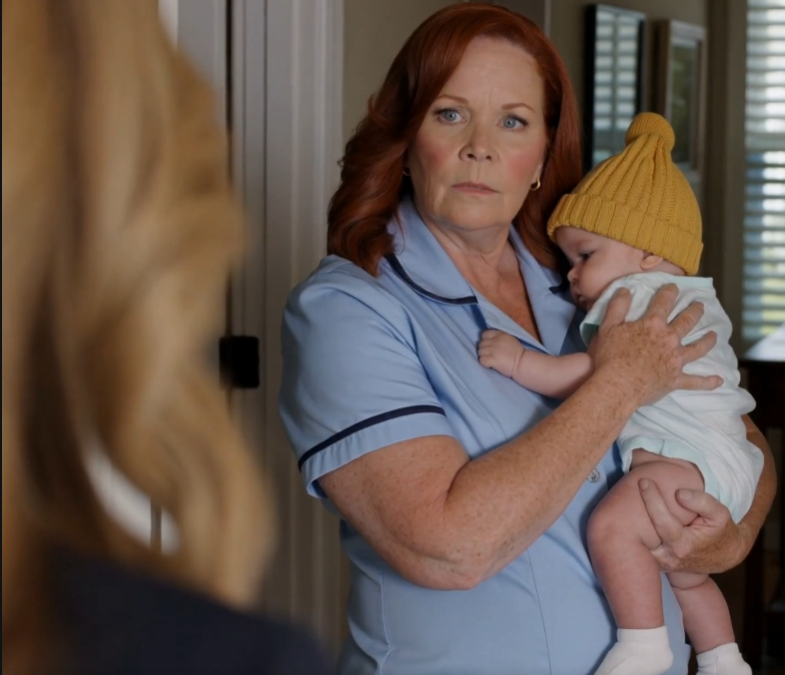
Last Thanksgiving, I told my family I was pregnant, and my mother set down her fork.
“Poor child,” she said. “It’s not even born yet, and it already has you for a mother.”
My sister laughed with her mouth full, and I put on my coat, left, and blocked them.
In April, my son was born, and a doctor told my husband to call whoever needed calling. Five weeks later, they stood on my porch demanding their grandson. Four times. Never his name.
What they didn’t know was that they had already come while I was unconscious, and every word had been written down.
The door opened, and my mother saw who was holding him and went silent.
That was when I knew they hadn’t come to visit, and I didn’t have to speak.
My name is Lily Barrett, and I’m 28 years old. Stay with me on this one. And if you’re listening a long way from Tennessee, tell me where you are. I like knowing who’s out there.
It started with a fork.
There were eight plates on my mother’s table that night. There were only six of us. She always set two extra—one for whoever might drop by from church and one, she said, for the Lord.
Nobody ever dropped by.
The Lord never used his fork.
My mother’s house is in Hixson, 15 minutes from where my husband and I rent in Red Bank. Fifteen minutes is close enough that not visiting takes effort. I had been putting in that effort for years without calling it anything.
I came for Thanksgiving. I came for Christmas Eve. I sent a card on her birthday.
That was the whole of it.
And she called it Lily being Lily.
I was 20 weeks pregnant. I had known since the end of August and told no one in that house. Three days earlier, at the anatomy scan, the tech had turned the screen toward me and said, “Well, that’s a boy.”
And I had cried in my car in the parking lot for reasons I couldn’t have explained to anyone.
I wore a sweater two sizes too big. I told myself I would say it after the pie.
“Lily, get the rolls,” my mother said as I walked in. “Courtney, sit. You’ve had a hard month.”
Courtney sat.
My sister is six years older than me, and in that house she has always been the one who sits. In October, she had finished her third round of IVF, and it had failed like the other two. I knew this because Kyle, her husband, had told Nathan, and Nathan had told me.
Courtney hadn’t told me anything.
She didn’t tell me things. She reported them to our mother, and our mother decided who else needed to know.
I got the rolls.
Ron, my stepfather, was already at the head of the table with his hands folded, waiting to be told when to pray. He has been married to my mother since I was 11. In 17 years, I don’t think he has finished a sentence she started.
Kyle nodded at me. Nathan pulled out my chair at the far end, the one next to Ron, and I saw my mother’s eyes drop to my stomach and come back up.
Then, a minute later, drop again.
She knew before I said it. I understood that afterward. She always looked at the thing she was about to be angry about a little before she was angry.
I didn’t wait for the pie. I don’t know why.
Maybe because Courtney was talking about a coworker’s baby shower in a voice that made everyone at the table go careful, and I thought I could change the subject into something good.
I put my hand on the sweater and said, “So, we have some news. I’m due in April. It’s a boy.”
Nathan reached over and squeezed my knee under the table.
My mother set down her fork. It touched the plate with a small sound. China on china—the kind of sound you only notice when nothing else is happening.
“Poor child,” she said. “It’s not even born yet, and it already has you for a mother.”
Courtney laughed.
She had just taken a bite of sweet potato, and she laughed through it, one hand up over her mouth, and looked at our mother the way you look at someone who has said out loud the thing you were thinking.
Kyle looked at his plate.
Ron picked his fork back up and kept eating.
Nobody said, “Diane.”
Nobody said, “That’s enough.”
I want to be precise about that because for a long time I told myself the silence was shock.
It wasn’t.
It was agreement.
It was the way the room had always worked, and the only new thing in it was me.
I counted the plates.
Eight.
Then I stood up, and Nathan was already standing. I went to the hall and got my coat.
My mother said, “Oh, for heaven’s sake, sit down. I was making a point.”
I didn’t answer her.
I have thought about it many times, and I still believe the coat was the first honest thing I did in that house in 10 years.
Nathan drove.
Highway 153 was empty, the way it is on holidays, and the streetlights came across the windshield one after another. He was angry. He kept starting to say things and stopping. He turned the radio on and turned it off again.
I sat with both hands on my stomach like I was apologizing to someone who couldn’t hear me yet.
Somewhere past the Walmart, I took out my phone and blocked my mother’s number.
Then Courtney’s.
It took about 15 seconds.
I put the phone in the cup holder, face down.
“Okay,” Nathan said.
Just that.
At home, he stopped in the hallway.
We have a wall of pictures there, most of them his family, a few of mine. He was looking at one I had hung the week we moved in and never really looked at since.
A little girl on a woman’s lap at a picnic table, both of them squinting into the sun.
The girl is me at four.
The woman has red hair pulled back and big, freckled hands. One of the hands is covering my knee like she’s keeping me from sliding off.
“Who’s the woman in the picture?” Nathan asked.
“Miss Pat,” I said. “She was Mom’s friend. Mom said she moved away when I was little.”
He nodded and didn’t ask anything else.
Neither did I.
I had brought that picture out of my mother’s house in a shoebox when I was 18, and I had never once asked where Miss Pat went.
That’s the kind of daughter I was.
You don’t ask about the people who are gone. You learn early that the ones who are gone left because of something, and you stop wanting to know what.
At 11:40 that night, my phone lit up with a number I didn’t recognize.
It was Courtney’s work cell.
You embarrassed your sister tonight.
I’d like to say I laughed.
I didn’t.
I read it three times, took a screenshot, and blocked that number too.
Over the next three days, there were 23 messages. I know because I saved every one before I blocked the number it came from. They came from Courtney’s work phone, from Ron’s cell, from my mother’s email account, which I hadn’t thought to block because in six years she had never once emailed me.
Not one of the 23 said sorry.
Not one asked how I was feeling or whether the baby was healthy.
The nineteenth, from Courtney:
Mom’s blood pressure is up because of you. Are you happy?
The twenty-third, from my mother, sent at 6:12 on Sunday morning:
When that baby comes, you’ll need us. You’ll see.
I didn’t answer any of them.
I want to be honest that this wasn’t strength.
I didn’t know what to say.
Every sentence I drafted in my head started with, “I’m sorry that…” And I couldn’t finish any of them without sounding like the version of me they wanted.
So I said nothing.
And I kept the screenshots in a folder on my phone labeled Family, which is a stupid name for it.
And I went to work.
I’m a radiology tech. I work at an outpatient imaging clinic off Gunbarrel Road, taking X-rays and helping with CT scans.
I’m good at it.
I’m good at seeing what’s inside people.
I say that not to brag, but because it took me years to notice that I had never once pointed that skill at the people I came from.
December and January went by quiet.
That’s the word I would use.
Not peaceful.
Quiet.
Nobody showed up at the clinic. Nobody left anything on the porch. Nathan’s family took over the space where mine had been without making a production of it.
His mother sent a casserole every other Sunday. His aunt Bev called to ask how I was sleeping.
Bev is the one who brought up the hospital.
She’s Nathan’s father’s sister, 55, and she has worked the front desk of the mother-baby unit at Riverbend Medical Center for as long as Nathan can remember.
In January, sitting at my kitchen table with her coat still on, she said, “You’re not delivering at Riverbend.”
“Why not?”
“I hadn’t decided.”
“Decide,” she said. “Fourth floor is locked. Card access. Nobody gets through that door you didn’t put on a list, and I’m the one holding the list. I’d know.”
I switched my care to Riverbend in February.
I told myself it was because of the NICU.
In case.
It wasn’t.
My birthday is March 12th.
I turned 28.
There was a card in the mailbox that afternoon. Cream envelope. My mother’s slanted handwriting on the front.
I put it on the refrigerator under the magnet from the tire place and didn’t open it.
Nathan looked at it every day for a week and never said a word.
That same week, at 34 weeks, I went in for my pre-admission paperwork. There’s a form for emergency contacts and a form for your visitor list.
I wrote Nathan’s name on both.
Then, under his, I wrote Bev’s.
Nathan read it over my shoulder.
“You don’t want to put your mom on there just in case?”
“If something happens to me, you call Bev, not her.”
He nodded.
He didn’t argue.
He also didn’t tell me that he still had my mother’s number in his phone.
And I didn’t ask because I assumed I knew what he would do with it.
That’s the thing about assuming.
You never have to find out you were wrong until it costs something.
On March 16th, Jenna from the front desk at work caught me by the break room. Jenna is friends with Courtney on Facebook. Most of the east side of Chattanooga is friends with Courtney on Facebook.
“Congratulations, by the way,” Jenna said.
“To your sister. I didn’t know.”
“I didn’t say anything.”
She turned her phone around.
The photo was of a room. Pale blue walls, a white crib against the far wall, a rocking chair by the window.
The caption said, Getting ready for our little man, with a blue heart.
It had been posted two days earlier.
Sixty-one likes.
“I thought she wasn’t able to…” Jenna said, and then heard herself and stopped. “Maybe it finally worked.”
“That’s good for her,” I said.
I said it easily, and I believed it mostly.
What I noticed and put away was the paint.
It was the exact blue I had pinned on my Pinterest board in February, a color called Morning Fog.
And the crib was the same white spindle crib from the same page.
I told myself blue was blue.
In the corner of the photo, half out of frame, was a cardboard box with a car seat printed on the side, still taped shut.
That night, I asked Nathan, “If Courtney were pregnant, would Kyle have told you?”
“He’d have told me.”
We left it there.
My son was born on Thursday, April 9th, at 2:10 in the afternoon.
I want to tell this part carefully because the parts that come after it don’t make sense unless you know how close it came.
I went into labor on my own at 39 weeks at four in the morning. It was, for eight hours, an ordinary labor.
Dr. Halverson was on.
Bev came down from the desk twice to squeeze my foot through the blanket.
At 2:10, Eli came out crying, 7 lb. 2 oz., and they put him on my chest.
And I remember the exact weight of him and the way his hand opened and closed against my collarbone like he was checking something.
Dr. Halverson said, “Perfect. Ten fingers. Let’s get that placenta and get you two home.”
The clock on the wall said 2:21 when the nurse pressed on my stomach for the third time and stopped talking.
I know what uterine atony is now.
I didn’t then.
What I knew was that the room got very full very fast.
That someone took Eli.
That Dr. Halverson’s voice changed into a voice I had never heard.
And that a nurse was saying numbers to someone in a doorway.
I know now that they tried medication and then a balloon and that nothing held. I know now that I lost 2.3 liters of blood and that I was given four units, and that at some point the decision was made to take me to surgery and take my uterus to stop the bleeding.
And that this decision was made in less time than it takes to tell it.
What I remember is the ceiling moving and a voice I think was an anesthesiologist saying, “Talk to her, Dad. Keep talking.”
And Nathan’s face upside down above me, saying my name over and over like he was trying to hold it in place.
I remember someone saying, “Call whoever needs calling.”
I don’t know who said it.
I don’t know if it was said to Nathan or about me.
I know he heard it.
I was in the ICU for three days.
I have no memory of the first one.
Eli spent those days in the nursery on the fourth floor and in Nathan’s arms. Bev walked him down to me on the second day and held him up next to my face so I could see him without lifting my head.
I couldn’t lift my head.
There was a line in my arm and a line in my neck, and the wristband that said BARRETT, LILY had been cut off to place one of them and taped back on.
So my name was in two pieces.
Nathan had not left the building.
He told me later that he slept in the ICU family room in a chair and that on that first night, at 8:40, he went out to the hallway by the vending machines and called someone.
I didn’t know that yet.
On the third day, when I was awake enough to be embarrassed about the catheter, the ICU nurse was changing a bag and said casually, the way nurses do, “Your mom and sister were up on the fourth floor yesterday morning. Security walked them out. I don’t know what that was about.”
I looked at Nathan.
“It was a misunderstanding,” he said.
He was looking at the bag, not at me.
I opened my mouth to ask how they had known, how anyone had known.
And I fell asleep before the question made it out.
The way you do on that much medication, with the question still in your mouth like something you forgot to swallow.
On Sunday, they moved me up to the mother-baby unit, fourth floor.
You get there through a set of double doors with a card reader. There’s a desk right inside, and Bev was at the desk.
She stood up when they rolled me through and put her hand flat on the side of the bed.
“Nobody’s coming through that door that isn’t on your list,” she said. “I promise you that.”
I noticed, in the drugged and distant way I noticed things that week, that she said it like she was answering something.
I hadn’t asked her anything.
There’s a logbook on that desk. Blue binder, three rings. Every visitor signs in and out.
I noticed it because I notice paperwork.
I didn’t ask about it.
I learned to hold Eli with an IV in my arm. I learned to shuffle to the bathroom bent over like a woman three times my age.
My blood counts were bad, and they were talking about a home health nurse for the anemia and the incision.
I slept with one hand on the side of the bassinet, which the nurses told me not to do, and then stopped telling me.
On Monday morning, a nurse I hadn’t seen before came in to change my dressing.
Fifties. Red hair going gray, pulled back hard. Freckled hands.
Her badge said P. Dunn, RN.
She was quick and careful, and she talked to Eli more than to me, which I liked.
When she went to check my wristband, she stopped.
She read it.
She read it again.
Her thumb stayed on it maybe two seconds longer than it needed to.
“Barrett,” she said. “Your mother—her name’s Diane?”
“Yes.”
“Okay,” she said.
That was all.
She finished the dressing. She reached into the bassinet and adjusted the hospital cap on Eli’s head with two fingers, the way you’d do something you’d done a thousand times.
Then, at the door, without turning around all the way, she said, “If anyone tries to visit that you didn’t invite, you tell me. Not security. Me.”
I said, “Okay.”
I read faces for a living, in a way. Patients tell you they’re fine while their hands tell you they aren’t.
I looked at that nurse’s face and saw nothing.
And I let it go because I had a two-day-old son and no blood, and I was not, that week, looking for anything.
That afternoon, the discharge planner came with a folder.
There was a consent for the home health agency. There was a sheet about the anemia. And there was a form she slid across last, pale green, which she explained while I was looking at Eli.
“This just says a visitor restriction was placed on your chart after an incident on the floor, and that you’ve been notified. Staff turned someone away. You’ll be told about it when you’re ready. Just initial there.”
Nathan held the pen steady for me.
I initialed it.
I didn’t read it.
I think about that more than almost anything else in this story.
I signed the thing that would matter, and I didn’t read it because my husband was holding the pen and I trusted his hand.
“Do we have to do the home health thing?” he asked the planner quietly.
“It’s for the anemia,” I said. “They said…”
We went home on Thursday, April 16th.
Eight days.
Eli was a week old.
I was a woman who had to sit down halfway up her own front steps.
That Sunday, three days after we got home, Nathan drove to the hardware store and came back with a door chain.
He drilled it into the frame of the front door while I sat on the couch with Eli and listened to it.
“We’ve lived here three years,” I said.
“Yeah,” he said. “And now there’s a baby.”
He threw the packaging in the kitchen trash.
He didn’t say anything else.
I didn’t ask because asking would have meant admitting I had noticed, and I was tired in a way I didn’t have words for.
On the fridge, under the tire magnet, my mother’s birthday card was still sealed.
On the calendar next to it, in Nathan’s handwriting:
Home health, Monday, April 20th, 10:00 a.m.
At 10 on Monday, the doorbell rang, and Nathan opened the door with the chain still on.
It was her.
Dunn. Red hair. Black nursing bag.
She was wearing a polo with Tennessee Valley Home Health stitched on the chest.
She took off her shoes at the door without being asked. She sat down across from me and took my blood pressure with one hand and held Eli in the other arm like it was nothing.
“I asked for you,” she said while the cuff tightened. “I work for the agency, and I pick up shifts at Riverbend when they need me. I saw your name on the board the day he was born. I picked up the next morning’s shift on the floor. I’ve never told anyone why.”
I waited.
“I’ll tell you why when you’re strong enough to hear it,” she said. “Today we do blood pressure.”
I didn’t push.
I want to say I was suspicious.
I wasn’t.
I was relieved in the way you’re relieved when a competent person walks into your house and starts doing things.
She checked my incision. She showed Nathan how to spot the signs of infection. She asked what I’d eaten and wasn’t happy with the answer.
Before she left, she stopped in front of the bookshelf in the living room.
There’s a picture there of me the day I was born.
My mother is out of frame. It’s just a red-faced newborn in a yellow knit hat with a twist stitch running around the brim. I’ve always kept it because it’s the only baby picture of me that doesn’t have anyone else in it.
She looked at it for a while.
“I remember that hat,” she said.
Then she picked up her bag and went.
She came back Wednesday.
She said less than on Monday, if that was possible, and she left a small paper bag on the counter without comment.
Inside was a yellow knit hat, newborn size, with a twist stitch running around the brim.
That night, after Nathan was asleep, I went to the hallway and took down the picnic picture.
Me at four.
The woman with the red hair and the freckled hands.
I set it on the kitchen table next to the newborn picture with the hat, and I turned on the light over the stove, and I looked at the hands.
Then I looked at the hair.
“Nathan,” I said, not loudly.
He came out anyway.
“The nurse,” I said. “Look at her hands in this picture.”
He looked.
He looked for a long time.
“That’s Miss Pat,” he said.
I picked up my phone.
I had her number from the agency paperwork.
I typed, You knew me?
And sent it before I could decide not to.
The reply came in under a minute.
Since 2:10 in the afternoon on March 12th, 1998.
I didn’t sleep.
I sat in the rocking chair in Eli’s room and did the math I could do.
She had been in the room when I was born.
She had been at that picnic table when I was four.
And then she had been gone.
And my mother had said moved away.
And I had never asked.
And she had been 20 minutes down the road the entire time.
Twenty-three years.
She had never once come to the door.
I didn’t know yet that she’d been told not to.
The next week, on Wednesday, April 29th, three weeks after Eli was born, she sat down at my kitchen table and put her bag on the floor and didn’t open it.
“You’re strong enough,” she said. “So I’m going to tell you about the morning of April 10th.”
Eli was asleep in the bassinet between us.
She looked at him while she talked.
She never once looked at me.
She had come in at seven. At about 9:30, a family was leaving through the double doors, and two women came in behind them before the doors closed.
That happens.
It’s not supposed to, but it happens.
They went straight to the desk, and the older one told Bev she was the patient’s mother and the emergency contact and she needed to see her grandson.
Bev checked.
Bev told her she wasn’t on the list.
“Your mother said the list was wrong,” Patrice said. “She said you were in the ICU and couldn’t have updated it, and that she was your next of kin. She used the word legally.”
My sister was standing behind her, nodding.
Bev was already on the phone with security, and while Courtney was arguing at the desk, my mother walked past it.
Down the hall on that floor, past the desk, is the nursery.
It has a window.
Eli was in it that morning because I was downstairs with a line in my neck, and Nathan was with me.
“I was coming out of the room next door,” Patrice said. “I got between her and the glass. I told her she needed to go back to the desk. She looked at me. Lily, she knew me. I saw it. And she said it anyway.”
Patrice’s voice slowed down on the next part.
Not for effect.
She just seemed to want to get every word in the right order.
“She said, ‘Its mother won’t be able to raise it even if she lives. We’ll be taking over.’”
I put my hand on my incision.
I don’t know why.
It was the part of me that hurt.
“It?”
“I said it. Twice.”
Security came.
The two of them were walked out.
Patrice wrote it down. The words. The time. The names. In the incident note, because that’s what you do.
Bev signed them out of the logbook.
A visitor restriction went on my chart.
That was the green form.
That was the thing I had initialed with my husband’s hand holding the pen.
The glass of water on the table between us was full.
Neither of us had touched it.
“How did they know?” I said. “How did they know I was in the ICU? Nobody called them.”
Patrice was quiet for a moment.
“Ask your husband,” she said.
I asked him that night.
I asked him at the kitchen table, in the same chair, with the same glass of water still sitting there because I hadn’t been able to make myself pour it out.
He didn’t lie.
I’ll give him that.
I’ll give him that for the rest of our lives.
“I called her, Lily,” he said. “From the ICU waiting room Thursday night. They just told me you might not make it through surgery. And I thought, she’s the grandmother. She should know. I thought if you died and she didn’t know, I’d never forgive myself.”
He held out his phone.
Call log.
April 9th, 8:40 p.m.
Diane Puit.
Three minutes and 12 seconds.
“What did she say?”
“She asked, ‘What room?’ I said you were in the ICU and nobody could come yet. She said, ‘We’ll be there in the morning.’ I said, ‘Not yet.’ She’d already hung up.”
He hadn’t gone to the fourth floor that morning.
He’d been with me.
Somebody from security had found him that afternoon and said his mother-in-law had been asked to leave the floor, and he had assumed, because he wanted to, that it was a mix-up about the list.
Bev had told him more later.
Not all of it.
Enough to buy a chain.
“I didn’t tell you because I didn’t want you to know I was the one who opened the door,” he said.
I looked at the phone in his hand for a long time.
I didn’t look at him.
Then I stood up slowly, the way I did everything that month, and walked into Eli’s room and closed the door and locked it.
I had never locked a door between me and Nathan in six years.
I lay down on the floor next to the crib and listened to my son breathe.
Patrice came on Friday.
She took my blood pressure and said it was better than she expected, all things considered.
And then she said there was something else, something she’d left out on Wednesday because she’d wanted to see how I took the first part.
“Before security came,” she said, “your mother got to the glass just for a second. I couldn’t stop her. And she said something to him. To the baby. I don’t think she meant for me to hear it.”
I waited.
“She said, ‘I won’t let anyone ruin you the way I ruined your mother.’”
I didn’t say anything.
Patrice picked up the glass of water finally and drank half of it.
“Why did she cut you off, Pat?” I said. “What happened when I was little?”
“Not today,” she said. “Today you eat.”
The letter came on Monday, May 4th.
Ron’s handwriting on the envelope. Small and even and slanted the same direction as my mother’s, like he’d learned it from her.
In 17 years, he had never written me so much as a birthday card.
Lily,
Your mother is not sleeping. She’s not eating either. Courtney has gone to a great deal of trouble. A room is ready. Whatever is between you and your mother, don’t let pride keep the baby from his family.
Don’t be proud.
Ron.
Not one word about the surgery.
Not one word about whether I had lived.
I read it twice and put it on the fridge under the tire magnet next to the birthday card I still hadn’t opened.
Nathan read it standing at the counter.
“Prepared a room for what?” he said.
I didn’t answer.
I didn’t have an answer.
I had a paint color and a crib and a box in the corner of a photo, and I had We’ll be taking over, and I could feel the shape of the thing they had made together, but I couldn’t yet make myself say its name.
Linda Greer came on Wednesday.
Linda is in my mother’s women’s group at Hicks and Grace. Sixty-two. A widow. The kind of woman who brings a casserole to a funeral before the body is cold.
She brought a chicken casserole.
She stood in my living room holding it and looked past my shoulder toward the bedrooms.
“Honey,” she said, “your mother’s told us everything. After what you went through, nobody expects you to manage. Nobody. She’s got it all worked out. All you have to do is let them in.”
“Manage what?”
“Well, all of it.”
She smiled at me like I was a patient.
“Nobody thinks less of you.”
She came again on Saturday with another casserole.
The first one was still in the fridge with two servings gone.
Patrice was in the kitchen that day, and she didn’t come out.
And Linda didn’t ask who was there until she was on the porch with her keys out.
“Oh,” she said, looking at the street. “Is that Patrice Dunn’s car?”
She didn’t wait for an answer.
She got in her own car and drove away faster than a woman her age usually drives.
That’s when I understood what Linda had been sent to check.
Not whether I was managing.
Whether I was alone.
On Tuesday, May 12th, Kyle called Nathan.
Nathan put it on speaker without asking me, which I’ve decided to count as one of the things he got right.
“I don’t know what’s going on with them, man,” Kyle said.
He sounded tired.
Not like a man with a plan.
Like a man who had been sleeping on the edge of one.
“I just know they’re coming Thursday. Courtney and Diane. Courtney says, ‘Please don’t make it ugly.’ I’m just passing that along.”
“Thursday, what time?” Nathan said.
“Morning. I’m at work. I’m not going to be there.”
He hung up.
Nathan didn’t put the phone down.
I was feeding Eli.
I looked at the calendar on the fridge.
“Thursday is Pat’s day,” I said.
That night, I didn’t sleep, and this time it wasn’t the baby.
I stood in front of the bathroom mirror and practiced saying things.
You’re not welcome here.
I know what you said.
Get off my porch.
Every one of them sounded like a woman in a movie.
None of them sounded like me.
There were two ways it could go.
I could keep the chain on and talk through the gap, and they would go home and tell the women’s group that I had shut them out, and Linda would nod, and the story would be about what I did.
Or I could open the door, and they would see who was in my house.
I’ve thought about it a lot since.
If you had been me, five weeks out, still counting the stairs, would you have opened that door?
Tell me in the comments.
I’m asking because I still don’t know if I was brave or just tired.
On Wednesday, when Patrice was packing her bag, I said, “Tuesday, Thursday, Saturday. Thursday’s yours.”
“I know,” she said.
“Don’t change it.”
“I wasn’t going to.”
Thursday, May 14th.
Five weeks to the day.
At 10:15 in the morning, Ron’s truck pulled into the space in front of the house and sat there with the engine running.
Courtney’s car pulled in behind it.
I watched from the edge of the front window.
My mother got out of the truck.
Courtney got out of her car.
Ron stayed where he was, both hands on the wheel.
They came up the walk together.
My mother was carrying a blue gift bag with tissue paper sticking out of the top.
She rang the doorbell.
Then she rang it again.
Then she knocked.
“Lily,” she said through the door in her clinic voice, the one she uses to tell parents the doctor is running behind. “We’ve been sitting out here 20 minutes. Open the door. We want to see our grandson.”
They had been there three.
I’d watched them park.
Patrice was standing in the hallway behind me with Eli on her shoulder.
He was wearing the yellow hat she’d knit him.
She hadn’t put it on him for the occasion.
He wore it every morning.
The house was cold.
I looked at her.
She nodded once.
I took the chain off.
I unlocked the deadbolt.
I opened the door.
My mother was mid-sentence.
“Because I don’t know what you’ve been told, but this has gone on long enough, and we have every right to see our grand—”
She stopped.
She looked at the hat first.
I saw her do it.
She looked at the hat, and then she looked at the woman under it, and something in her face shut like a drawer.
“Diane,” Patrice said.
Only that.
The gift bag slid down my mother’s wrist to the crook of her elbow.
Courtney looked at her, then at Patrice, then back.
“Mom?” Courtney said.
My mother didn’t answer her.
She was looking at Patrice the way you look at someone who has come out of a wall.
“What is she doing here?” she said very quietly.
It wasn’t to me.
I didn’t say anything.
I had my hand on the doorframe because standing still for long was hard, and I let it stay there.
It took my mother about four seconds to find the other voice, the family one.
I watched it arrive.
“Well,” she said, “I’m glad you have help. That’s good. That’s what we came to say, Lily. You need help right now, and we’re your family, and this silliness has gone on long enough. We want to see our grandson. We just want to be part of his life. Any grandmother would want that.”
“You don’t have to do this alone,” Courtney said.
She had her hands clasped at her waist.
“We have everything ready. We’re not trying to fight with you.”
I counted.
Grandson.
Grandson.
Our grandson.
The baby.
Him.
Everything ready.
At no point did either of them say his name.
I understood then that they didn’t know it.
Nathan had told my mother I was in the ICU.
He hadn’t told her what we’d named our son because she hadn’t asked.
Four times.
Never once.
My mother turned to Patrice.
“Patrice, this is a family matter.”
“It was a family matter on April 10th, too,” Patrice said.
Courtney’s hands came apart.
Patrice shifted Eli higher on her shoulder so his face turned toward the porch.
“You saw him, Diane,” she said. “Through the glass. You remember?”
My mother opened her mouth.
Nothing came out of it.
I closed the door.
I turned the deadbolt.
I slid the chain into its track.
And the sound it made was small and metal and final.
Then I sat down on the floor with my back against the door because my legs had decided they were done.
Patrice’s hand came down on my shoulder and stayed there.
Through the window beside the door, I watched them go back down the walk.
My mother got in the truck.
Courtney got in her car.
And when she opened the driver’s door, I could see into the back seat.
There was an infant car seat back there, rear-facing, installed.
The straps were already adjusted down to newborn size, the way you’d do if you’d read the manual and practiced.
Ron’s truck pulled away.
Courtney sat in her car for a full minute before she followed.
The next Monday, May 18th, a message came in from Courtney’s work number, which I had unblocked at some point in April for a reason I no longer remember.
It was long.
Four hundred words, give or take.
I know because I counted them later, the way I count things when I don’t want to feel them.
It began with the laugh.
She was sorry about the laugh.
She said she hadn’t been laughing at me, but at Mom’s way of putting things.
Then it was about the six years, the three rounds, the shots and the appointments and the two-week waits and the bathroom floors.
I read that part twice, and I want to be honest that it hurt to read because I had known and I hadn’t called her.
And that was true.
Even if the rest of it wasn’t.
Then, two paragraphs from the end, one sentence:
Our counselor said it’s normal for the birth mom to feel territorial at first. We’re not trying to take anything from you.
I read it four times.
Birth mom.
That’s a phrase with a meaning.
It’s the mother a child is born to in a story where someone else is the mother the child ends up with.
My sister had been to a counselor about my son, and the counselor had a name for me.
And she had typed it into a message she thought was an apology.
I took a screenshot.
I sent it to Nathan.
I sent it to Patrice.
I didn’t answer Courtney.
Nathan wrote back two words.
I’m sorry.
The next day, Tuesday, my mother posted on Facebook.
I didn’t see it first.
Jenna did.
And this time she didn’t smile when she turned her phone around.
It was the picture of me the day I was born.
The same one from my bookshelf, except cropped.
In my copy, there’s a freckled hand at the left edge holding the yellow hat in place.
In my mother’s copy, the left edge is gone.
Under it, she’d written:
Some children forget who raised them. I stood at that nursery window for one minute to see my grandson and a woman who is not family had me removed like a criminal. Now I am not allowed near him. Pray for my daughter. She’s being kept from her family by someone who is not family.
Three hundred and some shares by that evening.
Four hundred comments.
Most of them were from women I had known my whole life saying things like Praying and She’ll come around.
Two patients’ mothers at the clinic that week asked me gently if I was okay, and I said I was.
Then I went into the CT room and stood there with my hand on the table until I could go back out.
A woman who is not family.
Patrice had been in the room when I took my first breath.
My mother had known that when she typed it.
I went home and took the birthday card off the refrigerator.
Two months it had been there.
I opened it with my thumb.
Happy birthday. When the baby comes, we’ll talk. Mom.
That was all.
Not I hope you’re well.
Not I’m sorry about Thanksgiving.
She hadn’t been waiting for me.
She had been waiting for him.
Bev called Wednesday.
“She called Tom Hadley yesterday,” Bev said. “Tom is the nurse manager on the floor. She filed a complaint about Patrice. Said Patrice violated her privacy and interfered with a family matter. Tom pulled the incident note from April 10th. He’s asked me to write up what I saw that morning, since I was at the desk. That’s all I can tell you about that. And I’m only telling you because it’s about you.”
“Okay,” I said.
“But Lily, that post. ‘I stood at that nursery window.’ That window is past the locked door. There is no way to be standing at it unless you’re on the list or you got in some other way. She just told the whole town she was in a place she couldn’t have been.”
I was quiet.
“She put herself on the record,” Bev said. “In public. On purpose. I don’t think she even knows she did it.”
Patrice came Thursday morning.
She checked my incision and pronounced it healed, which it was.
She checked my blood pressure.
Then she sat down without opening her bag.
“It’s time I told you about 2003.”
She said she’d met my mother in 1991 at Northgate Pediatrics.
Patrice was a new nurse.
My mother was the receptionist, 21, not yet married, sharp and funny and lonely in a way that Patrice recognized.
They were friends for 12 years.
Patrice was at my sister’s christening.
When my mother went into labor with me in March of 1998, it was Patrice she called before she called my father.
“I was in the room,” she said. “I knit that hat the week before. She cried for an hour after you were born, and not the good kind of crying. She kept saying she couldn’t do it. I told her she’d be fine. I told her that so many times. I don’t know if she ever believed me.”
Then it was August of 2003.
My father had left in July.
I was five.
Patrice had come by the house on a Saturday with groceries because my mother wasn’t eating. She’d let herself in through the carport like she always did, and she’d heard my mother in the kitchen.
“You were at the table,” Patrice said. “You’d spilled something. And she said, ‘You’re the reason your daddy left. You know that, don’t you?’ And you said, ‘Yes, ma’am.’ Five years old. You said, ‘Yes, ma’am.’”
I didn’t remember it.
I want to be clear.
I have no memory of that afternoon.
But I knew the sentence.
I had known it my whole life without knowing anyone had said it out loud.
“I set the groceries down and I said, ‘Diane, you’ll break her.’”
“What did she say?”
Patrice looked at Eli.
“She said, ‘Then she’ll match.’”
I didn’t cry.
I’m telling you that because you might expect me to have.
I sat there and felt something settle in my chest that had been floating for 23 years.
Not new pain.
Old pain finding its place.
“She told me to get out of her house,” Patrice said. “I did. I told myself I’d go back in a week when she cooled off. Then it was a month. Then I heard she’d told people I moved to Georgia. I should have come anyway. I’ve thought about that every year on your birthday. I’m sorry, Lily. I’m sorry I let her make me disappear.”
I reached over and put my hand on her freckled one.
“I have a memory,” I said, “of being held. Somebody singing something low and a hand on my back. I always assumed it was her.”
Patrice didn’t say anything.
She turned her hand over under mine and held it.
“Did she keep the hat?” I asked. “Mine?”
“I don’t know,” Patrice said. “I’d like to think so.”
That night, Nathan and I sat in the two kitchen chairs with Eli in the bassinet between us.
It was the first real conversation we’d had since the night I locked the door.
“I don’t need you to hate them,” I said. “I don’t. I need you to pick a side when I’m unconscious.”
He looked at the bassinet for a long time.
“I did,” he said. “I picked wrong. I won’t again.”
Then he took out his phone, opened his contacts, found my mother’s name, and deleted it while I watched.
He set the phone face down on the table.
It wasn’t forgiveness.
I don’t know if forgiveness is a thing that happens all at once.
It was a beginning.
And I took it.
Bev called while we were still sitting there.
“Memorial Day cookout Sunday,” she said. “Same as every year. My backyard. I’ve invited both sides, same as every year. And your mother has already said yes on the event page because of course she has. I’m not uninviting anybody. I’m just done letting her be the only one in town telling it.”
I didn’t answer right away.
“You don’t have to say anything,” Bev said. “You don’t have to do anything. Just be there. Bring Patrice.”
I said I’d think about it.
I thought about it for a day.
Then I said yes on two conditions.
Patrice would be there.
And I would not be the one who had to talk.
On Friday afternoon, a number I didn’t know called my phone.
I almost didn’t pick up.
“It’s Kyle,” he said. “Please don’t hang up.”
He was in his car.
I could hear it.
He’d been going through their email looking for a receipt for the water heater, he said.
And he’d found a different one.
Riverbend Medical Center.
Childbirth Education.
Newborn Care Basics.
Six weeks.
$60.
Registered in March under Courtney Sloan.
In the field marked Baby’s Due Date, she had typed April 16th.
“That’s your date,” Kyle said. “That was your date, wasn’t it?”
I didn’t answer.
“Courtney told me the nursery was for hope. She said, ‘You paint the room and you put the crib together and you don’t let yourself stop believing.’ I believed her. I helped her put the crib together.”
His voice broke on the word hope.
He got it back.
“I need to know if what I’m thinking is true.”
“Come Sunday,” I said. “Look at your own car first.”
There was a silence.
“What car seat?” he said.
Bev’s backyard in Hixson is a quarter acre of grass with a deck on one end and a fire pit on the other. And on Memorial Day weekend, it holds about 30 people, most of them Coles.
This year, it was Sunday, May 24th.
Eli was six weeks and three days old.
I sat in a lawn chair in the shade of the deck with him asleep in his carrier at my feet, and Patrice sat in the chair beside me, and Nathan stood.
My mother arrived at one with Ron.
Courtney came separately with Kyle, and I watched Kyle get out of the passenger side and stand for a moment looking at the back window of his own car before he followed her across the grass.
My mother had brought a cake.
A store cake.
The label still on the box.
She carried it to the food table and set it down, then went around the yard hugging people.
Nathan’s father.
Nathan’s aunt Joyce.
Two cousins she’d met once.
She did not come to the shade of the deck.
She did not come within 20 feet of the carrier.
Courtney stood two steps from it on the grass and looked at it and didn’t come closer either.
I heard my mother say to Joyce in a voice meant to carry, “We’ve been shut out since the hospital, but we’re here now. That’s what matters.”
Joyce said something polite.
My mother patted her arm.
Patrice didn’t move.
Neither did I.
At about a quarter to two, Bev’s daughter, McKenzie, 16, came around the side of the house with the dog on a leash, back from the front yard, and said, loud, the way 16-year-olds say things, “Whose car has the baby seat? The gray one. There’s a baby seat in the back.”
It landed between songs on the speaker.
Nobody had been listening for it.
That’s why everybody heard it.
Kyle answered before Courtney could.
He was standing by the cooler.
“Mine,” he said. “Courtney’s. It’s been in there since March.”
He looked at his wife.
“I didn’t put it in.”
“Kyle,” Courtney said.
Joyce, who is a kind woman and had no idea what she was walking into, turned to Courtney with her whole face lit up.
“Oh, are you two expecting?”
Courtney didn’t answer her.
My mother set her plate down on the food table.
Then my mother walked into the middle of the yard, and I watched her decide to take it.
“Courtney has been getting ready to help her sister,” she said to Joyce, to the cousins, to everyone.
Calm.
Reasonable.
The clinic voice.
“That’s all that is. Lily had a very hard delivery. Very hard. We went to the hospital to visit our grandson, and we were treated terribly. And since then, Lily has been…”
She let it hang.
“…influenced by someone who is not family. We just want to be part of his life. That’s the whole story.”
She looked at Patrice when she said not family.
Ron stood behind her, looking at his shoes.
Nathan moved from where he was standing to the arm of my chair.
Bev set her glass down on the deck rail.
“Diane,” she said, “you weren’t on the list.”
My mother turned.
“I was at the desk that morning,” Bev said. “I’m the one who checked. You came in behind the Hendersons when they were leaving, and you told me you were the emergency contact, and you weren’t. And I called security while your daughter argued with me about it.”
“I was there for one minute,” my mother said. “To see my grandson. I said that. I’ve said that.”
“You did say that,” Bev said. “You wrote it Tuesday on Facebook. ‘I stood at that nursery window.’ I read it, Diane. Everybody in this yard read it.”
She wasn’t loud.
She didn’t need to be.
“That window is past the locked door, past the desk. You don’t get there by visiting. You get there by walking past me while I’m on the phone.”
Courtney sat down on the edge of the deck.
“She’s the one who—”
My mother pointed at Patrice and then didn’t finish because she couldn’t finish without saying what Patrice had done.
And what Patrice had done was hear her.
Patrice didn’t stand up.
I didn’t stand up either.
I took my phone out of my pocket and opened Courtney’s message from Monday to the paragraph I’d bookmarked.
I held it out.
Not to my mother.
To Kyle.
He came and took it.
He read it to himself first.
Then he read it out loud, one sentence, in a flat voice like a man reading a claim.
“Our counselor said it’s normal for the birth mom to feel territorial at first.”
“I didn’t mean—” Courtney said. “Kyle, that’s not—”
“You registered for the newborn class,” he said, “with her due date. I found the receipt. I helped you build the crib.”
Then Ron spoke.
I had known him for 17 years, and I had never once heard him speak into a room.
“Diane,” he said.
He was still looking at his shoes.
“I heard her read it in our kitchen Sunday night before she sent it. You told her it sounded fine.”
My mother turned to him.
She had a look on her face I had seen once at Thanksgiving, in the half second after I stood up.
The look of a woman whose room had stopped working.
She turned back to me.
Her voice came out smaller than I’d ever heard it.
“We just wanted to see the baby.”
I stood up then.
Slowly.
One hand on the arm of the chair.
One hand on my stomach where the scar was.
“His name is Eli,” I said.
She opened her mouth.
“You’ve never said it.”
She tried.
I watched her try.
I watched the name get as far as her teeth and stop there.
And I understood that it wasn’t spite anymore, if it ever had been.
It was that she had never once, in six weeks, in five months, thought of him as a person with a name.
He was a grandson.
He was a little man.
He was a second chance that had been born to the wrong woman.
Ron put his hand on her elbow.
“We’re leaving, Diane.”
He walked first.
She followed him.
Nobody in the yard said anything until the truck was out of the driveway.
And then Joyce, bless her, said, “Well,” and picked up a paper plate.
Courtney sat on the edge of the deck for another 10 minutes and cried without making any sound.
Nobody went to her.
Kyle stood by his own car and looked at the back seat for a long time.
Then he took the car seat out and set it on the grass by the curb and got in and drove away without her.
She called a ride.
Patrice reached down and unbuckled Eli, who had slept through all of it, then stood and put him in my arms and sat back down.
The fallout was quick.
That’s how it goes with people who live by what other people think of them.
Once the story changes, there’s nothing holding them up.
Kyle texted Nathan that night.
Staying at my mom’s. I’m sorry. I didn’t know.
Nathan wrote back that he believed him.
And he did.
And so did I.
On Tuesday, a message came from Courtney’s personal number, which she must have known was still blocked.
So it came through as a voicemail transcription from a number I didn’t know.
One line.
I wanted him so badly I forgot he was yours.
I didn’t answer it.
I didn’t delete it either.
It was the first true thing she’d said to me in years, and I’ve kept it for that.
Linda Greer didn’t come by again.
My mother’s post disappeared sometime Wednesday, and with it the 400 comments. Jenna told me the women’s group had gone quiet on Facebook in the way that means everyone is talking somewhere else.
Patrice cut my visits to once a week.
I was healed.
I didn’t need a nurse anymore.
She kept coming anyway on Thursdays with her bag, and we both pretended the bag was the reason.
On that Thursday, she said, “Your mother called me.”
I waited.
“She wants to bring something to you. Alone. She asked me to ask because she knows you won’t pick up.”
Patrice shrugged.
“I told her I’d tell you. That’s all I told her.”
There’s one more part.
It came in a shoebox.
Saturday, May 30th.
Ron’s truck pulled up in front of the house a little after 10:00.
Ron wasn’t in it.
My mother was driving.
She came up the walk with nothing in her hands.
And then I saw she did have something.
A shoebox.
Old, the brand name worn off the lid, held against her stomach with both arms.
I didn’t take the chain off.
I opened the door as far as it would go, four inches, and stood behind the gap.
She looked at the chain.
She didn’t say anything about it.
“I’m not staying,” she said. “I’m not going to ask to come in.”
She held the box up to the gap.
It didn’t fit.
She took the lid off and turned it sideways and passed it through.
And I took it.
Inside was a yellow knit hat.
Newborn size.
Twist stitch around the brim.
The yarn had gone soft and slightly gray the way yarn does after 28 years in a closet.
And one of the twists had come loose.
Under it was a Polaroid.
A hospital bed.
A woman in a gown, 28 years old, dark hair stuck to her forehead, holding a newborn in a yellow hat.
She is crying.
Not smiling through it.
Crying.
Her mouth is open.
She looks like someone who has been handed something she is afraid she’ll drop.
On the back, in a hand I now knew, in ballpoint gone brown:
March 12th, 1998.
You’re going to be fine.
P.
I looked up.
“I wasn’t,” my mother said.
“Fine.”
“I kept it anyway.”
She stood there.
She was looking at the hat in my hands.
Not at me.
“She was right about me,” she said. “Pat was. Every word.”
I didn’t say anything.
She didn’t ask me to.
She didn’t say sorry.
And I noticed that.
And I noticed that I didn’t need her to.
She had brought the one thing in her house that proved someone had once told her the truth about herself, and she had put it in my hands.
And that was as close to the truth as she could get.
She went back down the walk.
She got in Ron’s truck.
She sat there for a while with her hands on the wheel the way he does.
Then she left.
I didn’t open the door.
I want you to know that.
I stood behind the chain with the box, and I let her go.
And I didn’t feel like a woman who had won anything.
I felt like a woman holding a hat.
That night, after Eli was down, I got out the keepsake box I’d started for him.
It’s a plastic bin.
Nothing fancy.
Hospital footprints.
The card from Dr. Halverson’s office.
The first hat he ever wore, which is not the yellow one, just the striped cap they give everybody.
I laid the 1998 hat in it.
I laid the 2026 hat next to it.
The one Patrice had knit him.
The one he’d worn at the door.
Two hats.
Same stitch.
Same hands.
Twenty-eight years apart.
Then I took the two wristbands out of the drawer where I’d been keeping them.
BARRETT, LILY, in two pieces, taped back together.
COLE, ELI, BOY.
I laid them side by side on top of the hats.
I propped the Polaroid against the inside of the lid so it faced up.
Patrice was in the kitchen.
She’d stayed for dinner.
She wasn’t Miss Pat anymore.
Eli would need a name for her, and we hadn’t landed on one, and it didn’t matter yet.
“You want the hat on him tonight?” she called. “It’s cold.”
“Both of them are his now,” I said.
Nathan came and stood in the doorway of the nursery with Eli asleep on his shoulder.
And the three of us stayed there a minute without saying anything, which is a thing I had never had in a house before.
Quiet that wasn’t waiting for something.
“Poor child,” my mother said. “It’s not even born yet, and it already has you for a mother.”
She was right about one thing.
He does.
He had me before he had a name, before he had a hat, before anyone at that table had set down a fork.
It was the first thing he ever had.
It’s the one thing they couldn’t get through the—








