Two days before Thanksgiving, Mom called, “Grandma eats too slow. Neither of you is worth an extra plate.” Dad added, “Come wash the dishes afterward. Use the back door.” I said nothing; instead, I hosted Thanksgiving with Grandma and the rest of our family, and when my parents opened their front door that morning, Grandma had left them something.
Two days before Thanksgiving, my mother called me at work. I was standing in an ambulance bay, holding a clipboard.
“Grandma eats too slow,” she said. “Neither of you is worth an extra plate.”
Then my father took the phone.
“Come wash the dishes afterward. Use the back door.”
“Okay,” I said.
That was all.
I didn’t cry. I didn’t ask why.
For six years, my grandmother had lived in the room next to their washing machine. For six years, she had come and gone through the back door. My parents had told everyone they took her in, that she was expensive, that they carried her.
On Thanksgiving morning, my father opened the front door. A blue cookie tin was sitting on the step.
My grandmother’s room was empty.
He called me before he called his wife.
My mother did not know that tin would be there.
What my father did not know was worse.
My name is Kira Johnson. I am thirty-three years old. Welcome to Family Line Drama, where mothers share the moments that tested them most. Drop a comment and be sure to subscribe.
This is the story of the year my grandmother stopped using the back door.
It starts in the summer of 2019.
I was twenty-seven that June, and I drove my grandmother to a title office in Spokane Valley to sign away the only house she had ever owned. It was a small place in Millwood with a cracked driveway and a lilac bush my grandfather had planted in the seventies. He had been gone three years by then.
She said the house was too quiet. She said the stairs were getting long.
She signed her name eleven times: Vera Linkfist, in the neat, slanted script of a woman who had spent thirty-four years working at the public library. When it was done, the closing agent handed her a check for $25,000.
My grandmother folded it in half and slid it into her wallet next to a photo of my grandfather.
“That’s a lot of paper for one lilac bush,” she told me.
My mother was waiting outside, leaning against her car. She had not come in for the signing. She hugged my grandmother, took her arm, and started talking about paint colors for the spare room.
“Mom, you don’t need to worry about any of this,” she said. “I’ll handle the account. You just enjoy being with family.”
I noticed my mother’s purse was open. There was a folder inside it with a credit union logo on the front. The paperwork for the new account was already filled out. My grandmother’s name was on it, and so was hers.
The spare room, it turned out, was not the guest room upstairs. That one was being saved for my brother Colin in case he ever moved back home. He was twenty-one and had no plans to move back home.
The room my grandmother got was on the ground floor at the back of the house, between the laundry room and the mudroom. It had one window, a single bed, and a wall that shared a stud with the washing machine. When the spin cycle ran, the framed photo of my grandfather walked itself an inch across the dresser.
The closest door to the outside was the mudroom door.
The back door.
My mother said it was just easier.
“You don’t have to walk through the whole house, Mom. Just come and go right there.”
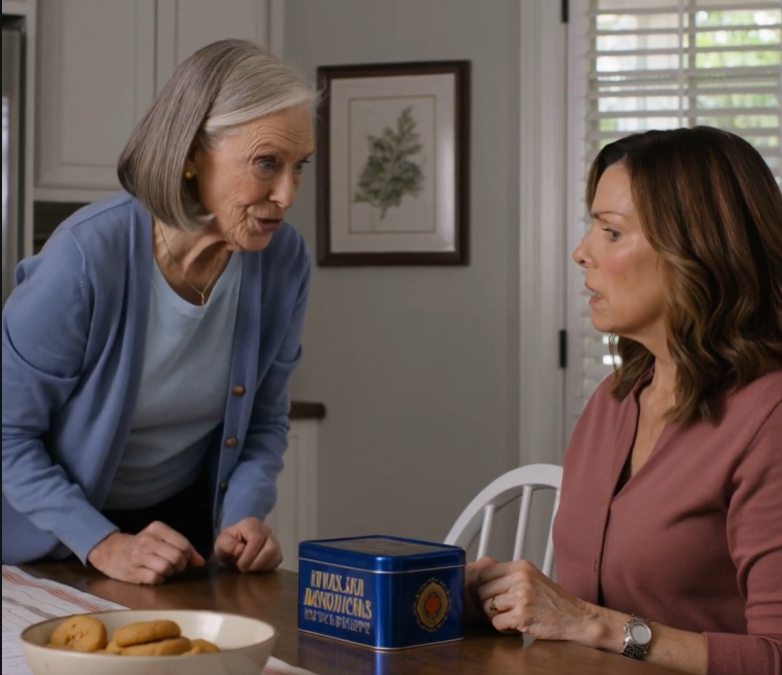
I helped her unpack that September. I hung a shelf above the closet, the highest one I could reach. She handed me a blue cookie tin, the kind Danish butter cookies come in, dented on one corner and faded on the lid.
It was light, but it wasn’t empty.
“It’s an old tin, honey. It’s just paper in there. Leave it up top.”
So I did.
Later that afternoon, I was in the hallway when I heard my mother in the kitchen on the phone with my father. He was somewhere in Montana with a load of lumber.
“She’s going to be expensive, Gary. Medicine, the doctor, all of it. But we’ll manage. Somebody has to.”
My grandmother had just handed her $25,000.
She had been in the house for four hours.
Over the next two years, I learned the rhythm of that house without ever being told it.
My grandmother received an envelope on the first of every month. It was white, and my mother wrote on the front in her slanted handwriting: Mom, then the month.
Inside was $200 in cash.
My grandmother never asked for more. She bought the cheapest toothpaste at the dollar store. She stopped getting her hair done. When I asked her about it, she said her money was being handled and that she didn’t want to be a bother about small things.
Then the kitchen happened.
In the spring of 2021, my parents tore out the old cabinets and put in new ones with a quartz counter and a farmhouse sink. My father showed it to me with real pride.
“Your grandmother insisted on paying for the kitchen,” he told me. “Said she uses it the most.”
I remember thinking that was a strange thing to say about a woman who ate most of her meals in a room by the dryer.
That same week, my grandmother said something I only understood much later. We were folding towels, and she nodded toward the envelope on her nightstand.
“You know, your mother has beautiful handwriting. Always did. I keep all of them.”
I thought she meant the envelopes.
In the fall of 2023, my grandmother bit into an apple and her dentures cracked. It was a Honeycrisp from the farmers market. She loved crisp things. She had worn the same set of dentures since 2012, and the lower plate split right down the middle.
She asked my mother about replacing them.
My mother works as a scheduling coordinator at an orthodontic office, so she knows what these things cost, and she knows exactly what insurance does and does not do.
“Medicare doesn’t cover dentures, Mom. I know it seems unfair. And with what’s left in your account, we just don’t have it right now.”
So my grandmother adapted.
She started cutting everything into small pieces. Apples became thin slices. Steak became something she pushed around a plate. She chewed slowly on one side, and she learned to smile without showing her teeth.
At a table full of people, she was always the last one eating.
And she started apologizing for it.
In February of 2024, I took her to Dr. Kesler, a dentist near my station, and paid $1,800 to have the plate repaired and relined.
It was a patch, not a fix.
Dr. Kesler looked at the chart and then at me.
“She doesn’t have anyone else covering this? She mentioned selling her house.”
I said it was complicated.
That was the first time I felt something turn over in my stomach.
Easter of 2025, my parents had people over. My mother’s friends from church, a neighbor couple, my brother, and his new girlfriend, Hannah. The dining room was loud with it.
My grandmother ate in her room.
My mother had suggested it gently, the way she suggested everything.
“Nobody wants to wait on you, Mom. You’ll be more comfortable.”
I made two plates and carried them to the back of the house. We sat on her bed with the plates on the quilt and the washing machine humming through the wall.
She told me about Hannah’s mother, Linda Brener, who had worked beside her at the library for eleven years.
“We shelved books together. She still sends me a card every Christmas. And now her daughter is going to marry Colin. Isn’t that a funny thing?”
I laughed with her.
Then I realized something.
My mother had been talking about the Breners for months. She had never once mentioned that my grandmother knew Linda.
Not once.
That August, I signed a payment plan for a full new set of dentures, $3,600 spread over eight months. The final fitting was scheduled for December 12.
I told my grandmother it was an early Christmas present. She cried a little, then pretended she hadn’t.
On the drive home, I kept the folded contract in the chest pocket of my uniform.
I have asked a hundred strangers where it hurts. I have asked people to tell me what they took, how much, and when.
I had never once asked my grandmother where her money went.
I told myself it was none of my business, that my mother was handling it, that asking would make me the difficult one.
Two months later, my grandmother asked me a question instead.
But before that question, there was the phone call.
It came on a Tuesday, two days before Thanksgiving, and by then my father had been home for one day. He had driven in on Monday after nineteen days on the road, hauling for a regional carrier out of the Spokane yard. He looked gray with tiredness. He said he planned to sleep until Thursday.
My grandmother was in the kitchen when my mother told her about the holiday.
“The Breners are coming at two, Mom. Paul and Linda and both girls. They’re formal people, and you tend to ask the same things twice. It’s just easier if you have your plate at three in your room. Nobody has to wait on you.”
My grandmother told me later that she said, “Of course.”
My father stood at the sink, drying his hands on a dish towel, looking at the towel.
He didn’t say anything.
She walked back to her room.
She looked at the shelf above the closet.
The next afternoon, at 10:02, I was in the ambulance bay checking the rig. My partner, Josh, was inside restocking. I had the clipboard against my hip, working down the list.
Oxygen. Suction. Airway kit.
My phone rang.
It was my mother.
She got right to it.
The Breners were coming. The table sat eight. My brother, Hannah, her parents, her sister, my parents.
That was eight.
“Grandma eats too slow,” she said. “Neither of you is worth an extra plate.”
I looked at the clipboard.
The line for oxygen wasn’t checked yet.
Then my father took the phone. His voice was flat, like he was reading something off a card.
“Come wash the dishes afterward. Use the back door.”
“Okay,” I told him. “Got it.”
I hung up.
I checked the oxygen line.
Josh came around the back of the rig and looked at my face.
“Who was that?”
“Someone who thinks she knows what she has.”
At twenty to seven, my grandmother called.
Her voice was low, and I could hear the dryer running behind her.
“Your mother called you, didn’t she?”
I said yes.
She was quiet for a moment.
“I read those pages again this morning, Kira. All twelve months. I think I’m done being surprised.”
I asked her what she wanted to do.
“I don’t want to argue,” she said. “I want to have people over. I’ll call you later tonight when the house is asleep.”
I finished my shift at six. I sat in my car in the lot with the engine off and the schedule taped to the visor.
I was on for Thursday.
I texted Josh and asked if he’d trade me Wednesday for Thursday.
He answered in under a minute.
Sure. You okay?
I had said okay to my parents.
I meant it.
I was okay.
I just wasn’t going to be there.
The pages my grandmother had been reading were the answer to a question she’d asked me a month earlier.
So I should tell you about the question.
On a Thursday in October, my brother sent my grandmother a text.
Thanks for the wedding help, Grandma. Means a lot.
There was a red heart at the end.
She showed it to me that Saturday, holding the phone out with both hands like it might go off.
“Why did Colin thank me for the wedding?”
I read it three times.
I asked her what she’d given him.
“I haven’t given that boy anything but socks.”
I called Colin from her room.
He didn’t pick up.
A few minutes later, he texted me instead.
Mom said Grandma agreed. It’s fine. Don’t make it weird.
I didn’t know it then, but Colin had sent that thank-you a month late.
My mother had told him back in September, at the vineyard where he and Hannah were booking their wedding, that Grandma was covering the deposit and that he should thank her. He’d been embarrassed and put it off. Hannah finally asked him in October whether he’d thanked his grandmother properly.
So he did.
The following Tuesday, I drove out to Liberty Lake and asked my mother two things.
I asked about the dental bills, and I asked what wedding help meant.
She was loading the dishwasher, and she didn’t stop.
“That account is for Mom’s care, Kira. I’m the one who handles it. Don’t make this a thing.”
I didn’t make it a thing.
I went to my grandmother’s room and asked her one question.
“Is your name on that account?”
She thought about it.
“Both of ours. Mine and Diane’s. I signed the papers in the parking lot.”
Then she could walk into a branch and ask for her own statements.
She had just never done it.
On November 14, a Friday, I picked her up at the back door and drove her to the credit union in Spokane Valley.
She wore her good coat. She brought her driver’s license and her library card, which made me smile, and she asked the young woman at the desk for the last twelve months of activity on the joint savings account.
The teller printed it.
My grandmother sat at a small table by the window and read every line with her finger, the way she used to check in returned books.
I read over her shoulder.
I had a yellow highlighter in my pocket.
I used it.
The balance was $61,300.
Her house money and six years of pension and Social Security deposits, down to that.
Every month there was a transfer of $2,400 to my mother’s checking account labeled HOUSEHOLD.
In March, $9,000 had gone to an RV dealership.
My brother’s truck.
On September 12, $18,000 had gone to a place called Sunset Ridge Vineyard.
“Would you like the full history since the account opened, ma’am?” the teller asked.
“No, dear. Twelve months will do. I already know the rest.”
She folded the pages in thirds and put them in her purse.
In the car, she didn’t cry.
She looked out the window at the freeway and did math in her head the way she’d done it at a circulation desk for thirty-four years.
“I’m not going to say anything yet,” she told me. “Colin is getting married. I won’t be the reason a wedding falls apart.”
I told her that was her choice.
“I thought I was the expensive one,” she said.
I said the thing I had been thinking since the dentist’s office.
She wasn’t being carried by anyone.
She had been carrying them.
She had paid for the house she had to enter through the back door.
“There’s one more thing at the house,” she said. “Your mother’s handwriting. I told you I kept it.”
That was November 14.
Eleven days later, my mother called and told me neither of us was worth an extra plate.
If you’ve ever found out that the person everyone called the burden was the one holding the whole house up, I’d like to hear about it. Tell me in the comments.
At 10:30 Tuesday night, my phone lit up with a video call.
My grandmother had figured out FaceTime that summer, mostly to see my face while she talked.
She was sitting on her bed with the door closed, and the blue cookie tin was on the quilt in front of her.
She took the lid off and turned it over.
Paper slid out.
Small pieces. Some torn from notepads, some from the backs of envelopes.
She sorted them by year with the flat of her hand, and then she started reading them to me, holding each one up to the camera so I could see the handwriting.
“Mom, borrowed 600 for the last of Kira’s braces. Pay you back in June. D.”
That one was from 2014.
“Mom, 900 for Colin’s tuition. Back by March. D.”
“Mom, 1,200. The furnace guy. Pay you back after taxes. D.”
Thirty-one of them.
I wrote the numbers on the back of an envelope as she read.
When she finished, the total was $23,400.
Not one of them had ever been paid back.
“She always wrote ‘pay you back,’” my grandmother said. “Every single one. I never once asked her to.”
I asked when it had started.
She said 2014, when she still had the house in Millwood, when my grandfather was still alive.
“Did Grandpa know?”
“No. I hid it from him. I told myself it was between a mother and her daughter.”
She put the lid back on the tin.
“I suppose that’s what she told herself, too.”
I told her we should take all of it to the house tomorrow night and put it on the table in front of both of them. Let them explain it with the notes in their hands.
She shook her head before I finished the sentence.
“I’m not going to stand in my daughter’s kitchen and argue with her. I’ve watched her win arguments since she was six.”
I asked what she wanted instead.
“You have Thanksgiving at your house. I’ll come. Walt will come if you call him, and I’m going to call Linda Brener.”
I sat with that for a second.
Linda was Hannah’s mother.
The Breners were the whole reason for the eight plates.
“And I’m going to leave the tin,” she went on. “On the step. Let your mother open it without me standing there. I’m not going to argue with Diane. I’m going to leave her the bill and let her clear the table herself.”
“Are you sure about Linda?” I asked. “She’s going to be Colin’s mother-in-law.”
“That’s why I’m calling her,” my grandmother said. “She’ll know what to do with the truth. She always did.”
At quarter to eleven, I called my uncle Walt in Coeur d’Alene.
He’s my mother’s younger brother, an HVAC contractor, a big, quiet man who talks to furnaces more than to people.
He picked up on the second ring because he assumed something was wrong.
I told him about the room next to the washing machine, the $200 a month, the dentures, the statements.
He didn’t say anything for a long time.
I could hear a fire going in his wood stove.
“Diane told me Mom gets tired when people visit,” he finally said. “That she’d rather have her quiet. I stopped coming by. I figured I was being considerate.”
He breathed out.
“Six years, Kira.”
I told him none of that was on him.
“Some of it is,” he said. “What does she need?”
I told him.
He didn’t ask a single question about my mother.
“Six-thirty Thursday morning. I’ll be in the driveway. Which door does she come out of?”
“The front one,” I said.
After I hung up, I did what I do at work.
I made a list.
I wrote it on the back of the shift schedule.
Turkey. Fresh, not frozen. Twelve pounds. There wasn’t time to thaw anything.
Tables.
My dining table sat four. Josh had two folding tables in his garage. I texted him.
His answer came back at midnight.
Tables are in my garage. Take the chairs, too. Whatever this is, good luck.
Chairs.
Walt could bring four more.
My grandmother, Walt, his daughter Sadi, and me. Then there were the Breners, Hannah if she came with them, and possibly one more person whose name I kept staring at.
Colin.
If I called my brother, he might tell my mother. He had texted me: Don’t make it weird.
He wasn’t cruel.
He was twenty-eight, and he had never once in his life had to choose between comfort and the truth.
I called my grandmother back.
She agreed we shouldn’t call him.
“Let Hannah tell him,” she said.
I asked why she trusted Hannah, a girl she’d met four times.
“Because Linda raised her.”
My grandmother said it like it settled everything.
“Colin is a good boy who hasn’t had to be brave yet. Thursday, he’ll get his chance.”
On my refrigerator was the engagement photo Colin and Hannah had sent everyone in June. Two people in a wheat field, laughing at something outside the frame.
I looked at it and thought, If he calls Mom tomorrow night, all of this falls down.
Before we hung up for the last time, I asked her something that had been bothering me.
“Why the tin? Why not a folder? An envelope? Anything?”
She smiled.
She ran one finger over a scratch on the lid, an old one worn smooth.
“This tin is older than you think, honey. I’ll tell you about it when your mother is standing in front of me.”
She paused.
“Some things you only say once. I’m saving that one.”
I didn’t push.
It was almost midnight.
Walt was coming.
The tables were coming.
The turkey was on the list.
The only two things I couldn’t control were a phone call to Linda Brener and a decision my brother hadn’t made yet.
Wednesday morning, I was at the station by six.
My grandmother made her phone call at 9:30, and she told me about it afterward in detail because she had rehearsed it.
My mother had left for the orthodontic office at eight. My father was on a ladder at the front of the house, replacing the porch light that had been out since October.
My grandmother put on her coat, went out the back door, and stood by the fence at the far corner of the yard, where the sound of the drill couldn’t reach her.
She called Linda Brener’s cell.
She kept it short.
The room by the washing machine.
The plate at three.
The words my mother had used about the extra plate.
And then the number.
$18,000.
September 12.
Sunset Ridge Vineyard.
Linda was quiet.
Then she said something my grandmother had not expected.
“Vera, Diane told us the Johnsons were covering the venue as a gift. She said you were thrilled about it. She said you’d insisted.”
“I’ve never seen that vineyard.”
Another silence.
My grandmother said she could hear Linda breathing carefully, the way people do when they’re rearranging everything they thought they knew.
“Give me the day,” Linda said. “I need to talk to Paul, and I need to talk to Hannah. I’ll call you tonight.”
My grandmother walked back across the yard.
At the front of the house, my father was testing the new light, switching it on and off in the gray morning.
It threw a clean white circle onto the front step.
What happened at Hannah and Colin’s apartment that evening, I know because Hannah told me the next day, standing in my kitchen with her hands around a coffee mug.
She just asked.
He said Mom had handled it.
She asked what that meant.
He said Grandma had helped.
“Then why did Grandma text Kira asking, ‘What wedding?’”
And he told her.
That my mother had said at the vineyard that Grandma was covering the deposit. That he’d sent the thank-you late because Hannah had nudged him. That when I called him in October asking what wedding my grandmother meant, he had known right then that she had no idea.
He had texted, Mom said Grandma agreed, because saying it made it feel true.
“You knew in October,” Hannah said. “You let me pick napkins.”
“I thought I could fix it after the wedding.”
There was a book of napkin samples on their table.
Hannah closed it.
“Tomorrow I’m eating at Kira’s,” she told him. “My parents are coming. You decide where you are.”
He didn’t call my mother that night.
I want to be fair to him.
He didn’t call anyone.
He sat with it.
That was what he had always done.
My shift that day was ordinary until three in the afternoon, when we got a call for a woman in her eighties who had fallen in her kitchen and couldn’t get up.
She lived alone.
She had been on the floor for two hours.
When we got to her, she kept apologizing.
She said she was sorry to be a bother. Sorry to take up our time. Sorry about the dishes in the sink.
I told her she wasn’t a bother.
I said it three times.
I meant it more than she could know.
At seven, I was at the grocery store on Division with a cart.
Fresh turkey. Twelve pounds.
Potatoes.
Squash.
A pie crust, because I am a paramedic, not a baker.
Josh’s tables were already in the back of my car, and the turkey rode home in the passenger seat with the seat belt across it.
While I was loading the trunk, my phone buzzed.
It was Linda.
We’re coming to yours. All four of us.
Don’t tell Diane. Let her hear it from us.
At nine that night in Liberty Lake, my mother set her table.
My grandmother watched from the kitchen doorway and told me about it the next morning.
Eight places.
Eight cloth napkins.
Eight of the blue-rimmed china plates my grandmother had received as a wedding present in 1967 and carried from Millwood in a box lined with dish towels.
My mother had borrowed the set years ago “for when it matters.”
It had been in her hutch ever since.
“I’m using your good china for the Breners, Mom. Isn’t that nice? It’s finally getting used.”
“That’s nice, Diane.”
“And I’ll fix you a plate at three. I’ll bring it back to your room myself.”
“Thank you.”
My father was in the recliner with the football pregame on, half asleep. He had said again at dinner that he was going to sleep late Thursday, all the way through, for the first time in a month.
My grandmother went to her room.
She took her small suitcase out from under the bed and packed it.
Two sweaters.
Her medications.
Her good coat.
The photo of my grandfather.
The tin went in last, on top, where she could reach it without opening the whole case.
Then she took out a pen. It was a wooden one engraved with Spokane Public Library from her retirement.
She wrote a note on an index card in her slanted, careful hand and read it to me over the phone at ten.
That’s my china on your table, Diane.
The rest of what’s mine is in this tin.
The dishes are yours now.
She set the card on top of the folded statements and closed the lid.
“Six-thirty,” she said. “Walt will be in the driveway. Don’t come get me. I’ll be on the front step.”
She paused.
“First time I’ve used that door since I moved in.”
“Are you all right?”
“I’m all right, honey. I’ve been getting ready for this longer than I knew.”
After she hung up, I stood in my living room and counted chairs.
Josh’s two tables made an L with mine. Ten seats once Walt’s chairs arrived.
I found two more folding chairs in the hall closet, the ones I use for barbecues, and set them at the far end.
Twelve chairs.
I told myself the extra two were for nobody.
Thursday morning, I was awake before my alarm.
At 6:30, in the dark, my grandmother pulled her suitcase down the hallway past the kitchen and stopped at the front door.
She had lived in that house six years and had never once opened it from the inside.
She said the deadbolt was stiff.
She said the cold came in all at once.
Walt’s truck was idling at the curb with the headlights off.
He got out and came up the walk and didn’t say anything.
He just took the suitcase.
She knelt on the step slowly and set the blue tin down in the center of the circle the new porch light made on the concrete.
Then she stood, holding the railing.
“Mom, you’ve got the tin?” Walt asked.
“It’s staying.”
She said, “I’m leaving.”
She didn’t lock the door behind her.
By five to seven, they were pulling up in front of my house in Hillyard.
At the same moment, twenty miles away, my father was waking up.
That part he told me himself twice.
Once on the phone, and once at my kitchen table.
He slept later than he had in weeks, but a trucker’s body has its own clock.
He came downstairs in socks.
Biscuit, their old yellow Lab, was waiting at the front door doing her morning dance. He opened it to let her out.
She didn’t go out.
She stopped on the step and put her nose on the tin.
He picked it up.
It was heavier than cookies.
He sat down on the top step in his socks in the cold and pried the lid off with his thumbs.
“I thought Vera left us cookies,” he said. “Then I saw Diane’s handwriting.”
The first note on top was the oldest one.
Mom, borrowed 600 for the last of Kira’s braces. Pay you back in June. D.
He read it three times.
The same way I had read Colin’s text.
Then he found the index card.
Then he found the statements, with my yellow highlighter running down the right-hand column like a warning.
My grandmother was standing in my front doorway with her suitcase still in her hand when my phone rang.
The screen said Dad.
His voice was very low.
“I’m holding a bank statement. There’s $18,000 going to a vineyard. I thought that was Colin’s savings. I thought he and Hannah saved that up.”
“It’s Grandma’s.”
“There’s $2,400 a month going to the checking account, Kira. Every month. For years.”
I didn’t say anything.
I let him hear himself.
“Is she okay? Vera—is she safe?”
“She’s here,” I said. “She left through the front door.”
He was quiet.
I could hear Biscuit whining somewhere behind him.
“I didn’t know, Kira.”
“You told me to use the back door, Dad.”
The silence went on long enough that I checked the screen to see if the call had dropped.
“Yeah,” he said. “I did.”
Then he said my mother was still asleep and he was going to wake her up.
He hung up.
For an hour and a half, I heard nothing.
Walt carried in four folding chairs and helped set up the three tables while my grandmother and I stood at the counter and rubbed butter under the skin of a twelve-pound turkey.
Sadi arrived with rolls from a bakery and hugged her grandmother for a long time without asking a single question, which told me Walt had explained enough in the truck.
At 9:35, my father texted.
Coming alone.
Your mother says it’s her account to manage.
I’m bringing the tin.
At 9:50, a group text lit up from Linda.
Told Diane. She’s calling Colin now.
I turned the phone face down on the counter and slid the turkey into the oven.
At ten, my father’s pickup turned onto my street.
He came up the walk carrying the cookie tin against his chest with both hands, the way you’d carry something that might spill.
He was wearing yesterday’s flannel.
He hadn’t shaved.
My grandmother stood in the open front door and did not step back.
“Vera,” he said. “I’m sorry I never asked.”
“Come in, Gary,” she said.
Then, after a beat:
“Front door.”
He set the tin down on my dining table, on top of the tablecloth between the salt and the folded napkins.
Then he took the lid off and did something I had not expected.
He laid the notes out.
All thirty-one of them.
In rows.
Sorted by year, the way she had sorted them on her quilt two nights before.
He stood over them like a man reading a map of a place he was supposed to have been living in.
“2014,” he said, and touched the first one. “That’s the year I bought my first rig. Diane told me we had a bonus from her office. Six hundred for the braces.”
He moved his finger down a row.
“2020. That’s Colin’s last semester. I thought that came out of the tax refund.”
Walt was standing behind him, not saying anything.
My father picked up the statement and found the line I’d highlighted, the one that repeated every month.
“Twenty-four hundred a month.”
He said it slowly.
“I thought that was me. I run three weeks out of four, Vera. I thought I was the one carrying this house.”
My grandmother was at the stove with her back to him.
She didn’t turn around.
“You were carrying a truck, Gary. I was carrying the house.”
Walt spoke then for the first time.
“Have you ever been in my mother’s room, Gary?”
My father looked at him.
“I mean it. Have you ever stood in it? In six years?”
My father didn’t answer.
Which was an answer.
I took my phone off the counter and found the picture.
My grandmother had sent it to me in the spring of 2024, asking whether I thought a small bookshelf would fit beside the dresser.
In the photo, you can see the single bed, the one window, the pill organizer on the nightstand, and, through the open door, the white side of the washing machine.
I handed it to Walt.
Sadi leaned in over his shoulder.
He looked at it for a long time.
Then he gave the phone back to me and walked out onto my back porch and stood there alone with his hands in his jacket pockets.
Five minutes.
Maybe more.
When he came back in, his eyes were red.
His voice wasn’t.
“She told me you were tired, Mom,” he said. “Every time I called, she said you were tired.”
My grandmother turned around then.
“I was,” she said.
Nobody had anything to add to that.
My father sat down heavily at the end of the table in front of the rows of notes.
At 11:30, my mother’s car pulled up in front of the house.
She came through the front door without knocking, the way she came into every room.
She didn’t say hello.
She looked at the table.
At the notes.
At my father sitting in front of them.
Then she went straight to him.
“What are you doing with that? That is between me and Mom. You had no business bringing it here.”
Then she turned to my grandmother, who was drying her hands on a dish towel.
“Mom, do you understand what you’ve done? Linda Brener called me at ten this morning and told me she wasn’t coming. Do you know how many calls I’ve made this morning trying to explain?”
“Explain what, Diane?”
“That you get confused.”
My grandmother folded the towel in half and set it on the counter.
My mother turned to the rest of us, and her voice found its footing.
This was the voice from the church committee, from the parent-teacher nights. Calm and reasonable and a little tired of everyone else.
“That account is Mom’s care account. It has always been Mom’s care account. Every dollar in it went to her care, her medication, her food, her share of the house. I have receipts.”
“So do we,” I said.
She looked at me the way she used to when I was fourteen and had talked back at dinner.
“You have no idea what it costs to keep a person, Kira. None.”
It was then that my mother noticed what the rest of us had already seen.
My grandmother was not sitting in a back room.
She was standing at the head of a table in her good coat.
My uncle was standing behind her.
And he had not said hello to his sister either.
My mother needed an example.
I watched her look for one.
“Fine. Her teeth. She’s getting new dentures next month. Thirty-six hundred dollars. Who do you think arranged that? Who do you think is paying for that?”
I reached into the chest pocket of my uniform jacket, which was hanging on the back of a chair, and took out a folded sheet of paper.
The payment plan from Dr. Kesler’s office.
Eight installments.
The name on the top line was mine.
I put it on the table next to the notes.
My father picked it up.
He read his daughter’s name and looked at his wife.
“Kira is exaggerating,” my mother said. “She likes being the hero. She always has.”
My grandmother spoke quietly.
She didn’t raise her voice at all.
“Diane, you work at a dental office. You know why I eat slowly.”
My mother said nothing.
“You told the Breners I eat too slow,” my grandmother went on. “You never told them why.”
I saw something move across my mother’s face.
Then I saw her put it away.
She changed direction the way she always had—fast and clean.
“Where’s Colin? Colin will tell you. Grandma agreed. She agreed to help with the venue. Colin will say so.”
At one, two cars parked in front of my house.
The Breners’ sedan.
And behind it, Colin’s truck, with Hannah in the passenger seat.
Linda Brener came up the walk first.
She is a small woman with gray hair cut short and a librarian’s way of walking—quiet and certain.
She passed my mother in the doorway without a word and went straight to my grandmother and put her arms around her.
She held on for a long time.
Paul Brener, behind her, shook my father’s hand and then, after a second, shook Walt’s.
Chloe, the younger daughter, stood near the wall holding a pie.
When Linda let go, she turned to my mother.
She didn’t raise her voice either.
That was the thing about that afternoon.
Nobody yelled.
“Diane, you told us your family was gifting the venue. We thanked you twice. We sent a card. We should have been thanking Vera.”
“That was Mom’s money. And Mom was thrilled to—”
“Diane.”
Linda’s voice was patient.
“I worked next to your mother for eleven years. She never once forgot where a book went.”
My mother looked past her to my brother, who was standing just inside the door with Hannah’s hand in his.
“Colin. Tell them. Tell them Grandma agreed.”
Colin looked at Hannah.
He looked at my grandmother.
He looked at the thirty-one notes on the table.
I watched him understand what they were without being told.
“I knew in October,” he said.
The room went still.
“When Kira called me and asked what wedding Grandma meant, I knew. Grandma didn’t know anything about it. I texted back that Mom said Grandma agreed.”
He swallowed.
“I was telling myself, not her. I didn’t say anything because the deposit was non-refundable. I thought if I just got to the wedding, I could fix it after.”
He turned to my grandmother.
“I’m sorry, Grandma.”
She looked at him for a long moment.
“You said it now,” she told him. “Sit down, Colin.”
He sat in the first of the two extra chairs I’d set at the far end.
The ones for nobody.
My mother’s face had gone white.
“You’re taking their side,” she said to him. “After everything I’ve done for you, you’re going to sit there and—”
“Diane.”
My grandmother’s voice was not loud.
It didn’t need to be.
“Sit down. There’s something I haven’t told you in forty-four years.”
My mother sat.
She took the other extra chair at the far end, across the table from her son, and held her purse in her lap like she might need to leave quickly.
My grandmother reached across the table and slid the blue tin to the center, between the carving board and the bowl of rolls, so that everyone could see it.
“Let’s be clear about one thing before I start.”
My mother said, “That is Mom’s care account. I’ve managed it because she forgets things. Somebody had to. I did this for her.”
Nobody answered her.
My grandmother lifted the lid off the tin.
Instead of reaching for the papers, she turned the lid over.
Taped to the inside of it, faded and curling at the corners, was a small square photograph.
She peeled it free and held it up.
“I bought this tin in the spring of 1974,” she said. “At the grocery store on Sprague. It came with butter cookies in it. When the cookies were gone, I used it for the grocery money. Every Friday, your father’s check got cashed, and thirty dollars went into this tin. That was what we ate on for the week.”
She turned the photograph so my mother could see it.
A kitchen.
A little girl standing on a chair at the counter, holding a blue tin with both hands and grinning at the camera.
“You were six. You drew a sun on the lid with a marker. It’s still there if you look.”
Everyone looked at the lid.
Under forty years of wear, there was the ghost of a child’s drawing.
A circle with lines coming off it.
“This tin fed you, Diane,” my grandmother said, “before it fed anyone else.”
My mother’s hand was tight on her purse strap.
“Do you remember the spring you were thirteen?”
“I don’t know what you’re talking about,” my mother said. “Mom, you’re confused. This is exactly what I’ve been trying to tell everyone.”
My father spoke without looking at her.
“Let her finish, Diane.”
“You’re on their side now, too. Fine.”
“There’s no side,” Walt said from behind his mother’s chair. “There’s just this table.”
My mother turned toward the Breners, toward Paul and Linda and Chloe, who were sitting in a row along the far wall.
“You’re doing this in front of strangers,” she said to my grandmother. “You’re humiliating me in front of people I barely know.”
Linda answered before my grandmother could.
“We’re not strangers, Diane. We’re family. That’s what you invited us to be.”
The turkey sat on the carving board in the middle of the table.
Nobody had cut into it.
My grandmother set the photograph down.
“Forty dollars,” she said.
My mother went very still.
“April of 1981. I opened this tin on a Friday morning and forty dollars was gone. That was more than a week of groceries. I knew who took it. You had gone to the movies twice that week and come home with a new jacket. And you had told me a friend’s mother bought it for you.”
Her voice was even.
She might have been reading from a card catalog.
“I never said a word. I picked up Saturday shifts at the library for two months to cover it. I told your father the hours were for a special project. I never told him. I thought, She’s thirteen. She’s ashamed. She’ll grow out of it.”
She looked at the rows of paper on the table.
“Then in 2014, you started writing ‘Pay you back.’ Every single note, Diane. You wrote it every time. You knew. You always knew it wasn’t yours.”
My mother’s eyes had filled.
And I want to be honest about what I saw.
It was not remorse.
It was the look of someone who has been seen through all the way to the bottom by the one person she had believed would never look.
“I forgave you in 1981,” my grandmother said. “I’m not asking you for the money. I’m asking for my name back. I want to stop being the confused old woman in the back room who eats too slow. I want to be your mother again in front of people.”
She looked at her daughter.
“That’s all.”
No one said anything.
Sadi set her phone face down on the table.
Hannah’s hand found Colin’s.
My father stared at his wife the way I have seen family members stare at a stretcher, trying to recognize someone they know.
In my job, silence after a question usually means the patient is deciding whether to tell you the truth.
I have learned to wait through it.
I waited.
My mother stood up.
And she said the thing you cannot take back.
“If it weren’t for me, you’d have been in a home five years ago. You’d be in a facility eating pudding off a tray. I gave you a room. I gave you a family to be near. You should be grateful.”
Walt straightened behind his mother’s chair.
“You told me she didn’t want visitors,” he said. “You told me she got tired.”
My father put both hands flat on the table.
“You told me Mom gave us the kitchen. You said she insisted.”
“I was never asked, Gary,” my grandmother said.
Linda Brener did not stand up, but her voice carried.
“You told us you were gifting the venue.”
Three people.
Three different lies.
All of them in the same room at the same time.
Which was the one thing my mother had spent six years making sure could never happen.
“She should be grateful,” my mother said again, to no one in particular. To the room.
“I was, Diane.”
My grandmother’s voice was almost gentle.
“For six years, that was the problem.”
My father stood up.
“Friday morning,” he said, “I’m driving Vera to the credit union. Her money goes into an account with just her name on it. All of it that’s left.”
“That’s my—”
“It’s not,” he said. “It never was.”
Paul Brener cleared his throat.
He is a big, careful man who spent thirty years carrying mail, and he spoke to Colin and Hannah, not to anyone else.
“I’m sorry, kids. Linda and I have talked about it. We can’t stand up at a wedding that was paid for with Vera’s money without her knowing. We won’t. It isn’t about the money. It’s about what it would mean to sit in those chairs.”
Colin nodded before he finished.
“I’ll call the vineyard tomorrow. I’ll ask if they’ll move the deposit to something smaller or give part of it back.”
“Eighteen thousand dollars,” my mother said. “Gone. That’s what you’re all choosing.”
My grandmother turned to my brother.
“I’d have given it, Colin. If anyone had asked me, I’d have given it gladly.”
She shook her head.
“But I don’t gift what was taken. You’ll marry on your own money, and I’ll be there.”
Hannah looked at Colin.
Then at her parents.
Then at my grandmother.
“Same date,” she said. “May 16. My parents’ backyard. Grandma Vera sits in the front row.”
Colin looked at his mother.
Then he said the bravest thing I have ever heard him say.
“You can come, Mom, if you apologize to Grandma first. Before, not after.”
My mother laughed.
It was a short, terrible sound.
My father was still standing.
“I’m going to sell the boat,” he said.
It was a bass boat he’d bought used in 2018, the one thing he’d ever spent money on for himself.
“And I’m going to take extra runs this winter. Vera, I’ll pay back what I can. Not because anyone’s making me. Because I ate at that table for six years on your money and never asked one question.”
“You’re choosing my mother over me,” my mother said. “In front of everyone. After thirty-five years.”
“I’m not choosing your mother over you, Diane.”
He said it quietly.
“I’m choosing to look at what I signed.”
My mother picked up her purse.
She looked at the table.
At the notes in their neat rows.
At the photograph of a little girl holding a tin.
She looked at her son, who did not look away.
Then she walked to the front door.
She opened it herself.
And she went out.
Nobody got up to stop her.
Her car started, and the sound of it faded down the street.
For a moment, none of us moved.
Then my grandmother reached over, picked up the carving knife, and held it out to me.
“The bird’s getting cold, honey.”
I carved.
Walt passed plates.
Linda found my serving spoons without asking where they were.
We sat around an L-shaped table made of one real table and two borrowed ones, in a rental house in Hillyard, with the oven still warm.
My grandmother sat at the head.
She ate slowly.
She cut her turkey into small pieces and chewed on the left side and took her time.
Nobody watched her do it.
Nobody waited for her to finish before they started talking.
Linda told a story about a man who had returned a library book thirty years late with a note that said, Sorry.
Sadi asked about the sun on the tin.
Paul asked my father about the routes he ran, and my father answered, and something in his shoulders came down an inch.
When everyone else’s plate was empty, nobody got up.
We stayed.
We passed the pie around a second time.
My grandmother ate her last bite of turkey at almost four.
“I’m slow, honey,” she told me when I reached for her plate. “Pass the potatoes anyway.”
It was the first time in six years that she was the one who ended the meal.
At the far end of the table, one of the extra chairs held my brother.
The other one was empty.
My mother had taken her place at the table.
And she had left it.
My father, when the dishes were cleared, stood up and rolled his sleeves and went to the sink.
He washed every one of them.
He didn’t ask where the back door was.
The credit union in Spokane Valley was open the morning after Thanksgiving, and my father was at my house at eight to drive my grandmother there.
He’d shaved.
He carried the statements in a folder now instead of a cookie tin.
I went along.
I sat in the lobby and watched my grandmother at the desk with the same young teller from two weeks before.
She opened a new savings account with one name on it.
She moved $61,300 into it, which was what six years of her life had left her.
She couldn’t simply take my mother’s name off the joint account.
So she closed it.
“Just your name on this one, Mrs. Linkfist?” the teller asked.
“Just mine.”
While we sat there, my father’s phone buzzed.
He turned it so I could see.
It was my mother.
You’re tearing this family apart.
He read it.
Put the phone face down on his knee.
Didn’t answer.
He drove my grandmother back to my house, not to Liberty Lake.
On the porch, she stopped and looked at him.
“Where are you going to go, Gary?”
He didn’t have an answer yet.
“I’ll figure it out.”
“You will,” she said. “Use the front door when you come by.”
On December 12, my grandmother got her new teeth.
Dr. Kesler fitted them, adjusted them twice, and told her soft foods for two weeks, then whatever she liked within reason.
On the drive home, she held a Honeycrisp apple in her lap.
I’d bought it that morning without thinking, then thought about it and brought it anyway.
She turned it over in her hands.
She didn’t bite it.
“I’ll bite something when I’m ready,” she said. “I’ve waited three years. I can wait for spring.”
That week, a package came to my house from a department store.
Inside was a set of bed sheets.
Queen-size.
Cream-colored.
Still in the plastic.
The gift receipt had my mother’s name on it.
There was no card.
I called her.
I kept it short, the way you keep things short when they matter.
I told her I wasn’t going to accept a gift in place of an apology.
I told her my door was open to her any day, the moment she stood in front of her mother and started a sentence with the words, I’m sorry.
“I don’t have anything to apologize for,” she said. “I took care of her for six years.”
“Then the door stays closed.”
“You’ve always been dramatic, Kira.”
“Mom,” I said, “I’m not angry. I’m done being the one who pays and says nothing.”
I drove the sheets to Liberty Lake the next morning and set them on the front step, still in the plastic, in the circle of the porch light.
Then I drove home.
My father moved out in February.
He’d spent December and January in the guest room, the one that had been saved for Colin.
He sold the bass boat in January to a man from Post Falls who paid $21,000 in a cashier’s check.
My father signed the check over to my grandmother that same afternoon.
She tried to refuse it.
He set it on her table and left.
“I’m not asking to be forgiven,” he told me in my driveway. “I’m paying what I ate.”
He rented a room in a house near the trucking yard and took every extra run they’d give him.
Colin called the vineyard as he’d promised.
They were polite and firm.
The deposit was non-refundable.
It said so in the contract.
They kept it.
“It was never mine to get back,” Colin told me.
He said it without bitterness.
I think he’d decided that some things you pay for in full.
In January, my grandmother signed a lease on a one-bedroom apartment in a senior building in North Spokane, eight minutes from my house.
Her pension covered it with room to spare.
Walt and Sadi carried the boxes.
I bought a little plastic label maker, printed her name, and stuck it on the mailbox in the lobby.
V. Linkfist.
On the day she moved in, she stood in front of her door with the key in her hand.
It was on a ring with a small brass charm shaped like an open book.
She didn’t turn it right away.
“Front door, Kira,” she said.
She smiled.
“Mine.”
Then she opened it.
The blue tin went on the kitchen counter next to the coffee maker.
She rinsed it out, dried it, and set it there empty with its lid beside it.
If you’ve ever had to decide whether a door stays open or closed for someone in your own family, I’d like to know how you chose. There’s no judgment here. Tell me in the comments.
My brother got married on May 16, the date he and Hannah had booked at the vineyard, under a rented white tent in the Breners’ backyard.
Thirty people.
Folding chairs.
A neighbor played guitar.
Linda had cooked for three days.
My grandmother sat in the front row on the aisle, in a seat Linda had saved with a folded coat.
Walt sat beside her.
Sadi took pictures.
My father stood at the back of the tent in a pressed shirt.
And when the music started, he took his hands out of his pockets.
Colin had invited our mother.
He had called her himself and repeated the condition and given her three weeks.
She answered him by text four days before the wedding.
I won’t apologize for taking care of my mother.
He showed it to me, put the phone away, and didn’t mention it again.
When it came time for the vows, Colin held Hannah’s hands and said the usual things.
Then he said one that wasn’t usual.
“I promise to say the hard thing the day I know it, not the day I’m caught.”
He looked down at the front row when he said it.
My grandmother nodded once, the way she used to nod at a child who had finally brought back an overdue book.
A week later, on the Saturday of Memorial Day weekend, I lit the grill in my backyard for the first time that year.
Walt and Sadi came.
Josh came with a cooler and the two folding tables, which had never gone back to his garage.
Colin and Hannah came sunburned from a honeymoon at the Oregon coast.
My father came last.
He walked up the front steps and knocked on the front door.
When I opened it, he was holding two bags of ice.
My grandmother sat in a lawn chair in the shade with her purse in her lap.
It was warm for May.
The lilac in my neighbor’s yard was going over.
She reached into her purse and took out an apple.
A Honeycrisp.
She had brought it from her own kitchen, in her own bag, from the store she now walked to on her own.
She turned it in her hands the way she had in December.
Then she bit it.
The sound carried.
That crisp, clean snap.
Everyone in the yard went quiet, the way you do when you know something is happening, but nobody’s told you what.
She chewed.
She swallowed.
She smiled.
And this time, she showed her teeth.
“Three years,” she said. “Still crisp.”
Sadi started laughing.
Then everyone was.
After we’d eaten, my grandmother went back to her chair and brought out the blue tin.
She had carried it over from her apartment on the seat beside her.
She set it on the picnic table and took the lid off.
It was full of butter cookies.
The old-fashioned kind.
The kind she’d stopped making when she moved into a room with no oven of her own.
She had baked them that morning.
“Sadi first,” she said.
Sadi asked about the sun.
The sun was still there on the lid, a circle and lines coming off it, drawn by a little girl fifty years ago.
“It’s a cookie tin, honey,” my grandmother said to me when she saw me looking at it. “It was always supposed to be a cookie tin.”
I sat down on the porch step and watched her.
She had a cookie in one hand and half an apple in the other, and she ate them both slowly, the way she eats everything.
Around her, in my yard, on borrowed chairs, nobody got up.
Nobody cleared a plate.
Nobody looked at the time.
My grandmother still eats slowly.
The difference is that now everyone at the table has learned to wait.
That was never about time.








