Twenty-two years. The clerk read my file and smirked. “Silver Star? Not in my database.” He called security. They walked me out past the whole waiting room. Through the glass, I watched him open the envelope I’d begged him not to touch. “Ma’am, did he break that seal?”
Twenty minutes after they walked me out of the building, I was still sitting in my truck in the parking lot, the engine off and my clearing papers spread across the dashboard. I watched the glass doors of the transition center the way you watch a pot you know is going to boil. It was two minutes to eleven on a Tuesday morning at the end of September, and it was already eighty-six degrees, because this was Central Texas and the calendar had no say in the matter. The air conditioning had been off for twenty minutes, and the cab was warming around me. I didn’t turn the key. I had nowhere I was allowed to go. Every office on that post that could sign the last line of my retirement paperwork was inside the building I had just been escorted out of.
I saw the first military police vehicle before I heard it. A white sedan with its light bar dark came around the corner of the lot faster than anybody should drive in a parking lot. A second one followed, and behind both of them was a plain gray government car with a man in a short-sleeved dress shirt behind the wheel. They didn’t park in spaces. They stopped in the fire lane in front of the doors. Two military police officers got out of the first car, a sergeant and a specialist, both in uniform, both moving with the particular unhurried speed of people who have been told something is serious and have been trained not to look like it.
The man in the gray car got out more slowly. He was in his fifties, heavyset, with a lanyard around his neck and a hard plastic case in one hand. It was the kind of case you carry a laptop in when the laptop isn’t allowed to touch anything else. The sergeant looked at the doors, then around the lot. Her eyes settled on my truck and on me sitting inside it. She said something to the man with the case and walked straight toward me.
I rolled down the window. She was in her late twenties, with dark hair pulled tight against her head and a name tape that read FERRARO. She bent slightly to look inside, taking in my uniform, the rank on my chest, and the folder on the dashboard.
“Ma’am, are you Master Sergeant Lindquist?”
“I am.”
“Ma’am, did he break that seal?”
I had spent thirteen years keeping that envelope closed. It had taken him about four seconds.
“Yes,” I said. “I watched him through the glass.”
She nodded once, as though I had confirmed a number she already had written down. Then she asked the second question, the one I have heard in my head every day since.
“Which desk was his?”
I looked past her toward the glass doors, through them into the long room on the other side, and toward the row of desks along the window where the records clerks sat. I didn’t have to think about it.
“Third from the left,” I said. “By the window.”
That morning, I had woken at five-thirty in a house that already had half its furniture packed into boxes, and I had put on my uniform for what I expected to be the last time. Retirement is not a ceremony. People think it is because of the movies, because of the flag folded into a triangle and the old sergeant major making a speech. That part exists if you want it, but it isn’t the part that makes you retired. The part that makes you retired is a scavenger hunt for signatures.
They give you a set of clearing papers, a long form with nineteen blocks on it, and you carry it from building to building across the post for two weeks, collecting a stamp or a set of initials from every office that ever issued you anything. The central issue facility, to prove you turned in your body armor. The library, to prove you have no overdue books. Finance, the dental clinic, the housing office. Every block is somebody confirming that you don’t owe the Army anything.
I had spent the previous two weeks collecting those signatures. I had stood in line at the central issue facility behind a row of young soldiers turning in their gear after their first enlistments, all of them talking about where they were going next. College, pipelines, girlfriends in other states. I had dumped twenty-two years of body armor, canteens, and a sleeping bag I had carried on three continents onto a long steel table, where a civilian with a clipboard counted everything and initialed my form without looking up.
At finance, a specialist half my age had walked me through my final pay with a patience that made me feel very old. At the dental clinic, a hygienist had asked whether I flossed, and I had lied. None of it was hard. All of it was strange. Every signature was a small door closing, and you don’t notice how many doors you have been living behind until you start walking through them one at a time.
By that Tuesday, I had eighteen of the nineteen signatures. The last block belonged to the records section at the transition center, where a clerk would review the worksheet for my DD Form 214, the single page that would follow me for the rest of my life. Every job I applied for, every loan, every benefit, every time anybody asked me what I had done for twenty-two years, the answer would be on that one page.
I was forty years old. I had enlisted at eighteen, out of Duluth, Minnesota, in the summer of 2004 because I wanted to see something that wasn’t Lake Superior in February. The Army made me a human intelligence collector, which is a long way of saying it taught me to sit across a table from people and listen until they told me the truth. I was good at it. I was good because I was patient, and because I had grown up the quiet one in a loud family and learned early that if you stayed still long enough, people forgot you were there and said what they meant.
I had a new job waiting for me, emergency management analyst for a county up in the Hill Country, starting the following Monday. A desk, a window, a pension, and nobody shooting at anybody. I had wanted that for a long time.
Inside my folder, behind the clearing papers, was a separate pocket. In that pocket was a large manila envelope, and inside it, I knew, was a second envelope containing a document with a red classification cover sheet. Taped to the front of the outer envelope was a memorandum from the Special Operations Command. I had read it so many times during the previous week that I could have recited it.
The memorandum stated that the enclosure contained the classified narrative supporting an award already recorded in my official file. It said the narrative was required to annotate Block 13 of my DD Form 214. It said, “DO NOT OPEN AT COUNTER. DELIVER UNOPENED TO THE INSTALLATION SECURITY MANAGER.” It gave his name and telephone number.
The command had originally wanted to send the material by classified courier. Somebody in somebody’s office had decided it would be faster to hand it to me in a sealed double wrapper, since I held a clearance and was going to the building anyway. I had argued against that decision. I had lost. I had argued politely by email three times, pointing out that a classified document should travel with a classified courier, not in the folder of a woman who would be standing in public lines all day.
A staff officer whose name I never learned had informed me that the risk was minimal, the envelope was double-wrapped, and the memorandum was clear. I was told it would save two weeks. Everyone in the Army is always trying to save two weeks. I was retiring, and people don’t listen very hard to a retiring master sergeant.
I parked at the transition center at nine-forty. It was a long, low beige building near the main gate, built sometime in the 1980s and renovated in a way that made it look newer without making it look better. Inside the front doors was a waiting room with forty plastic chairs bolted into rows, a television showing a cable news channel with the sound off, and a red machine that dispensed paper numbers like the deli counter at a grocery store.
Along the back wall, behind a long glass partition with a gap at counter height, stood six desks, each with its own little window in the glass and an illuminated number above it. I took a number. Forty-one. The board said twenty-nine.
I sat in the third row beside an old man with a cane who was waiting to renew his retiree identification card. He was seventy-eight, he told me without my asking. Vietnam, then twenty years more. His name was Virgil Stokes. He asked whether this was my last day, and I told him I hoped so.
“Last day’s the worst,” he said. “They save the dumbest form for last.”
I laughed. I remember that I laughed. It was the last time I laughed that morning.
At ten-eighteen, the board displayed forty-one. A bell rang, and the number above the third window from the left lit up.
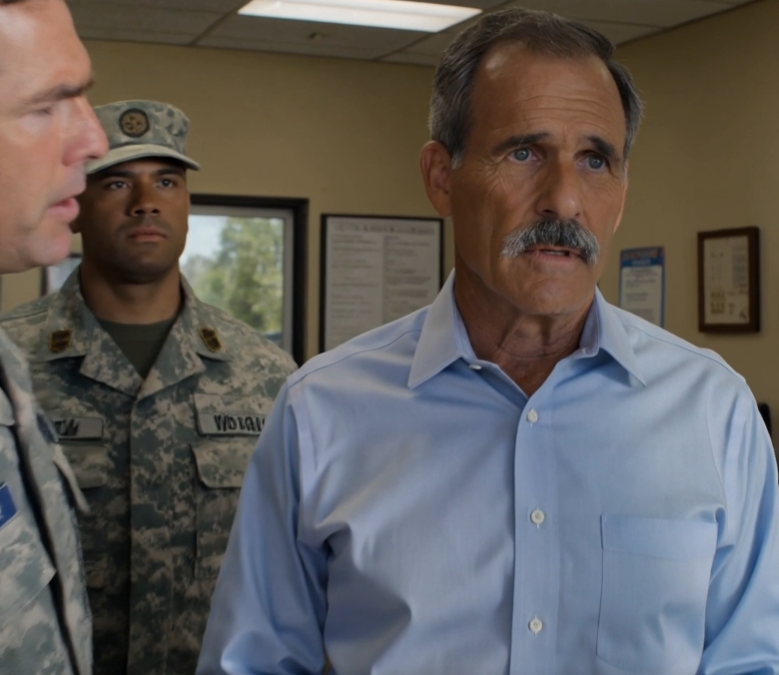
The clerk behind it was a civilian, a man in his late fifties with a gray mustache, reading glasses pushed onto his forehead, and a short-sleeved shirt with a pen in the pocket. The nameplate on the counter said D. PELLERIN.
I learned later that he had been a staff sergeant himself, a personnel specialist for twenty years, and had spent another twelve as a civilian in that same building doing the same work. Over the years, he had caught two people trying to put awards on their retirement paperwork that they had never earned. One had claimed a Bronze Star. The other had claimed a Purple Heart. Both had been prosecuted.
He was proud of that. He had reason to be.
I placed my clearing papers in the tray beneath the glass. He slid them through, examined them, checked the eighteen completed blocks with the speed of a man who had seen ten thousand such forms, and pulled up my record on his screen.
He scrolled for a while. He was thorough. I will give him that even now.
Then he stopped scrolling. I watched his face change, not dramatically, just a small lift at the corner of his mouth, the expression some people get when they find something they were half hoping to find.
“Twenty-two years,” he said without looking up. “Military Intelligence. Iraq. Afghanistan.”
He tapped the screen with his pen.
“Silver Star.”
“Yes, sir.”
He leaned back, pulled his reading glasses down from his forehead, and looked at me through the glass. Then he looked at the screen again.
“Narrative withheld,” he read. “No citation. No orders text. Just a line that says it exists.”
He turned toward me.
“Silver Star, not in my database.”
He said it louder than necessary, loud enough to carry through the opening beneath the glass and into the waiting room. Behind me, I heard the small sounds a room makes when forty people stop doing whatever they were doing. A magazine page stopped turning. Somewhere near the back, a child was shushed.
“Sir, the citation is classified,” I said. “That’s why the narrative is withheld. I have the supporting documents here.”
I removed the manila envelope from my folder and set it on the counter, on my side of the glass, with the memorandum facing upward.
“These go to the installation security manager, Mr. Ehart. The memorandum has his number. He’ll verify the award and send the confirmation back to you through the proper channel.”
Pellerin looked at the envelope. Then he looked at me.
“Classified,” he said. “That’s convenient.”
“It’s not convenient, sir. It’s just true.”
“Do you know how many times I’ve heard that?”
He was speaking to me, but he was addressing the room.
“Twenty-two years and a Silver Star, and nobody’s ever heard of you. You know what I call that? I call it the oldest trick there is. Put something on the paper nobody’s allowed to check.”
Somebody in the waiting room made a small sound, not quite a laugh. Pellerin heard it, and it seemed to encourage him. He leaned toward the opening in the glass, his voice taking on the tone of a man telling a story he had told before and enjoyed telling.
“I had a fellow sitting right where you’re sitting four years ago,” he said. “Bronze Star with Valor. Very sure of himself. Told me the paperwork got lost in a fire. You know where he was during his so-called valor? Kuwait. In a warehouse counting boots.”
He tapped the screen again.
“And a lady before that with a Purple Heart she got from a car accident on the way to the commissary. I’ve seen it all, Master Sergeant. I’ve seen every way there is to dress it up.”
One of two lieutenants sitting in the second row said something to the other. I didn’t hear what. The other lieutenant smiled at the floor.
“Sir,” I said, “I’m not asking you to take my word for it. I’m asking you to call the man whose job it is to check.”
I kept my hands flat on the counter.
“Sir, I’m asking you to call Mr. Ehart.”
“I’ll call who I need to call.”
He reached beneath the glass through the opening and put his hand on the envelope.
I did not grab it. I want to be clear about that, because later it mattered. I did not touch him, and I did not touch the envelope.
“Mr. Pellerin,” I said, “please don’t touch that envelope. It’s not addressed to you.”
He pulled it through the opening to his side of the counter.
“Anything you hand across this counter is addressed to me.”
“Sir, please.”
I had raised my voice. Not much. Just enough. In a room that quiet, enough is a lot.
He picked up his desk telephone and pressed two buttons without looking at them.
“Gerald,” he said, “window three. I’ve got a disturbance.”
The building had a civilian police officer stationed at the front desk, a Department of the Army officer in a dark blue uniform with a radio on his shoulder. His name was Gerald Tamson. He was in his forties and looked tired in the way people look when they spend their days standing in one place being polite to strangers.
He came through the side door behind me and stopped at my elbow.
“Ma’am,” he said, “I need you to come with me.”
“Officer, that envelope contains classified material. He’s not cleared to open it. I need it back, or I need the security manager called.”
Tamson looked at Pellerin. Pellerin slowly shook his head, the way you shake your head at a child trying a story on you.
“Ma’am,” Tamson said again, more quietly, “please don’t make me put a hand on you. Just walk with me.”
I considered it for about two seconds. I thought about saying more. I thought about the forty people watching. Then I picked up my folder, turned around, and walked.
Tamson escorted me up the center aisle of the waiting room between the rows of plastic chairs. Forty people. A young private with his mother. A spouse with a toddler on her hip. Two lieutenants in uniform. Virgil Stokes with his cane between his knees, watching me with an expression I couldn’t read.
Nobody said anything. I kept my eyes on the doors.
Tamson held the door for me and told me, not unkindly, that I needed to wait outside until things calmed down. Then I turned and looked back through the glass.
It was a long building, and from the front doors you could see straight down the room to the counter. I watched Pellerin set the outer envelope on his desk. I watched him slide a letter opener under the flap. I watched him remove the inner envelope, the one with the red cover sheet visible at its edge, and examine it for a moment.
Just a moment.
Then I watched him break the seal.
He read the first page with his mouth slightly open. He read the second. Then he stood, carried the documents to the scanner beside his desk, lifted the lid, placed the first page facedown on the glass, and pressed the button.
I watched the lid come down.
Behind me in the parking lot, a car door closed. Somebody’s spouse was coming back from the shopette with a bag of ice. A bird was making a racket in the one tree at the edge of the lot. The flag over the main gate, a quarter mile away, lifted in a hot breeze and fell again.
The world, as it does, went on.
I walked to my truck, climbed inside, and set my folder on the dashboard. I didn’t start the engine. I sat with my hands in my lap, looking through the windshield toward the glass doors, and began very carefully to count.
Not anything in particular. Just seconds.
It was something I had learned a long time ago in rooms where staying calm mattered. You count, and the counting becomes a rail you can hold on to. After a while, your heartbeat slows to match it.
I had counted to a little over twelve hundred when the first military police car came around the corner.
I should tell you what was in that envelope, or as much of it as I’m allowed to tell you, which isn’t very much.
In 2012, the Army began selecting women for something called Cultural Support Teams. The idea was simple, and it was old. Special operations forces were entering compounds and villages in Afghanistan where half the population consisted of women and girls, and the men on those teams couldn’t speak to them, couldn’t search them, couldn’t so much as enter the rooms they occupied without causing exactly the kind of trouble the mission was supposed to prevent.
So the Army went looking for female soldiers who could keep up physically, think under pressure, and walk into a dark room full of frightened people in the middle of the night and make it quieter instead of louder.
I was twenty-six and a staff sergeant. I volunteered because somebody told me I probably wouldn’t make it.
I made it.
Selection took place at Fort Bragg in the summer heat. Ruck marches before dawn. Classroom work on culture and language until our eyes closed. Problems in the woods with no right answers, designed to see who would freeze.
There were a lot of us at the beginning and a lot fewer at the end.
One of the women who made it through was a sergeant first class from Arkansas named Mara Jessup.
Mara was thirty-one. She had been a military police officer and, before that, a high school softball player of some regional fame. She still threw like one. She was loud where I was quiet, and she laughed at everything, including herself.
In the field, she was the steadiest person I have ever known. She could walk into a room where everybody was screaming, and somehow, within a minute, everybody would be sitting down.
I asked her once how she did it.
“Talk low, move slow,” she said. “Nobody panics if you don’t.”
We deployed together in the spring of 2013, attached to a special operations task force in southern Afghanistan.
I can’t tell you which one. I can’t tell you where.
I can tell you that most of the work happened at night, that most of the nights were long and cold and boring and ended with nothing. I can tell you that the women on our team went out with the assault force on those nights because there was nobody else who could do what we did.
There was a night in August.
I’m going to tell you the shape of it, not the details, because the details are in an envelope, and that envelope exists for a reason bigger than me.
There was a compound. There was an assault force. There was a building inside the compound where the men of the household had sent the women, the children, and the old people when they heard the helicopters.
Mara and I were the ones who entered that building.
There were fourteen people in a room the size of a kitchen. Some of them were screaming. One old man had a rifle he had forgotten he was holding.
Mara got the rifle.
Talk low. Move slow.
I got the room quiet.
Then the compound came apart.
Something happened outside in the courtyard that wasn’t supposed to happen. There was fire coming from a position nobody had seen. A Ranger named Eli Barnum went down in the open, twenty feet from our door, and the assault force couldn’t reach him without crossing the same exposed ground.
I could reach him. I was closer.
I’ll tell you that I went out the door, that I got to him, and that I lay on top of him in the dirt while things I won’t describe happened in the air above us. I didn’t get up until the men from his team could reach us.
I’ll tell you that when I returned to the building, the fourteen people inside were still quiet because Mara had kept them quiet. She had done it by standing in the doorway between them and the courtyard.
She was hit in that doorway.
She died on the helicopter.
I was holding her hand.
Talk low. Move slow.
She didn’t panic. Neither did I, not until much later.
Eli Barnum lived. He went home with a rebuilt leg and two children he hadn’t met yet.
Seven months later, in a small conference room in North Carolina with the blinds closed, a two-star general pinned a Silver Star on my uniform.
There were nine people in the room. No photographers. No families.
The citation was read aloud once, then placed back into a folder with a red cover sheet. The folder went into a safe.
I was told the citation was classified because of the unit, the location, and the methods, and that it would remain classified for a long time. I was told my official record would show the award with the narrative withheld.
I was told I could tell people I had received the Silver Star, but I couldn’t tell them what I had received it for.
Mara’s name was in that citation. So was what she had done. Her own award was in a different folder in the same safe.
I returned to my home unit that summer, a military intelligence battalion at a large post in the South.
My first sergeant there was a man named Cole Garrity. He had a big voice and was a good first sergeant in most ways. He had never had a woman in his formation return from where I had been, and he didn’t know what to do with it.
So he did what some men do with things they don’t understand.
He made it small.
The first morning I wore the ribbon on my uniform, he stopped me in the hallway outside the orderly room. Two other sergeants were standing with him.
“Nice ribbon, Sergeant,” he said.
He looked at it the way you look at a stain.
“Silver Star? They handing those out to the girls now?”
The other two laughed.
“First Sergeant, I can’t talk about it,” I said.
“No,” he said. “I bet you can’t.”
He looked at the others.
“That whole program is a recruiting poster. Put some women in a helicopter, take a picture, give them a participation trophy. Don’t get me wrong, Sergeant. Good for you.”
I stood there with my hands at my sides. I couldn’t answer him. Everything I could have said was in a safe in North Carolina.
I couldn’t tell him about the room with fourteen people in it. I couldn’t tell him about the doorway. I couldn’t tell him that the woman who had earned that program its reputation was buried in Arkansas, that her name was Mara, and that she threw like a softball pitcher.
So I said, “Yes, First Sergeant.”
And I walked away.
That was the moment I learned what the envelope would cost me. Not that night in August. That morning in the hallway.
I understood that for the rest of my career, any time somebody wanted to make me small, I would have nothing to answer them with except my own word. And my own word would never be enough.
I could carry the truth, but I could never show it.
So I stopped wearing the ribbon unless I had to. When people asked about it, I said it was a long story. After a while, they stopped asking.
I made sergeant first class, then master sergeant. I served in good units with good people. I never told any of them about August.
I put a photocopy of the orders in a drawer at home, the unclassified one-line version with the narrative withheld, and didn’t take it out again for twelve years.
Then I retired, and the one form that would follow me for the rest of my life needed that envelope opened carefully by the right person in the right room.
Just once.
Just long enough to write two words in Block 13.
That was all I wanted. Two words on a form. Silver Star. With Mara behind them, where nobody would see her, but where she would be.
So that was where I was at two minutes to eleven, with Sergeant Ferraro leaning through my truck window and asking which desk was his.
When I told her, she straightened, spoke into the radio on her shoulder, and turned back to me.
“Ma’am, I need you to stay right here. Mr. Ehart will want to talk to you.”
She didn’t say it like an order. She said it like a request from somebody who very much wanted me to say yes.
“I’m not going anywhere, Sergeant,” I said. “I can’t. My last signature is in there.”
She almost smiled.
Then she turned and walked back toward the doors. The specialist fell in beside her, and the heavyset man with the hard case was already holding one of the doors open, waiting for them.
I learned the rest of it later from Ron Ehart himself, sitting across a folding table from him in a borrowed office that afternoon. I’ll tell it to you the way he told it to me.
Every computer on that post, like every computer on every military installation, sits on a network that is watched. Not mostly by people, but by software.
One of the things that software watches for is classification markings. A document with the word SECRET printed at the top and bottom of every page in the format the government uses has a particular appearance to a machine.
When a document with that appearance is scanned on an unclassified scanner, turned into a file, and attached to an email on an unclassified network, the software notices.
It doesn’t decide anything. It just raises its hand.
A person in a network operations center somewhere sees the raised hand and picks up a telephone.
At ten-forty-one that morning, a workstation in the records section of the transition center had scanned four pages, each marked SECRET, and attached them to an email addressed to the Army’s awards branch.
The subject line read, “Possible fraudulent award claim, Lindquist. URGENT.”
The email never left the building’s network. The software caught it in the outbound queue.
But the file existed now. It existed in the scanner’s memory, on the hard drive of the workstation, on a mail server, and possibly on two or three other machines it had passed through along the way.
In the language of people like Ron Ehart, that is called a spill.
Classified information has gone somewhere it isn’t allowed to be. Until every copy has been found and destroyed, every machine it touched is contaminated.
The network operations center called the installation security manager at ten-forty-four. That was Ehart.
He had been expecting a phone call that week from the Special Operations Command about a sealed envelope a retiring master sergeant would be hand-carrying to his office.
He hadn’t been expecting this one.
He called the military police desk at ten-forty-six. He was in his car by ten-fifty.
The software could tell him which building. It could tell him which network port. It couldn’t tell him which human being had been sitting at that port, or which of six identical desks along a window it was connected to.
Somebody had to walk in and point.
That was why Sergeant Ferraro came to my window first. I was the name on the email. I was the one who would know.
I watched them enter through the glass doors.
The waiting room looked the same as it had when I left. Forty chairs. The television with the sound off. Virgil Stokes in the third row with his cane.
Then the doors opened, and two military police officers and a man carrying a hard plastic case walked inside. Every head in that room turned at once, the way a field of sunflowers turns toward the light.
Ferraro went straight to the counter. She didn’t take a number. She spoke through the opening beneath the glass to the woman at window one, a records clerk I hadn’t met.
The woman’s face went pale. She pointed toward the third desk from the left, by the window.
Pellerin was standing when they reached him. Even from the parking lot, I could see that he was standing the way a man stands when he believes the cavalry has come for him.
Shoulders back. Chin up.
He had made his call. He had sent his email to the awards branch. Of course the military police had come.
In his mind, I’m certain, they were there to deal with me, and he had stood up to help them.
I couldn’t hear anything. The glass was thick, and the doors had closed. But I didn’t need to hear it. I had sat across from enough people in enough rooms to read a conversation without sound.
Ferraro said something to him. He answered, raising his hands slightly, palms out, the way a man’s hands rise when he is explaining something he is sure of.
He pointed toward the scanner. Then toward the front of the building, toward the doors, toward me.
He was telling them about the fraud.
I knew he was. I knew exactly what he was saying because I had heard him say it to the waiting room twenty minutes earlier.
The specialist, whose name I learned later was Quill, stepped around the end of the desk and positioned himself between Pellerin and the keyboard.
He said something short.
Later, someone who had been close enough to hear told me the words.
“Sir, step away from the keyboard.”
Pellerin stepped away.
Ehart set his hard case on the next desk and opened it. He removed a pair of thin gloves and pulled them on.
He went to the scanner first, lifted the lid, and examined the glass. Then he checked the output tray. He took a small plastic bag from his case and placed the four pages of my citation inside without reading them.
He handled them the way you would handle something that might burn you.
Then he went to the desk and found the torn inner envelope with its red cover sheet and the outer envelope with the memorandum still taped to the front.
DO NOT OPEN AT COUNTER.
He read the memorandum. For a moment, he stood there holding it. Then he turned toward Pellerin and said something.
Only a few words.
I watched Pellerin’s face change. I watched the color drain out of it, from his forehead down to his mustache, like water running out of a sink.
He sat down, but not in his chair. He sat on the edge of the desk, as though his legs had made the decision without him.
The woman at window one had both hands over her mouth.
In the waiting room, nobody moved.
Forty people sat in their plastic chairs and watched a civilian records clerk perched on the edge of his desk with two military police officers standing over him and a man in gloves disconnecting his computer from the wall.
A few of them turned in their seats and looked through the glass doors toward the parking lot.
Toward the truck.
Toward me.
Then Pellerin looked up. He looked straight down the length of the room, past the counter, past the forty chairs, past the doors, and through the glass at me sitting in my truck in the sun.
I don’t know what he expected to see on my face.
Anger, I suppose. Satisfaction. Some sign that I was enjoying it.
I didn’t look away, but I didn’t give him either of those things.
I had nothing to give him.
I sat with my hands on the steering wheel and looked back at him. What I felt more than anything else was tired.
Thirteen years of keeping a seal closed, and it was open now. Nothing I could do would close it again.
Ehart carried the computer tower out to his car under one arm and the plastic bag in his other hand. He placed both in the trunk and locked it.
Then he walked over to my truck, and I rolled down the window again.
He leaned inside, removed one glove, and held out his hand.
“Master Sergeant,” he said. “I’m Ron Ehart. That envelope was addressed to me.”
“Yes, sir,” I said. “I know. I tried.”
“I know you did,” he said. “I read the memo.”
He looked back at the building for a long moment.
“I’m going to need a statement from you, and I’m going to need you not to leave the post today. I’m sorry. I know what today is.”
“I’m retiring,” I said.
“Not today, I’m afraid,” he said. “Not until I find every copy.”
They put me in a borrowed office on the second floor of the transition center, a small room with a metal desk, a window overlooking the parking lot, and a framed poster on the wall about the importance of financial readiness.
Somebody brought me a bottle of water. An hour later, somebody else brought me a second one because nobody had told them about the first.
The building had been locked down in a quiet administrative way. Nobody was being arrested. Nobody was being searched. But the network in the records section had been cut off from the rest of the post while Ehart’s people tracked down every machine the file had touched.
That meant the records section couldn’t process anything.
Which meant every person in that waiting room who had come that morning for a signature, a card, or a form was going to be there for a while.
Some of them left. Most stayed, because most of them were like me and had nowhere else to go for the thing they needed.
Ehart interviewed me at noon. He was patient and very precise, the way people become when they spend their careers in rooms where precision matters.
He had been an Army counterintelligence agent before becoming a civilian. He asked questions the way I used to ask them, in a careful order, returning to the same point from different directions to see whether the answer stayed the same.
“When you handed him the envelope,” he asked, “what exactly did you say?”
“I didn’t hand it to him, sir. I set it on the counter on my side of the glass, with the memorandum facing up. I told him it was for you. I asked him to call you, and he took it. He reached through the opening and pulled it to his side.”
“Did you try to take it back?”
“No, sir. I asked him not to touch it. I asked twice. The second time, I raised my voice. That was when he called the officer.”
Ehart wrote that down.
“Did he read it at his desk before scanning it?”
“He read the first page and the second page, sir. I could see him from the doors.”
“How long?”
I thought about it.
“Maybe a minute. Maybe less. He read it like a man reading something he couldn’t believe.”
Ehart nodded slowly.
“They usually do,” he said.
He wrote that down too.
He asked about my clearance, when it had last been renewed, whether I had ever taken the envelope out of its outer wrapper, and whether I had shown the memorandum to anyone at the other clearing stations.
He asked whether anyone at the counter besides Pellerin could have seen the inner cover sheet. He asked how far the glass doors were from the scanner.
I answered everything.
It was strange being on the other side of the table. I had asked people questions like those for most of my adult life, and I had always thought I knew what it felt like to be asked.
I hadn’t known.
“Did you at any point tell him what was in it?”
“I told him it wasn’t his to open. That’s all. I didn’t tell him what it was for. I couldn’t.”
Ehart looked at me over the top of his notepad for a while. Then he nodded and wrote that down too.
At one-thirty, Captain Neil Barstow came up to the borrowed office.
Barstow was the transition center’s out-processing officer. He was maybe thirty, a personnel officer with the slightly hunted look of a young captain who has inherited a problem from somebody more senior and been told to make it go away.
He sat across from me at the metal desk, placed a folder in front of him, and didn’t open it.
“Master Sergeant,” he said, “first of all, I’m very sorry about this morning.”
“Thank you, sir.”
“I want to help you,” he said. “I know you’ve got a job starting Monday. I know your movers are scheduled. I know you’ve got leave you need to start. And right now, your record is frozen.”
He glanced at the folder.
“Mr. Ehart’s investigation has to clear before we can process anything that touches the award. He says that could take days. Maybe a week.”
“I understand, sir.”
He leaned forward slightly.
“Here’s what I can do,” he said. “I can finalize your retirement today, this afternoon, everything except Block 13. We leave the award off. You sign, you go, and you start your job Monday. Then, in a month or two, when the investigation is finished, we submit a correction. A DD Form 215. It adds the award to your record after the fact.”
He paused, looking at me.
“It happens all the time. It’s one block on one form. We fix it in a month.”
I looked at him.
He meant it kindly. I want to say that because it’s true. He was trying to give me what he thought I wanted most.
“Can I think about it, sir?”
“Of course,” he said.
He stood.
“But I need to know by three. If you want it today, I need to get the paperwork moving.”
He left the folder on the desk.
I sat there for a long time after he was gone, looking out the window at the parking lot.
The military police cars had left. Ehart’s gray sedan was still there. My truck sat in the same parking space in the sun, my clearing papers still on the dashboard where I had left them when they asked me to come inside.
I thought about Monday. A desk, a window, a county that needed somebody to plan for floods, fires, and ice storms. People who wouldn’t know anything about me except what was written on one page.
I thought about how easy it would be.
At two o’clock, I went downstairs to find a restroom and a cup of coffee.
The only way to get there was through the waiting room. It was still more than half full. The television still had the sound off. The board above the counter still displayed forty-one, frozen because nobody had reset it.
When I came through the side door, every head turned.
Some people looked away quickly, the way people do when they’re ashamed of having watched something. A few didn’t.
I found the coffee machine. It was out of cups.
I turned around to go back upstairs, and Virgil Stokes was sitting in the third row, exactly where he had been at nine-forty that morning.
He hadn’t gotten his card. He wasn’t going to get his card that day.
He had stayed anyway.
When he saw me looking at him, he moved his cane from between his knees to the other side of his chair, leaving the seat beside him clear.
I sat down.
For a while, he didn’t say anything.
Then he said, “Silver Star.”
“Yes, sir.”
“I was in a room once, in 1968,” he said, “when a man got one. They read the citation out loud. I can still tell you every word of it.”
He was quiet for a moment.
“I’m guessing yours they didn’t read out loud.”
“Once,” I said. “To nine people, with the blinds closed.”
He nodded slowly.
He looked toward the counter, at the third window from the left, where Pellerin’s desk sat empty with its cables hanging down where the computer had been.
“I’ve known that fellow ten years,” he said. “Come in every time I renew. Always polite. Always careful.”
He shifted his cane.
“He caught a man once claiming a Purple Heart he never got. Fellow had never been closer to a war than a movie theater. Your clerk was proud of that. I was proud of him for it.”
He shook his head.
“Funny how the thing a man is proudest of is the thing that gets him.”
I didn’t say anything. I didn’t know what to say.
“They tell you to leave it off?” he asked. “The award. Sign today, fix it later?”
I looked at him.
“I’ve been retired a long time,” he said. “I know how this building thinks.”
“They offered,” I said.
“You going to take it?”
I looked toward the third window for a long time.
“I don’t know yet,” I said.
That was true when I said it.
It stopped being true about a minute later.
What changed my mind was a sound, a small one.
Somewhere behind the glass in the records section, a telephone rang. Somebody answered it and said, “Records. This is Pruitt.”
For some reason, that ordinary sound, a woman answering a telephone at her desk on a Tuesday afternoon, made me think of the conference room in North Carolina with the blinds closed.
Nine people. A citation read once and put back into a safe.
I had spent twelve years letting other people decide what that night was worth.
Garrity in the hallway, deciding it was a participation trophy. The Army, deciding it was a secret. Me, deciding it was easier not to wear the ribbon than to stand in front of people with nothing to say.
And now a captain with a kind face was deciding it was one block on one form and that it could wait a month.
Maybe it could wait a month.
Probably it could.
Barstow was right that corrections happened all the time. Nobody would ever know the difference except me.
But I knew something Barstow didn’t.
I knew that if I left that block empty and signed, the form would be correct and complete and final without it.
Every person who read that page for the rest of my life would read a page on which that night didn’t exist.
The correction might come later, or it might not.
Corrections get lost. Envelopes get opened.
I had learned that very well that morning.
And I knew whose name was in the citation.
Mara Jessup was not on my form. She couldn’t be. Her name would never appear on any piece of paper beside mine outside a safe.
But the two words in Block 13 were the closest she would ever come.
If I left them off to make my Monday easier, I would be doing to her exactly what Garrity had done to me in that hallway.
Making it small. Making it go away because it was inconvenient to the people in the room.
Talk low. Move slow.
Nobody panics if you don’t.
At ten minutes to three, I went back upstairs and knocked on Captain Barstow’s door.
“Sir,” I said, “I appreciate the offer. I’m going to wait.”
He looked at me for a long moment.
“Master Sergeant, it could be a week.”
“Then it’ll be a week, sir.”
“Your job?”
“I’ll call them.”
He sat back in his chair.
“Can I ask why? It’s going to be on there either way, eventually.”
I considered how to answer him.
I couldn’t tell him about August. I couldn’t tell him about the doorway. So I told him the only part that was mine to tell.
“Sir,” I said, “if it isn’t on the form, the night didn’t happen.”
“It happened.”
He didn’t understand.
I could see that he didn’t, but he nodded, picked up the folder he had left on my desk an hour earlier, and put it in a drawer.
Then I returned to the borrowed office and called the county.
The woman who had hired me answered on the second ring. I explained that there had been a problem with my out-processing, that it wasn’t my doing, and that I might not be able to start on Monday.
I told her I would understand if she needed to make other arrangements.
She was quiet for a moment.
Then she said, “Master Sergeant, our last emergency manager took six weeks to clear the Navy. We’ll be here.”
I thanked her.
Afterward, I sat with the telephone in my hand for a while.
At three-thirty, Ehart came back upstairs for the second half of my statement.
When he had finished his questions, he asked whether there was anything I wanted to add.
“Yes, sir,” I said. “I want it in my statement that I believe Mr. Pellerin thought he was stopping a fraud. I don’t think he opened that envelope to hurt me. I think he opened it because he’d caught people before, and he was sure he’d caught another one, and he wanted to prove it.”
Ehart stopped writing.
“He was wrong,” I said, “but he wasn’t malicious. I want that written down.”
Ehart looked at me over his notepad.
“You understand that doesn’t change the violation,” he said. “He opened a secret document he wasn’t cleared for and put it on an unclassified network. Intent doesn’t undo that.”
“I understand, sir. I’m not asking it to. I’m asking for it to be true.”
He studied me a while longer.
Then he wrote it down word for word, turned the notepad around so I could read it, and I initialed the statement in the margin.
Major Dana Holloway arrived at a quarter to six.
She had flown in from the Special Operations Command on a military aircraft that afternoon because a spill involving a classified award citation from her command’s safe was the kind of thing her command didn’t handle over the telephone.
She was thirty-eight, in uniform, with a security officer’s badge on a lanyard and a locked courier bag hanging from a strap across her chest.
She found Ehart first. They talked for twenty minutes behind a closed door.
Then she came to find me.
She shook my hand and held it a second longer than a handshake required.
“Master Sergeant,” she said, “the command’s apologies. That citation should never have been in a folder you carried. That was our decision, and it was the wrong one. You told them so. I’ve read the emails.”
“Yes, ma’am.”
“Mr. Ehart tells me every copy has been located and the spill is contained. Eleven minutes from the scan to the network block. The machines will be sanitized tonight.”
She paused.
“That’s the good news.”
She patted the courier bag.
“The other news is that I have in here a verification of your award, prepared and handled the way it should have been in the first place. Addressed to the records supervisor for annotation of your DD Form 214. I’d like to deliver it to her personally, with you there, if you don’t mind.”
I said I didn’t mind.
Before we went downstairs, she hesitated at the door of the borrowed office.
She looked at the poster about financial readiness for a moment, as if she were reading it. Then she turned back to me.
“Master Sergeant, I read the citation on the plane,” she said. “I had to, to prepare the verification. I want you to know that I read the other one too. The one in the same folder.”
She paused.
“Sergeant First Class Jessup’s.”
For a moment, I couldn’t say anything.
“I was a lieutenant at Bragg when your class went through selection,” she said. “I remember her. Everybody remembered her. She threw a grenade simulator farther than any of the instructors.”
She almost smiled.
“I just wanted somebody to say her name to you today, out loud, since nobody else in this building can.”
“Thank you, ma’am,” I said.
It came out rougher than I intended.
She nodded once, the way people nod when they have said what they came to say and don’t want to make you stand in it any longer than you have to.
Then she opened the door.
We went downstairs together.
It was almost six.
The waiting room had mostly emptied. The board still displayed forty-one. A janitor was moving a dust mop slowly up the center aisle between the chairs.
Virgil Stokes was still in the third row.
He had been there more than eight hours. He hadn’t gotten his card.
When we came through the side door, he looked up. He saw the major with the courier bag, took his cane in both hands, and very slowly stood.
He didn’t say anything.
He just stood there in the third row beside his chair.
The records supervisor was waiting for us at the end of the counter, where a door led into the back offices.
Her name was Yolanda Pruitt. She was in her fifties, small and brisk, with reading glasses hanging from a beaded chain around her neck.
She had been in the building since six that morning, and she looked it.
She led us through the door to her own desk at the far end of the row, away from the window.
Holloway unlocked the courier bag, removed a single sealed envelope, and handed it to Pruitt along with a form to sign.
Pruitt signed the form.
Then she opened the envelope and read the single page inside. It wasn’t the citation. It was a short memorandum from the command verifying that the award was valid and authorizing its entry in Block 13.
She read it twice.
Then she handed it back to Holloway, who returned it to the courier bag and locked it.
Pruitt sat down at her keyboard and pulled up my DD Form 214 worksheet.
She didn’t ask a clerk to do it.
She did it herself.
I stood behind her and watched her scroll down to Block 13.
Decorations, Medals, Badges, Citations, and Campaign Ribbons Awarded or Authorized.
It was already a long list. Twenty-two years of Army Commendation Medals, Achievement Medals, campaign ribbons, and Good Conduct Medals separated by commas.
The alphabet soup of a career.
At the front of the list, she typed two words.
Silver Star.
Then she typed a comma, moved on, finished the form, and printed it.
She turned the paper around on her desk so I could read it.
I read it.
I read Block 13 twice.
Then I picked up the pen she held out and signed my name at the bottom.
That was all.
That was the whole thing.
Two words on a form.
When we came back through the door into the waiting room, Pellerin was there.
They had kept him in an office at the back of the building all afternoon, taking his statement and waiting for his supervisor and Ehart to decide what happened next.
Now two military police officers were walking him out.
He wasn’t in handcuffs. He hadn’t been arrested, and he wouldn’t be.
A security violation isn’t usually a crime.
It’s a career.
His access had been suspended. His badge was in Ehart’s pocket.
He carried a cardboard box containing a coffee mug, a framed photograph, and a small potted cactus, the way people carry boxes in movies.
They walked him up the same center aisle of the same waiting room, between the same rows of plastic chairs where I had been escorted out at twenty minutes to eleven that morning.
Most of the chairs were empty now, but not all of them.
Virgil Stokes was still standing beside his.
Pellerin saw me.
He stopped.
The military police officers stopped with him.
He looked older than he had that morning.
He looked at me, then at the form in my hand, and I think he saw what was written in Block 13 because something in his face gave way.
“I’ve caught two fakes,” he said.
His voice was rough.
“Two. In thirty years. I thought you were the third.”
I looked at him for a long moment.
I thought about Garrity in the hallway. I thought about all the things I had wanted to say to Garrity for twelve years and never had.
I could say them now to this man, with forty empty chairs listening.
I could make him small.
It would have been easy.
“You were right to check, Mr. Pellerin,” I said. “You were wrong about how.”
That was all I said.
It was enough.
He nodded very slightly, as though I had read him a citation.
Then the military police walked him out through the glass doors into the evening, and he didn’t look back at the building.
Things moved quickly after that, the way they always do once whatever was stuck finally comes loose.
Ehart walked me out to my truck in the last of the daylight.
The heat had finally broken a little, and a breeze moved across the parking lot from the direction of the main gate, carrying the smell of cut grass and diesel from the motor pools on the other side of the road.
“You should know how it goes from here,” he said. “There’ll be a formal security inquiry. Mr. Pellerin will be interviewed again. His access will stay suspended while it runs. Most likely outcome, he loses his position in records. He might be reassigned somewhere he doesn’t handle sensitive material. He might retire. He’s got the years.”
He looked toward the building.
“Your statement will be in the file. The parts you asked for. It’ll matter to whoever decides.”
“Thank you, sir.”
“Don’t thank me,” he said. “I’ve been doing this for thirty years. Do you know how many people I’ve interviewed who asked me to write down something kind about the person who caused them the problem?”
I said I didn’t.
“Counting today,” he said, “one.”
He shook my hand and returned to his gray car.
I watched him drive away.
The next morning, I came back to finish the last of my out-processing, which now went through in about twenty minutes.
Captain Barstow met me at the counter. He looked as if he hadn’t slept much.
He said he wanted to apologize for the offer he had made the previous day, and that he hadn’t understood what he was asking.
I told him he had nothing to apologize for. He had been trying to help me.
He said he knew that, and that was what bothered him.
He said he had made that same offer to other people more than once, and every one of them had taken it.
Yolanda Pruitt called me over to the end of the counter before I left.
She lowered her voice.
“I went through the drawer last night,” she said. “After you left. The one where we keep records waiting on supporting documentation.”
She shook her head slowly.
“I’ve got three more of those. Narrative withheld. Waiting on envelopes. One of them’s been sitting there since July. A sergeant first class, retired already. He took the form without it.”
She looked at me.
“I’m calling Mr. Ehart about all three this morning. And from now on, nothing with a cover sheet comes across that counter. It goes straight upstairs. I wrote the procedure myself last night at my kitchen table.”
Then she reached beneath the counter, locked the drawer, and placed the key on the beaded chain with her reading glasses.
I learned a few other things in the days that followed.
I learned that the woman at window one, the one who had pointed toward Pellerin’s desk with her hand shaking, had been his friend for eleven years and had brought him soup when his wife was sick.
I learned that she had cried in the break room for an hour after they took him out.
I learned that Officer Tamson, the civilian police officer who had escorted me out, had gone to Ehart on his own that afternoon and given a statement saying I hadn’t touched anyone or anything, that I had left when asked, and that he had been wrong to treat me as a disturbance.
Nobody asked him to do that.
He just did it.
People are more than the worst thing you see them do in a waiting room.
I had known that for a long time.
It was good to be reminded.
I thought about Pellerin too, more than I expected to.
A man who had spent thirty years guarding a single page for other people, making sure nobody put a lie on it.
In his own way, he had been doing for strangers what I had been trying to do for Mara.
Protecting what was written down.
He had simply been certain.
And certainty is the most dangerous thing a careful person can carry.
I knew that because I had been certain about a few things myself, and some of them had been wrong.
I want to tell you that it all came out even, that I drove off the post feeling nothing but relief.
That would be a nicer story.
It wouldn’t be a true one.
The truth is that when I sat in my truck that Tuesday night, with the signed form on the passenger seat, the engine running, and the air conditioning finally blowing cold, I didn’t feel as though I had won anything.
The envelope was open.
It had been opened in about four seconds by a man who wasn’t supposed to see what was inside.
And then, for eleven minutes, its contents had existed on a network where they weren’t supposed to be.
That could never be undone.
Pellerin had read it. He knew now, in a general way, what had happened in that room in August.
So did Ehart, who hadn’t read it but had held it.
So did the woman at window one, a little, from whatever Pellerin had said to her that afternoon.
So did forty strangers in a waiting room who didn’t know what was inside the envelope but knew that something in it had been big enough to bring the military police running.
I had spent thirteen years keeping that night in one small room with the blinds closed.
Now the room had more people in it.
That was the cost.
It wasn’t a large cost in the scheme of things, but it was mine, and I paid it.
There was another cost too, a quieter one.
For twelve years, every time somebody like Garrity had looked at my ribbon and made it small, I had been able to tell myself that if they only knew, they would understand.
The envelope was a kind of armor.
As long as it remained sealed, the truth was safe inside it. Perfect and complete. Waiting.
Now I had seen what it actually looked like when somebody tore it open.
It didn’t make anybody understand anything.
It made a tired man go gray at his desk and a kind woman cry in a break room.
The truth didn’t arrive like a trumpet.
It arrived like a phone call from a network operations center.
I think I had needed to learn that.
I’m not sure I wanted to.
They offered me a retirement ceremony.
Pruitt mentioned it on Wednesday. Then a sergeant major from my last unit called and offered one too.
A proper ceremony, he said. Flag, speech, the whole thing.
They could arrange it for the following week if I could come back. They wanted to make up for the day.
I said, “No, thank you.”
I had been honored once already, in a room with nine people and the blinds closed.
That was the ceremony that counted.
Anything they did now in a gymnasium with folding chairs and a sheet cake would be about the waiting room, not about August.
I didn’t want my last day in uniform to be about Pellerin.
I wanted it to be over cleanly, the way you close a door behind you without slamming it.
On Thursday, the first of October, I returned to the transition center one more time to turn in my active-duty identification card and collect my retiree card.
It took eleven minutes.
The board displayed fifty-three when I walked in.
I sat in the third row.
Virgil Stokes wasn’t there.
I had hoped he would be. I had wanted to thank him for moving his cane.
I asked at the counter, and the young clerk told me Virgil had come in that morning at seven-thirty, gotten his renewed card, and left.
He had asked whether the master sergeant from Tuesday had finished.
When the clerk told him she had, he nodded and said, “Good.”
That afternoon, I drove off the post for the last time.
I went through the main gate, past the guard shack, where a young specialist in a reflective vest saw the decal on my windshield and saluted my truck out of habit.
I lifted two fingers from the steering wheel the way you do on a county road.
He grinned and waved me through.
I drove north toward the Hill Country with the windows down.
Somewhere around Lampasas, I pulled into a gas station, sat in the parking lot, and made a telephone call I had been putting off for nine years.
Eli Barnum answered on the fourth ring.
He lives in Tennessee now. He coaches high school wrestling and walks with a limp. He says the limp is mostly for sympathy.
We had spoken twice since 2013. Once at a reunion and once when his second daughter was born.
He didn’t sound surprised to hear from me.
He never does.
I told him I had retired.
He congratulated me.
I told him, in very general terms, about the envelope, the waiting room, and the clerk.
He was quiet for a long time.
“You finally put it on the paper?” he asked.
“It’s on the paper,” I said.
He was quiet again.
Then he asked, “Is she on it?”
He knew.
He had always known.
He had been lying in the dirt with my body on top of his, twenty feet from the doorway, and he had seen her standing there.
“Mara’s on it now,” I said. “Nobody can see her, but she’s on it.”
I heard him breathe out slowly, the way you breathe out after holding something for a long time.
“Good,” he said. “That’s good, Avery.”
We talked for a while after that about nothing much.
His daughters. My new job. The county I was moving to, which he said had good fishing.
When we hung up, I sat in the gas station parking lot for a few more minutes, watching the sun go down behind a water tower.
Then I got back on the road.
Some of what you earn, you will never be allowed to show anyone.
It might be an award in a safe. It might be a night nobody else saw, a choice nobody thanked you for, or years of work that will only ever appear on a form as a single line with the details withheld.
You will carry it anyway.
And sooner or later, somebody will look at that single line and decide that because they can’t see what’s behind it, there must be nothing there.
When that happens, you don’t have to tear anything open to prove them wrong.
You don’t have to raise your voice, make them small, or wait for the room to turn against them.
The truth has its own way of arriving, and it’s almost never the way you imagined.
Let it come.
Ask for what is fair.
Hold the line on what matters, even when somebody kind offers you an easier way.
And when it’s over, if you can, say one true thing to the person who got it wrong, then let them walk out through the door with their box.
The envelope is gone now.
The form is signed.
Two words in Block 13, and somebody behind them who will never be named.
I drove north.
I didn’t look back at the gate.








