“Too pretty to be real military.” My father-in-law laughed. 200 people joined in. I said nothing. Then his security man took the mic: “Sir… you have no idea who you just mocked.” “I was on her aircraft that night.”
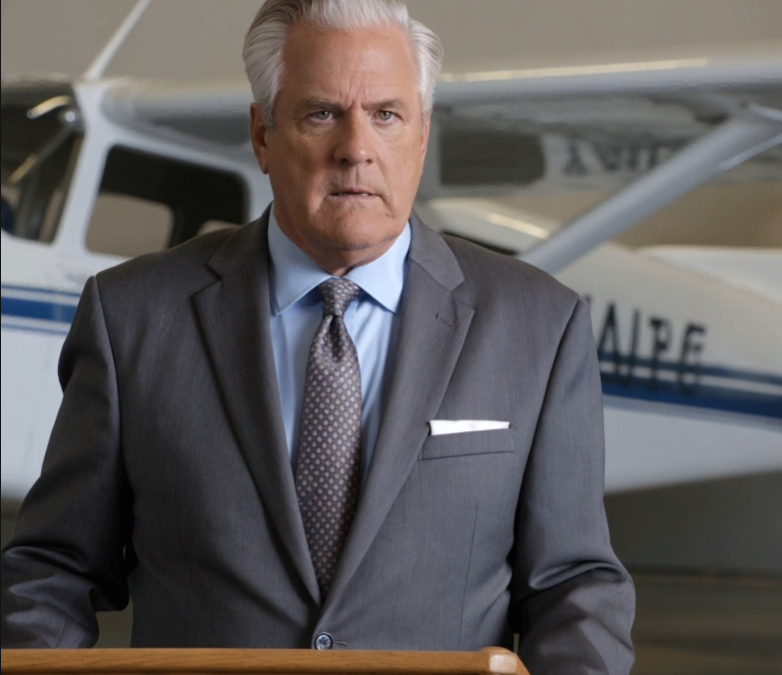
“She’s too pretty to be real military.”
The congressman said it into the microphone, and two hundred people laughed, because he had the microphone and I did not.
His name was Ray Soul. Nineteen years in the House of Representatives, a jaw you could hang a coat on. He was standing at a folding podium beneath the wing of a half-restored Cessna in Hangar 12 at Cobb Ridge Field, at the graduation of nine mechanics my husband had died training. My husband was his son.
He pointed his reading glasses at me across the folding chairs. “My daughter-in-law here likes to tell folks she flies airplanes for the government.” He smiled at the front row. “Look at her. Bless her heart.”
I was holding a paper cup of coffee I hadn’t touched. I didn’t put it down. I didn’t say anything.
Then the man in the dark suit at his shoulder leaned in and said nine words into his ear, and I watched a United States congressman lose the color in his face.
That man was on Ray’s own payroll. He had stood three feet behind that podium for eleven months, and nobody in the district had ever heard him speak out loud.
Fourteen months before that, I was seven thousand miles away in a windowless room that smelled like burnt coffee and hydraulic fluid, holding a helmet by the chin strap and waiting for a weather briefing.
A staff sergeant put his head around the door and said my name, not my rank. My name. The way you say it when you already know.
“Ma’am, there’s a call routed through the command post. Missouri number. They said it’s family.”
I set the helmet on the table upside down, the way you’re not supposed to. I remember that because Nathan would have said something about it. He always did.
Hollis Bird was on the line. Sixty-three years old, thirty of them spent under airplanes, with a voice like a rasp dragged across aluminum. He told me Nathan had gone down on the shop floor at 10:09, between the tool chest and the wing stand. He told me the ambulance had taken eleven minutes and that those eleven minutes had not been the problem.
“He didn’t suffer, Marin.” He drew a long breath. “I want you to have that. I was right there. It was his heart. It was fast. And he was standing in his own shop with a torque wrench in his hand. If you’d asked him where he wanted to be, he’d have said right there.”
I said, “Okay.”
Then I said, “Hollis, don’t let anybody move his bench.”
That was the whole thing. That was what I said to the man who had just told me my husband was dead.
I flew the next morning. The flight was scheduled, and I was the one scheduled to fly it.
Nathan Soul was forty-seven, an airframe and powerplant mechanic since he was twenty-two, and he had spent his last six years building something out of a leased hangar and a bad idea.
Veterans came off active duty having turned wrenches for a decade, with nothing on paper that said so. No certificate. No license. So Nathan built a program that ended with the federal certification that would allow a man who knew how to fix airplanes to be officially qualified to do it.
He called it the shop. Everybody else called it Hangar 12.
When he died, he had nine students, a memorial scholarship fund holding $186,000 raised in three weeks by people who knew him, and a company called Soul Aeroworks that owned the tooling, the leasehold, and the two airplanes the students learned on.
I flew home a week later.
Hollis met me at the shop door with a coffee can full of keys and put it into my hands like it weighed something.
“Nobody’s touched the bench,” he said. “Everybody wanted to. I told them what you said.”
The bench had a rag folded on it. A torque wrench set to a value, never reset. A phone charger. A cold cup of coffee somebody had had the sense to leave where it was.
“You want me to run the class till you sort things out?” Hollis asked.
“Run the class.”
“For how long?”
I looked at the wrench and did not pick it up.
“Until somebody tells us to stop.”
Nobody told us to stop for four months.
Then a courier found me in the gravel lot outside the shop at 8:40 on a Tuesday morning, in the rain, with the hangar door half raised behind me.
“Marin Ellison?”
“That’s me.”
He handed me an envelope, told me to have a good day, and got back into a Corolla with a dealer plate.
I read it standing up.
Ray Soul had filed to take control of Soul Aeroworks. Attached was a two-page amendment to the operating agreement, dated February 2, signed by Nathan and notarized by a woman named Dana Puit. It assigned sixty percent of the company to his father as repayment of capital.
Two months before Nathan died. Sealed and stamped.
There was a buyer, too. A distribution company out of Kansas City had made an offer on the leasehold and the ground rights. Two million four hundred thousand dollars, closing in thirty-one days, contingent on clean control of the company.
Sixty acres. Four hundred jobs. No airplanes.
Hollis came out with a rag in his hands and read it over my shoulder without asking, which he had earned.
“Thirty-one days.” He folded the rag in half. “Well, that’s not nothing.”
“It isn’t much, either.”
If the sale closed, the students had no shop. The training airplanes went to auction. The scholarship went wherever a majority member said it went. And six years of my husband’s life became a slab of concrete with a truck dock on it.
I drove to Ray’s district office, and I did not call first.
It was a converted bank building on Fourth Street with a flag out front. Ray came out of the back with his sleeves rolled up and a legal pad in one hand, and he did not look surprised.
“Marin.” He gestured toward a chair.
I stayed standing.
“You’ve talked to a lawyer, I assume.”
“I’ve talked to a courier.”
“I put three hundred thousand dollars into that field in 2019.”
He set the legal pad on the corner of the desk and squared it with two fingers.
“Nathan couldn’t get a bank to look at him. I co-signed a note I had no business co-signing, and I wrote a check my wife didn’t know about for eleven months. I did it because he was my son, and he had a dream, and dreams are expensive. There was never any paper. That was my mistake, and I’ve owned it. He and I fixed it in February. That’s the whole thing.”
“He never mentioned it.”
Ray smiled the way you smile at a heckler.
“Sweetheart, he didn’t mention a lot of things to you because you were in Nevada, and then you were overseas, and then you were somewhere you couldn’t tell us about for eleven months out of his last fourteen. I counted because I was the one in the chair.”
That was the true part. That was the part I could never get a hand on.
“And the buyer?”
“The buyer is four hundred jobs in a county that lost a plant. I don’t apologize for that.”
He picked the legal pad back up, and that was the end of the meeting.
My name is Marin Ellison. At the time, I was forty-one, and I had been in the Air Force for twenty-two years, which is long enough that people stop asking why.
I fly the big, ugly ones. Heavies. The airplanes nobody puts on a poster. The ones that carry gas and cargo and people who have to be somewhere, and land at night in weather with no second chance at the runway.
For six years, I’d been on the test side, which means I fly airplanes that have been modified and are not yet trusted. And I write down what they do.
Nathan’s family did not know any of that. Not one piece of it.
That was my call. I made it in 2016. And I’ll tell you exactly why, but not yet.
There was one more Soul.
Elias was Nathan’s son from his first marriage, nineteen years old, a sophomore at the state university an hour east, with his father’s hands. He’d lived with Ray and Carol for two years in high school when his mother moved to Arizona. He called Ray Pop.
I drove out to campus in September with a box of Nathan’s things. I thought he should have the sockets, a jacket, and a photograph of the two of them beneath the Cessna’s wing.
We sat on a concrete bench outside his dorm. He went through the box slowly, and when he got to the jacket, he held on to it.
“Pop says you’re suing him,” Elias said.
“Your grandfather sued me.”
“That’s not—”
He stopped, turned the jacket over, and looked at the sleeve.
“There’s a thing about February that I—”
His phone lit up on the bench between us.
He looked at it, put the jacket back in the box, and stood.
“I’ve got a lab,” he said. “Thanks for the stuff. Really.”
I sat on that bench for ten minutes after he was gone.
That was the first time. I counted them later, the way you count things later.
I hired a lawyer named Ruth Kettleman. Sixty-one years old, with an office a floor and a half above a dental practice. A woman who wrote on paper and made you wait while she did it.
She filed an objection and told me not to expect a courtroom to move at the speed of a closing date.
Ray did not stop at the courthouse.
Cobb Ridge Field sits on county ground, and the shop’s lease came up for renewal every three years. It had renewed since 1988 without anybody reading the file.
In October, it went sideways.
I sat at the back of that meeting on a folding chair in a room with a drop ceiling and a water stain shaped like Illinois.
Elias was there in a collared shirt beside Ray.
A commissioner named Dell Strong read a prepared question off an index card. He asked whether the board should renew a lease held by a company whose management was—and he read this part directly—“the subject of an active federal inquiry.”
There was no inquiry.
There had never been an inquiry.
I stood up and said so.
“There is no inquiry.”
Four words.
Dell Strong looked at his card again and said the board would table the item pending clarification.
Elias started to lean forward. I saw him do it. He got about four inches before Ray put a hand flat on his forearm without turning his head, the way you’d steady a glass on a table.
Elias sat back and looked at the floor.
Along the back wall stood a man in a dark suit with his hands folded, watching the doors instead of the speakers. I noticed him the way you notice furniture.
Nineteen years in Congress, and now Ray Soul traveled with somebody.
I got to my truck at 9:40 that night, put the key in the ignition, and did not turn it.
Forty minutes.
That’s how long I sat in the cab of a Ford in a public parking lot with my hands at ten and two on a steering wheel that wasn’t going anywhere.
There was a receipt in the cup holder in Nathan’s handwriting, and I picked it up and read it eleven times.
Hollis knocked on the glass. I rolled the window down four inches.
“You’ve been out here since the meeting let out,” he said. “I know because I’ve been standing by my truck since the meeting let out, on account of I couldn’t make myself get in it either.”
He looked across the lot.
“That man said the word inquiry in a public building. Marin, there are people in this county who will hear that word and never hear the next one. So you can sit here. That’s fine. But sit here on purpose. Don’t sit here because you’re stuck.”
“I’m fine, Hollis.”
He looked at me a second longer than was comfortable, tapped the roof twice with his knuckles, and walked off across the lot.
I put the receipt back in the cup holder, face down.
I told myself I stayed because I was angry. I want to be accurate.
I stayed because if I drove, I’d be driving to a house with his boots by the door, and I had gotten very good over twenty-two years at being somewhere else.
The number came at the end of October, and it came from an accountant, not from a person who loved anybody.
Priya Raghunathan kept the shop’s books out of a strip-mall office. She had printouts fanned across her desk when I came in, and she skipped the preamble.
“The scholarship account is at four thousand one hundred dollars.”
“It had a hundred and eighty-six thousand.”
“It had a hundred and eighty-six thousand on the eleventh of June.”
She turned a page toward me and put her pen on a line.
“On the twelfth, it went out in three transfers to something called the Cobb Ridge Youth Aviation Initiative, which is a real 501(c)(3), incorporated in April, with three board members. One of them is a scheduler in a congressional office. Another is her husband.”
“Who authorized it?”
“A majority member of the LLC, which, per the amendment on file, is your father-in-law.”
She capped her pen.
“I have to say this part out loud because it’s my license. If that amendment is good, what he did in June is legal, or close enough that nobody will touch it. Everything ugly here runs through one piece of paper. It isn’t three problems. It’s one problem wearing three coats.”
A hundred and eighty-one thousand nine hundred dollars moved in a single day out of money people had handed over at a funeral.
“Then it’s one problem,” I said.
I called Elias that night from the shop, sitting on Nathan’s stool with the lights off in the back half of the hangar.
He picked up on the second ring and talked for nine minutes about a thermodynamics professor, a roommate who cooked fish, and a wheel bearing. He talked the way you talk when you’re afraid of the pause.
When he finally stopped, I said, “Elias, did your grandfather ever mention an amendment? February? Anything about February?”
Two seconds of nothing on the line.
Then, “I’ve got to go.”
“Elias—”
“Yeah, I’ve got to go.”
“Okay. Tell Hollis I said hey.”
He hung up without asking me one single question.
Not about the case. Not about the shop. Not about whether I was all right.
A nineteen-year-old boy who had asked me four hundred questions about airplanes since he was eleven, and he did not ask me one.
That was the second time.
At two o’clock in the afternoon on November 8, in a hangar that smelled like degreaser and buttercream, a retired airline captain stepped up to a microphone and welcomed two hundred people to the first graduation Cobb Ridge Field had ever held.
We had gone ahead with it because the students had earned it, and because Hollis said that if we canceled, we would never get it back.
Nine of them. Eighteen months. Two thousand hours. A federal certificate for each.
Juny Alvarez had been a motor transport mechanic in the Army, had a four-year-old daughter, and had driven ninety minutes each way for a year and a half.
Hollis pressure-washed the floor twice.
Somebody’s mother made a sheet cake with a Cessna piped on it in blue icing and got the tail number right.
I had not wanted Ray Soul in the building.
Hollis pointed out that he was a sitting congressman, that he had put money into the field in 2019 and everybody knew it, that half the county board was coming, and that not inviting him would hand him the only story he needed.
Hollis was right.
I sent the invitation myself.
At nine that morning, a woman from Ray’s office called to confirm the room dimensions, whether there was a raised platform, and whether the venue had a second exit for the member’s security detail.
I told her there were four doors and none of them locked.
“Perfect,” she said. “He travels with one gentleman. He’ll be along the wall. You won’t even know he’s there.”
The students crossed in front of the wing one at a time. Juny’s daughter yelled, “That’s my mama!” at a volume you could hear out on the ramp.
Hollis handed each graduate a certificate and a torque wrench with their name stamped into the handle, because that was what Nathan had said he would do.
Then the captain said a few words about Nathan. After that, he announced that the congressman had asked to speak.
Ray Soul came up to the folding podium in a gray suit with the pocket square his wife had bought him.
He was good. I’ve never pretended otherwise.
He talked about the plant that closed in 2011 and the people it took with it. He talked about his son with his hand flat on the podium. And there was a moment when his voice moved, and it was not a technique.
I watched Elias watching his grandfather and saw a nineteen-year-old’s face do something complicated.
Then Ray got to the part he had come for.
“Now, there’s been some noise about the future of this field,” he said. “And I’m going to speak plain because I’m too old not to. The people who built this had a plan, and that plan had a signature on it, and I intend to honor it. Some folks have shown up late with a different idea of what my son wanted.”
Two hundred people got very still.
“You have to be here,” Ray said, “to know what somebody wanted.”
Then he found me by the coffee table.
“My daughter-in-law here likes to tell folks she flies airplanes for the government.”
He put on the smile. He let a beat go by.
“She’s too pretty to be real military.”
Somebody laughed.
Then thirty people laughed. The nervous kind. The kind that’s mostly relief that it isn’t them.
“Look at her,” he said. “Bless her heart. She sends postcards.”
Elias flinched.
That’s the only word for it. His whole upper body went an inch to the left, like somebody had opened a door on him. Then he put both hands on his knees and stared at his shoes.
Forty seconds later, he went out the side door by the parts cage and did not come back in.
I was holding a paper cup of coffee. My thumb went through the side of it, and coffee ran down my wrist into my sleeve. I didn’t move, because moving is a whole sentence.
Ray waited.
He was waiting for me to defend myself, which would have been the end of it. The widow in a hangar, telling a room full of neighbors what a big deal she was somewhere they couldn’t check.
Two hundred people turned around in their chairs to look at me.
I said one word.
“Sir.”
That’s all.
I have been asked about that a hundred times since, and people always want it to have been a strategy.
It wasn’t.
It was the only word that would come out with my voice level, and I had decided a long time before that I would rather be thought a liar than be heard shaking.
Ray nodded, satisfied, and turned back to his notes to close.
And the man in the dark suit, who had stood along the north wall for two hours with his hands folded and had not moved once, walked four steps to the podium and leaned in.
He said nine words.
I didn’t hear them. Nobody past the second row heard them.
Ray Soul stopped talking in the middle of a sentence.
He looked at the man beside him the way you look at a stranger who has just used your first name. Then he looked out at two hundred people, and whatever he had been about to say did not arrive.
The man in the dark suit picked up the microphone off the podium.
He didn’t take the stage. He stepped down onto the concrete floor with it, so he was standing at the same level as everybody else.
“Ma’am, I apologize,” he said to me. “I’ve been told my whole career not to do this.”
He didn’t raise his voice.
People always assumed there was a speech. There wasn’t. He talked at the volume of a man in a small room, and two hundred people leaned forward to hear him.
“My name is Desmond Whitaker. I do protective work for the congressman’s campaign, and today I’m on the clock.”
He turned toward the middle of the room.
“That woman by the coffee is Lieutenant Colonel Marin Ellison, United States Air Force. Twenty-two years in. She flies test aircraft. She has a Distinguished Flying Cross. And I know that because I was in the back of the airplane the night she earned it.”
Somebody in row six said a word out loud that made a mother cover her child’s ears.
“There were nineteen of us,” Dez said. “An engine came apart at altitude and took a piece of the wing with it, three hundred miles from anywhere, at night, over water. I’m not a pilot. What I know is that I was on the floor with a strap in my hands and a man’s blood on my sleeve, and it went on a long time. And then it stopped, and we were on a runway.”
He held up his phone with a photograph on the screen and turned it slowly, the way you show a room something you can’t hand around.
“My daughter turned six in March,” he said. “She’s got a father because that woman didn’t put us in the water.”
Nobody clapped.
It was not that kind of quiet.
Then Hollis Bird stood up in the front row, sixty-three years old, holding a stack of certificate folders against his chest.
“Nathan told me once,” Hollis said. “One time in eight years, we were rigging cables, and he said, ‘My wife flies the ugly, heavy stuff, and she’s better at it than anybody I ever met. And don’t ever bring it up in front of her because she’ll leave the room.’”
He sat down. He put the folders on his knees and squared them.
Now, I’ll tell you why.
Nobody in that family knew.
Thanksgiving, 2016.
Ray asked at the table what exactly it was that I did. I started to answer, and he turned to Nathan and said, “She’s a pilot, Nathan says. Little ones, like a Cessna?”
Nathan opened his mouth.
I put my hand on his arm under the table.
He closed it, and we did the dishes.
I made that call again for nine years, and I would like to tell you it was modesty.
It wasn’t.
I understood exactly what it would sound like. It would sound like a woman who had missed six Christmases producing evidence that she was a hero somewhere else. It would sound like an alibi.
And I cannot tell you, then or now, how much of that was accurate and how much was just an easier place to stand than the empty chair at his appointment.
Ray came down off the platform.
He had to walk the length of the center aisle to reach the doors, because we had put the doors at the back of the seating arrangement. Nathan had wanted people to walk past the airplanes on their way out.
Juny Alvarez stood up as Ray passed her row.
She still had her torque wrench in her hand.
Then the man beside her stood.
Then the woman behind him.
All nine of them, one at a time.
Not saying anything. Not looking at him. Just standing there in a hangar with their names stamped into steel, while a congressman walked forty feet through the middle of the thing he had spent four months trying to sell.
He got to the doors.
He stopped with his hand on the push bar, turned around, and looked back at all nine of them, still standing.
Then he went out into the parking lot.
The door banged, and the sound went up into the roof trusses and came back down.
I found Dez Whitaker by the fuel truck twenty minutes later, with his tie off and his jacket over his arm.
“You knew at the county meeting,” I said. “Three weeks ago, you were standing against the back wall.”
“Yes, ma’am.”
“You didn’t say anything.”
“It’s not my business who a principal argues with. That’s not the job.”
He looked out at the ramp.
“I told myself that three weeks ago, and I believed it. Then he said that thing about how you look, in a building your husband built, in front of a room of people who’d have to decide what to think about you on Monday. And I stood there four seconds doing math about my mortgage.”
He shrugged one shoulder.
“I won’t pretend the four seconds didn’t happen.”
“You’re fired.”
“I’ll get the call tonight. There’s always work for a guy who watches doors.”
He shook my hand with a grip like a man who had spent time holding on to things.
Which was when Alton Ree walked over from the parking lot with his phone in his hand.
Ree was Ray’s attorney. Sixty years old, wearing seersucker in November, a man who had driven up from Jefferson City that morning and had watched all of it from the sidewall.
He waited until the aisle cleared.
He was perfectly polite. That was the worst of it.
“Colonel,” he said, and he got the pronunciation right and everything. “That was a hell of a thing. I mean that. I’ve got two nephews in the Guard. Mr. Ree, I want to make sure you’re not carrying a wrong idea out of this room tonight, because it would cost you money. And I don’t like taking money off people who don’t have to lose it.”
He put his phone in his pocket.
“Nobody is going to dispute your service. Not tomorrow, not in a filing, not ever. And it has nothing whatsoever to do with the case. A gentleman in a suit says you’re a decorated officer. Fine. He didn’t say you’re a member of that company. He didn’t say the February amendment is invalid. He didn’t say one word about the document because he doesn’t know anything about the document.”
He nodded toward the hangar, the folding chairs, and the cake.
“A medal is not a signature,” he said. “I’d hate for you to spend the next four weeks thinking it was.”
And the thing about it is that he was right.
Ruth Kettleman had the amendment on her desk under a magnifier the next morning.
And she did not tell me it was going to be all right.
“I’ve had eleven calls since seven, including two reporters and a man who wants to donate a lawn mower,” she said. “Here’s what none of it changes. That document carries your husband’s signature. And I have no reason yet to think the signature isn’t his. It carries a seal, and Dana Puit is a real notary with a live commission out of Marston. And her journal has an entry for a signing on the second of February.”
She tapped the document.
“That’s a wall. You can pay forty thousand dollars for a handwriting expert to tell a judge the signature is probably genuine, and then you’ll have paid forty thousand dollars to lose.”
“So what breaks it?”
“Something that shows that page came off a different document.”
She set her glasses on the blotter.
“Or nothing. That’s a real answer. Then we negotiate, and you get eleven cents and a hangar full of memories.”
Twenty-six days.
Two days after that, I ran into Elias in the parking lot of the pharmacy on Route B.
It was raining, and we were both walking to our trucks. He had a paper bag in one hand and his keys in the other, and he stopped dead when he saw me, like a man who had come around a corner into weather.
“I saw the video,” he said. “Somebody’s aunt put it on Facebook. Four hundred thousand views. I’ve been told he hasn’t come out of the study since Saturday.”
He shifted the bag to his other hand.
“Marin, in June there was—he had papers on the desk, and I came in for the stapler, and there was a—”
His phone went off in his jacket.
The ring came through the fabric, loud, an old-fashioned bell tone. The kind you assign to one person so you know without looking.
He didn’t look.
He knew.
“I’ve got to take this,” he said.
He got into his truck with the door half closed and the rain coming in on his leg. He was still saying, “Yes, sir,” when he backed out.
I stood in the pharmacy parking lot and got wet and thought about a stapler.
The thing that broke it happened on an ordinary Wednesday in the shop at eleven in the morning, with the compressor running.
Juny Alvarez had stayed on to help set up the records room for the second class.
Records are the unglamorous half of the trade. Every repair, every part, every signature, kept for the life of the airframe.
She had four binders open on the layout table and a cup of coffee going cold beside them.
“He’d have hated this,” she said, tapping a binder.
“No, he’d have loved it.”
“He was a lunatic about it. You know, he made us photograph every single page before it left our hands. Every page. Work order, invoice, didn’t matter. Before you hand it to anybody, you shoot it on the bench. All four corners in the frame. He said paper walks.”
I put down the box I was holding.
“He said paper walks?”
“All the time. Said it was because of a shop in Springfield in 2011 that told him he never authorized a repair, and he couldn’t prove different. Cost him eleven thousand dollars and a friend.”
She looked up.
“Why?”
Nathan photographed things because he did not trust the world to remember them accurately. He wanted a picture because a picture is what’s still there afterward, whatever anybody says about it later.
“Juny,” I said, “where did the pictures go?”
The shop phone backed up to the office computer under the front window automatically, over the shop Wi-Fi, the way Nathan had set it up in 2018 and never touched again.
Hollis had the password on a strip of tape under the keyboard tray, because of course he did.
Eleven thousand four hundred photographs.
Six years of a man’s hands.
We sat at that desk from noon until almost six, Hollis and me, scrolling backward.
Cylinders. Rivet lines. A cracked bracket with a quarter beside it for scale. Elias at fifteen, holding a pushrod like a sword. Six hundred documents photographed flat on the bench, with the vise in the corner of every frame.
Hollis found it.
He put one finger on the screen and did not say anything for a second.
Then he said, “Marin.”
August nineteenth.
Four photographs in a row, taken at 4:39, 4:40, and 4:41 in the afternoon.
A four-page bill of sale for a 1978 Cessna 182, N-number and all, sold to a man in Chillicothe.
Nathan’s left hand was in the bottom of the frame, holding the page flat. Wedding ring. A split thumbnail he’d had since June.
Page four was the signature page.
It was the same page.
Not a similar page.
The same one.
His signature, with a little break in the downstroke of the S. A coffee ring across the lower left corner. Three staple holes along the top edge. A scratch in the bench varnish visible beneath the paper.
Five months later, that page was page two of a document Ray Soul had filed with a court, dated February 2.
I sat back in a rolling chair in a dark office and looked at my husband’s hand.
“He took the back page off an airplane sale,” Hollis said.
I didn’t answer.
“Marin. He took the back page off an airplane sale.”
Ruth Kettleman looked at those four photographs for eleven minutes without speaking, on a Thursday in an office above a dental practice, with a drill going somewhere below us.
Then she called her paralegal in and told her to clear the afternoon.
“Here’s the whole thing in plain English, and I want you to be able to say it to a neighbor at the gas station,” she said. “Nobody forged your husband’s name. That’s what made this so good.”
She laid the photographs beside the amendment.
“The signature is real because he really signed it on a bill of sale for an airplane in August, on that bench. Somebody kept that last page, typed two new pages to sit in front of it, dated the new pages February second, and walked the stack to a notary.”
She pointed to the photograph.
“This shows the exact same sheet of paper attached to a different document five months earlier. Same coffee ring. Same three staple holes.”
She leaned back.
“And the notary. The notary is where it dies. Her journal says she witnessed a signing. She cannot have witnessed that signing, because the page was already five months old and stapled to something else.”
She picked up her pen.
“Either she watched a man sign a page that already had his signature on it, which is a trick I would pay to see, or she stamped something somebody handed her.”
She capped the pen.
“Yesterday, your father-in-law had a paperwork problem,” she said. “This morning, he has a forged instrument. And those are not the same animal.”
Dana Puit gave a statement eight days later, with her own lawyer beside her and a box of tissues on the table.
She went through most of nine years notarizing for the district office. She said she’d been handed a stack of papers and told the signer had come in on a Tuesday, and that she had not checked.
Afterward, she asked whether she could go, and everyone said yes.
So she went.
The case ended in a conference room, which is where cases actually end.
Ray Soul signed a consent judgment on December 3, voiding the February amendment.
The distribution company’s offer expired on its own terms nine days later and was not renewed.
The Cobb Ridge Youth Aviation Initiative returned $181,900 to the scholarship account in two payments, the second one late.
The Secretary of State accepted Dana Puit’s surrender of her commission and referred the file to the county prosecutor, who is still deciding.
The House Committee on Ethics opened a preliminary review on January 12.
In February, Ray announced he would not seek a tenth term.
He cited his family.
The county board renewed the shop’s lease for three years, five votes to none, and Dell Strong made a point of shaking my hand in front of a local news camera, which I let him do.
Nobody went to jail.
I want to be accurate about that because people always want a cell door at the end.
There was no cell door.
There was a signature on a consent judgment, a surrendered commission, a returned wire transfer, and a man of sixty-eight who had to tell his wife.
Elias came to the hangar on a Tuesday night in December, three weeks after the consent judgment, and stood outside the fence for a while before he came in.
I knew he was there. You can see the whole approach from the office window, and there is not much traffic on that road in December.
He came in through the personnel door carrying a canvas bag and set it on the bench, on the rag beside the torque wrench nobody had moved in fourteen months.
“That’s his headset,” he said. “It’s been in Pop’s garage. I took it. I’m not sorry.”
“Okay.”
“In June, I came into the study for the stapler.”
He said it fast, the way you go into cold water.
“There was a stack of paper on the desk and a page off to the side by itself, and it had a coffee ring on it. And Pop put a magazine over it while I was standing there. He put a magazine over it.”
He looked down at the bench.
“And in August, he sat me down, and he told me the way it was going to be. That you were never here. That Dad was alone. That you’d come back for the money when it was easy.”
He was looking at the bench, not at me.
“I was in the room,” he said. “For all of it. And I never said one word to you or to anybody for six months.”
I didn’t say anything.
And this time it wasn’t armor.
There wasn’t anything to say yet.
“He raised me for two years,” Elias said. “He drove me to every practice. I’ve been trying to figure out why he did it since June, and I’ve thought about it every day, and I don’t know. I don’t know why, and I’m his grandson.”
“I don’t know either.”
“You’re not going to tell me it’s okay.”
“No,” I said. “It isn’t.”
He nodded.
He stood there with his hands at his sides in a cold hangar.
“Come Tuesday,” I said. “Six a.m. Bring gloves.”
He came that Tuesday at ten minutes to six, in the dark, wearing his father’s jacket and carrying a pair of gloves still stiff from the package.
We took the inspection panels off the underside of the left wing, which is forty screws and a bad angle and the least glamorous work in the trade.
He held the light.
Neither of us talked for the first hour.
The compressor cycled twice, and the sun came up over the east door and put a stripe of orange across the concrete.
Around 7:30, he said, “Was he good at this? Or is that a thing people say?”
I backed out from under the wing and sat up on the creeper.
“He was slow,” I said. “He was the slowest man in any shop he ever worked in, and it drove people crazy. And it’s why nothing he ever signed came back.”
I looked at the open inspection panel.
“He used to say, ‘The airplane isn’t in a hurry. It’s just sitting there.’”
Elias listened.
“Your father was the most patient person I’ve ever met. And he was patient about me, too, which is a harder thing. And I did not always deserve it.”
Elias took the last screw out and held it in his glove, looking at it.
“Forty?” he said.
“There’s forty.”
“There’s forty.”
He put them in a coffee can the way his father did.
And he hung the headset back on the hook by the door before he left, which nobody had asked him to do.
Ray came out to the field once in the middle of January, wearing a wool coat, and stood at the open hangar door while I was under the wing of the 182 with a light in my mouth.
I came out from under it.
I did not put the light down.
“Did you know the page was his?” I asked.
“I put three hundred thousand dollars into this ground when nobody in this county would take his phone call,” Ray said. “I’m sixty-eight years old. Everything I have ever done, I did for one of you people, and not one of you ever—”
“That isn’t what I asked.”
He stood there for a second.
Then he turned around and walked back to the car, and his driver got out and opened the door for him because that was the driver’s job.
And I went back under the wing.
The second class started on February 9 with fourteen students, three of them women, one of them fifty-one years old.
Elias comes on Tuesdays and Saturdays.
He’s not enrolled.
He sweeps. He breaks down cardboard. And about once an hour, he asks a question that takes twenty minutes to answer.
In April, he pulled a cylinder with Hollis standing over him.
When it came free, he set it on the cart and looked at it for a long time.
And Hollis said, “Your dad did that same face.”
A postcard came in March from a hospital in Tulsa. No return address. A picture of a lake on the front.
Dez Whitaker was running an overnight security desk.
His daughter had turned six on the eleventh, gotten a bicycle, and did not want the training wheels.
“Work is work, and doors are doors,” he wrote.
He did not ask for anything.
We printed one of Nathan’s photographs and put it in a plastic sleeve above the bench.
Not the signature page.
One from the same afternoon.
His left hand flat on a piece of paper, holding it down, the vise in the corner of the frame, the light coming through the west door at four in the afternoon.
Juny Alvarez looked at it once and said, “He knew somebody was going to need that someday.”
He didn’t.
That’s the part I keep coming back to.
He wasn’t protecting himself from his father.
He was protecting himself from a shop in Springfield in 2011.
And he took eleven thousand four hundred photographs for a reason that had nothing to do with any of this.
And one of them turned out to be the only thing left on Earth that could tell the truth about him.
I picked up the torque wrench in June, fourteen months late, and reset it to zero, which is what you’re supposed to do.
Then I put it in the drawer where it lived.
People will tell you what you look like.
They will be certain about it, and they will be loud, and some of them will have a microphone.
It doesn’t move one rivet.
The airplane doesn’t care what your face is.
It only ever asks whether you did the work.
I’ve told you all of it now, and I’d rather not be the only one talking.
If you stayed with me this far, tell me what stuck with you most. The nine of them standing up in that aisle, the man on the phone talking about his daughter, or the photograph of a hand holding down a page.
Tell me in the comments, and tell me where in the world you’re listening from tonight.
If this one reached you, subscribe and stay for the next.








