“This is my base, and you’re trespassing.” The colonel didn’t rise from his chair. “MPs are on the way.” I stood there while he called the Pentagon himself to have me removed, reciting my name like a complaint. “Yes, refusing to leave my office.” The voice on the line stopped him mid-sentence. He set the phone down and looked at me differently. “You’re telling me she’s what?”
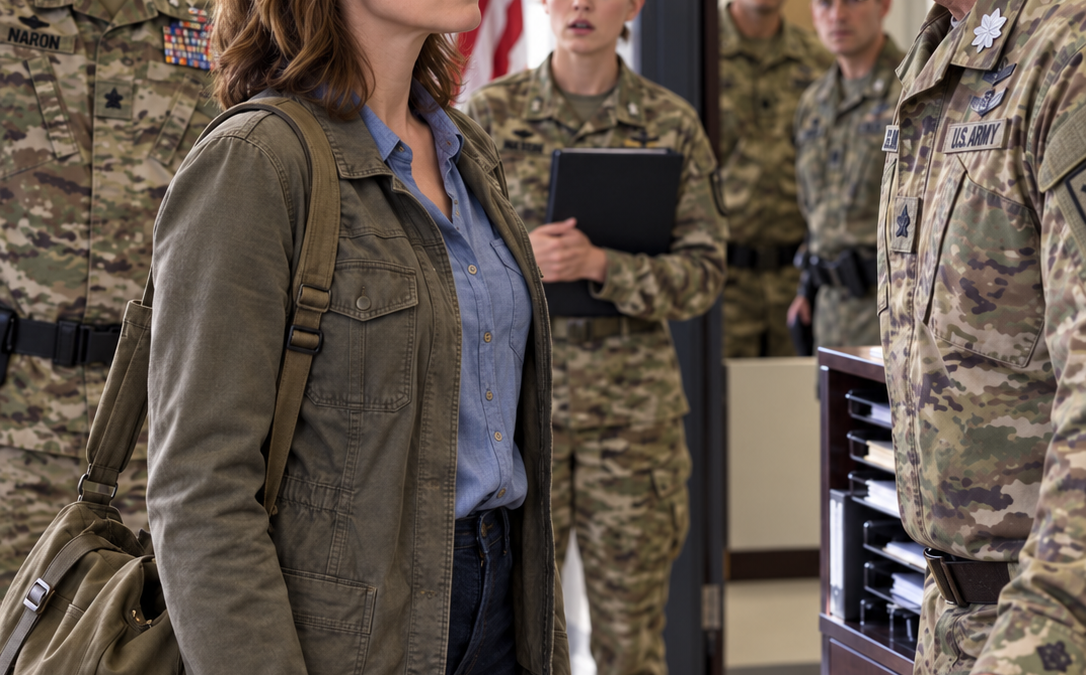
I could have ended it there.
I had a folded set of orders in the outer pocket of my bag and a military identification card in my wallet with a gold bar of rank printed beside my photograph, and either one would have turned the morning around inside of thirty seconds.
I did not reach for them.
Partly because I had learned a long time ago that the truth does more when it arrives on its own weight than when you shove it across a table. And partly, if I am honest, because I wanted to see how far the man would take something he was so sure of.
He took it all the way.
He turned to the desk against the wall, the kind of shared administrative desk that sits outside every command suite in the Army, and picked up the phone.
He did not lower his voice. He wanted me to hear it. He wanted the captain to hear it, and the two staff officers who had drifted to the doorway of the operations bay to hear it, and anyone else within range to understand that a problem had appeared and he was the solution.
“This is Lieutenant Colonel Cronin, acting garrison commander,” he said into the phone. “I need to report a security issue at the headquarters. I have a woman up on the command floor refusing to leave. No identification, no appointment.”
He glanced at me, and there was something close to enjoyment in it.
“She’s giving a name. Merrick. Diana Merrick. M as in Mike. E-R-R-I-C-K.”
He spelled it out like a citation, like he was reading a charge sheet.
“Yes. Refusing to leave my office. I’d like her removed.”
There was a pause while the other end of the line did whatever the other end of the line does.
I watched his face during that pause because his face was the only thing in the hallway that was about to change.
It changed.
It started at the mouth. The small, pleased set of his lips went flat. Then his eyes, which had been sliding over me like I was furniture to be moved, came back and held on me in a completely different way.
The captain saw it before I did, I think, because she had spent enough time near this man to read the weather in him, and the weather had turned.
He said, “Say again,” into the phone.
Then he said, “Wait. You’re telling me she’s what?”
He set the receiver down on the desk very slowly, as if it had become heavier than a phone should be.
The hallway did not move.
Nobody in it moved.
Two hours earlier, before any of that, I had driven onto the installation alone in the gray light before the sun cleared the tree line, and I had done it on purpose.
I had three days before I was due to take command. Three days before the folding chairs and the small stage and the colors passing from one set of hands to another while a band played and families squinted into the sun. Three days before the post learned my face from a program and a podium.
And I had wanted, before all of that, to see the place the way you can only see a place when nobody is performing for you.
To drive its roads while they were empty. To read its signs. To stand in front of the buildings and feel their age.
A commander who only ever sees her ground from a stage does not really know it. And I had promised myself a long time ago, and for reasons I will get to, that I would never command from a stage alone.
So I had flown in the night before under my own name, with no aide and no driver, rented a plain sedan at the airport, slept badly in a chain hotel off the highway, and come through the main gate at dawn with my identification card and a temporary pass and a guard who waved me through without a second look.
Because at that hour, the guards wave everyone through who has the right sticker and the right tired face.
I drove the loop road first. Motor pools still dark. A company of soldiers running in formation along the shoulder, their cadence coming through the closed windows as a low, rhythmic pulse, the same one I had heard on a hundred posts across two decades.
The sound of the Army waking up.
I passed the commissary and the chapel and the little strip of fast food that every installation grows at its edges. I passed the airfield, and I slowed there because the airfield is my country.
I had spent the best and worst hours of my life in aircraft, and a flight line at dawn will always be the place my chest loosens.
I got out of the car there and walked a little way onto the edge of the airfield, where a person is allowed to walk without setting anything off. I watched the medevac pad in the distance, where a single aircraft sat under its cover, blades tied down, waiting the way those aircraft always wait.
A crew was doing a preflight inspection in the half-dark. Three small figures moving around the airframe with the unhurried thoroughness of people who know that thoroughness on the ground is what buys speed in the air.
One of them was inspecting the tail rotor with a flashlight, running a hand along the edge of each blade the way you check something you intend to trust with your life in an hour.
I stood and watched them do it, and none of them knew that the woman at the fence line was about to be their commander.
I preferred it that way.
You learn more about a unit from watching it work when it does not know you are there than from any briefing anyone will ever give you.
That crew was squared away. Whatever else I found on this post, that crew, at that hour, in the cold, was doing the job right. I filed it away as the first true thing I knew about the place, earned rather than told.
I stood there until the sky went from black to the flat gray that comes before real light. Then I made myself leave the fence because I had one more stop before headquarters, and it was the one I had really come for.
I parked near headquarters and walked, before going inside, to the memorial grove.
Every post has one. A stand of trees, or a curve of low wall, or a garden with a flag where the names of the ones who did not come home are set into stone or bronze.
This one was a grove of young oaks in a half circle around a granite marker, and I had come to find a name on it because I had learned in a briefing packet six weeks earlier that the name was there.
I had not been able to stop thinking about it since.
I found it.
I will get to whose it was.
The grove was still wet with the night when I stood in it. There was a bench and a small stand for flags people had left, the little ones on wooden sticks, faded by weather, and a folded note in a plastic sleeve that I did not read because some things left at a stone are not for a stranger’s eyes.
The names ran across the granite in the order the post had lost them, and I ran my eyes down the column the way you scan a manifest, dreading and needing to find the one you were looking for.
And then it was there, and the dread and the need both went quiet at the same time.
The way they do when something you have been bracing for finally simply is.
I stood in front of it for longer than I meant to. Then I squared the strap of my bag on my shoulder, the way you square yourself before something you have decided to do, and climbed the headquarters stairs, expecting nothing more than an empty office and a quiet hour to sit in a chair that was about to be mine.
I did not expect a man in the hallway who had already decided I was no one.
But I want to be fair to him even now, even after everything, because a version of what he did was his job.
A stranger with no appointment on a command floor is someone a garrison commander is supposed to notice. If he had stopped me, checked me, and been wrong with courtesy, there would be no story.
The problem was never that he stopped me.
The problem was the certainty, the pleasure he took in the size he had assigned me, the way he reached for removal before he reached for a single question that might have told him the truth.
I have thought a great deal over the years about the difference between a man who is doing his duty and a man who is enjoying his authority.
They can look identical for about ten seconds.
After that, they never look the same again.
The reason I did not react the way Lieutenant Colonel Cronin expected has a date on it.
The fall of 2011.
I was thirty years old and a captain and a medevac pilot, which is the finest job the Army ever gave me and the one that cost me the most.
We flew air ambulances out of a dusty forward field, two aircraft and a handful of crews. And our whole reason for existing was the promise we made to every soldier on that ground.
If you fall, we come.
It did not matter how bad the weather was or how hot the landing zone.
If you fall, we come.
You learn to live inside that promise until it becomes the shape of you.
The work has a rhythm the movies never get right. Most of it is waiting. You sit in a tent near the aircraft in your flight gear with a radio turned up, and you play cards badly, and you wait.
And the waiting is not restful because at any second the radio will speak, and the words it speaks will be a nine-line.
The nine short lines of a medevac request. Location and radio frequency and number of patients and how bad and whether the landing zone is safe.
And the moment those words come, you are running before you have finished hearing them.
From the radio call to wheels up, we lived and died by minutes.
The wounded on the other end of that call were living and dying by them, too, more literally. And the number in your head the whole way out was the one that matters most in that work.
The golden hour.
The window inside which a torn-up human being can still be saved if you get them to a surgeon.
Everything we did was a fight against that clock. Every second of my thoroughness on the ground was bought so I could spend it later in the air.
You learn the country from above until it is more familiar than any place you have lived. You learn which valleys go quiet at night and which ones do not. You learn to read a landing zone in the two seconds you have to read it, to see the wires no one warned you about, to find the flat ground in the dark by the shape of the shadows.
And you learn to trust the person in the other seat completely because there is no time to check each other’s work, only time to do your half and trust that the other half is being done.
There was a night that autumn when a company walked into an ambush in a valley we all knew and all hated.
And the calls started coming, and they did not stop.
“Nine-line. Nine-line. Urgent surgical.”
The radio filled up with the worst arithmetic there is, the counting of the wounded, and we spun up and went because that was the promise.
My copilot that night was a chief warrant officer named Elliot Sarno.
He was twenty-eight, and he had a laugh that did not fit inside a cockpit and a baby daughter he had photographs of taped where he should not have taped them.
He was the best stick I ever flew beside.
He used to say that a medevac pilot has exactly one talent worth having, which is the ability to keep your hands steady while your whole body is telling you to leave.
He had that talent.
I learned mine partly from watching him.
He had a way of talking me down when a mission got loud. Not down as in discouraged. Down as in level.
When the radio was full of the worst arithmetic and my heart rate was climbing, Elliot would say something small and dry into the intercom, some observation about the coffee back at the field or the state of my landings.
And the smallness of it would pull me back to the size of the actual task, which was to fly this aircraft to that grid and hold it there and fly it home.
He understood better than anyone I ever flew with that panic is just a failure of scale, the mind making something larger than the hands can manage, and that the cure for it is to make the thing small again, one control input at a time.
I have used his trick a thousand times since, in cockpits and out of them.
I used it in a hallway fifteen years later without even noticing I was doing it.
When Cronin was spelling my name into a phone, some part of me was hearing Elliot’s dry voice telling me that this was small, that I had flown through worse than a rude man on a staircase, and to keep my hands level.
He talked me down from beyond the grave that morning and did not know it, and neither, for a while, did I.
We came into the valley low, and the valley was awake.
I will not narrate the whole of it.
It is enough to say that we took fire on short final, and we took more of it loading, and a ground medic I had never met and could not see clearly in the dark worked that landing zone like the ground was not trying to kill him, loading the worst of the wounded onto my aircraft while the tracers came in flat and bright.
He got them aboard.
All of them.
I have never in my life seen a man work like that.
And on the way out, climbing, a round came through the cockpit, and Elliot Sarno stopped flying.
I flew them home.
The wounded lived, most of them.
That is the part I hold on to.
The medic on the ground had done his half of the promise, and I had done mine, and the arithmetic came out on the side of life for men who had been on the wrong side of it an hour before.
They gave me a Silver Star for that night, for keeping the aircraft flying, for the decisions in the cockpit.
And I accepted it because you do not refuse something like that, but I have never worn it easily.
It is a strange medal to wear, the one you earned on the worst night of your life, the one that has your friend’s absence sewn into the ribbon.
I never learned the ground medic’s name.
In the way of that war, we scattered afterward, and the paperwork that would have connected us went into the great filing cabinet of things nobody has time to reconcile.
And I carried the memory of a man working a hot landing zone in the dark and never had a face to put with it.
Here is what that night gave me.
The thing that matters for this story.
It gave me a sense of scale that I have never been able to lose.
After you have flown out of a valley like that, most of what the world offers up as an emergency does not read as one.
A man in a hallway telling me I did not belong. Telling me he would have me removed. Spelling my name into a phone like a charge.
That was a small thing.
I had buried larger.
I had quite literally buried larger.
And so I stood in that hallway and let it happen. Not because I was weak, but because I had a ruler in my chest that measured things accurately.
And by that ruler, Lieutenant Colonel Cronin was not yet large enough to be worth a reaction.
The phone was about to change his size.
The operations center Cronin had called does not put a lieutenant colonel through to whoever happens to be walking past. It is a serious room, staffed around the clock, and when a garrison commander reports a security issue at headquarters, the report goes up, not sideways.
And it goes up fast because a security issue at headquarters is exactly the kind of thing that ends careers if it is mishandled, and no one wants it to be theirs.
What I did not know, standing in the hallway, and what Cronin could not have known, was who was in that room that morning.
My corps commander was a lieutenant general named Warren Thorp. He was the officer under whose orders I was reporting to take this command. He had interviewed me for it himself across a small table for the better part of an afternoon, and at the end of that afternoon, he had told me why he wanted me and not the others.
The reasons he gave were not the reasons I expected, and I had walked out of his office trusting him, which is not something I do easily.
General Thorp had a habit that made his staff crazy and made his subordinate commanders love him. He dropped in unannounced at odd hours on his own operations centers because he believed, as I believe, that you do not really know a place from a stage.
He had been standing in that operations center that morning, coffee in hand, for no reason other than that he liked to be there, when a call came up the chain about a woman named Diana Merrick refusing to leave the command floor of a headquarters he had personally assigned her to command.
I learned all of this later.
In the hallway, I knew none of it. I only saw the phone come to rest on the desk and the man’s face come apart.
And while it was coming apart, the second thing happened.
There were footsteps on the stairs behind me, unhurried, the heavy, even tread of a man who has walked a great many miles in boots and has nothing left to prove to a staircase.
A command sergeant major came up into the hallway, holding the highest enlisted rank there is. He was a broad man near fifty, with gray at his temples and a chest full of the small, colored evidence of a long, hard career.
He came up talking half a sentence to someone below him, the ordinary business of a morning.
He was the installation’s senior enlisted soldier, and this was his hallway, too. More his than Cronin’s in the ways that matter, because sergeants major outlast the officers who pass through, and they know it.
He saw my face, and he stopped.
I watched it move across him the way you watch weather cross a field. He looked at me the way you look at someone when a part of your mind that has been closed for years suddenly opens, and the thing behind the door is standing in front of you, older, in civilian clothes, in a hallway.
Impossibly.
The color went out of his face the way it goes out of a man’s face when he is looking at something he did not think he would ever see again.
And then, without a word, in a hallway where no order had been given and no ceremony was underway, he came to attention.
Not the sloppy half-straightening a soldier does out of habit. The real thing. Heels together, hands flat, chin level, the whole hard architecture of a body that has stood that way ten thousand times snapping into place because something in him had decided, before his mind had finished the sentence, that this was a moment that required it.
He did not do it because he had read my rank. I was in a canvas jacket, and there was no rank to read.
He did it because he knew my face.
And the room, which had been trying to work out what the phone meant, now had a second thing to work out, which was why the most senior soldier in the building was standing at rigid attention in front of a woman a lieutenant colonel had just tried to have arrested.
Two truths arriving at once, one down the phone line and one up the stairs.
And Marcus Cronin stood between them with his hand still resting on a receiver he had set down too late.
The thing about a room turning is that it does not turn all at once. It turns a person at a time, and you can watch it happen if you are still enough.
I have learned to be very still.
The captain turned first.
Elise Tran, her name was, though I did not know it yet. She was young and sharp, and she had spent however many months learning to survive in the orbit of a difficult man. Survival in that orbit had taught her to read shifts in power faster than anyone else in the building.
She read this one.
Her eyes went from Cronin’s stricken face to the sergeant major standing at attention to me, and I saw her recalculate the entire morning in about two seconds.
Then I saw her take one small step backward, away from Cronin, the instinctive step of a person who has just realized which side of a line she is standing on and would prefer to be on the other one.
The two staff officers in the doorway of the operations bay turned next.
They did not know what they were seeing. They only knew that the sergeant major did not come to attention for civilians, and the acting garrison commander did not go pale for no reason, and that the safest posture available to them was silence.
They took it.
A headquarters staff is a small town, and like any small town, it runs on information about who is up and who is down, who is safe to cross and who is not.
Every soldier standing in that hallway was, underneath the stillness, recalculating the map of the whole post.
If the woman in the canvas jacket outranked the acting garrison commander badly enough that the sergeant major stood at attention for her, then the map they had been living by that morning was already obsolete, and the new map had not finished drawing itself yet.
And the only safe thing to do while a map redraws is to hold very still and give nothing away.
I had seen staffs do this before. I would see this one do it again in smaller ways over the coming months, whenever something shifted at the top.
That morning, it was doing it for the first time on my account, and I watched them do it and thought: These are careful people, and careful is not the same as loyal, and I will have to learn which of them is which.
Cronin turned last, which is the way of it. The person at the center of a collapse is always the last to feel the floor go.
He looked at the sergeant major.
“Sergeant Major,” he said, and his voice had lost the pleasant certainty entirely. “What are you doing standing at attention?”
“Sir,” the sergeant major said.
He did not move. He said it to Cronin, but he was looking at me.
“For the colonel.”
The word sat in the hallway.
Colonel.
It landed on Cronin the way a stone lands in still water, and I watched the rings go out from it across his face.
“There’s a…” He tried to find the shape of the situation and could not. “There’s been a misunderstanding.”
“Yes, sir,” the sergeant major said. “There has.”
I want to describe what the pull felt like in that moment because it is the part of the story that matters most, and it is the part people always skip.
The moment a room turns in your favor, there is a pull on you, immediate and strong, and the pull is toward one of two things.
It pulls you toward mercy that is really a razor, the gracious little wave of the hand that says, “Oh, it’s fine. It’s nothing. Let’s all move on,” which feels like kindness and is actually a decision to let a wrong go unnamed so that everyone can be comfortable again as quickly as possible.
Or it pulls you toward the other thing.
The settling of the score. The enjoyment of the fall. The small speech that puts the man on the floor and keeps him there so the room can see you do it.
Both of those are easy.
That is what nobody tells you.
Erasure is easy, and vengeance is easy, and they are easy for the same reason, which is that they both end the discomfort fast.
The hard thing, the thing that almost no one does, is to stay in the discomfort long enough to name the wrong accurately. Hold the man responsible for exactly what he did, and not one thing more, and then decide what he is worth going forward on the evidence rather than on the adrenaline.
I had a phone on a desk with a lieutenant general on the other end of it who would, if I asked him to, relieve Marcus Cronin before lunch.
I had a sergeant major at attention who would have carried that decision out and slept fine. I had a captain already backing away from the man, ready to be told he was finished.
The whole room was leaning toward the fall.
All I had to do was let it lean.
I have watched other people take that lean over the years, and I have taken it myself when I was younger and did not know better. It always looks like justice in the moment, and it almost never is.
What it usually is, is relief.
The fastest way to end the discomfort of a wrong is to convert it into a punishment because punishment feels like resolution, feels like the ledger closing, and the body wants that closing so badly that it will take a wrong sentence over an open question every time.
I had been on the receiving end of that hunger, too.
I had more than once in my career watched a leader end me a little in front of others because ending me was quicker than understanding me, and it had taught me nothing except how it feels to be spent for someone else’s comfort.
I had promised myself I would not do to my people what had been done to me on the days I was small enough to remember it.
The hallway was the first test of that promise on this post, and Cronin, of all people, was the one who got to receive it.
I did not want to relieve him.
I want to be clear that this was not because I am gentle. I am not especially gentle. It was because I had not yet decided what he was, and I do not throw away soldiers on the strength of ten bad seconds, even ten bad seconds aimed at me.
Ten seconds is enough to convict a man of arrogance.
It is not enough to convict him of being worthless.
Those are different charges, and they carry different sentences.
And the whole art of command, the part they cannot teach you at any school, is refusing to collapse the two into one just because collapsing them would feel good.
So I did not reach for the fall.
I reached for the phone.
“May I?” I said to Cronin.
It was not really a question.
I crossed the hallway and picked up the receiver he had set down, and I turned my back on him slightly, the way you turn from something you have decided is no longer the most important object in the room.
I put the phone to my ear.
“This is Colonel Merrick,” I said.
“Diana.”
General Thorp’s voice was as unhurried as ever.
If he was angry, and he was, it did not show in the tempo. It showed in the precision.
“Tell me where you are and who is standing with you.”
“I’m on the command floor, sir. The headquarters. I came in early to walk the post before the ceremony. I’m with the acting garrison commander and the installation command sergeant major and a captain from the staff.”
“The acting garrison commander,” Thorp said. “That would be Lieutenant Colonel Cronin, who just called my operations center to have my incoming installation commander arrested for trespassing.”
“Yes, sir.”
There was a silence on the line, and it was not an empty silence.
It was the silence of a very senior officer deciding how much of the United States Army to bring down on one lieutenant colonel’s morning.
“I can have him relieved by noon,” Thorp said. “Say the word and it’s done. You should not have to begin a command by cleaning up after a man who treated you like that before he knew who you were, which I would point out is worse, not better, because it tells you exactly how he treats everyone he thinks is beneath him.”
He was right.
That was the sharpest part of it, and I knew he knew it was the sharpest part because he was the kind of man who found the sharpest part on purpose.
Cronin had not been rude to a colonel. He had been rude to a woman he believed to be no one, which meant the rudeness was not about me.
It was about size.
It was about what he did with people once he had decided they were small.
And a man who does that in a hallway does it in a hundred quieter rooms where no general is listening.
“I understand, sir,” I said. “I’d like to handle it myself.”
Another silence.
Then, quieter, almost warm, “You would? All right. It’s your post, Colonel. Three days early, but it’s yours. And how you handle this is going to tell every soul in that building who they work for now. Handle it well.”
A pause.
“And Diana, Acriman is standing there, isn’t he? The sergeant major.”
I looked at the sergeant major, still at attention, and something in my chest, which had been very steady all morning, moved for the first time.
“Yes, sir,” I said. “He is.”
“I thought he might be. Small Army.”
I could hear something in the old general’s voice that had not been there a moment before. Some knowledge he was choosing not to spend over a phone line.
“Ask him about the fall of 2011 when you get a minute. I’ll let him tell it.”
And then, in his ordinary voice, the command voice, he said, “Put me on speaker, please, Colonel. I have something to say to the room, and then I’m going to get off your post and let you run it.”
I set the phone in its cradle and pressed the button for the speaker.
The small mechanical click of it was very loud in the quiet.
And Lieutenant General Warren Thorp’s voice came into the hallway where everyone could hear it.
“This is Lieutenant General Thorp,” he said.
I watched Cronin’s spine straighten on reflex, the body obeying a rank the mind was still catching up to.
“I’m the corps commander. Some of you know my voice. For the ones who don’t, you’ll learn it. I’m speaking to everyone within range of this phone, and I’m going to say this once.
“The woman standing in your hallway is Colonel Diana Merrick. In three days, she takes command of this installation. She takes command of you.
“I selected her for it out of a field of officers who would have given a great deal for the job. And I selected her because I have watched her make hard calls under pressure that would have taken most people apart, and make them right, and make them without needing anyone to watch her do it.
“She came onto her own post early and alone this morning for the same reason I drop in on my own operations centers unannounced, which is that neither of us believes you can command a place you only ever see from a stage.
“She was met on her own command floor by an officer who decided, without asking her a single real question, that she was no one, and who reached for the military police instead of his own courtesy.
“I want every one of you to sit with that. Not because of who she turned out to be, but because of who he thought she was.
“The measure of an officer is how he treats the people he believes can do nothing for him. You just watched one take that test in a hallway. Remember the grade.
“Colonel Merrick has asked to handle this herself, and she will, because it is her post now and her decision to make.
“I’m going to get off the line. Serve her well. Thorp out.”
The speaker clicked off.
For a moment, no one said anything.
A general officer’s voice leaves a kind of pressure behind when it stops, the way a large aircraft leaves the air moving after it passes.
And the hallway sat in that moving air.
Then the sergeant major, who had held attention through the entire speech, spoke without being asked.
He spoke to the two staff officers and the captain, not to me, because he understood something about what the room needed that even Thorp had not supplied.
It needed the other half.
It needed to know not only who I was on paper, but who I was in the one place paper cannot reach.
“In the fall of 2011,” he said, “I was a ground medic in a valley I won’t name, on the worst night of my life, loading wounded onto a medevac aircraft that was taking fire the whole time it sat on my landing zone.
“The pilot of that aircraft held it on the ground while I loaded soldiers who should not have lived, and then flew them out through more of the same and lost her copilot doing it.
“I never got her name that night. I have wondered about her for fifteen years.”
He looked at me, and the granite in his face had a crack in it now.
One clean crack.
“It was you, ma’am. I’ve been standing at attention because I recognized your face before I understood anything else. I’d have stood there whether you were a colonel or a private.”
I have been given medals in front of formations. I have had my name read from stages.
None of it ever reached me the way that reached me.
A sergeant major in a hallway telling a room that he had been on the other end of the worst night of my life and had carried it as long as I had.
The grove downstairs, the name I had come to find, the medic I never met.
They closed the loop right there in front of a man who had tried to have me arrested, and I had to stand very still to keep my face in order.
Marcus Cronin had gone from pale to something worse than pale.
He had understood all at once not only who he had tried to remove, but what he had tried to remove her from.
It is one thing to be rude to a colonel.
It is another to learn in the same three minutes that the woman you spelled into a phone like a criminal had flown your soldiers out of a valley under fire while you were still a lieutenant somewhere safe.
The gap between the size he had assigned me and the size I actually was did not just close.
It fell on him.
“Colonel,” he said.
The word came out rough.
“I… There’s no excuse. I’m not going to offer one.”
That was the first thing he had done all morning that I respected.
A man reaching for an excuse in that moment would have told me everything I needed to know. A man declining to reach for one had at least a floor under him.
“No,” I agreed. “There isn’t.”
The hallway waited.
This was the moment the room had been leaning toward since the sergeant major came to attention. The moment where the new commander puts the old authority on the floor.
I could feel every person in earshot expecting it, some of them wanting it because Cronin had clearly not been an easy man to work for, and there is an ugly little pleasure in watching a hard boss meet a harder truth.
I have felt that pleasure myself. I know its taste.
I did not intend to feed it.
“Let’s be precise about what happened,” I said, “because precision is the only thing that’s going to be useful to either of us.
“You did not fail to recognize a colonel. Ranks travel in civilian clothes, and no one can be faulted for that.
“What you did was decide, in the absence of any information, that a woman standing quietly in a hallway was beneath your courtesy, and then act on that decision with enthusiasm.
“You reached for removal before you reached for a question.
“That is the thing I’m holding you to. Not the mistake about my rank. The choice about my worth.”
He took it standing.
I will give him that.
Some men crumble, and some men bluster, and a rare few just stand there and take the accurate weight of what they did.
And he stood there and took it.
“You’re right,” he said.
“I know I’m right. The question in front of me is not whether you were wrong this morning. That’s settled. The question is what kind of officer you are the other 364 days a year.
“And I don’t have that information yet. I am not going to pretend I do just because you handed me a good enough reason to end your career before lunch.”
I let that sit.
“General Thorp offered to relieve you. I told him no. Do you understand why?”
“No, ma’am,” he said. “Honestly, no.”
“Because relieving you would be the easy thing, and the easy thing is almost never the command thing.
“If I relieve you this morning, I get to feel powerful. The staff gets a story, and you get to spend the rest of your life believing you were destroyed by a technicality, by luck, by a woman who happened to outrank you.
“You would learn nothing because ruin teaches nothing. It just ends.
“I’m not interested in ending you. I’m interested in whether you can be better. And you cannot answer that question from the unemployment line.”
I did not let him off.
I want to be clear about that because there is a soft version of this story that people prefer, where the wronged woman is so noble she simply forgives.
That is not what happened, and it is not what should happen.
What happened was this.
That afternoon, once I had a desk and the actual authority to sit behind it, I brought Lieutenant Colonel Cronin in alone, and I gave him a formal counseling in writing that laid out exactly what had occurred in the hallway in language neither of us would enjoy rereading.
It went in his file.
It named the behavior precisely. Not a failure of identification, but a failure of character. The treatment of a presumed subordinate as a nuisance to be removed rather than a person to be addressed.
I made him read it in front of me.
I made him sign it.
There was no comfort in the room while that happened, and I did not offer any because comfort would have undercut the point.
And then, when it was signed, I told him the other half, which was that the counseling was a floor and not a grave.
I told him I had read his record before I ever set foot on the post because a commander reads the records of the officers she is inheriting, and that his record was, apart from a certain reputation for running people hard, a good one.
The installation had, in fact, run well under him through a difficult leadership gap, and competence is not nothing. I do not throw competence away lightly.
He had a real problem, a specific and correctable one, in the way he sorted human beings into worth my time and not worth my time.
I would be watching that specific problem, and if he fixed it, he had a future on my post.
If he did not, the counseling in his file would be the first page of a much longer document.
“Why?” he said.
Then he stopped and started again because it was clearly a hard question for him to ask.
“May I ask why you’re bothering? You had every reason not to. I gave you every reason not to.”
“Because the alternative is a lie I’d have to live in,” I said.
“If I relieve every officer who is ever unjust to someone he thinks is beneath him, I will spend my command relieving officers, because that failure is common, Colonel.
“It is the most common failure there is.
“It is in most of us, in some measure, on our worst days.
“The rare thing is not the failure. The rare thing is a leader who names it accurately and gives the person a real chance to correct it while making very clear that the chance is not the same as forgiveness and is not unlimited.
“That is the standard I want on this post, and I cannot hold you to a standard I am not willing to model on the very first day, in the very first case, which happens to be yours.
“You made yourself my first lesson to the staff. I intend to teach it correctly.”
“That’s more than I’d have given me,” he said at the end, quietly.
“I know,” I said. “That’s rather the point.
“You sort people fast, and you sort them low. I’m showing you the other way to do it by doing it to you.
“Whether you learn anything from that is entirely up to you. I’ve done my part.”
He stood, and he came to attention.
And this time it was not reflex. It was a decision, the way the sergeant major’s had been a decision, and a decision means more than a reflex ever can.
He held it a beat longer than he had to.
Then he said, “Thank you, Colonel.”
And he left, and the door closed behind him, and I sat alone in the office I had walked three days early to see.
I let out a breath I felt like I had been holding since the fall of 2011.
I spent the rest of that afternoon doing the unglamorous work that is most of command.
I read the installation’s readiness reports and its maintenance backlog and its list of open investigations. I read the memorandum Cronin had signed the week before about parking near the commissary and the one about barracks inspections, and I saw in the small, competent dryness of them that the man could run a post.
The machine had not seized under him. Whatever his failures of character, his failures of administration were few.
That mattered to my decision, and I want to be honest that it mattered.
If his record had shown a man who was cruel and also incompetent, I would have relieved him because then keeping him would have cost the post something real, and I would have been indulging a principle at my soldiers’ expense.
He was not that.
He was a capable man with a rotten habit, and a capable man with a rotten habit is worth the trouble of correction in a way that a cruel fool never is.
Command is full of these unromantic arithmetic problems, and the people who are good at it are the ones who do the arithmetic honestly instead of letting their feelings do it for them.
The staff learned what kind of commander had arrived.
Word of a hallway travels faster than any order I could have signed. By the end of that first day, every soldier on the post knew that the new colonel had been treated like a trespasser on her own command floor and had responded not by burning the man down, but by holding him precisely, exactly, unenjoyably accountable.
And she had kept him.
I did not plan that lesson, but it was a better first message than any speech I could have given from the stage.
And I understood, sitting in that quiet office, that the morning Cronin had tried to ruin had handed me the truest introduction a commander could ask for.
Captain Tran knocked around 1700 hours with the day’s business, and she lingered a moment at the door.
“For what it’s worth, ma’am, I’ve wanted to see someone stand up to him for a long time, but I didn’t expect that.”
She gestured vaguely at the whole day.
“The keeping him part.”
“The standing up is the easy half, Captain,” I said. “Anyone angry enough can do the standing up. It’s the keeping him part that’s the job. Remember that when it’s your post someday.”
She thought about it.
Then she nodded. The real nod, the one that means something has actually landed.
And she went home.
The cost came later, the way it always does in the quiet after.
I did not feel it in the hallway or the office. I felt it that evening when I went back down to the memorial grove alone in the last of the light because I had unfinished business with a name on a stone.
Command Sergeant Major Acriman was already there.
He was standing in front of the granite marker with his hands folded in front of him, out of uniform now, in a plain jacket much like the one I had worn that morning.
And I understood without asking that he came here often, that this grove was a place he kept.
He did not turn when I came up beside him.
We stood there together in front of a name, and the name was Chief Warrant Officer Elliot Sarno, cut into the stone with his dates, and under it the short, flat words the Army uses that never come close to holding what they mean.
“They put his name here,” Acriman said finally, “because his last unit stood up on this post. His widow lives twenty minutes off the gate. She comes on his birthday.”
He was quiet a moment.
“I come more than that.”
“I came in six weeks ago in a briefing packet,” I said. “There was a line about the memorial. His name was on the roster of the fallen honored here. I read it four times to be sure it was him.”
I looked at the letters.
“I’ve never been to it. I didn’t know it existed until six weeks ago. I’ve carried him fifteen years, and I never had a place to put him down.”
“That’s why you came early,” Acriman said.
It was not a question.
“Not the post. Him.”
“Both,” I said. “But him first.”
We stood there.
The light went out of the trees the way it does, slowly and then all at once.
And I told him the thing I had never told anyone straight, which was that the hardest part of that night had never been the fire or the flying or even the loss.
The hardest part had been the promise.
If you fall, we come.
I had built my whole self around that promise, and that night the promise had cost Elliot Sarno his life.
And I had spent fifteen years unable to fully decide whether the promise was worth what it cost.
The not deciding had become a kind of weight I carried everywhere without naming.
He told me, while the light went, the things I had never known because I had scattered from that war before anyone could tell me.
He told me the names of the men I had flown out and which ones were still living.
He told me that the young sergeant with the leg wound had gone home and become a high school teacher and coached a track team.
And that one of the others, the one we had all been sure would not make it to the surgeon, had three daughters now and sent Acriman a card every year at Thanksgiving.
The same card.
A picture of the girls getting taller on a porch.
He told me the arithmetic of that night, the way only the man who had loaded the aircraft could tell it, from the ground up, patient by patient.
And for the first time in fifteen years, the night had faces on the other side of it that were not just the face I had lost.
I had carried the cost of that night alone for a decade and a half. I had never once been handed the receipt for what the cost had bought.
He handed it to me in a memorial grove in the last of the light, name by name, and it was the heaviest and best thing anyone had ever given me.
“It’s worth it,” Acriman said.
He said it simply, the way a man says something he has already argued with himself about and settled.
“I’ve had fifteen years to hate that promise, too. I loaded those men. Some of them are grandfathers now. I’ve met their kids.”
He looked at me for the first time.
“You kept the promise. He kept the promise. The promise cost what it cost, and it bought what it bought, and you don’t get to keep the buying and give back the cost.
“That’s not a deal that’s on the table.
“I know. I’ve looked for it.”
I had flown out of a valley under fire and stood in a hallway that morning while a man tried to have me arrested, and I had not so much as changed expression through any of it.
And a sergeant major in a memorial grove, telling me something I had needed to hear for fifteen years, nearly took me apart.
I kept my face in order, but it was close.
He saw that it was close, and he had the grace to look back at the stone and let me have the moment in private, which is its own kind of salute.
Being unseen on ground you have paid for is a particular ache.
That morning, I had been unseen by a man who did not know what the ground had cost me.
Standing in that grove, I understood that the deepest version of that ache was not Cronin at all.
It was that I had paid for a place and never been to it.
I had bled for a promise and never stood at its stone.
The morning’s insult had been small.
This, the grove, the name, the fifteen years, this was the large thing, and I had at last come to stand in front of it.
I took command three days later, on schedule, from the stage with the folding chairs and the band and the families squinting into the sun.
Marcus Cronin was there in the front rank of the staff in his dress uniform.
And when the colors passed and I turned to face the formation for the first time as their commander, he saluted with the rest, and his salute was correct.
Something in his face had changed in three days in a way I chose to believe was real until proven otherwise.
Time would tell.
Time always tells.
But a commander who assumes the worst of a man she has decided to keep is just running his own failure in reverse.
And I had made a point that morning about the two ways to sort people, and I was not going to make a liar of myself inside a week.
In the weeks that followed, I learned the post the way I had wanted to, from the ground and not the stage.
And I learned Marcus Cronin, too.
I would like to tell you he transformed overnight into a gentleman because that is the tidy version, but transformation is slower and less dramatic than the tidy version.
Mostly, it looks like a person catching themselves.
I watched him catch himself.
I watched him in a meeting about barracks repairs start to talk over a young specialist who had come to brief a maintenance problem, and then stop and let her finish.
It was clumsy and visible, and it cost him something, and it was worth more than any smooth apology he could have made.
A habit does not die in a hallway.
It dies in a thousand small meetings where a man decides each time to do the harder thing while it is still hard.
He did the harder thing more often than not.
That was all I had asked, and more than I had expected, and I told him so once, briefly, and neither of us made it into a moment, which is how men like Cronin prefer to be told they are doing better.
Command Sergeant Major Acriman stood beside me, where the senior enlisted soldier stands, one pace off and slightly back, the position that says, I am with her.
And I returned the formation salute with him at my shoulder, and my hand was steady.
I had spent a great deal of my life keeping my hand steady while my body told me to leave.
I had learned it from a man whose name was cut into a stone a quarter mile from where I stood.
My hand was steady for him.
I did not give a long speech.
I told them I had come onto the post three days early and alone, and that most of them by now knew how the morning had gone.
And I wanted them to take from it not the story of a lieutenant colonel who made a mistake, but a single question they could carry into every hallway of their own careers.
How do you treat the person you are certain can do nothing for you?
The answer to that question was the entire measure of an officer, and I would be watching the answer in each of them, and I would expect them to watch it in me.
Then I told them I was proud to be their commander, which I was.
And I stepped back, and it was done.
The post was mine.
On my terms, which had been set not from the stage, but in a hallway by a man who tried to take my ground and instead handed me the truest introduction of my career.
I have thought since that I ought to thank him for it, and I have not, because some debts are better left unspoken.
I suspect he knows.
The grief has a place now.
That is the part I did not expect.
For fifteen years, Elliot Sarno had been a weight I carried in every room, a thing with no address.
Now he has an address, a grove of young oaks a quarter mile from my headquarters, and I go there.
And the sergeant major goes there, and the widow goes on his birthday, and the weight has become something closer to a keeping.
You do not put down a man like that.
But you can find him a place to stand, and standing in a place is easier to carry than standing nowhere.
I have thought a lot about hallways since that morning, and I want to hand you the one thing I took from it because you have probably stood in a hallway of your own.
Maybe someone looked at you and decided your size before you opened your mouth. Maybe they were pleasant about it, which is worse.
Maybe they reached for a way to remove you before they reached for a single question that might have told them the truth of you.
If you have served, or loved someone who served, or simply lived long enough to be underestimated on ground you earned, you know the ache.
I mean, it is not loud.
It is the quiet ache of being unseen where you have paid the most.
Here is what I learned standing in mine.
You do not have to win it in the moment.
The truth about who you are does not need you to shout it or flash it or spell it into a phone.
It has its own weight, and weight arrives on its own schedule.
And it arrives heavier when you have not spent yourself trying to force it.
My whole worth was in a folded set of orders in my bag the entire time, and I never reached for it.
And the morning corrected itself anyway, more completely than any card I could have produced.
And when the truth does arrive, and the room turns, and the person who wronged you is suddenly small and afraid and in your hands, you get one more test, and it is harder than the first.
You can erase the wrong so everyone is comfortable, or you can enjoy the fall so you feel powerful.
And both of those are easy, and both of those are small.
The hard thing, the only thing worth doing, is to name the wrong exactly. Hold the person to exactly what they did, and then decide what they are worth on the evidence instead of the anger.
That is not weakness.
That is the strongest thing I know how to do.
And it took me a valley and a grove and fifteen years to learn it.
There is one more thing, and it is the quietest and, I think, the truest.
The morning in the hallway was not, in the end, the important part of that week.
Though it is the part with the phone call and the pale face and the room turning, the part that makes a story.
The important part was a grove of young oaks and a name cut in stone and a sergeant major in the last of the light telling me the receipt for a cost I had carried alone for fifteen years.
The insult was small.
It corrected itself.
What was large was the grief I had never had a place to set down.
And it took a rude man on a staircase to send me early onto a post where the place was waiting for me.
I would not have gone to the grove three days early if Cronin had been courteous.
I would have arrived with the ceremony and shaken hands and put the grove off the way I had put it off for fifteen years until there was time.
And there is never time.
His contempt drove me onto my own ground early, and my own ground held the thing I most needed.
I have never worked out whether to call that luck or something with more intention behind it.
I only know that the worst mornings sometimes carry the doors we have been unable to open for ourselves.
Treat the person who can do nothing for you as though they might be the one who once flew your wounded out of the dark.
Because sometimes they are.
And even when they are not, the treating is the whole measure of you.
I am steady now.
Come find me at the grove sometime if you are ever on my post.
I will show you a name and tell you it was worth it because a sergeant major taught me that it was, standing in the last of the light, telling me something I had needed to hear for fifteen years.
That is the end.








