The week before my parents were supposed to put Grandma in a nursing home, they took my brother to Aspen. Mom texted, “She’s fine till tomorrow. Don’t make this harder.” I flew 1,200 miles home—and found two men in suits with a folder. Grandma smiled. “You should sit down, honey.”
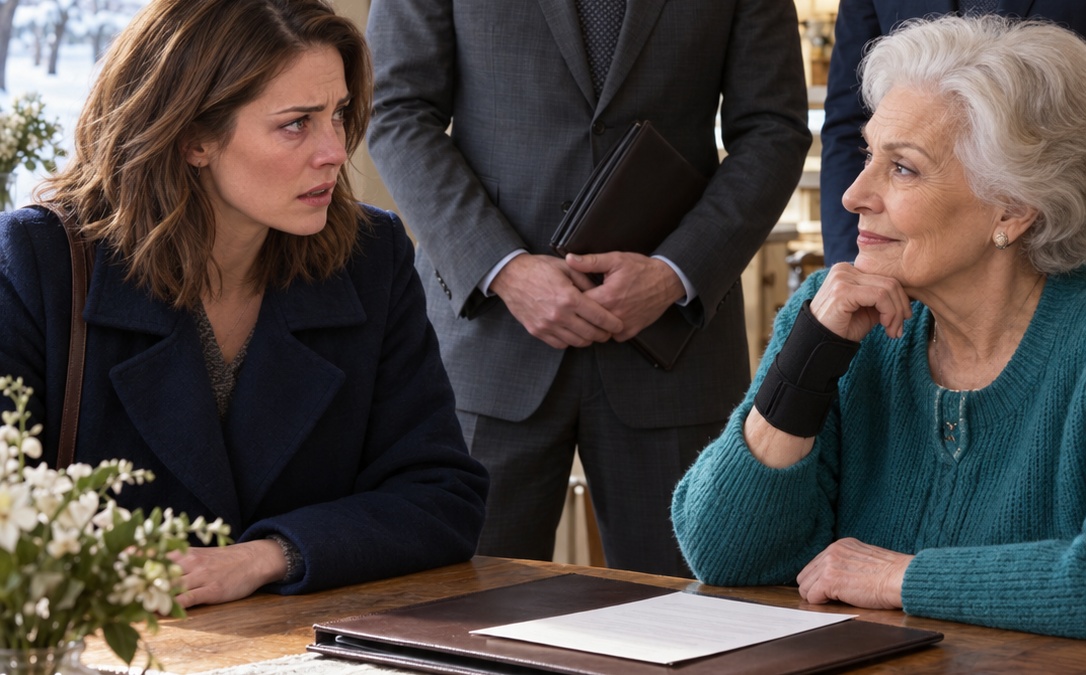
“She’s fine till tomorrow. Don’t make this harder.”
My mother sent that message from Aspen the night before my grandmother was supposed to be taken to a nursing home. She and my father had taken my brother with them. Grandma was home alone in a farmhouse six miles from anybody, waiting on a move they had arranged without asking her.
I didn’t argue. I have never argued with my mother in my life. I booked a flight.
By the next afternoon, I was opening Grandma’s kitchen door, expecting to find her sitting there by herself. Instead, there were two men in suits at her table, with a folder between them. She looked up at me and smiled.
“You should sit down, honey.”
I did.
I’m Greta Halverson. I was thirty-five years old, and I had spent every one of those years being the person who didn’t make things harder. My parents thought my grandmother’s future had already been decided. They were right about that. They were wrong about everything else.
Wherever you’re listening from—a kitchen, a night drive, a break room with bad lighting—I’m glad you’re in the room for this one. Tell me what town you’re listening from, too. I read them all.
Before I tell you what was in that folder, I have to tell you about a parking lot, because I’ve never told anyone about it.
In May of 2019, my grandmother, Edith Halverson, asked me to drive her to a law office in Sturgeon Bay. I was twenty-nine. I sat in the car with a ball game on the radio for forty minutes. When she came out, she had a manila envelope lying flat on her lap, and she asked if I wanted a fish fry.
I said yes. We got perch.
She never told me what she signed. I never asked. Not that year, and not in the six years that followed.
Egg Harbor in January has about two hundred people left in it and one restaurant still open at eight. So when my mother chose to announce the nursing home out loud at the fish fry instead of in Grandma’s kitchen six miles up County G, she wasn’t being careless. She was making sure the version everybody got was hers.
There were two phones face down on the placemat that night, one connected to me in Albuquerque and the other to Grandma on the wall phone in her kitchen. My mother, Sharon Halverson, had arranged it that way and called it a family conversation.
“We’ve been carrying this by ourselves for two years,” she said, and her voice did the thing it always does, that warm slide downward at the end of a sentence. “Nobody sees what it takes. Nobody’s asking anybody for anything.”
My father cut in from somewhere near the window.
“The cabins are doing great, by the way.”
Nobody had asked about the cabins.
Then came the details, quick and clean, the way you’d read off a grocery list. A bed at a place outside Green Bay. Friday the thirteenth, two in the afternoon. A patient transport service booked to come to the house.
I asked if I could fly out that week and sit down with all of them first. There was a pause filled with the sound of a deep fryer. Then Grandma’s voice came through the other phone, thin and flat and slightly too far from the receiver, the way she always held it.
“It’s already been decided, dear. Just not by them.”
My cousin laughed. My mother said something about how Grandma gets in the evenings. My father asked for more tartar sauce.
Seventy years of that woman being right about this county, and not one person at that table stopped chewing.
I want to tell you I pushed. I didn’t. I said, “Okay.” I said we’d talk Sunday.
My mother said, “We’re the ones who are—”
The fryer drowned out the rest.
She hadn’t fallen yet. I want you to sit with that. The bed was booked before there was anything to book it for.
She fell on the twenty-eighth of January. I didn’t know about it for sixteen days.
Here is what happened, assembled later out of other people’s ordinary afternoons.
There was ice on the back step. She went down on her right side and cracked her wrist. Marlene Sorenson from the next farm drove her to the after-hours clinic in Sturgeon Bay, waited, drove her home, made her tea, and went back to her own house, assuming somebody had called my father.
Nobody called my father.
The first Sunday in February, Grandma couldn’t lift her right arm high enough to reach the face of the clock. My grandfather Harold’s clock. Schoolhouse case, eight-day movement, wound eight turns every Sunday morning for fifty-one years.
It ran through Sunday, the morning she couldn’t reach it, and stopped Monday night in an empty kitchen at whatever time it happened to be.
Six miles south, nobody drove up.
She called me a few days after that. Her voice was fine. Her voice was always fine.
“The clock stopped, honey. I’ll get to it.”
I said, “Okay.” I said I’d call her Sunday. I hung up and went back to work.
An eight-day clock. It sat stopped for eleven days. Nobody in that house noticed.
The cherry tree went first, actually. Before the fall, before any of it.
The survey crew came in the middle of January, which is a strange month to survey forty acres of orchard in Wisconsin, and one of them backed a truck into the tree by the corner of the house.
My grandfather planted that tree the spring after their wedding. It’s a sour cherry Montmorency, older than my father. The truck took the leader off it. The break was white and wet and about the size of my forearm.
Marlene called me about it. Not my parents. Me.
“I don’t like to get in the middle,” she said twice, both times right before getting in the middle. “But I thought somebody in the family ought to know they were out there measuring.”
Then she told me about the Aspen thing in the same weather-report voice.
They flew out on the fifth. Somebody at church had asked my mother whether she’d thought about canceling under the circumstances. My mother had said the week was bought and paid for years ago, that it was nonrefundable, and that canceling it wouldn’t save a nickel. It would just change what people thought.
She didn’t hear herself say it. Marlene didn’t either.
Then Marlene said the other thing, the thing I kept turning over on the plane.
“She’s asked me three times now which day the van comes. Three times, Greta. I just tell her Friday and change the subject.”
Down here, we call that confusion. My mother had already called it that in front of eleven people at a restaurant.
Marlene never told my parents she’d called me. She just kept bringing soup.
If a woman like Marlene, seventy-seven years old, carrying a covered dish six miles down a county road every week without telling anybody—if that landed anywhere in you, go ahead and hit like for her. She’ll never know. Do it anyway.
It was February twelfth, 9:14 at night, and I had a phone in my hand in a dark apartment. I’d called my parents three times. Nothing. They’d landed in Green Bay that evening.
I called Grandma once and let it ring eleven times, which is what it takes for an eighty-seven-year-old woman to cross a kitchen to a wall phone. Then I let it ring nine more.
That was when my mother’s message came in.
“She’s fine till tomorrow. Don’t make this harder.”
I read it. I set the phone down. I picked it up and read it again.
I read documents for a living. Eight hours a day, I read sentences written by people who want them to sound like one thing and mean another. And the trick is never the words that are there. It’s the word that’s carrying weight it can’t hold.
She’s fine till tomorrow.
That is not a sentence about a person. That is a sentence about a schedule.
And then the second one. She wrote this. Not the home. Not Grandma. Just this.
I packed in an apartment my grandmother had never seen. I’d moved in 2024, one neighborhood over. Nothing dramatic. New lease, new address. The kind of change you mention once at Thanksgiving and nobody writes down.
A 5:40 flight out of Albuquerque, connecting in Denver. I booked it standing up, still in my coat.
Then I went to the second drawer of the dresser for the good gloves and found the funeral program instead.
October of 2016. Harold Halverson, my grandfather, born in 1934.
There’s a photograph on the front of him standing in the orchard in a short-sleeved shirt with his hands in his pockets. Inside, there’s an order of service and two hymns. On the back, somebody typed the wrong year for his marriage, and nobody caught it.
They told me three days after the funeral. My father called. He said they hadn’t wanted me to have to fly.
I believed that sentence for nine years.
I want to be honest about that. I believed it the way you believe your own address. And standing in my bedroom at eleven at night with my hand in a drawer, I finally heard what family it belonged to.
We didn’t want you to have to fly.
Don’t make this harder.
The same grammar. The same soft hand on the back of your neck, steering.
I put the program back in the drawer. Then I took it out again and put it in my bag.
I texted my brother Tyler three words.
Are you home?
It said delivered. It never said read.
In 2016, they didn’t want me to have to fly. I understand that sentence now.
Denver. Gate B29. Six fifty in the morning, and the message to Tyler was still sitting there unread at the top of the screen.
Here’s the part I’m not proud of. I don’t argue. I have never argued. What I do is offer to pay for things.
Standing at that gate with a paper cup going cold in my hand, I typed my mother a proposal.
Home care. Someone competent four days a week through the end of spring, while Grandma’s wrist healed and everybody calmed down and we could sit at a table like adults.
Forty-eight hundred dollars. I’d cover all of it. They wouldn’t be out a dime, and nobody had to apologize to anybody.
I read it twice for tone. I took out the word please, then put it back.
Four minutes later, she replied.
We’re the ones who are here.
That was the whole reply. Six words, no punctuation after them, from a rented condo eleven hundred miles from the woman we were discussing.
I sat there with the phone in my lap until they called my group.
It took her four minutes on a mountain in February. Six words on a screen, and then two hours of not looking at it.
Green Bay was gray and hard and smelled like cold metal. I got a rental and drove up the peninsula. The orchard came up on my right the way it always does, all at once. Forty acres of bare trees standing in rows in crusted snow. The stone wall my grandfather never finished. The light doing what February light does out there, which is nothing at all.
I slowed at the corner of the house because I wanted to see the tree. The break was still white. Somebody had gathered the fallen wood into a pile beside the trunk and left it there, neat, the way you’d stack something you intended to come back for.
I turned into the driveway at 1:25. Then I stopped because there were two cars parked in front of the porch, and I didn’t recognize either one.
A gray sedan with a rental barcode in the window. A silver SUV with a decal on the back glass.
Two cars in the driveway. Neither was my father’s. Neither was a van.
I came in the back door the way I’ve come into that house for thirty-five years. And the first thing I registered wasn’t the men.
It was the clock.
The hands were at twenty to four. It was not twenty to four.
My body knew something was wrong in that room a full second before my head did. And it knew because a sound that had been in that kitchen my entire life was not in it.
Two men stood up from the table. Suits, both of them, one gray and one navy. Both of them were holding coffee cups that didn’t belong to them.
She was at the head of the table with her right wrist in a black brace. She had her left hand around her own cup, and she was smiling at me like I was late for something we’d planned.
The taller one put his cup down.
“Miss Halverson? Greta?”
The taller one said my name before I said it, like he’d been waiting for me.
They introduced themselves standing up, which is how you know men are uncomfortable.
Paul Brandt. Attorney. Sturgeon Bay. Sixty-four, gray suit. The kind of careful older man who says the whole word attorney instead of lawyer. He said he’d drawn up papers for my grandmother in 2019 and had represented her since.
The other one had a harder time with it.
Dale Ostgard. He shook my hand.
“I do title work down in Sturgeon Bay.”
I have done title work for eleven years. I know what a title officer does on a Friday, and it is not this. A title officer sits at a desk and sends things. He does not drive out to a farmhouse.
“You’re the buyer’s side,” I said.
“I am.”
“Then why are you in the seller’s kitchen?”
He looked at the table for a second.
“Because I grew up four miles from here. Your grandfather there taught me to drive a tractor. I played ball with your dad.”
He turned his cup a quarter turn.
“Halverson came up on my file this morning, and I recognized it. I called Mr. Brandt because his name’s on the paper, and I wasn’t going to let an eighty-seven-year-old woman find out about this in a letter.”
Grandma got up and refilled all three cups, left-handed, slow, tilting the pot with her forearm. Nobody offered to help her because she does not permit it. Dale Ostgard sat there and watched her do it with his hands flat on the table like a man in church.
“They had it set to close the first week of March,” he said. “I sent the report out this morning.”
“Whose name is on the seller line?” I asked.
“Hers.”
He turned the cup another quarter turn.
“Edith Halverson signed in November.”
My grandmother did not look up from her coffee.
“And that,” Dale said, “is the problem.”
He said he’d sent the report out that morning. Nobody asked who.
Paul Brandt opened the folder and turned it around so it faced me. It was one page. A warranty deed, a county stamp in the top right corner, blue and half-faded.
He read it out loud without any expression at all, the way you’d read a number off a meter.
“Edith Marie Halverson to the Halverson Family Trust. Forty acres and the house. Recorded the twentieth of May, 2019.”
Then he read the next line.
“Successor trustee: Greta Marie Halverson.”
She kept her hands around her cup. She didn’t look at me. She had waited seven years, and she was not going to spend that moment watching my face.
I heard myself say three words, and they weren’t about the land.
“What was the date?”
I was in the parking lot. I had the radio on. I was twenty-nine years old.
The stamp had the date right there in the corner, and I couldn’t stop reading it.
The twentieth of May, 2019.
Six years and nine months.
That deed had been sitting in the Door County Register of Deeds for six years and nine months. Indexed. Public. Six miles from my father’s kitchen table.
I know exactly what that costs because it’s my job. Thirty dollars for the search. Eleven minutes if you’re slow.
Brandt said something about how records work, and I put my hand up. Not rudely. I just didn’t need it explained.
That’s the part I keep coming back to. Not that she hid it. She didn’t hide it. She put it in the most public place in the county and left it there like a plate on a windowsill.
My father grew up in this house. My mother has had a key for thirty-one years. My brother has a real estate license. Between the three of them and me—and I am including me; I want to be very clear that I am including me—not one person ever spent thirty dollars to find out what was true about the ground under this building.
We didn’t look because we already knew.
That’s what certainty is. It’s the thing that keeps you from checking.
And whatever my grandmother had signed in November, she’d signed as a woman who hadn’t owned this ground since 2019. It couldn’t move a single acre.
Grandma set her cup down and said lightly, like she was remarking on the weather, “It’s a funny thing to own something for seven years and have nobody argue with you about it.”
Dale Ostgard looked out the window at the orchard and didn’t say anything at all.
If anybody had looked, none of this would have happened. Nobody looked, including me.
I asked Paul Brandt why he was at that table on that particular Friday at one o’clock, thirty-five minutes before a van.
He took a second page out of the folder. One page, six lines, her signature at the bottom in a hand that had gone shaky and stayed dignified.
She’d signed it nine days after the fall. It said she was stepping down as trustee.
“It doesn’t do anything by itself,” he said. “A resignation with nobody to hand it to is just a piece of paper. The successor has to accept in writing.”
“So send it to me.”
“I did.”
He laid three envelopes on the table, squared and unopened, each one with a stamp across the front.
The second of February. The fifth. The ninth.
“That’s the address in the 2019 file.”
Albuquerque. The apartment I moved out of two years ago and never thought to update on a document I didn’t know existed.
“Then you call,” I said.
My voice came out flatter than I meant it.
“You had my number. She has my number on the wall next to the phone. You call.”
“I recommended that.”
He glanced at her and then back at me. I understood he’d already lost this argument once and had written down that he’d lost it.
“Your grandmother instructed me not to.”
The refrigerator kicked on. Nobody moved.
She turned her cup a half circle on the table with her left hand.
“I could have picked up that phone any day since the second of February,” she said. “And you’d have come. I know that. You’d have come because I asked.”
“Why didn’t you?”
It didn’t sound like a question.
“If I have to ask her to come,” she said, “I’ll never know.”
Her hands stayed on the cup. Mine were flat on the table on either side of a piece of paper I hadn’t signed.
I asked Brandt, “What happens if I don’t?”
“Then nothing happens,” he said. “She stays trustee. Eighty-seven years old, one wrist in a brace, managing forty acres. And if there comes a day she can’t, the family member closest at hand petitions to act on her behalf.”
He said the next part to the table.
“And your mother has been telling this county your grandmother is confused since Christmas. That isn’t gossip, Greta. That’s a record.”
Six miles.
I looked at the pen lying across the page. There was a cedar box on the table by her elbow, the lid down, and I didn’t ask about it because I already had one thing in front of me I couldn’t lift.
Here is what went through me, and I’d like to be honest about the order.
Not outrage. Not yet.
First came the arithmetic of a life. Four flights a year, minimum. Every family dinner from here forward with me as the one who took the farm. My mother’s voice in a hundred kitchens up and down this peninsula, telling her version to one person at a time for the rest of my life.
Thirty-five years of being the one who smooths things over, and this was the exact moment they’d all been building toward.
My hands would not pick up the pen.
Then, underneath it, came something I had never in my life let myself feel toward that woman.
I asked her the other question, the one I didn’t want the answer to.
“If I hadn’t come today, if those letters had just sat there, what were you going to do at two o’clock?”
Her chin came up about half an inch.
“I’d have gotten in the van.”
The chair under me creaked. It’s a wooden chair. It has always creaked.
“Not because they made me,” she said. “Because nobody came.”
She’d have gotten in the van. Not because they made her. Because nobody came.
I signed at 1:47.
Paul Brandt watched me do it, put the page in the folder, and closed the folder. The whole thing took less time than pouring coffee.
At 1:52, my grandmother stood up. She crossed the kitchen to the wall phone, cream-colored with a coiled cord, mounted next to the light switch since 1971. She lifted the receiver with her left hand and dialed with that same hand, one digit at a time, from a number written on the wall in pencil.
Somebody picked up.
“This is Edith Halverson. You can cancel the van.”
She listened for two seconds.
“Thank you.”
She hung the receiver back on the hook. Then she turned around and asked if anybody wanted more coffee.
Dale Ostgard apologized twice on his way out, once for coming and once for the coffee, and left a business card face up on the counter. Paul Brandt shook her hand with both of his.
Then the storm door banged, and it was the two of us and a table with nothing on it but the cedar box.
She pushed it across to me with the flat of her good hand.
I made that box in eighth-grade shop. I was thirteen. It’s quartersawn cedar with hand-cut dovetails, and three of the tails are proud on the left side because I sanded the wrong face. There’s a black scorch on the back corner where I set a wood burner down and forgot about it.
I brought it home, and my mother said it was nice and asked where I was going to put it.
I put it under my bed.
Grandma turned it so the burned corner faced up and touched it.
“Best thing anybody in this family ever made with their hands,” she said. “Your grandfather said that. I’m just repeating it.”
She’d had it on the windowsill over the sink for nine years. Everyone who ever ate in that kitchen had looked at it a thousand times, and not one of them had ever once asked what was in it.
Inside was a spiral notebook. Green cover, the cheap kind, corners gone soft.
“I want to explain 2019,” she said. “It isn’t what you think. I never thought Roger would steal from me.”
“Then what?”
“I thought he’d talk me into it.”
She smoothed the cover with two fingers.
“He’s my son. He’s been talking me into things since he was four. I didn’t need protecting from a thief, Greta. I needed protecting from a Sunday afternoon.”
The notebook started the week we buried Grandpa. The first line was something my father had said.
There were three columns. The first was dates. The second was money. It was small, and it was boring, and every dollar of it was hers.
Roof. 2018. Taxes. Insurance. A frozen pipe in the winter of 2021.
The third column wasn’t money.
It took me a minute to understand what I was looking at because it was just initials and tick marks. Then I understood, and my hand went flat on the page to keep it from turning.
She was counting who came through the door.
My father, six miles away, forty-one times in nine years.
Me, twelve hundred miles away, thirty-four.
I asked her why she wrote it down. I meant it as an accusation, and my voice came apart in the middle of the sentence.
She didn’t look up.
“Because they tell you a thing often enough, and you start to wonder,” she said. “I wrote it down so I wouldn’t forget I was right.”
Forty-one visits in nine years. Thirty-four.
And a reason she wrote it down.
The reason had a date on it, and the date was the day we buried him.
She read me the first line off the page in her own handwriting. I’m going to give it to you the way she gave it to me, slowly, because she read it slowly.
October 2016. Two hours after the burial. This kitchen. Ham sandwiches on the counter, forty people in the front room, and his coat still on the hook by the back door.
Roger asked when I’m going to do something about the land.
That’s it. That’s the whole entry.
I asked her why she never told me. Not in 2019, not in the seven years after. Not once.
The refrigerator ran. She let it.
“If I’d told him,” she said, “he’d have had seven years to work on me. Cousins calling. Papers to sign at Christmas. A man like my son doesn’t need to win, honey. He needs time. So I didn’t give him a fight. I gave him seven years of being sure.”
I have spent my whole life being the quiet one. My mother taught me that going along was the same as keeping the peace, and I was good at it. I was the best in the family at it.
I sat in that chair and understood that the woman across from me had been doing something else entirely with her silence for nine years.
Mine was a way of not being in trouble.
Hers was a plan.
I got up. I took the brass key down from the hook beside the case, opened the glass, and wound my grandfather’s clock.
I wound it eight turns, the way he taught her. It started on the second.
The clock had been running about twenty minutes when a truck came up the gravel. He parked by the corner of the house, close in, and the rear tire came to rest on the pile of cherrywood somebody had stacked beside the trunk.
He didn’t notice.
He got out with his phone in his hand. He stood there a second and looked at the driveway from left to right, counting cars. Then he came in the back door the way he has come into that house for fifty-nine years.
Storm door. Boots on the mat twice. The zipper of his coat.
He did not look at me first.
He looked past me, out the window, at the empty gravel where a vehicle should have been.
Fourteen months since I’d seen my father in a room. Fourteen months since Thanksgiving in a restaurant, since a conversation about the cabins that ended with him getting the check to prove something.
His first sentence to me in fourteen months was two words.
“Where’s the van?”
I told him there wasn’t going to be a van. I told him why. And I watched a thing happen on his face that I have thought about ever since.
He wasn’t shocked.
“That’s a cloud on title,” he said. “That’s all that is. It’s a paperwork problem. These get cleared up all the time.”
Cloud on title.
My father sells cabins in Fish Creek. That is not a phrase that lives in his mouth.
My mother came through the door behind him with two grocery bags and her coat still buttoned.
“Greta!”
She set the bags on the counter.
“Sweetheart, you flew all that way. Have you eaten anything?”
“He’s been down in Sturgeon Bay since eight this morning,” she said to nobody, to the bags as she unpacked them. “Sitting outside that title office all day, and not one of them would come to the door.”
She didn’t hear that one either.
That’s the thing about the two of them. They’re not the same weapon. He comes at you straight and calls it common sense. She comes at you sideways with a casserole and calls it love. By the time you’ve said thank you, you’ve agreed to something.
“She doesn’t understand what she signed,” he said. “Somebody put that in front of her at eighty-one years old, and she signed it because a lawyer told her to.”
“She was eighty-one,” I said. “She’s eighty-seven now. She’s sitting right there.”
Nobody looked at her.
Both of them were in that kitchen for four straight minutes. The woman whose wrist was in a brace, whose clock had sat stopped for eleven days, was discussed and diagnosed and explained, and not one person in her family asked her a single question.
My mother set down the grocery bags and asked if I’d eaten.
That’s the tell.
There were two grocery bags on that counter, which meant there was a dinner nobody had told me about.
And I finally asked the question I’d flown there to ask.
“Why now? Why not April? Why not wait for the wrist to heal? Wait for the ground to thaw? Sit down in June with a lawyer and a table and all four of us.”
He was fine right up until that.
“Because that land is the only thing that—”
He stopped.
I watched him swallow the rest of it. I watched him take half a second and put something harmless in the hole where the true thing had been.
Something about how everybody comes out ahead. How the money would take care of her for years.
I didn’t react. You don’t react.
I did what eleven years of reading other people’s documents has trained me to do, which is write down the sentence exactly as it broke.
My mother looked at him. One look, fast and sideways, and then away.
His phone was face down on the table. It buzzed. It buzzed again, and it kept buzzing. He never once turned it over.
The only thing that—
He swallowed the rest, and his phone kept buzzing.
At 3:30, I took my laptop up to my old bedroom, where the wallpaper still has horses on it. I opened the county’s records portal and paid thirty dollars.
This is the part where people expect something clever. There isn’t anything clever.
Land records in Wisconsin are public. Mortgages are public. Anybody with a browser and a debit card can look up what’s recorded against any parcel in the county. The only reason I’m faster at it than you is that I know which box to type the name into.
That’s the whole trick. That’s my entire profession.
I find out what’s actually true about a piece of ground before somebody signs their name to a lie about it.
The wheel spun.
The room smelled like a closed-up house, dust and cold plaster coming up through the floor. I could hear my mother on the phone downstairs, doing the voice she uses for vendors, and I caught three words clean through the boards.
“Make it twenty-two chairs.”
She was on with a rental place about folding chairs, and she was changing the number.
Thirty dollars. Eleven minutes.
Downstairs, my mother was adding a chair.
The results came up, and I only needed one line.
In June of last year, my father had mortgaged his own house.
Not the cabins. Not the business.
The house on the ridge in Egg Harbor that he and my mother built in 1998, that I grew up in, that has his name burned into a board over the garage.
The lender wasn’t a bank. It was three initials and an LLC, and there was a maturity date typed on it the way there always is.
The second of March.
I sat there and looked at that one line for a long time.
A man does not put his own roof up unless everything else is already gone.
I thought about him at that restaurant table in January, saying the cabins were doing great when nobody had asked. And I understood I hadn’t been listening to a brag.
It was never greed.
I want to be exact about that because it would be easier if it were greed.
My father was drowning, and his mother’s orchard was the only board in the water. The nursing home was never the point. The nursing home was housekeeping. It was how you get the last person out of the kitchen who can say no.
He never spent thirty dollars on her.
It cost me thirty to find him.
If that line landed anywhere in you, hit like. It’s the only thing that tells me to keep telling these.
So here’s where I was. Sitting on a twin bed under horse wallpaper with proof my father was going to lose his house in seventeen days and twenty-two chairs coming at five.
Tell you what. I want to know.
Do I go downstairs and put that on the table right then, or do I say nothing and let them set it? I’ve thought about it every day since. Tell me what you’d have done.
I was still on the bed with the laptop open when I heard him on the stairs.
Tyler came down into the kitchen at four in a ski jacket with the tag still on the collar. Jet-lagged, hair flat on one side. Twenty-two years old. He’d finished school in December, he was starting work on the first of March, and Aspen had been his graduation present.
He got a mug down, filled it, and put two sugars in it without asking anybody. He set it in front of Grandma.
“Thank you, honey,” she said.
He didn’t even look at what he was doing. His hands had made that cup a hundred times.
Then he sat down across from me.
“Why’d you fly out?”
“I wanted to be here.”
“Yeah.”
He turned his own mug around.
“It’s rough. Mom’s been dealing with all of it.”
He looked at the table. Then he said, not unkindly, the way you’d ask about the weather, “She’s pretty out of it these days, huh?”
Grandma was four feet away with a notebook in a cedar box in front of her that had nine years of dates in it.
I didn’t argue with him. There’s no point arguing with a man about the water he grew up in.
I asked him when the last time was that he sat down with her. Not stopped by. Not waved from a truck. Sat down at that table with a cup of coffee.
He started to answer. Then he stopped and actually did the arithmetic.
I watched him work backward through Christmases. The silence went on long enough that Grandma got up and started rinsing something in the sink so he wouldn’t have to be looked at.
He put two sugars in without asking.
Then he asked if she was out of it.
Marlene came at 5:10 with a covered dish, forty minutes early, because she’s been forty minutes early to everything since Nixon.
There was masking tape on the bottom of it with Sorenson written in ballpoint.
She meant to get it back. She was planning on a next week.
Chicken and wild rice. She likes it soft.
Marlene set it on the counter and lowered her voice like we were at a wake.
“Your mother’s been so strong through this, Greta. I don’t know how she does it.”
I stood in the kitchen where I learned to walk and understood exactly what tonight was.
Twenty-two people were not coming to say goodbye.
Twenty-two people were coming to sign off.
That’s what a send-off dinner is in a town this size. It’s a room full of neighbors agreeing out loud that the family did the right thing so that afterward nobody has to wonder.
My mother wasn’t throwing a party.
She was collecting witnesses.
I didn’t correct one word of it. Not one. I said the rice smelled good, and I got out a serving spoon.
That was the first thing I did all day on purpose.
At the door, Marlene pressed her house key into my hand and closed my fingers over it.
“In case it gets loud,” she said. “Stan goes to bed at eight. The side door sticks. You push it.”
She had taped her name to the bottom of the dish. She expected to want it back.
That dish went on the counter next to the guest list, and the guest list was stuck to the refrigerator under a magnet shaped like a cherry.
My mother’s handwriting. Weeks old. You could tell from the ink, from the way three names had been added at an angle down the side.
The pastor and his wife. The Sorensons. Two cousins from Sturgeon Bay. The Petersons. The couple from church with the boat.
I counted it.
Twenty-one.
I counted it again with my finger on the paper, the way you do when the number matters.
Twenty-one names, and not a Halverson among them.
Family doesn’t get a chair at a thing like this. Family stands at the counter and pours.
Twenty-one names on a list written weeks ago. And that afternoon, my mother had made it twenty-two.
I stood there with a serving spoon in my hand and thought about all the clocks I couldn’t see.
A wrist in a brace. A closing the first week of March. A phone lying face down on that table all afternoon.
Buzzing. Buzzing. Never once picked up.
Somebody was coming tonight that my mother had not been willing to write down.
Twenty-one names on the list. Twenty-two chairs on the truck.
Somebody wasn’t written down.
At 5:20, I sat down across from Grandma with the list still in my hand and asked if she wanted me to call it off.
I could have. That’s what the afternoon had bought me. I could have stood in that doorway at six o’clock and turned twenty-one people around in the driveway and been entirely within my rights.
She thought about it longer than I expected.
“No.”
“Why not?”
“Because if we cancel,” she said, “your mother tells it one at a time. In the grocery store, at coffee hour, at the post office, for six months. And every one of them hears it alone, with nobody in the room to say, ‘Wait a minute.’”
She looked at the window.
“If we let them come, they all hear it once, together. And then nobody has to repeat it.”
Seventy years in a town of two hundred. She knew exactly what she was building.
I said I wanted to bring the papers out.
“All right,” she said. “With two conditions.”
She held up one finger.
“Paul reads it. Not you.”
She said it gently, but it wasn’t a suggestion.
“They’ll listen to a lawyer. They won’t listen to a granddaughter, honey. Not in this county. You’ll just be a girl who wants the farm.”
“What’s the second one?”
She put her good hand flat on the table.
“Leave him a door.”
“Leave him a door,” she said.
She didn’t say what kind. I didn’t ask.
Paul Brandt came in at 6:12, and somebody took his coat and asked him if he was from the facility.
“No,” he said, and sat down.
By then, the house was full. Twenty-one people, folding chairs along the wall, three casseroles, coffee going gray in the big percolator my grandmother has used for church functions since 1988. It smelled like wet wool and warm rice.
Then the storm door opened one more time, and the twenty-second chair got taken.
Kurt Vance came in alone. Fifty-five, good boots, a developer out of Sister Bay.
Nobody introduced him. He shook two hands, said something about the weather, sat down in the chair nearest the door, and did not take off his coat.
My father stood by the fireplace and didn’t eat anything.
Then my mother stood up with a piece of paper folded in quarters, and she was good. I want to be fair to her. She was very good.
“Some of you have known Edith longer than I’ve been in this family,” she said. “This is the hardest decision Roger and I have ever had to make.”
She talked about dignity. She talked about how you have to do the loving thing even when it costs you. She said the word safe four times.
“We’ve made our peace with it,” she said, “because we’re the ones who are here.”
Somebody said, “Amen.”
Softly, the way people do.
And in that whole warm, crowded room, in twenty minutes, six people asked my mother how she was holding up. Two people asked my father about the cabins. One person asked me about Albuquerque.
Not a single person asked the woman at the head of the table anything at all.
Somebody asked if Mr. Brandt was from the facility. He said no and sat down.
Paul Brandt was still in the chair by the sideboard with his coffee untouched when my grandmother tapped her cup twice with her ring.
China on china. Small.
The room went quiet the way a room does when an old woman makes a noise on purpose.
“Paul, would you read the four lines?”
He stood. He didn’t take out a paper.
“Edith Marie Halverson to the Halverson Family Trust. Forty acres and the house. Recorded the twentieth of May, 2019. Successor trustee: Greta Marie Halverson.”
He didn’t explain it. He didn’t look at my father. He set the copy down in the middle of the table, face up between the rice and the pickles, and he did not sit back down.
My mother was still standing. She had a napkin in her hand.
The copy lay there, and nobody touched it.
I opened the cedar box.
Every person at that table had seen that box on the windowsill for nine years. Not one of them had ever asked.
I took out the notebook and turned to the third column. I read the dates. Just the dates, flat.
March. May. May. September.
Then four in a row with nothing after them.
Then two numbers.
“Forty-one,” I said. “That’s my father. Six miles.”
I looked down.
“Thirty-four. That’s me. Twelve hundred.”
I closed the notebook.
Marlene set her fork down on her plate. The pastor’s wife put her hand over her mouth. Somebody’s chair scraped and stopped.
Forty-one. Thirty-four.
I closed the notebook, and nobody at that table was chewing.
Then a chair moved by the door, and Kurt Vance stood up in his coat. He didn’t raise his voice. He didn’t look at anyone but my father.
“Roger. The title report hit my desk at 9:40 this morning. My lawyer called you at 9:42, and you called me at noon.”
Twenty-one people did that arithmetic at the same time.
He had known since breakfast. He had known when he walked in the back door and asked where the van was. He had invited the buyer to his mother’s house so the whole town could watch her call it a paperwork mistake.
Vance zipped his coat.
“You’re a piece of work,” he said, and went out.
The storm door banged.
Twenty-one people sat in a room with a door still swinging, and my father reached over and pulled out one of the rented folding chairs.
He sat down in it in front of me with his knees apart and his hands hanging between them.
“I need four hundred and twelve thousand dollars by the second of March.”
He said it clearly.
That was the worst part. He’d had that number in his mouth all day.
“Ten acres. The road frontage. Just the road frontage, not the orchard proper. Vance was paying three hundred and forty for that piece alone. It doesn’t touch the trees. It doesn’t touch her house. Greta, they take my house on the second.”
Three hundred and forty against four hundred and twelve.
I do that subtraction forty times a day for strangers. He was seventy-two thousand dollars short in his own best version of it.
He’d have lost that house in June instead of March. He wasn’t asking me to save him. He was asking me to help him lose it slower.
My mother came in from the side, soft.
“Gretchen, think about your brother. Think about what this does to Tyler.”
Nobody had called me that since I was six. She’d kept it in a drawer for twenty-nine years and took it out the one night she needed it.
Tyler was standing in the kitchen doorway with a dish towel in his hands. Nobody said his name to him. They said it near him.
My father leaned forward.
“You don’t know what these last two years have been,” he said. “You don’t get to fly in for one afternoon and decide. You weren’t here.”
He said it again.
“You weren’t here.”
Twenty-one people watched him say it to me.
I stood up. I took one more thing out of my bag and set it on the table next to the deed.
October of 2016.
His photograph on the front, standing in the orchard, hands in his pockets.
“I wasn’t at that either,” I said. “You told me it was so I wouldn’t have to fly.”
Then I put my hand flat on the lid of the cedar box, and I said the only thing I had.
“She wrote down every time you came. Forty-one. She wrote it down because she was afraid she’d forget she was right.”
Then I looked at my father. At the man I have called Dad since I could talk, sitting in a rented folding chair in his mother’s dining room.
“No, Roger.”
Three seconds.
In the quiet, you could hear a clock on the wall in the next room because it had been running since that afternoon. Half the people in that house had grown up hearing it and hadn’t noticed it was back.
I said no.
Then I said there was one more thing on the table.
The one more thing was a single sheet of legal-pad paper, handwritten between 5:20 and six. I read it out loud in the voice I use for grocery lists.
Roger and Sharon Halverson move into the back rooms of Edith’s house. They do the care: meals, medication, appointments, the drive to Sturgeon Bay every third Tuesday. Hours written down, a log kept daily in a notebook on that table.
Twenty-four hundred dollars a month, paid by me.
And Edith ends it any day she wants. She doesn’t have to give a reason.
Accept it here or refuse it here.
Those were the options in front of the pastor and the Sorensons and two cousins from Sturgeon Bay.
My mother understood it before he did. I watched it land on her.
“Any day she wants?” she said. “Without a reason?”
“Without a reason.”
My father said one word.
“Fine.”
Then people started finding their coats the way they do, all at once and too fast.
Marlene took the tape off the bottom of her dish and put it in her bag. I put her house key back into her hand at the door.
“It didn’t get loud,” I said.
“No,” she said. “It didn’t.”
Tyler stayed at the sink and washed every plate in that house, which was the first thing I ever saw my brother do because he decided to.
At the door, my mother tried it one more time. Quieter, almost to herself.
“We’re the ones who are here.”
I said, “Starting Monday, that’ll be true.”
The clock in the other room struck seven.
If you’ve ever been the one who got counted in somebody’s notebook, the one who drove the distance while somebody closer took the credit, tell me about it. That’s the story I want under this one.
And if you’d like to stay for how it ended, subscribe.
On the seventeenth of February, I drove down to Sturgeon Bay and did the thing nobody in my family had ever done.
I parked on Michigan Street, walked into the Register of Deeds, and slid two pieces of paper under the glass.
The resignation and my acceptance.
The woman at the counter asked if I wanted certified copies. I said yes. I paid, and she stamped everything and slid it back.
Eleven minutes.
Dale Ostgard came down the hall with a file under his arm, nodded at me, and kept walking. He’d closed his end the week before.
There was nothing left for either of us to say about it.
And that’s how you know it’s really over.
Nobody makes a speech.
That afternoon, I called my office and asked to go remote four days a week. They said yes in two days.
Eleven years, and it had never once occurred to me to ask.
Marlene’s son took the orchard on a one-year lease, handshake first, paper after. He walked the rows with me in the snow and told me which trees my grandfather had grafted himself and which ones came from the nursery.
He could tell by the bark.
Nobody clapped. Nothing happened.
It was a Tuesday.
Thirty dollars. Eleven minutes.
I still have the receipt in my wallet.
Two weeks later, the note came due, and my father lost the house on the ridge.
It happened on a Tuesday, the way these things do. No van, no crowd. A notice in the paper between a snowplow bid and a church supper.
I drove past it in April. Somebody had already pried the board off over the garage, the one with his name burned into it, and left the four screw holes in the siding.
I didn’t stop.
I’d stopped needing to.
They moved into the back rooms in April, which is exactly where they’d have moved my grandmother from.
He kept the log.
I want you to understand that he kept it.
I read it every Sunday. Photographs of a page my mother takes with her phone.
The early entries are four words long.
Meds. Ride. Groceries. Fine.
You can feel a man’s jaw in them.
By June, some of the entries ran three lines.
Took her out to the third row. She wanted to see whether the crew had got the standpipe. It’s fine. She stood out there twenty minutes.
My mother takes the photographs.
For thirty-one years, she decided what this family believed. Now she photographs a page in my father’s handwriting to prove she was in the room.
At the end of March, I grafted the cherry. Whip and tongue. Two scions off a branch that survived the truck.
I did the first one wrong. Cut the tongue too shallow. The cambium never met. I stood there in the mud with a knife in my hand and had to cut it off and start over.
And I did not do very well for a minute.
The second one took.
In April, Tyler drove her to her appointment without anybody asking him to. He sent me a photograph of a waiting room and no words at all.
My father and I speak. We say what’s necessary, and we don’t say more than that.
He has never apologized. I have never asked him to, and I’ve stopped expecting the sentence that would fix it because that sentence isn’t coming, and I’ve got other things to do.
Forgiveness wasn’t on the table.
Attendance was.
It got written down every day.
The third week of July, we picked tart cherries. They come off fast and all at once. A week, maybe ten days, and then they’re done for the year.
Marlene’s son ran the shaker down the far rows. My grandmother and I did the eight trees by the house by hand, the way she and Harold always did them.
She’s eighty-eight. The wrist healed crooked and works fine.
She sat on a folding chair under the third tree with a white bucket between her feet and picked what she could reach, slow, one at a time. She dropped the cherries in so they made a sound on the bottom of the bucket, and then they stopped making a sound as it filled.
She would not let anybody move her chair for her.
I was up the ladder. She looked at what I dropped in the bucket and said, “That one’s not ready. Leave the pale ones another day.”
That’s the only thing either of us said for about twenty minutes.
Inside the house, the clock was running because every Sunday morning, I take the brass key off its hook and wind it eight turns.
It always catches on the second.
Nobody mentioned February.
She never needed saving.
She left the date standing, and she waited for me.
Subscribe if you want the next one.








