On Father’s Day, I made plans with my son. Last minute, he texted, “It’s just a little party—not worth it.” 20 minutes later, his wife posted them at a steakhouse with her family: “Best Father’s Day—no cheap place.” That night, after seeing me in a viral clip, he called 61 times.
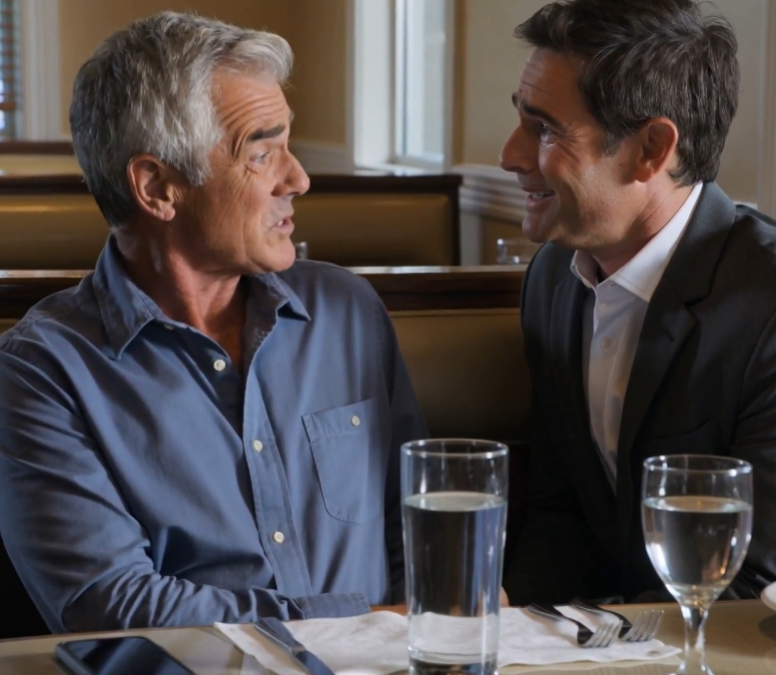
“Dad, emergency meeting. Can’t make it to that worthless dinner tonight.”
My son’s text arrived at 6:47 p.m.
Twenty minutes later, my daughter-in-law posted a champagne photo from a luxury country club.
“Father’s Day done right. Top 1% only. No cheap steakhouses.”
I sat alone at the steakhouse, staring at the untouched silverware across from me. Then a stranger walked in and dropped to one knee beside my table.
By that night, the video had crossed one million views.
My son called 61 times. His voice was shaking.
“Dad, the man who sat with you last night. He is—”
This is Silent Dad Revenge.
Before the story begins, leave a comment below. Where are you watching from? What country? What city? Wherever you are, let me hear from you. Subscribe and share if this one hits close to home.
Some details here were shaped for educational and storytelling purposes. Similarities to any names or places are coincidental. The lesson, however, is entirely intentional.
My name is Calvin Whitlock, and I have spent 60 years on this earth trying to be the kind of man my own father never was. I am not saying that to earn sympathy. I am saying it because it is the only way I know how to explain what happened on the night that changed everything, and why I was sitting alone at a corner table in a Texas Roadhouse wearing a shirt I had not been able to bring myself to put on for three years.
The shirt was blue.
May was my wife of 31 years. She passed away three years ago. Cancer, the kind that moves fast and does not negotiate.
The blue shirt was one of the last things she ever bought me. A soft, faded blue, the color of an early morning sky just before the heat of a Texas summer kicks in and turns everything pale and harsh. May picked it out herself from the rack at Dillard’s three weeks before the doctors told us there was nothing left to try.
She held it up against my chest in the middle of that department store aisle, tilted her head to one side the way she always did when she was deciding something, and said, “Calvin, this color does something wonderful for your eyes.”
I told her I did not need a new shirt.
She bought it anyway.
That was May. She spent her last good weeks making sure I would have things to reach for after she was gone.
I hung that shirt in the back of my closet, and I did not touch it for three years. But that Sunday morning, Father’s Day, I stood in front of my bedroom mirror and put it on.
My hands trembled as I worked the buttons, not from age, but from something heavier. Something that sat in my chest like a stone I had been carrying so long I had forgotten it had a name.
I straightened the collar. I looked at myself, and for just a moment, I could almost hear May’s voice.
“There. Now you look like somebody.”
I had made a reservation at the Texas Roadhouse on Westheimer Road two weeks in advance. Garrett and I used to go there when he was small, back when splitting a rack of ribs and a basket of rolls was the kind of Saturday night that felt like abundance.
We had not been back together in years, but I called ahead, asked for the corner booth, and told the young woman on the phone that I was coming for Father’s Day dinner with my son.
“That’s sweet, sir,” she said. “We’ll take good care of you.”
I arrived 15 minutes early.
Grant Hollister, the floor manager, was a broad-shouldered man with kind eyes and a mustache he had clearly been growing since 1987. He seated me personally and brought me a glass of water without being asked.
I ordered a sweet tea. I straightened the silverware on both sides of the table, mine and Garrett’s, and I waited.
At 6:47 that evening, my phone buzzed on the tablecloth.
“Dad, I’m so sorry. Emergency meeting just came up. Plant crisis overseas. The whole team has to be on a call tonight. I can’t make it. I’ll make it up to you. I promise.”
I read that message twice.
My chest did not crack open the way you might expect. It deflated slowly, like something that had been holding its shape through sheer force of habit and finally just gave up.
I typed back, “Okay, son. Be safe.”
Then I set the phone face down on the table, picked up my sweet tea, and took a long, slow sip.
I sat with that for about ten minutes.
Then my phone buzzed again.
Not a message from Garrett. A notification from Instagram.
I had downloaded the app six months ago because my neighbor Patrice said it was how people stayed connected these days. I had never quite figured out what I was supposed to post, but I had somehow ended up following my daughter-in-law, Belle.
And apparently, she had just shared something called a story.
I tapped it open.
A crystal champagne flute, photographed from below against a ceiling of dark polished wood, golden light catching the bubbles just so.
And beneath it, in the kind of looping script that people use when they want their carelessness to look elegant, the caption read:
“Father’s Day done right. Top 1% only. No cheap steakhouses. No boring small talk.”
I put the phone down.
I looked at the silverware on Garrett’s side of the table. The knife and fork I had straightened ten minutes ago. The napkin folded into a neat triangle. The empty glass I had asked Grant to fill, just in case Garrett wanted water when he arrived.
I thought about May’s voice in that Dillard’s aisle. About the shirt I had waited three years to wear because putting it on felt like admitting I was moving forward without her.
I looked down at my own chest and smoothed the front of that soft blue fabric with the flat of my hand.
My throat tightened so hard I had to breathe through my nose for a moment to keep my composure.
Then I picked up the menu, because I was hungry, and I had driven 20 minutes to get there, and I was not going to waste a good meal.
I flagged down a passing server and told her I would be dining alone tonight after all, and could she please bring me another sweet tea when she had a moment?
She was maybe 22 years old, and when she looked at the two sets of silverware on my table and then back up at my face, something shifted in her expression.
Not pity exactly, but something close enough that I had to look away.
I had just picked up the menu again when I heard the front door of the restaurant swing open behind me, and Grant Hollister’s voice changed.
Not louder. Just different.
The way a person’s voice changes when they suddenly are not sure of the correct thing to say.
I did not turn around, but I felt something in the room shift, the way air shifts before a storm rolls in off the Gulf, and every hair on the back of my neck stood up.
I did not turn around right away.
Thirty-five years of teaching teenage boys in a machine shop had trained me to read a room by sound alone. The shift in noise. The change in breathing. The way 20 kids could go from chaos to dead quiet the moment something real walked through the door.
And something real had just walked through that door.
When I finally turned, I saw Grant Hollister standing with both hands slightly raised, the way a man stands when he recognizes someone important and does not quite know the protocol.
Across from him stood a man in a black suit that cost more than my truck. Broad-shouldered, somewhere in his mid-forties, with the kind of face that had clearly been weathered by years of pressure rather than years of ease.
He was not looking at Grant. He was not looking at the menu board, or the hostess, or the mounted longhorn above the bar.
He was looking straight at me.
And then his face broke open.
I do not have a better way to describe it.
One moment, he was composed, the face of a man who had spent decades controlling rooms full of people. The next, something cracked behind his eyes, and he crossed that restaurant floor in twelve steps and dropped to one knee in front of my table like a man who had been rehearsing this moment for 30 years and had finally run out of reasons to postpone it.
“Mr. Whitlock.”
His voice came out rough, scraped raw at the edges.
“I’ve been looking for you for a long time.”
My sweet tea glass was halfway to my mouth.
I set it down very carefully.
“Dorian,” I said. “Dorian Ellsworth.”
He pressed his lips together and nodded, and his eyes went so bright with water that I had to grip the edge of the table to keep myself from standing up and grabbing the boy.
Because that is what I still saw when I looked at him, even inside that expensive suit.
The boy who used to show up to my third-period class with grease already on his hands before we even opened the shop, because he had been working on his neighbor’s engine since six in the morning, trying to earn bus fare.
“How did you find me?” I managed.
“Your neighbor,” he said, his voice cracking on the second word. “Mrs. Patrice. I went to your house first. She told me you came here for Father’s Day every year.”
He exhaled hard through his nose, fighting for composure and losing.
“I almost didn’t come in. I sat in the parking lot for 20 minutes arguing with myself.”
I should explain who Mrs. Patrice is.
She has lived next door for 20 years. She knows my routines better than I do, including the fact that I have eaten Father’s Day dinner at that Texas Roadhouse every year since Garrett was old enough to hold a fork.
She is the kind of neighbor who notices things and remembers them. Apparently, she told Dorian everything he needed to know in about two minutes flat.
“You should have come in sooner,” I said, my sweet tea getting warm.
He laughed at that, a wet, broken laugh, and reached up and pressed the back of his hand against his mouth for a moment.
Then he pulled out the chair across from me, Garrett’s chair, and sat down.
And for the next hour, Dorian Ellsworth told me everything.
He told me about the company, Ellsworth Global. Seventeen thousand employees. Offices in nine countries. The Forbes cover two years ago that his assistant had framed and hung in the lobby without asking him.
He told me he had built it from nothing, starting with a small landscaping contract in Austin at age 22, reinvesting every dollar, making every mistake a person can make, and surviving all of them.
And then he told me why he was really there.
“You sold your Mustang,” he said.
His voice dropped to something quieter, almost private.
“The ’67. Cherry red. You loved that car more than anything you owned.”
My throat tightened.
“I remember.”
“You sold it to pay my first semester at UT Austin.”
His jaw worked hard for a moment.
“I was 17 years old, and I was three weeks away from dropping out and going back to the kind of life that street was offering me. And you walked into my mother’s apartment, and you put a cashier’s check on the kitchen table, and you told me it was a loan, even though we both knew it wasn’t.”
He pressed his fist against his chest, right over his sternum, like he was trying to hold something in.
“You never told anyone. You never asked for anything back. You just… you just let me go build a life.”
I could feel the burn starting behind my eyes, and I blinked it back hard.
“You were worth betting on, Dorian. That was never a hard decision.”
“I came back.”
He leaned forward, and his voice shifted into something urgent, something that had clearly been stored under pressure for a very long time.
“Twenty-five years ago, I came back to your house. I had a check. I had interest calculated. I had a whole speech.”
His hands pressed flat on the table between us.
“A little boy answered the door. Maybe seven, eight years old. He told me you didn’t want to see anybody.”
I did the math without thinking about it.
Garrett is 35 now. Twenty-five years ago, he would have been exactly that age. Old enough to open a door. Old enough to make a choice.
“He said you were busy and that you didn’t want visitors.”
Dorian’s eyes searched my face.
“I thought maybe you didn’t want the reminder. That maybe moving on meant not looking back. So I left, and I kept leaving every time I thought about coming back. I talked myself out of it.”
“Dorian.”
My voice came out barely above a whisper, scraped hollow.
“I never knew you came. I never knew.”
We stared at each other across that table, and we both understood in the same terrible moment exactly who that little boy had been.
I felt something shift inside my chest.
Not anger. Not yet.
But something older and heavier than anger. The specific weight of a truth you were not prepared to carry.
Neither of us spoke for a long moment.
Then, from the table just to my left, I heard the quiet click of a phone camera.
I had not noticed the young man sitting there. Baseball cap, a half-eaten appetizer in front of him, a ring light propped against the condiment rack.
His eyes were wet. His phone was pointed directly at us.
He mouthed the words “I’m sorry” when he saw me notice him, but he did not lower the phone.
I found out what Nash Donovan had done at eight minutes past eight that evening, when Grant Hollister walked over to my table with his phone turned outward and his eyebrows somewhere near his hairline.
“Sir,” he said carefully, “I think you might want to see this.”
The clip was 47 seconds long.
It started with Dorian crossing the restaurant floor, then dropping to one knee, then the two of us talking. My face in profile, his face full-on.
The empty place setting, sitting on Garrett’s side of the table, was visible in the lower left corner of the frame the entire time.
Nash had steadied the shot against the condiment rack.
The audio was clear enough to hear Dorian’s voice crack when he said the word Mustang.
The caption read:
“I don’t know who these men are, but I just witnessed something tonight that made me cry in public. The empty place setting says everything.”
Eight hundred thousand views in two hours.
I handed the phone back to Grant, and I sat with that number for a moment.
Then I asked for the check, left a tip that I hope made that young server’s night a little better, and drove home in the dark with Dorian’s phone number saved in my contacts, the blue shirt still on my back, and a feeling in my chest that I did not yet have a word for.
I did not know, driving home that night, what my son was doing at that exact moment.
I found out later, piecing it together from things people told me and things I eventually heard directly from Garrett himself.
So I will tell it to you the way I came to understand it, because you need to know what was happening at the other table.
While Dorian and I were sitting in a corner booth at Texas Roadhouse, Garrett was 20 minutes across town at the Lexington Country Club, dressed in a suit that cost four times what I paid for my first car.
He was standing at the bar with a champagne flute in his hand and a smile on his face that had nothing behind it, nodding along while Clifton Waywright, his father-in-law, 65 years old, built like a man who had spent four decades making other people feel small, held court in front of three Houston real estate investors like a man auctioning livestock.
“This is my son-in-law, Garrett,” Clifton said, with the particular tone of a man introducing something useful rather than someone important. “Sales background. Good with numbers. He’s transitioning into a new role right now.”
What Garrett had not told anyone, including me, was that the company he worked for had been quietly purchased the week before by a corporation called Ellsworth Global.
He was at that country club dinner specifically because he needed Clifton’s help securing his position inside the new ownership structure.
He did not yet know who owned Ellsworth Global.
Neither did I.
Garrett told me later that he smiled through three hours of Clifton’s slow, grinding condescension because he kept telling himself it would be worth it. That by the end of the night, he would have the right introduction, the right handshake, the right name dropped in the right ear.
His phone was on silent in his jacket pocket.
He did not check it once.
He did not know that while he was performing for Clifton Waywright’s approval, a 47-second video was turning into something neither of us could have predicted.
By the time Garrett got home that night, the clip had crossed 1.2 million views.
He did not see it.
He took off his jacket, poured himself two fingers of bourbon, and told Belle the evening had gone well.
Belle was already in bed, scrolling her phone with the brightness turned all the way down.
She did not tell him what she had seen online.
She just said, “Good,” and kept scrolling.
She had seen the video.
She had seen the comments.
She had seen her own Instagram story zoomed in, screenshotted, and shared 400,000 times with her name attached to it.
She knew exactly what was coming, and she had already decided what she was going to do about it.
Which did not include telling Garrett.
The next morning, I was sitting at my kitchen table with a cup of coffee when my phone rang.
It was Nash Donovan.
His voice was shaking.
“Mr. Whitlock, I am so sorry,” he said. “I should have asked permission. I took that video down three times and kept putting it back up because I didn’t know what the right thing to do was. And now it’s everywhere. And I… I just want you to know I’m sorry.”
I told him to take a breath.
“Son,” I said, “don’t apologize. Some things need to be seen.”
There was a long pause on his end.
Then he said very quietly, “Yes, sir.”
I finished my coffee.
Outside the kitchen window, the Houston morning was already white with heat.
Somewhere across town, my son was about to open his laptop and find an email that would make his hands go numb.
Before I show you what four million strangers discovered in that 47-second clip, leave a blue shirt in the comments. It lets me know you are still here, and it keeps the story going.
Some details ahead were shaped to bring this story to life. If that changes things for you, now is a good time to step away. And there is absolutely no judgment in that.
I was on my second cup of coffee when Dorian called.
“Have you seen what they found?” he asked.
No greeting. Just that, straight out, the way a man talks when something has knocked the pleasantries right out of him.
I told him I had not looked at my phone since Nash called an hour ago.
Nash Donovan was the young man with the baseball cap and the ring light, the food blogger who had been sitting at the table next to ours. The one who filmed everything and posted it without asking.
“Pull up the video,” Dorian said. “Read the comments.”
I carried my coffee to the kitchen table, propped the phone against the sugar bowl, and scrolled.
The clip had crossed four million views overnight, but it was not the number that stopped me cold.
It was a comment pinned near the top, posted at 6:14 in the morning by someone whose profile picture was a cartoon dog.
It read:
“Wait, zoom in on his phone screen. Is that an Instagram story? Is that a champagne glass?”
Below it, 3,000 replies.
Someone had screenshotted the three seconds of footage where my phone was visible on the table, blown it up, sharpened it, and posted it side by side with Belle’s original story.
The champagne flute. The dark wood ceiling. The caption that read, “Top 1% only. No cheap steakhouses.”
From Belle.
They found Garrett in under 40 minutes.
His LinkedIn profile appeared in the comments like an exhibit entered into evidence. Profile photo in a navy suit, confident smile, the kind of headshot that costs $300 and communicates that the subject has arrived somewhere.
His bio read, in part:
“Self-made. Built from nothing. Learned early that no one was coming to save me, so I saved myself.”
The comments underneath that screenshot were not kind.
Someone wrote, “The empty fork. He ironed his shirt for a son who was drinking champagne across town.”
That one got 60,000 likes by noon.
I had to set my coffee down because my hands had started to shake.
Not from anger, but from the particular pain of being seen so completely by people who did not know my name.
I was still sitting there, phone on the table, trying to decide how I felt about all of it, when Dorian called back.
“I need to tell you something,” he said.
His voice had shifted into the register he probably used in boardrooms. Controlled. Precise. Each word carrying its own weight.
“I went back through the acquisition files last night after I left you. Garrett Whitlock is on my payroll, Calvin. He came over with the regional sales division when we closed the deal last week. I did not make the connection until I read his name in the comments this morning.”
I pressed my free hand flat against the kitchen table and stared at the wood grain.
“Dorian,” I said slowly, “you do not have to do anything on my account.”
“I’m not doing anything on your account,” he said, firm but not unkind. “I have 17,000 people working for me. Every one of them signed a code of conduct that covers conduct affecting the public reputation of this company. What happened last night is on every major platform right now, and it has my company’s name attached to it through Garrett’s employment profile.”
He paused.
“I called Janessa Holloway this morning. She is our chief human resources officer. I asked her to pull his contract and review it against our ethics standards. Whatever happens next goes through proper process. I want that to be clear.”
“Janessa Holloway,” I repeated.
“Twenty years in HR. The fairest person I have ever hired.”
He let that land.
“Whatever she decides will be by the book, Calvin. I just wanted you to hear it from me first.”
Then the line went quiet.
I need to explain something here because it matters.
When Ellsworth Global acquired Garrett’s company the previous week, every employee, including Garrett, became part of Dorian’s organization.
Dorian was not just a stranger who happened to sit across from me at dinner.
He was, as of seven days earlier, my son’s employer.
The man Garrett had abandoned me to avoid had become the man signing his paychecks.
And Garrett had no idea.
After we hung up, I sat in my kitchen for a long time.
The morning light was coming through the window at that low angle that always reminded me of May standing at the counter making toast. The way the sun would catch the side of her face, and she would squint and smile at the same time without realizing it.
I thought about what Dorian had said.
By the book.
Proper process.
I thought about Garrett somewhere across this city, getting dressed for work right now. Probably straightening his tie in the mirror. Probably rehearsing whatever pitch he had prepared for whoever he needed to impress today.
I thought about a little boy who had answered a door 25 years ago and sent away the one person who had come to help his father.
I picked up my coffee cup.
It had gone cold.
Outside, a car door slammed. Somewhere down the block, someone’s sprinkler system clicked on, throwing water in long silver arcs across a lawn that did not need it yet.
Houston mornings had a way of looking peaceful even when they were not.
My phone buzzed one more time.
A text from a number I did not recognize, with a name I would come to know very well in the days that followed.
Janessa Holloway.
It read simply:
“Mr. Whitlock, I want you to know the process has begun. You don’t need to do anything.”
I did not need to do anything.
I never had.
My phone rang 61 times that day.
I counted later, going back through the missed calls log.
Sixty-one times.
And I had not answered a single one.
I was not there when my son’s world came apart.
But I know exactly how it happened, because Garrett told me himself much later, in the way that broken people sometimes tell things in fragments, out of order, stopping and starting like a car engine that keeps stalling in the cold.
He had walked into the office at 8:47 that Monday morning with a large coffee in his hand and what he described as a good feeling.
He had convinced himself the previous night had gone well. Clifton had shaken hands with two of the three investors. One of them had asked for Garrett’s card.
He had driven home with the windows down and the radio up and told himself he was close.
He set his coffee on his desk.
He opened his laptop.
He saw the email.
It had arrived at 8:31 from an address he did not recognize at first: [email protected].
The subject line read:
“Notice of Suspension Pending Investigation — Garrett Whitlock, Regional Sales Division.”
Under the terms of Ellsworth Global’s acquisition agreement, all incoming employees were required to sign a code of conduct within their first week.
Garrett had signed his three days earlier.
Standard procedure, he had been told.
What he had not read carefully was Section 4, which gave the company the right to suspend any employee immediately if their conduct became a matter of public record in a way that reflected on the organization.
The video had nine million views.
His name was in the comments.
Section 4 applied.
He told me he read it four times before his hands started shaking.
Not because the words were complicated.
They were not.
They were very simple and very clear.
The way a door closing in your face is simple and clear.
The email stated that, effective immediately, he was placed on indefinite suspension pending a review of potential violations of Ellsworth Global’s core conduct standards, specifically conduct affecting the public reputation of the company during an active acquisition period.
His building access credentials had been deactivated.
He was asked not to report to the office until further notice.
A formal review would be scheduled within five business days.
He said the coffee cup slipped out of his hand when he got to the part about his credentials.
It hit the floor, and the lid popped off, and dark roast spread across the carpet in a shape that he stared at for a long time because he did not know what else to look at.
He called Belle.
She did not pick up.
He called again.
Voicemail.
He sat in his car in the parking garage for 20 minutes, engine running, air conditioning on full, trying to make himself think clearly.
Then his phone rang.
The screen showed Clifton Waywright.
He told me his first feeling was relief.
That even in that moment, even after everything, some part of him still believed Clifton was calling to help.
“Garrett.”
Clifton’s voice was the temperature of a February morning.
Not loud. Not cruel. Just cold all the way through.
“I’ve spoken with my attorney this morning. I need you to remove any association with the Waywright name from your professional profiles, your email signatures, and any pending contracts by end of business today.”
Garrett told me he could not make his voice work for a moment.
When it came back, all he managed was, “Clifton, I just got suspended. I need—”
“That’s why I’m calling,” Clifton said. “The Waywright Group has three active land negotiations with Ellsworth Global this quarter. I cannot have your name attached to mine while this is unresolved.”
A pause. Brief and businesslike.
“This is not personal, Garrett. This is asset protection.”
The line went dead.
Garrett sat in that parking garage and stared at the concrete wall in front of his car for a long time.
He told me it was the phrase asset protection that did something final to him.
Not the suspension.
Not the video.
Not even the four million people who had watched his father sit alone at a dinner table the night before.
It was those two words, spoken by the man he had spent four years trying to impress, that made him understand, in a way he could not unfeel, exactly what he had been to all of these people.
Not a son-in-law.
Not a colleague.
Not a partner.
An asset.
And assets get managed, not loved.
He drove home.
He did not turn the radio on this time.
When he got to the house, Belle’s car was in the driveway.
He sat outside for a few minutes, hands on the wheel, trying to find something inside himself that felt solid enough to stand on.
There was nothing there.
He went inside anyway.
The door to the kitchen was open.
He could hear Belle typing.
Belle was sitting at the kitchen island when Garrett walked in, her laptop open, both hands moving across the keyboard with the focused, unhurried energy of someone who had already made every decision that needed to be made and was simply executing them now.
She did not look up when the door opened.
She did not look up when Garrett set his keys on the counter.
She kept typing, and the sound of it, that steady, businesslike clicking, was somehow worse than anything she could have said out loud.
Garrett told me he stood in the doorway for a moment, just watching her, feeling something cold settle into his stomach that he could not name yet.
“Belle,” he said.
“I know,” she said, still typing. “I saw the email come through on the shared account.”
“Then you know I need—”
“Garrett.”
She stopped typing.
She closed the laptop slowly with both hands, the way you close something you are finished with.
Then she looked at him for the first time.
And he told me later that what undid him was not anger in her eyes. Not sadness. Not even disappointment.
It was the complete and total absence of surprise.
She had been waiting for something like this.
Maybe not this exact thing, but something.
She slid off the stool and walked to the drawer beside the refrigerator, the one they used for takeout menus and spare batteries and things that did not have another place to go.
She reached to the very back of it and pulled out a manila envelope, thick and slightly creased at the corners.
She set it on the island between them without a word.
Garrett stared at it.
His name was typed on the front.
Not handwritten.
Typed and printed like a legal document.
Because that is exactly what it was.
“What is this?” he asked, even though some part of him already knew.
“Our prenuptial agreement,” Belle said.
Her voice was not cruel. It was careful, the way a doctor’s voice is careful when delivering news they have rehearsed.
“You signed it four years ago, two weeks before the wedding. I had my attorney draft it, and I had your attorney review it. You had representation, Garrett. This was all done correctly.”
His hands were trembling when he opened the envelope.
The document inside was 14 pages long, paper-clipped in the upper left corner with a blue clip.
He flipped to the page she had marked with a yellow tab.
Clause 7B.
It read, in the flat, airless language of legal contracts, that in the event one party to the marriage was suspended or terminated from employment due to a publicly documented ethics violation, the other party retained the right to file for uncontested dissolution of the marriage within 30 days of said event, with asset division proceeding according to the terms outlined in Schedule A.
Garrett looked up from the page.
His face had gone the color of old concrete.
“Belle,” he said, and his voice cracked straight down the middle on her name. “We can get through this. I just need some time to—”
“I already signed the filing,” she said quietly. “My attorney submits it tomorrow morning. Under Texas law, there’s a 60-day waiting period before anything is finalized. You’ll have time to find representation.”
She picked up her laptop from the counter.
“I’m going to stay at my father’s this week. The guest room is yours.”
“Your father?”
The words came out of Garrett like something being pulled from a wound.
“Belle, your father told me this morning to scrub his name off everything I own. He called me an asset. An asset that needed to be protected against.”
His voice was climbing now, raw and unsteady.
“And you’re going to his house?”
She stopped in the doorway.
For just a moment, something moved across her face.
Not regret exactly, but the shadow of it.
The shape regret leaves behind when it passes through too quickly to take hold.
“I’m sorry, Garrett,” she said. “I genuinely am. But I built something before you, and I need to protect it.”
She paused.
“You knew who I was when you married me.”
Then she walked down the hall, and he heard the bedroom door close and the sound of her pulling a suitcase from the closet, the wheels rattling briefly across the hardwood floor.
Garrett stood alone in that kitchen, holding 14 pages of paper that had been sitting in a drawer for four years, waiting for a moment exactly like this one.
His legs felt like they had forgotten their purpose.
He reached out and put one hand flat on the island to keep himself upright, and he stood there breathing through his mouth until the shaking in his chest slowed down enough that he could think.
Then he sat down on the kitchen floor, back against the cabinet, prenup in his lap, and pressed the heels of both hands against his eyes until the burning stopped.
It did not stop for a long time.
Before I tell you what my son found when he typed my name into that search bar at three in the morning, comment “porch light” below so I know you are still with me.
A reminder: portions of this story include details added for storytelling purposes. If you would rather not continue, this is your moment. The door is open.
Either way, Garrett spent Monday night on the couch.
Not because the guest room was uncomfortable, but because he could not make himself walk down the hall, past the closed bedroom door, past the sound of Belle moving around in there, pulling things off hangers and folding them into a suitcase.
He lay on the couch with one arm over his eyes, stared at the inside of his own elbow, and waited for morning the way you wait for something you are not sure you actually want to arrive.
Belle left before seven.
He heard the front door close. He heard her car back out of the driveway.
Then the house was so quiet he could hear the refrigerator humming from the other room.
And that sound, that ordinary, indifferent hum, was one of the loneliest things he had ever heard.
He opened his laptop.
He had sent 14 job applications before noon. Regional sales director positions. Business development roles. One senior account manager listing he was overqualified for by six years.
He wrote each cover letter carefully, chose each word deliberately, and attached the résumé he had spent a weekend perfecting two years ago.
Then he clicked send, and he waited.
And the inbox stayed empty with a persistence that began to feel personal.
By Tuesday afternoon, he understood why.
Someone had found the LinkedIn post.
It was from 2019, a long-form article Garrett had written himself, the kind of personal-brand content that career coaches were telling everyone to publish back then.
The headline read, “What Growing Up With Nothing Taught Me About Building Everything.”
It had 3,200 likes.
Several business magazines had shared it. A motivational account with 400,000 followers had reposted it with the caption, “This is what a self-made man looks like.”
The post described, in Garrett’s own polished words, a childhood of scarcity and struggle. A young man who had put himself through college on sheer determination, who had graduated with no safety net and no one to call, who had clawed his way into a career through grit alone.
Every word of it was a lie.
I know this because I lived the truth of it.
I worked the early morning shift at a parts warehouse for two years while I was still teaching full-time so that Garrett’s tuition payments would clear without bouncing.
I sold the Mustang, the same car Dorian wept over in a Texas Roadhouse, to pay off Garrett’s student loans the December after he graduated because I did not want him starting his career underwater.
I let him live in his childhood bedroom for 22 months after college, rent-free, while he saved his first paychecks.
I never told anyone.
I never asked for anything back.
I did not even tell May the full amount because I knew she would worry.
By Wednesday morning, people who had gone to high school with Garrett were leaving comments.
Former neighbors. A woman who had lived three doors down from us for 11 years and remembered exactly what our life had looked like from the outside.
The comments were not vicious.
They were just precise.
And precision, in this case, was worse than cruelty.
The Houston and Dallas headhunter networks, tight, interconnected communities where reputations move faster than résumés, had already begun circulating Garrett’s name by Tuesday evening.
Not with a formal blacklist. Nothing that official.
Just the particular silence that falls over a group chat when someone types a name and three people respond with a single word.
“Saw it.”
In the hiring world, that kind of silence carries more weight than any official announcement.
No one sends an email saying they will not consider you.
They simply stop responding.
And when the person not responding knows every other recruiter in the market, the silence spreads faster than any press release ever could.
Garrett told me he sent two more applications on Wednesday morning, out of habit more than hope.
Then he closed the laptop and did not open it again.
He said he sat at the kitchen table for a long time, staring at nothing.
And then something made him pick up his phone and type my name into the search bar.
The clip came up immediately.
9.3 million views.
The thumbnail was a still frame.
Me, in May’s blue shirt, back straight.
Dorian across from me.
And in the lower left corner, perfectly visible, the empty place setting that had started all of this.
He told me he watched the whole 47 seconds without breathing.
Then he put on his jacket, picked up his keys, and walked out to his car.
It was 2:58 in the morning.
He did not know where he was going until he was already on the highway.
And then he knew exactly where he was going, and he drove the rest of the way with both hands on the wheel and his jaw so tight it ached.
My porch light was on when he pulled up.
It is always on.
I leave it on at night because May asked me to years ago, and I never found a good reason to stop.
I heard the car before I saw the headlights.
I had been sitting in May’s chair for the past two hours, the wingback by the window, the one with the flattened armrest on the right side where she used to rest her elbow when she read.
I do not sit in it often.
It still holds the shape of her, somehow, the particular way the cushion gives on the left.
And sitting in it feels like pressing on a bruise.
But that night, I needed to be close to something that remembered her.
So I sat there in the dark with my hands in my lap, and I waited without knowing exactly what I was waiting for.
The headlights swept across the ceiling.
The engine cut off.
Then silence.
Not the comfortable kind, but the kind that comes before something difficult.
I was at the door before he knocked.
Garrett looked like a man who had been awake for three days and underwater for two of them.
His shirt was wrinkled. His eyes were swollen and red-rimmed.
And when he saw me standing there in the doorway, he made a sound that was not quite a word, something low and broken that came from somewhere below language.
He dropped to his knees on my front porch.
“Dad.”
His voice came out in pieces.
“Dad, I need you to call Dorian. Please, just call him and explain that this was… that I never meant for any of this to… that it was a misunderstanding. And if you just talked to him, if you just said something, he would listen to you. He would always listen to you.”
He pressed one fist against his mouth, trying to hold himself together and failing completely.
Tears were running straight down his face and dropping off his jaw onto the porch boards.
“Please, Dad. I have nothing left. I have nothing.”
I looked at my son kneeling on the porch where he used to sit as a boy, eating popsicles in the summer heat, and my chest hurt in a way that I do not have clean words for.
Not anger.
Not satisfaction.
Something much older and much sadder than either of those things.
I said, “Come inside, son.”
I left him in the front room and went to the closet in the hallway, the one with the broken handle May always meant to fix.
On the top shelf, behind a shoebox of old photographs and a coffee can of loose change, was a manila envelope with Garrett’s name on the front.
I had written it myself in the same blue ballpoint pen I used to grade papers.
The envelope was yellowed at the edges.
The flap had been licked and sealed and never opened.
I had written that letter the day Garrett graduated from the University of Texas.
I had driven four hours to Austin in my good jacket, with a card and a small wrapped box, and I had stood outside the stadium in the sun for 45 minutes before I finally accepted that he was not coming out because he had not been inside.
He had called the week before to say there was a business conference in Dallas that he could not miss.
I drove home alone.
That night, I sat at the kitchen table and wrote him a letter instead because I did not know what else to do with what I was feeling.
I carried it to the front room and held it out to him.
That envelope had been sitting on that shelf for 13 years.
Every time I moved something in that closet, I saw it.
Every time I considered throwing it away, I could not.
I did not know why I kept it.
Now, standing in that room with my son on his knees, I understood.
I had been keeping it for exactly this moment.
He looked at the envelope, and his face crumbled.
His hand shook so badly he could barely work the flap open.
Inside were two pages of yellow legal paper covered in my handwriting, the same cramped, slanted print I had used on 35 years of lesson plans and report cards.
I told him in that letter that I was proud of him.
That every morning I drove to school before sunrise, I thought about the man he was becoming.
That I did not need him to be wealthy or important or impressive.
I needed him to be decent.
I needed him to be the kind of man who showed up.
I told him that the proudest I had ever been of him had nothing to do with grades or jobs or LinkedIn articles.
It was the time he was nine years old and found a wallet in the parking lot of a Kroger and stood there for 40 minutes in the rain, waiting to return it to the owner rather than walk away.
The letter ended:
“Whatever you become, you will always be the boy who fell asleep in my truck on the way home from school. That boy was enough for me. That boy was more than enough.”
Garrett read it twice.
By the end, he was not making any sound at all, just breathing in long, ragged pulls, bent forward with his elbows on his knees like a man who had taken a blow he had not braced for.
I let him finish.
Then I said the only thing left to say.
“I taught you how to be a man, Garrett. But you chose to be a product on your in-laws’ shelf, and products get discarded when they lose their value.”
I took the letter gently from his hands.
I folded it once along the original crease.
Then I went inside and closed the door behind me.
Not hard.
Not with anger.
Just closed it the way you close a chapter you have read all the way to the end.
I did not sleep that night.
I sat back down in May’s chair after I closed the door, and I listened to the sounds of my son on the other side of it.
The way his breathing slowly steadied.
The creak of the porch boards when he shifted his weight.
The long silence that followed.
I did not go back out.
I had said what needed to be said and given what needed to be given.
And sometimes the most honest thing a father can do is stay on his side of the door.
The Houston sky outside my window turned from black to the particular deep blue that comes just before dawn. That color that looks like the world is holding its breath before it commits to another day.
I watched it change.
I thought about May. I thought about a 17-year-old boy who used to show up to third period with grease on his knuckles and hunger in his eyes. I thought about a cherry-red Mustang I had not thought about in years, until that Sunday night when a man in an expensive suit wept over it in a steakhouse and made me understand that some investments pay interest in ways you cannot predict and cannot plan for.
At six in the morning, I got up, washed my face, put on a clean shirt, and made coffee.
Dorian had called the night before to say he was flying back from Dallas. He had been in meetings since Monday and could not get away sooner. He said he wanted to tell me something in person and asked if Wednesday morning would work.
I said any morning was fine.
At 6:23, I heard it.
The low, smooth sound of an engine that had never had to work hard a day in its life, pulling up slowly in front of my house.
I looked out the kitchen window.
A black car, long and quiet, idled at my curb. Not ostentatious, just certain of itself, the way things are when they do not need to prove anything.
Garrett was still on the porch.
He had not left.
He was sitting with his back against the railing, knees up, the way he used to sit as a child when he was thinking through something he could not quite solve.
His head came up when he heard the car.
He watched the door open.
Dorian stepped out.
He was dressed simply, dark jacket, no tie.
He looked at Garrett for a long moment, and I could see from the kitchen window that Garrett’s jaw tightened and his shoulders pulled inward, bracing for something.
But Dorian did not stop.
He walked past Garrett without a word, came up the porch steps, and knocked on my door.
I opened it before the second knock.
“Good morning, sir,” Dorian said.
There was something easy in his face that had not been there that Sunday night in the restaurant. Not happiness exactly, but the particular peace of a man who has settled a debt he has been carrying for 30 years.
“I wanted to tell you in person. The purchase agreement for the Lexington Country Club finalized yesterday afternoon. Signed, recorded, done. The board is meeting this morning, and they have asked me to bring the new honorary chairman to open the first round on the back nine.”
I looked at him for a moment without saying anything.
I should tell you why that detail matters.
The Lexington Country Club was the place where Garrett had spent Father’s Day night, the same night he canceled dinner with me.
It was the place where Clifton Waywright had introduced my son like a piece of furniture and called him an asset.
And now the man who had knelt on a steakhouse floor to thank me for believing in him 30 years ago had just written a check for the whole building.
Then I looked past him at Garrett, still sitting against the railing, watching us with eyes that were raw and exhausted and wide open in a way they had not been in years, maybe decades.
I stepped back inside.
I went to the hallway closet, reached past the shoebox of photographs, and picked up the manila envelope from the shelf.
I carried it to the front door.
Garrett was watching me.
His mouth opened slightly, like he thought I was going to hand it back to him. Like he thought this was the moment everything turned around, and his father extended a hand and pulled him up off the floor.
I folded the envelope once along the crease where I had folded it 13 years ago when I first put it on that shelf.
I tucked it into the left breast pocket of my shirt, directly over my heart, and buttoned the pocket closed.
That letter was not a tool for his redemption.
It was a record of my love, written when I still had hope, sealed when I did not know what else to do with the grief of being forgotten.
He had read it now.
That was enough.
The rest of the work was his to do alone.
Garrett’s face did something complicated and painful that I will carry with me for the rest of my life.
“Dad,” he started.
“I love you, Garrett,” I said.
And I meant it.
I meant it the way you mean something that does not require the other person to do anything with it. Does not ask for anything in return. Does not come with conditions attached.
“I have always loved you. That has never once been in question.”
I came down the porch steps.
Dorian fell into step beside me.
The morning air was cool for Houston, carrying that brief, rare freshness that burns off by eight and does not come back until October.
At the bottom of the steps, I stopped.
I turned back and looked at my son one last time, sitting on the porch of the house where he grew up, in yesterday’s clothes, in the early morning light, holding nothing.
“The porch light will still be on tonight,” I said. “It always is.”
Then I got in the car.
Dorian closed the door.
The engine pulled away, smooth and quiet, and I watched through the window as my house got smaller and my son stayed where he was.
One hand raised slightly.
Not quite a wave. Not quite anything.
Just a gesture that did not know yet what it was trying to become.
I faced forward.
I put my hand over the pocket on the left side of my chest.
Outside, Houston was waking up.
And for the first time in a very long time, so was I.
I have thought long and hard about what this season of my life taught me. But family justice is not something you chase. It finds you if you live with enough integrity to deserve it.
I believe God sees what happens in the dark, even when no one else does. And in my experience, family justice arrives exactly when it is supposed to, not a moment sooner.
I am a revenge dad who never planned a single moment of revenge.
I just kept showing up.
That is what a real revenge dad does. He outlasts the people who underestimate him.
If my story taught you anything, let it be this: Do not become the person who makes a revenge dad out of their father.
Do not wait until three in the morning on a cold porch to understand what family justice means. The people still here will not wait forever.
That is my honest opinion, and I am standing by it.
If this moved you, share it with someone who needs to hear it. Drop a comment below and subscribe so you never miss what comes next.
Thank you for staying until the end. It means everything.
Heads up: Some upcoming stories include fictional elements crafted to explore real human values. If that is not for you, no hard feelings.
But if you are staying, every story will be worth your…








