“No, you’re not welcome here.” My brother, the CEO, said it with a smile, right in front of my kids. Mom and Dad kept carving the Thanksgiving turkey. We left quietly. Monday, 8 a.m., his badge flashed red at his own company. The guard said: “Sorry, sir. You’re not welcome here.”
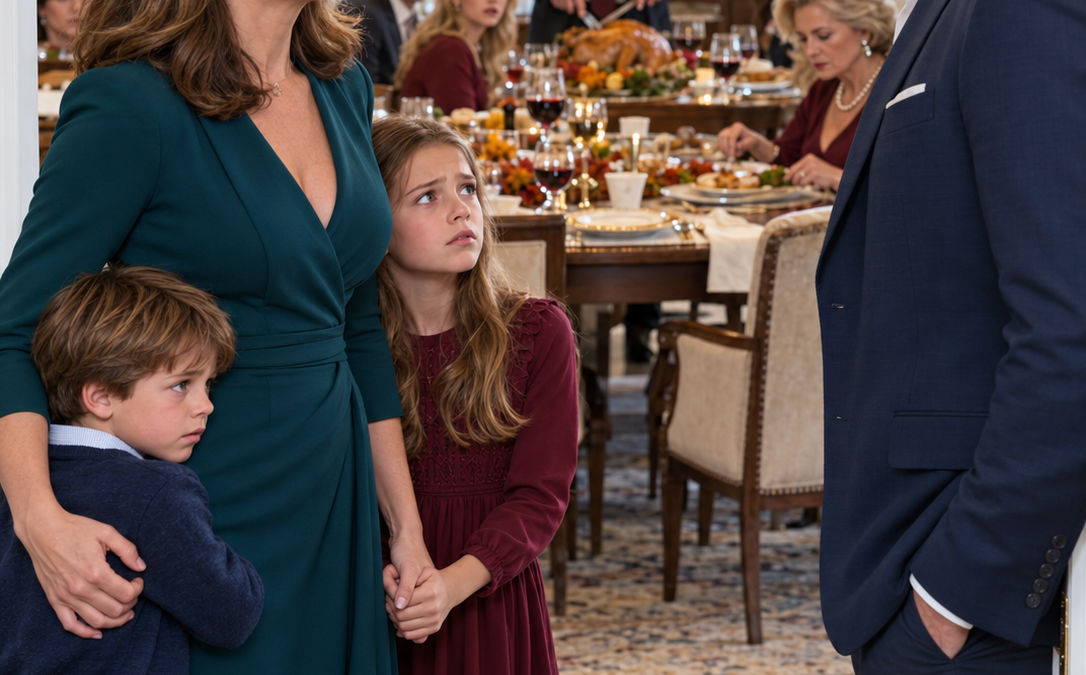
“No, you’re not welcome here.”
My brother smiled when he said it. He was standing in the dining room doorway on Thanksgiving, and the whole house smelled like turkey and my father’s cologne. My six-year-old son pressed against my leg. His small fingers found mine, and I closed my hand around them.
My daughter took my other hand. Past my brother, my mother sat at the table. I tried to catch her eye, but her fork kept rising toward her mouth. At the sideboard, my father went on carving. His knife scraped the platter. I waited for the knife to stop.
It didn’t.
My son pressed harder against me. I swallowed and turned my children away from the table. I kept hold of their hands, and I let go of the seat I’d been holding for him.
If you’ve ever stood in a doorway while the people who raised you kept eating, tell me about it in the comments and where you’re listening from.
That seat, though. Let me explain it first.
Where this ends, on Monday at 8:00 a.m., my brother’s badge will flash red at the entrance of his own company, and the guard at the desk will say to him the exact words he just said to me.
“Sorry, sir. You’re not welcome here.”
I’m giving you the ending first because this was never a story about a surprise. It’s a story about how long it takes to let go of something, and what you’re holding when you finally do.
My name is Rachel Whitlock. I run a company that cleans operating rooms and sterilizes surgical instruments for hospitals. It isn’t glamorous work. It’s the work that decides whether the glamorous work kills anybody.
In the house behind me, none of that exists.
In that house, I’m Rey, the one who quit. The bad investment.
In West University, ten minutes from the Texas Medical Center, even a hospital lanyard hanging from a rearview mirror is something to show off. A heart surgeon’s daughter quitting medical school didn’t need announcing. The coffee shop in Rice Village knew before dinner.
That’s the kind of house it is.
And the study is the kind of room it is.
Through the half-open door, past the dining room, you can see the wall. Three white coats in three frames, pressed flat under glass the way you’d press a flower you wanted to keep from changing.
My great-grandfather’s. My grandfather’s. My father’s.
The study smells like oak and the cigars my father pretends he quit.
The fourth frame has hung there since before I could drive. It’s empty. The brass plate under it was engraved early, the way you’d name a boat before it was built.
Dr. R. Ashby.
That was the plan.
Grant would hold the money. Rey would wear the coat.
My grandmother, Vera Ashby—Nana to me—was a surgical nurse for forty years in the same hospital where my father operated.
And there is no frame for her.
Nurses don’t get frames.
I’m going to tell this in order because the order is the point. That frame stayed empty after I quit medical school. Nobody took it down.
I wasn’t the only one keeping a place for someone.
Here is what the seat was, in plain words.
A man named Alan Brewster runs an investment fund. This fall, that fund agreed to buy my brother’s company: the surgical centers, the marble lobby, the name on the sign. My company was handed the operations—the sterile rooms, the cleaning crews, the trucks.
And when a company changes hands, somebody decides which of the old leadership gets to stay.
My people recommend. Brewster signs.
And somebody can always add a note at the bottom of the page.
That somebody was me.
All fall, my brother’s name—Grant Ashby, chief executive—sat on that list for one reason.
I put it there.
My own people told me not to. I did it anyway.
On Thursday, standing in that doorway with a six-year-old pressed against my leg, I stopped.
I didn’t make a call. I didn’t write a letter. I didn’t tell anyone in that dining room what I was.
I took my children’s hands and went home.
And on Sunday night, I sent one email that undid the one thing I’d done for him.
On Monday, the system did what systems do when a name comes off a list.
No lawyers. No shouting. Nobody kicked a door.
How I got from a mop bucket in a hospital basement to the desk where that list landed is the part that matters.
The seat was his corner office. I let go on Thursday, and on Monday the system did the rest.
The spring of my first year of medical school, I said it at the dinner table, which was my first mistake.
Everything in that house was decided at that table.
I told them what I’d found out about myself: that the part of surgery I loved was the hour before the surgeon walked in. The empty room. The instruments laid out in rows. The count said out loud by two people who didn’t trust their own eyes.
I loved how a room became ready.
I did not love the knife, and I’d stopped pretending.
My father, Howard Ashby, chief of cardiothoracic surgery and the owner of the voice that decided things in that house, set down his fork.
He didn’t shout. He never did.
He used the voice he used for money.
“A bad investment,” he said. “You cut your losses early.”
My mother, Carolyn Ashby, got up and poured water. Four glasses, each filled to the same line while her daughter was being written off at the other end of the table.
Water on crystal.
It’s the sound I still hear when I think about that night.
“Howard, not at dinner.”
“We don’t fund sunk costs at this table.”
He turned to my brother.
Grant was halfway through business school, and he was smiling because he was always smiling.
“The rest of the education fund goes to Grant’s second year. He’s building something.”
Nana’s money, set aside for me before I was born, moved across the table in one sentence.
“Rey, come on,” Grant said, light as a toast. “It’s about integrity. Standards. You don’t quit halfway and expect the family to clap.”
He tilted his head at me.
“Scrubs.”
It was the first time he called me that.
At the far end of the table, Nana put her fork down. She’d scrubbed in on four thousand surgeries.
She said one thing.
“The hour before the surgeon is the only hour that matters.”
Nobody answered her.
My mother sat down. My father picked up his fork. The cigar smell came in from the study, where the fourth frame was waiting.
The next morning, Nana was in her car outside the garage, engine running, and she wouldn’t say where we were going.
She drove me to my father’s hospital.
Not to the front entrance. To the service entrance, down a ramp that smelled like diesel. And then, as the doors opened, like something sharper.
Disinfectant.
It’s the smell of a room being made safe for someone who will never know your name.
The environmental services office was a room in the basement with a coffee maker older than me. The woman behind the desk had run that department for twenty years, and she and my grandmother looked at each other like two people who’d buried the same friends.
“Vera.”
“I brought you a worker.”
“Howard’s girl?”
The director looked me over.
“Honey, this floor eats people.”
“Give her the worst one,” Nana said. “The best surgeons I ever knew were afraid of the women who clean the rooms. Let her learn why.”
That was the whole interview.
I started Monday on the fourth floor, the one nobody wanted.
And I learned why.
They issued me a badge the first day. White plastic, blue stripe, my picture looking like it had been taken at a traffic stop.
R. Ashby. Environmental Services.
I clipped it to a gray uniform that had somebody else’s name inked inside the collar.
The first week, I learned that surgeons’ eyes slide off you. Not unkindly. They’re just gone.
I stood in an elevator with my father twice, and he was on his phone both times. I could smell his cologne. I’m sure he could smell me.
On the fourth floor, an operating room nurse taught me the turnover clock. Forty minutes from last stitch to next patient.
Every minute you shave off is a minute somebody doesn’t bleed in a hallway.
On the third day, I put the uniform in a bag and sat on the loading dock, ready to quit.
Nana had said, “Let her learn why.”
All I’d learned was that my knees hurt.
Then I thought about the count.
Two people sang the numbers out loud.
I went back up.
Nana picked me up that night with the windows down.
“You’ll smell like bleach at dinner tonight,” she said.
“Let them smell it.”
The badge said R. Ashby, Environmental Services.
The first time that name sat under a title that was mine.
A year later, my brother came back with the degree Nana’s money had paid for and a title at my father’s practice group.
Director of Operations.
It put him in my hospital.
It put him in the corridor outside the residents’ lounge on a Tuesday afternoon, with six residents behind him. Young men who laughed when he laughed.
He stopped me with two fingers on my badge.
“Hold still, Scrubs.”
He tipped it up toward him, uncapped a Sharpie, and wrote across my name in block letters.
MOP.
He capped the pen.
“So the residents know the standard,” he said. “Smile. It’s for morale.”
They laughed.
I don’t remember their faces. I remember the squeak of the cap going back on.
I didn’t say anything.
I’d like to tell you that was composure. Some of it was.
The rest was the thing that had already started in me. The thing that stayed quiet because quiet seemed like the only room I was allowed in.
In the elevator, I turned the badge face inward against my chest.
It stayed face inward for a week.
That Christmas, my mother printed a stack of cards. The family stood on the front steps, Dad’s hand on Grant’s shoulder, Nana in her good hat.
I wasn’t in it.
I’d been at work, and nobody had moved the date.
Alcohol would have taken the word off my badge.
I never tried.
The only person who didn’t laugh that day was pushing a gurney on two wheels.
His name was Derek Whitlock, and he moved patients for a living. Transport, the hospital called it.
He pushed a gurney the way other men drive a car they’re proud of. Slow on the corners, careful with the cargo.
He called every patient by name, and he remembered things.
Which side of the bed. Who got sick on turns.
“Mr. Alvarez likes the window side,” he told a nurse once.
And the nurse moved the bed.
He never said a word about the badge.
He’d seen it.
Instead, on the nights my floor was the worst, I’d come out of the stairwell and there would be a turnover cart at the end of the hall, already loaded, every bottle facing outward.
Nobody took credit.
I never asked.
Our first date was in the cafeteria at three in the morning, drinking coffee that tasted like the cup.
He asked what I liked about the work.
Nobody had ever asked me that.
I told him about the hour before the surgeon.
He didn’t laugh.
“That’s the hour I’m in the hallway, too,” he said.
We got married at the courthouse.
One guest. Nana, in her church hat, signing as witness with the hand she’d used to count sponges for forty years.
My parents were informed by voicemail.
My father let us live in the garage apartment because Nana told him her money had built that garage, and he didn’t argue with her about money.
At a family brunch, with Derek on shift, my father asked the table in the voice he used for money, “What’s the upside of a gurney boy?”
Nana said, “He carries people for a living. Your son carries a title.”
And I said the thing I’m least proud of in this whole story.
I said Derek worked in healthcare.
Not that he pushed gurneys. Not that he carried people.
Worked in healthcare.
I made him smaller so he’d fit in that room.
It would take me years, two children, and a Thanksgiving to understand what I’d done.
Two years after the wedding, the hospital put my name on the management board in ink that hadn’t dried.
The operations management track was the kind of thing that didn’t happen to people in gray uniforms.
Twelve people a year. Classroom in the mornings, floor in the afternoons, a sterile processing certification the hospital paid for. And at the end of it, you ran a department.
The director called me into her office and told me I was in.
I walked back to the fourth floor and cleaned three rooms without feeling the floor beneath my feet.
Two weeks later, she called me in again.
There was a letter on her desk.
She turned it so I could read it, and then she said the thing I’ll never forget.
“I’m not supposed to show you this.”
The letterhead was my father’s practice group, Ashby Cardiothoracic Associates, in the blue they used on everything.
A letter of concern addressed to the program.
It said the candidate had been dismissed from medical school for academic dishonesty, and the undersigned felt the program should know.
I didn’t read the body twice.
I read the bottom.
“Whose signature?” I asked, though I was looking at it.
Grant Ashby. Director of Operations.
My father’s name at the top of the page. My brother’s at the bottom.
For a long time, I told myself I didn’t know which was worse.
I knew.
Here is what I didn’t do.
I didn’t go to the program with my transcript. I didn’t go to my father. I didn’t call my brother.
I told myself that fighting it would drag my father’s name through the hospital where he still operated, and that silence was the dignified thing.
I want to be honest with you about that.
It wasn’t dignity.
It was fear wearing dignity’s coat.
The program gave my spot to someone else before the month was out.
Has someone who shares your last name ever written a sentence about you and then watched that sentence walk into rooms you’d never see?
Mine walked into all of them.
By Easter, it was at the brunch table of my mother’s sister, Celia, in the mouth of a woman who’d known me since I was baptized.
“Honey, is it true about the exam thing?”
“Pass the rolls?” I said.
She passed the rolls.
From then on, in the Ashby house, I was the cheater.
I never corrected it.
I called that dignity.
For three years, I said nothing and cleaned rooms.
Our daughter Ellie came along in the middle of them, with her father’s patience and my grandmother’s chin.
Then Nana had a stroke, and my father took over her affairs.
Her checkbook. Her mail. Her house, which was his house, which was the house with the garage apartment where my husband and my baby and I lived.
The text came the week the forecast got a name.
Conversion starts next week. Friday is reasonable.
Conversion.
The garage apartment was becoming a wine room.
The name on the forecast was Harvey.
I called my father and asked for a week.
He said the contractor had a schedule.
My mother called an hour later in the voice she used when she was carrying a message instead of a thought.
“Your father thinks it’s best for everyone, sweetheart.”
By the weekend, the street was a river.
Derek carried Ellie through water up to his knees to get her to the truck, singing to her the whole way. Something about a window side.
She laughed at the rain hitting her face because she was one and didn’t know what it was.
I went to the back door of the big house to return a key.
Nana was there in a wheelchair, in the doorway, wearing a housecoat with the rain coming in on her slippers.
The stroke had taken most of her words.
She’d kept enough.
She pressed something into my palm and closed my fingers over it.
A pin. Brass, worn soft at the edges.
The nursing school pin she’d worn on her collar for forty years.
“This,” she said, a few words at a time, “doesn’t need anyone’s permission.”
Then she gave me a folded piece of paper, already damp.
A name.
Bernice.
A Dallas phone number.
“Take it. ’74. She owes.”
I said thank you, and the word came out in two pieces. I had to wait for the second half.
“’74. She owes,” Nana repeated.
I didn’t know who Bernice was, and the engine was already running north on the interstate in the dark, with the wipers losing.
Ellie was asleep in her seat with wet socks.
One trash bag of clothes. A box of her things.
No address in Dallas because the number in my pocket was a number, not a door.
The taillights ahead of us smeared and came back and smeared.
In the mirror, Houston was a glow under a lid of cloud, and then it was nothing.
And I understood I’d just watched a city close over my family’s house the way water closes over a stone.
I held the pin in my fist the whole way.
Forty years on a collar had worn the edges down, and still they dug in.
I thought about the fourth frame. I thought about the Christmas card for a few miles.
I thought about turning around.
Then I looked at the socks on my daughter’s feet and stopped thinking about it.
Derek drove with both hands.
Somewhere past the county line, he said the only thing either of us had said for two hours.
“We’ve got gas to Huntsville. That’s a plan.”
It was a plan.
I’ve had bigger ones since.
I’ve never had one that mattered more.
Houston had no room for us that night.
The pin in my hand didn’t need anyone’s permission.
The number rang in a trailer behind a warehouse off the Dallas Loop.
And the woman who answered had been waiting for the call since 1974.
Her name was Bernice.
She’d started on a cleaning crew, then become a surgical tech, then a scrub nurse, then, in her forties, the owner of two vans and a company called Clear Line, which cleaned operating rooms for hospitals that had stopped trusting their own crews.
Her office smelled exactly like the fourth floor.
Disinfectant and old coffee.
On the wall behind her was a photograph of the two vans, both of them dented.
“Vera’s girl,” she said before I’d told her my name.
She told me about 1974 while she looked at my hands.
A surgeon had lost a patient to an infection, and the surgeon had told the board it was the cleaning crew.
The crew was Bernice.
The only person in that operating room who’d stood up and said what she’d actually seen—which was a surgeon rushing a count—was a nurse named Vera Ashby.
“Your grandmother taught me the surgeon’s hour is the hour before,” Bernice said.
Then she asked, “You want a job?”
“Yes, ma’am.”
“Supervisor. Second shift. It’s not a favor. I need someone who hates a dirty corner more than she likes being thanked.”
“What did she do in ’74?” I asked.
“Exactly. She told the truth to people who didn’t want it. That’s all anybody ever does that matters.”
Bernice sat back.
Then she asked the question I wouldn’t understand for months.
“Does anyone in your family know where you work?”
“Only Nana.”
“Good. Keep it that way as long as you can.”
She said it the way you’d say, Keep your head down in a storm.
I thought she was being dramatic.
I thought a lot of things that fall that turned out to be the tax I paid for not knowing my brother.
Bernice had asked who in my family knew where I worked.
I’d said only Nana.
Nana wasn’t the one who called.
The call came a few months later to Bernice’s office line on a Tuesday.
She told me about it that evening in the trailer with the door shut.
She didn’t soften it. She didn’t make it worse, either.
She reported it the way she’d report a count.
“A man with your last name called,” she said. “He smiled through the phone. I could hear it.”
I knew the smile.
I could hear it, too, from across the state.
It didn’t take me long to work out how he’d found her.
Nana’s mail went to my father’s desk now, and every Christmas a card came to her from Dallas with Clear Line on the return address.
My brother read everything on that desk.
He’d called as a courtesy.
He said he felt she should know.
His sister was unstable.
His sister had been dismissed from medical school for cheating.
His sister shouldn’t be anywhere near anything that mattered.
“What did you tell him?”
“That I’d take it under advisement.”
She folded her hands.
“Then I moved you to nights.”
The floor went out from under me, and I stayed standing on it.
Nights.
Seven years on the fourth floor, and a courtesy call had put me in a basement after dark.
Bernice watched that land.
Then she leaned forward.
“Nights are where he can’t see you,” she said. “And where you learn the whole building. Sterile core. Supply. The count. The clocks. Nobody’s watching. Learn it.”
I’d thought I was being punished.
I was being hidden and taught by a woman who’d been hidden once herself.
Nights started Monday.
Derek said he’d take days and Saturdays temporarily.
Temporarily lasted a year.
Derek took a day job pushing transport at a hospital across town, and we handed Ellie off in a parking lot every morning.
One of us arriving. One of us leaving.
A kiss over a car seat.
He worked every Saturday.
He didn’t tell me why.
I thought it was the rent.
I worked nights with Nana’s pin in the breast pocket of my uniform, where it pressed against me every time I leaned over a cart.
I learned the building.
The sterile core, where instruments came back from surgery bloody and went out again in sealed trays.
The count that happens twice, out loud, by people who’ve done it so long they still don’t trust it.
The clocks on the wall that tell you how long a room’s been empty and how much money that is.
I learned what a hospital looks like when nobody important is awake, which is what a hospital actually is.
One morning, I came home and there was an envelope on the kitchen table.
Not sealed.
Inside was a receipt.
The sterile processing certification course, paid in full.
“The one your brother blocked,” Derek said from the stove. “Nobody’s blocking this one.”
I tried to argue about the money.
He didn’t let me.
“It’s paid. Don’t look at the number.”
He flipped a pancake.
“I pushed people for nine years. I know what a year’s worth.”
I laughed, and the laugh went somewhere else halfway through.
He let it.
That was the night I stopped waiting.
I’d been waiting for a phone call, a card, a sentence that started with, “We were wrong.”
I stood in the basement at two in the morning with a tray of clamps and understood there was no version of that family that gave me what I’d earned.
There was one way left.
Get too big to deny.
I should tell you what that did to me because it wasn’t all clean.
I started running on the thing in my chest the way a truck runs on diesel.
Cold, steady, and not something you’d want to breathe.
That night, I stopped waiting for fairness from them.
Waiting is a full-time job, and I had one.
The next spring, Nana died.
Nobody called me.
Aunt Celia called the day after the funeral. My mother’s younger sister, who had never in her life kept a thing she’d heard.
“I thought you knew, honey.”
“Grant handled the list.”
“The list for the service. Who to notify. It was lovely. The flowers were from Grant’s company. Big ones.”
“Who made the list?”
“Honey…”
A pause while she decided whether she was gossiping or confessing.
“You know who makes the lists.”
Then, because she couldn’t help it, she asked, “Where are you these days?”
“A company called Clear Line,” I said. “I run a shift.”
It was true.
That spring, I’ve thought about that sentence more than most things I’ve said.
It went from Celia to my mother, and it sat in that house for six years, getting older and smaller, until it was the thing they thought they knew about me.
I drove to Houston that afternoon.
I got to the cemetery at dusk, and the family cars were gone.
The flowers were still fresh.
Big ones. White, mostly, in the company colors.
The grave was new enough that the sod still showed its seams, and somebody had left the florist’s card tucked under the ribbon so the name of the company faced the road.
There’s a fence along the roadside. Wrought iron, chest-high.
I stood at it with the pin in my palm the way I’d stood at the back door the night she gave it to me.
Except this time, nobody was waiting on the other side.
I didn’t go in.
I think going in would have been one more room I’d entered without being on the list.
My legs decided before I did.
I sat down on the curb with my back against the iron and stayed there until the sprinklers came on.
West University was eleven minutes away.
I could have knocked.
I didn’t knock that night.
Some doors you knock on, and you lose the whole hand.
Here’s how a mop becomes a company.
You measure.
I took what I’d learned in the basement and wrote it down.
How a sterile tray gets handled, step by step. No skipping.
How a room gets turned with a clock on it.
How a count gets done by two people, out loud.
Then I made every crew Clear Line sent out do it exactly that way.
And I checked.
Hospitals keep a number nobody likes to say out loud.
How many patients come out of surgery with an infection they didn’t go in with.
At the hospitals that used us, that number went down.
Not a little.
Enough that their people noticed.
And then their people’s bosses.
Hospitals don’t pay for clean.
They pay for that number.
Derek came over to Clear Line the year our son Max was born, and he brought the hallway with him.
He wrote the training himself.
The first page said, Patients remember the person who cleaned the room, not the surgeon. You’re the last face before the surgery.
He told every new hire, “Say their name.”
Two vans became a fleet.
Dallas became four states.
Every few years, Bernice moved me up a rung until the rung was the whole ladder.
When she retired, she handed me the keys to the trailer and said the thing she’d been saving.
“Vera’s girl, don’t let them make you fast. Make them make you clean.”
I’d like to tell you I celebrated.
I didn’t.
I checked the number.
Every morning before coffee, the infection rate at every site. And if it moved the wrong way, somebody heard from me before seven.
I was good at it.
I was cold about it.
Those had become the same thing, and I hadn’t noticed.
Then a man named Alan Brewster wanted to buy the company and asked what name I wanted on the badge.
Brewster ran a fund that bought companies like ours and made them bigger.
He didn’t want a new chief executive.
He wanted the number.
And the number was mine.
The signing took an hour in a conference room with a view of a parking lot.
He slid a form across the table.
Badge details for the new building.
“What name goes on the badge?”
“The one I’ve had since my wedding day.”
The badge came back a week later.
Rachel Whitlock. Chief Executive.
Blue stripe.
Better photo.
I have a drawer, top left, in a desk I’m still not used to.
I keep two things in it.
A spare charger and a white badge with a blue stripe and three block letters across the name in Sharpie.
MOP.
I’d carried it from Houston in the trash bag and from the trailer to the new building.
And I’d never once let anyone see it.
I told myself it was a reminder.
Of what the work was. Who it was for. What it cost.
That’s what I told myself.
I put the mop badge in my drawer.
A reminder, I said.
I didn’t know yet it was a chip.
Celia had kept calling since the funeral, which is how I learned that the house I wasn’t welcome in was being bet on my brother.
The year my father retired from surgery, he took his retirement and put it into shares of Grant’s company.
All of it.
Grant had told him the sale, when it came, would triple it.
Celia told me this with the relish of a woman who’d been in the room.
“Vera warned him. She said it years ago, right at the table. ‘Don’t put the house in Grant’s basket, Howard.’ He laughed. He laughed, and then he did it.”
This fall, the basket started leaking.
Ashby Surgical Partners had grown fast on cheap money and expensive buildings.
And the money wasn’t cheap anymore.
The centers were full, and the company was empty.
Grant put it up for sale.
And the buyer who came to the table was Alan Brewster’s fund, with Clear Line named as the operating partner.
Sterile processing. Cleaning. Logistics.
The parts nobody photographs.
The morning the name came across my desk, I walked into Brewster’s office and said it before I sat down.
“The seller is my brother. I’m out of the room.”
He didn’t blink.
“Noted. Price and terms, you’re out. Who stays on after close? Your people recommend, and I sign. Anything you add goes on the record with your name on it. You disclosed. That’s the point of disclosing.”
So I was out of the room where the money was decided, and Grant never saw me.
He dealt with the fund’s deal team.
On a conference call, he called Clear Line “the fund’s janitors,” and someone thought I’d want to know.
The deal team sent him a one-page summary of the operating partner’s leadership.
One line said: R. Whitlock, Chief Executive.
He’d never learned my husband’s last name.
In that family, Derek had only ever been the gurney boy.
He flipped the page.
My diligence team went into his buildings that month.
They came back with photographs.
His headquarters had a marble lobby, an espresso bar, and a guard desk with a laminated card on it.
A script.
The guards were to read it word for word to anyone the system denied.
My brother flipped past the line that said R. Whitlock, the last thing he could still afford to skip.
The card said, “Sorry, sir. You’re not welcome here.”
Grant had written it himself.
I was told he was proud of it.
Standards.
Here’s what else my people found, and I’m going to say it plainly because it’s the reason for everything after.
He’d cut his sterile processing staff in half.
The people who clean and sterilize surgical instruments between patients.
He’d replaced them with the cheapest outside vendor he could find.
And the infection rate in his centers was double what it should be.
There were incident reports.
The kind that get written when a patient comes back with a fever.
And those reports were not in the sale documents.
The money had gone into the marble, the espresso bar, the laminated card.
My head of sterile processing, a woman who’d been doing this since I was in high school, put the folder on my desk and said it in numbers because she was too angry for words.
“Half the staff. Double the rate. And a marble floor.”
Her recommendation, and the team’s, was at the bottom.
Do not retain the current leadership. Any of it.
I asked her one question about the vendor contract.
I did not say anything about my brother.
She noticed.
She was kind enough not to.
Now, the part you need in order to understand Monday.
The sale closes at eight on Monday morning.
At that minute, the building’s badge system switches over to one list.
The staff’s badges don’t change.
Old leaders on the retention list stay green, and they get a seat at the table.
Old leaders who aren’t on it go red, and they get a conversation with HR.
And one more thing, which Grant designed himself because the company was worth less than he’d hoped.
Most of the sale money gets paid out over three years on one condition.
He stays on as chief executive.
If he goes, the money goes.
Which meant my father’s retirement was sitting in a chair that had my name on the bottom of its leg.
Everything you need to know, you now know.
What’s left is what people do with it.
My people’s recommendation sat on my desk.
Three words.
Do not retain.
And I picked up the pen.
If you’ve held a paper that told you the truth about someone you still loved, tell me in the comments what you did with it.
Next, I’ll tell you what I did with that pen.
I’m not proud of it.
I wrote across the bottom of the recommendation in my own hand.
Retain G. Ashby. One year. Supervised.
Brewster read it twice and looked at me over his glasses.
“You sure? It’s your own people who flagged him.”
“I’m sure.”
“Then it’s on the record. Your name’s on it.”
“Mine.”
He signed under my note.
I want to explain this before you watch it fail because you’re going to watch it fail.
I wasn’t saving my brother.
I was buying a Thanksgiving.
I had a picture in my head, and I’d had it for a long time.
I walk into that study. My father is standing at the wall, and he takes the fourth frame down with his own hands and gives it to me because I’m the one who kept the name on the sign.
I’m the one who saved the Ashbys.
The bad investment pays out.
That’s what the mop badge in my drawer was for.
It wasn’t a reminder.
It was a chip.
And I’d been waiting fifteen years for a table to put it on.
You can pay for a seat at someone’s table with something that isn’t yours to give.
I paid with my own people’s work.
I paid with a patient safety number I’d spent a decade protecting.
I’ll show you what it cost and who paid.
Brewster had asked, “You sure?”
I was sure.
I just didn’t know yet who I was sure for.
My mother called in November, the first time in eight years that her name had lit up my phone.
I stood in my kitchen and watched it light up until it stopped.
And then I called her back.
She didn’t say why she was calling.
I found out later.
Grant had told her that after Monday, the family was set for life.
And for the first time in years, my mother had felt safe enough to spend something.
A phone call.
A gesture.
She wanted the picture full this year.
She didn’t tell Grant she was making the call because she knew what he’d say.
“We’d love to see the children,” she said. “If you think it’s appropriate.”
I said we’d come.
“Celia says you’re a supervisor now.”
Six years old, that sentence.
I could have fixed it in four words.
I had the four words.
I’d had them for years.
“Yes, ma’am,” I said.
I’ll tell you why.
As best I know, I wanted to walk in as the thing they thought I was and walk out as the thing I’d become, with the whole table watching the distance.
I’d tell them after the pie.
I’d say it at once, calmly.
The company that bought Grant’s is mine, and the reason he still has a job is me.
And then my father would stand up.
I rehearsed it in the shower.
I rehearsed it so many times the water went cold.
Derek listened to all of it from the doorway with a towel over his shoulder.
He didn’t argue.
He asked one thing.
“Do you want me there?”
“They didn’t invite you.”
“That wasn’t my question.”
I didn’t answer the question.
I’m telling you now because I didn’t tell him then.
I said, “Yes, ma’am,” and kept my secret the way you keep a gift nobody may accept.
Thanksgiving morning, in the driveway with the engine running and the kids buckled, I turned around in my seat.
“If Grandma asks,” I said, “Daddy works in healthcare.”
Ellie nodded.
She was nine.
She’d heard it before.
Max was six and took things exactly as they were.
“Does the gurney count?”
“Yes.”
I didn’t know yet what that yes was going to cost.
Derek had packed the kids’ bag.
Snacks. Books. The stuffed dog Max pretended he didn’t need.
He had zipped something into the pocket of my coat while I was in the shower, and I didn’t know that either.
He stood on the porch in his socks and waved.
“Drive safe. Text me at the exit.”
No complaint.
He’d had eight years of being left on porches, and he’d never once made me carry the look on his face down the driveway.
Four hours south.
I had the sentence ready.
I had the whole table in my head, seat by seat.
What do you let your children watch you ask for?
I’d never thought to ask it.
I had two of them in the back seat watching.
Max had asked if the gurney counted.
I’d said yes.
It was the last time I asked my children to make their father smaller.
The house smelled like turkey and my father’s cologne.
The same two smells.
Like no time had passed.
My mother hugged me a beat too long, the way you hold a door you’re not sure you can close again.
My father was already at the sideboard, carving the first bird.
He always carved early for the photograph.
He looked up once.
“Rey.”
One syllable.
One more than the elevator.
The table was set for eleven.
Beside Grant’s place at my father’s right hand, there was an empty chair with a plate in front of it.
“I set it every year,” my mother said, as if that were a kindness.
It was my chair.
Eight Thanksgivings, and nobody had called to tell me it was there.
Aunt Celia was already in the kitchen with a glass.
“You look thin, honey. Nights, I guess.”
Through the half-open study door, I could see the wall.
Three coats.
One frame still empty.
Still engraved.
I’d been in the house four minutes, and I’d already looked.
The kids sat on the couch with their hands in their laps the way I’d asked.
Plates went around.
My mother said Grant was running late.
“He has news.”
The empty chair waited beside my brother’s.
My brother was late with two bottles of wine and good news.
Grant came in through the kitchen with a bottle in each hand and the smile already on.
He didn’t take off his coat before he started.
“We’re set,” he said. “For life. It’s done. It’s signed. It closes Monday morning. I stay on as CEO.”
He set a bottle in front of my father like a trophy.
“The fund’s operating partner is some mop outfit called Clear Line. They don’t even have a real lobby.”
He laughed.
“Mine has a script. My guards say, ‘You’re not welcome here.’ With a smile. I wrote it. Red badge, they read it. Even if it’s me. That’s the standard.”
He’d been in the room thirty seconds and hadn’t looked at me.
He’d looked at the bottles, at my father, at the empty chair beside his own place.
And the chair hadn’t told him anything.
My mother, who had looked at me, filled the silence the way she filled water glasses.
“Rey’s at Clear Line,” she said, proud of the words. “She’s a supervisor now, aren’t you, honey?”
Grant stopped smiling.
I’ve thought about those ten seconds more than any other ten seconds of my life.
I can’t tell you what was in his head.
I can tell you what his face did, what he said next, and what I understood later.
He wasn’t protecting a deal.
The deal was done.
He was protecting a sentence he’d written on his father’s letterhead eleven years before.
The only person who knew that sentence was a lie had just been placed by his own mother inside the company that would be grading him.
“You’re at Clear Line,” he said slowly.
I watched the name travel back eight years across his face to a Tuesday phone call he’d never thought about again.
“Yes.”
“That’s a conflict, Rey. You know that, right?”
Celia said, “Ooh.”
My father didn’t look up.
He’d started on the second bird.
My mother looked down at her plate and stayed there.
Ten seconds.
The longest I’ve ever seen my brother go without a smile.
He stood up.
The smile came back.
And he walked to the dining room doorway and put himself in it.
“No. You’re not welcome here.”
He looked directly at me.
“You walked out the year of the storm. You don’t walk back in the week we close. Not with that job. Not near Dad’s money.”
Max pressed against my leg.
Ellie’s hand found mine.
I looked at my mother.
Her fork was rising.
It kept rising.
I looked at my father.
The knife went through the bird and scraped the platter, and the sound didn’t change.
Max pressed harder.
I had the sentence.
I’d rehearsed it until the water ran cold.
The company that bought yours is mine. The reason you still have a job is me.
I had two reasons not to say it, and I’ll give you both.
The first is that I wasn’t allowed to speak about the deal before it closed.
Not to anyone.
Not even to him.
I’d been ready to break that rule for a slice of pie.
Standing there, I remembered why the rule exists.
The second is that saying it in that doorway would have been buying a chair.
And two children were holding my hands.
I swallowed.
I turned them both away from the table.
I said nothing about the deal.
Saying it would have been buying a seat, and my children were watching.
Coats.
The front closet.
The kids’ coats on the low hooks my mother had put in that year, which I noticed and didn’t let myself notice.
Behind Grant, the empty chair sat with its plate.
My mother said, “Sweetheart,” and didn’t finish.
And the fork finished for her.
My father didn’t look up.
“Drive safe, Rey,” Grant said with the smile.
At the front door, I crouched to Ellie’s height.
“We’re going home.”
“Mom, seat belts.”
The porch was cold.
A front had come through while we were inside.
I opened my coat and put both kids under it, and we crossed the lawn like that.
One coat.
Three people.
The way you’d cross a parking lot in the rain.
At the car, buckling Ellie in, my hand went into my pocket for the keys and found paper folded small, wrapped around something hard.
I opened one fold under the dome light and read the first line.
You already have a seat.
I folded it back.
I didn’t read the rest.
I wasn’t ready for the rest.
Last time, I’d left that house in the rain.
This time, I was the coat over two children.
We drove north in the dark with the heater on high and nobody talking.
Max lasted to the city line.
“Why were they still eating?” he said to the window.
And then he was asleep with his mouth open, and I didn’t have to answer.
Ellie waited another twenty minutes.
She’s like her father that way.
She waits for the right hallway.
“Did we do something wrong?”
I pulled into a gas station so I could turn around and look at her when I said it.
There are things you can say to a child in a mirror, and there are things you can’t.
I turned off the engine so my hands would have nothing to do.
“No. You didn’t do anything wrong. Neither did Max. That chair wasn’t something you had to earn, and it wasn’t something I had to earn, either. I forgot that for a while.”
She thought about it.
“Okay,” she said.
And meant it.
Which is a thing children can do.
Under the canopy lights, I took the paper out again and read the whole thing.
You already have a seat. It’s at our table.
It was wrapped around Nana’s pin.
We got home near midnight.
The porch light was on.
Derek opened the door before I touched it, took Max out of my arms without a word, and carried him up the way he’d carried a thousand people.
Careful on the turns.
“Kids first,” he said when I started to talk.
He put them both down.
Then he came back to the kitchen.
He had a sentence he’d been holding for eight years, and I could see him deciding whether tonight was the night to set it down.
He stood on the other side of the kitchen island with his hands flat on it.
“You’ve had the kids say I work in healthcare for eight years.”
He looked at me.
“You hid me the way they hid you.”
I didn’t say anything.
My hands had gone cold on the counter.
The specific cold you get when the blood has somewhere more urgent to be.
He wasn’t angry.
That was the worst part.
He said it the way he’d tell a nurse which side of the bed a patient preferred.
Information that mattered, offered once.
I saw it all at the same time.
The way you see a room when the lights come on.
The sentence at the brunch.
Yes, ma’am.
Supervisor.
Daddy works in healthcare.
Retain. One year. Supervised.
They were one thing.
I’d been paying for a chair at their table with the people who were already at mine.
“I know,” I said.
He nodded.
He went to bed.
I didn’t.
When Ellie came down in her pajamas, I sat her at the island with a bowl of cereal and told her the truth before I’d had coffee.
“Your dad carried people for nine years. He was the last face they saw before surgery, and he said their names.”
She ate her cereal.
“I know,” she said. “He told me about Mr. Alvarez.”
Friday morning, my phone buzzed.
A forwarded email.
First line:
He’s talking about you.
My brother had spent his Friday morning the way a careful man would.
He’d searched for me first.
Rachel Ashby. Clear Line.
Nothing came back because there was no such person.
Then he’d called the fund’s deal partner and told him, in the voice he used for problems, exactly what he’d told Bernice eight years before.
His sister.
Night supervisor.
Dismissed from medical school for cheating.
Vindictive.
Then one more line in writing, because he put it in writing.
Don’t let a disgruntled night supervisor anywhere near my father’s retirement.
Three times now.
Once to a hospital.
Once to a cleaning company.
Once to the only people left on earth who could still save him.
The deal partner had replied that retention decisions would be communicated in person by HR on Monday morning.
Grant heard a formality.
The partner forwarded the whole thing to the chief executive of Clear Line with one line on top.
He’s talking about you.
I didn’t answer my brother.
I didn’t write a word about him.
On Sunday night, I wrote to Brewster three things.
I withdrew my note on the recommendation and asked him to let my people’s findings stand exactly as they had written them.
I would not be in the room when my brother was told.
I would be in the lobby at eight because there were sterile techs and cleaners in that building whose department he’d cut in half, and somebody should tell them in person that their jobs were safe.
Brewster wrote back in ten minutes.
Understood. Lobby before 8.
He added that he didn’t call people on a Sunday night about whether they still had a job.
He told them to their faces on Monday.
All the same way.
Dinner that night.
Four of us.
The phone face down on the counter.
I told my kids what their mother does.
“I run the company that makes operating rooms safe.”
I told them what their father does, and this time I used the right words.
“Is Mom the boss of Uncle Grant?” Max asked.
“No,” I said. “The numbers are.”
Bernice came at nine to stay with the kids.
Derek put the bag in the truck.
I told my kids what their mother does.
What their father does.
Nobody in this house auditions for a seat.
Marble first.
A floor you could see your shoes in.
And a guard desk with a laminated card on it, exactly where the photograph had put it.
Brewster’s transition team stood in the open part of the lobby in front of the turnstiles with coffee, ready to greet the staff coming in.
HR was waiting at the executive entrance on the side of the building where the old leadership usually came in.
A couple of them had already been met there and walked up, the ones who were staying.
My husband stood with our operations crew in Clear Line polos by the far wall.
Not with the executives.
Because that’s where he wanted to stand.
He gave me one nod across the floor.
The staff came in the way staff come in.
Scrubs. Lanyards. Phones.
Sterile techs. Cleaners. The front desk girl.
Badges beeping green at the turnstile, one after another.
A sound I’ve heard ten thousand times and never once thought about.
I went to the desk.
The guard was a broad, gray-haired man with a careful face.
“What’s your name?”
“Curtis, ma’am. Twenty-nine years in security. Three here.”
“Did you write this card?”
“No, ma’am. Mr. Ashby wrote it.”
“We’re to say it word for word?”
He looked at the card, then at me.
“Even to him. He told us that himself.”
The screens over the turnstiles ran the Ashby Surgical logo on a loop.
Brewster checked his watch.
“Your floor to open, Rachel,” he said, and stepped back.
My brother, I knew, would not use the side entrance today.
Today, he’d come through the front.
Through his people.
Because today was the day he’d stand beside Alan Brewster at 8:30 as the man who’d been kept.
Two minutes to eight.
Badges beeped green like a metronome.
The gate didn’t know what the lobby was about to see.
At eight, the front doors opened.
Grant came through them with a coffee and his phone to his ear.
He nodded at someone.
He didn’t look at the turnstile.
He never had to.
He swiped.
Red.
He swiped again.
Red.
The beep was wrong.
Everyone in the lobby knew the right beep.
Curtis stood up.
He looked at the screen.
He looked at the card.
He read it.
“Sorry, sir. You’re not welcome here.”
No smile.
Just the sorry in the place the smile had been on Thursday.
A tech in blue stopped midstep.
Then another.
The front desk girl put her phone down.
Grant laughed.
One sound.
“Curtis, it’s me.”
He swiped a third time.
Red.
“It’s me.”
“Sir, I’m going to need you to step back from the gate.”
“It’s me.”
Nobody moved him.
He stepped back on his own.
His coffee was still steaming.
The badge in his hand was plastic now.
He was the last person in the building to know.
My brother turned to find someone higher than a guard and found Alan Brewster standing next to me.
He crossed the marble in six steps.
“Alan, your system flagged my badge. Fix it.”
Brewster didn’t look at him.
He turned to me.
“Chief Executive Whitlock. Shall we begin?”
Grant’s face did the thing it had done on Thursday.
Longer this time.
“Rey?”
I didn’t answer.
I didn’t have to.
Then, loudly, to the room, to his own people:
“She’s a janitor. She was thrown out of med school for cheating.”
The murmur went around the lobby and came back.
Derek, by the far wall, didn’t move.
Brewster’s voice stayed flat.
“You told my partner the same thing on Friday. It was on my desk before lunch. We checked. She withdrew from medical school in good standing. I’ve known she was your sister since the first day of this deal.”
He paused.
“The recommendation not to retain came from her sterile processing team. She removed herself from the decision.”
The coffee tilted in Grant’s hand.
Nobody caught it.
Curtis sat back down.
Nobody laughed.
My brother looked at me.
He looked at the badge on my lapel.
He looked for the mop.
I hadn’t said a word to him.
Fifteen minutes later, the lobby screens changed on a schedule set before Thanksgiving.
The slide had been built by the integration team a week before Thanksgiving, the way these things are built, and loaded onto a timer.
Day One. Welcome.
It had been updated Sunday night to match the list.
Welcome to the Clear Line family.
The new leadership, in a row of photographs.
Mine was in the middle.
And it was the largest image in that lobby.
Three feet high over the turnstiles my brother couldn’t get through.
I’d known it was scheduled.
I’d let it stand.
I’m telling you that because I don’t want credit for a thing.
I only didn’t stop it.
Phones came up.
Not many.
Enough.
Aunt Celia, who followed Ashby Surgical’s page the way she followed everything, dropped a link into the family group chat.
The welcome post.
My face.
My title.
Celia told me later there were twenty-two people in that chat, and for the first time since it existed, nobody typed anything.
Grant had one hand on the turnstile.
His coffee was on the floor, and the puddle was spreading toward his shoes.
He didn’t step out of it.
He’d loosened his tie without seeming to know it.
“Rey, let’s talk in my office.”
He didn’t have an office.
Behind him, two sterile techs in blue were talking low, and the lobby was quiet enough that I heard it.
“That’s the Clear Line lady. The one who wrote the count protocol.”
“Her?”
“Her.”
He heard it, too.
I watched him hear it.
And then his voice dropped, and he reached for the only thing he had left.
The thing I’d been hoping he wouldn’t.
“Dad’s retirement is in that payout,” he said. “Rey, for Mom.”
Brewster looked at me.
“Rachel, the floor is yours.”
I didn’t speak to my brother.
I spoke to the lobby.
“My name is Rachel Whitlock. I cleaned operating rooms in this city for seven years.”
I pointed across the marble.
“My husband, Derek Whitlock, right there, pushed gurneys for nine. I know what the work is.”
Then, once and only once, so it would be on the record of the people who’d worked under him:
“Mr. Ashby wrote a letter about me to a hospital on his father’s letterhead. Mr. Ashby made a phone call about me to a company. And Mr. Ashby cut this company’s sterile staff in half and paid for this floor with it.”
Nobody clapped.
That was correct.
“Two things, effective now. Sterile processing is staffed back to full today, and every badge in this company gets reprinted with your whole name on it.”
I looked at the guard desk.
“We start with Curtis.”
Curtis said, “Ma’am.”
Nothing else.
And it was enough.
“Rey.”
Grant’s voice was low.
“For Dad.”
“You tied it to your chair,” I said. “Not me.”
He reached for my arm.
The hug, or the beginning of one.
I stepped past it to the desk and took the roll of new badges from Curtis.
And that was the only gesture I gave him.
He went out through the glass doors.
On the other side, he stood on the sidewalk, and his employees walked past him into the building, badging in.
Green.
Green.
Green.
I walked through the glass.
My badge opened the gate.
My brother stood outside it while his employees badged in past him.
My father called that afternoon when I was back at the hotel.
Grant had gotten to him first.
“Fix this,” my father said. “Or you’ve killed your mother.”
Derek was in the suite’s little kitchen, making coffee neither of us wanted.
“Don’t go,” he said. “There’s nothing there for you.”
He was right.
I went anyway.
I’m not going to defend it.
I’d carried it for fifteen years, and I wanted to put it down in the room where I had picked it up, under that wall, once and out loud.
Derek drove me.
He parked at the curb with the engine running and didn’t say another word about it.
They were in the study.
My mother was on the small sofa.
My father was standing at the wall where I’d pictured him.
“We only ever wanted what’s best for you,” my mother said. “You have to know that.”
“You’ve written this family off,” my father said. “Over a job.”
I said it once.
“Grant wrote a letter on your letterhead. He made a call to the only person who’d given me a job. You put your retirement in his basket after Nana told you not to, at that table. And on Thursday, a man told your daughter she wasn’t welcome in your house in front of her children.”
I looked at him.
“And the knife didn’t stop.”
My father started to answer in the voice he used for money.
I didn’t let him finish.
“You called me a bad investment. You were right about one thing. You never invested.”
I went to the wall.
I took the fourth frame down with my own hands.
The brass plate.
The empty glass.
And on my way out, I laid it facedown on the dining room table.
“Give it to whoever’s coming.”
My mother followed me to the hall.
“Christmas,” she said. “If you’ll give your brother a chance.”
Then, quieter, she said the only true thing anyone had said to me in that house.
“I invited you because I missed you. And because I was scared.”
I believed her.
It changed nothing.
Mom had said Christmas.
Her conditions were too big to fit through the front door.
So I opened it.
I opened the front door myself.
That’s the whole moment.
And I want you to hear it.
In fifteen years of leaving that house, it was the first time nobody had told me to go.
The porch.
The cold front gone.
The air soft.
A Houston night that smelled like somebody’s fireplace.
Behind me, the frame lay facedown on the table, and the study door stood open on a wall with three coats and a pale square where the fourth had been.
At the curb, the truck idled with the dome light on.
Derek had turned it on before I came out so I’d see him before I saw the dark.
He didn’t ask how it went.
He could read it off me the way he’d read a chart.
“Home,” he said.
“Home.”
The last time I’d left that house, the street had been a river, and my daughter had wet socks, and there was nowhere to go but Huntsville.
I sat down in the passenger seat.
The seat was warm.
Last time, I’d left with nowhere to go.
This time, an engine was running, and someone had the light on.
Nine months is long enough to see what people do with what they’ve got left.
Grant never saw the rest of the sale money.
Nobody did.
He’d built it that way.
The fund’s people don’t hire executives who email them lies about their own sisters.
And that’s a small world.
By spring, he’d taken a job as a regional director for a competitor in San Antonio.
My parents sold the West University house.
My mother’s texts kept coming, and they kept carrying their price.
Christmas, if you forgive your brother.
Easter, if you’d just call him.
I haven’t answered.
Aunt Celia, I’m told, now gossips in the other direction.
The centers are fine.
The sterile rooms are staffed.
And the people who were cut came back first, before anyone else was hired, because that was the order it should have happened in.
The incident reports went to the state the week after close, the way they should have gone the first time.
The infection number is where it should have been all along.
Which is to say, nobody thinks about it.
Curtis got his badge the first week.
He showed it to me the way you’d show a photograph of a grandchild.
“Ma’am, it’s got my whole name on it.”
I did ask myself whether I’d gone too far.
For about a month, most nights in the kitchen after the kids were down, I asked myself that question.
Here’s where I landed.
I didn’t do anything to him beyond three true sentences in a lobby.
I stopped doing something for him.
That’s the whole difference.
And it’s the difference between what I did and what he did.
He wrote a letter.
He made a call.
He sent an email.
I took my name off a line.
If you’ve ever held a seat for someone who never let you sit down—at a table, on a badge, on a card—tell me in the comments how you let go, or whether you have.
I read every one.
And if this story kept you company, a like and a subscribe help it find the next person standing in a doorway.
Nine months later, the last slot in the first frame of my life got filled.
Not in a study.
In a kitchen.
Sunday evening.
Our kitchen in Dallas, which is small and has one wall that used to be empty.
The frame went up the week after that Monday.
It isn’t fancy.
Three things under the glass and one slot left open.
My old badge.
White with a blue stripe.
The word MOP in black marker across the name.
Derek’s transport badge.
Nine years of wear on the clip.
Nana’s brass pin.
The edges worn soft.
Pinned through the matting so it catches the kitchen light.
And tonight, Ellie is standing on a chair with the frame open, pressing her new school ID into the last slot and smoothing it flat with her thumb.
Derek is carving a roast chicken at the counter.
The knife goes through and scrapes the plate.
And it’s the same sound.
And it isn’t.
Max is sitting on the counter, which he’s not allowed to do, holding the plates.
“Does mine open the door?” he asks, looking at the frame.
“Every card on this wall opens our door,” I tell him.
“Window side, Max,” Derek says.
He hands him the first plate, and Max carries it to the window side.
Ellie writes the place cards.
Four of them.
In the careful print of a ten-year-old who has decided names are important.
Whole names.
She knows why.
A place at a table was never the frame somebody else left empty for you.
It’s the table you set for the people you call home.
Ellie sets the last card down.
Derek Whitlock.








