My sister hid my Silver Star ceremony invitation to protect her perfect engagement weekend. She thought I’d never find out. But when the base commander knocked on our door, he saw the opened envelope and asked one question: “Who opened this?” My sister’s face went pale.
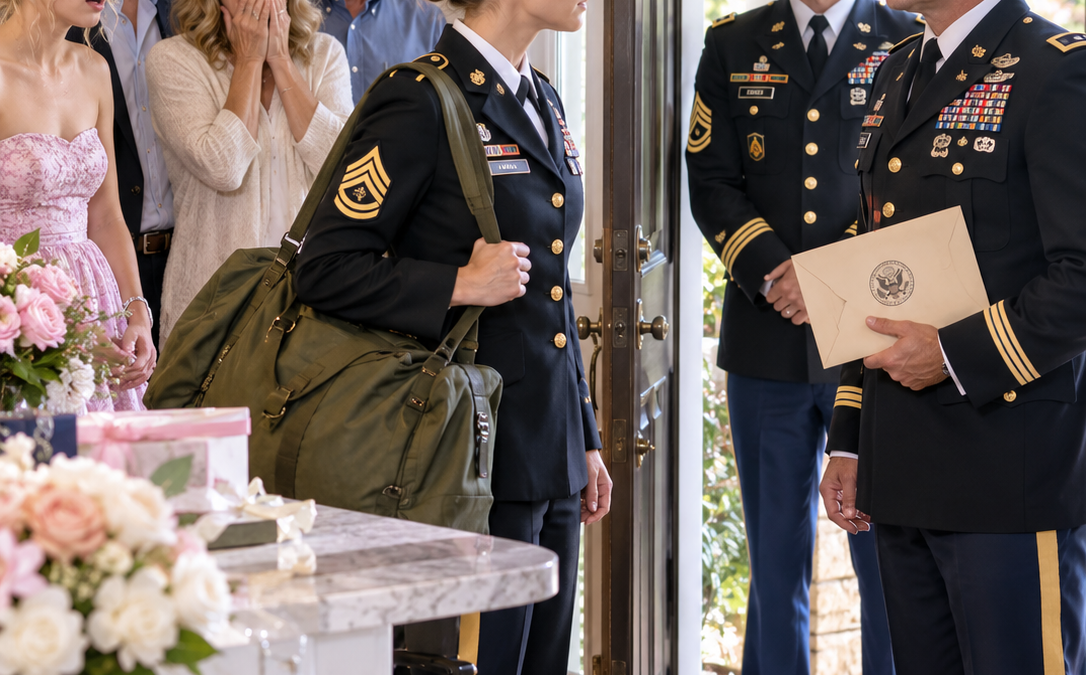
My sister opened the invitation to my Silver Star ceremony before I ever saw it. She read it, she hid it, and my parents knew.
At the time, I had no idea any of that had happened. I had just come home after fourteen months overseas, and I was still trying to remember how normal people lived when nobody was yelling over a helicopter engine.
I’m Sergeant First Class Samantha Miller. Most people call me Sam. I was thirty-two years old, an Army flight paramedic, and I had spent most of my adult life learning how to stay calm when everybody else had a very good reason not to be. That skill turned out to be useful with my family, too.
I pulled into my parents’ driveway in Alpharetta, Georgia, a little after ten in the morning. The house looked exactly the same. Trimmed lawn, clean windows, fresh flowers by the front steps. My mother could make a house look ready for a magazine shoot even when everyone inside it was losing their minds.
I killed the engine and sat there for a second. My right shoulder was throbbing. The shrapnel wound had healed enough that I could carry my own bags, which meant I carried my own bags. Army logic. If the arm still moves, congratulations, you have an arm.
I grabbed my duffel from the back seat and walked to the door. Before I could knock, my mother opened it.
She stared at me. “Sam?”
I smiled. “Hi, Mom.”
“You’re early.”
Not exactly the homecoming line I had pictured, but it was very Mom. She recovered quickly and hugged me carefully. I appreciated that. She knew about my shoulder, even if she didn’t know much else.
“You said this afternoon.”
“My flight changed.”
“You should have called.”
“I texted.”
She pulled out her phone. There were enough unread notifications on the screen to qualify as a second job.
“Oh.”
Then she hugged me again. This one felt more real.
“I’m glad you’re home.”
“Me too.”
I wanted to believe that.
I stepped inside. The first thing I saw was my sister. Not Aubrey herself, but Aubrey’s face. A giant framed engagement photo was sitting on an easel near the living room. She and Chad were standing in a field somewhere, both dressed in beige, smiling at each other like they had just invented marriage.
There were flowers around the frame. There were flowers on the stairs. There were boxes stacked against the wall. For a second, I wondered if I had walked into a wedding venue instead of the house where I grew up.
Mom noticed me looking.
“Beautiful, isn’t it?”
“Very beige.”
She gave me a look.
“I mean, beautiful. That’s what I said.”
She almost smiled. Almost.
My father came out of his office with his reading glasses still on his face.
“Sam.”
“Hey, Dad.”
He hugged me and slapped my back. Unfortunately, he picked the side with the bad shoulder. My entire arm lit up, but I kept my face still. That was another Army skill.
Dad stepped back. “How was the flight?”
“Long.”
“And the deployment?”
“Also long.”
He nodded like that covered fourteen months. Maybe it did for him.
“You need a car while you’re here?”
“I’ve got the rental.”
“You don’t need to waste money on that. Take mine if you need it.”
That was Dad. He could be generous. He just preferred problems that could be solved with keys, checks, or a phone call. People were harder.
Before I could answer, Mom called from the kitchen.
“Robert, did you confirm the Sterling dinner reservation?”
Dad looked over his shoulder. “Doing it now.”
And just like that, my deployment was over. We were back to the engagement.
I carried my duffel upstairs. My room had been cleaned. Fresh sheets, clean towels. Even the old photo of me and Aubrey at the beach was still on the dresser. Mom had made an effort. I noticed that. I always noticed when they tried. Maybe that was part of my problem.
I put the bag on the bed and rolled my shoulder. Bad idea. Pain shot down my arm, and I waited for it to pass. Three breaths. That usually did it.
From downstairs, something metal hit the floor.
The sound was sharp enough that my body reacted before my brain did. I turned toward the door, feet planted, heart racing, ready for something that wasn’t there.
Then I heard my mother yell, “Why are there serving trays in the hallway?”
I closed my eyes.
Serving trays.
Georgia. My parents’ house. Not overseas.
I rubbed a hand over my face.
“Welcome home, Sam.”
I said it quietly enough that nobody heard.
A few minutes later, I went downstairs. That was when Aubrey finally came through the front door. She had two garment bags over one arm and a phone pressed to her ear.
“No ivory,” she said. “Not white. If they send white chair covers again, I’m sending them back.”
She saw me, stopped, and screamed.
Not a combat scream. An Aubrey scream. There was a difference.
“Oh my God!”
She dropped the garment bags on a chair and hugged me.
“Sam!”
I laughed. “Hi.”
“When did you get here?”
“Ten minutes ago.”
She pulled back and looked at me.
“You’re so tan.”
“That’s one word for it.”
“And your hair is shorter.”
“Army barbers aren’t known for emotional attachment.”
She laughed. For a moment, she was just my sister. The same girl who used to steal my clothes and deny it while wearing them. The same girl who once drove three hours because I called her after a breakup.
Those memories mattered, too. That was what made the rest of it harder.
Aubrey touched my arm, then remembered.
“Oh, your shoulder.”
“I’m fine.”
“Are you sure?”
“Yeah.”
She looked relieved. Then she glanced at the boxes near the dining room.
“Thank God you made it back in time. We’re drowning here.”
There it was. Home for less than twenty minutes. Already employed.
I looked at the boxes. “What’s in them?”
“Glassware.”
“How much glassware?”
“Don’t ask.”
“That sounds expensive.”
“It is.”
“Now I’m definitely asking.”
She laughed again. Then she handed me a clipboard.
I stared at it. “What’s this?”
“Pickup list. Aubrey, please.”
She put both hands together in a pleading gesture.
“Mom ordered the wrong candleholders. Chad’s parents are coming tomorrow. The caterer moved the tasting, and Dad keeps saying everything is handled when nothing is handled.”
From the kitchen, Dad shouted, “I heard that.”
Aubrey shouted back, “Good!”
I looked at the clipboard.
I could have said no. Probably should have. But I had spent fourteen months being useful. Useful was easy. Family was complicated.
“Fine.”
Aubrey kissed my cheek. “You’re the best.”
“I want that in writing.”
“You have a clipboard.”
“Good point.”
By noon, I had picked up table linens, moved six boxes into the dining room, and learned more about floral centerpieces than any soldier should legally be required to know.
Mom kept apologizing. Sort of.
“I hate putting you to work your first day home.”
Then she would hand me something else.
Dad ordered lunch. He remembered that I liked turkey instead of ham. Aubrey brought me coffee without asking how I took it. She remembered.
Those little things made it easy to ignore the bigger ones.
That afternoon, a delivery guy noticed the Army sticker on my rental car.
“You military?”
“Army.”
“Just get back?”
“Yeah.”
He nodded toward my shoulder. “Rough trip?”
Before I could answer, Aubrey came through the doorway.
“Those boxes go in the dining room.”
The guy looked at her, then back at me.
“Welcome home.”
“Thanks.”
Aubrey was already checking the invoice. I carried another box inside.
Nobody said anything. Nobody had to.
By early evening, my shoulder was done negotiating. I picked up a box marked Champagne Flutes and felt a hard pull beneath the scar. I stopped for just a second. My grip shifted, and glass clicked inside the box.
Aubrey looked up immediately.
“Careful. Those are rented.”
I stared at her. She stared back.
Then her expression changed.
“Oh. Your shoulder.”
“Yeah.”
“Sorry.”
“It’s fine.”
And technically, it was. Nothing had broken.
That seemed to be the family standard. If nothing shattered on the floor, everything was fine.
I set the box down. Aubrey went back to her seating chart. Mom was arguing with the florist. Dad was in his office talking to somebody about contracts.
I stood in the middle of the house I had grown up in and realized something I didn’t want to admit.
I had been gone for fourteen months. I had come back with another scar and enough memories to keep me awake most nights. But here, none of that changed my position.
Aubrey had an engagement.
So Aubrey came first.
It wasn’t cruel. Not in the obvious way. Nobody told me I didn’t matter. They didn’t have to.
The house phone started ringing. Nobody moved at first. It rang again, and Aubrey pushed away from the table and grabbed it.
“Miller residence.”
She kept one hand on her seating chart while she listened. Her pen stopped moving.
“Yes.”
A pause.
Her eyes shifted toward the hallway, then toward me. I was standing at the kitchen counter, trying to open a bottle of water one-handed.
Aubrey turned slightly away.
“No, she’s here.”
Another pause. Her voice dropped.
“Yes, she got home this morning.”
I looked over. Aubrey caught my eye and gave me a quick smile. Then she tucked the phone closer to her ear.
“I can take a message.”
She picked up a pen and wrote something on the corner of her seating chart.
“Got it. I’ll let her know.”
She hung up.
I twisted the cap off my water and took a drink.
“Who was that?”
She didn’t look up. “Wrong number.”
I stared at her. “They asked if I was here.”
“Not you. Another Samantha.”
“Another Samantha Miller?”
That got her attention. For half a second, she looked caught. Then she smiled.
“You know what? Maybe I heard it wrong. I have six vendors calling this number because Mom keeps giving it out.”
Mom walked in carrying fabric samples.
“Giving what out?”
“Our home number.”
“Well, people actually answer it.”
She looked directly at me. I raised my bottle.
“I’ve been home six hours. I refuse responsibility.”
Aubrey laughed. The moment passed.
I let it.
That was something I had been doing with Aubrey my entire life. Letting things pass.
The next morning, she had me driving across Alpharetta before I finished my coffee. There was a problem with the place cards. Apparently, the gold lettering was too yellow.
I did not know gold could be the wrong kind of gold.
Aubrey did. She knew with conviction.
“These look cheap.”
“They’re pieces of cardboard with names on them.”
“They’re linen card stock.”
“Sorry. Expensive cardboard.”
She gave me a flat look.
“You’re enjoying this a little.”
She tried not to smile.
That was the thing about us. We could still be funny together. We could still sound like sisters, as long as nobody had to choose between us.
That was where things usually went wrong.
Growing up, Aubrey had been the one who needed things. Dance lessons, a better laptop, a car that wouldn’t embarrass her in high school, a semester abroad. There was always a reason. There was always a deadline. And somehow, there was always money.
Until there wasn’t.
I learned that when I was seventeen.
My parents had talked for years about helping both of us with college. Nothing extravagant, just enough to keep us from starting adult life buried in debt. By senior year, the number they had once discussed with me had gotten much smaller.
Some of the money had gone toward family expenses. Some had gone toward Aubrey. There had been tuition issues, housing, and other costs that were always described as temporary emergencies.
Nobody stole a college fund in the middle of the night.
It happened slowly, with explanations.
That was how my family did most things.
Dad sat me down at the kitchen table and said they would still help where they could. I remember asking how much that meant. He gave me a number.
I did the math.
Then I started looking at military recruiters.
Years later, Dad liked to tell people I had always dreamed of joining the Army. That version sounded better. Cleaner.
The truth was, I was eighteen, stubborn, broke, and looking for a way forward. The Army gave me one.
I stayed because I was good at the work. I built a career. I earned my own education benefits. I became a medic. Eventually, I became a flight paramedic.
None of that made my parents bad people.
But it did teach me something early.
When money got tight, I adjusted. When plans changed, I adjusted. When Aubrey needed something, everybody adjusted.
Usually me.
By noon, I was back at the house carrying corrected place cards. A man from the rental company was unloading chairs. He saw my Army T-shirt.
“Active duty?”
“Yeah.”
“What do you do?”
“Flight medic.”
He stopped with two chairs in his hands.
“No kidding.”
“No kidding.”
“You fly medevac?”
“Among other things.”
“Damn. That’s serious.”
Aubrey came through the front door with her phone in one hand.
“Sam, did you get the new cards?”
I lifted the bag. “Mission accomplished.”
The rental guy smiled.
“Sounds like she has you working a different kind of operation.”
“Lower survival rate.”
He laughed. Aubrey didn’t.
“The florist is going to be here in twenty minutes.”
“I’ll stay out of the way.”
“I actually need you to help Mom move the boxes from the dining room.”
Of course she did.
The rental guy looked from her to me. I shrugged.
“Duty calls.”
He carried the chairs away.
Aubrey waited until he was gone.
“Do you have to do that?”
“Do what?”
“The ‘move boxes, the Army’ thing.”
I looked down at my shirt. “You mean wear clothing?”
“You know what I mean.”
I didn’t. Or maybe I did.
“He asked what I do, and I told him.”
“That’s usually how questions work.”
She exhaled.
“I’m just stressed.”
“Clearly.”
“I want this weekend to go well.”
“I know.”
“Chad’s parents know everyone.”
“So?”
“So this matters.”
There was something underneath that sentence.
Aubrey had always cared about appearances, but this was more than that. The Sterlings had money. Real-estate money. The kind that put your last name on buildings and got your calls returned quickly.
Chad never acted impressed by it.
Aubrey did enough for both of them.
She had spent months planning the engagement weekend. The right restaurant, the right flowers, the right guests, the right photographs.
Nothing could look accidental.
Including us.
I softened a little.
“It’s going to be fine.”
“You don’t know that.”
“The chairs appear structurally sound.”
“Sam.”
“The gold is now the correct gold.”
She finally laughed.
“Idiot.”
“There she is.”
For a few seconds, the tension disappeared. Then Mom called Aubrey from the other room, and she was gone.
That evening, Chad arrived with his parents to go over plans for the next day.
I had met Chad before. I liked him. He was easygoing in a way that confused Aubrey. She could spend forty minutes deciding between two napkin colors. Chad would look at both and say, “Those are napkins.”
I respected him immediately.
His parents were polite, too. No attitude, no interrogation.
Mrs. Sterling asked how long I had been home.
“Yesterday.”
“You must be exhausted.”
“A little.”
“Fourteen months, right?”
I nodded.
Before she could ask anything else, Aubrey appeared beside us.
“Mrs. Sterling, I have the final dinner menu.”
Mrs. Sterling glanced at me, then at Aubrey.
“Of course.”
Aubrey guided her toward the dining room. I watched them go.
Chad was standing nearby with a beer. He took a sip.
“She’s in event-planning combat mode.”
“Please don’t use the word combat around those centerpieces.”
He laughed.
“She’ll calm down after the weekend.”
“That’s good to know.”
Dad called everyone into the living room a little later. He had opened a bottle of champagne. A test bottle, apparently.
I had never heard of testing champagne. I was learning a lot.
Dad handed out glasses.
“To Aubrey and Chad.”
Everyone raised theirs.
“To a great weekend,” he said. “This weekend is about Aubrey.”
I looked at my sister. She was smiling, happy, nervous, watching everyone watch her.
I raised my glass, too.
“To Aubrey.”
Her eyes met mine over the rim. Something changed in her expression for just a second. Not anger. Not guilt exactly.
Something tighter.
She looked away first.
Later that night, after Chad and his parents had left, Aubrey went into the kitchen alone. Her handbag was sitting beside the counter.
She checked the hallway, reached inside, and pulled out a thick cream-colored envelope.
I wasn’t there to see her do it. I learned about that moment later, piece by piece. But I know what was printed across the front.
Department of the Army.
And directly beneath it, in black letters:
Sergeant First Class Samantha Miller.
Aubrey held that envelope for several seconds before she opened it. I know because she admitted that later.
She saw my name. She saw the Army seal. She knew it wasn’t hers.
She opened it anyway.
Inside was the formal packet for my Silver Star ceremony at Fort Benning.
Friday. 1400 hours.
There were reporting instructions, ceremony details, and information for invited family members.
I already knew my Silver Star had been approved. That part wasn’t a surprise. The Army had notified me through official channels while I was transitioning home.
What I didn’t have was the final ceremony date.
I had been waiting for it.
Apparently, it had been waiting for me, too.
In my sister’s hands.
I didn’t see what happened in the kitchen that night. I learned pieces of it later. Some from Mom, some from Dad, some from Aubrey when she was angry enough to stop editing herself.
After she read the packet, she took it to my parents.
Dad was in his office. Mom was checking the final guest list.
Aubrey put the papers in front of them.
“The ceremony is Friday.”
Mom looked up. “This Friday?”
“Two o’clock.”
Dad read the first page.
“You opened this?”
“That’s not the point.”
“It has Sam’s name on it.”
“I can read.”
Apparently, Mom stepped in before they could start.
“What ceremony?”
Aubrey pointed at the packet.
“Her Silver Star thing.”
Her Silver Star thing.
That was how she described it.
Mom understood enough to know it mattered.
“We need to give this to her.”
Aubrey immediately said no.
Not because she had some grand plan. Not because she wanted to destroy my career.
Her reasoning was much more ordinary than that.
And honestly, that made it worse.
“She already knows she’s getting the medal.”
“That doesn’t mean she knows the ceremony is Friday.”
“Mom, she hates ceremonies.”
Dad looked at Aubrey.
“That isn’t your decision.”
“We have people flying in. Aubrey, the dinner is Friday night. Chad’s family has reservations. You invited clients. Mom has been planning this for six months.”
Mom’s voice got quieter.
“That still doesn’t make the letter yours.”
Aubrey folded her arms.
“Do you know what happens if Sam tells everyone she’s getting a Silver Star?”
Nobody answered.
“Every person at that party will spend the entire night asking her about the Army, about the deployment, about what happened.”
Dad leaned back in his chair.
“Aubrey, that’s not exactly unreasonable.”
“For once, can one weekend not turn into a story about Sam?”
That sentence changed the room.
Mom later told me she almost took the packet upstairs herself.
Almost.
My family had a long history with that word.
Dad looked at the schedule again. He knew the engagement weekend had become bigger than it needed to be. He also knew arguing with Aubrey the night before guests arrived would turn the house into a courtroom with flowers.
And Dad hated conflict he couldn’t bill by the hour.
So he made the choice people make when they want peace more than they want to be right.
He opened the lower drawer of his desk.
“Put it in here.”
Mom stared at him.
“Robert.”
“We’ll deal with it after the weekend.”
“The ceremony is before the weekend is over.”
“I know.”
Aubrey put the packet in the drawer.
Dad closed it.
That was it.
No evil music. No secret meeting.
Three people made one bad decision and called it practical.
Meanwhile, I was upstairs trying to sleep.
That part I remember clearly. At 2:17 in the morning, I was staring at the ceiling. At 2:43, I was still staring at it. At 3:10, I gave up and went downstairs for water.
The house was quiet.
Normal quiet.
I wasn’t used to it yet. Overseas, there had always been something. Engines, radios, doors, boots, somebody moving. Silence should have felt peaceful. Instead, my brain kept waiting for it to end.
I stood in the kitchen drinking water until my shoulder started aching again. The scar pulled when I moved the wrong way. I pressed two fingers against it.
For half a second, I smelled hot metal, dust, burning material. Someone shouting for a medic.
I blinked.
Kitchen. Refrigerator. A ridiculous amount of imported sparkling water Aubrey had bought for the party.
I took another drink.
“Not tonight,” I whispered.
By seven, Mom had me moving boxes again.
Nobody asked if I had slept. To be fair, I didn’t ask them either.
We were Millers. We handled things by pretending they were already handled.
Aubrey came downstairs dressed for a meeting with the florist. She handed me a stack of glass cylinders.
“Can you put these by the back doors?”
“Sure.”
“You look tired.”
“Thank you.”
“I didn’t mean it like that.”
“I know. Somehow that makes it better.”
She rolled her eyes.
I carried the cylinders outside. My shoulder complained immediately. I ignored it.
That worked until it didn’t.
Around ten, the house phone rang. Mom was outside. Dad had gone to his office. I was in the backyard helping a delivery driver figure out where Aubrey wanted two folding tables.
Aubrey answered.
“Miller residence.”
The voice on the other end asked for me.
This time, Aubrey knew exactly who was calling.
Fort Benning.
She glanced through the kitchen window. She could see me outside. I was maybe thirty feet away.
“She’s home,” Aubrey said.
A pause.
“She’s resting.”
Another pause.
“I’ll tell her you called.”
She wrote down a name and number, hung up, folded the note once, then twice, and slipped it under the edge of her planner.
She never gave it to me.
That mattered.
Hiding the packet could still be dressed up as panic. Bad judgment. Family pressure. A stupid decision made late at night.
Taking that second call was different.
She had time to stop.
She didn’t.
I came inside five minutes later. Aubrey was arguing with the florist about hydrangeas. I opened the refrigerator.
She looked straight at me.
Said nothing.
By lunch, I knew something was off.
Not what. Just something.
Mom and Aubrey kept having conversations that stopped when I walked into the room. Dad was quieter than usual.
At one point, I entered the dining room and heard Aubrey say, “Tomorrow afternoon. After that, it won’t matter.”
Mom saw me first. Her face changed. Aubrey turned.
I leaned against the doorway.
“What won’t matter?”
Aubrey didn’t even hesitate.
“The table layout.”
I looked at the table. There were printed diagrams everywhere.
“Must be a dangerous table.”
“You have no idea.”
Mom started collecting papers that didn’t need collecting.
I watched both of them. Neither looked at me.
I could have pushed.
Instead, I let it go again.
The next morning, I was halfway through my coffee when Mom came into the kitchen carrying a roll of ribbon.
“Sam, can you do me a favor?”
I looked at the ribbon.
“I’m afraid to ask.”
“I need the florist tape. Your father has some in his study.”
“Why does Dad have florist tape?”
“He took my supply last Christmas.”
“Of course he did.”
She pointed toward the hallway.
“Lower desk drawer, I think.”
I set down my coffee and walked into Dad’s study.
His desk was exactly the way it had always been. Files stacked on the left, legal pads on the right, reading glasses beside the keyboard.
I crouched down and pulled open the lower drawer.
The florist tape was sitting near the front.
Behind it was a thick cream-colored envelope.
I saw the Army seal first.
My hands stopped.
Then I saw the name printed across the front.
Sergeant First Class Samantha Miller.
The flap had already been torn open.
I left my hand on the envelope and stared at the torn flap. For a second, I didn’t pick it up.
I already knew I wasn’t supposed to find it there.
My name was printed clearly across the front. Not Dad’s. Not Mom’s. Not Aubrey’s.
Mine.
I pulled the envelope from the drawer. The packet inside had been opened neatly.
That almost bothered me more.
Someone had taken their time.
I unfolded the first page.
United States Army.
Official Ceremony Information.
Silver Star Presentation.
Fort Benning, Georgia.
Friday, 1400 hours.
I read the date twice.
My eyes moved to Dad’s desk clock.
Thursday morning.
Tomorrow.
The ceremony was tomorrow.
I sat down in his chair. Not because I was emotional. My legs had simply made the decision before I did.
For days, I had been telling myself the Army was still finalizing things. Paperwork moved slowly. Schedules changed. People got busy.
I had even wondered if I had missed an email somewhere during my transition home.
I had blamed the system.
Then I had blamed myself.
The whole time, the answer had been sitting fifteen feet from where my father worked every day.
I checked the rest of the packet. Reporting instructions, location, uniform requirements, guest information, contact numbers.
Everything I had been waiting for.
Someone had opened it.
Someone had read it.
Someone had put it in a drawer.
My first feeling wasn’t anger.
It was embarrassment.
That surprised me. I felt stupid.
I had spent two days carrying boxes for Aubrey’s engagement while my own ceremony invitation sat hidden inside my father’s desk.
I looked down at the florist tape beside my hand.
That almost made me laugh.
Mom had sent me in here for tape.
Instead, I found out my family had been lying to me.
Very efficient errand.
I picked up the packet and walked out.
The house was louder now. Chad had arrived with his parents for the final walkthrough. Mrs. Sterling was talking to Mom near the dining room. Mr. Sterling was checking something on his phone. Chad was helping move a case of wine.
Aubrey stood at the kitchen island with a binder open in front of her.
Nobody noticed me at first.
I walked over and placed the envelope on the island.
Not hard. I didn’t slam it. I didn’t throw anything.
I just put it down.
Aubrey saw it.
Her face changed immediately.
That was all the confirmation I needed.
Mom stopped talking. Dad had just come out of his office. He saw the envelope, too.
Nobody moved.
I looked at Aubrey, then Mom, then Dad.
“Who opened my mail?”
The silence stretched. Chad set down the case of wine. Aubrey closed her binder.
I asked again.
“Who opened my mail?”
Dad looked at Mom. Mom looked at Aubrey.
And Aubrey looked at me.
“I did.”
There it was.
No misunderstanding. No postal mistake. No administrative error.
My sister had opened it.
I nodded once while Aubrey took a breath.
“Sam, can we not do this right now?”
I looked around the kitchen.
“Is there a better time to discuss you opening my Army mail?”
Mrs. Sterling stepped back slightly.
Chad didn’t.
Aubrey glanced at them.
“That’s exactly what I mean.”
“What do they have to do with it?”
“Nothing.”
“Great. Then answer me.”
Mom moved closer.
“Sam, maybe we should talk privately.”
“No.”
My voice wasn’t loud.
That seemed to make everyone more uncomfortable.
“I asked one question.”
Dad stepped forward.
“Aubrey shouldn’t have opened it.”
I looked at him.
“You knew.”
It wasn’t a question.
His jaw tightened.
That told me enough.
I turned to Mom.
“You knew, too.”
She looked down.
I felt something settle inside me.
Not explode.
Settle.
That was worse.
“How long?”
Dad didn’t answer.
“Sam—”
“How long has that been in your desk?”
“A couple of days.”
I stared at him.
“A couple of days.”
“We were going to talk to you when—”
Aubrey cut in.
“We were trying to figure out the schedule.”
I turned toward her.
“What schedule?”
She pointed vaguely toward the dining room.
“This weekend.”
I looked at the packet, then at her binder, then back at her.
“My ceremony is tomorrow at two.”
“I know.”
“You know?”
“Yes.”
“And you hid the invitation.”
“I didn’t hide it.”
I looked toward Dad’s office.
“It was in a closed desk drawer.”
“I put it somewhere safe.”
I almost smiled.
“Safe from who?”
She crossed her arms.
“You’re twisting this.”
“I just found my mail in Dad’s desk.”
“I was going to give it to you.”
“When?”
“After everything calmed down.”
“The ceremony is tomorrow.”
“I know that.”
“Apparently, everyone knows that except me.”
Mom said my name softly.
“Sam.”
I held up one hand. I nodded at her just enough to stop the next excuse.
Chad was watching Aubrey now. His expression had changed.
He wasn’t angry yet.
He was confused.
That mattered more.
“Aubrey,” he said, “why would you keep that from her?”
She turned toward him.
“I didn’t keep it from her.”
I tapped the envelope.
“What would you call this?”
Aubrey’s face tightened.
“You already knew about the medal.”
“I knew the award was approved.”
“Exactly.”
“No. Not exactly.”
I opened the packet.
“I didn’t know when the ceremony was. I didn’t know where to report. I didn’t have the final instructions.”
“You could have called someone.”
That one actually got me.
I stared at her.
“I could have called someone?”
She realized how it sounded.
“That’s not what I meant.”
“Good. Because somebody did call this house.”
Aubrey froze.
It was tiny. A fraction of a second.
But I saw it.
So did Dad.
I remembered the phone call. The one she had called a wrong number.
I looked at her.
“Who called the other day?”
She didn’t answer.
“Aubrey.”
Mom stepped between us with her voice, not her body.
“This is getting out of hand.”
“No, Mom. It got out of hand when somebody opened an envelope with my name on it.”
Aubrey pushed the binder away.
“Fine.”
Her voice changed. The careful tone disappeared.
“You want to know why I opened it?”
“Yes.”
“Because I saw the Army seal, and I knew it was going to be something that changed the entire weekend.”
I blinked.
“That’s your reason?”
“You don’t understand how much work has gone into this.”
I looked around.
Flowers. Boxes. Wine. Linen samples. Correctly gold place cards.
“I’ve carried most of it.”
“That’s not funny.”
“I wasn’t joking.”
Her cheeks flushed.
Mrs. Sterling looked toward her husband. Neither said anything.
Aubrey noticed.
That made her more defensive.
“This weekend has been planned for six months. And people are coming for us.”
She pointed between herself and Chad.
“For our engagement.”
“I know what an engagement party is.”
“Do you?”
Chad frowned.
“Aubrey.”
She ignored him.
“You walk in here after being gone forever, and suddenly everyone starts asking about you.”
I stared at her.
“Who? The delivery guy?”
“My future mother-in-law. Dad’s friends will do it, too. Everybody hears Army and deployment, and suddenly that’s the conversation.”
“I didn’t ask anybody to talk about me.”
“That doesn’t matter.”
Now I understood.
Not all of it. Enough.
This had never been about scheduling.
Not really.
I asked one more time.
“Why did you hide the letter?”
Aubrey looked straight at me.
“Because I knew exactly what would happen if everyone found out.”
“Found out what?”
Her eyes flicked toward the Silver Star packet, then back to me.
“That somehow my engagement weekend had become about you.”
Nobody spoke.
I waited for her to take it back.
She didn’t.
She stood there beside the flowers and seating charts, breathing hard, like she had finally said something she had been holding in for years.
And the worst part was the look on her face.
Aubrey wasn’t ashamed.
She thought she had a point.
I kept looking at her, waiting for something in her expression to change.
Nothing did.
She actually believed what she had just said.
I lowered my voice.
“So you hid my ceremony because people might ask me questions at your party.”
“That’s not what I said.”
“It’s pretty close.”
“No. I said this weekend is important, and the ceremony is—”
She threw up her hands.
“You hate ceremonies, Sam.”
I stared at her.
“That’s your defense?”
“You do.”
“I hate making speeches. I hate being stared at. I hate dress shoes.”
Chad almost smiled.
Aubrey didn’t.
“That doesn’t mean you get to decide whether I show up.”
“The Army can reschedule things.”
I laughed once.
I couldn’t help it.
“The Army?”
“Yes.”
“You think the United States Army is going to move a Silver Star ceremony because you booked dinner?”
“That’s not what I meant.”
“Good.”
Dad stepped in.
“Enough.”
I turned toward him.
He used that voice when we were kids. The conversation-is-over voice. It had worked when I was sixteen.
I was thirty-two now.
It had lost some range.
“Aubrey was wrong to open the envelope,” he said.
Aubrey looked at him.
“Dad.”
He held up a hand.
“She was wrong.”
For one second, I thought he was actually going to say it. The whole thing.
Then he kept talking.
“But we also need to be reasonable about what happens now.”
There it was.
Reasonable.
My family loved that word. It usually meant I was about to lose something politely.
I looked at him.
“What happens now is I go to Fort Benning tomorrow.”
Mom moved closer.
“Of course we’re proud of you.”
I turned to her.
“I didn’t ask if you were proud.”
She flinched.
I hated that.
I didn’t want to hurt my mother, but I was getting tired of protecting everyone from conversations they had created.
I pointed at the envelope.
“Did you know she opened this?”
Mom hesitated.
“Yes.”
“How long?”
“Sam—”
“How long?”
“Since Tuesday night.”
I nodded.
“Two days.”
I looked at Dad.
“You, too?”
“Yes.”
“And nobody thought I should know?”
“We were going to tell you,” he said.
“When?”
Silence.
I waited.
Nobody had an answer.
Aubrey stepped forward.
“We were trying to get through the weekend.”
“The ceremony happens during the weekend.”
“You know what I mean.”
“No, I really don’t.”
She pressed both palms against the kitchen island.
“People have booked flights. Chad’s parents changed their schedule. Mom has deposits everywhere. Dad invited clients. We have dinner reservations that took months to get.”
I held up the packet.
“And I have an order to report.”
“It’s an award ceremony.”
“It’s a military ceremony.”
“It’s still a ceremony.”
“Aubrey.”
“What?”
She looked exhausted now. Not evil. Not smug.
Just angry that reality had refused to cooperate with her seating chart.
“It’s one ceremony, Sam.”
The room went still.
Even Aubrey seemed to hear it after she said it.
I looked down at the papers in my hand.
One ceremony.
I thought about being seventeen at the kitchen table while Dad explained the college money.
One adjustment.
I thought about birthdays moved because Aubrey had dance competitions.
One weekend.
Family trips planned around her schedule.
One compromise.
Christmas dinners delayed because she was coming home late.
One more thing.
It was never presented as choosing Aubrey over me. That would have sounded ugly.
Instead, I was always the one who could handle it.
Sam understands.
Sam is independent.
Sam doesn’t care about that stuff.
Sam will be fine.
And I usually was.
That had become the problem.
Because I survived every compromise, everyone decided the compromises didn’t cost me anything.
Dad rubbed his forehead.
“Don’t blow up this family over a scheduling problem.”
I looked at him.
“I’m not the one who opened the letter.”
His hand dropped.
Nobody said anything.
I continued.
“I didn’t hide it.”
Dad’s face tightened.
“I know.”
“I didn’t lie about a phone call.”
Aubrey looked at me.
“You don’t know what that call was.”
“Then tell me.”
She said nothing.
That was enough.
Chad finally stepped away from the counter. He had been quiet through most of it.
Now he looked at Aubrey.
“You knew the ceremony was tomorrow.”
She turned toward him.
“Chad, please.”
“That’s a yes-or-no question.”
“It’s more complicated than that.”
“Is it?”
She stared at him.
His parents were still near the dining room. They looked like they wanted to disappear without making the situation worse.
I couldn’t blame them.
They had come over to discuss appetizers.
Instead, they got the Miller family trial package.
No reservation required.
Aubrey lowered her voice.
“I was going to handle it.”
Chad frowned.
“Handle what?”
“The conflict.”
“By not telling her?”
“I knew she’d react like this.”
I almost admired that one.
“You hid my mail because you knew I’d be upset that you hid my mail.”
“That’s not what I said.”
“You’ve said that a lot today.”
Mom stepped closer to me.
“Sam, please.”
I looked at her.
“Please what?”
“Just slow down.”
“I’m standing still.”
“You know what I mean.”
I did.
She wanted me to make this easier.
Not fix it. Not confront it.
Make it easier for everyone else.
Mom lowered her voice.
“Aubrey made a terrible choice.”
Aubrey looked offended.
Mom ignored her.
“But walking out now is going to make everything worse.”
“I have to be at Fort Benning.”
“You can leave in the morning.”
“I’m not staying here tonight.”
That landed harder than I expected.
Dad looked at me.
“Where are you going?”
“I’ll get a hotel.”
“That’s ridiculous.”
“I’ve slept in worse places.”
“This is your home.”
I looked around the kitchen.
That sentence should have meant something comforting.
It didn’t.
Mom’s eyes filled.
“Sam, if you walk out right now, don’t expect Aubrey to just forgive you for ruining this weekend.”
I honestly thought I had misheard her.
Aubrey looked at Mom.
Even she seemed surprised.
I waited.
Mom realized what she had said, but she didn’t take it back.
Something inside me became very quiet.
For years, I had thought that if I explained things clearly enough, calmly enough, fairly enough, my family would eventually see the pattern.
Standing there, I finally understood.
They saw it.
They just expected me to keep accepting it.
I folded the ceremony papers and slid them back into the envelope.
“I’m going to Fort Benning.”
Dad sighed.
“Sam—”
“It’s not a request.”
I walked upstairs.
Nobody followed me.
My duffel was still open on the bed. I packed fast. Uniform items, toiletries, medication, phone charger, the basics.
I stopped when I saw the old beach photo on the dresser.
Aubrey and me.
Teenagers. Sunburned. Laughing.
I left it where it was.
I wasn’t deciding the rest of my life. I wasn’t cutting anyone off forever.
I just knew I would not sleep under that roof tonight.
I zipped the duffel and lifted it with my left hand.
My right shoulder protested.
“Yeah, yeah.”
Talking to injured body parts is normal after thirty.
That’s my medical opinion.
I carried the bag downstairs.
Everyone was still there.
The room had changed.
No one was talking about flowers anymore.
Aubrey stood beside Chad. He wasn’t touching her. Mom looked like she had been crying. Dad had both hands in his pockets.
I walked toward the front door.
Aubrey spoke behind me.
“So that’s it?”
I kept moving.
“You’re just leaving?”
My hand reached for the doorknob.
Before I touched it, the doorbell rang.
I stopped.
Mom wiped her face.
“That’s probably the caterer.”
The bell rang again.
I set my duffel down, opened the door, and automatically straightened my back.
Two soldiers stood on the front step.
The senior officer looked directly at me.
“Sergeant Miller.”
“Yes, sir.”
The answer came out automatically.
The man on the step wore an Army uniform and the kind of expression that made you check your posture without being told.
I recognized him.
Colonel Marcus Vance, the Fort Benning installation commander.
Beside him stood Command Sergeant Major Joshua Hayes.
Hayes looked at me, then at the duffel sitting by my feet, then back at me.
Colonel Vance let out a small breath.
“Good to see you standing, Sergeant Miller.”
That was not a normal greeting.
My stomach tightened.
“Sir?”
“We’ve been trying to reach you.”
I glanced toward the kitchen.
Nobody behind me made a sound.
“How long, sir?”
“Since yesterday.”
That got my attention.
“I didn’t receive anything.”
Hayes spoke.
“Your team leader called. Staff tried the number listed in your transition contact information. We also left messages.”
I looked over my shoulder.
Aubrey was standing beside the kitchen island.
Her face had gone completely still.
I looked back at Hayes.
“I wasn’t given any messages, Sergeant Major.”
His eyes moved past me.
He didn’t ask the obvious question.
Not yet.
Colonel Vance nodded toward the hallway.
“May we come in?”
“Of course, sir.”
I stepped aside.
They entered.
Mom recovered first. She had spent years around attorneys, executives, clients, and people who expected handshakes.
Military commanders were new territory, but hospitality was hospitality.
“I’m Evelyn Miller.”
Colonel Vance shook her hand.
“Ma’am.”
“This is my husband, Robert.”
Dad introduced himself, then Chad and his parents. Aubrey stayed near the island.
Nobody seemed interested in engagement plans anymore.
Amazing what two uniforms could do to a room full of flowers.
Colonel Vance turned back to me.
“Sergeant Miller, I had an official engagement in Atlanta this morning. When I heard staff still hadn’t gotten confirmation from you, Sergeant Major Hayes and I decided to stop by on our way back.”
I felt heat crawl up my neck.
“I apologize, sir. I wasn’t aware anyone was trying to reach me.”
“That’s why we came.”
His tone wasn’t accusing.
If anything, it sounded relieved.
“You don’t miss three calls and ignore your team leader. That’s not like you.”
“No, sir.”
Hayes nodded once.
“Exactly.”
That was the entire reason they were there.
No dramatic rescue. No one had assumed I was falling apart. My chain of command had noticed behavior that didn’t match me and checked.
Simple. Professional.
And somehow, more consideration than I had gotten inside that house all week.
Colonel Vance looked down.
My duffel was still beside the door.
“You headed somewhere?”
“Fort Benning, sir.”
“Good.”
One word.
No debate. No request for a family vote.
I almost smiled.
He glanced at the clock.
“Were you planning to stay on post tonight?”
“Yes, sir. Or nearby if lodging is full.”
“We’ll sort that out.”
Dad stepped forward.
“Colonel, I’m sorry. I’m not sure I understand. Is there some problem with Samantha’s ceremony?”
Colonel Vance looked at him.
“That’s what we were trying to determine.”
He turned to me.
“Sergeant Miller, did you receive your ceremony packet?”
The kitchen suddenly felt smaller.
I looked toward the island.
The cream-colored envelope was still there, open.
Colonel Vance followed my eyes.
His expression changed.
Not much.
Just enough.
I walked over and picked it up.
“Yes, sir.”
“When?”
I checked the clock on the wall. I had found it shortly before the argument started.
“About twenty minutes ago.”
Colonel Vance stared at me.
“Twenty minutes?”
“Yes, sir.”
Hayes looked at the envelope, then at me.
“Was it delivered today?”
“No, Sergeant Major.”
I could feel my father watching me.
Aubrey had stopped moving entirely.
Colonel Vance held out his hand.
“May I?”
I gave him the envelope.
He checked the front. My full name. The official markings. Then the torn flap.
He didn’t remove the papers.
He didn’t need to.
“This was already opened.”
“Yes, sir.”
“By you?”
“No, sir.”
Nobody breathed normally after that.
Colonel Vance looked around the room.
“Who opened it?”
Aubrey swallowed.
I didn’t answer for her.
Neither did my parents.
For once, nobody stepped in to make things easier.
Aubrey lifted her chin.
“I did.”
Colonel Vance looked at her.
“You’re Sergeant Miller’s sister?”
“Yes.”
“And you opened correspondence addressed to her?”
Aubrey shifted her weight.
“It came to this house.”
“That wasn’t my question.”
Her cheeks flushed.
“Yes. I opened it.”
Colonel Vance handed the envelope back to me.
“And you deliberately kept it from Sergeant Miller?”
Aubrey looked at Dad.
Bad choice.
Dad looked away.
“I wasn’t trying to keep it from her forever.”
Hayes’s face remained neutral.
Colonel Vance did not blink.
“That wasn’t my question either.”
Aubrey crossed her arms.
“It’s complicated.”
Colonel Vance waited.
That was all.
He didn’t raise his voice. He didn’t threaten her.
He just let the silence sit there until Aubrey decided she had to fill it.
“We have an engagement event tomorrow.”
Colonel Vance glanced at Chad, then back at Aubrey.
“All right.”
“We’ve been planning it for six months.”
“I understand.”
“People are coming from out of town.”
He nodded.
Aubrey seemed encouraged.
“The ceremony was at the same time.”
“No,” I said.
Everyone looked at me.
“The ceremony is at two. The dinner is in the evening.”
Aubrey’s jaw tightened.
“It affects the whole day.”
Colonel Vance looked at her for a long second.
“So you opened Sergeant Miller’s packet, learned when the ceremony was scheduled, and chose not to give it to her.”
When he said it that plainly, there wasn’t much left to decorate.
Aubrey tried anyway.
“She already knew about the medal.”
Colonel Vance’s eyes moved to me.
“You knew the recommendation had been approved?”
“Yes, sir.”
“But you did not have the final ceremony instructions?”
“No, sir.”
He looked back at Aubrey.
She rubbed her palms against her arms.
“I thought it could be moved.”
Hayes finally spoke.
“Based on what?”
Aubrey opened her mouth.
Nothing came out.
Hayes nodded slightly.
“Understood.”
That one word hurt more than a lecture.
Dad stepped forward.
“I want to be clear that Samantha’s mother and I did not open the envelope.”
I looked at him.
Technically true.
Colonel Vance did, too.
“But you knew it had been opened.”
Dad paused.
“Yes.”
“And you knew she had not received it.”
Another pause.
“Yes.”
Mom closed her eyes.
Colonel Vance didn’t react.
He didn’t need to.
Dad was an attorney. He knew exactly how his answers sounded.
Aubrey looked around the room. Her engagement binder sat open behind her. The flowers were arranged. The glasses were polished.
Everything she had spent months controlling was still exactly where she wanted it.
Except the conversation.
She pointed toward me.
“You’re all acting like I destroyed her career.”
Nobody answered.
“I didn’t throw it away. I didn’t call the Army pretending to be her. I didn’t stop her from getting the medal.”
“Aubrey,” Chad said quietly.
“No. Everyone is looking at me like I committed some horrible crime.”
Colonel Vance’s expression stayed calm.
“I haven’t called you a criminal, ma’am.”
Dad looked down at the envelope.
That was the moment I saw his lawyer brain finally take over.
He understood there could be consequences to deliberately opening and concealing correspondence addressed to someone else.
Colonel Vance continued.
“But you deliberately opened official correspondence addressed to a soldier and kept it from her. I would be very careful about how you explain what happened next.”
Aubrey’s face lost some color.
Dad said nothing.
Mom reached for the back of a chair.
I held the packet against my side.
Aubrey looked at me, then at Colonel Vance.
She was embarrassed now.
Cornered.
And when Aubrey felt cornered, she usually said the thing she should have kept to herself.
“You’re acting like she won the Medal of Honor.”
Colonel Vance turned his head toward her.
His voice stayed completely level.
“No, ma’am.”
He glanced at the Silver Star packet in my hand.
“I’m acting like she earned the Silver Star.”
Colonel Vance let those words sit for a second.
Aubrey looked at him, then at me.
I wished he would leave it there.
I had never told my family exactly what happened overseas.
That was intentional.
Some things were easier to carry when nobody asked you to turn them into dinner conversation.
Aubrey broke the silence.
“I know the Silver Star is important.”
Colonel Vance nodded.
“Do you know what it’s awarded for?”
She hesitated.
“Service?”
“No, ma’am.”
He didn’t embarrass her.
He just corrected her.
“The Silver Star is awarded for gallantry in action against an enemy of the United States.”
Mom looked at me.
I looked at the floor.
Colonel Vance continued.
“Sergeant Miller isn’t receiving it because she had a difficult deployment. She’s receiving it for what she did during a specific combat action.”
Dad’s voice was quieter now.
“What did she do?”
I looked at Colonel Vance.
“Sir.”
He understood immediately.
He didn’t start reciting my citation.
He kept it simple.
“Only what they need to understand, Sergeant.”
I nodded.
That was enough permission.
He turned toward my family.
“Her element came under hostile fire. A vehicle carrying wounded personnel was hit. Sergeant Miller was struck by shrapnel in the right shoulder.”
Mom’s eyes went straight to my arm.
I had seen that look before.
Just never from her.
“She was wounded?”
“Yes, ma’am.”
Mom looked at me.
“You said it wasn’t serious.”
“I said I was fine.”
“That’s not the same thing.”
“No.”
Colonel Vance continued.
“Sergeant Miller had an opportunity to move to better cover.”
The room disappeared for half a second.
Heat.
Dust.
A hard ringing in my ears.
My gloves slick with blood.
Not all of it mine.
Someone yelling.
“Medic!”
I pressed my thumb against the edge of the packet.
Kitchen.
Alpharetta.
Thursday morning.
I stayed there.
Colonel Vance’s voice remained steady.
“She went back instead.”
Nobody interrupted him.
“There were three severely wounded service members who needed to be moved and treated. She returned into the exposed area, helped extract them, and continued medical care while the element was still taking fire.”
I could hear breathing behind me.
Maybe Mom.
Maybe me.
My memory gave me pieces.
A hand grabbing my sleeve. Blood across a uniform. My shoulder burning every time I pulled.
One of the wounded looking straight at me, terrified.
“Don’t leave me.”
I remembered my answer.
“I’m not going anywhere.”
I hadn’t meant it as a heroic statement.
I was a medic.
He was my patient.
There wasn’t much else to discuss.
Colonel Vance kept going.
“She stabilized all three until they could be evacuated.”
Aubrey stared at me.
The anger had drained out of her face.
“So you went back after you were hit?”
I shrugged slightly.
My shoulder reminded me not to.
“They needed a medic. That’s it. What else would I do?”
She opened her mouth, then closed it.
Command Sergeant Major Hayes looked at me.
He knew that answer.
So did Colonel Vance.
My family didn’t.
That was the difference.
Dad sat down.
Actually sat down.
My father was the kind of man who stayed standing when everyone else sat because it made him look in control.
Not now.
He rubbed one hand over his jaw.
“Three people?”
“Yes,” I said.
“Three?”
“Yes, Dad.”
Mom’s eyes were wet.
“Are they alive?”
That question hit me harder than anything else had.
“Yes.”
She covered her mouth.
I looked away.
I didn’t want to cry in that kitchen.
Not over Aubrey.
Not over the letter.
And definitely not because my mother had finally asked the right question.
Aubrey shook her head.
“I didn’t know.”
I looked at her.
“You never asked.”
She flinched.
I didn’t say it to hurt her.
That was simply the answer.
When I came home, everyone asked whether I was tired, whether my shoulder was better, whether I could pick up linens, whether I could move boxes.
Nobody asked what had happened.
Maybe they were afraid to.
Maybe they thought I didn’t want to talk.
Maybe I didn’t.
But Aubrey had opened an Army envelope with my name on it and still never stopped long enough to wonder why I was getting the medal inside.
Colonel Vance shifted the conversation before it turned into something else.
“The details will be read during the ceremony tomorrow.”
Dad looked up.
“Colonel, regarding the envelope…”
He stopped.
The attorney in him had finally arrived.
Colonel Vance didn’t give him legal advice.
He didn’t threaten anyone with federal charges.
He simply said, “Sir, I’m not here to conduct an investigation.”
Dad nodded.
“But the correspondence was deliberately opened and withheld from Sergeant Miller. I suggest everyone be precise and truthful if anyone asks about it.”
Dad went quiet.
That was probably the first sentence anyone had spoken all week that he had no desire to negotiate.
Aubrey looked at Chad.
He had barely moved since Colonel Vance began talking.
“Chad?”
He looked at her.
She stepped toward him.
“I didn’t know any of that.”
He nodded slowly.
“But you knew the ceremony was tomorrow.”
Aubrey stopped.
“It’s complicated.”
“No.”
His voice wasn’t loud.
“That part isn’t.”
She stared at him.
He didn’t say anything else.
No dramatic breakup. No ring thrown across the room. No speech about what kind of person she was.
Just one sentence.
And for Aubrey, that was enough.
His parents stayed silent.
Mrs. Sterling looked down at the engagement binder. Mr. Sterling put his phone into his pocket.
Nobody seemed particularly interested in the dinner schedule anymore.
I felt no satisfaction.
That surprised me.
For two days, I had been carrying boxes while Aubrey protected her perfect weekend from me.
Now the room had turned against her without me doing anything.
And I didn’t feel victorious.
I felt tired.
Colonel Vance looked toward my duffel.
“You packed?”
“Yes, sir.”
“Everything you need for tomorrow?”
“Yes, sir.”
He glanced at Hayes.
The sergeant major picked up my duffel before I could stop him.
“I can carry that.”
“I know.”
He kept walking.
I almost argued. Then my shoulder gave one sharp pulse.
I decided senior enlisted wisdom should occasionally be respected.
Mom stepped toward me.
“Sam.”
I turned.
She looked like she wanted to hug me or apologize.
Maybe both.
She didn’t know which one she was allowed to do.
Neither did I.
“I need to go.”
She nodded.
Dad stood.
“Call us when you get there.”
I looked at him.
Not angry.
Not forgiving him, either.
“Okay.”
Aubrey said nothing.
I walked toward the door.
For years, I had imagined what it would feel like to finally stop giving in. I thought it would feel powerful.
It didn’t.
It felt quiet.
I stepped outside.
Hayes put my duffel in the Army SUV. Colonel Vance walked around to the other side.
I got in.
Nobody from my family followed us into the driveway.
The door closed.
The house disappeared behind tinted glass.
I let out a breath I hadn’t realized I was holding.
Colonel Vance glanced back from the front passenger seat.
“There are three people waiting to see you tomorrow.”
My hands stopped on the seat belt.
He didn’t give me their names.
He didn’t have to.
I already knew.
I clicked the seat belt into place and looked out the window.
Three people.
That changed everything.
The drive back to Fort Benning was quiet. Colonel Vance took two calls. Command Sergeant Major Hayes answered emails whenever traffic slowed.
Nobody asked me how I felt.
I appreciated that more than they probably knew.
About halfway there, Hayes looked back.
“You eat lunch?”
“Not really.”
“That means no.”
“I had coffee.”
“That also means no.”
Colonel Vance glanced over.
“Sergeant Major, I believe you’ve identified the problem.”
“I usually do, sir.”
Twenty minutes later, we stopped for food.
No ceremony. No discussion about my family.
Hayes handed me a sandwich and told me to eat it.
There are moments when being an E-7 gives you authority.
Being handed lunch by a command sergeant major is not one of them.
I ate the sandwich.
By the time we reached Fort Benning, my breathing had changed.
I noticed it at the gate.
Concrete barriers. Uniforms. Government buildings. Motor pools.
Nothing about the place was beautiful in the way my parents’ neighborhood was beautiful.
No perfect lawn. No engagement flowers. No carefully arranged champagne glasses.
But I knew the rules here.
I knew where I stood.
That made it easier to breathe.
Hayes helped get me into temporary lodging for the night.
Before he left, he pointed at my shoulder.
“You have what you need for that?”
“Yes, Sergeant Major.”
“Pain meds?”
“Yes.”
“Uniform ready?”
“Yes.”
“Alarm set?”
“I’m thirty-two.”
“That wasn’t my question.”
I sighed.
“Yes, Sergeant Major.”
He nodded.
“Good night, Miller.”
“Good night.”
I closed the door and stood alone.
For the first time since coming home, nobody needed me to carry anything.
I showered, checked my uniform, set the alarm, then checked it again because Hayes had apparently infected me with responsibility.
My phone had eleven notifications.
Three were from Mom. Two from Dad. One from Chad.
Five were from Aubrey.
I didn’t open any of them.
Not because I was punishing anyone.
I just didn’t have room for that conversation.
Not tonight.
I put the phone facedown and got into bed.
Sleep came in pieces.
It was still better than Alpharetta.
The next morning, I woke before the alarm.
Of course I did.
I got dressed slowly. My shoulder made the jacket harder than it should have been. I worked around it.
By the time I finished, everything was where it belonged.
Rank. Ribbons. Insignia.
No wrinkles. No excuses.
I looked at myself in the mirror.
I didn’t feel heroic.
Mostly, I felt like I needed stronger coffee.
There was a knock at the door.
Hayes was outside. He looked me over once.
“You’ll pass.”
“High praise.”
“Don’t get used to it.”
He handed me coffee.
That might have been the nicest thing anyone had done for me all week.
We headed toward the ceremony area.
I assumed we were early.
We weren’t.
Three men were already waiting.
I saw them before they saw me.
And my feet stopped.
Daniel Ruiz stood closest to the entrance.
He had a prosthetic left leg now. The last time I had seen him, he was on a litter with blood soaking through everything I put on him.
Beside him was Marcus Bell.
He leaned on a cane because of nerve damage in his right leg. He hated that cane. I could tell because he was holding it like it had personally insulted him.
The third was Owen Carter.
The burns along the left side of his neck and jaw were still visible.
Otherwise, he looked healthier than I remembered.
He had gained weight.
Good weight.
Alive weight.
Carter saw me first.
His face broke into a grin.
“Well, look who finally showed up.”
My throat tightened.
I walked toward them.
“You look terrible.”
Ruiz laughed.
“There she is.”
Bell pointed his cane at me.
“You really thought we’d let them do this without us?”
“I didn’t know you were coming.”
“That was the idea.”
Carter hugged me carefully.
He remembered the shoulder.
Of course he did.
Ruiz hugged me next.
Bell just opened his arms.
I looked at the cane.
“You going to hit me with that?”
“Depends how emotional this gets.”
“Fair.”
I hugged him, too.
Nobody cried.
Thank God.
Instead, Ruiz complained about airport parking. Bell complained about military coffee. Carter complained about both of them.
It felt normal.
That nearly got me.
We found seats near the staging area.
Ruiz tapped his prosthetic.
“Security made me take extra time.”
Bell looked at him.
“You tell everybody about that leg.”
“It gets me sympathy.”
“It gets you attention.”
“Same thing.”
I laughed.
The sound surprised me.
It had been a while since laughing didn’t require effort.
I asked what they had been doing.
Ruiz pulled out his phone.
“My daughter is four months old.”
He showed me a photo.
Tiny baby. Pink hat. Completely unimpressed with the camera.
I stared at him.
“You have a daughter?”
“Yeah.”
“You’re responsible for a human being?”
“That was my wife’s reaction.”
I stared at the picture longer than I needed to.
Four months old.
A whole person who had not existed when I dragged her father away from that vehicle.
Bell was back in college, studying engineering. He complained about freshmen who called him sir.
“You are old,” I told him.
“I’m twenty-eight.”
“Ancient.”
Carter was getting married in the spring.
He showed me a picture of his fiancée.
“She knows what she’s getting into?” I asked.
“Apparently.”
“Then she’s not smart.”
He laughed.
Three lives.
Not three casualties.
Not three names on a report.
Lives.
A baby.
A degree.
A wedding.
For the first time, I understood why the ceremony felt different with them there.
The medal wasn’t about the worst day of my deployment.
It was about everything that came after it.
Ruiz put his phone away.
“My mom wanted me to tell you thank you again.”
I looked at him.
He said it casually.
That made it worse.
“She still talks about you.”
I swallowed.
“She doesn’t have to.”
“I told her that.”
“And?”
“She said I was an idiot.”
“Your mother is very perceptive.”
He smiled.
Then his expression softened.
“She said she got her son back because you didn’t leave him there.”
I looked down at my hands.
For a second, I couldn’t answer.
My own mother had spent the previous day learning what happened to me.
Ruiz’s mother had been living with what happened to him for months.
She understood the cost from the other side.
I cleared my throat.
“Tell her I said hi.”
Ruiz nodded.
No speech.
No thank-you.
That was enough.
An NCO appeared at the doorway.
“Sergeant First Class Miller.”
I stood.
“Yes?”
“We’re ready for you.”
The three men stood with me.
Bell adjusted his grip on the cane. Ruiz straightened his jacket. Carter gave me a small nod.
I had walked toward aircraft under fire with less tension in my chest.
That realization almost made me laugh.
Combat was simple in one terrible way.
Someone needed help.
You moved.
This was different.
I was about to stand in front of a formation while someone read aloud the part of my life I had spent months refusing to explain.
Ruiz touched my arm.
“Hey.”
I looked at him.
“We’re right there.”
He pointed toward the seats reserved near the front.
I nodded.
The doors opened.
Commands carried across the room.
I stepped forward, saw the formation waiting, and kept walking.
My boots hit the floor in time with the commands around me.
I knew how to stand in formation.
I knew where to put my hands.
I knew exactly where to look.
Knowing what to do didn’t make it easier.
Colonel Vance stood near the front. Command Sergeant Major Hayes was a few feet away.
Behind them sat the guests.
I found Ruiz first.
Then Bell.
Then Carter.
Three familiar faces in a room full of uniforms.
There were other chairs reserved for family.
Some were empty.
I noticed them.
I kept moving.
When I reached my position, I turned and faced forward.
The ceremony began.
No dramatic music. No long speech about destiny.
Thank God.
The Army had procedures for these things, and procedures were comforting.
Commands were given.
People stood.
People sat.
Colonel Vance spoke briefly about service, duty, and why recognition mattered.
I heard most of it.
Not all.
My pulse was louder than I wanted it to be.
Then the orders were read.
My name came first.
“Sergeant First Class Samantha Miller.”
Hearing my full name through the microphone felt strange, almost like they were talking about somebody else.
I kept my eyes forward.
The citation began.
It described the hostile engagement, the damaged vehicle, the wounded personnel, my own injury.
Each sentence was clean, official, controlled.
The actual event had been none of those things.
When the citation mentioned the vehicle, I smelled smoke again.
For one second, I saw the dust hanging in the air.
I remembered trying to hear through the ringing in my ears. Someone was yelling my call sign. Someone else was screaming.
My shoulder felt hot.
Then wet.
I had looked down and seen blood.
My first thought had been stupidly practical.
That’s going to make moving people harder.
The citation continued.
It described me moving back into the exposed area despite my injury.
I remembered Ruiz.
He had been closest.
His leg was badly damaged.
He kept trying to help me move him.
I had yelled at him to stop.
He had yelled back.
Very moving battlefield moment.
Mostly profanity.
I almost smiled.
From the corner of my eye, I saw Ruiz sitting in the front row.
Two legs had gone into that deployment with him.
One had come home.
But he had come home.
That was the part that mattered.
The citation moved to the second casualty.
Bell.
Nerve damage. Blood loss. Barely responsive when we got to him.
I remembered checking his airway.
I remembered him waking long enough to ask whether everyone else was okay.
Typical Bell.
Half-conscious and still trying to take attendance.
Now he sat a few feet away, holding the cane he hated.
He was back in college, complaining about homework.
Exactly where he should be.
The citation reached Carter.
Burns. Trauma. Immediate treatment under fire.
I remembered his hand grabbing my sleeve.
“Don’t leave me.”
“I’m not going anywhere.”
At the time, I meant the next five minutes.
Get him stable.
Keep him breathing.
Move him.
Do the job.
I had no idea those five minutes would someday become a wedding he was planning.
That was when the words being read stopped sounding like a story about me.
I looked at the three of them.
Not the medal.
Not the officers.
Them.
Ruiz caught my eye.
He gave me the smallest nod.
My throat tightened.
The citation ended with the formal language about gallantry, devotion to duty, and the highest traditions of military service.
I had heard language like that before.
It always sounded larger than the people involved.
That day, I finally understood why.
Official words had to summarize moments that didn’t fit neatly into sentences.
How do you write down fear?
How do you put the weight of another person into a citation?
How do you explain the sound someone makes when they realize they might live?
You don’t.
You record what happened.
The people who were there carry the rest.
Colonel Vance stepped toward me.
I held still while the Silver Star was pinned to my uniform.
His hands were careful.
My shoulder hurt.
Of course it did.
Apparently, my body had no respect for ceremonial timing.
When he finished, he stepped back.
The room applauded.
I hated being applauded.
Always had.
But I didn’t look at the floor.
I looked at Ruiz.
He raised a hand in a small salute.
Bell nodded once.
Carter smiled.
And something inside me finally settled.
For years, I had treated achievement like evidence.
Another promotion.
Another qualification.
Another school.
Another thing I could bring home and quietly place on the table.
Maybe this one would make them understand me.
Maybe this one would make Dad stop describing my career as something that had worked out.
Maybe this one would make Mom ask more than whether I was safe.
Maybe Aubrey would look at me without checking whether anyone else was looking, too.
Standing there, I realized how tired I was of collecting proof.
The Silver Star wasn’t proof that I was better than my sister.
It wasn’t proof that my parents had been wrong about every choice they made.
And it sure as hell wasn’t a trophy I could wave around the kitchen and call revenge.
It meant that three men had needed me.
I had stayed.
They had made it home.
That was enough.
Colonel Vance extended his hand.
I shook it.
“Congratulations, Sergeant Miller.”
“Thank you, sir.”
He held my hand for half a second longer.
His voice dropped so only I could hear.
“Welcome home, Sam.”
I stopped breathing for a moment.
Not Sergeant Miller.
Sam.
I had heard welcome home several times since landing in Georgia.
At the airport.
From the rental car employee.
From the delivery guy.
From people who meant well.
This one felt different.
I had returned to the United States days ago.
I had walked into my childhood home.
I had slept in my old bedroom.
None of that had made me feel at home.
This did.
I swallowed.
“Thank you, sir.”
He nodded and moved on.
The ceremony continued.
Photos were taken, and hands were shaken.
Hayes leaned toward me once and said, “Try smiling.”
“I am smiling.”
“That’s concerning.”
I laughed.
The photographer caught it.
Ruiz immediately demanded a copy because, according to him, photographic evidence of me enjoying a ceremony had significant resale value.
Bell told him nobody would pay for it.
Carter suggested blackmail.
Five minutes after receiving the Silver Star, I was arguing with three idiots about a photograph.
Perfect.
Eventually, the formal crowd began to thin.
I stepped away and checked my phone.
There were more messages.
Dad.
Aubrey.
Chad.
At the top of the screen was a missed call.
Mom.
The phone vibrated again while I was holding it.
Mom.
I watched her name on the screen.
Ruiz and the others were a few feet away, arguing about where we should eat.
Nobody was waiting for an answer from me.
Nobody was telling me what the reasonable thing was.
The phone kept vibrating in my hand.
I looked at my mother’s name for another second, pressed the side button, and slipped the phone back into my pocket.
Ruiz noticed.
“You coming?”
I adjusted my jacket over the medal.
“Yeah.”
He pointed toward the exit.
“Good. Bell picked the restaurant, so if the food sucks, this is his fault.”
Bell raised his cane.
“I can still hit you with this.”
I walked toward them.
“Now this feels like home.”
And for once, I didn’t need to explain what I meant.
I used to think family was mostly about history.
Same house.
Same holidays.
Same last name.
But history doesn’t guarantee loyalty.
Some people can know you your whole life and still only see the version of you that is easiest for them.
Other people meet you on the worst day of your life and never forget who you were when it mattered.
My parents may change.
Aubrey may change.
Maybe one day we’ll sit down and have the conversation we should have had years ago.
Maybe we won’t.
I don’t have to decide that today.
Forgiveness doesn’t mean unlimited access.
And walking away doesn’t always mean revenge.
Sometimes it just means you finally stop paying for everyone else’s peace with pieces of your own self-respect.
I didn’t leave that house to punish my sister.
I left because I finally understood something.
I didn’t need her to see my worth.
I didn’t need my parents to choose me for my life to matter.
The Silver Star on my uniform was never the most important thing I brought home.
Three living men were standing right in front of me.
One had a daughter waiting for him.
One had a degree to finish.
One had a wedding to plan.
That was enough.
If you’ve ever had to choose between keeping the peace and keeping your self-respect, you probably understand why I walked out that door.
And if you enjoy military stories, family revenge stories, and stories about loyalty, family betrayal, and people who finally stop letting others decide their worth, subscribe to the channel.
There are more stories like this waiting for you.
Stories where revenge doesn’t always mean destroying someone.
Sometimes the strongest revenge is simply building a life where their approval no longer matters.








