My sister dropped her 3 kids at my door at 6 AM with a note: “Back Sunday. Mom said you’re free.” It was Wednesday. Mom texted: “You don’t have kids, you have time.” I said: “Sure.” Then I drove all three to the one place my sister never let them go—their father’s house. On Sunday, she came home to a court notice…
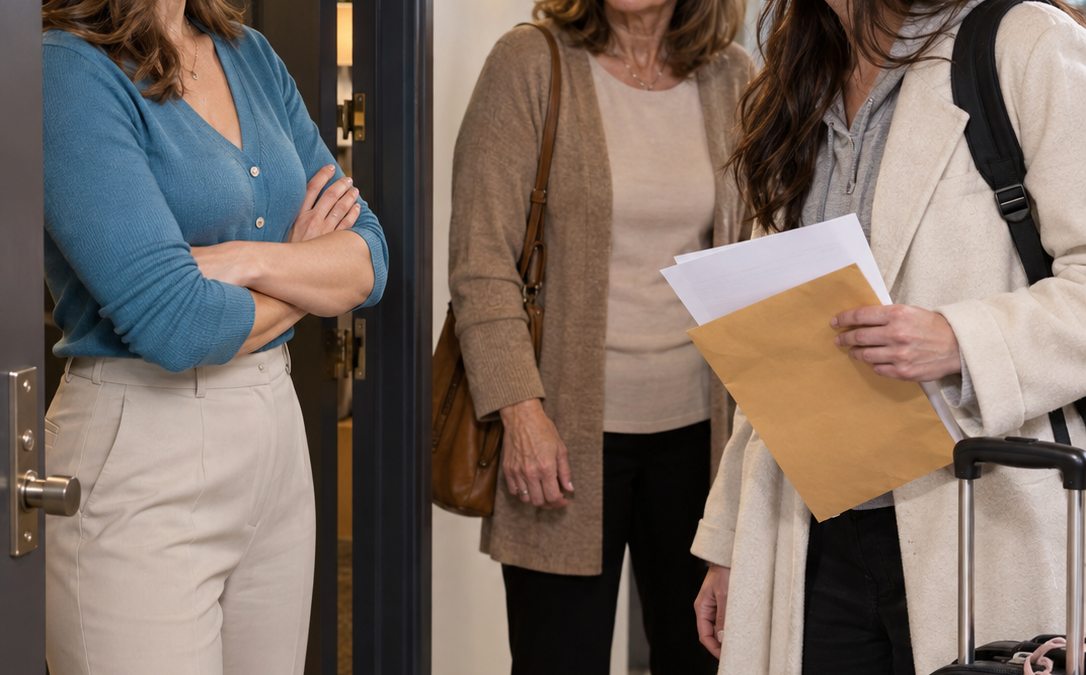
My sister dropped her three kids at my door at 6:03 on a Wednesday morning with two duffel bags, one school backpack, a grocery bag full of socks, and a note taped to my door.
“Back Sunday. Mom said you’re free.”
I know it was 6:03 because I was in my kitchen wearing one slipper, a green clay face mask, and a T-shirt that said, ASK ME ABOUT EMULSIFIERS, when my doorbell camera announced, “Person detected.”
Technically, it detected four.
My sister Celeste was already speed-walking toward a waiting rideshare while her children stood on my porch like passengers whose airline had just gone bankrupt. Liam, 11, had his backpack. Nora, 8, was hugging a stuffed capybara named Attorney Steve. Max, 5, was holding a family-sized box of Cinnamon Toast Crunch.
Not a suitcase. Just cereal.
I opened the door.
“Mom said you know,” Liam told me.
“You know what?”
He looked at Nora. Nora looked at Max. Max raised the cereal.
“We have breakfast.”
My phone buzzed.
Mom: You don’t have kids, Priscilla. You have time. Celeste has an important opportunity. Please don’t make this difficult.
I looked at the message, then at the children, then at Celeste’s disappearing car. Something inside me quietly clicked off.
I texted, “Mom, sure.”
She sent a heart.
Celeste sent three hearts, a clapperboard emoji, and, “Knew I could count on you. Love you.”
Twenty-eight minutes later, all three children were buckled into my car. But I wasn’t taking them to school. I was driving them to the one house Celeste had spent years finding excuses to keep them away from: their father’s.
And by Sunday afternoon, my sister would be standing outside my apartment holding a court notice and accusing me of sabotaging her artistic destiny.
To understand how we got there, you need to understand Celeste.
Celeste had been becoming famous for nine years. Not trying to become famous. Becoming famous. That distinction mattered enormously to her.
Every failed audition was industry politics. Every unanswered email was a soft hold. Every casting assistant who said, “Thanks. We’ll let you know,” was apparently so overwhelmed by her performance that they needed several months to recover.
Celeste was 34 and had been on the verge of her breakthrough since Barack Obama was president. She had three children, an ex-husband named Daniel, 14 ring lights, six garment bags, and no reliable income.
I was 37 and worked for a cosmetics company developing skincare and color products. People hear that and imagine me sitting in a beautiful laboratory inventing lipstick shades called Champagne Regret. The reality is less glamorous. I formulate products, adjust textures, test stability, work with chemists and regulatory teams, and occasionally spend six hours trying to understand why a moisturizer that behaved perfectly on Monday has transformed into cottage cheese by Thursday.
I like my job. I also like pottery, mystery novels, expensive tea, and using the bathroom without somebody asking me to locate a dinosaur.
According to my family, these things meant I had no responsibilities.
Celeste, meanwhile, lived in a permanent state of emergency caused almost entirely by Celeste.
When she and Daniel divorced four years earlier, I tried not to take sides. Daniel worked in commercial construction management. He earned good money, owned a three-bedroom house 15 minutes from the kids’ school, coached Liam’s recreational soccer team, and possessed the rare adult skill of knowing exactly where his children’s birth certificates were.
Celeste called him controlling. Daniel called Celeste unreliable.
Their custody arrangement originally gave them substantial shared time. Then Celeste started finding reasons Daniel couldn’t have the kids.
Max wasn’t sleeping well. Nora didn’t vibe with his house. Liam had activities. Someone had a cough. Someone had homework. Mercury was probably in retrograde.
Gradually, Daniel saw them less. Meanwhile, Celeste told everyone she was basically raising three children alone.
There was one problem.
She wasn’t.
I was helping raise them.
The first time I understood how bad the arrangement had become was two years earlier. Celeste called me at work crying because she had an audition for a regional commercial.
She was playing an approachable dental patient.
Apparently, this could change everything.
“What does an approachable dental patient do?” I asked.
“Why are you like this?”
“I’m genuinely asking.”
“The audition moved. I need you to pick up the kids.”
I had a stability report due. She had already told the school I was coming, so I left work early.
I collected three children from two schools, bought groceries, made pasta, supervised homework, washed Max’s hair after he somehow got yogurt behind his ear, and found his missing library book under Celeste’s bathroom scale.
Celeste returned after 11. Her quick audition had become drinks with industry people. She came through the door carrying mozzarella sticks.
“How did it go?” I asked.
“They said I was too expressive.”
“For dentistry?”
“They don’t understand subtlety.”
She did not get the commercial.
But something important happened that evening.
Nothing happened to Celeste.
I solved everything.
She learned that if she created enough chaos, Priscilla became infrastructure.
Six months later, the landlord raised her rent. Celeste couldn’t cover it. Mom called me before Celeste did.
“She has children.”
“I know.”
“You make good money.”
“I know that, too.”
“What is money for if not family?”
“Retirement.”
Mom did not appreciate that answer.
I suggested Celeste move somewhere cheaper. Celeste said she needed to remain close to the industry.
We lived in Pennsylvania.
Her industry appeared to be concentrated around a Cheesecake Factory and a shopping mall.
Eventually, I agreed to help with rent for six months. Exactly six. That was the agreement.
I paid $850 a month.
Six months became nine. Nine became 12. Twelve became 18.
Every month, Celeste promised something huge was developing.
A mattress commercial. A community theater production. A streaming crime series filming two states away. A pharmaceutical advertisement where she auditioned for “woman enjoying picnic after discussing moderate to severe plaque psoriasis.”
She didn’t get it.
“They went older,” she told me.
The actress in the finished commercial looked 27.
Celeste was 33.
I decided silence was cheaper than therapy.
Meanwhile, I paid for Nora’s dance class because Celeste missed the registration deadline. I bought Liam’s soccer cleats because Celeste’s debit card was “acting weird.”
Her debit card wasn’t acting weird. Her bank account was behaving with complete mathematical integrity.
Then Max arrived at my apartment one November wearing only a hoodie because Celeste had spent her coat budget on new acting headshots.
In one photo, she was holding a wooden chair.
Not sitting on it. Holding it.
“Why the chair?” I asked.
“It shows range.”
“Of what? Furniture removal?”
She didn’t speak to me for two days.
I remember those days fondly.
My birthday should have been the final warning.
I turned 37 in April. I wanted one Saturday alone. I had booked a pottery workshop, ordered Thai food in advance, and bought a mystery novel involving a suspicious lighthouse keeper.
At 8:12 that morning, Celeste called.
I ignored it.
She called again. Then Mom called, then Celeste, then Mom, then Liam.
I answered Liam because when an 11-year-old calls you repeatedly before breakfast, you assume someone has been eaten by an appliance.
“Aunt Priscilla?”
“What happened?”
“Mom says we’re coming to your house.”
“Why?”
“She has an audition.”
Of course.
Twenty minutes later, Celeste appeared at my door wearing sunglasses large enough to receive satellite television.
“Happy birthday.”
“No.”
She was already handing me Max’s backpack.
“What?”
“No.”
She stared at me.
It was the first time I’d ever seen my sister genuinely confused by the word.
“But I have an audition.”
“And I have plans.”
“You said pottery?”
“Yes, Priscilla. It’s pottery.”
“Yes, Celeste. That’s why I called it pottery.”
“You can do that anytime.”
“So can actors, apparently. You’ve been auditioning since 2017.”
Mom called during the argument and informed me that a child-free woman could be flexible on her birthday.
I took the kids.
I missed my workshop.
Celeste didn’t get the role.
It was for a furniture store commercial. The role was “stylish mom.”
“They said my energy was too glamorous.”
Liam, doing homework at my counter, whispered, “They wanted a mom buying a couch.”
I had to walk into my pantry because I started laughing.
But even that didn’t stop me.
That’s the embarrassing part.
People imagine boundaries arrive with dramatic music. Usually, they arrive after you’ve ignored arithmetic for too long.
You excuse one school pickup, one rent payment, one Saturday, one emergency.
Then you open your banking app and discover you’ve spent $14,700 in 18 months supporting a household you don’t live in.
That number bothered me.
Then Daniel called.
It was about six weeks before the Wednesday morning delivery.
“Is Celeste with you?”
“No.”
“Are the kids?”
“No.”
He went quiet.
“She told me they were.”
I sat up.
“Why?”
“I asked to take them this weekend. She said they already had plans with you.”
They didn’t.
I later discovered they were with Mom because Celeste had driven three hours for another audition.
Daniel sighed.
“I’m not asking you to get involved.”
“Good.”
“But if she leaves them with you again, call me.”
There was something in his voice I hadn’t heard before.
Not anger.
Exhaustion.
“I’m their father, Priscilla. I keep asking for my parenting time. She keeps telling me they’re sick, busy, with you, with your mom. Then I find out later they were available.”
I didn’t promise him anything.
But I remembered.
Then came Wednesday.
6:03 a.m.
Three children. Two duffel bags. One cereal box. One note.
Celeste had gone to Chicago for what she had described to Mom as a major acting opportunity. It was actually a four-day networking intensive costing $1,200.
She had not asked me to babysit.
She asked Mom.
Mom volunteered me.
And Celeste apparently decided consent was an optional administrative feature.
I called her voicemail. I called Mom.
She answered immediately.
“Good. You’re awake.”
“Why are there three children outside my apartment?”
“Oh, Priscilla, don’t start.”
“I’m not starting anything. Celeste started it at dawn.”
“This Chicago thing could be important.”
“So you volunteered me?”
“You work from home Wednesdays.”
“I’m working.”
“But you’re home.”
“Yes. That’s where the home part comes from.”
“You don’t have kids, Priscilla. You have time.”
There it was.
The family constitution.
No husband, no children, therefore apparently no ownership of my own calendar.
I looked into the kitchen. Liam was eating cereal from a mixing bowl. Nora was introducing Attorney Steve to my houseplants. Max had discovered my digital kitchen scale and was weighing individual grapes.
I said, “Sure.”
Mom immediately relaxed.
“I knew you’d understand.”
“Oh, I understand.”
I hung up.
Then I called Daniel.
He answered on the first ring.
“Everything okay?”
“Are you home?”
“Yes.”
“Do you want your children until Sunday?”
Silence.
“What?”
“Celeste left them on my doorstep this morning. She’s gone until Sunday.”
Another silence.
“Then she did what?”
“Would you like them?”
“Yes.”
No speech.
No accusation.
Just yes.
I told the kids to put their shoes back on.
Nora looked confused.
“Where are we going?”
“Your dad’s.”
All three stopped.
Liam frowned.
“Mom says we’re not supposed to.”
“Did she say why?”
He shrugged.
“She says Dad makes everything complicated.”
Max looked up.
“Dad has waffles.”
That apparently settled his position on the custody dispute.
Daniel lived in a brick house on a quiet street with a basketball hoop above the garage. When he opened the door, he was halfway dressed for work.
He looked at the kids, then the luggage, then Max’s cereal.
“Why do you have Cinnamon Toast Crunch?”
Max hugged the box.
“Emergency.”
Daniel nodded.
“Reasonable.”
The kids went inside.
Nora immediately ran upstairs, yelling that she wanted to see whether her room was still purple.
It was.
Liam asked whether his bike was still in the garage.
It was.
Max asked about waffles.
Daniel said Saturday.
Max countered with Thursday.
They settled on Friday.
I stood in the hallway realizing something that should have been obvious years earlier.
This wasn’t a house the children hated.
This was a house Celeste didn’t want them using.
Daniel came downstairs.
“I need to tell my attorney what happened.”
“Okay.”
“I’m not trying to involve you.”
“I know.”
“But I have messages from the last year where Celeste refused my parenting time because she said the kids were staying with you.”
My stomach dropped.
“That wasn’t true.”
His expression changed.
“How many times?”
“I don’t know.”
He rubbed his forehead.
“Thank you for bringing them.”
I went home.
At 8:41, Celeste texted: Kids okay?
Yep.
At 10:16: Tell Nora her jazz shoes are inside pocket.
Okay.
At 1:07: Max can’t have orange juice after 6. He gets insane. LOL.
Noted.
I didn’t lie.
I simply stopped providing unnecessary information.
Wednesday evening, Mom asked me for a picture of the kids.
I sent her a photograph of my empty couch.
She called immediately.
“Where are they?”
“With their parent.”
“You’re their aunt.”
“Yes. Daniel is their father.”
A pause.
Then the emotional kettle began boiling.
“You took them to Daniel?”
“Yes.”
“Priscilla.”
“Yes.”
“Still, Priscilla, you had no right.”
“That’s interesting.”
“What does that mean?”
“Celeste can leave three children at my home without permission, but I can’t call their father?”
“You know how she feels about him.”
“I know how she feels about employment, too. Reality remains involved.”
Mom hung up.
Celeste called five minutes later.
“Where are my kids?”
“At Daniel’s.”
Silence.
Wonderful silence.
Expensive silence.
At my company, we could have bottled that silence in frosted glass and sold it for $72.
“You did what?”
“I brought them to their father.”
“You can’t relocate my children.”
“He lives 15 minutes away, Celeste. I didn’t ship them to Belgium.”
“You know I don’t want them there.”
“Then don’t leave them on porches.”
“I left them with family.”
“He is their father.”
“That’s not the point.”
“What is the point?”
“You agreed.”
“I said ‘sure’ after you were already gone.”
“You knew what I meant.”
“Yes. That’s why I called Daniel.”
Her breathing changed.
Celeste’s angry crying was extremely theatrical. There were pauses, breath control, whispered sentences. If she could reproduce it in auditions, she might actually have had a career.
“I cannot believe my own sister would undermine me during the most important week of my professional life.”
“How’s the intensive?”
“That is irrelevant.”
“Did you book anything?”
Silence.
“I made connections.”
“So, no.”
“You’re jealous.”
“Of what?”
“My courage.”
“I develop foundation, Celeste. I spend my weekdays preventing separation. I’m not jealous of a woman whose childcare arrangement separated before sunrise.”
She hung up.
I laughed until my face hurt.
The next morning, I went to work.
Nobody needed a ride. Nobody needed money. Nobody had forgotten dance shoes.
I spent three peaceful hours testing a serum that had developed a terrible smell during accelerated stability testing.
My coworker, Miriam, sniffed it.
“This smells like a cucumber died with unresolved business.”
I told her what Celeste had done.
Miriam stared at me.
“She left three children at your door?”
“Yes.”
“And flew away?”
“Yes.”
“Like an Amazon return?”
“Apparently. I would have charged a restocking fee.”
That evening, Daniel sent me a picture of the kids making pizza. Liam was grating cheese. Nora had flour on her nose. Max had arranged six pepperoni slices around one olive with the concentration of a Renaissance architect.
Daniel wrote, “They’re good.”
Then Nora sent me a voice message.
“Aunt Priscilla, Dad says Attorney Steve cannot go in the oven, even if he is supervising.”
Daniel’s voice came from the background.
“I said what I said.”
For the first time in years, seeing those children happy didn’t come with a bill attached.
Friday morning, I canceled the automatic $850 transfer to Celeste. Then I removed my card from Nora’s dance account and sent Daniel the information.
I went through my banking records.
Rent. Shoes. Groceries. School supplies. Dance fees. Pharmacy charges. Camp deposits.
I wasn’t doing it to demand repayment.
I needed to see the pattern.
For years, I had told myself I was helping my sister through a temporary crisis.
But a temporary crisis lasting several years is no longer a crisis.
It is a business model.
And I was the investor.
Saturday, Daniel called.
His attorney had filed for an emergency custody review.
Not because of one Wednesday.
Wednesday simply connected everything.
He had messages showing repeated attempts to use his parenting time. He had Celeste’s refusals. He had dates when she claimed the children were with me. He now knew some of those claims were false. And he had Celeste’s handwritten note showing she had left the children until Sunday without confirming childcare.
“Would you be willing to confirm what happened?” he asked.
“Yes.”
That was all.
No revenge speech.
No dramatic plan.
Just yes.
Sunday afternoon, Celeste arrived at my apartment.
Mom was with her.
Celeste still looked like she had just stepped off a plane: leggings, oversized coat, giant sunglasses, and a travel pillow hanging from her carry-on.
She was holding an envelope.
She rang my bell three times.
I opened the door.
She lifted the envelope.
“What is this?”
I looked at it.
“Paper.”
“Don’t be cute.”
“I’m not. Cute costs extra.”
“This is a court notice.”
“Then I assume it came from a court.”
Mom stepped forward.
“Priscilla, enough.”
“No.”
She stopped.
I hadn’t shouted.
That was what made it effective.
Celeste waved the papers.
“Daniel is trying to take my children. He’s asking the court to review custody.”
“Because of you.”
“Because you left three children outside my apartment and flew to Chicago.”
“I had an audition.”
“You had a networking workshop.”
“It included casting directors.”
“Did they cast you?”
Her mouth opened.
Nothing came out.
Mom said, “That’s cruel.”
Celeste pointed at me.
“You have always hated that I had something bigger in me.”
“I paid your rent.”
“That doesn’t mean you supported me emotionally.”
“I bought Max a winter coat because you bought headshots holding a chair.”
“That was editorial.”
“You looked like you were helping someone move.”
Mom closed her eyes.
“Can everybody please focus?”
“I am focused,” I said. “That’s the problem.”
Celeste began pacing.
First, Daniel had planned this. Then I had planned it with Daniel. Then the workshop was apparently a scam, which somehow became my fault.
Then she announced she had been invited to a private audition Saturday but couldn’t perform because she was emotionally destabilized.
“What was the role?” I asked.
“That doesn’t matter.”
“What was it?”
She looked away.
“It was a web series.”
“Paid?”
“That is not how independent art works.”
“So, no.”
“It had exposure.”
“What was the show?”
Silence.
“Celeste.”
She muttered, “It was about a haunted laundromat.”
I stared at her.
Mom stared at her.
“What were you auditioning for?”
Celeste’s jaw tightened.
“Assistant manager.”
I tried.
I genuinely tried.
But a sound escaped me like a bicycle horn.
Celeste’s face turned red.
“This is funny?”
“No.”
Another bicycle horn escaped.
Mom said, “Priscilla.”
That finished me.
I leaned against my door, laughing while my sister stood in the hallway wearing a neck pillow and holding custody paperwork after losing an unpaid role as assistant manager of a paranormal laundromat.
When I finally recovered, I told her what would happen next.
No more rent payments. No more automatic babysitting. No more activity fees she hadn’t budgeted for. No more Mom volunteering me. No more school pickups because an audition suddenly appeared.
If Celeste needed help, she could ask.
I could say yes.
I could say no.
And if the children needed a parent while she traveled, Daniel would get the first call.
Celeste stared at me.
“You’re choosing him over your sister.”
“No. I’m choosing not to pretend I’m the third parent.”
“What am I supposed to do about rent?”
“Pay it.”
“With what?”
“A job.”
“I have a job.”
“You have Backstage.”
“Acting is a job.”
“Then eventually it should issue money.”
Mom inhaled sharply.
Celeste started crying.
But this time, under all the drama, I saw genuine fear.
And I did feel sorry for her.
Celeste wasn’t evil.
She loved her children.
She was also irresponsible, entitled, and so obsessed with the future version of herself that she had outsourced the present version to everybody around her.
“I don’t want you to fail,” I told her.
She looked at me.
“I just won’t keep financing your refusal to deal with reality.”
“You think I’m a joke.”
“No.”
I meant it.
“I think you might actually be talented. But talent doesn’t pick kids up from school.”
For once, she had no answer.
Mom tried one last time.
“So, you’re abandoning your family?”
“No, Mom.”
I looked directly at her.
“I’m resigning from a position I never applied for.”
Then I closed the door.
Everything after that was consequence, not revenge.
The court didn’t magically hand Daniel full custody the next morning. Real life is slower than that.
But the temporary arrangement changed while the situation was reviewed. The children spent most school nights with Daniel because he had a stable schedule and could show that Celeste’s travel repeatedly interfered with hers.
Celeste still had regular parenting time.
Nobody was erased from the children’s lives.
Nobody got a movie-ending punishment.
A judge simply looked at calendars, messages, school pickups, childcare arrangements, and travel dates.
Facts are rude like that.
They don’t care about your monologue.
Daniel covered the kids’ everyday expenses without turning every pair of shoes into a financial emergency.
More importantly, he kept me out of the middle.
If Nora wanted to visit me, we planned it. If Liam wanted help with something, he called. If Max wanted waffles, he continued negotiating with every adult in Pennsylvania.
But I became their aunt again.
Not their backup mother. Not their chauffeur. Not their emergency fund.
Celeste moved into a smaller apartment six months later. She posted online that she was “simplifying her environment to protect her creative energy.”
The new apartment was 12 minutes from the old one.
She also got a real job three days a week at a boutique fitness studio doing reception and social media.
She told everyone it was temporary.
It has now been 11 months.
She’s extremely good at it.
Naturally, she refuses to admit that.
She still auditions.
I hope she gets something. A real role. A paid one. Preferably one whose production budget includes childcare.
Our relationship is different now, more formal, but healthier.
The first time she asked me to watch the kids after everything happened, her text said, “Hey, are you free Saturday from 1–5? Totally okay if not.”
I stared at those last four words.
Totally okay if not.
Beautiful.
Historic.
Possibly framable.
I said yes.
The kids came over.
Nora brought Attorney Steve. Liam destroyed me at a board game. Max arrived carrying Cinnamon Toast Crunch.
I looked at the box.
“Emergency?”
He nodded.
“You never know.”
Mom took longer to adjust.
For months, she kept trying different versions of the old system.
“Could you help Celeste just this once?”
“Could you be flexible?”
“Could you think about the children?”
Eventually, I developed one answer.
“Ask their parents.”
Mom hated it.
Then something remarkable happened.
She adapted.
It turns out people become incredibly resourceful when the person they’ve been using as the solution stops volunteering.
Last month, Celeste had another Saturday audition.
She called Daniel.
He already had the kids.
No emergency. No duffel bags. No 6 a.m. delivery.
Nobody even told me.
I learned about it Sunday when Celeste called.
“I didn’t get it.”
“I’m sorry.”
“They said I was too polished.”
“What was the role?”
A pause.
“Exhausted mother buying discount paper towels.”
I laughed.
For once, she laughed, too.
“Okay,” she admitted. “Maybe I misunderstood the assignment.”
That might be the most personal growth anyone in my family has achieved in one sentence.
As for me, once I stopped subsidizing Celeste, I discovered I had enough extra money to do something completely irresponsible.
I signed up for pottery again every Thursday, 7 to 9.
My first bowl looked like it had witnessed a crime.
My second looked like the crime.
My third was actually usable.
I keep it on my kitchen counter.
A few weeks ago, the kids came over for a planned Saturday afternoon. Max poured Cinnamon Toast Crunch into my bowl.
He inspected it.
“You made this?”
“I did.”
He ran one finger along the uneven rim.
“It’s kind of weird.”
“Thank you.”
“Can I have it?”
“No.”
He considered that, then shrugged.
“Okay.”
And he ate his cereal.
That tiny moment made me happier than it probably should have because a year earlier, somebody in my family would have explained why I should give it to him.
He’s little.
You can make another.
You don’t need it.
Family shares.
For years, I thought boundaries were what broke families.
I had it backward.
Our family had been breaking itself by treating one person’s time, money, apartment, and goodwill as communal property.
The boundary didn’t destroy anything worth preserving.
It simply made everyone carry their own bags.
And now, whenever my doorbell camera says “Person detected” before 7 in the morning, I still experience a brief spiritual evacuation.
So far, it has only been delivery drivers and, once, inexplicably, a raccoon.
I checked.
He wasn’t carrying luggage.
And most importantly, he didn’t have a note from my—








