My sister called what she did to my 11-year-old daughter a joke in front of our entire family. Hours later, she was in surgery. She still would not apologize. “Stop overreacting. She will be fine.” While she was still laughing, the doctor walked back into the room and handed me something. My sister never saw it.
My brand.
That was the joke of the century.
Blythe’s brand consisted of running up massive amounts of credit card debt and emotionally manipulating our parents into bailing her out.
But in that house, Blythe was the golden child. She was the beautiful, glamorous one. Her minor inconveniences were treated as national tragedies, while my major milestones were barely acknowledged.
When I paid off my college loans by working three jobs, my father patted me on the back and immediately changed the subject to Blythe’s new modeling portfolio.
That was our family dynamic. It was the air we breathed.
My 11-year-old daughter, Mave, was sitting on the living room rug, happily sketching in her notebook. She was a quiet, sweet child, observant and deeply empathetic. She had my husband’s dark hair and my stubborn chin.
Declan, my husband, sat on the sofa near her, reading a book while keeping a protective, loving eye on our girl.
They were my sanctuary. They were the only real family I had.
Blythe glanced over at me, her eyes sweeping up and down my faded sweater. Her lips curled into a smirk.
“Hey, Sloan,” she called, her voice cutting through the chatter. “Are you ever going to buy clothes that don’t look like they came out of a thrift store donation bin? I mean, Cashin and I are hosting a huge engagement party next month at the country club. Please tell me you’re not planning to wear something like that. I’d die of embarrassment.”
A heavy silence fell over the dining room. Several relatives awkwardly lowered their eyes to their plates.
This was Blythe’s favorite game: public humiliation.
Family drama was her lifeblood. She fed on making other people feel small so she could feel enormous.
I calmly set down the sponge and dried my hands on a towel.
“I’m sure whatever I wear will be fine, Blythe. You’re the star of the show anyway. Nobody will be looking at me.”
She scoffed, tossing her hair over one shoulder.
“Well, that’s true. But still, you have to make an effort. You represent me now.”
A familiar knot of anger tightened in my stomach, but I forced my expression to remain completely blank.
I’d spent 37 years mastering the art of not reacting to her toxic bait. Reacting only gave her power. Reacting made me the angry, jealous older sister in my parents’ eyes.
So I offered a hollow smile and went back to washing dishes.
I was used to being the shadow. What I didn’t know was that Blythe’s arrogance that night would soon demand a price paid in my own daughter’s blood.
The rest of dinner dragged on with the agonizing slowness of a nightmare. The air in the house seemed to grow thicker, suffocating me beneath the weight of decades of unspoken resentment.
I carried a stack of heavy ceramic plates into the kitchen, desperate for a moment of quiet away from Blythe’s piercing voice.
But peace was never an option in my family.
Aunt Vesper followed me into the kitchen.
Vesper was my mother’s sister, a woman whose entire existence seemed dedicated to enforcing toxic family loyalty. She was the ultimate flying monkey, always ready to swoop in and do Blythe’s dirty work while pretending to be the voice of reason.
She cornered me beside the refrigerator, her expression arranged into a mask of artificial concern.
“Sloan, dear,” she began, lowering her voice to a conspiratorial whisper. “I was hoping we could chat for a second about Blythe’s wedding.”
I continued loading the dishwasher without looking at her.
“What about it, Aunt Vesper?”
“Well, you know how stressful this is for her and for your parents. A wedding of this caliber is an enormous financial burden. Your mother is losing sleep over the catering costs alone.”
Vesper leaned closer, bringing with her the smell of cheap perfume and stale wine.
“I think it would be a beautiful gesture, a real show of sisterly love, if you offered to pay for her honeymoon. Or perhaps that designer dress she wants. Just a little contribution from the older sister to bless the marriage.”
I stopped moving.
Then I turned and looked at her. Really looked at her.
The sheer audacity of the request was staggering.
They thought I was struggling to get by. Yet they still expected me to bleed myself dry to fund Blythe’s vanity project. They wanted me to go into debt so she could post photographs from a luxury resort in the Maldives.
“Aunt Vesper,” I said, my voice dangerously calm and flat, “I’m not paying for Blythe’s honeymoon. Cashin makes a good living, and if they can’t afford a luxury trip, they can go somewhere cheaper. That’s how the real world works.”
Vesper gasped softly, pressing a hand to her chest as if I’d slapped her.
“Sloan, how can you be so selfish? Your sister is finally settling down. This is her dream. You always do this. You always hold on to your little pennies while she’s out there trying to build a beautiful life.”
She shook her head in theatrical disappointment.
“It’s just a few thousand. You could take out a small loan. Family does that for family.”
“Family doesn’t demand loans for vacations, Vesper,” I replied, staring directly into her eyes. “My answer is no. Please excuse me.”
I turned my back on her and walked toward the dining room, my heart hammering against my ribs.
I wanted to scream.
I wanted to pull out my banking app, shove my $7 million balance in her face, and tell her I could buy the entire wedding venue in cash the next morning if I wanted to, but Blythe wouldn’t see a single red cent of it.
Instead, I held my tongue.
Silence was my armor.
As I stepped back into the living room, I stopped in my tracks.
From where I stood in the hallway, I had a clear view of the sofa. Declan had put his book down and was helping Mave with a complicated math problem.
They were laughing together. Declan ruffled her hair, and Mave beamed up at him, her face glowing with genuine, uncomplicated happiness.
It was a beautiful, simple moment between a father and daughter who truly loved each other.
Then I looked past them.
Sitting in the armchair opposite the sofa was Blythe.
She wasn’t looking at her shiny new handbag. She wasn’t looking at her fiancé.
She was staring directly at Declan and Mave.
The expression on her face made my blood run cold.
It wasn’t her usual smug, camera-ready smile. Her features had twisted into a mask of pure, unadulterated malice. Her eyes were narrowed, dark with a deep, seething jealousy that seemed to radiate from her skin.
She looked at my daughter’s innocent, happy smile as though it were a personal insult.
In that fleeting second, the truth hit me harder than a physical blow.
Blythe hated us.
She didn’t simply look down on me because of my clothes or my quiet life. She hated me because I had something she could never buy.
I had real love.
I had a husband who adored me and a child who was kind and grounded.
Blythe spent her entire life performing for strangers on the internet, terrified that if the camera stopped rolling, she would cease to exist. She was hollow, and seeing my full, happy family was driving her insane.
Before I could fully process the depth of that hatred, my mother clapped her hands loudly, breaking the spell.
Blythe instantly rearranged her face into a perfect, empty smile and looked away from my family.
“All right, everyone,” my mother announced cheerfully. “Time for dessert. I made my special blackberry cobbler, but it’s still down in the basement freezer.”
I stepped forward.
“I can go get it, Mom.”
“No, no.” My mother waved me off. “You’ve been cleaning all night. Let the kids do something. Mave, sweetheart, be a good girl and run down to the basement pantry and grab the big glass bowl of cobbler for Grandma.”
Mave looked up, eager to help.
“Sure, Grandma.”
She hopped up from the floor, her sneakers padding softly against the hardwood.
The route to the basement pantry required going down a flight of steep, unforgiving concrete stairs. The house was old, and the basement steps had never been renovated. They were rough gray concrete with sharp edges, descending into a chilly, dimly lit lower level.
I watched Mave walk toward the hallway door leading to the stairs.
My maternal instinct flared. A sudden, inexplicable tightness gripped my chest.
“Be careful, Mave,” I called. “The steps are slippery. Use both hands on the bowl.”
“I know, Mom,” she sang back cheerfully.
I turned to retrieve the dessert plates from the cabinet, but out of the corner of my eye, I caught a movement.
Blythe had slipped out of her armchair.
She was moving quietly, unusually quietly for her, following the same path Mave had just taken toward the hallway.
The dinner conversation around me blurred into a dull drone.
A heavy, dark premonition settled over my shoulders.
Dinner had been awkward enough, but when my mother sent Mave toward those concrete stairs with the dessert bowl, I missed the sharp, cold glare Blythe directed at my daughter.
The next sixty seconds are burned into my brain with agonizing, microscopic clarity.
I can still smell the roast beef. I can still hear the ice clinking in my father’s glass. I can still feel the exact temperature of that room.
I was pulling small ceramic dessert plates from the upper cabinet, carefully stacking them on the counter.
Through the open archway, I had a partial view of the basement door.
Mave had just reached the top of the concrete stairs. She was standing on the landing, bending to pick up the heavy glass bowl of cobbler that my mother had temporarily placed on the top step to cool.
It was a massive vintage glass dish, heavy and cumbersome even for an adult.
Mave gripped its edges with both small hands, her face scrunched in concentration. She took a deep breath and prepared to take her first step down, intending to bring the bowl to the lower kitchen prep area.
Then Blythe appeared.
She didn’t walk normally.
She moved with a predatory stealth, her expensive heels making almost no sound against the runner rug.
She stopped directly behind Mave.
My daughter couldn’t see her. All of Mave’s attention was on balancing the heavy glass bowl and navigating the steep, treacherous concrete steps below her.
My stomach dropped.
A primal alarm went off inside my head.
“Blythe!”
I said her name sharply, stepping away from the counter.
But I was too far away.
Blythe leaned forward, bringing her face within inches of the back of my daughter’s neck.
Later, much later, I would learn exactly what she whispered.
“Watch out, little rat.”
Then, with deliberate, calculated force, Blythe thrust her right foot forward.
She hooked her expensive leather heel around Mave’s left ankle and yanked backward.
It was a hard, violent trip.
It wasn’t a playful nudge.
It was an assault.
Everything shifted into horrific slow motion.
I saw Mave’s eyes widen in sheer terror as her center of gravity was violently ripped away from her. Because both her hands were occupied with the heavy glass bowl, she had absolutely no way to catch herself.
No way to grab the handrail. No way to brace for impact.
Mave screamed.
It wasn’t a child’s startled yelp. It was a raw, guttural shriek of pure panic.
She pitched forward, plunging headfirst down the steep stairwell.
The glass bowl slipped from her grasp and struck the concrete steps first.
It exploded.
Thick, jagged shards of heavy vintage glass flew in every direction like shrapnel.
A split second later, Mave’s small body crashed onto the shattered remains of the bowl.
The sound of her body hitting the concrete was a sickening, heavy thud that I’ll hear in my nightmares until the day I die.
She tumbled down four steep steps, her arms and legs flailing, her skin tearing against sharp concrete and broken glass, before finally coming to a stop on the small midway landing.
Silence descended over the house for exactly one heartbeat.
Then Mave began screaming in agony.
I didn’t run.
I teleported.
I don’t remember crossing the living room. I don’t remember pushing past my father.
The next thing I knew, I was dropping to my knees on the hard, cold concrete landing, ignoring the shards of glass biting into my jeans.
Mave was curled into a tight ball, sobbing hysterically, her face pale as a ghost.
“Mom! Mom, it hurts!”
“Mom’s here, baby. I’m right here.”
I reached for her, my hands shaking violently.
Then I saw her right arm, and the breath was punched out of my lungs.
A massive, jagged spear of glass had sliced deep into her forearm, just below the elbow.
The wound was horrifyingly deep. Her skin had been laid open, exposing the pale yellow layer of fat and the dark red muscle beneath it.
Blood was pumping out in a terrifyingly steady rhythm, instantly soaking her shirt sleeve and pooling on the gray concrete.
Her left knee was also torn open and bleeding heavily.
Declan dropped to his knees beside me a second later.
He took one look at the wound, ripped off his button-down shirt, and pressed the fabric brutally hard against Mave’s arm to create makeshift compression and stop the bleeding.
“Call 911!” Declan roared, his voice shaking the walls. “Get an ambulance right now!”
Total chaos erupted upstairs.
My mother was shrieking, her face buried in her hands. My father was shouting into his phone. Aunt Vesper was crying.
But amid the screaming, the sobbing, and the terrifying sight of my daughter’s blood spreading across the concrete floor, I heard another sound.
A sound that turned the blood in my veins to ice.
Laughter.
I slowly turned my head and looked up the stairs.
Blythe was standing on the top landing, looking down at us.
She wasn’t horrified.
She wasn’t rushing to help.
Her hands rested casually on her hips, her head tilted back, and she was laughing.
A loud, sharp, arrogant laugh.
“Oh my God, so dramatic!” Blythe snorted, rolling her eyes as if she were watching a bad sitcom. “She’s so clumsy. She tripped over her own feet, just like you always do, Sloan. It was just a joke. I barely even touched her. Don’t make such a huge deal out of a little scrape.”
I stared up at her.
I looked at the amusement dancing in her eyes.
Then I looked down at my husband, whose hands were covered in our child’s blood as he desperately tried to stop the bleeding.
I looked at my sweet, innocent 11-year-old girl, shaking with shock, her face gray, crying out in unbearable pain.
And in that precise fraction of a second, something inside my soul snapped.
The quiet, compliant, invisible sister died on those bloodstained concrete steps.
The woman who had spent 37 years keeping the peace was gone.
I didn’t yell at Blythe.
I didn’t curse at her.
I simply locked my eyes on hers.
Kneeling in my daughter’s blood, my hands trembling as I held her uninjured arm, I made a silent, unbreakable vow.
I was going to destroy her.
I was going to tear down her fake life, strip away her arrogant smile, and take everything she’d ever cared about.
I knelt there in my daughter’s blood, holding her wound as she screamed. When I looked toward the top of the stairs, my sister was still laughing.
The Sloan she knew was dead.
Only a mother willing to burn everything to the ground remained.
The ambulance ride to the hospital took exactly nineteen minutes.
I know because I spent every second staring at the digital clock mounted above the ambulance doors, counting the glowing red numbers as if they could somehow anchor me to reality.
The back of the ambulance smelled of sterile alcohol wipes and metallic blood.
Mave lay on the stretcher, her small body trembling uncontrollably from shock. Her right arm and left knee were wrapped in thick pressure bandages already blooming with dark crimson stains.
Declan sat beside her, his large hands gently holding her uninjured left hand.
His face was a mask of pure, terrifying stoicism, but I could see the frantic pulse beating in his jaw.
The paramedic, a calm woman with tired eyes, worked quickly, connecting IV lines and checking Mave’s vital signs.
“Mom,” Mave whispered, her voice barely louder than the hum of tires against asphalt. “It hurts so bad. Am I going to lose my arm?”
I leaned closer, pressing my forehead against hers.
My heart was breaking into a million jagged pieces, but I forced my voice to remain steady.
“No, baby. You’re not going to lose your arm. You’re going to be okay. The doctors are going to fix it. I promise.”
I made that promise without having any idea whether I could keep it.
When we burst through the double doors of the emergency room, chaos swallowed us whole.
Bright fluorescent lights. The frantic beeping of monitors. The sharp smell of antiseptic.
They rushed Mave into a trauma bay, and Declan and I were pushed back behind a heavy curtain.
The next hour was a blur of agonizing waiting. Doctors and nurses moved in and out, their faces grim and focused.
Finally, a tall, sharp-featured man in scrubs walked toward us.
His badge read Dr. Alaric, Orthopedic Trauma Surgeon.
He didn’t have the soft, comforting bedside manner of a pediatrician. He had the intense, no-nonsense gaze of a man who dealt with shattered bones and torn flesh for a living.
“Are you the parents?” he asked, his voice clipped and professional.
“Yes,” Declan said, stepping forward. “How is she?”
Dr. Alaric glanced down at his chart and then back at us. His expression was incredibly serious.
“She’s stable, but the injuries are significant. The glass lacerated her right forearm deeply. It completely severed the flexor tendon and nicked the median nerve. Her left knee also suffered a deep puncture wound that narrowly missed the patellar ligament.”
He paused, allowing us a moment to absorb his words.
“She’s going into surgery right now. We need to repair the tendon and clean out any microscopic glass fragments to prevent infection.”
I felt the room spin.
Surgery.
Tendon damage.
Nerve damage.
My 11-year-old girl, who loved to paint and ride her bike, was being wheeled into an operating room because my sister thought it would be funny to trip her down a flight of concrete stairs.
“Will she have full use of her hand again?” I asked, my voice trembling.
Dr. Alaric sighed quietly.
“We’ll do everything we can. The surgery will take at least three hours. After that, it’ll be months of intensive physical therapy. Even then, I can’t guarantee she’ll regain one hundred percent of her fine motor skills. It’s a severe injury.”
Before I could begin processing the devastating weight of his words, the heavy automatic doors to the emergency waiting room slid open.
My parents walked in, followed closely by Aunt Vesper.
Right behind them, looking incredibly annoyed, was Blythe.
She’d changed out of her silk blouse and was now wearing designer sweatpants and oversized sunglasses.
I looked directly at her.
“You think Mave is clumsy?” I asked, the words tasting like ash in my mouth. “You think she tripped?”
Blythe let out a loud, dramatic sigh and pulled her sunglasses down the bridge of her nose.
“Oh my God, Sloan, stop trying to make this a federal case. I stuck my foot out as a joke. I didn’t push her. She panicked and fell. It’s not my fault she can’t walk down a flight of stairs holding a bowl. Honestly, I’m the one who’s traumatized. That glass almost hit my new shoes.”
Declan lunged forward.
I grabbed his arm, digging my nails into his skin to hold him back.
If he touched her, he’d go to jail.
And Mave needed us here.
“You’re a monster!” Declan spat at Blythe, his chest heaving. “If you ever come near my daughter again, I’ll break your neck.”
Aunt Vesper immediately stepped between them, her hands raised in a placating gesture.
“Now, now, let’s not say things we’ll regret. We’re family. Family forgives. Blythe made a mistake, but threatening her is simply unacceptable. Declan, you need to calm down.”
I felt a cold, hard shell forming around my heart.
They were a wall of indifference. They’d completely insulated themselves inside their own delusion.
There was no reasoning with them.
There was no making them see the truth.
They would always, always protect Blythe.
I didn’t scream.
I didn’t cry.
I looked at my parents, then my aunt, and finally my sister.
“Get out,” I said quietly.
“Sloan, don’t be unreasonable,” my father began.
“I said, get out.”
My voice dropped an octave, carrying a terrifying, absolute authority I’d never used before.
“Leave this hospital right now. Don’t call me. Don’t text me. Just get out.”
My mother opened her mouth to argue, but the sheer fury radiating from me must have finally registered.
She took a step backward.
“Come on, Theren. Let’s give her some space. She’s just emotional.”
Blythe rolled her eyes, shoving her phone into her pocket.
“Whatever. Call me when you stop acting like a psycho.”
They turned and walked out of the emergency room, leaving Declan and me standing alone beneath the harsh fluorescent lights.
I collapsed into one of the hard plastic waiting room chairs and buried my face in my hands.
The silence they left behind was deafening.
Ten minutes later, Dr. Alaric walked back into the waiting area.
He wasn’t holding a medical chart this time.
He was holding a small, clear plastic biohazard bag.
“Mrs. Sloan,” he said softly.
I looked up, my eyes red and burning.
“The nurses were removing Mave’s clothes to prepare her for surgery,” he explained, handing me the bag. “We found this inside the pocket of her cardigan. It’s covered in blood, but the screen is still lighting up. I thought you might want to keep it somewhere safe.”
I took the bag.
Inside was Mave’s pink smartwatch.
The glass face had completely shattered in the fall and was stained with dark, dried blood, but a small green light was still blinking steadily along its side.
Sitting in that cold hospital waiting room, holding my daughter’s broken, bloody watch, I suddenly remembered something.
Mave had a habit of leaving the voice memo app running on her watch whenever she felt nervous at large family gatherings.
It was her way of pretending she was a secret agent, a little coping mechanism for the overwhelming noise and tension.
A chilling thought struck me.
If the watch had been inside her pocket when she fell, it might have been recording.
The surgery lasted three agonizing hours.
Declan paced the length of the waiting room, practically wearing a path into the cheap linoleum floor. I sat perfectly still in my hard plastic chair, staring at the clear plastic bag resting on my lap.
The shattered face of Mave’s smartwatch stared back at me like a silent witness.
When the surgical nurse finally emerged to tell us that Mave was out of the operating room and being moved to recovery, I released a breath I felt as though I’d been holding for decades.
Declan broke down, sobbing quietly into his hands.
The surgery had been successful, but the road to recovery would be brutally long.
We were allowed to see her an hour later.
She was pale, fragile, and heavily medicated, her small right arm encased in a massive, heavy white cast.
She was sleeping soundly, the steady beeping of the heart monitor the only sound in the dim hospital room.
Declan sat beside her bed, holding her left hand against his cheek. I stood at the foot of the bed, watching her chest rise and fall.
“Declan,” I whispered, breaking the silence. “I need you to stay here with her. I’m going to the cafeteria to get us some coffee. But really, I just need five minutes alone.”
He nodded, his eyes never leaving Mave’s face.
“Take your time. I’m not going anywhere.”
I picked up my purse, grabbed the plastic bag containing the watch, and walked out into the quiet, brightly lit hospital corridor.
I didn’t go to the cafeteria.
Instead, I found a small, empty family consultation room at the end of the hallway.
I stepped inside, shut the heavy wooden door behind me, and locked it.
The room was silent.
I sat at the small circular table in the center, my hands trembling violently as I unsealed the biohazard bag.
The metallic smell of blood reached me immediately.
I pulled out the broken pink watch.
Its screen was dead, shattered into a spiderweb of cracks, but I knew the internal storage was robust.
I reached into my purse and took out my work tablet and a small universal adapter cable I always carried for emergencies.
My heart pounded against my ribs like a trapped bird.
I plugged the cable into the small port on the side of the watch and connected it to my tablet.
For ten agonizing seconds, nothing happened.
Then a small icon appeared on the tablet screen.
External drive connected.
I opened the file folder.
There were dozens of short audio clips. Most were from several days earlier.
Mave talking to our dog.
Mave humming a song.
I scrolled to the bottom of the list, examining the timestamps.
There was one file recorded at 7:42 p.m.
Exactly three minutes before the ambulance had been called.
I clicked Play.
At first, there was only the muffled rustling of fabric, confirming that the watch had indeed been inside her cardigan pocket.
Then the ambient sounds of my parents’ house filtered through.
I could hear the distant clinking of dishes and the low murmur of conversation from the dining room.
I heard the rhythmic thud of Mave’s sneakers crossing the hardwood floor as she approached the hallway leading to the basement.
Then I heard my own voice, distant but clear.
“Be careful, Mave. The steps are slippery. Use both hands on the bowl.”
Mave’s cheerful reply followed.
“I know, Mom.”
The audio captured the sound of her stopping at the top of the stairs. I could hear the slight exertion in her breathing as she bent to pick up the heavy glass bowl.
And then the blood in my veins turned to absolute ice.
The recording picked up a new sound.
The distinct, sharp clicking of Blythe’s expensive heels against the floorboards, moving quickly and quietly toward Mave from behind.
But it wasn’t what Blythe said to Mave that made my world stop spinning.
It was what she was saying before she reached her.
Blythe was on her cell phone.
Her voice came through as a low, vicious whisper, captured perfectly by the microphone in Mave’s pocket.
“Yeah, I’m looking at the little brat right now,” Blythe hissed into her phone. “I’m so sick of Sloan acting like her life is so perfect. Her kid is just as annoying as she is. I’m choking on all this perfect-family nonsense.”
My stomach twisted as the recording continued.
“I’m going to teach her little brat a lesson. Always acting so perfect. I’m going to make her fall neck-first.”
I stared at the tablet.
It wasn’t a prank.
It wasn’t a joke gone wrong.
It wasn’t an impulse.
It was a calculated, premeditated act of violence, born of pure, toxic jealousy.
Blythe had intended to cause serious harm.
The recording continued.
I heard her end the phone call.
I heard her lean closer.
“Watch out, little rat,” Blythe whispered directly behind Mave.
Then came the sickening sounds of the scuffle.
Mave’s sharp gasp.
The horrifying crash of the heavy glass bowl exploding against the concrete.
The brutal, heavy thuds of my daughter’s body tumbling down the steep stairs.
And finally, Mave’s agonizing, bloodcurdling screams.
But the recording didn’t end there.
It captured the aftermath.
It captured the sound of me rushing down the stairs. It captured Declan’s frantic shouts.
And looming over all of it, clear and sharp on the audio file, was the sound of Blythe laughing.
I pressed Pause.
Silence rushed back into the small consultation room, but it was deafening.
My hands were no longer trembling.
The panic, the fear, and the frantic desperation of a mother in an emergency room had vanished.
In their place was a cold, dark, terrifying clarity.
If I took that recording to the police right then, Blythe would be arrested for assault.
She would face charges, but she would post bail.
My parents would hire the best defense attorney their mortgaged house could afford. They would drag the case through court, claiming the recording had been taken out of context, insisting the entire thing had been a terrible accident.
The family would rally around her, painting me as the vindictive, jealous older sister trying to ruin her wedding.
She would suffer, yes.
But she wouldn’t be destroyed.
And I needed her destroyed.
I needed to dismantle her entire existence.
I needed to strip away the fake luxury, the arrogant smirks, and the safety net provided by my enabling parents.
I needed her to lose everything she valued, publicly and permanently.
I safely ejected the drive, unplugged the watch, and slipped it back into the biohazard bag.
Then I transferred the audio file to my secure, encrypted cloud server.
I walked out of the consultation room, tossing my empty coffee cup into the trash, and returned to Mave’s hospital room.
Declan looked up at me, his eyes red and exhausted.
“Are you okay?” he asked softly.
I walked over to the bed and looked down at our sleeping daughter.
Gently, I brushed a stray lock of hair away from her pale forehead.
“I’m fine, Declan,” I said, my voice steady and completely devoid of emotion. “Everything is going to be exactly the way it’s supposed to be.”
Mave spent four days in the hospital before we were finally allowed to bring her home.
Those four days were an exercise in supreme restraint.
My phone blew up with messages from the family group chat, all carefully orchestrated by my mother to sweep the incident under the rug.
There were no apologies.
There were no inquiries about the nerve damage.
Instead, there was a steady stream of toxic positivity.
Aunt Vesper texted, “So glad our little trooper is coming home. Sending healing vibes. Remember, God tests our patience with family for a reason. Love always wins.”
A few hours after we’d settled Mave into her bed at home, the doorbell rang.
I opened it to find a delivery driver holding a cheap, generic fruit basket wrapped in tacky cellophane.
The attached card read:
Get well soon, clumsy girl. Try not to break anything else before the wedding. Love, Auntie Blythe and Cashin.
I took the basket, walked straight into the kitchen, and dropped the entire thing into the trash without breaking stride.
Declan watched me from the kitchen island.
He looked exhausted, the dark circles beneath his eyes a testament to the sleepless nights he’d spent in a hospital chair.
He didn’t ask about the basket.
He knew.
“What are we going to do, Sloan?” he asked quietly. “I can’t let them get away with this. I want to go over there. I want to tear her apart.”
I poured him a cup of coffee and slid it across the granite counter.
“Don’t go near her, Declan. Physical retaliation is exactly what she wants. She wants to be the victim. She wants to call the police on you and make this about your anger management.”
“Then what do we do? We just cut them off? We just pretend they don’t exist while my daughter has to learn how to hold a pencil again?”
“No,” I said, my voice dangerously calm. “Cutting them off is too easy. It lets them continue living in their delusion. We’re not going to ignore them.”
I looked him directly in the eyes.
“We’re going to ruin them.”
Declan paused with his coffee cup halfway to his mouth.
He looked at me, truly seeing the cold determination in my eyes.
Slowly, he set the cup down.
“How?”
“While you were sleeping at the hospital, I made some calls,” I explained, leaning against the counter. “My logistics company relies heavily on background checks and deep financial vetting for corporate partners. I know the best private investigators and forensic accountants in the city.”
I watched his expression sharpen.
“I hired a team to look into Blythe’s so-called luxury lifestyle. I wanted to know exactly what her vulnerabilities were before I filed any civil lawsuits.”
“And?” Declan asked, leaning forward.
I pulled out a thick manila folder I’d printed at my office earlier that morning and tossed it onto the kitchen island.
“The results came back yesterday,” I said, a grim smile playing on my lips.
Declan reached for the folder.
“It turns out Blythe isn’t a luxury lifestyle coach. She’s a walking financial disaster. She currently has $120,000 in high-interest credit card debt spread across seven different banks. Her car is leased, and she’s three months behind on the payments.”
I paused.
“But that’s not the best part.”
Declan opened the folder, his eyes scanning the documents.
“The best part?”
I tapped a specific page with my manicured fingernail.
“My parents. You know how they’re always bragging about their paid-off house in the suburbs? The house they’ve lived in for thirty years?”
“Yeah.”
“They don’t own it outright anymore,” I said softly. “Six months ago, Blythe convinced them she needed seed money to launch a high-end cosmetics line. A line that, shockingly, never materialized.”
I watched Declan read the financial records.
“She convinced them to take out a massive reverse mortgage and a home equity line of credit. They pulled out $450,000 against the house and handed it straight to her.”
Declan’s jaw dropped.
“Four hundred and fifty thousand dollars? Are they insane? That’s their retirement.”
“They’re enabling addicts, and Blythe is their drug,” I replied. “But here’s where the plot thickens.”
I leaned closer.
“Blythe blew through that money in less than five months. Designer clothes, first-class trips to Dubai for her Instagram, and down payments on luxury wedding venues to trap Cashin into the whole fantasy.”
Declan shook his head in disbelief.
“She was supposed to be making the monthly mortgage payments on the new loan,” I continued. “She hasn’t made a single payment.”
Declan looked up from the papers, his eyes wide.
“You mean—”
“Yes. The mortgage is four months in arrears,” I stated, cold satisfaction settling deep in my chest. “The bank has already issued the final notices of default. My parents are completely oblivious because Blythe intercepts the mail.”
I tapped the next document.
“They’re approximately thirty days away from the bank initiating formal foreclosure proceedings and kicking them out onto the street.”
A heavy silence filled the kitchen.
The sheer magnitude of the betrayal, the absolute recklessness and selfishness of it all, hung in the air between us.
My parents had quite literally bet their entire lives on their golden child, and she’d gambled everything away on handbags and fake internet clout.
Declan stared at the documents, slowly shaking his head.
“So the bank takes the house. They lose everything. Blythe is exposed as a fraud. That’s justice, Sloan. We just sit back and watch it burn.”
I shook my head, reaching out to close the folder.
“No, Declan. If the bank takes the house, my parents will just declare bankruptcy, move into a smaller apartment, and blame the economy. Blythe will spin some sob story online about being the victim of predatory lending.”
I paused, studying his face.
“They’ll still have each other. They’ll still have their delusion.”
Declan frowned.
“Then what’s the play?”
I looked him dead in the eye, feeling the power of my own financial independence surge through my veins like electricity.
“The play,” I said quietly, “is that the bank isn’t going to foreclose on them.”
I allowed the words to settle before finishing.
“I am.”
Declan blinked, stunned.
“What?”
“Through my corporate attorney, I’ve quietly set up an anonymous limited liability company,” I explained.
The plan was already fully formed and flawless in my mind.
“Tomorrow morning, my LLC is going to contact that specific bank. We’re going to offer to purchase the toxic, nonperforming loan on my parents’ property for cash, in full. The bank will be thrilled to unload a bad debt without the legal headache of foreclosure.”
Declan exhaled slowly, finally realizing exactly what I was saying.
“My God, Sloan. If you buy the debt—”
“I become the lienholder,” I finished. “I become the bank. I own the paper on the house they sleep in.”
I watched the realization spread across his face.
“And since the loan is already four months past due and in total default, I have the legal right to demand immediate acceleration of the loan. Full payment within thirty days, or I seize the property and evict them.”
It was a masterstroke of financial warfare.
They thought they were untouchable inside their suburban fortress.
They thought they could sacrifice my daughter’s physical well-being to protect Blythe’s fake image.
They had no idea that the quiet, boring, poorly dressed sister they’d ignored for three decades was about to become the landlord of their entire existence.
“They want to play family politics,” I whispered, staring at the closed folder. “I’m going to show them what real power looks like.”
The following week was a master class in deception, a stark contrast between the agonizing reality inside my home and the calculated silence I projected to the outside world.
To my family, I was the defeated, emotional older sister who had simply withdrawn from the conflict.
I ignored their group texts.
I didn’t return my mother’s voicemails.
I let them believe they’d won, that the storm had passed, and that they could safely return to their glittering illusion of a perfect life.
But inside the sleek, glass-walled conference room of my attorney’s downtown office, I was orchestrating their total financial ruin.
It took exactly four days for my legal team to finalize the creation of the anonymous limited liability company.
We named it Ironwood Holdings.
The name sounded boring, corporate, and entirely detached from the messy family drama unfolding in the suburbs.
My lead attorney, a ruthless corporate litigator named Harrison, contacted the regional bank holding my parents’ defaulted mortgage.
The bank executives were practically falling over themselves to finalize the deal.
My parents owed $450,000 on a home equity line of credit that was bleeding out. They were four months delinquent.
For the bank, initiating foreclosure meant months of legal fees, property assessments, and public auctions.
When Ironwood Holdings offered to buy the toxic debt for cash, assuming all rights as the primary lienholder, the paperwork was fast-tracked with dizzying speed.
By Friday afternoon, Harrison slid a thick stack of finalized contracts across his mahogany desk.
I picked up the heavy gold pen he offered and signed my name.
With that single stroke of ink, the legal control over the debt on my parents’ house effectively passed to me.
I now held the authority to demand the full $450,000 immediately or proceed against the property.
I didn’t feel joy.
I didn’t feel a rush of victory.
I felt a cold, hard sense of justice settling deep in my bones.
When I returned home that evening, the reality of why I was doing all this hit me again.
I walked into the living room and found Mave sitting on the floor, surrounded by her sketchbooks.
Her heavy white cast rested awkwardly on a pillow.
She was trying to hold a charcoal pencil with her left hand, her face scrunched in frustration.
She dragged the pencil across the paper, but the line was shaky and uneven.
She tried again, pressing harder, but the charcoal snapped.
Mave let out a frustrated sob and pushed the sketchbook away, burying her face in her good hand.
“I hate this,” she cried softly. “It looks stupid. I can’t do anything right.”
My heart shattered all over again.
I sat beside her on the rug and wrapped an arm around her shaking shoulders.
“It doesn’t look stupid, sweetie. It just takes time. Your brain has to teach your left hand how to do what your right hand already knows. It’s like learning a new language.”
She leaned against me, her tears soaking into my shirt.
“I miss drawing my normal way. I miss when it didn’t hurt.”
I held her tightly, staring over her head at the blank wall.
Every single tear she shed added another layer of steel to my resolve.
Blythe had stolen this from her.
Blythe had taken a beautiful, talented little girl and turned her world into a frustrating, painful struggle, all for a fleeting moment of cruel amusement.
Later that night, after Mave had finally fallen asleep, exhausted from her physical therapy exercises, Declan came into the kitchen holding his phone.
His expression was a mixture of disgust and sheer disbelief.
“You’re not going to believe what your sister just did,” he said, sliding the phone across the counter.
I looked at the screen.
It was Blythe’s Instagram page.
She’d posted a new, heavily filtered photograph of herself looking heartbroken, staring out a window with a single, perfectly placed tear rolling down her cheek.
The caption made my blood boil.
It has been the hardest week of my life. My sweet little niece suffered a terrible accident at my parents’ house. My heart is just shattered seeing her in pain. Medical bills are piling up for her family, and I want to do everything I can to help.
I have set up a GoFundMe campaign to assist with her recovery and surgery costs. Please, if you have ever supported my platform, consider donating. Link in bio.
I clicked the link.
The campaign was titled Help Little Mave Heal.
The fundraising goal was set at $50,000, and people were actually donating.
Her followers, strangers who bought into her fake luxury persona, were pouring money into the account.
It had already raised more than $12,000 in just a few hours.
Declan slammed his hand against the counter.
“She’s using our daughter’s tragedy for clout. She’s turning Mave’s torn tendon into a content strategy.”
I stared at the screen, my eyes narrowing.
“It’s worse than that, Declan. Look at the organizer details.”
I pointed to the small print at the bottom of the page.
The campaign wasn’t linked to a trust.
It wasn’t linked to a hospital account.
It was linked directly to Blythe’s personal checking account.
“She’s not giving us a dime of this,” I said, the realization washing over me like ice water. “She’s drowning in credit card debt. Her wedding to Cashin is next month, and she needs cash to pay the vendors.”
I looked up at my husband.
“She tripped Mave down a flight of concrete stairs, and now she’s using the bloody aftermath to crowdfund her own luxury wedding.”
Declan’s face went pale.
“That’s… that’s literal fraud. It’s wire fraud.”
I picked up the phone, a dark, terrible smile slowly forming on my face.
“Yes,” I said. “It is.”
I walked over to the stack of mail on the entryway table.
Sitting directly on top was a thick, cream-colored envelope with gold foil lettering.
It was the formal invitation to Blythe and Cashin’s engagement party, scheduled for the following Saturday at the most expensive country club in the county.
I picked up the invitation and tapped the thick cardstock against my palm.
“Are we going?” Declan asked, watching me closely.
I studied the gold lettering, thinking about the ironclad mortgage documents sitting in my safe and the digital audio file of Blythe’s voice locked inside my encrypted drive.
“Oh, we’re definitely going,” I said. “I wouldn’t miss this party for the world.”
I looked at Declan.
“We’re going to give Blythe a celebration she’ll never, ever forget.”
The Oakridge Country Club was a monument to old money and desperate pretension.
It was exactly the kind of place Blythe belonged.
The driveway was lined with imported luxury cars. Massive oak doors were guarded by men in tailored suits, and the grand ballroom inside glittered with crystal chandeliers and ridiculous floral arrangements that probably cost more than my first car.
Declan and I arrived precisely an hour late.
We didn’t dress down, but we didn’t play their game either.
I wore a sharply tailored black suit that radiated quiet authority, and Declan wore a dark navy tuxedo.
We looked like we belonged in a boardroom, not a circus.
The moment we stepped into the ballroom, the noise hit us.
A string quartet was playing in the corner, its music nearly drowned out by the loud, superficial chatter of two hundred guests drinking expensive champagne.
Waiters in white gloves circled the room, carrying silver trays of caviar and oysters.
And right in the center of it all, standing beneath the largest chandelier, was Blythe.
She looked like a bridal magazine cover brought to life.
She wore a stunning, floor-length white silk gown that clung to her figure, her hair styled in elaborate waves.
She held a flute of champagne, tossing her head back in fake laughter as she entertained a group of Cashin’s wealthy finance friends.
My parents hovered nearby, my mother beaming with a terrifying level of pride and my father puffing out his chest.
I scanned the room and caught Aunt Vesper’s eye.
She immediately looked away, her expression tightening.
They’d assumed I would stay home.
They’d assumed I was too ashamed, too broken by the accident, to show my face.
Seeing me walk in, standing tall and utterly unbothered, sent a visible ripple of unease through the family.
Declan squeezed my hand.
“Let the games begin.”
We moved to a quiet table near the back of the ballroom, where we could observe the room without attracting too much attention.
I watched Blythe work the crowd.
Every few minutes, she would put on her tragic face, placing one hand over her heart as someone offered condolences about her niece.
She was milking the GoFundMe campaign for everything it was worth, playing the role of the devastated, generous aunt to absolute perfection.
Cashin, her fiancé, looked considerably less thrilled.
He stood a few feet away from her, nursing a scotch, his smile tight and forced.
He was a smart man, a numbers guy. I’d always wondered how long it would take him to see through Blythe’s smoke and mirrors.
About thirty minutes into the party, I noticed Cashin slip away from the crowd and head toward a quiet, dimly lit hallway leading to the private restrooms and coat check.
A moment later, my mother and father followed him.
Blythe noticed their departure, excused herself from her group, and hurried after them.
My instincts flared.
I touched Declan’s shoulder, signaling him to wait, and quietly followed them.
I slipped into the hallway just as the heavy velvet curtains swung shut behind Blythe.
The corridor was empty, the music from the ballroom reduced to a muted, distant thud.
I pressed myself against the wall, hiding in the shadows near a large potted palm, and listened.
They were standing near the coat check counter.
Blythe’s voice, stripped of its sweet party tone, was harsh and frantic.
“I don’t care what you have to do, Mom,” she hissed. “You need to talk to Sloan. You need to tell her to back off. She hasn’t donated a single dollar to the GoFundMe, and her silence is making me look bad online. People are starting to ask questions.”
My mother sounded exhausted.
“Blythe, honey, we can’t push her right now. Mave is still in a cast. Sloan is furious.”
“I don’t care if she’s furious!” Blythe snapped. “Give her some money. Buy her a new car. Pay for the kid’s physical therapy out of your savings. Just do something to shut her up before she ruins my wedding aesthetic with her depressing attitude.”
Then Cashin’s voice cut through the tension.
It was low, sharp, and laced with genuine confusion.
“Pay her off? What are you talking about, Blythe? Why would your parents need to pay Sloan off?”
I heard him shift his weight.
“The fundraiser has already pulled in thirty thousand dollars. That should easily cover Mave’s medical bills. Haven’t you sent the first transfer to Sloan yet?”
A heavy, dead silence settled over the hallway.
Blythe stammered, her confidence instantly vanishing.
“Well, um, the funds take a while to clear, Cashin. You know how these platforms are. It’s a slow process.”
But Cashin wasn’t an idiot.
He was a financial analyst. He understood banking better than anyone in that hallway.
He took a step toward her.
“I looked at the platform rules yesterday. Blythe, you set it up as a personal withdrawal. The money deposits into your checking account within forty-eight hours. Where’s the money?”
My father tried to intervene, his voice shaky.
“Now, Cashin, son, let’s not discuss finances tonight. It’s your engagement party.”
Cashin ignored him.
His eyes remained locked on Blythe.
“Where’s the thirty thousand dollars, Blythe? You said you needed five grand yesterday to finalize the down payment for the florist. You used your debit card. Where did that money come from?”
Blythe’s face turned a terrifying shade of pale.
“Cashin, stop it. You’re stressing me out. It’s my money. I raised it. I’m managing it. I’ll give it to Sloan when the time is right.”
Cashin stared at her.
The realization dawned on his face like a slow-moving horror show.
He looked at my parents, who were staring at the floor, utterly unable to defend her.
He was finally seeing the rot beneath the silk and the fake smiles.
Without another word, he turned on his heel and walked away from them, striding briskly down the hallway.
I stepped out of the shadows, blocking his path.
Cashin stopped, startled.
“Sloan.”
He looked at me, his expression a mixture of anger, betrayal, and deep embarrassment.
He opened his mouth, apparently preparing to apologize or smooth over whatever he thought I’d just overheard.
But I raised my hand to stop him.
“Don’t apologize for her, Cashin,” I said softly. “You’re starting to see the cracks, aren’t you? You’re starting to wonder what else she’s lying about.”
He swallowed hard, looking back toward the velvet curtain.
“She’s keeping the money, isn’t she?”
“She’s drowning in debt,” I corrected him. “She’s using my daughter’s tragedy to fund the wedding you think you’re sharing with her.”
Cashin’s jaw tightened.
“I need proof, Sloan. If I’m going to walk away from this, if I’m going to blow up my life, I need to know for sure.”
I reached into my clutch purse and pulled out my phone.
I opened the encrypted drive and retrieved the audio file from Mave’s smartwatch.
Then I handed him an earbud.
“You want proof of who you’re marrying?” I asked, my voice cold. “Listen to this. Listen to what she did to a child just to get a laugh.”
Cashin put the earbud in his ear.
I pressed Play.
I watched his face as the recording unfolded.
I watched his eyes widen when he heard Blythe’s vicious whisper over the phone.
I watched every trace of color drain from his face when he heard the heavy crash of glass and Mave’s agonizing screams.
And I watched something inside him completely break when he heard his fiancée laughing at a bleeding 11-year-old girl.
He pulled out the earbud, his hand shaking violently.
He looked physically sick.
“I’m so sorry,” he whispered, his voice cracking. “My God, Sloan. I had no idea. She’s a monster.”
I took my phone back.
“Yes, she is. And tonight, everyone else is going to find out, too.”
Cashin took a deep breath and straightened his jacket.
Then he reached into his pocket and pulled out a small silver USB drive.
He held it up to me.
“We share a laptop at the apartment,” he said quietly. “I found a folder she tried to hide. It contains the downloaded bank statements for the account linked to the GoFundMe. Every single transaction is there.”
His voice hardened.
“Chanel. Dior. The florist. The caterer. Not a single cent has gone to medical bills.”
I took the USB drive, feeling the cold metal against my palm.
“Thank you, Cashin.”
He looked at me, his eyes hard and resolute.
“Burn her down, Sloan,” he said. “Burn it all down.”
An hour later, the string quartet stopped playing.
The lights in the grand ballroom dimmed slightly, and a spotlight focused on a small stage near the massive windows.
It was time for the toasts.
Cashin stood near the edge of the stage.
He looked remarkably calm, the kind of calm that comes only when a man has made a permanent, life-altering decision.
Blythe stood beside him, practically vibrating with excitement, holding a fresh glass of champagne.
My father tapped a spoon against his crystal glass, signaling for quiet.
The room of two hundred guests slowly fell silent, turning their attention toward the stage.
“Family and friends,” my father began, his voice booming through the microphone. “We’re gathered here tonight to celebrate the union of two beautiful people. My daughter, Blythe, who is the light of our family, and Cashin, a man we’re proud to welcome into our fold.”
I felt a surge of nausea at his words, but I kept my expression blank.
I was standing near the audiovisual table at the back of the room.
The technician had stepped away to grab a drink, leaving the laptop connected to the massive projector screen behind the stage completely unattended.
My father finished his toast to polite applause.
Blythe stepped up to the microphone, wiping a fake tear from her eye.
“Thank you, Daddy,” she cooed, her voice echoing perfectly through the speakers. “And thank you all for being here. This has been a difficult week for my family. As many of you know, my precious niece was in a terrible accident.”
She paused, pressing a hand to her chest.
“But seeing all of you here tonight, seeing the love and the generous donations to her recovery fund, reminds me that family and community are everything.”
She smiled and raised her glass.
“To love. To family.”
The crowd murmured its agreement, raising champagne glasses in the warm chandelier light.
I didn’t raise mine.
Instead, I stepped up to the unattended laptop.
I plugged Cashin’s silver USB drive into the port.
I minimized the slideshow of their engagement photographs and opened the main bank statement file.
Then I picked up the spare microphone resting on the technician’s table and flicked its switch to On.
“To family,” I echoed.
My voice suddenly boomed through the speakers, cutting through the polite applause like a thunderclap.
The entire room froze.
Two hundred heads turned toward the back of the ballroom.
I stepped out from behind the table, holding the microphone, my eyes fixed directly on Blythe.
Her smile vanished instantly.
She lowered her champagne glass, her eyes darting nervously toward our parents.
“Sloan, what are you doing?” she asked, her voice faltering over the main speakers.
“I’m just adding to the toast, sister,” I said, walking slowly down the center aisle toward the stage. “You speak so beautifully about community and generosity. I think it’s only fair that your generous donors see exactly how much you care about your precious niece.”
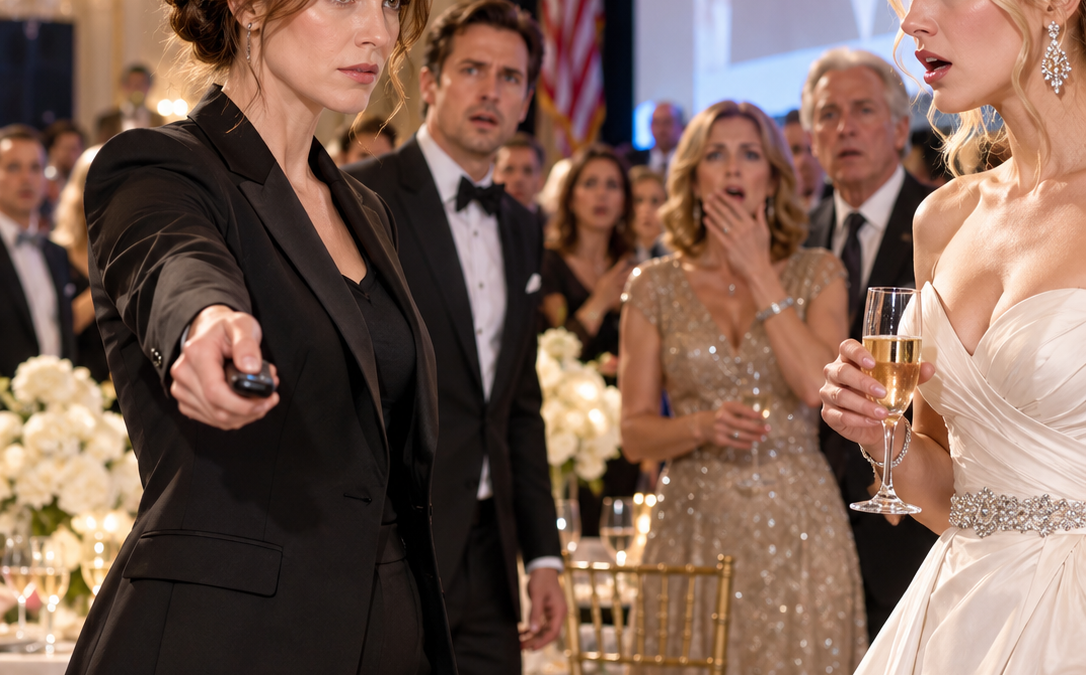
I pressed the Enter key on the wireless presentation remote in my hand.
The massive projector screen behind Blythe flickered.
The romantic engagement photographs disappeared.
In their place appeared the highlighted bank statements Cashin had provided, blown up to ten feet tall.
A collective gasp rippled through the ballroom.
The numbers were undeniable.
“Take a good look, everyone,” I said, my voice echoing off the crystal chandeliers. “That’s the GoFundMe account you all so kindly donated to.”
I gestured toward the screen.
“Notice the deposits. Twelve thousand dollars on Tuesday. Eight thousand dollars on Wednesday. Now look at the withdrawals.”
I clicked to the next slide, highlighting the spending column in bright red.
“Five thousand four hundred dollars at the Chanel boutique. Two thousand dollars at a luxury day spa. Three thousand dollars to the florist standing in the corner of this very room.”
I paused, allowing the silence to stretch until it became suffocating.
“Not one single dollar has gone to a hospital. Not one single dollar has gone to a pharmacy.”
I looked directly at Blythe.
“Every cent you donated to help a bleeding 11-year-old girl was stolen by the woman standing on that stage to pay for her shoes and her champagne.”
Pandemonium erupted in the ballroom.
People began whispering fiercely.
A woman near the front row covered her mouth in shock.
Blythe dropped her champagne flute.
It shattered against the stage floor.
She grabbed the microphone stand, her hands shaking violently.
“That’s a lie!” she screamed, her voice shrill with panic. “She hacked my account! She’s jealous! Sloan has always been insanely jealous of me!”
My mother rushed toward the stage, her face ghostly white.
“Sloan, stop this right now! Are you crazy? You’re ruining her night!”
I didn’t stop.
I stood ten feet from the stage, my face carved from stone.
“I have one more thing to share,” I said, “because stealing from an injured child is only half the story.”
The room began to quiet again.
“You all need to know exactly how my daughter ended up in an operating room.”
I pressed the final button on the remote.
The bank statements vanished.
The screen went black.
And then the crystal-clear audio from Mave’s smartwatch blared through the massive concert speakers.
“Yeah, I’m looking at the little brat right now. I’m so sick of Sloan acting like her life is so perfect. Her kid is just as annoying as she is.”
The voice was unmistakably Blythe’s.
“I’m going to teach her little brat a lesson. I’m going to make her fall neck-first.”
The venom, the malice, and the sheer cold-blooded calculation echoed off the walls.
Then came the footsteps.
The whispered warning.
“Watch out, little rat.”
The horrifying crash of glass.
Mave’s agonizing screams ripped through the audio track, filling the silent ballroom with the sound of pure childhood terror.
And finally, echoing above the screams of a bleeding child, came Blythe’s laughter.
When the recording ended, the silence was absolute.
It was the kind of silence that felt heavy, suffocating, almost violent.
Nobody moved.
Nobody breathed.
My parents stood frozen, their mouths hanging open, staring at the blank screen as though it had just announced the end of the world.
Aunt Vesper, standing near the buffet table, dropped her plate of food onto the floor.
Cashin stepped forward.
He didn’t yell.
He didn’t cause a scene.
He simply reached into his pocket, pulled out the velvet box containing the expensive diamond engagement ring, and placed it quietly on the edge of the stage, right at Blythe’s feet.
Then he turned his back on her, walked down the steps, and strode out of the ballroom without looking back.
Blythe fell to her knees.
Her pristine white silk gown pooled around her amid the shattered glass of her champagne flute.
Her heavy makeup ran down her face in dark streaks.
“It’s fake!” she sobbed hysterically, clawing at her hair. “It’s AI! She made it up! Don’t look at me!”
Suddenly, a tall, imposing figure stepped out from the crowd near the back.
It was Dr. Alaric.
I’d invited him, warning him exactly what was going to happen.
He walked forward, his posture rigid and commanding.
“I’m the orthopedic trauma surgeon who spent three hours repairing the severed tendons in that little girl’s arm,” he announced, his deep voice carrying easily across the stunned crowd.
“The injuries were consistent with a high-velocity fall onto shattered glass. It wasn’t a simple trip. And for the record, I’ve already forwarded a copy of those bank statements and the audio file to the local police department.”
He scanned the room.
“Wire fraud and child endangerment are not family matters. They’re felonies.”
The room erupted in murmurs of disgust.
Guests started turning away, setting down their drinks and grabbing their coats.
The party was over.
The illusion was dead.
My father, his face purple with rage and humiliation, marched toward me and pointed a shaking finger directly at my face.
“You’re sick!” he spat, his voice trembling. “You’re a sick, vindictive woman! Get out! Get out of this club, and don’t you ever, ever set foot in my house again! You’re dead to us!”
I looked at his shaking finger.
I looked at the man who had spent his entire life protecting a monster.
And I felt nothing but profound pity.
Then I smiled.
It was a small, cold, utterly victorious smile.
“That’s the problem, Dad,” I said softly, making sure the microphone captured every syllable.
“It’s not your house anymore.”
My father stared at me, his hand still suspended in the air, his index finger trembling.
The silence in the ballroom shifted from shocked anticipation to heavy, suffocating dread.
The remaining guests, those who hadn’t already scrambled for the exits, stood frozen in place, watching the destruction of the family they’d come to celebrate.
“What did you just say?” my father asked.
His voice was barely a whisper, all the bravado drained from his face.
I didn’t raise my voice.
I didn’t need to.
When you hold the winning hand, you don’t need to shout.
I reached into my sleek leather clutch and pulled out a thick, legal-sized envelope.
I walked forward and dropped it onto the table nearest the stage.
It struck the wood with a heavy, definitive thud.
“I said it’s not your house anymore, Dad,” I repeated, my tone as casual as if I were discussing the weather.
“At eight o’clock yesterday morning, Ironwood Holdings officially purchased the nonperforming debt on your property. Your $450,000 home equity line of credit. The one you haven’t made a payment on in four months. The one Blythe swore she was taking care of.”
My mother let out a small, strangled gasp.
She grabbed my father’s arm, her fingernails digging into his suit jacket.
“Theren,” she whimpered. “Theren, what is she talking about?”
I turned my gaze toward my mother, the woman who had spent my entire life telling me to make myself smaller so Blythe could shine.
“I’m talking about reality, Mom.”
I let the words hang between us.
“Ironwood Holdings is my company. I’m the sole owner. I own the paper on your house. I’m the primary lienholder. And because the loan is in severe default, I exercised my legal right of acceleration yesterday afternoon.”
I pointed toward the envelope on the table.
“Those are the formal eviction notices. You have exactly thirty days to vacate the premises. If you’re not out by the first of next month, I’ll have the sheriff’s department forcibly remove you and your belongings from the property.”
My father looked as though he’d been physically struck.
He stumbled backward, his knees buckling slightly, forcing him to lean heavily against the edge of the stage.
He looked from me to the envelope and then down at Blythe, who was still weeping on the floor in her ruined designer dress.
“Blythe,” my father choked out, his voice cracking with a terrifying vulnerability. “Tell me she’s lying. Tell me you paid the mortgage. Tell me you didn’t gamble away our home.”
Blythe couldn’t even look at him.
She buried her face in her hands, her shoulders shaking violently as she sobbed.
She had no defense left.
Her entire world, constructed from lies, stolen money, and toxic manipulation, had collapsed around her in the space of twenty minutes.
Aunt Vesper, who had been silent through the confrontation, finally found her voice.
“You can’t do this, Sloan!” she shrieked, rushing forward. “They’re your parents! They raised you! You’re throwing them out onto the street over money!”
I turned on my heel and fixed her with a glare so cold she physically recoiled.
“I’m not throwing them out over money, Vesper. I’m throwing them out because they chose to protect a monster who permanently mutilated my 11-year-old daughter.”
My voice remained steady.
“I’m throwing them out because they’d rather see Mave bleed than hold Blythe accountable. They made their choice. Now they get to live in it.”
I looked back at my parents.
They were broken.
The arrogant, dismissive people who had ordered me out of their sight only moments earlier were gone.
In their place stood a terrified, aging couple staring down the barrel of total financial ruin.
“Please, Sloan,” my mother begged, tears streaming down her face and ruining her expensive makeup. “Please, we didn’t know. We didn’t know she tripped Mave on purpose. We thought it was an accident.”
She struggled to catch her breath.
“We’ll do anything. We’ll force her to get help. We’ll pay you back. Just don’t take the house. It’s all we have left.”
I felt a brief, microscopic flicker of pity.
Then I extinguished it.
The image of Mave screaming on those concrete stairs burned bright in my mind.
“You don’t have the money to pay me back, Mom,” I said simply. “Blythe has $120,000 in credit card debt. She’s going to be facing felony wire fraud charges by Monday morning.”
I looked from my mother to my father.
“Your house is gone. Your reputation is gone. And your golden child is going to jail.”
I turned my back on them.
I walked over to Declan, who had been standing silently near the rear of the ballroom, watching the entire confrontation with a stoic, protective expression.
He reached for my hand.
His grip was warm, solid, and incredibly grounding.
“Let’s go home,” Declan said softly.
We walked out of the Oakridge Country Club side by side.
We didn’t look back at the chaos unfolding in the ballroom.
We passed through the massive oak doors and stepped into the cool, quiet night air.
The valet brought our reliable ten-year-old Honda around.
I slid into the passenger seat, resting my head against the cool glass of the window.
As we drove away from the country club, leaving the wreckage of my toxic family behind, I finally released a long, shuddering breath.
I’d won.
I’d taken back the power they’d stolen from me for 37 years.
But victory felt heavy.
It felt like walking out of a burning building. You survive, but you still have to smell the smoke.
The story of my family didn’t end with a dramatic shouting match in a parking lot.
It ended with the quiet, devastating realization that some people will burn down their own sanctuary just to keep a fake fire burning.
But I was no longer trapped in the flames.
Three months is a strange amount of time.
It’s long enough for a broken bone to knit itself together, but nowhere near long enough to heal a shattered family.
In the ninety days following the engagement party from hell, the dominoes fell exactly as I’d orchestrated.
My parents didn’t fight the eviction.
They had no money for lawyers, and the bank statements I’d exposed left them with zero legal standing.
They packed thirty years of memories into cardboard boxes and moved out of their spacious suburban home into a cramped two-bedroom apartment on the other side of the city.
Blythe’s downfall was swift and brutal.
Dr. Alaric kept his word.
The police launched a full investigation into the GoFundMe campaign.
When confronted with subpoenaed bank records and the audio recording of the incident, Blythe cracked during her first interrogation.
She was charged with felony wire fraud and reckless endangerment of a minor.
Her internet presence vanished almost overnight.
Her sponsors dropped her.
Her followers turned against her, flooding her remaining social media pages with furious comments before she finally deactivated everything.
She avoided prison time only because it was her first offense, accepting a plea deal that resulted in five years of strict probation, mandatory psychiatric counseling, and an order to pay full restitution to the donors she’d scammed.
She was working shifts at a local grocery store to make ends meet, living in the second bedroom of our parents’ tiny apartment.
The luxury lifestyle coach was gone, replaced by a ghost haunting the aisles of a supermarket.
I didn’t witness any of this firsthand.
I heard about it through the grapevine, through distant relatives who occasionally tried to reach out before realizing my silence was permanent.
I’d changed my phone number.
I’d blocked their email addresses.
My house was a fortress, and they were permanently exiled.
Until a rainy Tuesday afternoon in November.
I was sitting in my corner office, reviewing a quarterly logistics report, when my receptionist buzzed my intercom.
“Miss Sloan, I’m so sorry to interrupt, but there’s a woman down here who insists on seeing you. She says she’s your mother. She doesn’t have an appointment, and she’s crying.”
I set my pen down.
The quiet hum of city traffic outside my window suddenly seemed amplified.
“Send her up,” I said.
A few minutes later, the heavy glass door to my office clicked open.
My mother walked in.
I almost didn’t recognize her.
The polished, immaculately dressed woman who used to host lavish dinner parties was gone.
She looked ten years older.
Her hair was pulled back in a messy clip. Her coat was damp from the rain, and the dark circles beneath her eyes spoke of endless sleepless nights.
She stood just inside the doorway, looking around my massive, sleek office with a mixture of awe and profound intimidation.
She’d never visited my workplace before.
She’d never cared enough to see what I’d built.
“Sloan,” she whispered, her voice trembling.
I didn’t stand.
I didn’t offer her a chair.
I sat behind my heavy mahogany desk, my hands folded perfectly still.
“Why are you here, Mom?”
She took a hesitant step forward, clutching her purse against her chest like a shield.
“I wanted to see you. I needed to see you. We miss you so much. Your father… his blood pressure has been terrible. He asks about you every day.”
I stared at her, my expression unreadable.
“You don’t miss me. You miss the peace I used to provide. You miss having someone to clean up the messes.”
Tears immediately spilled over her lower lashes.
“No, Sloan, that’s not true. We were wrong. We were so, so wrong. I see it now. I see what Blythe is.”
Her voice broke.
“Living with her in that tiny apartment is a nightmare. She blames us for everything. She screams at your father. We lost our home. We lost our friends. We lost you.”
She took a shaky breath and stepped closer to the desk.
“I came to beg for your forgiveness. Please, I’m your mother. You can’t cut us out forever.”
I remained silent.
“Thanksgiving is next week,” she continued. “Please, just let us come over for an hour. Let us see Mave. We just want to see our granddaughter.”
The mention of Mave’s name sent a spike of pure, protective fury through my chest.
“Forgiveness isn’t a receipt you can use to buy back your access, Mom,” I said, my voice dropping to a dangerous, quiet register. “You don’t get to cash in your tears for a seat at my dinner table.”
“Sloan, please,” she sobbed.
I stood, resting both hands on the desk as I leaned forward.
“Where were these tears when Mave was bleeding on the concrete? Where was this desperation when Blythe was laughing at my child’s agony?”
My mother’s face crumpled.
“You stood in that hospital waiting room and told me not to call the police because it would ruin Blythe’s brand. You chose your side.”
I pointed toward the glass door.
“Mave is still going to physical therapy three times a week. She cries when she tries to hold a paintbrush. She flinches every time she hears a loud noise.”
I felt my throat tighten, but I didn’t let my voice waver.
“I spend my evenings holding my daughter while she mourns the childhood your golden child stole from her.”
I looked directly into my mother’s eyes.
“You don’t get to see her. You will never see her again.”
My mother let out a devastated wail, burying her face in her hands.
She stood in the center of my office, a broken shell of a woman, weeping for a family she’d destroyed with her own enabling hands.
I walked to the door and opened it.
“Goodbye, Mom.”
She looked at me one last time, searching my face for some trace of the compliant, desperate-to-please daughter she used to know.
But there was nothing there.
She turned and walked out, her shoulders slumped, disappearing down the hallway.
I closed the door, returned to my desk, and went back to work.
That evening, I went home to the sanctuary I’d built.
The house was warm and smelled of roasting garlic and fresh bread.
Declan was in the living room, sitting cross-legged on the rug with Mave.
They were doing her exercises.
Mave’s heavy cast had been removed a month earlier and replaced by a sleek, custom brace.
Her right arm was marked by a thick, jagged pink scar running from her elbow toward her wrist.
“Okay,” Declan said gently, holding out a small, squishy red therapy ball. “Squeeze it for five seconds. Ready? Go.”
Mave focused intently on the ball.
She reached out with her right hand, her fingers trembling slightly.
Slowly, she closed her hand around the ball and squeezed.
Her face tightened with effort, and a tiny bead of sweat formed on her forehead.
“One, two, three, four, five,” Declan counted. “Release.”
Mave let go and blew out a long breath.
She looked up at him, a genuine, tired smile spreading across her face.
“I did it. It didn’t hurt as much today.”
Declan beamed, leaning forward to kiss her forehead.
“You’re a warrior, Mave. I’m so proud of you.”
I stood in the doorway, watching them.
The bitter taste of my mother’s visit washed away, replaced by an overwhelming sense of gratitude.
This was my family.
This was real love.
It wasn’t built on fake Instagram posts or expensive handbags.
It was built on patience, resilience, and showing up for each other when the world fell apart.
Life moves forward, even when the past tries to drag you backward.
Winter gave way to spring, and with the changing seasons came a quiet, profound healing in our home.
Mave’s recovery was slow, grueling, and marked by small victories.
The day she successfully tied her own shoes without asking for help, Declan and I celebrated as though she’d just won an Olympic gold medal.
She started sketching again.
She couldn’t use her right hand with the same precision she’d once had, so she stubbornly taught herself to draw with her left.
Her art changed.
It became abstract, messy, and incredibly beautiful.
The jagged lines told the story of a girl who refused to be broken.
As for the house, the suburban fortress my parents had cherished for thirty years, I never set foot inside it again.
Ironwood Holdings took full possession of the property.
I hired a real estate agent to clean it out, stage it, and put it on the market.
It sold in less than two weeks for significantly more than the mortgage value.
I didn’t keep the money.
I took the entire $450,000 from the sale and established a charitable trust.
I named it the Mave Foundation.
The trust provides direct financial assistance to families whose children require emergency physical therapy and reconstructive surgery following domestic accidents or abuse.
I took the toxic legacy of my parents’ enabling behavior and turned it into a shield for children who actually needed protection.
The irony wasn’t lost on me.
The wealth my family had always assumed I lacked was the very thing that dismantled them and built something beautiful in their wake.
Real wealth isn’t a designer label.
Real wealth is having the power to walk away from toxic people and never having to look back.
Real wealth is the freedom to protect the people you love.
We settled into a new rhythm, a life completely free of the chaotic, draining drama that used to define my existence.
I no longer spent my Sundays dreading dinner at my parents’ house.
I no longer had to bite my tongue while my sister insulted me.
My shadow had vanished.
I was finally standing in the sun.
But family ties, no matter how toxic, are like deep roots.
They’re difficult to pull out entirely.
Yesterday morning, I walked out to the mailbox and found a thick, heavy envelope sitting inside.
There was no return address, but I recognized the erratic, shaky handwriting immediately.
It was from my father.
I carried it inside and sat at the kitchen island with a cup of coffee.
For a long time, I simply stared at the envelope.
Then I picked up a knife and sliced it open.
Inside was a letter ten pages long, written on cheap notebook paper.
I read it in silence.
It was a desperate, rambling plea.
My father detailed the misery of their current life.
He wrote about Blythe’s erratic behavior, how she blamed them for her downfall, and how the apartment felt like a prison.
He wrote about my mother’s failing health and his own crushing regrets.
But the heart of the letter, the reason he’d spent hours writing those ten pages, was buried in the final paragraph.
We have officially kicked Blythe out of the apartment.
We couldn’t take the screaming anymore. She’s staying on a friend’s couch somewhere. We’re finally done with her.
Sloan, we see the truth now. We cut the cancer out.
Now we’re begging you. Please. Thanksgiving is coming up. We’re old. We’re tired. And we just want to see our granddaughter.
We want to apologize to Mave in person.
Just give us one hour. One chance to prove we’ve changed.
I sat in the quiet kitchen, the letter resting on the granite counter.
Declan walked in a few minutes later and noticed the pages.
He picked them up and scanned the final paragraph.
Then he sighed, rubbing the back of his neck.
“What are you going to do?” he asked quietly.
I picked up all ten pages, aligned their edges perfectly, and walked over to the paper shredder tucked into the corner of our home office.
I fed the letter into the machine.
I listened to the satisfying hum as my father’s desperate pleas were reduced to tiny, illegible strips of confetti.
“I’m going to make a turkey,” I said, looking back at Declan. “And we’re going to have a quiet, peaceful dinner with our daughter.”
Declan smiled, a soft, relieved expression washing over his face.
“Good call.”
I don’t regret my decision.
I don’t lose sleep over my parents living in a cramped apartment.
I protected my child, and I severed a disease that would eventually have infected my own home.
But sometimes, in the quiet moments of the night, a tiny voice whispers in the back of my mind.
It’s the voice of the old Sloan, the sister who just wanted to keep the peace.
It makes me wonder about the future, about the permanence of the walls I’ve built.
My parents claim they’ve banished Blythe.
They claim they’ve finally seen the light.
They’re elderly. They’re broken.
And they’re begging for a single hour to apologize to the granddaughter they failed.
So I’m turning to you, the people who have listened to my story.
I need you to be my jury.
Am I wrong?
Am I letting my own anger blind me to the possibility of genuine change?
If they’ve truly cut Blythe out of their lives, if they’re willing to grovel for a single hour of our time, am I wrong to deny them a second chance?
Will Mave grow up and resent me for permanently erasing her grandparents from her life?
Or is keeping that door permanently bolted shut the only way to ensure the monster never finds a way back in?
Tell me what you think.
Thank you so much for listening to my story. If this resonated with you, or if you’ve ever had to make the agonizing choice to cut toxic family members out of your life, please share your thoughts in the comments below.
Don’t forget to hit the Like button and subscribe to the channel for more stories. Your support means the world, and it helps this community grow.
Until next time, stay strong and protect your peace.








