“My husband’s a cop, he’ll beat you up,” my neighbor screamed, then dumped lemonade on my 8-year-old over a $2 cup—so I did something that made her spiral for days.
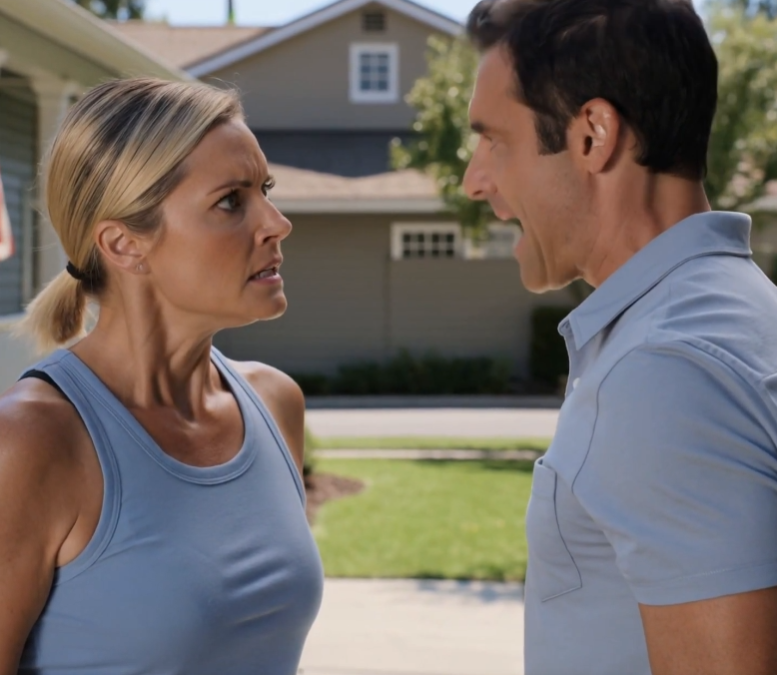
“My husband’s a cop. He’ll beat you up.”
My neighbor screamed that, then dumped lemonade on my eight-year-old over a two-dollar cup.
So I did something that made her spiral for days.
Hey, Reddit. My neighbor said her husband would make my life hell. All I did was let her make her own life hell first—and document every second of it.
I’m a thirty-eight-year-old guy who owns a small plumbing operation in a suburb outside Portland. My son, Nolan, is eight years old and has the energy of a border collie that just discovered espresso.
The kid never stops moving. Never stops asking questions. Never stops calculating how every situation can somehow benefit him financially.
I don’t know where he gets it, because I spent most of my twenties trying to figure out which end of a wrench was the business end.
On the second Saturday of June, Nolan walked into the kitchen and hit me with a business proposal. He used those exact words.
He’d watched some kid on YouTube clear a hundred bucks in a weekend selling lemonade, and now he wanted in. He’d written the whole plan on notebook paper with a crayon that was running out of wax. Half the letters were just dents in the paper.
Two bucks a cup at the end of our driveway. Profits going toward new Beyblades because the ones he had were “mid.”
His word.
I said yes. Obviously. What kind of dad says no to that?
His profit margins assumed zero cost on lemons, which I was apparently expected to bankroll as an angel investor, but the enthusiasm was worth every cent.
We spent Friday night building the stand: a folding table from the garage, a piece of plywood I painted with leftover deck stain, and a cooler full of ice.
NOLAN’S LEGENDARY LEMONADE was written in wobbly block letters across the front.
He insisted on squeezing every lemon himself, which took four times longer than necessary, but the kid was committed.
Saturday morning, we set up at 8:30.
Nolan wore a backward cap and a shirt that said BOSS on it, a joke gift from his aunt that he’d adopted as a permanent lifestyle choice. He positioned himself behind the table like a general surveying the field, with his pricing on a sticky note taped to the cooler.
$2. No negotiating.
The kid had already decided he wasn’t running a charity.
He’d made a customer log in a composition notebook. Every sale got a timestamp and a tally mark, like he was running inventory for a warehouse instead of a card table with lemons on it.
By noon, he’d sold fourteen cups, and the neighborhood was treating him like a local celebrity. People stopped by just because the kid was radiating pure, uncut enthusiasm.
He was making change out of a Ziploc bag of ones and quarters I’d provided as startup capital. A guy walking his dog told Nolan he should be on Yelp.
Nolan didn’t know what Yelp was, but he said, “Thank you, sir. I appreciate the exposure.”
It was something he’d memorized from a YouTube video about marketing and had apparently been waiting for the exact right moment to deploy.
That was also when the first correction happened.
After his fourteenth sale, Nolan leaned back in his chair, crossed his arms, and said loudly enough for a passing couple to hear, “Two bucks is honestly kind of cheap for what I’m offering.”
I leaned over from the porch.
“It’s lemon juice and sugar, man. You didn’t invent it.”
“Yeah, but my version hits different.”
“Your version is the same recipe everybody’s grandma uses. Stay humble or I’m pulling the plug.”
He uncrossed his arms real fast.
“I’m humble. I’m very humble.”
Then, quieter, “But it does hit different, though.”
Eight years old. Already needed ego management.
But the kid was polite. He looked people in the eye. He made change correctly. And he said thank you every single time.
Everything I’d spent years teaching him was showing up in real time.
I sat on the porch and watched him work and felt something I don’t really have a word for.
Pride doesn’t quite cover it.
Then Tanya showed up.
Tanya lived four houses down. Mid-forties. Bleached hair that always looked one bad decision away from snapping off entirely. Real estate agent. White Lexus SUV. Vice president of the HOA. Nextdoor account with more posts than a town crier.
She had opinions about everything.
The length of your grass. The color of your mailbox. Whether your existence was up to her standards.
Her daughter, Payton, was nine. Quiet, a little awkward, always standing slightly behind her mom like she was waiting for instructions.
I always felt bad for Payton.
Good kid stuck in the orbit of a woman who treated every social interaction like a campaign stop.
Tanya walked up to Nolan’s stand around one in the afternoon, Payton trailing behind her.
Payton drank a cup, smiled, and said it was good.
Nolan beamed.
Tanya said nothing. She just watched Payton finish, then turned and walked back toward her house without a word.
Cold, but Tanya ran cold by default.
I thought that was the end of it.
I was wrong.
Three hours later, she was back.
She wasn’t browsing this time. She was on a mission, marching up the sidewalk like she was leading a battalion. Payton half-jogged behind her, looking confused.
Nolan was counting his money—thirty-eight bucks, which he was losing his mind about—and looked up with that wide-open kid face that hasn’t learned to read danger yet.
“Your lemonade made my daughter sick,” Tanya said.
Not a question. Not a concern.
A declaration.
Loud enough that the neighbors across the street looked up from their garden and the couple walking their dog stopped moving.
I was on the porch about twenty feet back. I stood up and walked over.
Didn’t rush.
“What do you mean, sick?”
“Stomach cramps since she drank that.”
She pointed at the cooler like it was a biohazard.
“What did you put in it?”
“Lemons, sugar, water. Same recipe since roughly forever.”
She didn’t like that.
She picked up one of Nolan’s paper cups, sniffed it like a sommelier rejecting a wine, and dumped it slowly onto the sidewalk.
“Something in there isn’t right. You can’t just sell food to children without any kind of oversight.”
Nolan froze and looked at me.
I gave him a small nod.
Stay calm. I got this.
“Tanya, kids get stomachaches. It’s ninety degrees. She probably had three popsicles before she got here.”
Tanya’s face went tight.
Then she reached for the pitcher.
The half-full one sitting in the center of Nolan’s table.
She grabbed the handle and started pulling it toward herself, and I could see exactly where this was going.
She was going to dump it on the stand. On Nolan’s money. On the sign he’d painted.
On my kid.
I stepped forward, got my hand on the pitcher at the same time she did, and pulled it back toward me.
She yanked harder.
I held firm.
Then she leaned forward across the table, practically lunging into Nolan’s space with her chest against the edge, and I did the only thing that made sense in that half second.
I tilted the pitcher and let gravity do the rest.
Over Tanya.
All of it.
Down her blouse, across her white capris, pooling in her sandals.
Three cups’ worth of lemonade, gravity-assisted, delivered with the precision of someone who works with pipe fittings for a living.
The entire street went dead silent.
Payton’s mouth was open.
Nolan looked like he’d just watched a nature documentary come to life.
The couple across the street were frozen mid-crouch over their garden bed.
Tanya stood there dripping.
Sticky. Sweet. Furious.
“You just—you just poured that on me,” she sputtered.
“You grabbed my kid’s property and tried to destroy it,” I said. “I pulled it back. It spilled. Unfortunate.”
“That is not what happened.”
“Ring doorbell’s been recording since six this morning.”
I pointed at the camera above the front door.
“We can let the footage sort it out.”
That landed.
Her face cycled through about five emotions in two seconds. Rage. Confusion. Something close to fear.
But she buried it fast.
“My husband is a police officer,” she said, her voice shaking. “You have no idea what you just started.”
“Tell him I said hi.”
She grabbed Payton’s arm and stormed off, lemonade dripping off her elbows the whole way home.
Payton looked back once with a face that said she already knew her mom had just lost something she couldn’t get back.
I looked at Nolan.
He was staring at the empty pitcher with a mournful expression that had nothing to do with the confrontation and everything to do with inventory.
“Dad, that was like four dollars’ worth of lemonade.”
“I know, bud.”
“Can we write that off as a business expense?”
Eight years old.
Kid processes trauma through profit-and-loss statements.
I downloaded the Ring footage that night and watched it twice.
The grab for the pitcher. The lean across the table toward Nolan. The spill.
On camera, it looked exactly like what it was: a grown woman trying to destroy a kid’s stand and a dad pulling his property back.
The lemonade going all over her was a consequence of physics.
Nothing more.
I backed the footage up three ways.
Laptop. Cloud. And a USB drive I handed to my buddy Reggie the next morning.
“Is this about the lemon lady?” he asked.
Apparently, a neighbor’s Facebook post had already made the rounds.
I started a file.
Yellow legal pad. Date. Time. Exact quotes. What everyone was wearing. Angle of the Ring camera. Everything.
Twelve years of running a business teaches you one thing above all else.
Documentation isn’t paranoia.
It’s preparation.
Two Saturdays later, Nolan wanted to run the stand again.
Same setup. Same recipe. Same spot.
I let him.
Except now, four houses down, Payton had a lemonade stand too.
I am not making this up.
Tanya had built Payton a full Pinterest operation. Matching tablecloth. Canva banner. Mason jar dispensers. Chalkboard sign listing flavors: strawberry, lavender, classic.
Priced at $1.50 a cup.
She had undercut an eight-year-old by fifty cents.
A forty-five-year-old real estate agent with a white Lexus and a graphic design subscription was engaging in a price war with a third grader selling lemonade out of a Costco cooler.
This was the timeline we were living in.
But she didn’t stop at competition.
She weaponized the sick-kid story.
Over that first week, Tanya launched a one-woman smear campaign. She told parents at school pickup. Posted on the neighborhood Facebook group without naming names, but with enough detail that everyone knew.
She even told the crossing guard Nolan’s lemonade had made Payton violently ill.
And it worked.
That second Saturday, Nolan sold nine cups.
The following Saturday was worse.
Six families walked past without stopping.
Moms who’d bought cups three weeks ago crossed to the other side of the street.
One dad came up, looked at the stand, said, “Oh, this is that one,” and kept walking.
Nolan heard him.
He sat there updating his customer log with big gaps between entries, pretending it didn’t bother him.
Down the street, Tanya was personally waving people toward Payton’s stand like a car-dealership inflatable tube man in a Lilly Pulitzer dress.
Nolan looked at me with an expression that was way too world-weary for a third grader.
“That’s not fair.”
“It’s not. But here’s what I’ve learned about fair. It doesn’t always show up on time. Sometimes it takes a while. But we’re not going to sit here feeling sorry for ourselves.”
He looked at me.
“We’re going to be better.”
We hit Costco that afternoon and came back loaded.
Clear cups with dome lids and straws. Fresh mint. Frozen strawberries. Extra lemons.
We spent three hours developing what Nolan called “the new menu.”
Classic over crushed ice.
Strawberry mint.
Nolan’s invention tasted like summer in a cup.
And the nuclear option: extra sour, double lemon, and a pinch of salt that made your face involuntarily pucker.
Nolan named it, taste-tested it, and approved it with a dead-serious nod like a chef on a competition show.
We raised the price to $2.50 and added a loyalty card.
Buy five, get one free.
Printed on cardstock, hole-punched by Nolan because he said it looked more official.
He wasn’t wrong.
Then came the petty move.
I sat down one night after Nolan went to bed and designed what I can only describe as the most professionally unnecessary document in the history of children’s beverages.
I called it the Nolan’s Legendary Lemonade Official Compliance Sheet.
Laminated.
Mounted on cardboard.
Zip-tied to the front of the stand.
It listed a seasonal vendor permit number—once I got it. More on that in a second.
Full ingredient disclosure: lemons, sugar, water, ice.
That’s it.
Hand sanitizer station present and operational.
Last health department inspection result: no violations found.
Customer satisfaction rating: 5.0 stars based on twenty-nine verified transactions.
And at the very bottom, in small professional italics:
This stand is not FDA approved. Neither is your aunt’s potato salad, but nobody’s filing complaints about that.
I also pulled an actual seasonal vendor permit from the city.
Forty-five bucks. Basic application. Approved in three business days.
Completely unnecessary for a kid’s lemonade stand, like putting a racing stripe on a tricycle.
But now it was laminated and mounted right next to the compliance sheet.
Nolan thought the compliance sheet was the greatest thing ever created.
He started telling customers about it unprompted.
“We’re fully permitted and compliant,” he’d say, pointing at the laminated cards like he was pitching investors.
Then he’d lean in and whisper, “Our competitor down the street is not.”
I had to pull him aside.
“Hey, we don’t trash-talk a nine-year-old’s stand. Payton’s not the problem.”
“I didn’t say Payton. I said competitor.”
“Nolan.”
“Fine. But I’m still pointing at the compliance sheet.”
The kid was getting a little too comfortable with winning.
But I let the compliance sheet stay because—and I cannot stress this enough—it was doing exactly what I designed it to do.
It made Nolan’s stand look like a certified operation.
And it made Tanya’s Pinterest setup look like exactly what it was.
An ego project dressed up as a child’s business.
The next Saturday, Nolan’s stand opened with a menu board, a tip jar, the compliance sheet, the laminated permit, and a cooler that looked like it belonged at a farmers market.
The sick-kid rumor had started dying under the weight of zero evidence and the counter-testimony of Payton herself, who’d been overheard at school telling a friend, “I wasn’t even sick. My mom just said that.”
Kids are terrible secret keepers.
Nolan sold thirty-one cups.
The following weekend, forty-two.
The nuclear option was the top seller.
Down the street, Payton’s stand had dried up.
Tanya’s approach was all presentation and zero soul.
Payton was running someone else’s business plan. And once the pity angle stopped working, so did the traffic.
Payton had been spotted riding her bike looking relieved, which told you everything about whose dream that stand had actually been.
The compliance sheet drove Tanya insane.
I know because a neighbor told me Tanya had been photographing it and texting people about how smug it was.
She called the HOA.
She called the city clerk.
She called the county health department.
An inspector showed up, looked at Nolan squeezing lemons into a pitcher, looked at the hand sanitizer, looked at the laminated permit, and said, “This is the complaint?”
He bought a nuclear option on his way out.
Nolan charged full price.
The following Monday, I got a formal email from the HOA requesting that I cease all activity pending a review at the next board meeting.
CC’d to the full board.
Subject line: UNPERMITTED COMMERCIAL ACTIVITY — RESIDENT COMPLAINT.
Three guesses who filed it.
First two don’t count.
I called the city clerk’s office the same day.
The woman who answered actually laughed.
She emailed me the city’s official guidance on residential sales by minors, which basically said a kid’s stand was fine as long as it wasn’t blocking sidewalks, selling cooked food, or turning into a weekend farmers market.
I forwarded that email to the full HOA board and politely asked if they’d like to send the same guidance to Tanya regarding her undocumented copycat setup, which had been running without so much as a sticky note of authorization.
I’m a contractor.
I deal with permit offices and compliance departments every week.
Tanya had brought a passive-aggressive email to a regulatory-warfare fight.
The HOA dropped it within forty-eight hours.
The president, a retired guy who mostly just wanted to fish and watch Jeopardy! in peace, sent me a private email.
“Between us, we know who filed that. Sorry for the hassle. Your boy makes a damn good lemonade, by the way.”
Tuesday evening, there was a knock at my door.
Derek.
Tanya’s husband.
County sheriff’s department. Patrol division.
Civilian clothes. Jeans. Polo. Tired eyes.
Dude looked like every year of that marriage had aged him double.
I stepped outside and closed the door behind me.
Nolan was in his room playing video games. I didn’t want him hearing this.
“I’m Derek. Tanya’s husband.”
“I know who you are.”
He sighed.
Not a threatening sigh at first. More rehearsed, like he’d practiced this in the truck on the way over.
“Look, she gets heated sometimes. I think this whole situation got out of hand, and it’d be best for everybody if we just let it settle down. You know how neighborhoods work.”
“If we just what, Derek?”
His tone shifted.
Subtle, but deliberate.
The way someone applies pressure and pretends they’re not.
“I’m just saying. Permits get looked at. Complaints have a way of sticking around. Things get complicated when people push too hard on stuff like this. Nobody wants that.”
From somewhere behind him—their house, four doors down—I could hear Tanya’s voice carrying through the evening air.
Muffled, but unmistakable.
She was on their front porch, phone to her ear, loud enough that Derek’s jaw tightened when the sound reached us.
Something about, “Tell him what happens if he doesn’t drop it.”
I let Derek’s words hang in the air for a beat.
Then I said, “Derek, your wife tried to destroy my kid’s stand on camera. She’s been running a slander campaign against an eight-year-old. She threatened me with your badge, and I’ve documented every single piece of it. Footage. Dates. Exact quotes. Everything. It’s backed up in three places, one of which is not in this house.”
Derek’s entire demeanor changed like somebody hit a switch.
The veiled pressure disappeared, and suddenly he was choosing every word like a man who had just remembered his training on recorded statements.
“I never told her to say any of that,” he said carefully.
“That’s between you and her. But the police report stays. The footage stays. And if she comes near my son again, I’m filing for a restraining order.”
He stood there for a long time, processing.
Then, quietly, “What would it take to make this go away?”
“It’s not going away, Derek. It’s going on the record.”
He nodded slowly.
Didn’t argue.
Walked back to his truck and sat in the driver’s seat for a good thirty seconds before starting the engine, just staring at his steering wheel like a man running through every decision that had gotten him to this exact parking spot in life.
Derek wasn’t at the end of his rope.
He’d been past the end for a while and was just free-falling.
Not my problem.
My problem was his wife.
Nolan had cleared more than a hundred and twenty bucks and was already talking about expanding into cookies and, in his words, “Maybe a rewards app if you can figure out the technology.”
“Dad,” I told him, “focus on operations before scaling.”
“That’s what I’m doing. This is phase two.”
I don’t know where he learns these phrases.
Tanya was still swinging.
Nextdoor thread: UNSANITARY FOOD VENDORS IN OUR NEIGHBORHOOD. SHOULD WE BE CONCERNED?
The retired firefighter down the street responded, “Lady, it’s a kid selling lemonade. Relax.”
Forty-seven likes.
Tanya’s post got two.
One was her own account.
Noise complaints.
Fake vehicle reports.
A burner account.
A one-star review on my business’s Google page that said I’d flooded a kitchen and refused to pay for damages, which was interesting because I’d never worked at the address listed.
All of it came back unfounded or got removed.
Then she escalated to my livelihood.
And that’s when I stopped being patient.
She called three of my clients, got their information from the lettering on my truck, and told them she was a concerned neighbor reporting safety violations at my company.
One client panicked and put a hold on a six-thousand-dollar bathroom remodel.
I spent half a day driving across town, sitting in their kitchen, showing them my license, my insurance, my bonding, and my inspection record.
I said calmly, “If you want this person’s name, I’ll give it to your attorney.”
They unfroze the job by the end of the day.
But that was three hundred and sixty dollars in labor I ate because Tanya decided to weaponize gossip against my income.
That crossed a line I don’t let anyone cross.
She wasn’t messing with a lemonade stand anymore.
She was messing with my mortgage.
Then she crossed the other line.
It was a Saturday in late July.
Portland hit ninety-four degrees.
Nolan’s stand was packed.
He’d sold twenty-two cups by early afternoon and was getting a little too comfortable with success.
He’d started telling people the nuclear option was “not for beginners” and that his operation was “basically the only permitted stand on the street.”
Technically true.
But delivered with the energy of a kid who needed to be humbled.
A mom from the next block asked for a recommendation.
Nolan actually said, “Depends on your palate.”
I almost got up right there.
Then he told a dad who asked if he could get a cup for $1.75, “We don’t do discounts. This is a premium product.”
I called him over.
“Nolan, you’re selling lemonade out of a Costco cooler, not running a Michelin-star restaurant. Be grateful people are coming. Be nice about it.”
“I am nice.”
“You just told a grown man your lemonade is premium.”
“It is, though.”
“Nolan.”
He looked at his shoes.
“Fine. I’ll be more humble.”
He went back to the stand and offered the next customer a free sample with a smile.
Good kid underneath the CEO energy.
Just needed guardrails sometimes.
I was on the porch when Tanya came down the sidewalk alone this time.
No Payton.
No pretense.
She walked straight to Nolan’s table and, without a word, picked up his tip jar—about eleven bucks in it—and dumped the coins onto the ground.
Nolan scrambled off his chair to pick them up.
Then she grabbed a lemon from his supply bag and threw it at my kid.
It hit Nolan in the chest.
Not hard enough to injure him.
Hard enough to leave a wet mark on his shirt and shock him into silence.
He stood there dripping, a lemon rolling at his feet, and for two full seconds the entire block went quiet.
I was already moving.
I got between them in three steps and looked at Tanya with the kind of calm people mistake for composure but is actually the last breath before something irreversible happens.
“You just assaulted my eight-year-old,” I said. “On camera. Again.”
“It was a lemon,” she said.
“It was a lemon you threw at a minor. And I have every second of it.”
Tanya’s face flickered.
She turned and walked away without a parting shot.
Even she knew she’d gone somewhere she couldn’t come back from.
I knelt beside Nolan.
He was fighting tears, but holding it together because he’s tougher than any eight-year-old should need to be.
Money scattered in the grass. Lemon juice on his shirt. His sign still standing.
But the kid behind it looked smaller than he had five minutes earlier.
“Why does she keep doing that?” he asked.
“Because some people are mad at the world, and they take it out on whoever’s closest.”
I looked him in the eye.
“That’s not your fault. Not even a little.”
We cleaned up and went inside.
I downloaded the new footage.
Watched the lemon hit his chest three times.
Then I sat at the kitchen table and added everything to the file.
Every incident. Every recording. Every quote.
Organized in the most devastating order I could manage.
Nolan came into the kitchen while I was writing, wearing a changed shirt. He watched me for a second.
“Are you going to get her in trouble?”
“I’m going to make sure she can’t do this to you or anyone else.”
He thought about it.
“Okay. Can I have mac and cheese?”
That kid is unbreakable.
I filed a formal complaint with the county sheriff’s department—not against Derek specifically, but about his wife repeatedly using his badge to intimidate people.
I cited the voicemail Tanya had left me the previous month.
Two minutes starting with, “You think you’re so clever,” and ending with, “Derek is going to make your life a living hell.”
I cited the grocery-store parking-lot recording where she’d cornered me, called me a bad father, and said Derek had friends in the department who could make things difficult.
I cited every incident where she’d invoked his badge as a threat.
Every sentence factual.
Every claim documented.
Just the facts arranged to do maximum structural damage.
That complaint landed on an internal affairs desk on a Friday afternoon.
By Monday morning, Derek had been called in for a conversation with his supervisor.
I know because Derek showed up at my door again.
Same tired eyes.
But this time he looked broken, like wreckage he’d been trying to hold together for years had finally given way under its own weight.
“I need you to understand,” he said. “I never threatened you. I never told her to say those things. I didn’t know about the voicemails until the department played them for me.”
“I believe you,” I said.
And I meant it.
Derek’s problem wasn’t malice.
It was cowardice.
He’d spent years letting Tanya throw his badge around because it was easier than telling her to stop.
He never explicitly threatened anyone.
He just never told her she couldn’t use his name as a weapon.
And there’s a word for that kind of silence.
“But she said them,” I continued. “Multiple times. On record. And your department needs to know, because if she does it to someone else and there’s no paper trail, that’s on everyone who stayed quiet.”
Long pause.
Then Derek said, “She’s going to lose it when she finds out about the review.”
“Not my problem, Derek.”
“I know.”
Another pause.
“I’m filing for separation.”
I didn’t respond to that.
Nothing to say.
The man had been drowning for years.
Tanya was the anchor.
Two weeks later, there was a moving truck in front of their house.
Derek and Payton were loading boxes.
Tanya was nowhere in sight.
Derek moved Payton into an apartment closer to his station.
Filed for divorce the same week.
Tanya was alone in that house and spiraling.
Fourteen-paragraph Nextdoor rant about “toxic masculinity in our community.”
So obviously about me that six people reported it.
Taken down.
Reposted.
Taken down again.
Then a shorter version accusing the moderators of silencing women’s voices.
Also removed.
She showed up at the September HOA meeting and tried to get my permit revoked.
The president shut her down in front of the room.
“That permit was issued by the city. We have zero authority over it. You’d have more luck revoking his driver’s license.”
Three board members visibly tried not to laugh.
Then Tanya lost a listing.
A big one.
Four-bedroom house in the nicest part of the neighborhood.
The kind that makes a suburban agent’s entire quarter.
The sellers fired her after she showed up twenty minutes late and visibly agitated, then got into a phone argument in the driveway while the buyers were touring inside.
Her managing broker gave her a formal written warning.
One more incident and she’d be looking for a new brokerage.
Everything she touched turned to ash.
And every bit of it was self-inflicted.
I just documented what she did, responded proportionally, and let her own behavior do the heavy lifting.
In October, the stand packed up for the season.
Nolan made $312 over the summer, which he split between his Beyblade fund and a savings account I helped him open at the credit union.
He told the teller he was “reinvesting in next season.”
She almost cried.
Then a letter came from the county courthouse.
Tanya had filed a small claims suit.
Two thousand dollars.
Emotional distress. Property damage. Harassment.
The woman who threw a lemon at my kid, left threatening voicemails, weaponized a badge, called my clients, and filed false complaints everywhere she could think of was suing me for harassment.
She showed up in a blazer and heels looking ready to list a colonial, carrying a folder of printed emails and screenshots, most of which were her own Nextdoor posts somehow reframed as evidence of my campaign against her.
The judge listened to Tanya for about six minutes.
She talked about feeling targeted.
Feeling unsafe.
She described Nolan’s stand as a public nuisance, but she couldn’t produce a single citation or health department finding.
She tried to submit screenshots of the compliance sheet as evidence of my mocking and hostile behavior.
The judge looked at the compliance-sheet photo.
Read the potato-salad line.
And I swear I saw the corner of her mouth move.
The only official document related to the stand was my permit, which actively undermined Tanya’s case.
Then it was my turn.
Chronological.
No emotion.
No editorializing.
Facts in order.
The same way I present project timelines to clients looking for reasons to dispute an invoice.
Ring footage on a tablet.
The judge watched the lemon hit my son’s chest.
Watched it twice.
I played the voicemail.
Played the grocery-store parking-lot recording.
Presented every false complaint and its unfounded outcome.
The fake Google review and its removal.
The internal affairs complaint the sheriff’s department had found credible enough to act on.
The judge looked at Tanya.
Then at me.
Then back at Tanya with an expression I can only describe as the judicial equivalent of, Are you serious right now?
“Ma’am, not only does your claim lack merit, but the evidence here shows a clear pattern of harassment from you, not him. Dismissed with prejudice.”
Tanya stared at her.
The judge continued.
“I’d strongly recommend consulting an attorney before filing anything else in this court, because the next judge may not be as patient as I am.”
Tanya’s mouth opened.
Nothing came out.
Like somebody had unplugged her operating system mid-sentence.
Two weeks later, the neighborhood held its fall festival.
Bounce houses. Food trucks. Pumpkin patch. HOA tent, where the president sat with candy corn and the facial expression of a man doing jury duty in his own neighborhood.
Nolan and I were there.
Derek and Payton were there.
Half the block was there.
And Tanya showed up.
She looked wrecked.
Not rough-morning wrecked.
Hasn’t-slept-since-the-courtroom wrecked.
Hair half done. Eyes bright in a way that meant unstable. No blazer. No realtor armor.
Just Tanya.
Raw and furious.
Walking like she’d been rehearsing a speech for days and had finally decided everybody needed to hear it.
She spotted me near a hot-cocoa vendor and came straight over like she was being pulled by a magnet.
Derek saw her coming.
The HOA president saw her coming.
Everybody saw her coming the way you see weather rolling across a flat highway.
“You ruined my life,” she said.
She wasn’t yelling.
Almost worse.
That low, shaking voice people use when they’ve been practicing in the mirror for three days straight.
“You took my husband. My career. You turned this whole neighborhood against me. And for what? A lemonade stand? A stupid little lemonade stand?”
I set my cup down.
“Tanya, I didn’t take anything. You threw a lemon at an eight-year-old and tried to outsource the consequences. I just kept receipts.”
She shoved me.
Both hands square in the chest.
The retired firefighter, ten feet away holding a funnel cake, said, “Whoa,” out loud.
Derek stepped forward.
The HOA president stood up from his candy-corn table.
Derek didn’t move toward me.
He moved toward Payton.
Pulled her behind him like he’d done it a hundred times before.
“Tanya, stop.”
She ignored him.
Which told you everything about their marriage in two seconds.
Tanya grabbed the edge of the vendor’s folding table and yanked.
Sample cups hit the ground.
Cocoa splashed.
Kids jumped back.
The vendor stepped away and said, “Someone call this in.”
An off-duty local police officer was already moving toward her.
Calm voice.
“Ma’am, you need to leave now.”
“You’re all in on it!” Tanya shouted. “All part of his little campaign!”
“Last warning. Walk to the parking lot or you’re getting cited.”
Tanya picked the dumbest option available.
She stepped forward like she wanted to keep performing.
The officer took her by the elbow and guided her out.
She ranted the whole way, loud enough for the festival to hear about conspiracies and victimhood in a movie only she was watching.
Disorderly conduct citation.
Trespass warning.
In front of the HOA president, the retired firefighter, the mom she’d tried to recruit, and her own daughter.
Derek didn’t chase her.
He just stood there holding Payton’s hand while she watched her mom get walked out like a problem everybody had been too polite to address until now.
The following week, I filed the restraining order I’d been holding in reserve since the very first incident.
Original footage.
Voicemail.
Parking-lot recording.
Small claims dismissal.
The shove at the festival with a dozen witnesses.
The court granted a temporary order fast.
Tanya could have contested it.
She didn’t.
Either she knew she’d lose, or she couldn’t sit still long enough to survive a hearing.
Five hundred feet from me, my son, and my property.
Her managing broker terminated her that Monday.
Between the lost listing, the written warning, and a public meltdown with a citation attached, there was nothing left to salvage.
Two weeks after the festival, a FOR SALE sign went up in Tanya’s front yard.
Her former brokerage’s sign.
Different agent’s name on it.
The lawn was longer than HOA regulations allowed.
The white Lexus was gone.
The garage was mostly empty.
I drove past it once.
Not to gloat.
Just to look.
Then I kept driving.
Nolan was in the back seat talking about how next summer he wanted to add cookies to the menu, maybe get a real cash register, possibly hire someone.
I told him to pump the brakes on hiring until he could legally sign a W-2.
He said, “What’s a W-2?”
I said, “Exactly.”
A few weeks later, I ran into Derek at the hardware store.
Payton was with him, holding a bag of light bulbs and looking more relaxed than I’d ever seen her.
Not jumpy.
Not scanning for her mom’s mood.
Just a kid holding light bulbs on a Saturday afternoon.
Derek looked lighter too, like someone had removed a weight he’d been carrying for so long he’d forgotten what standing up straight felt like.
He walked over.
Hesitated for a second, like he wasn’t sure whether I’d talk to him.
I gave him a nod.
“How’s the boy?”
“Good. Planning world domination. One cup at a time.”
Derek almost smiled.
Almost.
“Payton wants to do a lemonade stand next summer.”
I looked at Payton.
She looked at me.
Shy, but steady.
Not hiding behind her dad the way she used to hide behind her mom.
“Tell you what,” I said. “Nolan could use a partner. They can split a table.”
Payton’s face lit up.
First time I’d ever seen that kid look genuinely excited about anything.
Derek nodded.
“I think she’d like that.”
We shook hands.
Two dads in a hardware store figuring out how to make next summer better than the last one.
I walked out into the parking lot.
October air.
Sharp.
Leaves turning.
The kind of afternoon where everything feels like it’s resetting.
Guys, we are so close to hitting 100,000 subscribers on this channel. If you are not subscribed to the channel, please consider subscribing. It really helps us hit that 100,000 mark.








