My ex’s new BF was screaming at my kids during drop-offs. I installed Ring cameras & got full custody in 2 months.
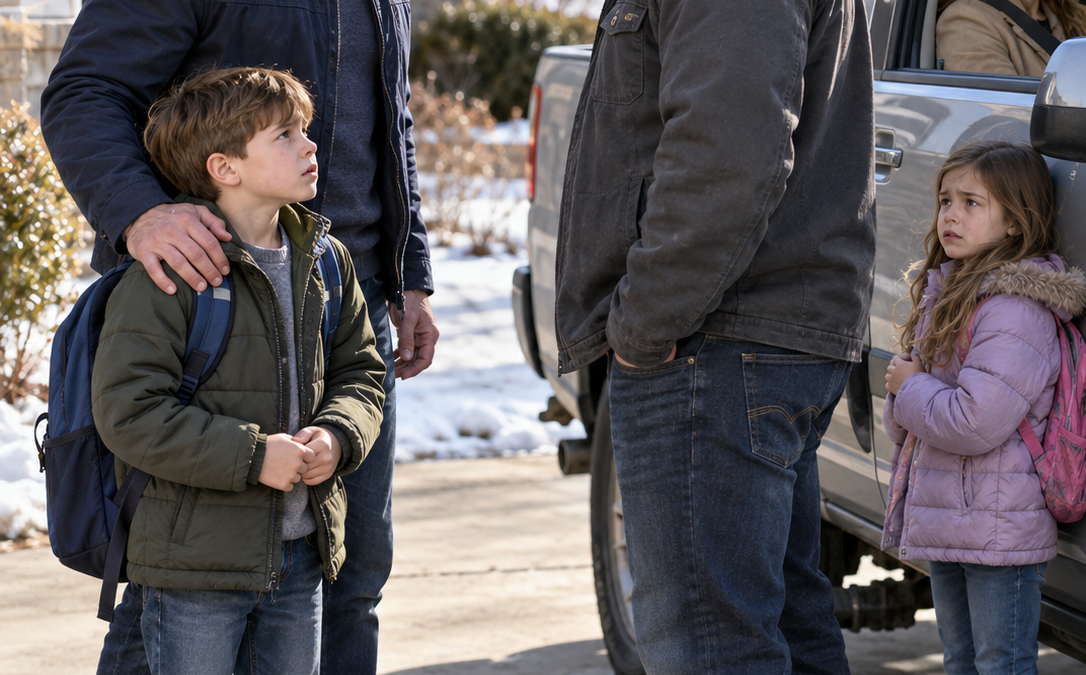
My Ex’s New Boyfriend Was Screaming at My Kids During Drop-Offs. I Installed Ring Cameras and Got Full Custody in Two Months.
What you’re about to hear is the story of a divorced father named Phil, a man who had what might have been the most ordinary custody arrangement in the world. Fifty-fifty. Week on, week off. Everything was civil, predictable, and about as uncomplicated as a divorce involving two young children could reasonably be. Then his ex-wife started dating a man who apparently believed screaming at an eight-year-old in the middle of a driveway was an acceptable form of parenting.
Phil began noticing changes in his children. They grew quieter, started choosing their words carefully, and seemed to be constantly walking on eggshells. They even flinched at loud noises. So he did what any concerned father would do when he suspected something was wrong but couldn’t prove it: he bought a Ring camera.
What those cameras captured over the next two months gave a family court judge everything she needed to make one of the fastest custody decisions I’ve ever heard about. Settle in, because this is quite a story.
My ex-wife’s new boyfriend was screaming at my children during custody exchanges. I installed Ring cameras, documented what was happening, and ended up getting full custody in two months.
I need to get this story out because I’ve been holding everything together for months, and I honestly think that if I don’t put it down somewhere, I’m going to lose my mind. Not in some dramatic, spectacular way. More like that quiet kind of unraveling where you suddenly realize you’ve been clenching your jaw for six straight weeks, and your dentist casually asks whether everything is okay at home.
Anyway, here’s what happened.
My name is Phil. I’m thirty-four years old, and I work as a fleet maintenance coordinator for a regional courier company just outside Columbus. Basically, my job is to make sure our delivery vans don’t fall apart while they’re traveling down the highway. I diagnose mechanical problems, order replacement parts, schedule repairs, and maintain detailed service records. It’s not exactly glamorous work, but it pays reasonably well, and I’m good at what I do. I’ve been with the company for seven years.
My ex-wife, Lori, and I separated about three years ago. There wasn’t some enormous fight that destroyed our marriage. Nobody cheated. There wasn’t a dramatic confrontation or some terrible secret that finally came out. We simply stopped working as a couple.
You know that feeling when you’re sitting across from someone at dinner, and both of you realize there’s absolutely nothing left to talk about, but neither person wants to be the one who acknowledges it? That was our marriage for roughly a year and a half before we finally decided to end it.
I remember one particular Saturday when we were sitting in the living room. Lori was looking at her phone, and I was watching a game on television. Our son Caleb came into the room and asked whether we would play a board game with him. Without even looking at each other, we both answered, “In a minute,” at exactly the same time.
I remember sitting there afterward, thinking that this was what we’d become. Two people sharing a mortgage and a Wi-Fi password, living under the same roof without really sharing much of anything else.
We handled the divorce through a mediator. We kept things civilized and agreed to split custody of our two children equally. Caleb is eight now, and our daughter, Nora, just turned six. I moved into a three-bedroom rental about ten minutes from Lori’s house. It wasn’t anything special. Brown siding, a small yard, and a detached garage. But it had a decent kitchen, and there was enough space for each of the kids to have a bedroom of their own. That was really all I needed.
For the first two years, our arrangement worked surprisingly well. We lived about twelve minutes apart, and our regular schedule had the kids staying with me from Sunday evening through Thursday morning. Lori had them from Thursday after school until Sunday evening. We alternated holidays and handled most of our communication through a co-parenting app.
Our messages were generally short and practical. Pickup times, medical appointments, report cards, and anything else involving the children. We weren’t particularly friendly, but we were respectful. I never had any serious complaints about Lori as a co-parent. She was dependable, and we both understood that our children needed us to cooperate.
Then, about eight months ago, she started dating someone.
Interestingly enough, I found out about him through Caleb. One evening during dinner, he casually mentioned that Mommy’s friend Garrett had been spending a lot of time at her house. He also told me Garrett had a really loud truck.
I didn’t ask him any additional questions. I’ve always had a firm rule about not making my children feel as though they’re being interrogated about whatever happens at their mother’s house. They’re children, not informants, and they shouldn’t have to worry about managing their parents’ relationship.
So I said something along the lines of, “Oh, that’s cool, buddy,” and we continued eating dinner.
And I’ll be completely straightforward about this: I didn’t care that Lori was seeing someone. I’d actually been dating a woman casually for a few months myself. That relationship didn’t work out, but that’s an entirely different story. Lori’s personal life was none of my business as far as I was concerned, provided it didn’t negatively affect our children.
At first, there didn’t seem to be any problems. Then, about four months into her relationship with Garrett, things began to change. The changes were subtle enough that I probably wouldn’t have recognized them immediately if I hadn’t spent so much time around my kids.
Caleb started becoming unusually quiet during custody exchanges. It wasn’t the kind of silence that comes from being upset or refusing to talk. It was more deliberate than that, almost as though he was carefully considering every word before allowing himself to speak.
Nora began asking whether she could stay at my house on nights when she was supposed to be with her mother. She never threw a tantrum or made a scene. She would simply look up at me and ask in this incredibly soft little voice, “Can I stay here tonight, Daddy?”
Whenever I explained that it was Mommy’s night, she would nod, collect her bag, and get ready to leave without arguing. For some reason, that bothered me more than it would have if she’d started crying. It was the way she accepted the answer, almost as though she’d already known there was no point in asking.
I started watching them more closely.
Whenever I helped Caleb into the car on Thursday mornings, or whenever Lori came to collect the children, I noticed that his entire body would stiffen. His shoulders would creep up toward his ears, and he’d become unusually still. He used to wave goodbye through the car window every single time we separated. Now he just stared straight ahead.
Nora became increasingly clingy right before our exchanges. She would wrap her arms around my leg and refuse to let go until the very last moment. Once, while we were standing in the driveway, she squeezed my hand so tightly that I could feel her little fingernails pressing through my work gloves.
Other things were changing, too. Caleb stopped talking about his time at his mother’s house. Previously, he’d return on Sunday evenings practically bursting with stories. They’d gone to the park, watched a movie, or Nora had accidentally spilled juice on the couch. Just ordinary kid stuff, the sort of random little details children love telling their parents.
Now he’d come home, walk directly to his bedroom, and close the door. The kid was eight years old. Eight-year-olds don’t usually shut themselves away like that unless something is bothering them.
Nora started carrying her stuffed elephant around everywhere again. She’d stopped doing that about a year earlier, but suddenly she needed it with her constantly. She held it in the car, carried it to the dinner table, and clutched it whenever she sat on the couch. It was almost as though she’d rediscovered a security blanket she’d outgrown because she suddenly needed the comfort again.
One evening in late October, Caleb was sitting at our kitchen table working on his homework. I was nearby, and I casually asked him how things were going at his mother’s house. I wasn’t trying to steer the conversation toward anything specific. It was just a normal question from a father to his son.
“Fine,” he answered without looking up.
I was about to leave it at that when, after several seconds, he raised his head.
“Dad, does Garrett live with us now?”
I told him I wasn’t sure and asked why he wanted to know. Caleb looked down at his homework again before answering.
“Because he’s always there, and he gets mad a lot.”
I felt my stomach drop, but I made an effort to keep my expression neutral. I didn’t want Caleb to think he’d said something wrong or that his answer had frightened me. I simply asked him what he meant when he said Garrett got mad.
Caleb shrugged. “Like, loud mad.”
That was all he said. He returned to his homework, and I didn’t push him to elaborate.
For the next two days, I went back and forth with myself about what I should do. I considered sending Lori a message and asking her directly whether anything was happening. I thought about sitting Caleb down and asking him more questions. I came up with at least a dozen different approaches, then spent hours imagining everything that could possibly go wrong with each one.
Here’s the thing about being a divorced father: you have to be careful about how you handle situations like this. Say the wrong thing, push too aggressively, or make an accusation you can’t substantiate, and suddenly you risk being portrayed as the jealous, controlling ex-husband who’s creating problems where none exist.
I’d watched similar situations unfold with guys at work. One wrong move, and the entire narrative could change. I wasn’t about to make an accusation that might end up hurting my children more than it helped them.
So I decided to approach the situation the same way I approach a recurring mechanical problem at work. When a delivery truck keeps returning with the same mysterious issue, and nobody can identify what’s causing it, I start documenting everything.
That’s exactly what I did with my children.
I bought a cheap composition notebook from the dollar store and began recording dates, observations, changes in their behavior, and anything unusual they told me. Whenever one of them said something relevant, I tried to write down their exact words rather than relying on my own interpretation.
I kept the notebook in the drawer beside my bed. Nothing fancy. No specialized app, cloud storage, or elaborate organizational system. Just an old-fashioned paper notebook and a pen.
One afternoon, my buddy Hank noticed me writing in it while we were eating lunch at work. He asked whether I’d suddenly decided to start keeping a journal. I told him to mind his own business and finish his turkey club sandwich.
By early November, I’d made another decision.
I purchased a Ring video doorbell and a second Ring camera, one of those stick-up models, and installed both at my house. The doorbell camera covered the front porch and driveway, while I mounted the second camera on the garage, angling it toward the street.
My reasoning was simple. All our custody exchanges took place in my driveway. If something inappropriate was happening during those exchanges, I wanted a video record of it.
And before anybody gets the wrong idea, I wasn’t attempting to spy on Lori. I had absolutely no intention of recording anything inside her house, tracking her vehicle, or interfering with her personal life. Both cameras were mounted on my property and pointed toward my driveway and front yard.
I understood that what I was doing was legal, and I wasn’t trying to keep the cameras a secret. In fact, I sent Lori a message through our co-parenting app to let her know I’d installed them.
“Hey, just installed some security cameras at the house, FYI. Been some package thefts in the neighborhood.”
She responded, “Okay, thanks for the heads-up.”
That was the entire conversation.
For the first two weeks, absolutely nothing happened. Our custody exchanges were completely ordinary. Lori would arrive, the children would get out, I’d wave goodbye, and that would be it. On days when she was collecting them, I’d walk them to her car, make sure they were buckled in, and watch her drive away.
Garrett wasn’t present during any of those exchanges, so there was nothing particularly interesting for the cameras to capture.
Then came Thanksgiving week.
I’d originally remembered the incident as happening on the Thursday before Thanksgiving, but it was actually Wednesday, the day immediately before the holiday. Lori arrived to pick up the children, except this time she wasn’t driving.
Garrett was behind the wheel of an enormous silver pickup truck. You know the kind I’m talking about. One of those trucks that’s so ridiculously clean you can tell immediately that it has probably never hauled anything heavier than a couple bags of groceries. Lori was sitting in the passenger seat.
I walked Caleb and Nora into the driveway with their bags. As we approached the truck, Garrett climbed out, and I got my first proper look at him.
He was a stocky guy, maybe five feet ten inches tall, with a buzz cut and wraparound sunglasses pushed up onto his head. It was around forty degrees outside, but apparently that didn’t discourage him from wearing them.
He had a particular kind of energy about him, too. You probably know the type. The guy who walks into a room and immediately needs everyone to acknowledge his presence. He stands too close when he’s talking, speaks louder than necessary, and laughs at his own jokes whether anyone else finds them funny or not.
Garrett didn’t say a word to me. He didn’t even bother making eye contact. He simply stood beside his truck with his arms folded across his chest, looking like an overly enthusiastic nightclub bouncer guarding the entrance to a club nobody wanted to enter.
I loaded the children’s bags into the back seat while trying to get a sense of the situation. Lori wasn’t making eye contact with me either. She was sitting in the passenger seat, scrolling through something on her phone.
Whatever. I didn’t need to be best friends with her boyfriend. I certainly wasn’t planning to invite the guy into some friendly group chat. All I cared about was getting my children safely into the vehicle and completing the exchange without any unnecessary drama.
Then Caleb dropped his backpack while climbing into the truck.
It hit the pavement, and several things tumbled out. A folder, some crayons, and his water bottle scattered across the driveway. Completely ordinary stuff. The sort of harmless little accident that happens when you’re eight years old and trying to manage a backpack that’s practically half your size.
I was already bending down to help him when Garrett suddenly lost his temper.
And when I say he yelled, I mean he really yelled. He turned directly toward Caleb and shouted something along the lines of, “Are you kidding me? Pick that up! You’re always dropping stuff! What is wrong with you?”
Right there in my driveway, with me standing only a few feet away.
Caleb completely froze. He stood motionless beside the truck, his eyes wide, looking as though he couldn’t figure out what he was supposed to do next. Nora instinctively backed away until she was pressed against the vehicle’s door.
I straightened up and looked directly at Garrett. He returned my stare with an expression that practically dared me to challenge him.
Believe me, I wanted to. Every single part of me wanted to step right up to him and make it unmistakably clear that he was never going to speak to my son like that again. The words were already forming in my head, and I could feel myself getting angrier with every passing second.
But I didn’t do it.
Instead, I crouched beside Caleb and helped him gather his belongings. I picked up his folder, collected the crayons, and handed him his water bottle. Then I rested a hand on his shoulder.
“You’re fine, buddy. It’s just a backpack.”
Once he’d finished putting everything away, I looked toward Lori. She was still sitting in the passenger seat, staring straight ahead as though she were desperately trying to make herself invisible.
She didn’t say a single word.
I helped the children into the truck, closed the door, and stood there while Garrett drove away. Then I went back inside, sat down on my couch, and replayed the entire exchange in my head at least thirty times.
Eventually, I remembered the cameras.
I opened the Ring app and checked both recordings. Both cameras had captured the incident, but the driveway camera had recorded the entire confrontation with remarkably clear audio. Garrett’s face was plainly visible, and the footage showed exactly how Caleb had frozen when the man started screaming.
Everything was there.
I immediately saved the recording, downloaded a copy to my laptop, and backed it up onto a USB drive. Then I took out my notebook and wrote down every detail I could remember, including the date, the time, the exact location, and what everyone had said and done.
That’s how I know the exchange happened on Wednesday, the day before Thanksgiving. The children were scheduled to stay with Lori throughout the holiday weekend, which meant I spent Thanksgiving alone in my house, eating leftover pasta and watching old football games on television while wondering whether my kids were okay.
Hold on. For everybody listening, this is me jumping in for a moment, not Phil. I need you to appreciate what just happened here.
This grown man had just screamed at an eight-year-old because the kid dropped his backpack. A backpack. Not an expensive laptop or some priceless antique vase. A perfectly ordinary school backpack filled with crayons and homework.
Garrett sounds like the kind of guy who watches pickup truck commercials and somehow concludes that yelling at small children is what makes a man an alpha male. He’s basically the discount-store version of every obnoxious villain you’ve ever seen in a Lifetime movie. All bark, absolutely no brains, and apparently not an ounce of self-awareness.
Meanwhile, Lori sat there as motionless as a mannequin at a JCPenney going-out-of-business sale.
But Phil was doing something important. Instead of giving Garrett the confrontation he seemed to be looking for, he was thinking several moves ahead. He was collecting evidence, and he wasn’t about to lose his advantage.
Keep listening, because the situation was about to get considerably more serious.
After Thanksgiving, our custody schedule returned to normal, and I started watching the Ring recordings with the kind of attention I’d normally reserve for diagnosing an especially stubborn mechanical problem.
The first couple of weeks in December were relatively uneventful. Lori handled most of the pickups herself. Garrett accompanied her on two occasions, but he stayed inside the truck both times and didn’t interact with the children.
I recorded those exchanges in my notebook anyway. Dates, times, who was present, what happened, and even what didn’t happen. I wanted a complete record, not just a collection of incidents that made Garrett look bad.
Then December 19 arrived.
Lori pulled into my driveway, and once again, Garrett was driving. I walked the children outside, carrying their belongings as usual. Everything seemed relatively normal until Nora stepped off the curb on her way toward the truck and tripped.
You know how six-year-olds are. Sometimes they manage to stumble over absolutely nothing. She wasn’t seriously hurt, but the surprise of falling frightened her, and she started to cry. Not hysterical screaming or anything like that. Just that quiet, heartbreaking little whimper children make when they’re trying not to cry too hard, with their lower lips trembling.
Garrett climbed out of the truck and immediately told her to stop crying and get inside.
His exact words, which the Ring camera recorded perfectly, were, “Knock it off and get in the truck. We don’t have time for this.”
She was six years old. Six.
I picked Nora up, wiped the tears from her cheeks, and reassured her that she was okay. Then I carried her over to the truck myself. Garrett stood nearby with his jaw clenched, looking thoroughly annoyed by the entire situation.
I helped her into her seat, fastened her seat belt, and kissed her forehead.
“See you Sunday, sweet pea.”
Then I turned around and walked back into my house without so much as looking at Garrett. Once I was inside, I opened the Ring app, saved the recording, downloaded it, backed it up, and documented the entire exchange in my notebook.
That evening, I came incredibly close to calling Lori. I really wanted to confront her about what was happening and demand an explanation for why she was allowing this man to treat our children that way.
But I couldn’t stop thinking about the two most likely outcomes of that conversation.
Either Lori would become defensive and accuse me of overreacting, which would probably alert Garrett to the fact that I was documenting his behavior, or she would privately agree that he was behaving inappropriately but fail to do anything about it. By that point, I was beginning to suspect she was genuinely afraid of standing up to him.
Neither outcome seemed particularly helpful to my children.
So I kept my mouth shut and continued documenting everything.
Around that time, I also started doing something I probably should have done from the beginning. I began taking screenshots of the Ring recordings with the timestamps clearly visible, then emailing those screenshots to myself. That gave me another backup, complete with an additional date stamp in my inbox.
Maybe that sounds excessively cautious, but when you work in fleet maintenance, you learn something pretty quickly: the one time you decide something isn’t worth documenting is usually the exact moment when you’re going to need that record later.
I wasn’t willing to make that mistake when my children’s well-being was involved.
Anyway, Christmas eventually arrived. According to our custody agreement, I had the kids on Christmas morning, which was easily the best part of the entire year.
Caleb finally got the model truck kit he’d been asking for over the previous several months. It was one of those ridiculously complicated sets with something like two hundred tiny pieces, the kind that practically guarantees you’ll spend half the day hunting for one missing component under the furniture.
Nora got an enormous set of art markers, which she absolutely loved. Unfortunately, they were also the kind of markers that bleed straight through ordinary paper and stain whatever surface happens to be underneath. I discovered that particular feature the hard way when she decided to color a picture directly on our kitchen table.
We made pancakes that morning and poured far more syrup over them than any reasonable person would recommend. Caleb wanted to start building his truck immediately, while Nora was determined to test every marker in her new collection. For a few hours, everything felt exactly the way Christmas morning was supposed to feel.
It was good. Really good.
But that afternoon, when it was time to take them to Lori’s house for the second half of Christmas, I noticed Caleb growing tense in the back seat. He wasn’t complaining or asking to stay with me. He simply became unusually quiet, staring out the window while we drove.
When we arrived, I walked them to the front door. Garrett answered.
He was standing in the doorway with the same attitude he’d displayed in my driveway, as though he owned the entire place and we should all be grateful he’d bothered to open the door.
He didn’t wish us a merry Christmas. He didn’t say hello, thank me for bringing the children, or offer even the most basic acknowledgment of my existence. He simply stepped aside so Caleb and Nora could enter the house.
Caleb turned around and looked at me once before disappearing inside. Just once.
I’ve thought about that look more times than I can count. I don’t think I could adequately describe the expression on his face even if I wanted to. And honestly, I don’t particularly want to try.
I drove home, pulled into my garage, turned off the engine, and sat in my truck for probably twenty minutes without moving.
At some point, Hank sent me a text asking whether I wanted to come over for leftover Christmas ham and a movie. I answered, “Maybe later,” but I never went. I just stayed home, thinking about the children and trying to figure out what I was supposed to do next.
On January 5, Lori dropped the kids off at my house after school. Garrett was with her again, although this time he was sitting in the passenger seat.
As Caleb climbed out of the car, Garrett leaned toward the open window and said something to him. I heard it clearly, and fortunately, the Ring camera recorded the entire exchange.
“And next time, don’t leave your shoes in the hallway, or I’m throwing them in the trash.”
All that anger and hostility over a pair of shoes.
I didn’t react. I didn’t approach the vehicle, start an argument, or say anything to Garrett. I took the kids inside and went about our normal evening routine.
For dinner, I made spaghetti, Caleb’s favorite. We ate together, cleaned up afterward, and eventually I got both children settled into bed.
Then I returned to the kitchen, pulled out my notebook, and opened the folder containing the Ring recordings from the previous two months.
I sat at that table for a long time, looking through everything I’d documented. The recordings, the dates, the children’s behavioral changes, and all the little details that had seemed relatively insignificant when considered individually.
I’d been patient. I’d been careful. I’d tried to avoid creating unnecessary conflict. But sitting there that night, I finally accepted that continuing to document the situation without taking additional action wasn’t going to be enough.
I’d reached my limit. Something had to change.
Before we continue, I want to talk about something that’s probably happening inside Lori’s head, because it’s an important part of this story.
She’s watching her boyfriend bark orders at her children and apparently doing absolutely nothing to stop him. I know some of you are probably thinking that makes her just as responsible as Garrett, and I understand why you’d react that way.
But I suspect Lori had gradually become trapped in a relationship where unacceptable behavior kept getting normalized. Sometimes somebody starts by raising the volume a little, then a little more, and by the time they’re practically screaming all the time, you’ve somehow convinced yourself that’s just how things are.
I don’t think Lori was necessarily evil. I think she’d lost perspective and become frightened of confronting the situation she’d allowed to develop. Unfortunately, her children were the ones suffering the consequences.
And while we can acknowledge that Lori may have been frightened herself, that doesn’t change the fact that her children needed someone to protect them.
At this point in the story, Phil was the one taking concrete steps to do exactly that. He understood that his children weren’t supporting characters in somebody else’s relationship. They were people, and their safety had to come first.
Now, back to what happened.
The following Monday, I contacted a family law attorney named Russell Whitmore. He’d been recommended by one of my coworkers, whose brother had gone through a particularly ugly custody dispute a few years earlier.
I arranged to meet Russell during my lunch break and brought everything I’d collected. My notebook, the Ring recordings, descriptions of the four separate incidents I’d documented, and my observations about the changes in Caleb’s and Nora’s behavior.
I laid everything out on his desk and explained the situation as carefully as I could. Then Russell sat back and watched all four recordings, one after another, without saying a word.
I sat across from him in a large leather chair that made an irritating squeaking noise every time I shifted my weight. I tried not to study his expression, but that’s easier said than done when you’re sitting in a lawyer’s office wondering whether you’ve finally gathered enough evidence to protect your children.
When the last recording finished, Russell removed his glasses and placed them on his desk.
“How soon do you want to file?”
“Yesterday,” I told him.
He explained how the process worked. In our state, he said, it was possible to request an emergency custody modification if we could demonstrate that the children’s current living situation presented a risk to their physical or emotional well-being.
According to Russell, there were essentially two ways to approach a case like mine. We could present one particularly disturbing incident and hope the judge considered it serious enough to justify immediate intervention. Or we could present a documented pattern of behavior demonstrating that the situation was ongoing and harmful.
He explained that the Ring recordings were strong evidence on their own, but my handwritten notebook was what could really distinguish our case.
We had four separate incidents documented across roughly two months, complete with dates, times, direct quotations, and corroborating video recordings. That wasn’t simply one bad afternoon or a single argument that had gotten out of hand. It demonstrated a pattern.
And Russell made it clear that patterns were something family court judges took seriously.
He asked me a long series of questions. How long had Garrett been involved with Lori? Had either child described specific incidents that happened inside her house? Had their performance at school changed? Had I noticed any physical evidence suggesting they were being hurt?
I answered every question as honestly and precisely as possible. No, I hadn’t observed bruises or any other visible marks. But the changes in their behavior were real, and those changes appeared to be getting progressively worse.
Russell listened carefully and took notes. By the end of our meeting, I felt as though we had an actual plan rather than another collection of unanswered questions.
His retainer was expensive enough to make my eyes water a little, but I signed the agreement without hesitating. Some things are worth every dollar, and protecting my children was certainly one of them.
We filed the motion on January 21.
Now, here’s the part of this entire situation that genuinely surprised me.
I’d prepared myself for Lori to fight the custody modification as aggressively as possible. I expected her to retain an attorney, file a countermotion, and accuse me of being an obsessive, controlling ex-husband who’d installed security cameras specifically to manipulate the situation.
I’d mentally prepared for a prolonged legal battle. I figured we’d spend months exchanging accusations, attending hearings, and arguing about every detail of our parenting arrangement.
But that’s not what happened.
Instead, I received a phone call.
Lori called me the evening after she’d been served with the legal paperwork. She wasn’t angry or screaming. She was crying.
I remember what she said because I don’t think I’ll ever forget hearing those words.
“I know.”
That was it at first. Just those two words.
“I know.”
Then she started explaining what had been happening. Things with Garrett had gotten worse, and his aggressive behavior toward the children wasn’t limited to the incidents I’d witnessed during our custody exchanges. He’d been treating them that way inside her house, too.
She told me Caleb had started wetting the bed again, something he hadn’t done since he was four years old. Nora had been having nightmares, and their home life had deteriorated considerably.
Lori admitted she’d wanted to end her relationship with Garrett for weeks, but she was afraid of him. And not just because of what he might do to the children. She was frightened for her own safety as well.
I sat there holding the phone, trying to process everything she was telling me. I honestly didn’t know what to say.
Part of me wanted to demand an explanation for why she hadn’t come to me sooner. Another part of me wanted to yell at her for allowing the situation to continue when she’d clearly known something was wrong.
But a larger part of me, the part that had spent seven years diagnosing problems and fixing them before they became more serious, understood that getting angry wasn’t going to solve anything.
“We’ll figure this out,” I finally told her. “But the kids have to come first.”
She agreed.
And to her credit, she didn’t fight the custody modification after that conversation.
Her attorney and Russell worked together to establish the proposed terms. Under the arrangement, Lori would have supervised visitation on weekends. The reasoning wasn’t that she was inherently a bad mother, but that as long as Garrett remained involved in her life, there were serious concerns about whether the children would be safe in her care.
She accepted those conditions without challenging them. In some ways, I honestly think she was relieved that somebody was finally intervening and bringing the situation to an end.
Our court hearing was scheduled for February 11.
I arrived at the courthouse wearing my best pair of khakis and a button-down shirt I hadn’t worn since my cousin’s wedding. Russell had specifically advised me to dress like the dependable, boring father I actually was. Those were his exact words, and I wasn’t particularly offended by them.
I’ve never been the kind of guy who tries to make an impression with expensive clothes or a flashy personality. If appearing dependable and boring was going to help my children, I was perfectly happy to play that role.
Lori was already there when I arrived. She looked exhausted. Not angry, defensive, or ready for a fight. Just incredibly tired, like somebody who hadn’t had a decent night’s sleep in a very long time.
Her attorney sat beside her throughout the hearing and didn’t object to a single piece of evidence Russell presented.
Russell had organized all four Ring recordings and arranged to play them one after another. He’d connected his laptop to a monitor positioned where the judge could clearly see everything.
While the recordings played, I found myself watching the judge instead of looking at the screen. I already knew what the videos contained. I’d watched them so many times that I practically had every second memorized. What I wanted to know was how she would react.
During the first two recordings, her expression barely changed. She sat there with the kind of perfectly controlled expression you probably develop after spending years listening to people argue in court.
But when the third video played, the one where Garrett told Nora to knock it off after she’d tripped and started crying, I noticed the judge’s jaw tighten ever so slightly.
It was an incredibly subtle reaction. If I hadn’t been studying her face so closely, I probably wouldn’t have noticed it.
When the fourth recording ended, she briefly closed her eyes. Then she removed her glasses and placed them on the bench in front of her.
The courtroom became completely silent. I could hear the ventilation system humming overhead.
The judge was an older woman with an unmistakably no-nonsense demeanor. She struck me as the sort of person who’d spent enough years hearing custody disputes to recognize when somebody was wasting her time. She certainly didn’t seem interested in theatrics or elaborate speeches.
She looked directly at Lori and asked her a single question.
“Is this man still in contact with your children?”
Lori answered no.
She explained that she’d ended her relationship with Garrett two weeks after receiving the legal paperwork and that he’d moved out of her house. Her voice trembled as she spoke, but she managed to get through her answer.
The judge examined the timestamps on the Ring recordings, then reviewed my handwritten behavior log. Russell had submitted the notebook as a supporting exhibit, complete with a table of contents and a date index. That man is thorough, and I was increasingly grateful for it.
She also reviewed the children’s school records.
Those records revealed that Caleb’s grades had declined and that Nora had been sent to the school nurse’s office on two separate occasions because of stomachaches for which there was no apparent medical explanation.
Stress can do that to children. Sometimes their bodies reveal what they don’t yet know how to explain in words.
After reviewing the evidence, the judge asked Lori’s attorney whether he had any objections to the proposed custody modification. He said he didn’t.
She asked whether either party wanted to add anything before she made her decision. Russell declined, and Lori’s attorney did the same.
That was it.
The judge granted the modification, awarding me full physical custody of Caleb and Nora.
Lori was granted supervised visitation every other weekend, with a gradual plan to increase her parenting time if she could demonstrate that Garrett was permanently out of the picture and that her home environment was stable.
I didn’t celebrate when the judge announced her decision. I didn’t pump my fist, turn around with some triumphant smile, or exchange an enthusiastic high five with Russell. I didn’t do any of the things you sometimes see people doing in courtroom scenes on television.
I just sat there.
For the first time in months, I felt the tension begin to disappear from my shoulders. It was almost as though I’d been holding my breath since October, and somebody had finally given me permission to exhale.
Outside the courtroom, Russell shook my hand.
“You did the right thing,” he told me.
I nodded and thanked him. At least, I think I thanked him. I don’t remember the conversation particularly clearly because my brain was doing that strange thing it does when you’ve been running on adrenaline for hours and everything finally comes to a stop.
I walked out to the parking lot and sat in my truck for a while before attempting to drive home. I needed a few minutes to process what had just happened.
Eventually, I called my mother.
She started crying almost immediately. I came pretty close to crying myself, but I managed to hold it together. I was sitting in a public parking lot, and for some ridiculous reason, breaking down in front of a bunch of strangers felt awkward.
My mother told me she was proud of me. Then she said my father would have been proud of me, too.
My dad passed away about five years ago. Heart attack.
I know that probably seems like a random thing to mention in the middle of this story, but hearing my mother bring him up at that particular moment affected me more than I expected.
He was exactly the kind of father who would have handled a situation like this the way I did. Quiet, steady, and meticulous about documenting everything. The man actually kept a maintenance log for his lawnmower. Every repair, every adjustment, every little thing he did to keep that machine running properly went into the notebook.
I guess that’s where I learned to approach problems the way I do.
And sitting there in the courthouse parking lot, knowing my children would finally be living with me full-time, I was glad I’d inherited that part of him.
Okay, time out. Can we talk about the real MVP of this story for a second? Because somewhere in the middle of this whole ordeal is a Ring doorbell camera that probably costs about fifty bucks when it’s on sale.
Think about that. Phil didn’t hire an entire team of private investigators. He didn’t turn into Liam Neeson in Taken. He didn’t conduct some elaborate undercover operation or spend thousands of dollars purchasing sophisticated surveillance equipment.
He bought the same little gadget your neighbor probably uses to catch people stealing Amazon packages off the front porch, and somehow that camera ended up providing critical evidence in a family court custody hearing.
If Ring ever needs an idea for its next commercial, forget about those adorable families waving at the mailman. Just show Phil’s driveway footage and put a tagline underneath it: “Ring. Because some people shouldn’t be around kids.”
I’d buy stock.
But here’s the thing. Getting custody wasn’t actually the end of Phil’s story. There was still the matter of helping two young children recover from everything they’d experienced, figuring out what his relationship with Lori would look like going forward, and rebuilding some sense of normality after months of uncertainty.
And fortunately, that’s where this story starts getting a little happier.
It’s been about two months since the judge issued the custody modification, and I’m happy to report that the children are doing better.
They’re not magically back to normal, and I’m not going to pretend everything that happened simply disappeared the moment we walked out of that courtroom. But they’re improving, and those improvements mean more to me than I can adequately explain.
Caleb’s grades have started climbing again. His teacher actually sent me an email last week telling me he’d earned a perfect score on a science quiz about the water cycle. I realize that probably doesn’t sound like some enormous accomplishment, but three months ago, the kid was barely managing to turn in his homework.
Seeing him get excited about school again has been incredible.
He’s also starting to act like the loud, goofy eight-year-old I remember. He’s making ridiculous fart jokes, leaving Lego pieces scattered across the house, and somehow managing to position those little plastic land mines in the exact places where I’m most likely to step on them at two in the morning.
He joined a flag football team last month. And I’ll be honest with you: he’s absolutely terrible at it.
I love the kid more than anything in the world, but I don’t think we’re looking at the next professional football superstar here. Half the time, he seems to forget which direction he’s supposed to be running. But he races around that field with this enormous, ridiculous grin plastered across his face, and that’s the only part I actually care about.
Every Saturday morning, I take my camping chair and a cup of coffee down to the field. I sit on the sidelines and watch my son run around with the other kids. Sometimes he manages to grab a flag, sometimes he runs in completely the wrong direction, and sometimes he gets so distracted that he barely notices what’s happening around him.
And you know what? It’s wonderful.
I get to sit there and watch him be a kid. That’s it. That’s the whole thing, and it’s more than enough.
Nora’s doing better, too. She’s sleeping through the night much more frequently now. She still has an occasional rough night, and the nightmares haven’t disappeared entirely, but they happen far less often than they did before.
More importantly, she’s becoming her old, talkative little self again.
That girl can talk. I’m not exaggerating when I say she can maintain a conversation practically nonstop from the moment she gets home until I finally convince her it’s time for bed.
She tells me about everything. What she ate for lunch, what her friend Kennedy said during recess, the squirrel she spotted running along the backyard fence, and why purple is objectively superior to blue. She’ll spend ten minutes explaining something that happened at school, get distracted halfway through by an entirely unrelated thought, and somehow end up telling me about a picture she wants to draw.
I missed that. I really missed having that kind of noise in my house.
For a while, both my children had become so unusually quiet that I’d started forgetting what our home used to sound like. Now there are toys everywhere, somebody’s usually asking for a snack, and Nora apparently feels obligated to narrate practically every thought that enters her head.
I wouldn’t trade any of it for the world.
The other day, she announced that when she grows up, she wants to become either a veterinarian or a race car driver. She spent several minutes explaining the advantages of both professions, apparently having decided that saving animals and driving extremely fast were equally important contributions to society.
I told her there was absolutely no reason she couldn’t be both. She seemed pretty satisfied with that answer.
As for Lori, we’re on reasonably decent terms these days.
I wouldn’t say things are great between us. There’s an awful lot that remains unsaid, and I genuinely don’t know whether we’ll ever have the kind of conversation that addresses everything that happened.
Maybe we will. Maybe we won’t.
Right now, I’m more concerned about maintaining a stable relationship for the children’s sake than trying to resolve every complicated feeling left over from the situation.
Lori attends her scheduled visits, and when she’s with the kids, she seems genuinely engaged. According to the visitation supervisors, there haven’t been any problems worth reporting, which is obviously encouraging.
I think losing primary custody may have been the wake-up call she needed. At least, I sincerely hope that’s what happened. Not because I particularly care about whether she learned some great personal lesson, but because Caleb and Nora still need their mother, and I want them to have a healthy relationship with her.
If she can rebuild that relationship while providing a stable, safe environment, that would be a good thing for everybody involved.
As for Garrett, I have absolutely no idea where he is now, and I couldn’t care less.
What matters to me is that he’s no longer around my children. I don’t need to know where he’s living, what he’s doing for work, whether he’s dating somebody else, or what he thinks about the entire situation.
Lori mentioned on one occasion that Garrett had attempted to contact her after everything happened, and she blocked him. I didn’t ask for any additional details. Their relationship is her business, provided it doesn’t affect our children.
As long as he stays out of their lives, I’m perfectly satisfied.
And speaking of people who made an enormous difference, Russell Whitmore turned out to be worth every penny I paid him.
After the hearing, he explained something to me that I’ve thought about quite a bit since then. Family court judges spend an extraordinary amount of time dealing with custody disputes in which one parent makes an accusation and the other parent denies it. Without reliable evidence, those situations can become incredibly difficult to resolve.
He said that having clear video recordings, complete with audio and visible timestamps, was an important part of what made our case different.
But he also emphasized the significance of my notebook.
The handwritten behavior log demonstrated that I hadn’t simply become angry over one unpleasant encounter and rushed to court in response. I’d observed a series of concerning incidents, recorded them consistently, and documented the corresponding changes in my children’s behavior.
I’d been identifying a pattern rather than reacting emotionally to an isolated event.
Russell told me that distinction matters much more than most people realize.
I think about that whenever I open the drawer beside my bed and see the notebook sitting there. It’s strange to look at something so ordinary and realize how important it became.
Last week, Hank finally asked how everything had turned out.
I hadn’t given him every detail while the case was unfolding, partly because I didn’t want to spend every lunch break discussing custody proceedings and partly because I simply didn’t have the emotional energy to explain the situation over and over again.
So I gave him the abbreviated version. I told him about the cameras, the attorney, the court hearing, and the fact that the kids were now living with me full-time.
Hank listened, nodded, and said, “Good for you, man.”
Then, without missing a beat, he asked whether I wanted half his sandwich because his wife had accidentally packed him two.
It was roast beef. I accepted.
That’s Hank for you. Sometimes it’s nice having a friend who doesn’t feel obligated to turn every conversation into some enormous emotional event.
Anyway, I suppose the thing I keep returning to is the realization that nobody was going to step in and save my children unless I did something.
Lori couldn’t protect them at the time because she’d become trapped in a bad situation and couldn’t seem to find her way out of it. The school didn’t know what was happening inside her house, and Caleb and Nora were too young to fully understand what they were experiencing, much less explain it clearly enough for somebody else to intervene.
Ultimately, the responsibility fell on me.
And what bothers me when I look back on everything is how close I came to doing absolutely nothing.
Not because I didn’t care. Not because I didn’t believe my children. But because I was frightened of making an already complicated situation worse.
I was afraid of rocking the boat. I was afraid of being portrayed as the difficult ex-husband who couldn’t stand seeing his former wife in a new relationship. I was afraid that if I pushed too hard or made one wrong move, I’d end up losing the custody arrangement I already had.
Those concerns went around and around in my head for weeks. Every time I considered confronting Lori or taking some sort of legal action, I imagined all the ways it could backfire.
But here’s what I eventually learned.
Documenting a problem isn’t the same thing as overreacting. Installing security cameras on your own property doesn’t automatically mean you’re paranoid. And writing down concerning behavior in a cheap notebook from the dollar store doesn’t mean you’re being unnecessarily dramatic.
Sometimes, being the boring, methodical, systematic person who pays attention to little details is exactly what your children need you to be.
That’s what I do for a living, after all. I fix trucks.
When one of our vehicles develops a problem, I identify the symptoms, figure out what’s causing the trouble, and document everything. Then I order whatever parts are necessary, schedule the repair, and make sure the problem actually gets resolved.
That’s the process. It’s not particularly exciting, and nobody’s making an action movie about the thrilling adventures of a fleet maintenance coordinator. But the method works, and over the years, I’ve learned to trust it.
It turns out that the same general approach can be pretty useful when the thing that needs fixing is your custody arrangement.
I still have that composition notebook in my bedside drawer. I haven’t written anything in it for weeks, and I can’t even begin to explain how good that feels.
For months, opening that drawer meant recording another troubling observation, trying to remember exactly what one of my children had said, or reviewing something that made me worry about what was happening when they weren’t with me.
Now the notebook just sits there.
I hope it stays that way.
There’s one part of this entire experience that I still haven’t completely figured out, though. I don’t know what I’m going to tell Caleb about everything that happened when he’s older.
He’s eight years old. He understands that things have changed, and he knows he lives with me full-time now. He’s aware that his visits with his mother are different from the way they used to be, but he doesn’t know about the cameras, the recordings, the court hearing, or any of the work that happened behind the scenes.
As far as he’s concerned, the adults made some decisions, and now his life looks a little different.
Someday, he’s going to start asking questions.
He’ll want to know why the custody arrangement changed, what happened between his mother and me, and why Garrett suddenly disappeared from their lives. He may even want to understand whether there was something he could have done differently.
I don’t know exactly how I’m going to answer those questions yet.
I’ve turned the whole thing over in my head a hundred times, trying to imagine the conversations we’ll eventually need to have. I want to tell him the truth, but I also want to make sure he understands that none of this was his responsibility.
Finding the right words isn’t going to be easy.
Maybe by the time he’s old enough to ask those questions, I’ll know exactly what to say. Maybe I won’t. I suppose that’s something I’ll have to figure out when the time comes.
For now, I’m trying to focus on what’s directly in front of me.
My children are safe. They’re sleeping in their own beds, just down the hallway from my bedroom.
Caleb’s nightlight is on. He still refuses to admit that he uses it, but I can see the faint glow coming from underneath his bedroom door whenever I walk past. I don’t bring it up because there’s absolutely no reason to embarrass him about something that helps him sleep.
And Nora’s in her room with that stuffed elephant tucked securely beneath her arm, exactly where it belongs.
They’re both here. They’re both safe. And when I wake up tomorrow morning, I’ll be able to make them breakfast, remind Caleb to put his shoes away, listen to Nora explain some incredibly detailed theory about why purple is the greatest color ever invented, and get them ready for another ordinary day.
That’s enough for me.
That’s everything.
So, yeah. That’s my story.
If you’re a father dealing with something similar, or a mother, for that matter, I hope there’s something useful you can take away from my experience.
Document everything. Be patient. Pay attention to the details, even when they seem relatively insignificant. And don’t be afraid of being the boring, dependable parent who takes careful notes and asks difficult questions when something doesn’t seem right.
Most importantly, be the person your children can count on, even when they don’t yet have the words to explain what’s troubling them.
The legal system can be slow, complicated, and incredibly frustrating. I certainly understand that much better now than I did a few months ago. But in my case, providing clear evidence and a consistent record made it possible for the court to understand what had been happening.
Would I go through the entire process again if I had to?
Every single part of it, without hesitation.
Anyway, thank you for reading all of this. I didn’t realize how much I needed to put the experience into words until I actually started writing. It feels good to finally get everything down somewhere other than that old composition notebook.
And I suppose I’m interested in hearing what other people think. Did I handle the situation correctly? Would you have done anything differently if you’d been in my position?
Hold on before we wrap this up, because there’s one final thing I want to point out, and I think a lot of people might overlook it.
Phil literally used the exact same set of skills he relies on every day at work to protect his children. Think about his entire approach. When something goes wrong with one of his delivery trucks, he identifies the problem, documents the symptoms, investigates what’s causing the trouble, and schedules whatever repair is necessary.
That’s precisely what he did here.
The only difference was that the broken component wasn’t a transmission, an alternator, or some mysterious electrical problem. It was a custody arrangement that was no longer keeping his children safe.
This man essentially treated Garrett’s behavior like a check-engine light that refused to turn off. He kept investigating until he understood the problem, assembled the evidence, and then filed the equivalent of a repair order with the family court.
If there’s some kind of Father of the Year award out there, I don’t think Phil particularly needs it. He’s probably too busy making spaghetti, helping his son assemble model trucks, and watching terrible flag football games from the comfort of his camping chair.
And frankly, that seems better than any trophy somebody could give him.
The part I find especially interesting is that Phil didn’t do anything particularly flashy. There wasn’t some dramatic confrontation where he marched across the driveway and challenged Garrett to a fight. He didn’t create a viral moment, engage in an enormous screaming match, or announce to everybody that he was about to take his ex-wife to court.
He installed security cameras. He kept a notebook. He collected evidence, contacted an attorney, and allowed the documentation to speak for itself.
Sometimes, the most powerful thing you can do when everything around you seems to be falling apart is remain steady enough to recognize what actually needs to happen next.
And that’s exactly what Phil did.
Now, I want to hear what you think about this whole situation, because there are a few different ways somebody might have responded to what happened in that driveway.
If you’d been standing there when Garrett started screaming at Caleb over a dropped backpack, would you have confronted him immediately? Would you have called Lori afterward and demanded that she do something about her boyfriend’s behavior? Or would you have taken Phil’s approach, documented the incidents, gathered evidence, and pursued the matter through the court?
Drop a comment and tell me how you would have handled it.
And if you haven’t already subscribed, go ahead and hit that button. I’ll see you in the next one.








