. My company promoted 5 supervisors, everyone except me. When I turned in my resignation, my boss panicked: “What will those 5 do without you?”
“You always have the exact answer before I finish asking the question, Webb,” he muttered. “That is why I have kept this contract with Meridian for eleven years. Send me the stamped carrier confirmation as soon as it posts.”
I confirmed that I would, set the receiver down, and became aware of the sudden murmur rising from the hallway. A cluster of junior account coordinators had gathered near the bulletin board. They were pointing and whispering in the way people do when something has just changed the order of things.
For six weeks, our senior management had been circulating word about five newly created regional supervisor positions, a structural reorganization meant to build what the executive team called a leadership pipeline.
For fourteen years, through two ownership changes, a facilities consolidation, and one near bankruptcy, I had held the title of senior operations coordinator. I was the person who had built the pipeline they were now reorganizing.
I stood up, straightened my jacket, and walked down the hallway to read the document for myself.
The group parted when they heard my footsteps. I studied the single sheet of cream-colored letterhead bearing the embossed seal of Meridian Industrial Coatings.
Notice of Regional Supervisor Appointments.
The first name was Colt Waverly, an account assistant I had personally trained over three years, a young man who, two years earlier, could not read a chemical freight manifest without calling me twice for clarification.
The second was Pamela Hutchkins, a billing coordinator I had mentored through product liability compliance when her department was folded into ours during the consolidation.
The third was Dax Fenwick, the forty-year-old brother-in-law of our division president, Frank Dobbins, a regional sales representative who had spent five years on the road and never once managed a fulfillment schedule.
The fourth was Sloan Burquette, a business school graduate eighteen months out of Ohio State who communicated primarily in quarterly projections and stakeholder alignment frameworks.
The fifth was Norris Calendarer, a billing transfer whose uncle sat on the county industrial board and who had recently played nine holes with Frank Dobbins at a charity scramble.
My name was not on that sheet.
I stood in front of it for about ten seconds. I did not feel rage. I have never been built that way. Over fifty-seven years of life, thirty of them spent in industrial operations, I had learned that the more profound the betrayal, the colder and cleaner my mind becomes. The storm inside does not disappear. It simply descends below the waterline, where it cannot be seen.
“Webb.”
I turned.
Colt Waverly was standing directly behind me, holding a paper coffee cup in both hands, looking at me with the particular expression of a man who knows he has benefited from someone else’s misfortune. His jaw worked for a moment before any words came out.
“I just want you to know,” he said quietly, “that I didn’t ask for this. Frank called me in this morning at seven and handed me the letter. I honestly didn’t see it coming.”
I looked at him for a moment.
“You did the work, Colt,” I said evenly, without a trace of sarcasm. “Now go back to your desk and review the afternoon manifests. We have three LTL loads heading to the Northern Depot, and the drivers need updated hazmat placarding confirmations before four.”
He swallowed, nodded, and disappeared down the hall.
When I came to work for Frank Dobbins fourteen years earlier, I was forty-three years old. The company I had spent sixteen years building inventory control systems for had been acquired and dismantled by a private equity firm out of Atlanta. I walked away with a severance package, a reference letter, and a practical education that no graduate school offers.
Meridian Industrial Coatings, at the time, was a thirty-person operation running out of two leased floors above a welding supply depot in the West End. Frank had personally recruited me after a mutual contact in the chemical distribution trade gave him my name.
Frank had sat across from me in a booth at a diner on Madison Road and told me that if I could build his operational infrastructure the way I had built my previous employer’s, he would make certain my contributions were never invisible.
I accepted.
I started at $3,400 a month and worked long days for the first two years designing fulfillment protocols, renegotiating carrier contracts, rebuilding quality assurance documentation, and training every coordinator who walked through the door.
As the company grew to 140 employees across three regional facilities, I became the institutional center of gravity for everything operational. When a client threatened to cancel, the answer was always, “Get Webb on the phone.” When a junior employee made an error that could cost us a contract, the answer was always, “Bring it to Webb, and he’ll sort it out.”
When the bank scrutinized our compliance documents during refinancing, it was my filing systems they cited as the only reason to extend the credit line.
And every time a supervisory title opened up, Frank had a different explanation for why the timing was not quite right.
In my fifth year, he said the floor needed my direct presence too much for me to be tied up in meetings. In my ninth year, he said the budget cycle was difficult.
Now, in my fourteenth year, he had manufactured five brand-new supervisor positions with salary increases of $18,000 to $24,000 each and awarded every single one to people I had trained, a family connection, a recent hire, and a man whose uncle played golf with him.
I walked back to my desk, sat down in my chair, and spent three minutes composing the most deliberately calm document I had written in a decade.
My formal notice of resignation, effective at the close of business. Personal considerations. Three sentences total.
I printed it, folded it in thirds, and sealed it in a plain white envelope. Then I stood up and walked toward the elevator that led to the executive suite on the fourth floor.
Pamela Hutchkins intercepted me at the elevator bank. She was clutching a folder against her chest, and her eyes were already pink around the edges. When she saw the envelope in my hand, she flinched visibly.
“Webb,” she whispered, grabbing my sleeve. “Please tell me that is not what I think it is.”
I gently removed her hand from my sleeve and held her gaze steadily.
“You spent two years learning product liability compliance, Pamela. You passed the state certification exam on your second attempt. You built the audit log that saved us from that EPA discrepancy last spring. You earned your promotion.”
“But if I had known—”
“Do not apologize for accepting an opportunity that was given to you,” I said firmly. “Go back to your desk. Make sure the polymer distribution certificates are filed before noon, and carry yourself like the supervisor you are now. That is what the title requires.”
She pressed her lips together and turned away. I stepped into the elevator.
Frank Dobbins occupied a corner office on the fourth floor with a view of the Ohio River. The carpet up there was thick and hushed, a different world from the hum of the operations floor below. I knocked three times on the glass. He called out for me to come in.
Frank was fifty-nine years old, barrel-chested, with the permanent tan of a man who spent weekends on a pontoon boat and the wardrobe of a man who had recently decided he should look the part of a CEO. He was on a wireless call, pacing behind his standing desk. He held up one finger at me.
I stood before his desk and waited.
When he clicked off, he turned and spread his arms with the practiced warmth of a man who had spent thirty years in sales.
“Webb, sit down. Listen, I know the board looked unusual this morning. This was purely a structural move. We needed younger bandwidth absorbing day-to-day client friction so you could stay focused on the strategic accounts. You are the engine here. You know that.”
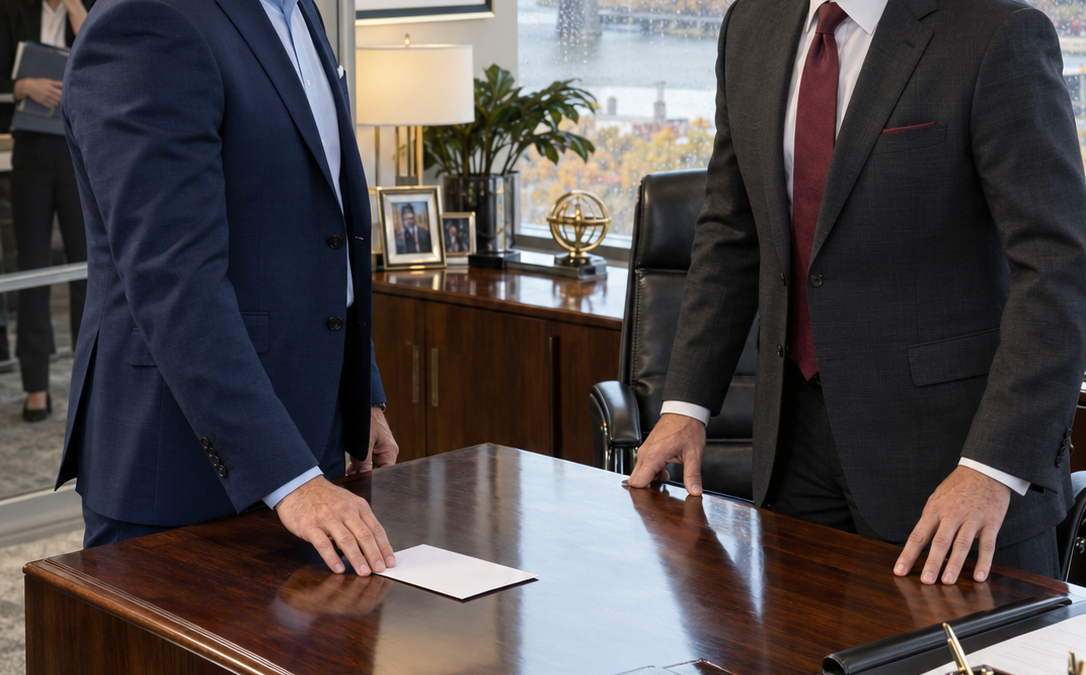
I stepped forward and set the white envelope on his desk blotter.
Frank looked at it. The warmth in his face went somewhere it could not be retrieved from.
“What is this?”
“My resignation,” I said. “Today is my last day.”
He stared at the envelope the way a man stares at a check he cannot cover. Then a short, disbelieving laugh escaped him.
“You cannot be serious, Webb. You are fifty-seven years old. You have fourteen years invested here. You are going to throw all of that away because you didn’t get a supervisor title?”
“I am not throwing anything away,” I said. “Fourteen years ago, I came to this company when you had thirty employees above a welding depot. You told me my contributions would never be invisible. For fourteen years, I designed your systems, trained your people, and rescued your accounts. I accepted ordinary wages in the early years because I believed the promise.”
I held his gaze.
“I have now watched you create five supervisor positions and award every one of them to the people I made competent. I understand now that being useful to you is not the same as being valued by you. Those are different things, Frank.”
He pushed to his feet, and his chair rolled back and struck the credenza.
“You think you are indispensable?” His voice had dropped into the register where authority and desperation sound identical. “I gave you a job when your last company dissolved around you. You owe this company loyalty.”
“You paid me a market wage for fourteen years of above-market contribution,” I said, looking him directly in the eye. “That debt was settled every two weeks. My departure is effective at five.”
The anger in his face shifted. Beneath it, I could see the exact moment it happened: the calculation that begins when a man realizes the machine he has been operating is not automatic.
The color drained from his face. What replaced the anger was something that looked very much like fear.
“Webb,” he said, quieter now, almost involuntarily. “If you leave today, how are those five going to run operations?”
I allowed myself a small, unhurried smile.
“You promoted them, Frank,” I said. “They will figure it out.”
I turned toward the door.
“Wait.” He reached after me. “I can adjust your compensation. Give me sixty days to restructure the grade levels. I’ll create a director role, base pay of $130,000. You would have final sign-off on every carrier contract.”
I stopped at the door without turning around.
“You made an almost identical promise six years ago, Frank. I have no more time available for promises.”
I stepped out.
Downstairs, I packed my personal effects into a copy-paper box: two annotated compliance binders I had written myself, my father’s brass letter opener that had lived on my desk for fourteen years, a charging cable, and a ceramic mug I had bought at a highway truck stop on my first road trip to visit a client in Louisville.
I was sealing the box with a strip of packing tape when Dax Fenwick materialized at the edge of my cubicle, his hands in his pockets and the expression of a man who has just been told he inherited a house without being told the roof was rotting.
“Modern logistics is about agility and fresh perspective,” he said with a studied confidence that almost passed for conviction. “The industry has moved past your generation’s approach.”
I looked at him patiently.
“Before you authorize any flatbed loads crossing the Brent Spence Bridge, verify the axle certificates against the bridge authority’s posted limits. The Kentucky Transportation Cabinet conducted a load restriction review last quarter. If you send an overweight rig across that bridge without the proper documentation, the fine starts at $18,000, and the vehicle gets impounded on the Kentucky side.”
The confidence left his face like air from a punctured tire.
Norris Calendarer muttered something about how my leaving would hurt the quarterly numbers. I told him I had simply stopped carrying them alone.
Wallace, the building security guard who had worked the lobby desk for sixteen years, gave me a two-finger salute as I walked out through the glass doors.
I drove home through the October drizzle to my apartment in Hyde Park, set the box on my dining table, put the kettle on, and sat down in the quiet that greeted me like something I had forgotten the taste of.
By four in the afternoon, Frank had called six times. At 4:50, he left a voicemail that contained both a threat and a plea compressed into ninety seconds. He threatened to delay my final paycheck and accrued vacation payout pending an internal records audit.
I sat down at my laptop and drafted a precise, measured electronic notice addressed to Frank and Meridian’s retained corporate counsel. I cited Section 4113.15 of the Ohio Revised Code, governing timely wage payment, along with the relevant federal FLSA provisions under Title 29 of the United States Code.
I noted clearly that willful withholding of earned wages exposed the employer to liquidated damages equal to the withheld amount, potential personal officer liability, and mandatory attorney fee awards. I copied the Ohio Department of Commerce, Division of Labor and Worker Safety, and transmitted the notice at 5:03.
At 7:42 the following morning, my bank sent an alert confirming that the full balance of my final wages and accrued vacation had been wired into my checking account.
For the next five days, I experienced a stillness I had not felt in over a decade. I woke each morning without the alarm that had dictated my schedule for fourteen years. I made coffee in my French press and sat by the window, watching the fog lift off the Ohio River while it was still dark.
I walked through Eden Park in the mornings, listening to the geese and the distant sound of barges on the river. I ate lunch when I was hungry rather than between calls. I read two books I had started in 2019 and never finished.
The quiet was not empty. It was weighted with something that felt like the return of a self I had been lending out for a very long time.
On the sixth evening, a hard series of knocks sounded at my apartment door. I checked through the peephole.
Frank Dobbins was standing in my hallway in a rain-soaked overcoat, his silver hair dripping, looking like a man who had driven across the city rehearsing the whole conversation, only to arrive and discover he had forgotten his lines.
I opened the door.
“Come inside, Frank.”
He stepped in, leaving wet footprints across my hardwood floor, and lowered himself heavily into my armchair as though his legs were done pretending. I brought him a glass of water. He took two long swallows and set it on the side table with trembling deliberateness.
“Webb,” he said, and his voice had lost every trace of the executive register he normally inhabited. “It is falling apart.”
“Tell me what happened.”
He pressed both palms against his forehead and exhaled the breath of a man who had been holding it for days.
“Norris went into our accounts receivable system looking for what he called an optimization opportunity and found a $74,000 variance in the carrier billing ledger. Instead of running it through our reconciliation protocol, he went directly to our two primary chemical carriers and accused them of double-billing us fraudulently.”
Frank shook his head slowly.
“Both carriers suspended service the same afternoon. Forty-seven delivery vehicles off route. No warning, no wind-down period. Just forty-seven trucks parked.”
“What happened with the Scoffield account?”
“That’s the worst of it. Raymond Scoffield’s team called in a delivery amendment on a specialty order. The kind of modification you can authorize in your sleep. Pamela took the call.”
Frank rubbed his eyes.
“She went to Dax for authority to amend the manifest. Dax went to Sloan. Sloan said it needed to go through Colt first because of some interdepartmental structure he invented during a meeting I wasn’t in. Raymond waited three hours for a callback that never came. He invoked force majeure on the delivery window and put the amendment in writing to our legal team.”
“What about the carrier contracts?”
Frank laughed, but it was the kind of laugh that has no humor in it anywhere.
“Dax signed a new regional carrier agreement last Thursday without running it through compliance review. He negotiated it himself over lunch at a downtown steakhouse and thought he was being proactive. Sloan, apparently also feeling proactive, had already signed a competing agreement with a different carrier for the same routes three days earlier.”
He looked at me with an expression of exhausted disbelief.
“We now have two carriers, two valid-looking contracts, and $60,000 in cancellation exposure. And neither Dax nor Sloan will admit which agreement is actually enforceable.”
He reached inside his wet coat and removed a sealed envelope from a commercial bank. I could see the outline of a cashier’s check through the paper. He placed it on the table between us.
“Fifty thousand dollars,” he said. “Immediate bonus. Effective Monday, you are executive director of operations. I will build the title around whatever you want it to say. Base compensation of $145,000 to start. Full authority over every department, every carrier contract, every supervisory decision. Just come back.”
I looked at the envelope. Then I looked at Frank Dobbins sitting in my armchair, soaked through and smaller than I had ever seen him.
And I felt something I had not expected.
Not satisfaction. Not vindication.
Just a quiet, clean sorrow for a man who had spent twenty years confusing the tool for the craftsman.
“Take the check home with you, Frank,” I said, sliding it back across the table.
“Webb, if—”
“If I come back,” I said steadily, “I will spend six months rescuing this situation. And when the situation stabilizes, I will be exactly where I was before, invisible again until the next emergency. You do not miss me, Frank. You miss what I did for you. Those are different things, and I cannot fix the second one by returning.”
He sat without speaking for a long moment. Then he said quietly, “What am I supposed to do?”
“Teach your supervisors to do the work,” I told him. “Or learn to do it yourself. Either way, that is no longer my problem to solve.”
Frank stood slowly, buttoned his coat, and walked to the door. He paused with his hand on the knob and looked back at me. Something moved behind his eyes that I cannot fully name.
Then he left.
I noticed the following morning that he had set the cashier’s check on my kitchen counter before leaving. I put it in an envelope, addressed it back to Meridian’s accounts payable department, and dropped it at the post office on my way to a morning walk.
I kept the certified mail receipt.
On the eighth day after my resignation, Raymond Scoffield called my personal cell phone. His voice was flat and unhurried, the tone of a man who had already made his decision.
“Webb,” he said, “I terminated the Meridian contract this morning. Three and a half million dollars in annual billings, canceled effective immediately.”
I sat down at my kitchen table.
“Tell me what happened, Raymond.”
“Your former colleague, Dax Fenwick, sent my legal team a contract renewal document last week.” Raymond explained that the document had altered the delivery liability clause without notice or consent and misspelled the legal name of his company in a way that would have voided their insurance indemnification under Ohio’s UCC provisions.
“When my team flagged the error and requested a correction call, Fenwick told my operations manager—and I am quoting here, Webb—to take it or leave it.”
Raymond paused.
“I left it. I have done business with Meridian for eleven years because of you and one other reason. Because you never let a document leave that building that wasn’t clean. That is gone now.”
“You made the right business decision, Raymond,” I said.
“Come work for me.”
I said nothing for a moment.
“I am building out a three-state distribution hub,” he continued. “I want you running the operation from the ground floor. Name your terms.”
I stood at my kitchen window and watched a barge move slowly south on the river.
“Raymond, that is a serious offer, and I am genuinely grateful for it. But after fourteen years of functioning as someone else’s operational anchor, I think I need to test my value on neutral ground. Somewhere I earn the role rather than carry it in on someone else’s reputation. If I come to you directly, I will always wonder.”
Raymond was quiet for a moment.
“You are either the most principled man I have ever dealt with or the most stubborn,” he said.
“Probably both.”
“The door is open permanently. If your next company ever needs a fabrication supplier, have your people call my people directly.”
Two days later, Pamela Hutchkins knocked on my apartment door on a Thursday afternoon. She was standing in the hallway in her good work coat, holding a paper bag, and her eyes were the eyes of someone who had not slept well in a week.
“Come in, Pamela,” I said.
She sat at my kitchen table and pressed both hands flat against the wood as though steadying herself.
“I cannot stay at that company, Webb. Not like this. Raymond Scoffield’s cancellation hit the floor this morning, and Frank called an all-hands meeting and spent forty minutes blaming Dax. And Dax blamed Sloan. And Norris blamed the carrier software. And Colt sat in the corner having what I can only describe as a genuine existential crisis.”
She looked down at her hands.
“Everyone is looking at everyone else, waiting for someone to absorb the impact.”
She pushed the paper bag toward me.
“You left your reference binder in your desk drawer, and I brought you some decent coffee because I didn’t know what else to bring.”
I took the bag, set it on the counter, filled two mugs with coffee from my French press, and sat down across from her.
“Pull yourself together,” I said in the same calm, measured voice I had used on freight carriers and panicking clients for thirty years. “You are thirty-three years old, Pamela. You are certified in product liability compliance. You built our audit documentation from a folder on a shared drive into a system that passed state inspection without a single finding.”
I waited until she looked at me.
“You are not struggling because you lack ability. You are struggling because you are waiting for someone else to authorize your confidence.”
She held my gaze across the table.
“Frank is completely irrational right now.”
“Frank’s panic is Frank’s problem,” I said. “You do not work for Frank’s emotional state. You work for your own professional record.”
I leaned forward slightly.
“Tomorrow morning, you contact Raymond Scoffield’s operations director directly without asking anyone for permission. You request a meeting. You bring a corrected contract with the accurate legal name and the original liability language. You acknowledge the error plainly. You explain the corrective measures, and you ask Raymond what delivery performance benchmarks would rebuild his confidence.”
She listened without interrupting.
“And if he won’t take the meeting, then you leave the corrected documents with his assistant. You return to your desk, and you audit the next account with the same thoroughness. You do not hide in a parking lot. Pamela, a supervisor’s function is not to be comfortable. It is to stand in the difficult moment, make the decision, and document the outcome.”
I let those words settle between us.
“You have the skills. The only thing you are still waiting on is your own permission.”
She sat with that for a moment. Her hands stopped pressing into the table, and some of the pallor left her face. She finished her coffee, thanked me with a sincerity that had nothing performative in it, and walked back out into the October afternoon with her chin level.
That evening, Colt Waverly called me in a controlled panic about the two conflicting carrier contracts. I refused to resolve the situation for him, but I asked him one question.
“Which carrier holds a valid Ohio hazardous materials transport certification for chemical freight on interstate routes?”
When Colt confirmed that only one of the two carriers held the current certification, I told him that the other contract was commercially void under Ohio Administrative Code Chapter 4901. No licensed hazmat authority, no enforceable obligation. He had the right to notify them in writing of commercial impossibility, pay their standard deadhead rate, and release them without penalty.
“Draft the letter yourself, Colt,” I told him. “Get two signatures on it from your supervisory group. Document your reasoning, and from this point forward, establish a rule that no carrier agreement is valid without compliance review and two supervisor sign-offs. You have the authority now. Use it.”
He thanked me, and I told him it was the last operational guidance I intended to provide.
That night, I sat at my desk and rebuilt my résumé from the ground up for the first time in fourteen years. I had allowed the modest title of senior operations coordinator to obscure fourteen years of accomplishments that any executive recruiter would recognize immediately.
I replaced vague responsibility descriptions with precise outcomes: fourteen years directing regional chemical and industrial product logistics across five states; management of a $3.5 million annual enterprise account portfolio with zero contract defaults under my tenure; a 97.6% on-time delivery compliance rate maintained across three regional facilities; and the design and implementation of an operations training program that had produced five supervisors.
The résumé was three pages.
I submitted it to four logistics and industrial operations firms in the Cincinnati and Columbus markets.
On the third day, a talent director from Keystone Distribution Partners, a publicly traded industrial supply chain company headquartered in Columbus and operating eighteen regional distribution centers, contacted me about a senior leadership opening.
The interview was the following Tuesday in a clean, well-lit conference room on the fifteenth floor of an office building on High Street in Columbus.
Across the table sat Norah Brennan, senior vice president of operations, fifty-four years old, wearing wire-rimmed glasses and possessing the kind of precise, unhurried manner that signals a person who has been in rooms where real decisions were made.
She reviewed my résumé for a moment, then looked up.
“How does someone with this depth of operational experience and compliance mastery stay at the senior coordinator level for fourteen years?” she asked.
I held her gaze without hesitation.
“Because for fourteen years, I confused silence with professionalism and reliability with job security. I believed that if I absorbed every operational failure quietly, executive leadership would eventually recognize the value of someone who prevented crises rather than just responded to them.”
I paused, then continued.
“I was wrong. What I failed to understand was that when you fix problems before they are visible, poor managers do not reward the prevention. They simply extend the expectation that you will continue absorbing everything indefinitely while redirecting the visible opportunities to people they find more convenient.”
Norah listened without moving.
“I also failed to document and communicate my contributions with the same precision I applied to everything else. I treated accurate operational reporting as a management function and humility as a professional virtue. In that environment, it turned out to be neither.”
Norah set my résumé down and folded her hands.
“That is the most candid performance self-assessment I have heard in twenty-two years of hiring,” she said. “We need operational leaders who build systems that function without depending on any single individual as an invisible load-bearing wall.”
The formal offer arrived four days later.
Regional Operations Director.
Base salary: $162,000. Performance incentive up to 28% annually. Comprehensive benefits and four weeks of paid leave.
It was the first time in my professional life that a title and a compensation figure accurately reflected the work I had been doing for years.
I called my parents that evening. My father, Edmund, eighty-three years old, a retired industrial machinist who had spent forty years working tolerances of a thousandth of an inch, answered on the second ring.
When I told him what had happened—all of it, including the resignation, the chaos at Meridian, and the new offer—he listened without interrupting.
When I finished, he said, “A machine that stops running when one man walks away was not built correctly, son. A well-engineered system has redundancy. If it collapses when the most knowledgeable person leaves, that is a design failure, and it was never your fault to compensate for it permanently.”
He let the thought settle before adding, “Go build something that doesn’t need you to hold it together by hand.”
My mother, Beth, took the phone and cried a little and laughed a little and made me promise to bring her a piece of the celebratory cake she was already planning.
I told her there wasn’t a cake yet.
She told me there would be.
My first eight months at Keystone Distribution Partners were the most professionally alive I had felt since my thirties. I managed twenty-two operations analysts, eight facility coordinators, and carrier relationships across twelve states. I had real budget authority, real decision-making latitude, and access to an executive team that treated operational leadership as a strategic function rather than a utility service.
I built standardized operating procedures with named owners, trained backups, and clear escalation paths. I instituted a documentation requirement for every significant carrier decision.
I mentored my deputy, Ingrid Callaway, a thirty-one-year-old operations analyst with sharp instincts and a habit of deferring her own judgment to avoid conflict.
When she flagged a carrier attempting to route chemical freight through a residential district to shave forty minutes off delivery time, in direct violation of FMCSA routing requirements, she hesitated to raise it in the executive meeting because the carrier relationship was managed by a senior director.
I told her to raise it, and I backed her fully when she did.
The route was rejected. The carrier was placed on a sixty-day compliance probation.
After the meeting, when Ingrid told me she had been worried about the friction, I said to her what I had learned at too great a cost to have learned it any other way.
“You work for the integrity of the operation, not for the comfort of the room. When the data says something is wrong, the most professional thing you can do is say it clearly. That is not friction. That is your function.”
Through industry contacts, I followed developments at Meridian Industrial Coatings from a careful distance.
The company had suffered significant financial consequences in the months following my departure. The Scoffield contract termination had triggered a review of other enterprise accounts. Two additional clients had reduced their order volumes substantially.
Frank Dobbins had brought in an outside consulting firm to restructure the operations floor and had been required by the bank to install a full-time compliance officer.
But without anyone to absorb their mistakes on their behalf, the five supervisors had eventually been forced to become competent.
Pamela Hutchkins had scheduled a face-to-face meeting with Raymond Scoffield’s operations director six weeks after I left, presented corrected contract documentation, and offered a performance guarantee on the next three shipments at no markup.
Raymond had restored partial order volumes six months later on the strength of that meeting.
Colt Waverly had implemented the two-signature carrier protocol and had not had a compliance gap in the last two quarters.
Norris Calendarer had discovered, after proper reconciliation, that the $74,000 variance was a duplicate software entry created by a system upgrade error, not carrier fraud, and had formally apologized to both carrier partners in writing.
Dax Fenwick had been quietly moved from carrier contracts to facility coordination, where his energy was useful and his reach was appropriately limited.
Sloan Burquette had taken a regulatory compliance course and was now producing documentation that actually reflected the operational reality.
Deprived of someone to absorb the consequences of their errors, they had grown into the roles they had been handed.
Eleven months into my time at Keystone, Pamela Hutchkins submitted an application for an open regional compliance coordinator position at our Columbus facility.
I removed myself from the hiring committee entirely.
She completed four rounds of evaluation and presented a case study on chemical transport liability management that the hiring panel described afterward as the strongest submission of the cycle. She was offered the position based entirely on her own work.
On her first day, she walked into my office in a sharp gray blazer and set a small potted plant on the corner of my desk without explanation.
“I owe you a plant,” she said. “You told me to carry myself like a supervisor once. I didn’t really do it until you weren’t there to catch me.”
I shook her hand.
“You did the catching yourself,” I said. “Welcome to the operation.”
Exactly one year after the morning I had read five names on a bulletin board and not found mine among them, an envelope arrived at my Keystone office.
Inside was a handwritten note signed by all five of them—Colt, Pamela, Dax, Sloan, and Norris—inviting me to dinner at a restaurant downtown on a Saturday evening.
No occasion named. Just an address, a time, and five signatures.
I drove to Columbus that Saturday evening and found them at a round table near the windows overlooking the Scioto River.
They stood when I walked in.
Colt Waverly extended his hand first, and when I took it, he used both of his.
“We wanted to do this properly,” he said, and there was nothing rehearsed in his voice. “A year ago, when that board went up and your name wasn’t on it, every one of us felt like we had won something.”
He glanced around the table before continuing.
“It took about two weeks after you left for us to understand that we had been given the credit for the engine and left to figure out that we did not actually know how to run it.”
Norris Calendarer raised his glass.
“You could have stayed and covered for us forever, Webb. You didn’t. You walked away and made us stand in it. That is the hardest kind of teaching, the kind where the lesson is the absence.”
Sloan Burquette, who had once introduced herself to me by quoting a Harvard Business Review article, said very simply, “I am sorry we did not fight for your name to be on that list. We should have.”
I looked around the table at five people who had come through a year of real professional difficulty without the crutch I had unknowingly become, and I felt something settle in my chest that I had been carrying upright through tension for a long time.
“You did the work,” I said. “I only refused to do it for you.”
Near the end of the evening, the restaurant door opened, and Frank Dobbins walked in.
He was wearing a plain sport coat rather than one of his tailored suits, and his face carried the particular weathering of a man who had spent a year learning expensive lessons.
He hesitated in the doorway, reading the room.
Colt caught my eye, and I gave the smallest nod. Colt stood and gestured to an empty chair.
Frank sat down at the end of the table. He accepted a cup of coffee from Pamela and held it in both hands without drinking.
After a few minutes of quiet conversation around him, he reached inside his sport coat and placed a white envelope on the table in front of me.
I recognized the weight and size of it immediately.
“Your resignation letter,” he said. “I never processed it. I told human resources you were on extended administrative leave. For twelve months, your status in our system was pending.”
He pushed the envelope closer.
“I told myself I was leaving a door open.”
He lowered his eyes to the table for a moment.
“Honestly, I think I could not make myself sign the document that acknowledged what I had done.”
I picked up the envelope and broke the seal with my thumb.
The letter inside was still crisp, my own typeface, my three quiet sentences from that October morning. I smoothed it on the table.
Then I took a pen from my jacket pocket, wrote my signature and the current date across the bottom margin, and folded it closed.
“Thank you for telling me the truth about that, Frank,” I said.
He nodded, not trusting his voice.
He shook hands with each of us in turn, pressed my shoulder once with a firmness that was apologetic and final at the same time, and walked back out into the night.
Later, I drove home alone through the dark.
The highway was mostly empty, and the city lights receded in my mirrors as I headed south toward Cincinnati. I passed an exit sign for the town where I had grown up, and I thought of my father in his workshop, measuring tolerances with an instrument he had used for forty years, working with the particular patience of a man who understood that precision and time are the same thing.
Fourteen years. That was the number.
Fourteen years of absorbing what the structure would not. Fourteen years of making myself the single point of failure for an operation that deserved better design and that, in the end, had been as unfair to the five people I trained as it had been to me.
I pulled into my parking spot in Hyde Park just before midnight, cut the engine, and sat for a moment in the silence.
The Ohio River was somewhere in the dark below the ridge, moving the way it always moved, indifferent and permanent.
I thought about what it costs a man to wait for recognition he has already earned, and about what it costs him to stop waiting.
The answer to both questions is the same.
Everything or nothing.
It depends entirely on when he decides he is…








