My 8-year-old spent 2 days baking her own birthday cake with me. At the party, my sister-in-law swung her purse and knocked it into the grass. “Oops. It’s just cake.” My daughter stared at the ground. I picked up the purse, a $2,000 Louis Vuitton, and set it in the firepit. “Oops. It’s just a bag.” 6 months later…
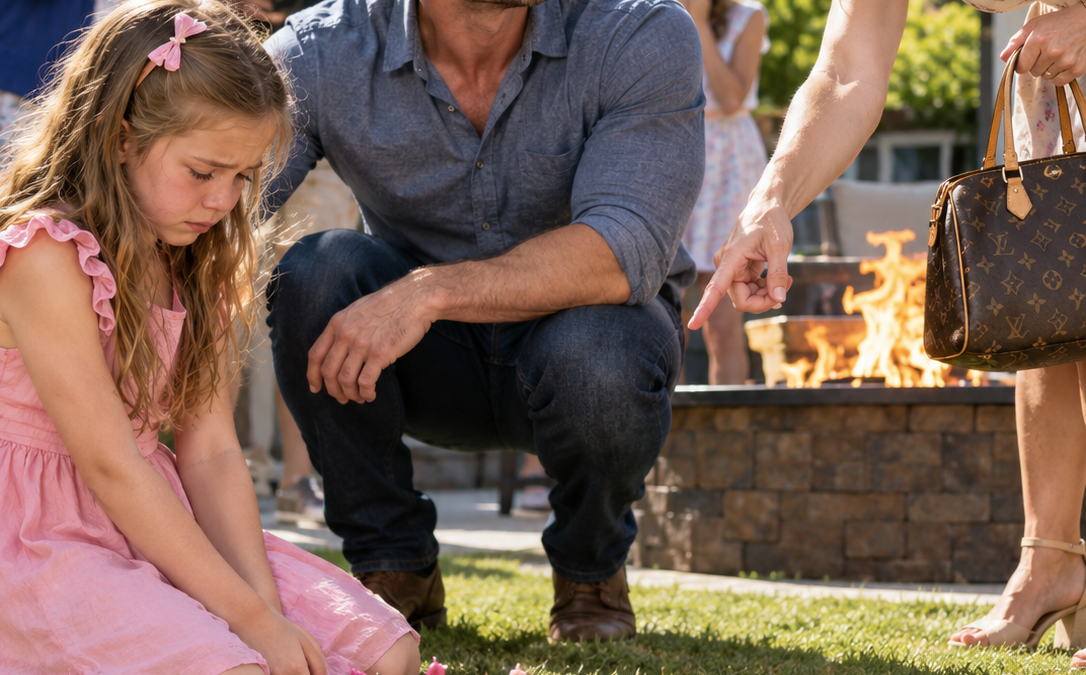
The cake hit the grass frosting-side down. That’s where I’ll start, because that’s the part I still see when I’m lying in bed. It didn’t make much noise. A three-layer strawberry cake doesn’t crash. It sort of slumps. It slides off the cake board, folds over on itself, and suddenly there’s pink frosting on a dandelion and eight candles pointing toward the fence. My daughter Maisie was standing about two feet away, holding out the box of matches. She wasn’t allowed to strike them. That was the deal we’d made that morning. She got to hold the box. I got to do the striking. And she got to say “now” when it was time to light the candles. She never got to say “now.”
My sister-in-law Courtney was on the other side of the picnic table, sliding her purse back onto her shoulder. She’d walked past the table and swung the thing off her shoulder in a big, lazy loop, the way you’d swing a bag of ice into a cooler, and the bottom corner had caught the edge of the cake board. She looked down at the cake in the grass. Then she looked across the table at Maisie.
Then she said, “Oops. It’s just cake.”
There were about twenty people in my backyard. My mother had a paper plate in each hand. My brother Kevin was at the grill with a brat on a fork. My buddy Gabe from work had his two boys over by the sandbox. Nobody moved. Somebody’s phone was still playing music in the kitchen window, a song about summer even though it was April.
Maisie didn’t cry. That’s the part I think about most.
She’s a crier normally. She cries at commercials with old dogs in them. She cried last summer when the ice cream truck came down our street playing its song and didn’t stop. But she didn’t cry that afternoon. She just stood there, staring at the ground, at the cake, at the toes of her own sneakers. Then she put the box of matches behind her back, like she was the one who’d done something wrong.
Courtney turned around to say something to my mom. She set her purse down on the patio chair next to the fire pit to free up her hands, because Courtney talks with her hands. The fire pit had been going since noon. We’d planned to make s’mores after the cake.
I walked over, picked the purse up by both handles, and set it in the fire.
I didn’t throw it. I’d like that on the record, because a lot of people tell the story like I threw it. I set it down on the coals the way you’d slide a casserole into the oven. Then I looked at Courtney and said, “Oops. It’s just a bag.”
Courtney screamed. Not words at first. Just one long, high sound, like a smoke alarm when you burn toast. Then came the words.
“That’s Louis Vuitton! That’s a two-thousand-dollar bag! Kevin! Kevin!”
Kevin dropped the brat in the grass, which was a waste of a perfectly good brat. He ran for the garden hose, but the garden hose was coiled up behind the garage, where it lives, and by the time he dragged it around the corner and got the water going, the handles were gone.
They didn’t burn. They melted.
They dripped down into the coals like candle wax and hissed. The brown checkered part bubbled up, shiny and puckered, and the smell coming off it was not a leather smell. Gabe said later it smelled exactly like the time his oldest boy left a pool float on the grill. I’ll come back to that.
Courtney grabbed the grill tongs and tried to fish the purse out, but Kevin was spraying the whole pit by then, so she got a face full of steam. The purse ended up sitting in a puddle of gray, ashy water, looking like something that had been run over on the highway.
“You’re paying for that,” Kevin said.
He kicked over a patio chair. Then he kicked over a second one, which seemed unnecessary, since the first one had made the point.
“Every penny, Heath. Two thousand dollars.”
My mom said, “Heath, what on earth is wrong with you?”
I said, “Party’s over. Thanks for coming, everybody.”
Courtney pointed at the dripping purse in the pit. “Keep your garbage. You’re buying me a new one.”
Then she grabbed her kids by the wrists and went out the side gate. Kevin followed her with the hose still running in the grass.
There was a white Tahoe idling at the curb out front. It had been sitting there maybe twenty minutes. I’d noticed it because it was parked in front of my neighbor’s mailbox, and he gets touchy about that. Courtney didn’t go to her own car. She walked straight to the Tahoe, leaned into the driver’s window, and talked to whoever was inside for about a minute, her hands moving the whole time. Then the Tahoe pulled away, and Courtney stood in the middle of the street watching it go.
I remember thinking that was strange. I didn’t think much more about it than that. I had other things to do, like picking a birthday cake up off my lawn with a snow shovel.
I’m Heath. I was thirty-six that spring.
I install commercial glass in Rapid City, South Dakota. Storefronts, mostly. Strip malls, dentist offices, the big front windows on the new car wash out on Elk Vale Road. If you’ve ever walked into a building in this town and the door didn’t stick, there’s a fair chance that was me.
I have a habit I picked up from my first foreman, an old guy named Orin, who’d been setting glass since the Nixon years. When you finish a pane, before you pack up your tools, you tap it twice with your knuckle. Not hard. Just two taps, like knocking on a door on your way out. Orin claimed it was to check that the glazing was seated right. And maybe it is, but I think he just liked doing it. He retired. I kept the habit. Every pane, every job, twelve years. My crew thinks I’m a little touched.
Maisie was turning eight that day. It’s been the two of us since she was two. Her mom moved to Tucson with a man who sells solar panels, and she calls on birthdays and Christmas and sends gift cards that sometimes show up on time. I’m not going to say anything bad about her. I’ll just say that when your mom lives eleven hundred miles away, your birthday cake matters a little more than it otherwise might.
That’s why the cake took two days.
Maisie wanted to make it herself, from scratch. The strawberry kind, from a recipe card my grandma wrote out for me when I moved into my first apartment. Friday night, we baked the layers, and the middle one came out lopsided because I kept opening the oven to check on it. Saturday morning, we made the frosting. Maisie decorated the cake herself, and it was crooked, and there was a bald spot on one side where she’d licked the knife and gone back in. I thought it was the best-looking cake I’d ever seen.
She wrote her own name across the top in pink gel. The S came out backward. She decided to leave it.
So that was the cake.
Courtney is married to my older brother, Kevin. Kevin is thirty-nine. He’s the parts manager at the John Deere dealership on the east side of town, and he has been my parents’ favorite since roughly the day he was born. I don’t say that bitterly. It’s just a fact, like the weather.
My mom, Lorie, and my dad, Dwayne, still live out past Box Elder in the house we grew up in. When Kevin married Courtney twelve years ago, my mom more or less adopted her. Courtney is her girl. Courtney calls her every day. Courtney picks out her Christmas sweaters.
And Courtney has a business.
I need to explain the business because it matters.
About two years before all this, Courtney started a Facebook group called Courtney’s Closet. “Pre-loved designer,” she called it. She sold used purses and wallets and sunglasses, the expensive kind, the kind with the letters printed all over them. She said she bought them at estate sales and consignment shops in Denver and Minneapolis and resold them here, where there’s nowhere to buy that kind of thing.
Every bag came with a little card guaranteeing it was one hundred percent authentic.
The group had something like four thousand people in it. Half the women in my mom’s church circle had bought from her. My mom brought it up at every holiday. Courtney’s an entrepreneur. Courtney had such a good month.
At Thanksgiving, my dad, who worked thirty-one years at the cement plant and thinks a purse is a purse, said, “Who knew there was money in used pocketbooks?”
My mom gave him a look like he’d spit in the gravy.
Fine. Good for her. I don’t care what anybody sells.
What I cared about was how she was with Maisie.
Courtney never liked Maisie, and I could never figure out why. I still only half understand it. Her own kids are Brinley, who’s ten, and Paxton, who’s six. My mom loves all three of her grandkids, but my mom can only really love one of them at a time. And for a while there, for whatever reason, it was Maisie’s turn.
Maisie draws, and Mom put her drawings on the fridge. Maisie asked Mom to teach her to sew, and Mom did, at the kitchen table, two Sundays in a row. I think Courtney counted every bit of that like it was being taken out of her own kids’ account.
She’d say things. Never big things.
“She’s a lot, isn’t she?”
“Must be hard for her, not having a mom around. They get so needy.”
At Easter, Maisie was telling a long story about her class guinea pig, and Courtney said, loud enough for the whole table to hear, “Does she ever stop?” Then she laughed like it was a joke.
My mom laughed, too.
I took Maisie outside to look for eggs we’d already found.
The day of the party, Courtney showed up forty minutes late. She said she’d had to run to the post office to pick up a shipment. She said it the way people say things when they want you to ask a follow-up question. Nobody asked.
Here’s what happened about five minutes before the cake. I didn’t know it mattered until later.
My mom walked over to the picnic table, looked at Maisie’s cake, and said, “Oh, honey, that’s prettier than the one we bought for Brinley’s party.”
She meant it nicely. She probably forgot she’d said it a minute later.
But Courtney was standing right behind her.
And I watched Courtney’s face do something.
A few minutes after that, she came walking past the table with her purse on her shoulder.
So that’s everybody. Back to that night.
Maisie was quiet at bedtime. She brushed her teeth without being told twice, which is how I knew something was wrong.
When I tucked her in, she asked, “Was it because I made it wrong?”
“No. The S was backward. The S was perfect.”
“Then why’d she do it?”
I didn’t have a good answer. I told her some people get upset when other people are happy, and they don’t know what to do with that feeling, so they knock something over.
She thought about it.
“Like Paxton?”
“Sort of like Paxton. Except Paxton’s six.”
She asked if I was in trouble for the purse. I said maybe a little. She asked if I was sorry.
I thought about lying to her and decided not to.
“No,” I said. “I’m not sorry.”
She nodded like that settled something, rolled over, and was asleep in about two minutes.
Kids.
Sunday morning, I went outside with a cup of coffee and a rake to clean up the fire pit. The purse was still sitting in the ash where Courtney had left it. It didn’t look like a purse anymore. The checkered canvas had shrunk into a stiff, shiny shell, like the skin on a pudding. The handles were gone except for two little metal rings.
The bottom had burned clean through, but one side had been pressed down into the wet ash when Kevin hosed it. On that side, the inside zipper pocket had mostly survived.
The zipper pull was still there. Gold-colored. A little scorched.
I unzipped it.
I’m going to tell you what was in that pocket. Just not yet.
Partly because that’s how it went for me. It took me a long time to understand what I was holding. And partly because if I told you now, you’d see everything coming.
None of them did.
Here’s what I did with it. I put it in a gallon freezer bag. Then I put the freezer bag in the fireproof box in my closet, where I keep Maisie’s birth certificate and the title to my truck.
I put what was left of the purse in a black contractor bag, tied it off, wrote DON’T on it in marker, and set it on the shelf in the garage above the snow tires.
Then I finished my coffee.
Courtney called at a quarter after ten that same morning. I’ll give her that much. She didn’t waste time.
She wasn’t calling to apologize.
“I need my purse back.”
“You told me to keep it.”
“I said that because I was upset. I need it back for insurance.”
“What insurance?”
“Homeowners. They need the item. They need to see it.”
“Then they can come see it.”
There was a pause.
“Did you throw it away?”
“No.”
“So it’s still there?”
“It’s here.”
“Then I’m coming to get it.”
“No.”
“It’s my property, Heath.”
“You told me to keep it, Courtney. In front of twenty people and whoever was in that Tahoe.”
The pause was longer this time.
“Who was that, by the way?” I asked.
“A friend.”
“Huh.”
“Just give me the bag.”
“There’s nothing in it you’d want,” I said.
Then I hung up.
Kevin called that afternoon.
Kevin’s always calmer on the phone than he is in person. He talked for a while about how upset Courtney was, how the bag was an anniversary present, how I’d humiliated her in front of the whole family, and how I needed to make it right.
I let him talk.
Then, right at the end, after a pause long enough that I thought the call had dropped, he said, “You didn’t go through it, did you?”
“Through what?”
“The purse.”
“Why would I go through your wife’s purse, Kevin?”
“No reason. Never mind. Forget I asked.”
I didn’t forget he’d asked.
My mom called Monday. She wanted an apology. Not to her. To Courtney. In person, and also written in Courtney’s Facebook group where people could see it.
“She’s had a terrible week, Heath. She’s running a business. Do you know what people are saying?”
“What are they saying?”
“That it wasn’t—never mind what they’re saying. You need to apologize.”
“Did Courtney apologize to Maisie?”
“That was an accident.”
“It wasn’t.”
“You don’t know that.”
“I watched it, Mom. So did you.”
“You’ve always had a temper. Ever since you were little.”
“I set a purse down. Courtney swung one.”
“You will apologize to that girl.”
“No.”
She hung up on me.
My mom has hung up on me maybe five times in my life, and two of them were that year.
My dad called Tuesday night. My dad doesn’t call. When he does, it’s usually because the snowblower won’t start.
“Your mother’s pretty upset,” he said.
“I know.”
“That was something you did.”
“I know.”
There was a long quiet, the kind my dad is good at.
Then he said, “Was it a real nice cake?”
“It was a real nice cake, Dad.”
“Well,” he said.
And that was the whole call.
Now, the pool float.
Gabe told the pool-float story to the guys at the lumberyard. His wife told it at her volleyball league. Rapid City is a big small town, and by the middle of May, I had a woman I barely knew stop me in the hardware store and ask, “Was it real? The purse?”
“You’d have to ask Courtney,” I said.
A week after that, a friend of mine sent me a screenshot.
Courtney had posted in her group. I’ll give you the gist. Some people in her own family had destroyed her authentic Louis Vuitton out of pure jealousy, and now they were spreading lies about her business. Every item in Courtney’s Closet was one hundred percent authentic, and she stood behind every single bag.
My mom had commented underneath it.
“Proud of you, sweetheart.”
There was one more comment. It was gone the next time I looked, but my friend had screenshotted that, too.
It was from Marlene Hagen, a retired school secretary from my mom’s church.
Marlene wrote, “Courtney, can I bring mine by so you can look at it? Mine gets a funny smell when it’s warm in the car.”
That summer, I spent a lot of evenings at the kitchen table after Maisie went to bed, sitting with my laptop and that freezer bag.
I’m not a purse guy. I had to learn a lot of words I never planned on knowing. Date codes. Heat stamps. Vachetta, which turns out to be the leather they use on the handles of the real ones. Untreated cowhide.
It doesn’t melt.
It burns. It goes black and curls up like bacon. It does not drip into a fire pit like candle wax.
I read until about one in the morning most nights. Then I’d put the freezer bag back in the fireproof box and go to bed.
In June, Brinley turned ten. The party was at my parents’ house.
Maisie wasn’t invited.
She found out at swim lessons at the rec center, from Paxton, who told her there had been a bounce house and a snow cone machine. She came home and told me about it while she ate her macaroni. Real casual, like she was reporting the weather.
Then she asked if she could have more cheese on top, and I gave her about twice as much cheese as anybody needs.
She didn’t cry that time either.
I was starting to wish she would.
Also in June, my mom called for the first time in about six weeks. She didn’t mention the purse. She didn’t mention Brinley’s party.
She said she and Dad had their forty-first anniversary coming up in July, and Courtney was holding a bag for her.
“A Speedy,” Mom said, like I’d know what that was.
By then, I did.
“Don’t buy anything from her,” I said.
“Excuse me?”
“Don’t buy anything from Courtney. That’s all.”
“Why on earth not?”
“I’m just asking you not to.”
“Because you’re jealous of her. You’ve always been jealous of what your brother has.”
“I’m asking you not to, Mom. Once. I’m not going to ask again.”
She bought it.
On the Fourth of July, she posted a picture of herself holding it in front of the grill, with my dad behind her in his cement-plant cap, squinting.
The caption said, “41 years and my girl Courtney found me the perfect gift.”
My girl.
In August, Kevin texted me. It was the first time I’d heard from him since the phone call.
Paxton had put a baseball through the patio slider on their house. Double-pane. He asked if I could come out Saturday and replace it. Family rate.
I wrote back, “No.”
He wrote, “Seriously? Over a purse?”
I wrote, “Over a cake.”
Then I sent him the number of a guy across town who does good work and charges about twice what I do.
About ten minutes later, Kevin texted again.
“You know she’s going to sue you.”
I wrote, “Okay.”
That same month, I ran into my mom at the grocery store on Mount Rushmore Road.
Well, I saw her.
She was two lanes over at the checkout with the new bag on her arm. If she saw me, she didn’t let on. I looked at that bag for a long time from where I was standing. I looked at the handles, which were a nice pale tan, the way they’re supposed to be when they’re new. I looked at the gold zipper pull.
Then I paid for my milk and went home.
The papers came in September by certified mail.
Small Claims Court. Pennington County.
Courtney, plaintiff. Me, defendant.
She was asking for two thousand dollars for the destruction of an authentic Louis Vuitton Neverfull handbag. The hearing was set for the fourteenth of October.
The word authentic was in there twice.
I’ve been served papers before, for a contract dispute on a dentist’s office in Sturgis, and I can tell you that you don’t usually see a lot of adjectives in court papers.
She wanted it written down by somebody official.
That was the whole point. Not the two thousand dollars.
She wanted a judge to say it was real so she could post that in her group.
That Saturday, my mom, my dad, and Kevin showed up at my front door. Courtney stayed home.
They had a deal.
Kevin did the talking. I’d pay Courtney the two thousand dollars, and I’d post an apology in her group, and she’d drop the case.
Kevin even had the apology already written. He held his phone out so I could read it.
It said I had destroyed Courtney’s authentic designer bag in a moment of anger, that I was ashamed, and that the rumors about her business were false and had nothing to do with her.
“I never said anything about her business.”
“I said your friend did. People think you’re behind it.”
“So you want me to say the purse was real?”
“It was real,” my mom said. “Courtney showed me where Kevin bought it.”
“Where’d Kevin buy it?”
“Minneapolis,” Kevin said. “On a work trip.”
“Huh.”
“I said you’re going to lose, Heath,” my mom said. “It’s her word, and a whole backyard full of people watched you do it.”
“They did.”
“So pay her.”
“No,” I said. “I’ll see her in court.”
Kevin looked past me, down the driveway toward the garage. He looked at it for a long time.
“You don’t want to do that,” he said.
“Why not, Kevin?”
“Just don’t.”
My dad had been standing back in the yard the whole time, with his hands in his jacket pockets, looking at the fire pit. He didn’t say anything. He just looked at that fire pit like he was trying to do math.
They left.
Maisie had been sitting at the top of the stairs in her pajamas the whole time, which I should have guessed.
“Are you going to jail?” she asked.
“No. It’s small claims. It’s like the principal’s office for grown-ups.”
“Are you going to lose?”
“I’m going to pay something,” I said. “That part I’m pretty sure about.”
Maisie’s half birthday is the twelfth of October. We don’t usually do anything for it, but that year she asked if we could make the cake again.
Same recipe. Same three layers.
She called it a do-over.
So on the twelfth, after school, we made it again.
I didn’t open the oven once, and the middle layer came out flat. Maisie said that was cheating. She frosted it herself and left a bald spot on purpose, in the exact same place.
Then she wrote her name on top in pink gel, slowly, with her tongue sticking out of the corner of her mouth.
The S came out forward.
She looked at it for a while.
“It looks weird,” she said.
“You want me to scrape it off?”
“No,” she said. “I’m keeping it. It’s still mine.”
She got to say “now.”
I lit the candles.
We ate about a third of the cake standing at the counter, and she asked if she could bring a slice to court for the judge.
I told her that was probably against some kind of rule.
The fourteenth of October was cold and bright.
The small-claims hearings in Pennington County are held in a little courtroom on the second floor that looks like a school library. A row of tables in front, a few rows of chairs in back, and a judge up at a desk that’s only a little higher than everybody else’s.
Ours was Judge Ellingsson, a woman about sixty, with her reading glasses on a beaded chain.
Courtney sat at the plaintiff’s table in a blazer. Kevin sat next to her. My mom sat in the first row behind them with the new bag on her lap, both hands folded on top of it.
My dad stood in the back by the door with his cap in his hands, like he hadn’t decided yet whether he was staying.
I sat at the other table by myself.
I had a manila folder and a black contractor bag with DON’T written on it.
Courtney went first.
She was good, I’ll say that. She’d practiced.
Her husband had bought her the purse for their tenth anniversary at a store in Minneapolis on a work trip. Two thousand dollars and some change. It was the nicest thing she owned.
Her brother-in-law had a long history of jealousy and a temper. At a family birthday party, in front of twenty witnesses, he’d taken it and burned it on purpose.
She’d suffered a great deal of embarrassment, and her business had suffered, too, because of rumors.
Judge Ellingsson asked if she had a receipt.
“It was a gift,” Courtney said. “Kevin paid cash.”
The judge looked at Kevin.
“Sir?”
“Cash,” Kevin said. “Yes, Your Honor. Two thousand dollars in cash. I’d been saving up.”
“Do you have a bank withdrawal, the box it came in, a credit card statement, anything showing the purchase?”
“We threw out the box,” Courtney said.
“All right,” the judge said, and wrote something down.
Then she looked at me.
“Sir, did you put the plaintiff’s purse in a fire?”
“Yes, ma’am.”
“Why?”
“She knocked my daughter’s birthday cake into the grass with it and said, ‘Oops, it’s just cake.’ My daughter was turning eight. She baked it herself. So I set Courtney’s purse in my fire pit and said, ‘Oops, it’s just a bag.'”
Somebody in the back row laughed and turned it into a cough.
“That’s not a defense,” the judge said.
“I know it’s not, ma’am. I’m not here to say I didn’t do it. I did it. I’m here about what it was worth.”
She took her glasses off and let them hang on the chain.
“Go ahead.”
I opened the contractor bag and set the purse on the table.
Or what was left of it.
The shrunken shell, the two metal rings, the burned-out bottom.
It still smelled like a pool float.
I could see Kevin’s jaw working.
“The handles on a real one are made out of untreated cowhide,” I said. “Leather burns. It goes black. These melted. I’ve got about ten people who’ll tell you they watched them drip.”
“Of course it melted,” Courtney said. “You put it in a fire.”
“That’s fine,” I said. “That’s not really what I came to show you.”
I opened the manila folder and took out the freezer bag.
Then I set the freezer bag on the table and unzipped it.
Here’s what was in that zipper pocket.
The first thing was an invoice folded into quarters. One corner was scorched brown, but you could read all of it.
It was a packing list from a shipping company in Guangha, China.
One line item.
Neverfull. Size medium. Monogram.
Quantity: 40.
Unit price: $58.
It had shipped on the second of April, and it was addressed to Kevin at their house on Fairmont Boulevard.
The second thing was a stack of ten little cream-colored cards with gold edges. Across the top of each one, in fancy script, it said:
Courtney’s Closet Certificate of Authenticity.
Under that:
This item has been personally verified 100% authentic.
There was a blank line where you’d write in what the item was, and at the bottom, printed right onto the card, was Courtney’s signature.
The third thing was a sticky note in Courtney’s handwriting.
It said:
“Shauna R. Neverfull, medium, $1,150, 3:00 at H’s.”
H’s as in Heath’s.
As in my house.
As in my daughter’s eighth birthday party.
“She buys these forty at a time for fifty-eight dollars apiece,” I said. “And she sells them for eleven hundred, twelve hundred dollars, with one of these cards.”
I looked at the purse on the table.
“That one in my fire pit? She’d just picked up the box that morning at the post office. She was going to sell one to a woman in a white Tahoe in front of my house during the cake.”
Courtney had gone very still.
“That’s why she wanted the purse back so badly the next morning,” I continued. “Not for insurance. She’d had the certificate in her purse, and she’d lost the sale. She needed to know if I’d found the rest.”
“Those aren’t mine,” Courtney said. “He planted them. He’s had six months.”
The judge picked up the invoice by one corner and read it. Then she looked over the top of it at Kevin.
“Sir, is this your address?”
Kevin didn’t say anything.
“Sir?”
“I think I’d like to talk to a lawyer,” Kevin said.
“This is small claims, sir. You’re welcome to talk to a lawyer. Not right now, though.”
And then my mom stood up.
I don’t think she meant to. I think her legs just did it.
She’d been sitting there with that bag on her lap the whole time, and I’d watched her look down at it while the judge was reading.
She unzipped the inside pocket.
She took out a little cream-colored card with gold edges.
Then she walked up to my table, passed Courtney without looking at her, and laid it down next to the stack of blanks.
Same card.
Same gold edge.
Same printed signature.
Hers just had the line filled in.
Speedy 30 Monogram.
In Courtney’s handwriting.
Then my mom turned her bag over and looked at the zipper pull.
She looked at it the way I’d looked at it in the grocery store.
“Courtney,” she said, “how much did I pay you?”
“Lorie, please sit down.”
“Fourteen hundred dollars. I paid you fourteen hundred dollars.”
Her voice was very flat.
“Marlene bought one. Joanie Schaefer bought two. I told them to. I told the whole circle. I told them you were an entrepreneur.”
Nobody said anything for a while.
In the back of the room, my dad put his cap on and then took it off again.
“All right,” Judge Ellingsson said. “I’m going to stop everybody here.”
She put her glasses back on.
“Whether any of these items are counterfeit and what anybody did with them is not the question in front of me today. Some of that may be a question for somebody else. The question in front of me is the value of the item the defendant destroyed, which he admits he destroyed.”
She looked down at her notes.
“The plaintiff has offered no evidence of a two-thousand-dollar purchase. The defendant has offered an invoice showing items of that exact description purchased for fifty-eight dollars apiece, which he says came out of the plaintiff’s own purse and which is addressed to the plaintiff’s own house.”
She wrote something down.
“Judgment for the plaintiff in the amount of fifty-eight dollars.”
Courtney opened her mouth.
The judge held up one finger.
“Sir,” she said to me, “next time, set it on the porch.”
“Yes, ma’am.”
“Ma’am,” she said to Courtney, “I would strongly encourage you to speak with an attorney before you sell anything else to anybody.”
I paid at the clerk’s window downstairs.
I gave her three twenties, and she gave me two dollars back and a receipt.
Courtney was sitting on a bench in the hallway with her coat on her lap. Not crying. Just looking at the wall.
I walked over and set the receipt on the bench next to her.
“For the bag,” I said.
Then I looked at her.
“It’s just a bag, Courtney.”
She didn’t pick it up.
I don’t know if she ever did.
Kevin caught up with me on the stairs.
“You could have just told me you had it,” he said. “Six months. You could have just told me.”
“You could have just asked your wife what was in her purse.”
I looked at him.
“You knew. Your name’s on the invoice, Kevin.”
He didn’t have anything for that.
He just stood there on the landing and stared at the floor.
I’d seen that exact look before, on an eight-year-old in April.
My dad was waiting in the parking lot, leaning against his truck. My mom was already in the passenger seat with the door shut and the bag in the footwell by her feet, like she didn’t want it touching her.
“How long have you had that?” Dad asked.
“Since the morning after the party.”
“And you sat on it six months?”
“I told Mom not to buy one.”
He looked over at my mom through the windshield.
“She said you were jealous.”
“I know what she said.”
He rubbed his face with one hand, all the way down, like he was wiping off a window.
“Fourteen hundred dollars,” he said.
Then he got in the truck.
Courtney’s Closet disappeared about a week later.
The whole group. Four thousand people. Gone overnight.
Four thousand people noticed.
Marlene Hagen didn’t wait to hear it from anybody. She took her bag and the screenshot of Courtney’s post, the one about standing behind every single bag, and filed a complaint with the South Dakota Attorney General’s Consumer Protection Office.
Then she called the other women in the church circle and told them to do the same.
They did.
So did a lot of women who’d never set foot in my mom’s church.
By Christmas, Courtney had signed an agreement with the state. She’d refund every buyer who came forward, and she’d never sell anything advertised as designer again.
Thirty-one buyers came forward.
The refunds came to a little over thirty-four thousand dollars.
Courtney didn’t have thirty-four thousand dollars.
Neither did Kevin.
They emptied their savings, and Kevin cashed out part of his retirement from the dealership, penalties and all. They sold Courtney’s car.
She drives his old pickup now. It’s got a John Deere sticker on the back window, which I’m told she hates.
My mom had to call the women in her circle one by one, because she was the one who’d sent most of them to Courtney in the first place.
She’d run the circle’s fall bazaar for eleven years.
That November, somebody else ran it.
My mom said it was for health reasons.
Everybody knew what it was for.
Courtney doesn’t call her every day anymore. I don’t know if she calls at all.
The Speedy is in the hall closet at my parents’ house. My dad told me that. He said my mom won’t throw it away because she paid fourteen hundred dollars for it.
My mom called me once in November.
“You humiliated this family.”
“I told you not to buy it.”
“You could have told me why.”
“You’d have told her,” I said.
She didn’t say anything.
Then she hung up.
That was the second time.
Courtney never apologized to Maisie.
I want to be clear about that because people always ask.
She never did. And at this point, I don’t expect her to.
Maisie doesn’t ask about it anymore.
Kevin texted me once more around Thanksgiving.
“You could have just given it back.”
I wrote, “She could have just let my kid have her cake.”
He read it.
He never wrote back.
In November, I did a job downtown for a woman named Karen who was opening a bakery on St. Joseph Street.
The biggest piece was the display case. Curved glass on the front, the kind where you can see every cake from three angles. It took me most of a Saturday.
When I finished, I tapped it twice with my knuckle, like always.
Karen asked me what that was for.
I told her about Orin. I told her it was to make sure the glass was seated right, and that maybe it was really just a way of saying you’re done, and it’s good, and you can leave it alone now.
She asked if I had kids.
I said I had a daughter who bakes.
She asked if I wanted to order a birthday cake for her sometime.
“No thanks,” I said. “She makes her own.”
Maisie turns nine this April.
She’s already got the recipe card out on the counter, held down with the salt shaker so it doesn’t get lost.
Three layers.
Strawberry.
She told me last week she’s going to put the S on backward again, on purpose this time, so everybody knows it’s hers.
And there’s one new rule at our house for parties.
Purses stay in the








