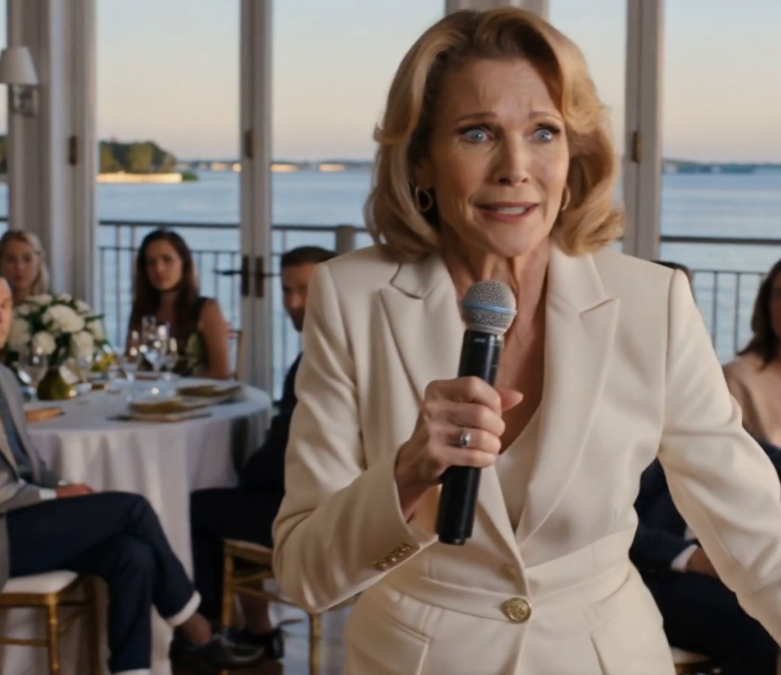
Mom took the mic at my engagement party and said: “She dropped out of med school and her first marriage failed. That’s who you’re marrying.” Dad stood up. My fiancé beat him to it. “Should I tell them why she had to leave med school?” Mom’s glass slipped from her hand. “Don’t.”
THE STORY SHE TOLD ABOUT ME
She didn’t wait for a private room. She waited for the toast.
Seventy-eight people. My engagement party. A microphone. His parents sitting in the front row.
“She dropped out of medical school,” my mother said, smiling. “Her first marriage failed. That’s who you’re marrying. I thought you should know before you make the same mistake we already paid for.”
The room went silent.
My father stood up, ready to rescue her performance, but my fiancé beat him to it. He didn’t shout. He simply asked one question.
“Should I tell them why she had to leave medical school?”
My mother’s wineglass slipped from her hand. It shattered at her heels.
“Don’t.”
Not I’m worried. Not Sweetheart.
Just one word.
“Don’t.”
It was the first time I’d ever heard fear in my mother’s voice. She thought she still owned the story. She didn’t know Ethan already had the original, and she certainly didn’t know that someone else in that room had read it years before I had.
That night, she came to warn him about me. She left as the woman everyone in the room had been warned about.
If this story has already struck a chord with you, like, subscribe, and tell me where you’re listening from, along with your local time. I want to know where everyone is hearing this story.
My name is Valerie Shanks. I’m thirty-three years old, and this is the story of the night my mother tried to destroy my wedding and lost control of the story she’d been telling about me for seven years.
To understand why a single question from my fiancé was enough to make her drop a wineglass, you first have to understand how my mother worries.
I’ll start with a Sunday phone call.
One week before the party, on Sunday, April 19, my phone rang at exactly four in the afternoon, just as it had at four o’clock on Sundays for as long as I could remember.
I was standing at the kitchen sink in our apartment in Pittsburgh. Before answering, I did what I always did. I glanced at the clock on the microwave. I liked knowing how long our conversations lasted, although I’d never told anyone that.
“There she is,” my mother said when I answered. “I was starting to think you’d forgotten me.”
“It’s four, Mom. You called at four.”
“I know, sweetheart. I’m teasing.”
She immediately launched into a discussion of the engagement party. She talked about the venue at the Bayfront Hotel in Erie, the room with enormous windows overlooking the water, and the menu she’d selected because Ethan’s parents would want something classic.
She’d chosen the flowers and the music. She’d even sent me a spreadsheet containing the seating chart, with every table color-coded.
I hadn’t been consulted about any of it. I hadn’t expected to be.
Then her voice softened.
This is the part I want you to remember.
“Are you sleeping enough? You sound tired.”
“I’m fine, Mom.”
“You say that.”
“I’m fine.”
“I’m just worried about you, sweetheart. That’s all this ever is.”
I told her I knew. I told her I loved her.
When I finally hung up, the microwave clock told me the conversation had lasted nineteen minutes. I placed my phone facedown on the counter and stood there for a moment, my hands still submerged in the dishwater.
From the living room, Ethan called out, “She asked about sleep again?”
I didn’t turn around.
“She always asks about sleep.”
“I know,” he said. “I’ve started counting.”
I should tell you who Ethan is, because the way he listens is the reason this story ends the way it does.
Ethan Puit is thirty-seven years old. He’s a psychiatric nurse at a hospital in Pittsburgh, where he works in the inpatient behavioral health unit. A few nights each week, he’s assigned to the emergency department to assess patients who arrive unable or unwilling to explain what’s wrong.
I met him in that emergency department, but I’ll get to that.
The evening after my mother’s Sunday call, Ethan came home from a shift and told me about a patient. He never shares identifying details or confidential information, only the general shape of a situation.
This particular patient was a man in his sixties whose daughter had brought him to the hospital. The daughter had done nearly all the talking. She’d arrived with a list of medications he’d supposedly stopped taking, things he’d allegedly said, and a detailed history that sounded as though she’d rehearsed it.
Ethan had spent forty minutes speaking with the man alone.
“Half my job is figuring out who’s telling the story and why,” he said as he sat on the edge of our bed, unlacing his shoes. “The daughter had one story. The patient had a different one. My job is to write down what I see, not what I’m told.”
“Which one was true?”
“Doesn’t matter tonight. I’m telling you because I keep thinking about your mom.”
I didn’t answer.
He didn’t push me. Instead, he finished removing his shoes and said, “I’m driving on Saturday. You don’t need to drive.”
Later, after he’d fallen asleep, I walked over to the desk in the corner of our bedroom and opened the top drawer.
There was a pale yellow folder inside. I’d placed it there in January of the previous year, and I hadn’t opened it since.
For a long time, I simply stared at its corner. Then I closed the drawer.
I told myself I didn’t need to look inside again.
I was about a week away from discovering just how wrong I was.
The seating chart arrived on Tuesday. Seventy-eight names, arranged in neat, color-coded groups. I studied the document the way you study something you’re afraid of, searching for the problem before you allow yourself to notice anything else.
Table one was positioned directly beside the stage. It contained four names I recognized from my mother’s world. Beverly Ostrander, the board chair of my mother’s foundation, was listed first. Three other board members occupied the remaining seats.
Table two was reserved for Ethan’s parents, Walt and Janine.
I scrolled farther down.
My friend Claire was assigned to table nine.
I called my mother.
“Why is the board coming to my engagement party?”
“Beverly has known you since you were twelve.”
“Mom, there are a lot of people I don’t know.”
“They’re my family in Erie, Valerie. It’s a beautiful night, and I want to share it. Don’t make this difficult.”
I hung up and stared at the seating chart again. My thumb hovered over Claire’s name. I considered calling my mother back and asking her to remove Claire from the guest list.
It wasn’t because I didn’t want Claire there.
Claire had been my roommate in medical school, and in my mother’s presence, she represented a part of my past I didn’t want anyone touching.
Ethan glanced over my shoulder.
“Keep Claire on the list.”
“It’s easier if she’s not there.”
“Keep her on. Not for the party. For you.”
He said it gently, but his eyes lingered on that seating chart longer than necessary.
I noticed. I didn’t ask.
He had a reason I didn’t know about yet.
On Wednesday evening, Ethan stood in the kitchen doorway while I was cutting an apple. He told me there was something he needed to say, although he’d rather wait until after the party.
Then he stopped. I watched him reconsider.
“Forget that. I’ll ask you straight. If she says something about the past on Saturday, in front of everyone, do you want me to stay quiet?”
Before answering, I put down the knife.
That’s the detail I remember most clearly. I put down the knife because I couldn’t say yes, and I couldn’t say no.
To answer his question, I would have had to explain what I’d believed about myself for seven years.
So I started at the beginning.
I was seventeen the first time my mother told my story for me.
It happened at a cross-country meet in October 2010, in Erie, Pennsylvania, where I grew up. I’d run the final half mile with almost nothing left in my legs. When I crossed the finish line, I collapsed.
Dehydration. That was all it was.
My mother drove me to the emergency room, where we waited for four hours. When the doctor finally came in and asked how I’d been feeling, my mother answered before I could open my mouth.
“She skips meals when she’s stressed. She’s under so much pressure with school. I’ve been worried.”
I hadn’t skipped a meal in months, and I said so.
My mother patted my arm and explained to the doctor that I was a perfectionist who didn’t like admitting when she was struggling.
The doctor wrote something down.
They gave me two bags of intravenous fluids and sent me home.
As we were leaving, my mother took the little scissors attached to her keychain, cut the plastic hospital bracelet from my wrist, and placed it in her wallet.
I asked her why.
“I told them everything, sweetheart. You don’t have to worry about a thing.”
I thought that was love.
I want to be fair to the girl I was back then. It looked like love.
My mother is Diane Shanks. She’s sixty-one now, and for most of my life, she’s run the Harbor Light Family Foundation, a nonprofit organization in Erie that provides grants to families in crisis.
People in our town speak her name the way they speak about a good church. She’s respected, admired, and trusted.
She has never once raised her voice at me.
She doesn’t need to.
My mother has a special voice she uses when she’s worried. It’s softer than her ordinary voice, almost tender, and it works better than shouting ever could.
My father is Gordon Shanks. He’s sixty-three and used to work as an accountant. He’s the sort of man who immediately finds something to do with his hands whenever a room becomes tense. He washes a dish. He repairs a hinge. When my mother cried at the dinner table, he cleared the plates.
For thirty years, he had one sentence he used whenever anyone questioned her behavior.
“Your mother just worries. It’s how she loves.”
I believed him.
I believed him much longer than I should have.
I’d wanted to become a doctor since I was fourteen. Not because of my parents. In spite of them, although I wouldn’t have dared say that at the time.
I studied biology at a college in Pennsylvania and graduated in 2015. Afterward, I moved back to Erie, planning to work as a medical scribe for a year, take the MCAT, and apply to medical school.
It took three years.
I took the MCAT twice and went through two application cycles. During those three years, I lived in an apartment ten minutes from my parents’ house and worked at an urgent care clinic, entering doctors’ observations into patient charts while they conducted their examinations.
My mother called every day.
Once a week, she brought lunch to the clinic in a plastic container with a handwritten note taped to the lid.
Proud of you. Call me.
Every note. Every week.
One afternoon, the office manager stopped me in the hallway. She was laughing.
“Your mom called the front desk this morning. She wanted to know if you seemed emotionally okay. I told her you were great with patients.”
I laughed, too.
I want you to understand that I laughed.
At the time, I genuinely believed it was simply one of those things mothers did.
My acceptance letter arrived in the spring of 2018. I’d been admitted to a medical school in Pittsburgh, approximately two hours from Erie along Interstate 79.
For the first time in my life, I was going to live somewhere my mother couldn’t reach in ten minutes.
I told my parents over dinner.
My mother cried.
“Pittsburgh is so far away, Valerie.”
My father got up and started washing the pot while she cried. On his way past my chair, he rested a hand on my shoulder and delivered the same sentence he’d been saying my entire life.
“Your mother just worries.”
I moved to Pittsburgh in August 2018, when I was twenty-five.
My roommate was Claire Donnelly, a woman from Ohio whose laugh was loud enough to hear from the parking lot. I had a student identification card attached to a navy-blue lanyard, and during that first semester, I was so delighted to be there that I actually fell asleep wearing it twice.
Claire took a photograph both times.
I did well in medical school.
I want to say that plainly because of everything that happened afterward.
I did well. I was happy. And I called my mother every single day because that was our arrangement and because I hadn’t yet learned to recognize it as an arrangement.
Things changed in the summer of 2019.
My mother wanted me to come home and volunteer at the foundation. I’d been offered a research position in Pittsburgh, and I decided to accept it instead.
She said she understood.
She said it three times, which was how I knew she didn’t.
That fall, during my second year of medical school, I did something I’d never done before. I reduced our daily phone calls to Sundays.
I told her it was because of my course load. That was half the truth.
The other half was that I’d started noticing how I could hear the microwave clock counting in my head whenever my phone rang.
She reacted to the change the way she reacted to everything.
Softly.
“You’ve changed since you moved there,” she told me during a Sunday conversation in September. “I’m just worried about you.”
In October, a text message arrived while I was sitting in a lecture. I read it discreetly beneath my desk.
I called the school today just to check in. Don’t be upset.
I called her that evening from the stairwell of the library.
“Who did you call? What did you say?”
“They have a whole office for this, honey. Student support. I just wanted to make sure you knew it was there.”
“I know it’s there.”
“Then there’s no harm done.”
I heard a glass touch a table on her end of the line.
My mother drinks a glass of white wine at six o’clock every evening. I know the sound of that glass settling against her kitchen counter as well as other people know the melody of a familiar song.
I told Claire about the call that night. I said my mother was simply being my mother.
Claire was lying on her bed with a textbook resting on her chest. Without looking up, she said something I wouldn’t fully understand for years.
“Val, schools don’t take those calls lightly.”
I told her it was fine. I told her it was only one call.
It wasn’t only one call.
I know that now because I’ve read every single one of them.
But at the time, all I possessed was a text message and a familiar, uncomfortable feeling. And because that feeling was familiar, I pushed it aside.
November unfolded the way Novembers tend to unfold for second-year medical students. There were exams, insufficient sleep, and a cardiology block that consumed three weeks of my life.
On November 8, I received an email from the student affairs office asking me to stop by for a wellness check-in.
I went.
A woman with a kind face asked how I was managing the semester. I told her I was tired but fine. She asked whether I was sleeping, and I said mostly. She asked if I had a support system.
I told her I had a roommate and a mother who called every Sunday.
She smiled.
“That’s wonderful.”
And I left.
I thought it was something the school did for everyone.
I think about that meeting more than almost anything else in this story.
On November 12, our cardiology examination scores were released.
I got a ninety-one.
I sat in the library staring at that number for an entire minute before I allowed myself to believe it. Then I texted Claire.
91! Dinner’s on me.
She replied with a string of exclamation points.
We went to a Thai restaurant three blocks from our apartment. I paid for dinner, and Claire took a photograph of me holding up the receipt like a trophy.
I still have that photograph.
She still has the text message.
That matters later, so remember it.
That was Tuesday. I remember thinking it was the best week I’d had since moving to Pittsburgh.
On Thursday, November 14, my phone rang at nine in the morning. I recognized the number immediately. It was the school’s main line.
A woman asked if I could come to the student affairs office at eleven.
When I arrived, there were two people waiting in the room: the woman from my earlier wellness check-in and a man I’d never met, an associate dean.
He had a folder in front of him.
He didn’t open it.
He explained that the school had received communication from a family member expressing serious concern for my safety. Given the nature of the information reported, school policy required them to place me on an interim leave of absence, effective immediately, pending a formal evaluation.
I asked what had been reported.
He said he couldn’t share the specifics because the school took the confidentiality of people who raised concerns seriously.
I told him it was my mother.
He neither confirmed nor denied it.
“We’re not saying anything is wrong with you, Ms. Shanks. We’re saying we can’t take the risk.”
I asked about my examinations. I asked about the clinical skills training scheduled to begin in January. I asked whether I could continue attending lectures while the evaluation was being arranged.
Every question received essentially the same answer.
Not until the evaluation was complete and the school was satisfied.
I walked out of the building and tried to enter the library. I needed somewhere quiet to sit down and think.
I swiped my student identification card at the entrance.
The reader flashed red.
I tried again.
Red.
They’d deactivated my card before I’d even left the meeting.
I stood outside holding the lanyard in my hand. I remember its navy-blue fabric resting against my palm. I remember not crying, because I hadn’t yet understood that there was anything to cry about.
I called my mother from the parking lot.
She answered on the first ring.
“Are you okay? Tell me you’re okay.”
Not hello. Not What’s wrong?
Tell me you’re okay.
It was as though she’d been sitting beside the telephone, waiting for precisely that call.
“Mom, what did you say to them?”
“Valerie, calm down.”
“I’m calm. What did you say?”
“I told them I was worried. I may have said I was worried. Is that a crime now?”
She drove to Pittsburgh that afternoon. Two hours on the road.
She arrived carrying a bag of groceries and a printed list of psychiatrists in Pittsburgh, their telephone numbers highlighted in yellow.
While she talked, she rearranged the contents of my refrigerator.
She never once explained what she’d written in her email. She only said she’d been honest with the school about a mother’s concerns, that the school had clearly taken those concerns seriously, and that the situation presented an opportunity to get ahead of things.
“Ahead of what?”
“Sweetheart, you know how you get.”
I didn’t know how I got.
As far as I was concerned, I had never gotten any particular way. I was a second-year medical student who’d just earned a ninety-one on a cardiology examination.
But my mother was standing in my kitchen with a list of doctors. My school had confiscated my identification card. And that evening, my father called and spoke in the same measured voice he used whenever he discussed taxes.
“Just do what the school asks, Val. It’ll sort itself out.”
That was when it started.
Not the leave of absence. Something underneath it.
The thought that if my school, my mother, and my father all believed there was something wrong with me, perhaps the problem really was me.
I wouldn’t say that thought aloud for three years, but it moved into my head that night and made itself comfortable.
My mother slept on our couch.
Claire slept with her bedroom door locked.
I noticed.
I didn’t ask why.
My evaluation took place in January 2020.
It lasted ninety minutes and was conducted by a psychologist contracted by the school, a woman in her fifties named Dr. Helen Marsh. Her office contained a plant that desperately needed water.
She asked about my sleeping habits, my appetite, and whether I’d ever experienced thoughts of harming myself. I answered no. She watched me as I answered, and something in her expression told me she believed me.
Then she glanced down at her form.
“Can you tell me about the incident when you were seventeen?”
I had no idea what she meant.
“The hospitalization,” she clarified.
I explained the cross-country meet, the dehydration, and the two bags of intravenous fluids.
She stopped writing.
For a moment, she placed her pen on the desk and simply looked at me. Then she picked it up, wrote something on her form, and underlined it.
She asked about my medications.
I told her I’d never taken any psychiatric medication.
She asked whether I’d stopped taking anything recently.
I told her there was nothing to stop taking.
At the end of the appointment, she closed her folder and asked one final question. It was the strangest question anyone had asked me that entire year.
“Whoever has been calling the school, do they have a copy of your medical records?”
I told her my mother kept everything.
I said it as though it were perfectly normal.
Dr. Marsh nodded slowly.
“Okay.”
And the session ended.
Her conclusion was sent to the school two weeks later. I received the results over the telephone.
There were no clinical findings that would prevent my return.
I sat on my bedroom floor and breathed freely for what felt like the first time since November.
Then came the second half of the sentence.
Because of the history reported by my family, the school required a letter from a treating provider confirming that I was stable and engaged in ongoing care. I would also have to provide a written commitment to continue that care.
“What care?” I asked. “There’s nothing wrong with me.”
The dean’s assistant said the office understood my frustration.
Then, very carefully, she informed me that my family member had contacted the office twice more in February to express concern that I was refusing treatment.
Think about that for a moment.
To prove I wasn’t sick, I needed a letter from a doctor who was treating me for an illness I didn’t have.
I tried.
I called two psychiatrists from my mother’s highlighted list. One had a four-month waiting list. The other required a referral and a diagnosis, and I had neither.
Then March 2020 arrived, and the world shut down.
Offices moved to remote operations. Emails went unanswered for weeks. The evaluation office suspended new appointments.
I sat in my Pittsburgh apartment through a spring that didn’t feel like spring, waiting for something to happen.
Every Sunday at four, my mother called and asked whether I’d found someone yet.
In August, a letter arrived from the school.
It contained two paragraphs.
My interim leave had exceeded the maximum duration of two semesters. My place in the program could no longer be held. I was welcome to reapply through the standard admissions process when my circumstances permitted.
I placed my student identification card in an envelope and mailed it back.
I kept the lanyard.
I don’t know why.
I put it in a shoebox with the photograph Claire had taken of me holding our dinner receipt.
Claire helped me pack my car. She didn’t say much. When she hugged me goodbye, she held on a moment longer than usual.
“This isn’t you, Val. I want you to remember I said that.”
When I pulled into my parents’ driveway in Erie, my mother was waiting at the front door.
She embraced me on the doorstep.
“You’re home now. That’s all that matters.”
She said it like a diagnosis.
I was twenty-seven.
I found another medical scribe position at an urgent care clinic fifteen minutes from my parents’ house. I rented an apartment ten minutes from theirs because that was what my mother suggested, and by then, I no longer had the energy to suggest anything else.
My father helped carry my boxes inside. He told me the apartment had good natural light.
In November 2020, my mother invited a family from her church over for dinner.
The Hutchkins family.
Carol Hutchkins had been my mother’s friend for twenty years. Her son, Dale, was thirty years old and worked as an insurance claims adjuster. He was tall, polite, and the sort of man who held doors open because he genuinely believed it was the right thing to do.
My mother arranged the seating.
Dale sat to my left.
She positioned herself directly across from us, where she could watch everything.
Dale was easy to talk to. Halfway through dessert, he lowered his voice and said something I interpreted as kindness.
“Your mom told me everything. I want you to know it doesn’t change how I see you.”
“Thank you,” I said.
I said it the way you thank someone when you don’t actually understand what you’re being thanked for.
Later, we stepped outside onto the porch, and I asked him what he meant by everything.
“The hospital stuff,” he explained. “The medication. The stuff at school.”
I’d never taken psychiatric medication.
I told him that.
He gave me a small, sad smile.
“That’s okay. You don’t have to explain.”
I should have walked away from that porch.
I didn’t.
I was tired, and Dale was kind. He seemed like a man who already knew the worst about me and had decided to stay anyway.
When you’ve been taught to believe there’s something fundamentally wrong with you, a man who promises to stay in spite of it can seem like a gift.
We married in September 2021.
It was a small wedding. My mother planned it.
I was twenty-eight.
The pill organizer appeared during the second month of our marriage.
It was an ordinary plastic container with seven compartments, one for each day of the week. Dale placed it on our bathroom counter beside the sink.
“For your meds,” he explained.
“I don’t take any meds.”
“Val.”
He rested his hand on my back.
“Your mom said you’d say that.”
He checked the organizer every night. Every compartment, every evening. They were always empty.
Afterward, he would disappear into the bedroom and text someone.
I knew who.
On the third night, I finally asked him.
“Are you reporting to my mother?”
“I’m not accusing you of anything. I just want to keep you safe.”
That was Dale.
He never raised his voice, either.
He’d learned from the best.
Our marriage lasted seventeen months.
I don’t want to make it sound worse than it was, and I don’t want to make it sound better.
He didn’t hit me. He didn’t cheat on me.
He watched me.
He asked how I was feeling the way someone asks a patient, rather than a wife. He discouraged me from taking night shifts because, according to him, routine was important for me.
Whenever I became quiet, he asked whether I needed to talk to someone. Whenever I seemed particularly happy, he wanted to know if I was feeling a little too energetic.
In 2022, I started doing something I’m not proud of.
I began monitoring myself.
Was I tired? Was I sad? Was this ordinary sadness, or was it the other kind everyone seemed to believe I had?
I’d spent two years living in an environment where everyone treated me like a diagnosis, and gradually, I’d started behaving as though I were one.
Eventually, I found a therapist.
A real therapist, someone I’d chosen myself, without consulting my mother’s list.
I attended one appointment.
I sat in her office and asked the only question I could think of.
“Am I okay?”
She studied me for a long moment.
Then she asked, “Who told you that you weren’t?”
I didn’t have an answer.
That evening, I typed her question into the notes app on my phone.
I’ve never deleted it.
Not yet, I thought.
Not yet.
I filed for divorce in February 2023.
Dale cried when I told him.
Then he became angry.
He became angry in the way people sometimes do when they know exactly which part of you is most vulnerable and decide to use it.
On March 9, at eleven o’clock at night, an email arrived in my inbox.
The subject line read: Since You Want the Truth.
There were fourteen attachments.
They were emails my mother had sent to Dale.
The first had been written before our very first dinner together. She’d contacted him to prepare him for meeting me.
She described a supposed history of hospitalization, a pattern of discontinuing medication, and a breakdown at medical school.
Every one of the fourteen emails contained instructions.
Watch her sleep.
Make a note of her moods.
Don’t let her convince you she’s fine.
There was one sentence I read five times.
She’ll tell you she was never on anything. That’s the pattern.
I sat on the floor of my apartment with my phone resting in my lap and experienced something I hadn’t felt since November 2019.
It wasn’t grief.
It was something colder, something much more useful.
My mother had lied to Dale.
She hadn’t exaggerated. She hadn’t misunderstood.
She’d lied.
She had constructed an entirely different version of me and handed it to a man before I’d even met him. He’d married that version, and I’d spent seventeen months trying to live according to a description of myself that had never been true.
If she’d lied to Dale about me, who else had she lied to?
I made a list that night.
The school was at the top.
My divorce was finalized in August.
In September 2023, I moved back to Pittsburgh.
Not to return to medical school. I had a job waiting for me.
I’d accepted a position as a medical scribe in a hospital emergency department. The shifts were twelve hours long, mostly at night.
My mother was opposed to the move.
“That city made you sick once. I’m just worried it’ll happen again.”
I moved anyway.
This time, my hospital identification badge was gray. A scribe’s badge. I attached it to a gray lanyard and briefly thought about the navy-blue one I’d left in a shoebox.
Then I stopped thinking about it.
I had a shift to work.
I never confronted my mother about the emails she’d sent Dale.
I want to be honest about why.
I still wasn’t certain what those emails meant in the larger picture. I knew she’d lied to Dale, but I didn’t know whether she’d also lied to my medical school. Perhaps she’d simply exaggerated her concerns, and the school had overreacted.
There was a difference between a mother who exaggerated and a mother who invented things.
I wasn’t ready to discover which kind I had.
I met Ethan at three o’clock in the morning in March 2024.
A patient in Bay Six needed a psychiatric assessment, and the nurse who came down to perform it approached my workstation and asked to borrow a pen.
I handed him one.
“Thank you.”
He wrote for ten minutes, then returned it.
An hour later, he came back and asked to borrow the same pen.
That’s when I noticed he had a perfectly good pen clipped to his identification badge.
We went for coffee after our shift.
Then we went to dinner.
What followed was the kind of slow, careful relationship in which two people who work nights gradually learn each other’s schedules by heart.
Ethan was quiet in a way that felt like attention rather than distance. He asked questions and waited until I’d finished answering before asking another.
I told him about my past in June.
I gave him the version I knew, which was mostly my mother’s version with a few personal revisions. I explained that I’d experienced some kind of crisis during medical school, that the school had placed me on leave, and that I’d been married before, although the marriage hadn’t worked out.
He listened without interrupting.
When I finished, he didn’t tell me he was sorry. He didn’t say it must have been difficult.
Instead, he reached for a napkin from the holder on our table, wrote down three questions, and slid it across to me.
What were your symptoms at the time?
Who reported the concern to the school?
Did you ever see the report?
I read the questions.
I couldn’t answer a single one.
“I didn’t have symptoms,” I finally said. “I don’t think I did. I was tired, but everyone was tired.”
“Who told the school? You or someone else?”
“My mother called them.”
“What did she say?”
“I don’t know.”
Ethan nodded as though that was precisely the answer he’d expected.
“In four years, has anyone ever shown you what she said?”
Four years.
In four years, I’d never asked.
Not once.
I’d allowed a room full of people sitting behind a folder to decide who I was, and it had never occurred to me to ask what was inside that folder.
“You know you can request it,” Ethan said.
I looked up.
“Your student records. The letters they received about you should be in your file. It’s a form, Val. You’re not accusing anyone. You’re asking for your own file.”
I didn’t submit the request that night.
I didn’t submit it that month, either.
That summer, I applied to a physician assistant program in Pittsburgh. It was a twenty-seven-month program with a January start date.
I’d decided I could live with not becoming a doctor.
There was another reason, too. Some part of me was afraid that if I applied to medical school again, an admissions office would see the leave of absence and believe exactly what my mother had wanted everyone to believe.
In November 2024, I finally submitted the records request.
It was seven o’clock in the morning, just before a shift. I sent one email to the registrar with one completed form attached.
I told myself I was doing it to close that chapter of my life.
I wasn’t.
I was doing it because I needed to find out whether my mother had written my diagnosis for me.
The envelope arrived during the first week of January 2025.
Thirty-one pages.
Ethan was working when it arrived, so I opened it alone at the kitchen table.
The first page was a cover letter from the registrar.
The second was the interim leave notice dated November 14, 2019.
I’d never actually seen that notice before. I’d only been told what it contained.
The third page was an email.
Date: October 21, 2019.
Subject: Concern Regarding My Daughter, Valerie Shanks.
It began with the words:
“My husband and I are writing to you as parents who are frightened.”
Frightened.
I stared at that word.
The email continued for an entire page. My mother claimed that I had a documented history of self-harm dating back to a hospitalization when I was seventeen. She claimed that I’d recently stopped taking psychiatric medication without medical supervision.
She also claimed that I’d cut off contact with my family.
That was how she described my decision to change our daily telephone calls to weekly ones.
I read the email twice.
Then I stood up, walked to the window, and returned to the table.
There were six emails in total.
October 21.
October 28.
November 2.
November 6.
November 9.
November 12.
Each successive email introduced something new.
In the fourth, she’d suggested that I might have made troubling comments about not wanting to continue.
In the fifth, she’d asked whether the school had a protocol for students in crisis and urged them to intervene before it was too late.
The sixth email was dated November 12.
The day of my cardiology examination.
The day I texted Claire.
My mother had written:
“She sounded elated on the phone today. With her history, that frightens me more than sadness.”
Elated.
I’d earned a ninety-one on an examination.
I’d called my mother to tell her because I was happy, because I’d worked hard, and because I still wanted to share my accomplishments with her.
She’d listened to my happiness and transformed it into a symptom in an email to the dean.
The kitchen seemed extraordinarily quiet.
I became aware of the refrigerator humming. I noticed that my hand was resting flat against the table, although I couldn’t remember placing it there.
I continued reading.
There were more pages.
Page nine contained notes from my wellness check-in on November 8.
Student reports fatigue but denies distress. Presents as engaged and appropriate. Recommend continued monitoring given family report.
Given family report.
I read those last three words again.
Given family report.
They’d sat across from me and observed a normal student. Yet they’d continued the process because of what my mother had written.
Then I reached page twenty-seven.
It was another copy of the sixth email, the one describing me as elated. This version included the complete email header: sender, recipient, date, and a carbon-copy line.
Gordon Shanks.
My father’s email address. The same address he’d used since 2004.
I went back and checked the other five emails.
He’d been copied on every single one.
My husband and I are writing to you.
My mother hadn’t merely included him in the correspondence. She’d explicitly named him as a participant, and he’d allowed her to do it.
I spread the six pages across the kitchen table.
Six carbon-copy lines, arranged side by side.
Then I thought about my father’s voice on the telephone in November 2019.
Just do what the school asks. It’ll sort itself out.
He’d said those words after receiving every accusation she’d sent them.
He hadn’t necessarily lied to me.
He’d simply never said a word.
Page thirty was a letter printed on the letterhead of Dr. Helen Marsh.
It was dated January 2020 and addressed to the associate dean.
Two pages.
Until that moment, I’d only ever heard the school’s one-sentence summary of her evaluation.
Her actual conclusion appeared in the first paragraph.
No clinical findings. No indication of risk. No history of psychiatric treatment reported by the student, and no records available to confirm the history reported by the family.
Under additional comments, there was a sentence someone at the school had underlined in blue ink.
Family-reported history is inconsistent with clinical presentation. Recommend verifying the source of concern before further action.
Verifying the source.
She’d told them.
In January 2020, a psychologist had spent ninety minutes evaluating me, compared her findings with my mother’s emails, and concluded in plain English that the two accounts didn’t match.
The school had read that conclusion.
Someone had underlined it.
And then they’d asked me to obtain a letter proving I was receiving treatment anyway, because my mother had called twice more in February.
Someone had believed me five years earlier.
Nobody had told me.
That was the page I was holding when Ethan arrived home at seven o’clock that morning.
I didn’t say anything.
I simply handed him the final page.
He read it while standing in the kitchen, still wearing his coat.
Then he sat down and read all thirty-one pages, the same way he reads a patient’s chart at work: from beginning to end, without skipping anything and without speaking.
It took him twenty minutes.
He picked up a pencil from the cup on the table and made three small marks on the documents.
Then he set everything down.
“This isn’t a mother who worried,” he said. “This is a mother who wrote a chart.”
I looked at the pencil marks.
“What are those?”
“October twenty-first. She says you stopped taking medication two weeks earlier. November sixth, she says you’ve been off it since summer. November twelfth, she says you’ve been unstable for years.”
He tapped the pages.
“She contradicts herself three times. Anyone reading carefully would have caught it.”
He paused.
“Dr. Marsh caught it.”
I asked what he thought I should do.
He told me that wasn’t his decision.
Instead, he asked what I wanted.
I wanted to talk to Claire.
Claire Donnelly was a third-year family medicine resident by then, working at a hospital across town. We met at a coffee shop near her hospital two days later.
I brought the folder.
I didn’t need to.
Claire had never needed convincing.
Before I’d finished explaining what I’d discovered, she took out her phone and began scrolling through her old messages.
She found our conversation from November 2019 and turned the screen toward me.
There it was.
My text message.
91! Dinner’s on me.
Tuesday, November 12, 6:42 p.m.
Then she found the photograph.
Me, holding our dinner receipt, grinning like a child who’d just won something wonderful.
“Two days before they pulled you,” she said.
She studied the photograph.
“I’ve kept this the whole time. I don’t know why. I think I knew.”
Then she told me something I’d never known.
On the night my mother slept on our couch, she’d gone into the kitchen while I was taking a shower. She’d approached Claire and quietly asked whether I’d ever said anything about harming myself.
Claire had answered no.
Never.
My mother had looked directly at her.
“She’s very good at hiding it.”
Claire stared into her coffee.
“I locked my door that night because she scared me,” she said. “I never told you why. I’m sorry.”
I didn’t cry at the coffee shop.
Afterward, I sat alone in my car for approximately four minutes with the pale yellow folder resting on the passenger seat, and that was when I cried.
Then I drove home and called my father.
He answered on the second ring.
He sounded pleased to hear from me. He asked about the weather in Pittsburgh.
“Dad, the school sent me my file. All six of her emails. You were copied on every one.”
Silence.
“Dad, did you read them?”
I counted.
I was looking at the microwave clock in the kitchen, and I counted six seconds before he answered.
“Your mother was worried.”
I hung up.
I placed the folder in the top drawer of my desk and closed it.
I decided I wouldn’t open it again.
I had the truth. I didn’t need anyone else to have it.
My physician assistant program was scheduled to begin in three weeks. I would start school, keep my Sunday telephone calls short, and let my mother believe whatever she needed to believe.
I’d made my decision.
Unfortunately, my mother had made a different one.
My program began at the end of January.
On the first day, they handed us our student identification badges. I clipped mine to the lanyard they’d provided, glanced down, and nearly laughed.
Navy blue.
Exactly the same shade of navy blue.
I’d been carrying the other lanyard around in a shoebox for four years.
During the first Sunday call after classes began, my mother asked, “Are you sure you can handle it, sweetheart? After last time—”
“Mom, I’m going to stop you there.”
The line went quiet.
“I’m going to do well. That’s all I’m going to say about it.”
“I’m just worried about you.”
“I know. I’m going to go.”
I hung up first.
I’d never done that before.
It felt like stepping onto a frozen lake without being entirely certain the ice would hold.
The year went on.
I studied. I passed my examinations. Ethan worked nights, I attended classes during the day, and we saw each other during the brief hours when our schedules overlapped.
I didn’t open the desk drawer.
In November 2025, my aunt tagged me in a video on Facebook.
The caption read: Diane speaking about you last night. So moving.
It was a recording from my mother’s annual foundation gala.
Lanterns on the bay. A ballroom filled with round tables. A stage illuminated by warm lights.
The video was eleven minutes long.
Beverly Ostrander introduced my mother, who walked onto the stage wearing a navy-blue dress. She approached the microphone and adjusted its height.
I already knew what was coming.
She was announcing a new grant program called the Student Wellness Fund. It would provide assistance to families whose children were struggling silently in high-pressure academic environments.
Then she told my story.
She didn’t use my name.
She didn’t need to.
Everyone in that ballroom had known me since I was twelve.
She explained that her daughter had once attended medical school.
“I got the call every mother dreads,” she said.
She described having to make the hardest decision of her life and pull her child out of the program.
“I did what any mother would do.”
At six minutes and twelve seconds into the recording, she wiped her eyes.
The ballroom erupted in applause.
I watched the entire video twice.
Then I sent it to Ethan.
When he came home, he watched it on his phone while standing in the hallway. At one point, he stopped the recording and rewound it.
“She said she got the call,” he said.
I looked at him.
“Val, there was no call. She made the call.”
I hadn’t thought about it that way.
My mother hadn’t merely lied about what happened to me. She’d rearranged the sequence of events so that she was the person receiving terrible news rather than the person sending it.
She’d presented herself as a mother confronted with an impossible situation instead of the person who’d created that situation.
And she’d done it in front of two hundred people while raising money.
She’d even cried.
Ethan proposed at Christmas.
Not because of the video.
He’d already purchased the ring in October.
He asked me to marry him in our kitchen on Christmas morning while the coffee was still brewing. I said yes before he’d finished asking the question.
Then I called my parents.
My mother was delighted.
Truly delighted.
I could hear it in her voice, and I hated that her happiness still meant something to me.
She immediately announced that she’d host our engagement party in Erie the following spring, when the bay would be beautiful again.
The end of April, she suggested.
“We’ll do it right.”
I told her I’d think about it.
She’d already booked the room.
On Monday, March 23, 2026, at 6:14 in the morning, Ethan received an email from my mother.
He showed it to me that evening.
She’d written it the way she wrote everything: warmly, thoughtfully, and with impeccable grammar.
She introduced herself as a mother who’d made peace with having a difficult daughter. She said she simply wanted Ethan to understand what he was getting into before marrying me.
Then she listed everything.
The supposed hospitalization.
The medication.
The breakdown at medical school.
The failed marriage.
She included a sentence that made my stomach tighten.
Someone should have told Dale.
My father was copied on the email.
I read it three times.
Then I finally said the thing I’d been afraid of since the day I met Ethan.
“She’s going to do to you what she did to Dale.”
He placed his phone on the table.
“She’s going to try.”
Three days later, the human resources department at Ethan’s hospital called him in for a meeting.
A thirty-minute appointment appeared on his calendar.
It was labeled Confidential.
He told me about it when he got home, speaking in the same calm, matter-of-fact way he used when telling me about anything else.
The hospital had received an outside complaint.
A concerned family member of an allegedly vulnerable individual with a psychiatric history had questioned whether one of the hospital’s nurses was involved in an appropriate relationship with that individual.
Human resources had reviewed the complaint.
There was nothing to substantiate.
I’d never been Ethan’s patient. Our relationship hadn’t developed through a treatment arrangement, and there was no improper professional relationship for the hospital to investigate.
They cleared him.
Then, in that carefully neutral tone human resources departments seem to cultivate, they offered one final piece of advice.
“Just be careful.”
Ethan sat on the edge of our bed and began unlacing his shoes.
I waited.
“She’s not going to stop with me,” he said. “And I’m not going to be the second man who lets her write your chart.”
I didn’t fully understand what he meant at the time.
I found out on Wednesday, April 22, when he stood in our kitchen doorway and asked whether I wanted him to remain silent if my mother brought up my past at the engagement party.
That was when I put down the knife and finally told him everything.
That evening, after I’d finished telling my story, I answered his original question.
“I don’t want a scene,” I said. “I don’t want to stand in front of a room reading documents. That’s her game. Making people watch.”
“Okay.”
“But if she does it, if she uses the party to tell everyone who I am, then you can ask one question. One question, and after that, it’s mine.”
“What question?”
I reached for a napkin from the holder on our kitchen table.
The napkin Ethan had written on two years earlier was still tucked away in a drawer somewhere. This time, I was the one holding the pen.
I wrote a single sentence and handed it to him.
He read it.
Then he nodded once and folded the napkin into his wallet.
“One question,” he said. “Then it’s yours.”
I called Claire.
“Sit at table nine. Bring your phone.”
“Bring my phone?”
“The text. The picture. Just have them.”
There was a pause.
Then she said, “Val. Okay.”
On Friday, the day before the engagement party, I drove to Erie alone.
I told Ethan I needed to make one final attempt to prevent what I could already see coming.
He didn’t argue.
“Call me after,” he said.
My parents’ house looked exactly as it always had.
The dining room contained the same wooden sideboard, and against the far wall stood the same tall filing cabinet where my mother had kept every piece of paper concerning me since 2010.
My report cards.
My immunization records.
Every document she’d ever decided was important.
Somewhere among her belongings, there was even a hospital bracelet tucked inside a wallet.
I asked my mother to sit down.
My father remained standing in the kitchen doorway.
“I requested my records from the school,” I began. “Last year, they sent me everything.”
My mother didn’t blink.
“Everything?”
“Your emails. All six.”
“I don’t know what you think you have, Valerie. I know what I did for you.”
I looked directly at her.
“I’m asking you one thing. Tomorrow night, don’t talk about the past. Don’t talk about school. Don’t talk about Dale. Let it be a party.”
She folded her hands neatly in her lap.
“I’ll say what I feel needs to be said. I’m your mother. I don’t need your permission to be honest with a man who’s joining this family.”
I turned toward my father.
He was drying a drinking glass that was already dry.
“Let’s just have a nice night tomorrow,” he said.
I left.
I drove back to the hotel and called Ethan from the parking lot.
“She’s going to do it.”
“Then I’ll ask.”
Saturday, April 25.
Five o’clock in the afternoon.
Ethan drove, just as he’d promised.
The pale yellow folder was in the door pocket on my side of the car. Thirty-one pages, enclosed in the same cover I’d been staring at for more than a year.
I didn’t bring it into the hotel.
I’d made that decision on Wednesday.
Whatever happened in that room would happen through words and people, not through a stack of paper.
My mother had already made an entire room of people watch me once. I wasn’t going to stand there handing out documents and asking strangers to read them.
I turned to Ethan before we got out of the car.
“If she uses the microphone, ask the question. If she doesn’t, we go home engaged, and I never say a word.”
“Okay.”
We walked inside.
My mother was standing beside the DJ’s table, tapping the microphone to make sure it worked.
The first hour was beautiful.
I want to be honest about that.
The ballroom had enormous windows extending along an entire wall, and the bay beyond them was turning gold in the evening light.
Ethan’s parents, Walt and Janine, had driven in from Ohio. They were seated at table two, directly in front of the little stage.
My mother had greeted them like old friends.
Janine hugged me when we arrived.
“Your mother is so proud of you,” she said. “She told me all about it.”
I smiled.
“Thank you.”
I didn’t ask what my mother had told her.
Beverly Ostrander came over from table one. She was wearing a gray suit, and she kissed my cheek in greeting.
“Twelve years old,” she said, smiling. “I remember. Congratulations, honey.”
My mother held a glass of white wine throughout the entire evening.
She held it the way she always did at home, gripping the stem between her fingers with the base resting lightly against her wrist.
For most of that first hour, I allowed myself to hope.
I watched her laughing with Walt. I watched my father talking to Ethan’s father about the drive from Ohio.
I thought that perhaps she’d looked around the ballroom, seen all those people gathered to celebrate us, and decided that it was enough.
Perhaps, for once, she would simply let me be happy.
At 7:15, the DJ handed the microphone to Walt Puit.
Ethan’s father delivered a speech that consisted of three sentences.
He said he’d raised a son who didn’t talk very much but noticed everything. He said he’d never seen that son look at another person the way he looked at me.
Then he said he was grateful.
The room applauded.
Janine wiped her eyes.
My mother stepped forward to take the microphone, apparently intending to say a few words in response.
She began by thanking everyone for coming.
She thanked the foundation’s board members for being my family through every chapter of my life.
Then she started talking about Valerie’s journey.
I felt the room settle into that comfortable, attentive silence people adopt when they believe they’re about to hear a sentimental speech from the mother of a bride-to-be.
My mother smiled.
She turned toward table two.
“She dropped out of medical school,” she said. “Her first marriage failed. That’s who you’re marrying. I thought you should know before you make the same mistake we already paid for.”
Seventy-eight people.
The sound of silverware against plates stopped.
I watched my father rise from his chair.
I knew exactly what he was preparing to say.
We did everything we could for her.
He’d said it at Thanksgiving.
He’d said it at my first wedding.
But Ethan was already on his feet.
He didn’t take the microphone.
He didn’t need to.
He stood at the edge of table two and spoke clearly enough for his voice to reach the back wall.
“Should I tell them why she had to leave medical school?”
My mother’s wineglass didn’t so much fall as fly from her hand.
It struck the wooden floor at her heels and shattered, scattering glass in every direction.
“Don’t.”
One word.
Nobody moved to clean up the broken glass.
A server stood motionless, holding a tray.
“Then I won’t,” Ethan said. “You tell them. Tell them how many emails you sent her school in the fall of 2019.”
I watched my mother.
“I counted six.”
Her chin lifted.
Her voice settled into that familiar softer register.
“I was worried about my daughter.”
I’d heard that sentence my entire life.
Not once had it failed her.
I watched it settle over the ballroom, and for the first time in my life, I watched an entire room refuse to accept it.
Ethan turned away from her.
He looked at my father, who was still standing beside his chair.
“Mr. Shanks, you were copied on all six. Did you read them?”
My father looked at Ethan.
Then he looked at my mother.
Finally, he looked at me.
Six seconds.
I counted.
I couldn’t help myself.
“Yes.”
Then he sat down.
That was all.
He offered no explanation. He made no attempt to defend her.
He simply said one word and returned to his chair.
My mother turned toward him.
She looked at him as though she’d never seen him before in her life.
At table nine, a chair scraped against the floor.
Claire stood up.
She was holding her phone, but she didn’t wave it around or attempt to display anything. She kept it at her side.
“I was her roommate,” Claire said.
Her voice carried easily across the ballroom. She was a resident physician by then, accustomed to making herself heard over noise.
“I have a text she sent me two days before the school pulled her. It’s an exam score. She got a ninety-one. She took me to dinner.”
She paused.
“That’s what she was doing that week. That’s all.”
Then she sat back down.
At table one, Beverly Ostrander placed her napkin carefully on the table.
She didn’t stand.
She didn’t raise her voice.
She looked at my mother the way a board chair looks at an executive director whose explanation no longer makes sense.
“Diane, is this the story you told at the gala?”
My mother didn’t answer.
That was the answer.
I stood.
When my mother saw me, something appeared in her expression that I’d never seen there before.
“Valerie, don’t,” she said quietly.
I walked toward her.
I extended my hand for the microphone.
She gave it to me.
I don’t know why.
Perhaps she thought I was about to defend her. Perhaps she’d simply run out of moves.
I didn’t look at her.
I faced the room.
“I didn’t leave medical school because I was sick,” I said. “I left because someone told the school I was.”
I paused.
“I’ve read what they were told. So has my father. I don’t need anyone here to take my word for it. The file exists.”
That was it.
That was everything I’d planned to say.
Then I turned toward my mother.
I said the sentence I’d written on the napkin four days earlier, the one I’d given Ethan to carry in his wallet.
“I know you were worried, Mom. I’ve read every word of it.”
I handed the microphone back to the DJ.
I didn’t drop it.
I set it down.
My mother walked out.
She stepped over the broken glass, crossed the ballroom, and continued toward the exit without looking back.
My father remained seated for a moment with both hands resting on the table.
Then he looked at me.
I’ll always remember that he looked at me first.
Afterward, he got up and followed her.
The room seemed to breathe again.
Janine Puit came around table two and wrapped her arms around me without saying a word.
Walt shook Ethan’s hand.
Somewhere behind me, a server finally began sweeping up the broken glass.
For a little while, the sound of glass being collected from the wooden floor was the only sound in the ballroom.
The following morning, there was a knock on our hotel room door at seven thirty.
It was Janine.
She was wearing her coat and carrying two cups of coffee.
She came inside, sat on the edge of the bed, and handed me one.
“We know exactly who we’re getting,” she said. “We got lucky.”
I couldn’t think of anything to say.
She didn’t need me to.
At eight o’clock, my phone rang.
It was Beverly Ostrander.
She said she hadn’t slept.
She explained that she’d introduced my mother onto the stage at the foundation gala the previous November. She’d stood there, listened to the speech, and applauded a story that she now understood had been told at my expense.
A story that had been used to raise money.
She apologized.
Then she said the board would be meeting.
I told her she hadn’t known.
She acknowledged that it was true, but said it didn’t make her feel any better.
At nine o’clock, an email arrived from my father.
It was long.
He apologized. He said he hadn’t known what to do at the time. He explained that my mother had always been the person who handled things in our family.
He wrote that he hoped we could eventually come together as a family and heal.
I read the email twice.
Then I wrote back two sentences.
You read them and said nothing. I’m going to do the same now.
On Tuesday, April 28, I sent one final email to both my parents.
There was no greeting.
There was no sentimental introduction.
I told them that all future communication would have to take place by text message or email.
No telephone calls.
No check-ins.
They would not be attending our wedding.
I wrote the email the way my mother wrote hers: clearly, precisely, and completely.
Then I signed it with my name.
I didn’t include the word love.
My mother had taught me that you could change another person’s life with a document.
I’d learned the lesson.
She never replied.
Two weeks later, my aunt sent me a screenshot.
The Harbor Light Family Foundation had released an official announcement. Its longtime executive director would be stepping down for personal reasons.
My mother’s name appeared in the final paragraph.
Beverly’s name appeared in the first.
I didn’t feel what people might expect someone in my position to feel.
I didn’t feel victorious.
I didn’t feel as though I’d won.
Instead, I felt as though a room I’d been standing in for my entire life had finally been emptied, and for the first time, I could hear the sound of my own footsteps.
Ethan and I set a wedding date for the fall.
It’s going to be small.
Claire is standing up with me.
There will be no table one.
Sometimes, I think about Dale.
I don’t think about him with anger anymore.
My mother handed him a version of me before he’d ever shaken my hand. He married that version, and throughout our marriage, he did exactly what he’d been instructed to do with it.
I don’t want to talk to him.
But I don’t hate him.
He was the first person my mother prepared.
He wasn’t the last.
Yet he was the one who, without meaning to, handed me the first piece of genuine evidence I’d ever possessed.
I think about medical school, too.
For years, I thought about it as the thing I’d lost.
I don’t see it that way anymore.
I didn’t drop out.
I didn’t fail.
I was removed from a room because of a story someone else had written about me.
And I allowed that story to stand for seven years because everyone I trusted kept telling it.
I’d chosen the physician assistant program before I knew the truth about any of it.
I’m glad I did.
It’s the first major decision I’ve made in my entire life without stopping to ask myself whether it would make my mother worry.
The therapist’s question is still saved in my phone.
Who told you that you weren’t?
I know the answer now.
I’ve known it since I read page three of that folder.
I keep the question anyway.
On Monday, May 18, I began my first clinical rotation.
Ethan drove me.
He’d worked the previous night. He was tired, and he drove me anyway.
When we reached the parking lot, he leaned across the car and straightened the lanyard around my neck, the way you’d straighten someone’s collar before an important occasion.
Navy blue.
My third badge.
The school had taken back my first one.
I’d chosen the second one because it was gray, ordinary, and unlikely to inspire questions.
This one had my name printed across the front.
Valerie Shanks, PA-S.
Nobody could take it from me because nobody had put me there except myself.
As I walked toward the hospital entrance, my phone buzzed.
A message from Claire.
Dinner’s on me.
I laughed out loud in the parking lot.
Then I clipped my badge to my pocket and went inside.
Nobody wrote my chart this time.








