I was terminated and about to leave when I saw the chairman with his biggest client. The client spotted me and shouted: “Brother!” Our chairman froze.
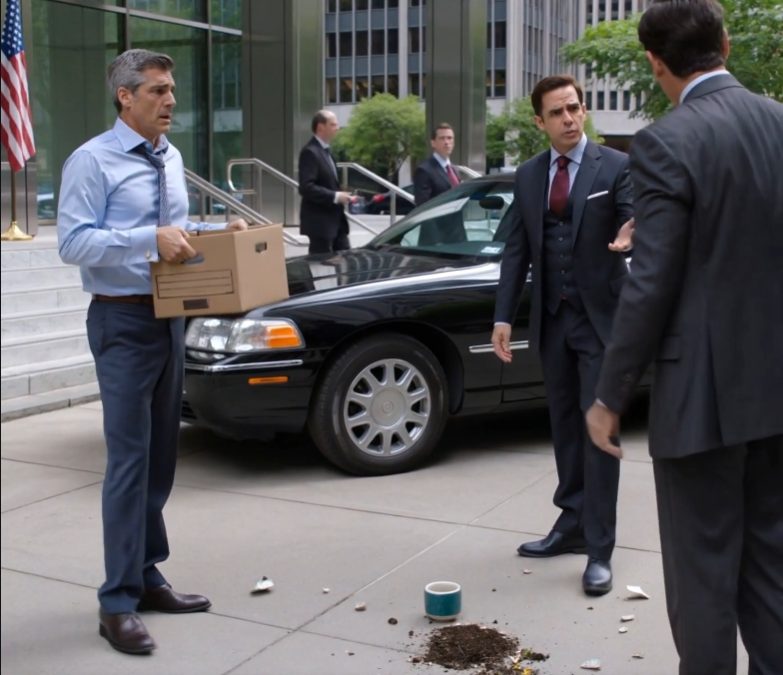
“Mr. Hughes,” Howard stammered, his face red with confusion. “You know this former employee?”
Darren looked down at Howard, his warm smile turning to stone.
“This former employee is my brother, Howard. We survived college together. Why is he standing on the street with his belongings in a box?”
Howard dropped the ceramic shard, sheer panic spreading across his face.
“A clerical misunderstanding,” Howard squeaked, scrambling to his feet and brushing dust off his knees. “A complete oversight by human resources. Grant, please come upstairs immediately. Your office is untouched. I will personally review your compensation structure right now and double your bonus pool.”
Janice Floyd had rushed through the revolving glass doors, holding my signed paperwork. She stopped dead in her tracks when she saw her boss groveling before the man she had discharged twenty minutes earlier.
I looked at Howard, then at Janice, feeling a sudden wave of calm wash over me. The humiliation that had gripped my stomach dissolved.
“No, Howard,” I said clearly, loud enough for passing commuters to hear. “It was no mistake. Your choice was deliberate, and my answer is no. I am done cleaning up your chaos.”
Darren looked at Howard with cold disgust, shaking his head.
“Put away your presentation, Howard. The forty-million-dollar supply contract between Hughes Dynamics and Vanguard Global is canceled. My company does not do business with executives who treat foundational leaders like trash.”
Darren nudged me toward the Maybach.
“Leave the mess, Grant. We are getting an honest lunch.”
We drove south along the lakefront to an old brick tavern near our former university campus, where we ordered roast beef sandwiches and dark ale.
Over the past six years, Hughes Dynamics had grown into a premier clean-energy power provider, manufacturing and deploying regional power grids valued at well over one billion dollars. Darren was widely celebrated as an unstoppable industrial innovator. Yet as we talked, I saw the weariness around his eyes.
Darren was solitary and exhausted. His marriage had ended three years earlier under the strain of eighty-hour workweeks on factory floors. He possessed private jets and enormous capital, but he lacked a single soul in his inner circle who was not scheming for a piece of his equity.
“I watched you outside Vanguard, Grant,” Darren said, setting down his glass. “You took their insult with your dignity intact, just like you did when we worked warehouse shifts in college. I need you at Hughes Dynamics. I need a chief operating officer who knows how to move heavy freight. But more than that, I need someone who will never lie to me.”
My throat tightened.
At forty-eight, the prospect of steering a billion-dollar clean-energy enterprise felt less like an opportunity and more like a terrifying cliff. What if corporate bureaucracy had dulled my instincts?
“Give me a few days, Darren,” I told him quietly. “Let me think it through.”
When I stepped into our suburban home that afternoon, the house was quiet except for the hum of the refrigerator. Laura was at the kitchen counter reviewing Toby’s fifth-grade math worksheets while checking monthly utility statements. She looked up and smiled, brushing hair from her forehead.
“You’re home early, Grant. Everything all right at the office?”
I placed my briefcase on the counter, leaving the cardboard box containing my belongings hidden in the trunk of our car.
“Fine,” I managed to say, forcing a relaxed tone. “Finished our regional inventory audit ahead of schedule. Thought I would take a quiet afternoon breath.”
Laura studied my face for two seconds. After twenty-two years of marriage, she could sense the slightest shift in my mood, but she chose not to press. Instead, she slid a warm mug of black tea toward my hands and laid her fingers over mine.
“I’m glad you’re home,” she said softly. “Toby wanted to show you his wooden suspension bridge for the science fair.”
That evening, I sat on the carpet in Toby’s room, helping him align balsa wood beams with glue. He asked me if real suspension bridges ever snapped under heavy traffic.
“Not if the foundation is anchored deep into the bedrock, buddy,” I told him, smoothing down his hair. “As long as the base holds, the bridge can withstand any storm.”
As I said those words, a sharp pang of hypocrisy struck my chest. My own foundation had just been pulled out from under me, and I was too cowardly to admit it to the people who depended on me most.
Later that night, while Laura and Toby slept, I sat in the dark living room looking at our household accounts on my laptop. With fifteen years remaining on our mortgage, $22,000 left on our family vehicle loan, and healthcare coverage tied directly to my corporate job, our modest savings would vanish in four months without income.
Pride is a dangerous poison for an older man.
I could not bring myself to call Darren and accept what felt like fraternal charity. I wanted to prove that my twelve years of experience still held value on the open market.
Over the next forty-eight hours, I sent customized résumés to nineteen supply chain and logistics companies across the region. The responses were a harsh lesson in corporate ageism. Recruiters glanced at my graduation date, saw four decades of life experience, and dismissed me as an overqualified relic whose salary expectations would strain their tight budgets.
One hiring coordinator at a freight brokerage questioned whether a forty-eight-year-old would feel comfortable reporting to a thirty-two-year-old director. Another interviewer bluntly asked if I would accept $45,000 a year for an entry-level dispatch role, an eighty-percent reduction from my previous compensation.
The corporate landscape had shifted, treating middle-aged operational mastery as an expensive liability rather than an asset.
By the end of the week, anxiety overruled common sense. I accepted an immediate offer as operations supervisor at Apex Freight, a run-down trucking depot run by Brenda Wallace.
Brenda was frantic, aggressive, and operated on razor-thin margins. My workspace was a battered metal desk shoved behind a screeching dot-matrix printer, running twelve-year-old dispatch software on computers where half the keys stuck.
When I handed Brenda a three-phase plan to reduce fleet fuel consumption and save $15,000 monthly through vendor renegotiation, she tossed it aside.
“Grant, I hired you to keep trucks rolling, not to write dissertations,” she barked, setting her coffee mug on my report. “File the bills of lading and stay out of strategy.”
I drove home every night exhausted, handing Laura modest paychecks while pretending I was spearheading an operational turnaround. The deception weighed heavily on my conscience.
When Darren phoned on Thursday to check in, I told him I had taken a solid interim post to stay occupied.
Darren went completely silent on the line.
“Grant,” he said, his voice grave, “my legal team checked Apex Freight when you mentioned their name. Brenda Wallace’s holding firm is buried in defaulted commercial real estate notes. They face an involuntary Chapter 11 bankruptcy petition within sixty days. You are standing on a collapsing dock. Why punish yourself when I have an executive desk waiting for you?”
“I cannot accept charity, Darren,” I replied, staring into the dark street.
“It is not charity, Grant,” Darren fired back. “It is a battlefield, and I need a commander I can trust with my life. Stop letting Vanguard define your worth.”
Two weeks later, Darren’s warning came true.
I arrived at Apex Freight at dawn to find the gates padlocked and federal marshals posting seizure notices across the docks. Brenda Wallace had fled town. Payroll accounts were frozen, and eighty-five workers were stranded without their final paychecks or health insurance.
I stood in the gravel lot, numb and exhausted.
When I walked through our front door at noon, Laura was seated at the kitchen table with her hands folded. Beside her phone lay a notepad with Eli Campbell’s name written on it.
Eli, my former logistics analyst at Vanguard, had called to check on me after discovering Janice Floyd had purged my corporate contact details.
“How long were you planning to carry this alone, Grant?” Laura asked. Her voice cracked with heartbreak.
I sat down, burying my face in my hands.
“Laura, I was dismissed twelve days ago. I took a dreadful job to protect our mortgage, and it just collapsed into federal receivership. I am forty-eight, and I feel like an absolute failure who cannot protect his family.”
Laura walked around the table and embraced me tightly.
“You stubborn, beautiful idiot,” she whispered, tears dampening my shirt. “Did you think I married your title at Vanguard? We love you because you are the bedrock of this home. But marriage is a two-way suspension bridge, Grant. When you hide your pain, you leave me standing alone across the chasm.”
We sat together until twilight, reviewing every statement and every fear. For the first time in weeks, the heavy burden felt shared.
“Call Darren,” Laura told me firmly, wiping her eyes. “Not because he is wealthy, Grant, but because he sees the executive Vanguard tried to diminish. Go build something real.”
The next morning at eight, I badged into the soaring glass atrium of Hughes Dynamics in downtown Chicago.
The corporate headquarters occupied forty floors of steel and glass, energized by hundreds of engineers and supply chain specialists. Darren was waiting outside his corner office on the thirty-eighth floor, holding two cups of black coffee.
He offered no awkward condolences about Apex Freight. He simply handed me a cup and pointed toward the boardroom.
“Welcome to the front lines, Grant,” Darren said, his eyes bright with focus. “Let’s get to work.”
He unfolded a massive technical schematic across the walnut conference table. Hughes Dynamics had just won a crucial regional mandate: manufacturing and deploying thirty modular utility-scale energy storage and distribution substations across ten Midwestern states within a tight six-month window.
If we met the deadline, our public valuation would exceed two billion dollars. If we missed it by even thirty days, contractual liquidated damages would trigger sixty million dollars in penalties, draining our operating reserves.
The previous operations head had resigned under stress, leaving procurement in total disarray. Battery modules were stalled at ports, transformer orders were disputed, and utility interconnect permits were trapped in administrative delays.
Darren looked at me intently.
“I am appointing you executive vice president of global rollout. You have full operational control over logistics, procurement, and deployment teams. Straighten this out, brother.”
For the next four months, I lived inside that operational challenge. The tired manager who had been called obsolete at Vanguard vanished, replaced by an executive operating at his absolute best.
I restructured our maritime shipping corridors, replacing delayed container bookings with dedicated rail charters from West Coast yards. I renegotiated long-term supply guarantees with Tier 1 electrical component suppliers, securing volume rebates that saved $4,200,000 in our first ninety days.
Every morning at six-thirty, I led cross-functional briefings connecting sixty field engineers, thirty site managers, and our regulatory council. When municipal zoning boards in Ohio delayed substation permits, I traveled personally to county seats, presenting our safety engineering data and securing approvals in days rather than months.
By the end of the fourth month, twenty-two of the thirty regional substations were operational and feeding energy into the regional grid.
Three weeks ahead of schedule, the board of directors held an extraordinary review on a crisp Tuesday morning. Darren stood before the institutional directors and presented our operational metrics.
“Grant Bennett has executed the most demanding logistical deployment in this company’s history,” Darren announced. “Effective immediately, with the board’s unanimous consent, Grant is named chief operating officer of Hughes Dynamics.”
As the directors applauded, I felt a quiet sense of triumph settle into my chest. My twelve years at Vanguard Global had not been wasted. They had simply been spent under leadership that suppressed talent.
Under genuine leadership, operational discipline was an unstoppable engine.
That evening, as I reviewed dispatch schedules in my office, my phone rang with an incoming call from Eli Campbell.
His voice was frantic.
“Grant, I’m calling from my car. Vanguard is tearing itself apart.”
“What happened, Eli?” I asked, leaning forward.
“Howard Vance initiated a mass layoff this morning,” Eli said, his voice trembling with anger. “Over 120 operations and warehouse employees were escorted off the property with thirty minutes’ notice. No severance, no healthcare continuation, nothing. Howard claimed liquidity problems due to lost enterprise accounts.”
“Did Howard give sixty days’ advance notice?” I asked, my grip tightening on the phone.
“Not a single day,” Eli replied. “Janice Floyd told everyone that private firms don’t have to provide notice. People are standing in the parking lot crying. Grant, veteran workers with twenty years of service cannot pay their bills next month.”
A cold, deliberate anger gripped me. Howard Vance had preyed on his employees’ lack of legal knowledge for years, but this time he had crossed a bright federal boundary.
“Eli, listen carefully,” I told him. “Janice Floyd lied to you. Under the federal Worker Adjustment and Retraining Notification Act, codified under Title 29 of the United States Code, Section 2101, any enterprise employing over one hundred full-time workers that carries out a mass layoff of fifty or more employees must provide written notice at least sixty days prior to termination.”
Eli paused in surprise.
“What does that mean for us?”
“It means Howard Vance broke federal law,” I said steadily. “Vanguard is liable to every terminated employee for sixty days of full back pay, civil penalties of five hundred dollars per day, and mandatory coverage of medical claims during that window. I am connecting you tonight with our primary employment litigation firm. We will finance the class-action lawsuit. Eli, tell everyone to keep their paperwork and refuse to sign any release waivers.”
Within forty-eight hours, forty former Vanguard employees formed the core of a federal class-action lawsuit filed in the United States District Court for the Northern District of Illinois, naming Vanguard Global and Howard Vance personally for willful WARN Act violations.
Yet even as legal retribution closed in on Howard Vance, an internal storm was brewing inside Hughes Dynamics.
Our early expansion had been funded by forty million dollars in Series B preferred capital from Apex Horizon Ventures, an aggressive private equity group led by Garrick Stone.
Garrick was forty-six, polished, and carried a ruthless reputation for corporate restructurings. Under the Series B agreement, Apex Horizon held two board seats and possessed restrictive covenants on debt financing.
With our public offering on the horizon, Garrick Stone saw an opportunity to seize control.
At our Thursday executive meeting, Garrick walked into the boardroom with outside advisers, sliding a bound document across the table to Darren and me.
“Darren, your growth phase is complete,” Garrick said with smooth condescension. “Public markets require professional governance. Apex Horizon is proposing an interim management committee to oversee executive decisions. We are moving Grant Bennett into a secondary advisory role. Traditional operations managers lack the agility needed for a modern technology public listing.”
I looked at Garrick Stone and saw the exact same corporate predator I had encountered in Howard Vance. But this time, I was not an isolated employee holding a cardboard box. I was chief operating officer of a two-billion-dollar enterprise, and I knew how to fight back.
Darren slammed his palm onto the walnut table, the sound echoing through the thirty-eighth floor.
“Garrick, you hold two minority board seats,” Darren said with sharp authority. “You do not dictate operational appointments, and you will never sideline my chief operating officer.”
Garrick remained unfazed, leaning back with a smug grin.
“Check your Series B covenants, Darren. Section 8.4 gives preferred holders a veto over capital expenditures exceeding fifteen million dollars unless approved by an independent committee. We have frozen your equipment credit lines. Without an additional sixty million dollars in Series C capital before the third quarter ends, Hughes Dynamics will breach its debt service covenants. You either accept our restructuring, or Apex Horizon triggers an involuntary recapitalization that dilutes your founder shares to zero.”
Garrick gathered his portfolio and walked out with his advisers, leaving a heavy silence in the boardroom.
Darren rubbed his temples in frustration.
“He has backed us into a corner. Grant, our Series B capital is fully committed to the thirty regional substations. If our credit lines stay frozen, we cannot purchase inventory for our final installation phase. Liquidated damages will ruin us.”
I stood up and mapped our corporate structure on the whiteboard, detailing share classes, voting thresholds, and board covenants.
“Darren, Howard Vance tried to break me with fear,” I said firmly. “We are not letting Garrick Stone pull off the same trick. What is Garrick really after?”
“He wants to force an emergency down round,” Darren answered. “Apex Horizon wants to inject fifty million dollars of distressed equity at a cheap valuation, securing fifty-one percent voting control and removing me as chief executive officer before our public listing.”
“Then we will not let him,” I responded. “We find an anchor Series C partner who values operational execution, someone with deep capital to redeem Apex Horizon’s preferred notes entirely. And while we hunt for that partner, I will comb through Garrick Stone’s filings until I find his vulnerability.”
Over the next four weeks, Darren and I conducted an intense cross-country capital tour, presenting to twenty-one institutional funds across New York, Boston, and San Francisco.
Darren presented our technological innovations while I backed him with clear operational data: declining megawatt costs, shortened lead times, and predictable deployment milestones.
We worked as an inseparable team. Darren articulated the vision, and I proved the execution.
Between presentations on long flights, I examined Apex Horizon’s vendor filings alongside our forensic accountants. My instincts told me Garrick Stone was cutting corners. A man orchestrating a corporate coup always leaves traces.
On our nineteenth day of travel, we uncovered the proof.
Embedded within equipment contracts Garrick had pushed through our purchasing division was an exclusive subassembly agreement with a Delaware entity named Terrapoint Logistics.
I examined Terrapoint’s incorporation filings and found that its beneficial ownership rested in an offshore trust benefiting Garrick Stone’s brother-in-law.
Garrick had attempted to steer forty-two million dollars in Hughes Dynamics capital to a self-dealing shell company charging twenty-five percent above market prices.
Under Delaware General Corporation Law Section 141, corporate directors owe duties of loyalty and care to the enterprise. Garrick Stone had committed an undeniable breach of fiduciary duty, combined with an unlawful attempt to dissipate corporate assets through self-dealing.
Furthermore, our company records showed that Garrick had submitted an unauthorized written consent document to our commercial lenders, attempting to pledge our core energy patents to Apex Horizon.
Under commercial law, any agreement secured through unauthorized execution and misrepresentation is void ab initio, possessing zero legal validity from its creation.
Armed with our forensic file, Darren and I entered our twenty-first meeting on the top floor of a Boston tower overlooking the harbor.
Our host was Walter Bradley, the seventy-one-year-old chairman of Bradley Capital. Walter had built manufacturing enterprises for fifty years before establishing one of the most respected private equity firms in the nation.
He listened thoughtfully for ninety minutes as Darren explained our technology and I detailed our logistics milestones.
When we concluded, Walter closed our prospectus and smiled faintly.
“Most tech founders I meet cannot balance an operating budget,” Walter noted. “And most operations managers cannot grasp an innovative vision. But you two operate as one mind. Darren builds the engine, and Grant keeps the train locked onto the rails. That is the only balance that succeeds on public markets.”
Walter leaned forward, resting his hands on the mahogany table.
“Bradley Capital will lead your Series C round with seventy million dollars in primary equity. That gives you ample capital to retire Apex Horizon’s preferred stock, eliminate their board covenants, and finish your thirty-site rollout with surplus reserves.”
Darren exhaled in relief, but Walter raised a finger to pause him.
“I have one nonnegotiable term,” Walter added, looking straight at me. “My capital backs this partnership. Under Section 218 of the Delaware General Corporation Law, I require Darren Hughes and Grant Bennett to enter into an irrevocable dual voting trust. Your founder and executive shares will be pooled and voted as a unified block for three years following the public offering. Neither of you can be removed or diluted independently. If I back this company, I back both brothers.”
Darren looked at me with a wide grin, the same look he had worn when we signed our first college lease.
“We have a deal, Walter,” Darren said, extending his hand.
The emergency board meeting of Hughes Dynamics opened at nine sharp on Monday morning.
Outside the conference windows, heavy rain beat against the glass, matching the tension in the room. Garrick Stone sat at the far end of the table, flanked by two attorneys in charcoal suits.
He looked confident, expecting our frozen credit lines to compel our surrender before noon.
“Darren, let us settle this quickly,” Garrick began, tapping his fountain pen. “The restructuring resolution is prepared. You step down as executive chairman. Grant Bennett resigns as chief operating officer, and Apex Horizon provides the bridge financing. Let us sign and avoid embarrassment.”
I remained seated beside Darren, opening a thick binder and distributing three packets across the table to Garrick and the directors.
“There will be no bridge financing, Garrick, and there will be no resignations,” I said steadily, my voice cutting through the silence. “First, Hughes Dynamics has executed a definitive agreement for seventy million dollars in Series C equity led by Walter Bradley of Bradley Capital. The capital cleared escrow this morning. We have wired forty million dollars plus accrued interest to Apex Horizon’s trustee, exercising our corporate right to redeem your preferred shares in full.”
Garrick’s pen froze in midair.
“What did you say?”
“Your preferred shares are retired, and your board covenants are gone,” I continued, pointing to the second exhibit. “But that is only your first problem today. Document two is a forensic audit of your dealings with Terrapoint Logistics over six months. You attempted to steer forty-two million dollars in procurement funds to an entity owned by your brother-in-law, representing a clear breach of fiduciary duty and attempted dissipation of corporate assets under Delaware General Corporation Law Section 141.”
Garrick’s face drained of color.
He glanced nervously at his lead counsel, who was already reviewing the exhibits with deep concern.
“Furthermore,” I added, “document three is an affidavit from our lenders proving the patent pledge consent you submitted was executed without board authorization. Under established law, that transaction is void ab initio. Our litigation counsel is prepared to file complaints with the Securities and Exchange Commission and the federal prosecutor by two o’clock today.”
Garrick’s hands trembled against the table.
His attorney leaned in, whispered urgently for thirty seconds, and then looked across at us.
“What are your terms?” the lawyer asked quietly.
“Immediate resignation of both Apex Horizon board seats,” Darren said with absolute finality. “A full surrender of voting rights, forfeiture of unvested options, and an agreement not to interfere with our public offering. You have ten minutes to sign, Garrick, or marshals will meet you in the lobby.”
Garrick Stone signed the paperwork in complete silence, gathered his briefcase, and hurried out of the room.
His career as an institutional power broker was finished.
As the remaining board members ratified our Series C closing and finalized the dual voting trust under Section 218, my assistant entered quietly and handed me a sealed envelope from our employment litigation team.
It contained a certified copy of the federal court judgment regarding Vanguard Global.
The judge had ruled entirely in favor of the terminated workers, holding Howard Vance personally liable for willful violations of the Worker Adjustment and Retraining Notification Act under Title 29 of the United States Code, Section 2101.
The court awarded $3,600,000 in back wages, healthcare coverage reimbursements, and statutory penalties.
Unable to handle the judgment after losing our contract, Vanguard’s lenders had initiated liquidation. Howard Vance was ousted by his board in disgrace, his personal equity wiped out to satisfy labor claims.
Two weeks later, Hughes Dynamics acquired Vanguard’s forty-acre logistics center in suburban Chicago at a bankruptcy sale for ten million dollars.
On our first morning at the facility, I stood at the main gate holding a stack of executive employment contracts instead of a cardboard box.
Eli Campbell and seventy-four former Vanguard workers were gathered outside. Every single worker was hired on the spot by Hughes Dynamics with twenty-percent wage increases, full family medical benefits, and company equity participation.
Poetic justice, I realized, was not about watching adversaries fall. It was about lifting up the people they had attempted to crush.
Fourteen months later, the ringing of the opening bell echoed across the trading floor of the Chicago Stock Exchange.
Digital banners illuminated the trading posts with the ticker symbol HDN as Hughes Dynamics went public at a valuation of $2.4 billion.
Flashbulbs lit the stage as Darren Hughes stepped to the podium before gathered investors, journalists, and employees. His gaze found me, Laura, and Toby standing in the front row.
“Ten years ago, I thought building an enterprise was about technology and money,” Darren said into the microphone. “But a company is only as durable as the people who stand firm when the storm breaks. Today belongs to every worker who was told they were too old, too ordinary, or too disposable. And most of all, it belongs to my brother, Grant Bennett, who showed me that true leadership is defined by loyalty and standing together when everything is on the line.”
The exchange floor erupted in applause.
Darren handed me the microphone.
For a brief second, I recalled the man at forty-eight holding a cardboard box on the street, believing his life was over.
“Twelve years of devotion to the wrong company nearly convinced me I had no future,” I told the crowd, my voice clear and firm. “But adversity is not a final verdict. It is an audit. It strips away comfortable illusions so you can discover your genuine resilience. If you are standing at the bottom of the canyon today, do not stay there. Stand up. Find the people who believe in you, and build your own bridge.”
That evening, our home was warm with celebration.
Laura had baked an apple pie while Darren sat on the living room rug with Toby, assembling a solar model car.
Toby looked up at me with bright eyes.
“Dad, can this car go as far as your substations?”
“Even further, buddy,” I laughed, ruffling his hair. “It can go wherever you lead it.”
Later, Laura and I stood on the back porch under a summer sky, listening to the gentle rustle of the trees.
Laura rested her head on my shoulder, her arm around my waist.
“Are you happy, Grant?” she asked softly.
I looked at the woman who had stood beside me through every uncertainty.
“I am grateful,” I answered, kissing her forehead. “Getting dismissed outside Vanguard felt like disaster, but it was the best turning point I was ever given. It forced me to stop merely surviving and start—”








