I was a Delta Force operator for 22 years. My son’s teacher called: “7 senior football players hospitalized him.” I saw him in ICU with a fractured skull. I visited the school. The principal said, “What’re you gonna do, soldier boy?” I didn’t respond. Within 72 hours, all 7 players were in the same hospital. Their fathers showed up at my door with baseball bats. Big mistake… True story.
“Between us, I’ve got three witnesses who say otherwise, but they’re scared kids, and the football program brings in a lot of money for that school. The players’ families have connections.”
Ray absorbed the information, filing it away.
“Names of the players.”
Platt hesitated, then pulled out his notebook.
“Darren Foster, Eric Orasco, Benny Gray, Gary Gaines, Everett Patrick, Ivan Christensen, and Colin Marsh. All seniors. All being recruited by Division I schools. Foster’s father owns half the commercial real estate in town. Orasco’s dad is a city councilman. You see how this goes?”
“I see.”
That night, Freddy coded twice. The second time, they barely brought him back.
Ray stood outside the ICU, watching doctors and nurses swarm his son’s bed, and felt something cold settle in his chest. Not rage. Rage was hot, chaotic, useless. This was something else. It was the same feeling he’d had in Kandahar when his team had walked into that compound.
This was operational clarity.
By morning, Freddy was stable again, but still unconscious. Ray left the hospital at dawn and drove to the school.
Riverside High was a sprawling campus, its new athletic facilities gleaming in the early sunlight. The football field had stadium seating for thirty thousand. The scoreboard was digital and probably cost more than most people’s houses.
Principal Blake Low’s office was on the second floor, decorated with photographs of championship teams. Low himself was in his fifties, with silver hair, an expensive suit, and the kind of tan that came from golf courses and country clubs.
He looked up when Ray entered, and something flickered in his eyes. Annoyance, perhaps, or calculation.
“Mr. Cooper. I was expecting you’d come by. Terrible situation. Truly terrible.”
“My son has a fractured skull.”
“Yes. And we’re all praying for his recovery. The boys involved have been suspended pending investigation. We take these matters very seriously.”
“Seven players. All bigger than Freddy. All athletes. They beat him until he stopped moving, then kept going.”
Low spread his hands.
“From what I understand, it was a fight that escalated. Teenage boys, hormones. These things happen. Nobody wanted this outcome.”
“These things happen,” Ray repeated. “My son is on a ventilator.”
“I understand you’re upset, Mr. Cooper. Any parent would be. But we need to let the authorities handle this. The police are investigating.”
“What about the school’s investigation?”
“We have security footage. Witness statements. It’s being reviewed.”
Low leaned back in his leather chair.
“Let me be frank with you. These boys have futures ahead of them. Scholarships, opportunities. What happened was tragic, but ruining seven young lives won’t help your son.”
Ray stood.
Low watched him, a slight smile playing at his lips.
“That’s it? You’re not going to make threats? Get angry?”
Ray said nothing.
Low’s smile widened.
“What are you going to do, soldier boy? This isn’t whatever Third World hellhole you used to operate in. This is America. We have laws, procedures. Those boys have rights, and their families have lawyers. Good ones.”
Ray looked at him for a long moment.
“Soldier boy,” he said quietly. “That’s original.”
He left without another word.
Ray spent the next twenty-four hours at the hospital. Freddy remained unconscious but stable. Dr. Colin Marsh, the neurosurgeon, explained that the swelling in his brain needed to subside before they could fully assess the damage. There was a chance of permanent injury. There was also a chance Freddy might never wake up at all.
On the second night, Ray sat in the hospital cafeteria, drinking coffee that tasted like burnt plastic. His phone buzzed with a text from an unknown number.
Your kid should have known his place. Maybe this teaches you military trash to stay in your lane.
Ray deleted the message. Then he opened his laptop.
Twenty-two years in Delta Force taught a man many things. Most people thought it was about kicking down doors and shooting bad guys. That was part of it, certainly. But the real skill was intelligence gathering, surveillance, operational planning, finding people who didn’t want to be found, learning their patterns, their weaknesses, and their secrets.
Darren Foster, eighteen years old, quarterback. His father, Edgar Foster, was a real estate developer. His mother, Jesse Foster, was a socialite. The family lived in a gated community on the east side of town.
Foster Senior had two DUIs swept under the rug in the past five years. Junior had three assault complaints filed against him, all mysteriously dropped. His younger sister, Candi, had been in rehab twice.
Eric Orasco, seventeen, linebacker. His father, Kirk Orasco, was a city councilman running for the state senate. His mother, Sonia Orasco, ran a nonprofit that seemed to spend most of its donations on administrative costs.
Eric had been arrested the previous year for possession with intent to distribute. The charges vanished. His social media accounts were full of videos showing off weapons and drugs.
Benny Gray, eighteen, defensive end. His father, Al Gray, owned a construction company that had won every major municipal contract for the past decade despite multiple safety violations. Benny had put two kids in the hospital before Freddy. Both families had settled out of court.
The list went on.
Gary Gaines was the son of a police sergeant. Everett Patrick’s mother sat on the school board. Ivan Christensen and Colin Marsh had fathers who were both attorneys at the same firm that represented the school district.
It wasn’t just corruption. It was a system, a network of privilege and protection. These boys had never faced consequences because their parents had ensured they never would. They’d learned they could do anything to anyone, and someone would always clean up the mess.
Ray made notes. Addresses, schedules, security systems, vehicles, routines. Old habits came back effortlessly.
By 3:00 a.m., he had a complete operational picture.
The question wasn’t how. Delta Force had taught him a hundred ways to neutralize threats. The question was proportion. Precision.
These were kids, even if they were monsters. But their parents had created them, enabled them, protected them. The rot went deeper than seven teenagers.
At 4:00 a.m., Freddy’s vitals spiked.
Ray sprinted to the ICU, arriving just as the nurses stabilized him. Davenport caught his arm in the hallway.
“He’s okay. His brain activity increased. That’s actually a good sign. He might be starting to wake up.”
Ray nodded, but his hands were shaking.
He’d faced Taliban fighters, had bombs dropped dangerously close to his position, and had cleared buildings full of hostiles. None of it compared to watching his son fight for his life against injuries that never should have happened.
He went back to his laptop and started making a different kind of list.
The next morning, Ray visited the Riverside gym at 6:00 a.m. Darren Foster was there, just as he’d predicted. The kid was bench-pressing 225 pounds, his spotters cheering him on. He wore a shirt that said Undefeated.
When he saw Ray, he smirked.
“Hey, you’re that kid’s dad, right? Hope he’s doing better. Accidents happen, you know.”
Ray watched him.
Foster’s spotters, other football players including Eric Orasco and Benny Gray, moved closer. Their posture was protective, threatening.
“We were just messing around,” Foster continued. “Your kid got mouthy. Things escalated. He’ll be fine. Maybe he learned not to run his mouth to people better than him.”
“People better than him,” Ray repeated.
“Yeah. People with futures. People who matter.”
Foster racked the weights and stood up. He was six-foot-two, 220 pounds, all muscle and arrogance.
“My dad’s lawyers say we’re covered. Juvenile stuff. Worst case, some community service. We’ll be in college next year while your kid’s still eating through a tube.”
Orasco laughed. Gray bumped chests with Foster.
They were performing, Ray realized, showing off for the handful of other gymgoers who were watching nervously.
Ray left without responding.
As he walked to his truck, he noticed the security cameras covering the parking lot. He also noticed the gym attendant making a phone call while watching him leave.
Word would spread fast. The victim’s father had shown up, had been scared off, and now knew his place.
Good. Let them think that.
Ray spent the third day gathering intelligence. He drove past homes, observed routines, and tracked movements. All seven players maintained their normal schedules. School, practice, parties. Why wouldn’t they? They were untouchable.
That evening, he visited Principal Low’s house. Not to confront him, just to observe.
Low lived in a sprawling ranch house with three cars in the driveway and a boat in the garage. Through the windows, Ray could see him drinking wine with a woman who wasn’t his wife, judging by the photographs Ray had seen in his office.
Ray photographed everything. Then he moved on.
By the fourth day, Freddy’s eyes had opened briefly. He couldn’t speak because of the ventilator, but he squeezed Ray’s hand when asked. The doctors called it promising.
Ray called it a reason to be very, very careful about what came next.
Detective Platt visited that afternoon.
“The district attorney is reviewing the case. Between you and me, it’s not looking good. The boys’ stories align. Their lawyers are claiming self-defense, and the school’s security footage mysteriously malfunctioned during the critical period.”
“Convenient.”
“Yeah.” Platt looked tired. “I’ve been a cop for twenty-three years. I know how this goes. These kids will walk. Their families will make sure of it. I’m sorry, Mr. Cooper. I really am. But unless something changes dramatically, justice isn’t coming through official channels.”
Ray nodded.
“I understand.”
“I hope you’re not thinking of doing something stupid. I saw your military record. I know what you’re capable of. But this is a small town with powerful people. You can’t win this fight.”
“Can’t I?”
Platt held his gaze.
“Whatever you’re thinking, don’t. For your son’s sake, if nothing else. He needs his father.”
After Platt left, Ray returned to Freddy’s bedside. His son’s eyes were open again, more alert this time. The nurse said they might try removing the ventilator the next day if he continued improving.
“Hey, champ,” Ray said softly. “You’re going to be okay. I promise.”
Freddy’s eyes moved toward Ray’s face. There was something in them. Recognition, fear, a question.
Ray squeezed his hand.
“Don’t worry about anything. Just focus on getting better. Everything else is handled.”
That night, seventy-two hours after the attack, the first of the seven players ended up in the hospital.
Darren Foster was found unconscious in his car at 11:00 p.m., parked behind an abandoned strip mall on Highway 9. Both hands were broken, the small bones shattered with precise, targeted force. His right knee had been hyperextended until the ligaments tore.
No weapon had been used. The damage was systematic, professional, the kind that spoke of extensive hand-to-hand combat training.
The police found no witnesses, no security footage, no evidence.
Foster would recover, but his football career was over. His scholarship offers were rescinded within hours.
Six hours later, Eric Orasco was discovered unconscious in similar condition at the public park. Same injuries. Hands, knee. Precise trauma that would heal but leave him permanently unable to play contact sports.
By noon the next day, Benny Gray had been found. Then Gary Gaines, followed by Everett Patrick, Ivan Christensen, and Colin Marsh.
All seven were discovered within seventy-two hours, all with identical injuries. None could remember what had happened. They reported being approached by someone, then nothing until they woke up in agony.
Not one could identify the attacker.
The police had no leads. The boys were terrified, their parents outraged, and the entire town was buzzing with theories.
Ray spent those three days at the hospital with Freddy, who was improving steadily. The ventilator came out. Freddy could speak, though his head still hurt. The doctors were now optimistic. No permanent brain damage, though recovery would take time.
Detective Platt visited Ray on the morning of the sixth day.
“Where were you the past seventy-two hours?”
“Here with my son. Ask any nurse.”
“I have. They confirm you barely left his side.”
Platt studied him.
“Seven boys hospitalized with identical injuries. Professional work. Military-grade combat training. And you’ve been here the whole time, in front of witnesses.”
“Sounds like a mystery.”
“Mr. Cooper—”
“My son nearly died because seven teenagers decided to beat him unconscious for fun. Now those same teenagers are injured, and suddenly everyone cares about justice. Interesting.”
Platt said nothing for a long moment.
“The parents are pushing hard for an investigation. They want answers.”
“I hope they get them. Nobody should get away with violence.”
After Platt left, Ray checked his phone.
Multiple news alerts had appeared about the Riverside Seven, as the media was calling them. There was speculation about gang activity, targeted revenge, and vigilante justice.
The story was spreading beyond the small town.
More importantly, seven angry fathers were organizing.
Ray had expected this. Counted on it, actually.
The trap was almost set.
On the seventh day, Freddy was moved out of the ICU. His skull fracture was healing, the swelling had gone down significantly, and while he would need physical therapy and monitoring, the doctors declared him out of immediate danger.
Ray helped him settle into a regular room, watching his son move carefully, still in pain, but alive.
Alive.
“Dad,” Freddy said that evening, his voice still weak. “I heard the nurses talking. Those boys who hurt me—”
“Don’t worry about them.”
“They’re saying you did it. But you’ve been here. I saw you.”
Ray smiled.
“Exactly. I’ve been here taking care of you. That’s all that matters.”
Freddy studied his father’s face, something like understanding beginning to dawn.
“When I was unconscious, I could hear you sometimes. You promised everything would be okay.”
“It will be.”
“Those guys, they’ve done this before, Dad. To other kids. Everyone’s too scared to say anything because their families run everything.”
Freddy swallowed, struggling to continue.
“Darren Foster held me down while the others—”
His voice cracked.
“They were laughing. Said I was a nobody. That they could do whatever they wanted.”
Ray felt that cold clarity again.
“They were wrong.”
“The school won’t do anything. Principal Low called Mom yesterday. Said we should consider accepting a settlement to help with medical bills. Like we’re the ones who should be grateful.”
“Your mother’s coming back tomorrow.”
Ray’s ex-wife, Alice, had remarried and now lived two states away with Ryan. She visited twice a year. She and Ray had divorced when Freddy was ten, keeping things civil but distant.
“Yeah, she’s worried. Angry, too, but at the wrong people. She said we should take the money and move on. Not cause trouble.”
“That’s not happening.”
Freddy managed a small smile.
“I didn’t think so.”
That night, while Freddy slept, Ray received a text from an unknown number.
We know it was you. Tomorrow night, 9:00 p.m., your address. Come alone.
Ray texted back.
I’ll be there.
He spent the next day preparing.
First, he visited a storage unit across town that he’d rented under a false name. Inside were items he’d kept from his service days, equipment that technically should have been turned in but had mysteriously remained in his possession.
Medical supplies, communications gear, surveillance tools, and weapons, though he doubted he’d need those.
The fathers coming to his house weren’t trained. They were angry, entitled men who’d never faced real danger, coming to intimidate someone they thought was a threat.
They had no idea what a real threat looked like.
Next, he stopped by his house, a modest three-bedroom home in an older neighborhood. He checked the security cameras he’d installed years ago, made sure they were recording to the cloud and backed up to three separate servers, then checked the angles, lighting, and audio quality.
Afterward, he visited Erica Pace, Freddy’s English teacher.
She lived alone in a small apartment, and when she opened the door, her eyes widened with recognition and something like fear.
“Mr. Cooper, I—how’s Freddy?”
“Getting better. I wanted to thank you for calling me that day. For caring enough to make sure I knew.”
She nodded slowly.
“He’s a good kid. What happened to him was—”
She trailed off and glanced behind Ray, as if expecting to see someone.
“Are you okay?” she asked. “I heard about those boys, and people are saying—”
“I’ve been at the hospital the entire time. Witnesses can confirm.”
“Right. Of course.”
She hesitated.
“Mr. Cooper, Freddy talked to me sometimes about the bullying. I tried to report it, but Principal Low said boys will be boys. That Freddy needed to toughen up. I should have done more. I should have—”
“You did what you could in a corrupt system. That’s not on you.”
Tears filled her eyes.
“Those boys have tormented half the school. Everyone’s too scared to speak up. Their families have too much power.”
“Had,” Ray corrected quietly. “Past tense.”
He left her apartment and headed back to the hospital.
He spent the evening with Freddy talking about nothing important. Movies, fishing, plans for when he was fully recovered. Normal father-son conversation.
Around 8:00 p.m., Ray kissed Freddy’s forehead and headed home.
The trap was set.
Now he just had to spring it.
Ray arrived at his house at 8:45 p.m. The street was quiet, suburban, calm. He parked in the driveway, left the lights off inside, and waited.
At 8:57 p.m., three vehicles pulled up. Two trucks and an SUV.
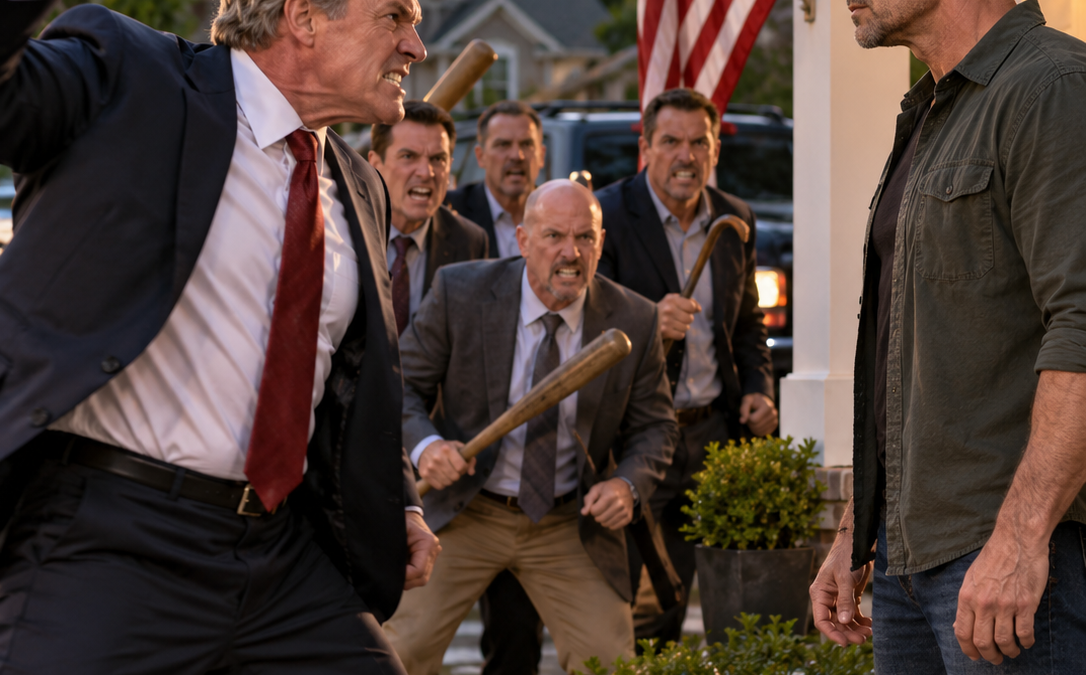
Seven men emerged, carrying baseball bats and crowbars, anger written across their faces.
Edgar Foster led the group. He was a big man, six-foot-four, probably sixty, but still solid. Behind him came Kirk Orasco, Al Gray, James Gaines, Roland Patrick, Ivan Christensen Sr., and Ken Marsh.
The fathers of the seven boys. All successful, powerful men in this town. All unaccustomed to consequences.
Ray opened his front door before they could knock and stepped out onto the porch, his hands visible and empty.
The security cameras hidden in the eaves, the doorbell, and the porch light captured everything.
“Gentlemen.”
Foster stepped forward, a bat resting on his shoulder.
“You son of a bitch! You think you can fuck up our boys and get away with it?”
“I’ve been at the hospital. Multiple witnesses.”
“Bullshit!” Orasco snarled. “We know it was you. Who else has the training to do that kind of damage?”
“Maybe someone who decided your sons needed to learn about consequences. Novel concept, I know.”
Gray swung his bat, stopping inches from Ray’s face.
“You think you’re funny? You think we’re scared of some washed-up soldier? We own this town. The police, the courts, everything.”
“We’ll bury you like you buried every other person your sons hurt.”
Ray’s voice stayed level.
“How many kids have they put in the hospital? How many families have you paid off or threatened into silence?”
“Those were accidents,” Marsh said. “Boys playing rough. Your kid was weak. Couldn’t take it.”
“My son has a fractured skull. Seven players beat him unconscious and kept going. That’s not playing rough. That’s attempted murder.”
“That’s a lie!” Patrick snapped. “Your boy started it. Couldn’t finish it. Our sons were defending themselves.”
“Seven against one. Elite athletes against a kid who weighs a hundred and forty pounds. Some defense.”
Foster raised his bat.
“We didn’t come here to argue. We came to make sure you understand your position. You’ve hurt our sons. Destroyed their futures. Now we’re going to return the favor. And when we’re done, you’ll wish you’d taken the settlement and kept your mouth shut.”
“A settlement,” Ray repeated, “for my son nearly dying because your kids are sociopaths you raised to believe they’re above the law. That was the offer? Money to shut up and go away?”
“That’s right. But now? Now you get nothing but pain.”
Foster looked at the other fathers.
“Teach this military trash what happens when you mess with our families.”
They moved forward as a group, weapons raised.
Ray didn’t move. Didn’t flinch. He just watched them come, counting steps, calculating angles.
When Foster swung the bat at Ray’s head, Ray wasn’t there anymore.
Twenty-two years of combat training meant reading body language, anticipating attacks, moving before the enemy completed an action. The bat whistled through empty air.
Ray’s hands snapped out and struck Foster’s extended elbow. The bat clattered to the ground as Foster screamed, his arm hyperextended, ligaments torn.
Orasco charged next, crowbar raised.
Ray sidestepped, drove his fist into Orasco’s solar plexus, and followed with a knee to the face as the man doubled over.
The crowbar fell. Orasco hit the ground, gasping.
Gray and Gaines came together, coordinating better than the others. Ray backpedaled off the porch, giving himself room.
Gray swung high, Gaines low.
Ray jumped over the low swing, caught Gray’s bat in mid-arc, yanked it from his grip, and used the momentum to spin and crack the bat across Gaines’s knee.
The joint buckled the wrong way.
Gaines collapsed, howling.
Patrick, Christensen, and Marsh hesitated, suddenly realizing they’d made a catastrophic miscalculation.
These were men used to boardrooms and golf courses, not violence. They’d brought weapons to a fight against someone who’d spent two decades training for war.
Ray didn’t wait for them to recover their courage.
He closed the distance to Patrick and struck precisely at pressure points and nerve clusters in his neck, the inside of his arm, and his floating ribs.
Patrick went down, conscious but unable to move.
Christensen swung wildly with his crowbar. Ray caught his wrist, applied pressure, and felt bones grind together. The crowbar dropped.
Ray swept Christensen’s legs and put him face-first on the ground, one knee pressed into his back.
Marsh backed away, hands raised.
“Wait! Wait! This is assault! We’ll have you arrested!”
Ray looked at him.
“You came to my home with weapons. Seven against one. That’s recorded.”
He pointed toward the cameras.
“Every angle. Audio, too. You confessed to obstruction of justice, admitted your sons attacked mine, threatened me with violence, then initiated an assault. All on video, backed up to three servers. Already sent to my lawyer with instructions to release it if anything happens to me or my son.”
The men on the ground groaned.
Foster clutched his arm. Orasco’s face was a mask of blood. Gaines couldn’t put weight on his leg. Patrick gasped for air. Christensen lay still beneath Ray’s knee.
“Here’s what’s going to happen,” Ray continued, his voice calm. “You’re going to wait right here while I call the police. You’re going to be arrested for assault, criminal threatening, and conspiracy. Your sons are going to be charged with aggravated assault of a minor. The school district is going to be sued into oblivion for covering it up. Principal Low is going to lose his job when the evidence of his complicity goes public.”
He looked from one man to the next.
“And all of you, every single one of you, are going to learn that actions have consequences.”
“You can’t do this,” Gray wheezed from the ground. “We have lawyers. Connections.”
“So do I. The difference is, I have evidence and the moral high ground. You have corruption and a history of enabling violent criminals you raised as sons.”
Marsh tried one more time, his voice shaking.
“This won’t work. We’ll fight this. We’ll—”
“You’ll lose,” Ray interrupted. “Because I spent twenty-two years fighting people far more dangerous than seven entitled men who’ve never been told no. I’ve been shot at, bombed, ambushed by professionals, and I’m still here. You really think you scare me?”
Sirens wailed in the distance.
Someone had called the police. Ray had arranged that, too, through a neighbor he’d briefed earlier.
Everything was proceeding exactly as planned.
Detective Platt arrived first and took in the scene. Seven men lay on the ground with various injuries, weapons scattered around them. Ray stood calmly with his phone out, showing the camera footage.
“Mr. Cooper?”
“Detective. These men came to my home armed with weapons and attacked me. It’s all recorded. Self-defense, clearly documented.”
Platt looked at the footage, then at the groaning men, then at Ray’s unblemished appearance.
Something like satisfaction crossed his face.
“I’ll need statements from everyone. Medical attention for the injured. This is going to be a long night.”
“I’ve got time.”
More police arrived. Ambulances, too.
The seven fathers were treated, arrested, and read their rights. They shouted threats, promised lawsuits, and demanded their lawyers.
None of it mattered.
The evidence was overwhelming.
As they were being loaded into police cars, Foster locked eyes with Ray.
“This isn’t over.”
“Yes,” Ray said. “It is.”
The next seventy-two hours were chaos.
The arrests made regional news. Seven prominent citizens charged with assault. The footage Ray had recorded went viral, showing the men confessing to covering up their sons’ crimes before attacking Ray.
Public opinion shifted violently against them.
The district attorney, seeing both clear evidence and political opportunity, moved fast. The seven teenage players were charged as adults with aggravated assault. Their previous victims’ families, who had been paid off or threatened into silence, started coming forward.
Fifteen other incidents emerged, revealing a pattern of violence the families had systematically suppressed.
Principal Low was placed on administrative leave as the school board launched an investigation. Emails surfaced showing that he had deliberately ignored complaints, destroyed evidence, and coordinated with the families to protect the football program.
He resigned within a week to avoid being fired, his pension now in jeopardy.
The school district faced multiple lawsuits. The football program was suspended. Several school board members resigned, including Everett Patrick’s mother.
The entire corrupt structure began collapsing under the weight of evidence and public outrage.
Ray spent those days with Freddy, who was recovering steadily. His son was stronger now, the physical damage healing. But there was something else, too, a quiet strength Ray recognized from his own experience with trauma.
Freddy had survived something terrible and come out the other side.
“Dad,” Freddy said on the tenth day, “everyone’s saying you’re a hero. That you took down the whole system.”
“I just documented what happened and defended myself when attacked.”
“You planned it. All of it. You knew they’d come after you. Knew they’d confess on camera. Knew exactly how to beat them.”
Ray met his son’s eyes.
“I knew entitled men who’ve never faced consequences would make predictable mistakes when someone finally stood up to them.”
“You could have killed them. Those seven guys, their dads. You could have done permanent damage.”
“I could have. But that’s not justice. That’s revenge. Justice is making sure they face the legal consequences they’ve avoided for years. Justice is exposing a corrupt system. Justice is giving their other victims the courage to come forward.”
Freddy smiled slightly.
“And revenge? Revenge is making sure those seven boys will never play football again. Making sure their dads lose everything. Reputation, power, influence. Making sure everyone knows what they did and who they really are.”
Ray looked at him.
“Maybe there’s a little revenge in there, too.”
On the twelfth day, Freddy was discharged from the hospital. He still needed physical therapy and still had headaches, but he was home, alive and safe.
That evening, while Freddy slept in his own bed for the first time in nearly two weeks, Ray sat on the porch.
The street was quiet. No threats lurking. No enemies approaching.
His phone buzzed with a message from Detective Platt.
The DA formally charged all seven players and all seven fathers. Strong cases on all counts. Thought you’d want to know.
A second message followed.
Also, thought you should know. I’m glad you were at the hospital those three nights. Whoever put those boys in the hospital did this town a favor.
Ray deleted the message.
Let Platt have his theories.
Another message arrived, this one from Erica Pace.
Freddy’s classmates are talking more openly now about the bullying. Three other families are filing complaints. Thank you for giving them courage.
Then came one from a number he didn’t recognize.
You don’t know me, but my son was hurt by Darren Foster two years ago. We took a settlement and kept quiet. Not anymore. We’re filing charges. Thank you.
Messages kept coming throughout the night.
Stories of violence, of systematic abuse, of a community that had looked the other way because the families involved had power.
Now that power was broken, and people were speaking up.
Ray sat in the darkness and thought about justice, about revenge, about the thin line between them.
He’d spent twenty-two years fighting enemies overseas, protecting people who couldn’t protect themselves. He’d retired thinking that part of his life was over.
Turned out, sometimes the fight came home.
Sometimes the enemy wore expensive suits and sat in school board meetings. Sometimes protecting your family meant destroying corrupt systems, brick by brick.
Two weeks after the attack, the first trial began.
Darren Foster was charged with aggravated assault. His lawyer tried to argue self-defense, tried to paint Freddy as the aggressor.
The prosecution presented medical evidence showing it was impossible for a 140-pound teenager to seriously threaten seven elite athletes. They presented witness testimony from students who had been too scared to speak before. They presented Freddy’s injuries, documenting the systematic beating he’d endured.
The jury deliberated for three hours.
Guilty on all counts.
The other six trials proceeded quickly, each with similar results.
The fathers’ trials took longer. Their lawyers were better, their resources deeper. But Ray’s footage was devastating. Their own voices had been recorded confessing to covering up crimes, threatening violence, and attacking an unarmed man at his home.
One by one, they were convicted.
Edgar Foster received three years. Kirk Orasco received four, his political career destroyed. Al Gray lost his construction company when his illegal practices were exposed during the trial.
The others faced similar fates. Prison time, financial ruin, reputations demolished.
Their sons received juvenile detention until the age of twenty-one, with permanent criminal records. Their scholarships vanished. Their futures as athletes ended.
Their names became synonymous with unchecked privilege and violence enabled by corrupt parents.
Three months after the attack, Ray and Freddy went fishing.
They returned to the same spot they’d visited before, the small lake outside town where the water was calm and a person could think without interruption.
Freddy’s physical recovery was nearly complete. The scar on his skull was hidden beneath his hair. He’d regained full mobility.
The doctor had said he’d been lucky. Another few minutes of that beating, and he wouldn’t have survived.
But he had survived, and now he was stronger for it.
“I’ve been thinking,” Freddy said, casting his line, “about what happened. About what you did.”
“What I did was be in the hospital with you.”
“Right.” Freddy smiled. “But if you hadn’t been in the hospital, hypothetically, and someone had done what happened to those guys, I think I’d understand why.”
“Hypothetically?”
“Yeah. Because sometimes the system doesn’t work. Sometimes bad people have too much power, and the only way to fix things is to force them to face consequences.”
Ray reeled in his line and cast again.
“The system worked eventually. Evidence, trials, justice.”
“After someone made it impossible to ignore. After someone documented everything and pushed those men into revealing their true selves.”
Freddy looked at his father.
“You taught me something these past few months. That being strong isn’t about muscles or violence. It’s about knowing when to fight and how to fight smart. It’s about protecting people who can’t protect themselves. It’s about making sure bullies learn they can’t win just because their parents have money.”
“Those are good lessons.”
“I want to study law. Maybe become a prosecutor. Help people like us. People who get crushed by systems designed to protect the powerful.”
Ray felt something warm in his chest. Pride mixed with relief.
His son hadn’t just survived. He’d found purpose.
“That sounds like a good plan.”
“Of course, I’ll need to graduate high school first. The new principal seems better. Miss Pace got promoted to vice principal. The whole school feels different now.”
“Change is good sometimes.”
They fished in comfortable silence for a while. The sun moved across the sky. A hawk circled overhead.
Normal. Peaceful. Safe.
“Dad,” Freddy said eventually. “Thank you for everything.”
“You don’t need to thank me. That’s what fathers do. They protect their children.”
“Even when it means going up against powerful people? Even when it means risking everything?”
“Especially then.”
Freddy smiled and went back to fishing.
Ray watched him, this kid who’d almost died, who’d survived, and who was now building something strong from the rubble of trauma.
In twenty-two years of Delta Force operations, Ray had achieved many successful missions. He’d saved lives, stopped threats, and protected innocent people.
But this, watching his son heal, seeing justice served, knowing he’d broken a corrupt system that had hurt so many, felt like the most important mission he’d ever completed.
Later that week, Ray received a final message from Detective Platt.
Case officially closed. All seven suspects in the attacks on those boys remain unidentified. No leads. Probably never will be leads. Sometimes justice works in mysterious ways. Take care of your son, Cooper. This town’s better for having you in it.
Ray deleted the message, smiled slightly, and went to help Freddy with his homework.
The football field at Riverside High sat empty that fall. No championship games, no recruitment events, no star players signing scholarships. Just grass growing back over ground that had seen too much violence protected for too long.
In town, seven families dealt with the consequences of their actions. Seven boys learned that being bigger and stronger didn’t mean being better. Seven fathers discovered that money and connections couldn’t erase evidence or public accountability.
And in a modest three-bedroom house in an older neighborhood, a father and son lived their lives, fishing on weekends, talking about college plans, healing from wounds both visible and invisible.
Ray Cooper had been a Delta Force operator for twenty-two years. He’d seen war, had fought enemies, had done things most people couldn’t imagine.
But his greatest victory hadn’t come from military operations or classified missions.
It had come from being a father when his son needed him most. From standing up to bullies when no one else would. From proving that even in a corrupt system, one person with the right skills and the right motivation could change everything.
Sometimes the battlefield was a school hallway. Sometimes the enemy wore letterman jackets. Sometimes the most important mission was protecting your family and giving others the courage to fight their own battles.
Ray Cooper had completed his final mission.
And he’d won.
This is where our story comes to an end. Share your thoughts in the comment section. Thank you for your precious time. If you enjoyed this story, please make sure you subscribe to this channel. That would help me a lot.
Click on the video you see on the screen, and I will see you…








