I taught high school science for 12 years, had the best AP scores in the district, and they told me teaching was “a calling” when I asked for a raise. Then I found out they spent $80K on a scoreboard. So I left.
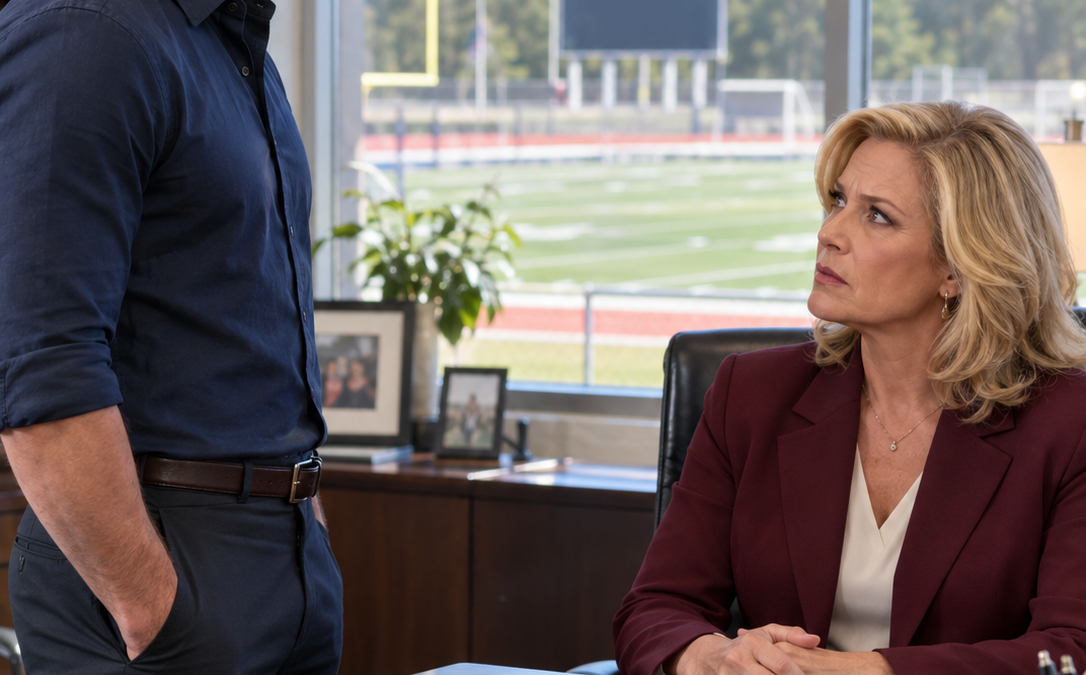
The $80,000 Scoreboard: Why I Walked Away After 12 Years of Teaching
What you’re about to hear is the story of a high school science teacher who gave twelve years of his life to one school. He ran the robotics club, coached the academic decathlon team, and consistently produced the highest AP exam scores in the entire district. This guy was practically carrying the science department on his back. And every single year, when he asked for a raise, he heard the same answer: teaching was a calling.
Then he discovered that the district had just approved $80,000 for a brand-new football scoreboard. Eighty thousand dollars for a scoreboard. What he did next sent the entire school into a tailspin it still hasn’t fully recovered from.
Buckle up.
I taught high school science for twelve years. My students had the best AP scores in the district, and every time I asked for a raise, the administration reminded me that teaching was a calling. Then I found out they’d spent $80,000 on a scoreboard.
So I left.
I need to get this off my chest because the last few months have been the wildest stretch of my life, and I’m still trying to process everything that happened. My name is Bryce. I’m thirty-six years old, and until October of last year, I was a high school science teacher at a midsized public school in the Midwest. I taught AP Chemistry, AP Physics, and regular Biology. I also ran the robotics club, coached the academic decathlon team, and volunteered for practically every science fair, STEM night, and college preparation event the school organized.
Twelve years. That’s how long I was there. I walked through those doors at twenty-four, fresh out of my teacher certification program, carrying a box of laboratory supplies I’d purchased with my own money. And I never left. Well, not until I finally did.
Before I get into everything that happened, I want to make one thing clear. I didn’t become a teacher for the money. Obviously, nobody enters the teaching profession expecting to get rich. I knew the pay wasn’t going to be great when I signed up. During my first year, I earned $31,000. In the Midwest, that wasn’t exactly a starvation wage, but it certainly wasn’t enough to live comfortably, either.
For my first three years, I had a roommate because I couldn’t afford a one-bedroom apartment on my own. We shared a two-bedroom duplex near the railroad tracks, and my bedroom was so small that my dresser blocked half the closet door. I drove a 2004 Honda Civic until 2021. The air conditioning stopped working in 2018, and I never bothered to get it fixed. Every August, I’d drive around with the windows rolled down like it was 1987.
I packed my lunch every single day, too. And I mean every day, not just most days. I’m talking about a Tupperware container filled with the previous night’s leftovers, a banana, and one of those little cheese snacks. Yes, I’m a grown adult who still eats string cheese, and I absolutely refuse to apologize for it.
My parents thought I was out of my mind. My dad’s an electrician, and my mom works at a dental office. Both of them spent years dropping increasingly obvious hints about how I could make more money doing practically anything else. My dad would call on Sundays and casually mention that his buddy’s son had just landed a job as an operations manager, making $75,000 straight out of college.
Thanks, Dad. Really helpful.
But I loved teaching. I genuinely did. There’s this moment when a kid who’s been struggling with something all semester finally understands it. You can actually see it happen. There’s a little flash of recognition on their face, as though somebody has suddenly flipped a switch. Nothing else I’ve ever done has come close to giving me that feeling.
The point is, I wasn’t expecting to earn six figures. I simply wanted to be compensated fairly for the work I was actually doing. And without trying to sound arrogant, I was doing substantially more than most of the teachers at my school. That wasn’t because they were lazy. Most of them were excellent educators. But I was putting in more than sixty hours a week, teaching three AP courses, managing two extracurricular programs, and redesigning the entire science curriculum to align with new state standards.
That curriculum redesign alone consumed an entire summer. I did the whole thing for free. No stipend, no additional compensation, nothing.
I first asked for a raise during my fourth year. By that point, I was teaching three sections of AP Chemistry and two sections of regular Biology, and I’d just started the robotics club as an after-school activity. My AP students had recently earned the highest scores in the district for the second consecutive year. Not just the highest scores at our school. The highest scores in the entire district.
I had students earning fives on the AP Chemistry exam who’d entered my classroom barely understanding atomic structure. One kid, a sophomore named Wes, had been getting C-minuses in regular science. He started sitting in on my class simply because he was curious. After one semester, he took the AP exam and scored a four. A four, as a sophomore who wasn’t even officially enrolled in the course.
Armed with those results, I sat down with my department head, a woman named Linda who’d been teaching for thirty years. I laid out the numbers, explained my responsibilities, and showed her what my students had accomplished. She agreed that I deserved more money. In fact, she wrote a letter of support and sent it up the administrative chain alongside my request.
The request was denied.
Not reduced. Not negotiated. Denied outright.
The explanation I received, and I swear this is almost word for word, was that teaching was a calling, not a career driven by financial incentives. The principal at the time, a guy I’ll call Dr. Whitfield, delivered that line with a completely straight face while sitting in his office beneath a framed photograph of himself shaking hands with the superintendent at some golf fundraiser.
I’m not going to pretend that didn’t sting. It did. But I let it go. I was twenty-eight, and I figured that maybe the district really was dealing with budget constraints. Maybe things would improve the following year.
The following year arrived, and I asked again. I received essentially the same answer, only with slightly different wording.
“We value what you do, Bryce, but the budget doesn’t allow for individual salary adjustments outside the negotiated scale.”
Cool. Got it.
So I kept my head down and continued teaching.
By my seventh year, I’d transformed the robotics club from six kids meeting in my classroom after school into a twenty-two-member team that placed third at the state competition. Third in the entire state. These were public school students competing against private school teams that had ten times our funding. I personally paid for roughly half the parts we used.
My buddy Nate, who owns an auto repair shop, donated scrap metal and let us use his garage on weekends. We’d spend our Saturdays duct-taping servos onto reclaimed aluminum and somehow outperforming teams with sponsored CNC machines. And I loved every minute of it. Those kids were the reason I got out of bed in the morning.
I should mention that one of those students, a junior named Caleb, eventually received a full scholarship to Georgia Tech to study engineering. During his freshman year, he sent me a handwritten thank-you note. I still have it taped inside my desk drawer.
Anyway, around my eighth year, Dr. Whitfield retired, and a new principal arrived. I’ll call her Mrs. Hadley. She was in her mid-fifties, came from the administrative side of education, and, as far as anybody could tell, had never actually taught a classroom full of students in her life.
She had this particular way of carrying herself that made every interaction feel like a board meeting where everybody below her was an intern. She smiled constantly, but she never seemed to listen to anything anyone said. You know the type. She’d nod along while you were talking, but you could practically see her mentally checking her email.
Still, I gave her the benefit of the doubt. New leadership meant a fresh start, and I thought maybe things would finally change.
During my annual performance review that year, she described me as “a cornerstone of the science program.” I remember the exact wording because I actually wrote it down afterward. A cornerstone. That was the word she used.
I thanked her and asked whether a cornerstone might possibly qualify for a cost-of-living adjustment, considering my salary hadn’t meaningfully increased in eight years. She assured me that she’d look into it.
She did not look into it.
During my ninth year, I asked again and was denied. In my tenth year, I submitted another request. This time, I received a $200 stipend for running the robotics club. Based on the actual number of hours I spent managing the program, that worked out to approximately sixty cents an hour.
I know because I actually calculated it on a napkin during lunch one afternoon while eating leftover pasta.
Hold on. For everybody listening, this is me jumping in, not Bryce. I need you to really appreciate what just happened here. This man built a competitive robotics team out of scrap metal and what was essentially his string-cheese money. He helped send a kid to Georgia Tech on a full scholarship. And the school’s response was basically, “Here’s two hundred bucks. Go buy yourself something nice.”
Two hundred dollars. That’s not a stipend. That’s what you tip your barber at Christmas.
Mrs. Hadley was out here calling this man a cornerstone while paying him like a doorstop. If undervaluing employees were an Olympic sport, this school district would be banned for doping. And here’s the thing: the real kicker hadn’t even happened yet.
Year eleven was the breaking point. Actually, no. Let me correct that. It wasn’t quite the breaking point. It was the year the cracks became too big to ignore.
The academic decathlon team I coached won the regional championship. It was the first time in our school’s history that we’d ever accomplished that. I’m not exaggerating. The first time ever. The local newspaper published an article about it, and the school celebrated the victory on its website and social media accounts.
Mrs. Hadley stood beside me during the photo opportunity and told the reporter that I was the heart and soul of STEM education at our school.
The following week, I submitted a formal written request for a salary review. This wasn’t just some casual conversation in the hallway. I put together an extensive packet documenting my work. It included twelve years of AP exam score data, the robotics team’s competition history, the academic decathlon results, student testimonials, letters of support from three other teachers, and a spreadsheet comparing my salary with the district average for teachers who had equivalent experience and credentials.
I even included the state averages. At that point, I was earning approximately $11,000 less than the district average and nearly $15,000 less than the state average for somebody at my level.
Mrs. Hadley called me into her office. My packet was sitting on her desk, and I could tell she’d barely looked at it. The pages were still arranged in exactly the same order I’d submitted them. There were no notes, no folded corners, no indications that she’d spent any meaningful time reviewing the material.
She told me that she appreciated my dedication, but the district’s salary structure had been established through collective bargaining, and she didn’t have the authority to approve individual exceptions.
I asked whether there might be another option. A department chair position, perhaps, or a curriculum coordinator role. Anything that would recognize the additional responsibilities I was already handling.
She looked at me and said something that has been burned into my memory ever since.
“Bryce, you’re an incredible teacher, but teaching is a calling. The reward is in the work itself.”
The reward is in the work itself.
I didn’t say anything. I simply nodded. She smiled, made some comment about how happy she was to have me on the team, and I walked out of her office.
That conversation happened in March.
Six months later, in September, I was standing in the front office picking up some forms when I overheard two administrative assistants talking. One of them casually mentioned that the school board had just approved a budget request for a brand-new digital scoreboard for the football field.
I wasn’t deliberately eavesdropping. I was standing right there, and they were speaking at a perfectly normal volume. When I heard them mention the scoreboard, I asked how much it was going to cost.
One of them looked at me and said, “$80,000.”
Eighty thousand dollars. For a scoreboard.
At a school where the science laboratory still had beakers from the Clinton administration and I was purchasing my own dry-erase markers, the district had somehow found eighty thousand dollars for a football scoreboard.
I went home that evening and sat on my couch for a very long time. My dog, Diesel, a mutt I’d adopted from a shelter during my sixth year of teaching, walked over and rested his head on my lap. I sat there scratching his ears, staring into space and running numbers through my head.
Twelve years. Five requests for raises. Every single one denied.
When I considered the difference between my actual compensation and what I would have earned at the state average over that entire period, I estimated that I’d come up short by approximately $120,000. That was a conservative calculation. And now, apparently, the district had managed to find another eighty grand for a scoreboard.
I remembered asking Mrs. Hadley for $300 to replace the fume hood in the chemistry lab because its exhaust fan had started making a horrible grinding noise that frightened the freshmen. She told me to submit a facilities request and assured me that it would be prioritized.
That had been fourteen months earlier. The fan was still grinding.
I want to be absolutely clear about something. I don’t hate football. I have nothing against the athletes or their coach. This was never about sports versus academics. It was about spending twelve years being told there wasn’t enough money, then watching the district approve $80,000 for something that displayed numbers on a screen while the teacher consistently producing the highest test scores in the district couldn’t even secure a cost-of-living increase.
That night, I opened my laptop and pulled up my résumé. When I looked at the professional summary, I realized it still described me as a recent graduate. I hadn’t updated the thing in twelve years.
Twelve years of accomplishments weren’t documented anywhere because I’d never imagined that I’d need to look for another job. I’d spent so much time focusing on my students and my programs that I’d never bothered to keep a proper record of everything I’d achieved.
I spent the entire weekend rewriting it. I listed every AP score record, every competition result, every curriculum development project, and every major accomplishment I could remember. By the time I finished, the document was three pages long.
I know that’s too long for a résumé. At that point, though, I genuinely didn’t care. I needed to see all of it written down. I needed to remind myself that I wasn’t crazy for wanting more.
On Monday morning, I started applying to private schools.
Okay, stop for a second. Let me paint this picture for you because I don’t think the math has fully sunk in. Eighty thousand dollars. That’s enough to cover Bryce’s raise for the next five years and still have money left over to replace every cracked beaker in that science laboratory.
Instead, they bought a scoreboard. A screen that tells people a number.
You know what else tells people a number? The AP exam results that Bryce’s students were absolutely crushing every single year. But sure, let’s spend eighty grand so the Friday-night crowd can see “Home: 14, Away: 7” in high definition.
That’s like selling your car’s engine so you can afford a really nice bumper sticker.
I didn’t tell anybody at school that I was looking for another job. Not even Linda, my department head, whom I trusted completely. I simply didn’t want the administration finding out before I had something lined up.
Over the next three weeks, I applied to seven different schools. Most evenings, after finishing my grading, I’d sit at my kitchen table rewriting cover letters while Diesel snored beneath my chair. Within two weeks, I’d received three callbacks. Two came from private schools in the area, and the third was from a charter school about forty-five minutes away.
I attended all three interviews and was completely honest about why I wanted to leave my current position. Every single interviewer reacted in essentially the same way. They’d give me a slow, knowing nod and a look that seemed to say they’d heard this story a hundred times before.
At the charter school, the department head actually laughed when I explained my situation.
“We get at least two teachers a year from public schools telling us the exact same story,” he said. “Different scoreboard, same ending.”
The private school that interested me most was called Ridge View Academy. It was considerably smaller than my current school, with approximately four hundred students in total. But it had something my public school had apparently never considered particularly important: a properly funded STEM department.
Ridge View had a dedicated STEM wing, actual laboratory equipment manufactured within the last decade, and a robotics program with a real operating budget. And then, during the campus tour, I saw something that nearly made me burst out laughing.
There was a 3D printer sitting in one of the classrooms. Just sitting there, like it was a perfectly normal piece of educational equipment.
I’d spent three years writing grant applications, desperately trying to secure a 3D printer for my old school. Every single time, I’d been told it wasn’t in the budget. Meanwhile, Ridge View had one sitting in a classroom as though it were no more remarkable than a pencil sharpener.
They offered me a position teaching AP Chemistry and AP Environmental Science, along with responsibility for overseeing their STEM enrichment program. The salary was $20,000 higher than what I was currently earning. Twenty thousand dollars more, plus a professional development stipend and actual funding for the extracurricular activities I’d be running.
And the people interviewing me seemed genuinely excited about the possibility of having me there. At the end of the interview, the head of school shook my hand, looked me in the eye, and said, “We’ve been looking for someone exactly like you.”
I accepted on the spot.
Well, almost on the spot. I actually went home first, took Diesel for a walk around the neighborhood, and spent the entire time thinking about the decision. I kept going back and forth in my head because twelve years is an awfully long time to spend in one place.
I knew every crack in the hallway tiles at my old school. I knew which drinking fountain had the cold water and which one tasted like somebody had filled it directly from a swimming pool. I knew the bathroom on the third floor had a sticky lock and that you had to jiggle the handle twice to get the door open. That building had become as familiar to me as my own apartment. It was woven into the fabric of my everyday life.
But as Diesel and I continued walking, I started thinking about Caleb’s thank-you note. I thought about the robotics kids and all the mornings I’d walked into that building genuinely excited to teach. Then I thought about all the afternoons I’d walked out feeling as though the school administration couldn’t have cared less whether I was there.
I thought about Mrs. Hadley calling me a cornerstone while paying me like a temporary employee. And I thought about that brand-new, gleaming scoreboard sitting beside the football field, costing more than my entire annual take-home salary after taxes.
By the time Diesel and I made it back to the house, my mind was made up.
I submitted my resignation in mid-October and gave the school two weeks’ notice.
I know some people are going to say that quitting in the middle of a semester wasn’t a particularly considerate thing to do. And look, I understand that perspective. But I’d given that school twelve years of work that consistently went above and beyond my contractual responsibilities. In return, I’d received a $200 stipend and a pat on the back.
My employment contract contained a standard resignation clause, and I followed it to the letter. I wasn’t about to sacrifice another semester waiting for a convenient time to leave when the administration had never once bothered to wait for a convenient time to deny me a raise.
On the day I submitted my resignation letter, Mrs. Hadley called me into her office.
She looked confused. Not angry, not sad, just genuinely confused, like a computer that had received an input it didn’t know how to process. She asked me why I was leaving, and I explained the situation as calmly as possible. There was no dramatic speech, no shouting, and no attempt to turn the conversation into some enormous confrontation.
I told her that I’d been requesting fair compensation for years and that every single request had been denied. I’d now found another position where my work would be valued appropriately, and I’d decided to accept it.
I also mentioned the scoreboard. I didn’t yell or accuse her of anything. I simply pointed out that when a school district could find $80,000 for a scoreboard but couldn’t find $5,000 to give its highest-performing teacher a raise, the message was pretty clear.
She gave me this strange little half smile and said, “Well, I’m sorry you feel that way.”
I’m sorry you feel that way.
Not, “I’m sorry we failed you.” Not, “What can we do to convince you to stay?” Just that classic non-apology that manages to sound polite while communicating absolutely nothing.
I looked at her and said, “I don’t feel that way. It’s just what happened.”
Then I left.
Wait, wait, wait. I need everybody listening to appreciate that last line. “I don’t feel that way. It’s just what happened.” That’s not a comeback. That’s a verbal fatality.
Mrs. Hadley tried to play the classic “sorry you feel that way” card, and Bryce responded with raw, uncut facts like he was filing a police report. No emotional outburst, no anger, just a straightforward description of what had happened. Meanwhile, she’s sitting there looking like a Windows error screen.
This man didn’t flip a desk or raise his voice. He simply stated the situation and walked out. Absolute ice in his veins. And the best part of the story still hadn’t happened.
My final two weeks at the school were strange. Word spread much faster than I’d anticipated. By lunchtime on the day I submitted my resignation, practically half the building already knew.
The other teachers had mixed reactions. Some completely understood my decision and told me they wished they had the courage to do the same thing. A couple of them pulled me aside in the hallways to ask where I was going. They weren’t being nosy. They genuinely wanted to know whether my new employer might be hiring more teachers.
A few of the older teachers gave me speeches about loyalty. I respected their perspectives, even though I didn’t agree with them. One woman who’d been teaching at the school for twenty-five years told me I was making a terrible mistake and would eventually regret leaving.
I told her I hoped she was right.
One of the football coaches actually approached me in the parking lot and said, “For what it’s worth, nobody on the coaching staff asked for that scoreboard. That was all administration.”
I told him I appreciated him saying that, and I genuinely meant it. He went on to explain that the old scoreboard had been functioning perfectly well and that most of the coaches believed the money should have been spent repairing the school’s facilities instead.
So even the football coaches thought the whole thing was ridiculous.
The hardest part, though, was telling my students. I’m not going to pretend I handled it perfectly because I absolutely didn’t. When I informed my AP Chemistry class that I was leaving, one of my seniors, a girl named Jolene who was probably the smartest student I’d ever taught, simply stared at me.
“Mr. Bryce, are you serious?”
I had to stop for a moment before I could answer her.
I told the class the truth, although I obviously didn’t go into every detail. I explained that I’d been offered an opportunity I couldn’t pass up, and I assured them they were going to be fine because they were the most prepared students in the district. And I meant that. They really were.
The robotics kids took the news particularly hard. On my last day, a couple of them came to my classroom after school and presented me with a card that the entire team had signed. One student had drawn a little robot on the front holding a sign that read, “We’ll miss you, Mr. B.”
Another kid had written, “Thanks for believing we could build stuff that actually worked.”
I’m not ashamed to admit that those words hit me right in the chest. I kept the card, of course. It’s sitting in the same drawer as Caleb’s thank-you note now.
The last thing I did before leaving was clean out my classroom. It took me approximately two hours to gather everything I’d accumulated over twelve years. There were posters I’d made, laboratory equipment I’d purchased, and a coffee mug one of my students had given me that said “World’s Chemist.”
I packed everything into four cardboard boxes and carried them out to my car. By then, the parking lot was empty. It was around 5:30 in the evening, and the sky was beginning to darken.
I sat behind the steering wheel for a minute and looked at the building. Then I started the engine, drove home, and that was it.
Here’s where things started getting interesting.
After I left, the school couldn’t find anybody to replace me. Not for three months. For three entire months, my AP Chemistry and AP Physics classes were taught by a rotating collection of substitute teachers who, bless them, were doing their absolute best but simply weren’t equipped to teach college-level science courses.
The substitute assigned to AP Physics was a retired gym teacher. I’m not making that up. Apparently, on his very first day, he told the students he wasn’t really a science guy, but they’d figure everything out together.
Now, that’s a lovely sentiment. It’s also absolutely terrifying if you’re a seventeen-year-old trying to prepare for the AP exam in May.
The robotics club shut down completely because nobody was willing to take responsibility for it. The kids tried to continue meeting on their own for a while, but without an official faculty adviser, the school wouldn’t allow them to use the laboratory space or equipment. Eventually, the entire program simply disappeared.
Twenty-two kids with nowhere to go.
The academic decathlon team struggled through the rest of its season under a replacement coach from the English department. Again, a wonderful person, but somebody who couldn’t have explained the difference between an endothermic and an exothermic reaction. After winning the regional championship the previous year, the team didn’t even qualify for regionals.
My former AP students took their exams in May, and the results arrived over the summer. I’m not going to share the exact scores because I don’t want any of those kids to feel bad about what happened. None of it was their fault.
But the overall pass rate dropped by more than forty percent.
Forty percent.
In a single year, the program went from having the highest scores in the district to performing below the district average. And a significant part of the problem was that the school had spent three months trying to find one qualified person to replace me.
That’s when the parents started getting angry.
The first wave came in the form of emails. Parents began contacting the school board, demanding to know what had happened. They wanted explanations for the dramatic decline in AP scores, the disappearance of the robotics club, and the academic decathlon team’s sudden collapse from regional champions to a team that couldn’t even qualify for the competition.
The school board responded the way school boards tend to respond. They formed a committee.
Apparently, the committee was responsible for assessing the impact of recent staffing transitions on student outcomes. I know this because one of my former colleagues sent me a screenshot of the official email announcing its formation. We both had essentially the same reaction, which consisted of one very long exhale.
The second wave came in the form of a petition. A group of parents organized an online petition demanding that the school board conduct a comprehensive review of its spending priorities and teacher compensation policies.
The last time I heard anything about it, the petition had collected more than six hundred signatures. For a school district our size, that’s a substantial number of people. It’s more than the number who typically show up for the homecoming football game.
Then the local news got involved.
Somebody, and I genuinely have no idea who, contacted a reporter at our local television station and told them what had happened. The station decided to produce a segment about the situation, framing it around the departure of a top science teacher who’d repeatedly been denied a raise and the school’s subsequent struggle to replace him.
They interviewed parents. They interviewed students. They even included footage of the brand-new scoreboard.
I mean, you really couldn’t make this stuff up.
The reporter literally stood in front of the football field with that enormous new digital scoreboard glowing behind her while explaining how the district had failed to retain one of its most successful teachers.
One of the parents said something along the lines of, “They had eighty thousand dollars for a scoreboard, but they couldn’t keep the best teacher in the building.”
Apparently, that particular clip went semi-viral around the area. A buddy of mine who lives two states away actually sent me a text about it.
Yo, time out. This story just went from ordinary workplace drama to a full-blown public meltdown, and I am here for every second of it.
The local news is running stories. Parents are writing angry letters. The AP scores look like they’ve fallen straight off a cliff. And somewhere in the background, that eighty-thousand-dollar scoreboard is sitting beside the football field, glowing like a monument to the dumbest budget decision in the entire school district.
You can’t write irony this good. A Hollywood screenwriter would probably read this script and say, “Nah, that’s way too obvious.” But apparently, real life doesn’t have to worry about believable plot development.
This is what happens when you tell your MVP that he should keep working for the love of the game and then blow the budget on a giant Jumbotron for a football team with an 0–5 record.
The school board held a public meeting in January. I didn’t attend because I was already settled into my new position at Ridge View, but three different people texted me afterward to tell me what had happened.
From what I heard, the meeting was intense. Parents actually showed up in large numbers. This wasn’t one of those routine board meetings attended by the same four people who always came. The room was packed, and people were asking pointed questions about teacher retention, salary competitiveness, and how the district decided which projects deserved funding.
Apparently, one father stood up and read my resignation letter aloud in front of everybody. I didn’t even know the parents had obtained a copy of it.
Mrs. Hadley was there, too. According to the people who contacted me, she spent most of the meeting looking uncomfortable and redirecting questions to the superintendent. The superintendent made some statement about how the district valued all its teachers and remained committed to offering competitive compensation.
You know, the kind of sentence that sounds impressive until you realize it doesn’t actually mean anything.
About a week after that meeting, I received a phone call from the president of the school board. His name was Gerald, and I think I’d met him maybe twice during my entire twelve years with the district.
He was extremely polite. He explained that the board had been reviewing the situation and wanted to discuss the possibility of my returning to the school. Apparently, they were now prepared to offer me a $15,000 salary increase, an official department chair position, and additional funding for both the robotics club and the academic decathlon program.
Fifteen thousand dollars.
After twelve years of being told there wasn’t any money. After I’d already resigned, accepted another position, and started building a new life somewhere else. After the AP scores had collapsed, the robotics club had disappeared, and the entire situation had become a local news story.
Suddenly, they had fifteen thousand dollars.
I thanked Gerald for calling. I told him that I genuinely appreciated the board recognizing the problem and making an effort to address it. Then I explained that I was going to respectfully decline their offer.
There was a long silence on the other end of the phone. Eventually, he asked whether there was a particular salary figure that might convince me to reconsider.
I told him it wasn’t about the number anymore.
I explained that I was already working at Ridge View, earning $20,000 more than I’d made at his school. I had access to the resources I needed, and I was surrounded by colleagues and administrators who treated me like an actual professional instead of an unpaid volunteer.
I also told him that I hoped the board would use everything that had happened as a reason to invest in the teachers who were still working in the district. There were plenty of outstanding educators in that building who deserved better than what they were getting, and I genuinely hoped the administration would recognize their value before losing them, too.
Gerald thanked me for being straightforward. He said he understood my decision and wished me well.
Then we hung up.
After the conversation, I sat down and wrote Gerald a short, polite email formally declining the board’s offer. I thanked them for reaching out, wished the school the best, and repeated my hope that they would invest in the teachers who were still there.
I read the email three times before sending it. I wanted to make absolutely certain that nothing I’d written sounded bitter or smug. I wasn’t interested in rubbing their mistake in their faces. I simply wanted my position to be clear.
After I clicked Send, I sat there for a minute.
I’m not going to lie. A tiny part of me still felt a pull toward that place. Twelve years is a long time, and I couldn’t simply erase everything that had happened during those years.
I missed those hallways and classrooms. I missed those kids. I missed the robotics laboratory with its familiar smell of solder and burnt rubber. I even missed the sound of students arguing over whether some mysterious substance was an acid or a base.
I missed it. Parts of it, anyway.
But I didn’t miss being told that teaching was a calling every time I asked to receive fair compensation for doing it. I didn’t miss purchasing my own classroom supplies. I didn’t miss watching administrators approve five-figure purchases for athletic facilities while informing me that the science department’s budget was frozen.
And I certainly didn’t miss Mrs. Hadley’s empty smile and her endless collection of meaningless answers.
Here’s my final update.
It’s been approximately five months since I started working at Ridge View, and I’m not going to pretend the place is perfect. No school is perfect, and claiming otherwise would be ridiculous.
My commute is slightly longer than it used to be. The parking lot is strangely small for a school of that size. And one of the other science teachers has developed an unfortunate habit of microwaving fish in the faculty lounge, which, if you’ve ever experienced it, you know is basically a war crime.
But the work itself? The work is fantastic.
My AP students are engaged, motivated, and genuinely interested in what they’re learning. More importantly, I actually have the equipment and materials necessary to teach them properly.
I’ve already started a new robotics program, and the administration gave me a real operating budget. Not two hundred bucks and a condescending pat on the head. An actual budget that allows us to purchase the materials we need and build the things we’re excited about building.
We’ve already got fifteen students signed up, and my buddy Nate has been helping me source parts again. The biggest difference is that this time, I’m not paying for half the equipment out of my own pocket.
A few weeks ago, I received an email from Caleb, the former robotics student who’d earned a full scholarship to Georgia Tech. He’s a sophomore now, working on some kind of mechanical engineering project involving autonomous drones.
He told me he’d heard about my departure from the old school and wanted to make sure I was doing okay.
I wrote back and told him I was better than okay.
His response was short and simple.
“Good. You deserved better than that place.”
Coming from a twenty-year-old kid I’d once helped teach how to build robots out of scrap metal, those words hit differently.
There’s one other thing worth mentioning.
A couple of weeks ago, one of my former colleagues told me that Mrs. Hadley had quietly moved into a different position within the district over the summer. Nobody seems willing to confirm whether she was officially reassigned or whether she chose to leave the principal’s position voluntarily, but I have to admit that the timing is interesting.
Apparently, the new principal has already contacted the school board about the possibility of making meaningful adjustments to the district’s teacher salary scale.
Whether anything actually comes of that, I have absolutely no idea. But I hope it does. For the sake of the teachers who are still working there, I genuinely hope the district finally makes some changes.
As for the robotics club at my old school, the last I heard, it’s still gone. Nobody ever stepped forward to take over the program.
Twenty-two kids had something meaningful to do after school. They had a place where they could learn problem-solving skills, develop teamwork, and discover what they were capable of accomplishing. At least one of those students earned a full college scholarship after participating in the program.
And all of that simply disappeared because the district couldn’t figure out how to retain one teacher.
I don’t regret leaving. Not even a little.
I gave that school everything I had for twelve years. And when I finally asked for something in return, the administration essentially pointed toward an eighty-thousand-dollar scoreboard and told me I should feel grateful for the privilege of being there.
So I found a place that didn’t confuse dedication with desperation.
But I still think about those robotics kids. I wonder what they’re doing after school these days. I wonder whether any of them are still building things in their garages or experimenting with whatever materials they can find. I wonder whether one of them might eventually follow in Caleb’s footsteps and earn a scholarship to study engineering.
More than anything, I wonder whether they’ll have somebody in their corner when that moment comes. Somebody who believes in them, encourages them to keep trying, and helps them recognize what they’re capable of achieving.
Anyway, that’s the whole story.
Did I make the right decision by leaving in the middle of the semester, or should I have stayed until the end of the school year?
Man, this story really stuck with me.
Bryce gave that school twelve years of his life. He built successful academic programs from practically nothing, helped students earn places at prestigious universities, and consistently delivered some of the best academic results in the entire district. Yet the administration couldn’t even bring his salary up to the state average.
But the moment somebody wanted a new football scoreboard, they managed to find eighty thousand dollars without much trouble.
And the best part? After everything fell apart, they came back and offered him an additional fifteen thousand dollars as though it were some kind of incredibly generous peace offering.
Bro, the man was already earning twenty thousand dollars more at another school that actually respected his work.
I love it.
Drop a comment and tell me what you think. Was Bryce right to leave in the middle of the semester, or should he have waited until the school year was over?
Subscribe if you haven’t already, hit that notification bell, and I’ll see you in the next one.








