I never told my fiancé I led a Pentagon task force. He thought I was a base supply clerk. When he brought me home, his father handed me his promotion file, mocking, “You’ll never understand this level of service.” I spotted an active ethics case number and made one call. His smile vanished.
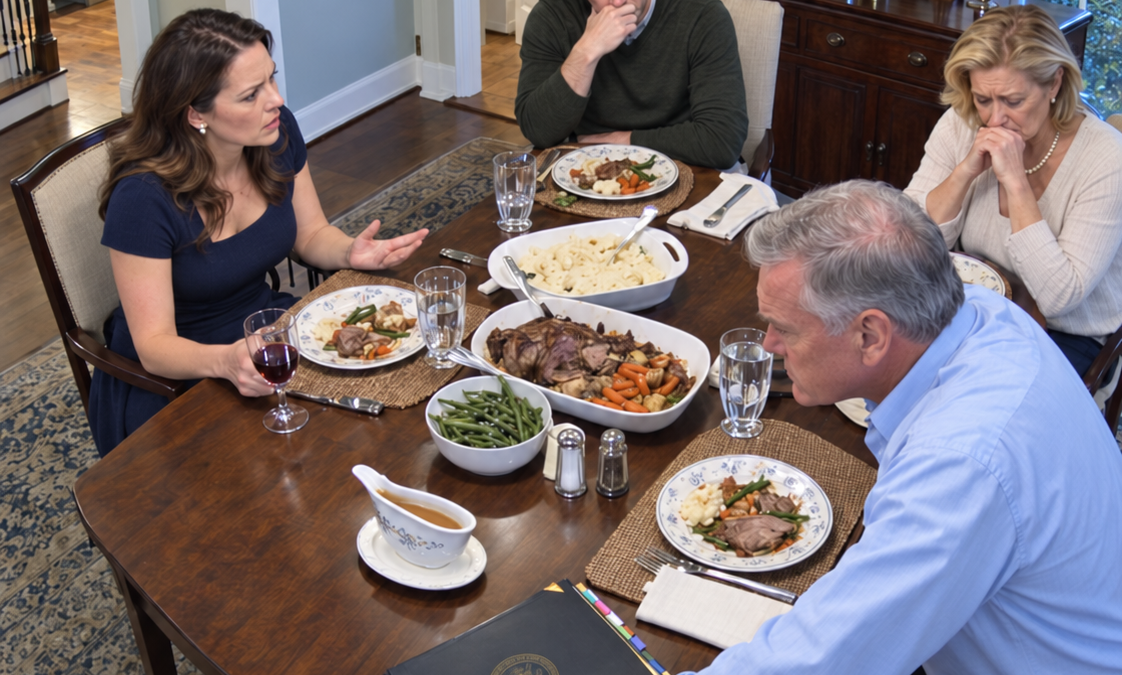
The folder he set on the table was thick enough to prop open a door. Its tabs were color-coded, its cover typed with the words Senior Advisory Nomination. He pushed it toward me with two fingers.
“You’ll never understand this level of service,” he said.
“Dad,” Ethan said with a small laugh.
“Come on, I’m only being honest, son.”
Richard turned to me, warm as a bank lobby.
“This is the senior advisory position I’m being considered for, Addison. A program worth hundreds of millions of dollars. Tell me, does counting inventory at a base give you any feel for decisions like that?”
Linda stared at her plate.
I felt the old heat rise at the base of my neck, the one I had learned to leave in the car. And I set it down the way I’d been trained to set down everything that wasn’t useful.
“I think a file like that gets judged on two things,” I said evenly. “Competence and integrity. Most people only prepare for the first.”
Richard laughed, a short, dry sound.
“That’s very good. Did they teach you that in a training slideshow?”
I looked at Ethan.
This was the moment I’d kept a place for, the small pause where a man who loves you says, “Dad, that’s enough.”
He gave me an apologetic half smile instead.
“Dad likes to test people,” he said. “Don’t take it personally.”
I remember the sound of the clock in the hallway. I remember deciding not to cry, not to correct anyone, not to say a single word about the office I walked into every morning. Not because I was ashamed, but because I had spent a decade learning that the quietest person at the table often sees the most.
Richard wasn’t finished.
He talked for ten minutes about budget lines and acquisition cycles, dropping terms the way a magician flashes cards, watching my face for the flinch. I gave him nothing but attention.
Somewhere in that monologue, I noticed his thumb pressing the edge of the folder, a small, unconscious gesture, as if the paper might slide away from him.
Then he flipped the folder open to show off a signature page, thumbed past it, and stopped at an appendix near the back.
“Page forty-one,” he said, proudly tapping it. “That’s what real accountability looks like.”
My eyes followed his finger.
In the upper corner of the page sat a case code, a string of letters and numbers formatted in a way I knew far too well. I had seen that structure in risk-control reports, in the kind of files that only exist when someone, somewhere, has asked a hard question about a contract.
It had no business sitting in a man’s personal nomination package.
I couldn’t conclude anything. A code is not a verdict. But I put my fork down quietly, and for the first time that night, I stopped looking at Richard Walker as Ethan’s father.
I started looking at him as a question that somebody soon would have to answer.
Richard didn’t notice the change in me.
Men like him rarely do, because they measure a room by how much of it is listening. He leaned back, folded his hands over his stomach, and started in on the part of the evening he had clearly rehearsed.
He told us about Fort Hood in the nineties, about a winter when a convoy ran short of fuel in the middle of an exercise and he rerouted supplies across three battalions before sunrise.
“Thirty years of service,” he said. “And what do I have to show for it? Relationships. That’s the real currency, Addison. People who pick up when I call.”
He mentioned Victor Hail, who ran a defense consulting firm in Arlington, as the kind of man who understood that.
“Victor doesn’t care whether you’ve memorized the regulations. He cares whether you’ve been in the arena, unlike the young administrators they keep hiring now.”
I let the word administrators pass. It was a small thing, and I had a bigger one in front of me.
“May I?” I asked, nodding at the folder.
Richard hesitated, then slid it back across the table like a man granting a favor to a child.
“Page forty-one is the highlight. Go ahead.”
I turned the pages slowly, the way you would in any stranger’s home. The appendix gave me three things, and I took them in without letting my face change.
First, the case code in the corner, formatted as an ethics matter, with a status line that read Active. Second, the name of an acquisition program I knew by heart because my team had been coordinating conflict-of-interest reviews around it for months. Third, a handwritten note in the margin: Package routed through outside advisory firm for review.
I didn’t know what any of it meant, and I want you to understand that.
I didn’t know whether Richard had done something wrong or whether a clerk had stapled the wrong page into the wrong binder. What I knew was that an active ethics code had no reason to appear in a document a man carried around to impress his son’s fiancée.
“Mr. Walker,” I said, “do you know what this code refers to?”
The folder was out of my hands before I saw him move.
He closed it, squared it against the edge of the table, and laid his palm flat on top.
“Administrative housekeeping. Every file in this business is full of internal notations. A man who’s been around the Pentagon as long as I have doesn’t lose sleep over a footnote.”
“Of course,” I said. “Has anyone told you formally whether that matter was closed?”
It was a gentle question, asked in the tone you’d use to ask if someone had taken their coat, but something flickered behind his eyes, there and gone like headlights passing a window at night.
For the first time since I’d walked into his house, Richard Walker wasn’t amused.
“People who aren’t in this world,” he said, “shouldn’t get curious about it.”
He turned to Linda.
“Is there any more of that gravy?”
Linda passed it with a hand that wasn’t quite steady.
Ethan reached under the table and squeezed my knee. A quick apology, and I understood he thought the tension was about me. I smiled at him. It was the most honest lie I told all night, because the smile wasn’t for what he believed.
The drive back to Arlington was dark and wet, the wipers keeping a slow beat. Ethan gripped the wheel with both hands.
“He was testing you. You know, he does that to everyone.”
“Has your dad ever mentioned Victor Hail?” I asked. “Or the program he was talking about?”
“Victor’s a client or a friend. I honestly don’t know. Addie, Dad’s consulting thing is basically a black box.”
He glanced at me.
“Why? You’re not going to turn this into a thing, are you? It was one dinner.”
“A case code that’s still open isn’t a joke,” I said quietly.
“That’s all. It’s a number on a page.”
I looked out at the wet road.
He wasn’t wrong, exactly. He wasn’t right, either.
I said nothing else, and the silence rode with us all the way home.
Lying awake that night, I thought about a depot in Colorado early in my career.
A shipment of communications gear had arrived, marked fully delivered, the paperwork flawless, but an independent test report sat in a drawer showing that a third of the units had failed acceptance standards.
A colonel I respected asked me kindly to sign off so the schedule wouldn’t slip. He wasn’t a villain. He was tired, and he had convinced himself that one signature wouldn’t hurt anyone.
I refused until the units were retested, and I spent the next month as the least popular officer on the post.
I never forgot what that taught me.
Serious wrongdoing rarely begins with something dramatic. It begins with a signature, an overlooked appendix, or a decent man who believes he has earned an exemption from the rules.
Ethan was asleep by midnight.
I slipped into the spare room with my laptop and did something that took less than a minute and felt like an hour. I checked only what my role legitimately allowed me to see, not one file further, and confirmed that the code was still carried as an open matter.
I didn’t search for names. I didn’t open anything that wasn’t mine to open.
I closed the laptop and sat in the dark.
Here was the problem. A man who would soon be my father-in-law had put a document in my hands that might touch an ongoing review. If I said nothing, I would be quietly deciding the matter by myself, and I had built a career on the belief that no one should do that alone.
If I spoke, I knew what it might cost.
Ethan had already told me, in so many words, that I’d be making something out of nothing.
I opened a blank message and typed the first line of a conflict-of-interest disclosure. Then I deleted it and typed it again.
I called Margaret Cole at seven the next morning from my car on a side street, with the engine off.
Margaret had spent twenty-five years in government ethics law, and her voice was plain and unhurried, like dry toast, which was exactly what I needed.
I laid it out the way I’d been taught to lay out anything that might one day be read aloud in a hearing room: date, place, who handed me what, what I saw, and what I did not see.
She listened without interrupting.
When I finished, she asked one question.
“Did he ask you to do anything with that file?”
“No. He used it to put me in my place.”
“Then you haven’t been asked to touch it, and you won’t.”
I heard a pen click.
“Addison, listen carefully. Recognizing a code isn’t the same as knowing what it means. You are not going to decide Richard Walker did something wrong, and you are not going to steer this toward an outcome you’d enjoy. Report what you saw, then step back. And because you’re engaged to his son, you disclose that in the same breath.”
“I was already planning to.”
“I know. I’m saying it so you hear it from someone else.”
That afternoon, I called the integrity office’s designated point of contact, a man named Greg Alvarez with a flat Midwestern patience.
I stated what I had directly observed: an active case code on page forty-one of a private nomination package, the name of a program my task force was coordinating on, and a margin note about an outside advisory firm.
I said I had no knowledge of wrongdoing. I did not ask anyone to be suspended or investigated. I asked how to handle the information, and I disclosed my relationship to the Walkers in my second sentence.
“Understood,” Greg said. “I’ll log this and route it to the independent review office. Don’t discuss it with the family.”
“I won’t.”
“And Miss Miller, these things don’t move fast.”
I hung up, feeling neither relief nor triumph.
My hands were cold.
I had dropped a stone into a river and had no idea where it would land.
It landed on Thursday.
Richard learned of it the way proud men learn most bad news: from a form letter.
The nominating office wrote that his package required supplemental review due to integrity and conflict-of-interest questions, and that the process was paused until those questions were resolved.
It accused him of nothing.
It didn’t need to.
I wasn’t there, so I’m telling this part as it was told to me later by Ethan and by Linda, who watched from the kitchen.
Richard read the letter twice, standing at the counter. Then he sat down, which Linda said she had seen him do maybe three times in forty years.
He called a retired general he’d golfed with for a decade and demanded to know what in God’s name was happening.
The general was kind and utterly useless. The file had gone to an independent office. He said nobody could touch it, and nobody should.
Linda said Richard set the phone down very gently, the way a man does when he’d rather throw it.
He never asked whether the review might have a point. He never asked what the code meant or why it sat in his folder.
He asked one question over and over, to himself and to anyone who would listen.
Who did this?
By evening, he had called Ethan.
“Did Addison say anything about my nomination? Anything at all?”
“No, Dad. She asked about Victor Hail on the drive home. That’s about it.”
“What did she ask about Victor?”
Ethan told me later that something cold slid down his spine.
Nothing had connected until his father said the word code. Then he remembered me in the car saying an open case code wasn’t a joke.
He came home that night and stood in the kitchen doorway, keys still in his hand.
“Did you do something?”
“I’ll tell you what I can,” I said. “I disclosed my connection to your family to the appropriate office, and I reported something I saw. I can’t say more than that.”
“You reported my father.”
“I reported what I saw on a page. I didn’t accuse him of anything, Ethan. I don’t have the authority to decide what it means, and I wouldn’t use it if I did.”
He looked at me as though I’d begun speaking another language.
“You could have talked to me first.”
“And left you knowing something you’d be asked about?” I said gently. “That wouldn’t have protected you.”
He didn’t answer.
He set his keys on the counter and went to bed.
Margaret called the next morning with the consequence I had expected and dreaded.
Because of my engagement, I would be walled off from any decision touching Richard, Victor Hail, or that program. My colleagues would take over those review items. I would keep my role, but part of my own work would be carved out, and the pace would suffer.
I said yes before she finished the sentence.
A wall that costs you something is the only kind that holds.
That night, my phone lit up with a message from Richard.
You had no right to interfere with a man’s career.
I read it three times, then typed:
I reported what I saw. What happens next depends on what the evidence shows.
Three dots appeared, vanished, and appeared again.
Then nothing.
I set the phone face down on the nightstand.
I knew a man like Richard wouldn’t let it rest, and I suspected he would reach for Ethan before he reached for anyone else.
Five days later, Linda called me from the garage, her voice low.
Richard had asked her to book a table at a quiet restaurant in Georgetown for Tuesday evening.
“He says it’s for the two of you,” she told me. “He wants you to take something back.”
The restaurant sat on a cobblestone side street in Georgetown, all candlelight and low voices, the kind of place where deals get done between the salad and the entrée.
Richard had taken the corner table with his back to the wall. He stood when I arrived, which surprised me, and didn’t offer his hand, which didn’t.
Ethan wasn’t there.
Margaret had told me to keep it short, keep it public, and say nothing about the review. So I ordered iced tea and waited.
Richard took a long time to start.
He turned his water glass a quarter turn, then another.
“I gave this country thirty years,” he said finally. “I buried friends. I missed my son’s Little League championships because a brigade needed fuel. And now a file I’m not allowed to see is being picked over by people half my age who’ve never shorted a platoon.”
“I understand it’s frustrating.”
“Do you?”
His voice stayed low, but it had an edge.
“I’m told you can make a call. I’d like you to make it and tell them you misread a page.”
“I didn’t misread it.”
“Then tell them it was a misunderstanding.”
“I don’t decide the outcome, Mr. Walker. I’m not even permitted near it. If I asked them to look away because you’re Ethan’s father, I’d be doing exactly what the review exists to catch.”
I kept my hands in my lap.
“I reported what I saw. That’s all I did and all I can do.”
He sat back.
“You did it because I embarrassed you.”
“No.”
“You sat at my table. I put you in your place, and you went home and found a way to put me in mine.”
“If you’d shown me that file politely, I’d have made the same call.”
“I made you feel small.”
“Yes. That isn’t why I picked up the phone.”
He studied me like an equation that wouldn’t balance.
Then he lowered his voice another notch, and the conversation changed temperature.
“Ethan has a lot ahead of him. Good company, good prospects. People in this town talk, Addison. A scandal follows everyone in a family. Doors that open easily today have a way of sticking. I’d hate to see my son pay for your principles.”
He never said anything you could write down. It was only the weather forecast of a man who knew which clouds he could summon.
I understood then what frightened Richard Walker most.
Losing the nomination was a bruise. Losing control of how people saw him was what kept him awake.
“I won’t take anything back,” I said, and stood. “But I hope the review treats you fairly. I mean that.”
His jaw worked.
I left a ten on the table and walked out into the cold. Only half a block later did I notice my hands were shaking.
Ethan was waiting on the steps of our building, and he had already heard his father’s version.
“He says you’re using your job to punish our family.”
“Did he tell you he asked me to retract my report?”
Ethan blinked.
“No.”
“Then let me tell you what I can, which isn’t everything.”
I sat down beside him.
“I made a disclosure. I didn’t accuse your dad of a crime. I’m walled off from any decision about him. That’s the full extent of my power here, and I gave up some of it on purpose.”
“That’s a convenient thing to hide behind,” he said. “Every time I ask what you actually do, there’s a rule that says I can’t know.”
It landed because it was partly fair.
I had let him believe in a smaller life than mine, and some of the distance between us was my own making.
“That’s true, and I own it,” I said. “But I won’t lie to you to keep the peace, and I won’t break a rule to prove I trust you.”
He rubbed his face.
“I don’t know who to believe.”
“Then watch what the evidence shows.”
He went upstairs without me.
I stayed out there until the cold was too much.
Linda called two days later from her car, engine running, voice pitched low.
She said Richard had changed over the past few years, bitter about being passed over, convinced his generation had been tossed aside by people with spreadsheets.
“He used to be proud of what he did,” she said. “Now he’s proud of who he knows.”
She told me she had once overheard him arguing with Victor Hail about a contract that had been delayed. She didn’t know the details, but she remembered Richard saying, in a tone she’d never heard from him, that he had stood up for some people and was tired of being the one holding the bag.
“No evidence,” she said. “Only a feeling.”
She apologized for it.
“You’ve given me something true,” I said. “That’s enough.”
I did nothing with it because I couldn’t.
The next morning, Greg Alvarez called to say the independent review had expanded my recusal to cover Hail’s firm by name.
He didn’t say why.
The firm’s name had surfaced in correspondence about how bidders were being evaluated, and he told me plainly that it proved nothing. But it raised a hard question: Had an outside adviser reached further into a decision than an adviser should?
“Stay far away from this,” Greg said.
“I will.”
I stood at my kitchen window, watching the streetlights come on.
This was no longer a story about one stiff old colonel, and I would have to live inside it without seeing the whole picture.
What I couldn’t see was what happened that same night in a study in McLean.
Richard sat alone with a bourbon he didn’t drink and called Victor Hail, demanding to know why his nomination was being picked apart.
Victor’s voice came through the speaker, smooth as a car salesman’s.
“Nothing to worry about,” he said. “Everything had been handled according to the agreement.”
Richard set the glass down.
“What agreement?”
Linda, passing the study door, told me later that she heard the silence stretch.
Then Victor said, almost kindly, “You really don’t remember what you signed?”
I learned the rest of what happened in that study the way you learn most of what matters: in pieces over months, from people who had no reason to flatter anyone, including themselves.
Richard didn’t sleep that night.
At two in the morning, Linda found him in his study with a banker’s box open on the floor and papers fanned across the desk like a hand of cards.
He had pulled every consulting agreement and email thread connected to Victor Hail. He was reading with the stiff concentration of a man hunting for a leak in a roof he was sure was sound.
The memorandum was in the third folder.
Richard recognized his own signature before he recognized the language.
It described him as an advisory consultant to Hail’s firm, and it said he would introduce Victor to certain people connected with the acquisition program and provide professional assessments of the firm’s capabilities.
When Richard signed it eighteen months earlier, he’d considered it ordinary business. Old officers advised companies all the time. It was legal, expected, even flattering.
Then he turned to the attachment.
The attachment was a capabilities brief, thirty glossy pages, the kind a firm sends to people with budgets.
On page six, under a heading about senior leadership endorsement, sat a paragraph attributed to Colonel Richard Walker, U.S. Army, Retired.
It read as though he had personally vouched for Hail’s firm on the very program that now carried a case code.
He remembered writing a few sentences of general praise.
He did not remember these.
Linda said he sat so still she thought he might be ill.
Then he started comparing.
The assessment he had emailed Victor in the spring was two short paragraphs, careful and full of qualifiers. The version in the brief was longer, cleaner, and missing every one of his qualifications.
A sentence that read, “Capable of performing work of this type, subject to verification of staffing,” had become, “Fully capable of performing this work.”
Someone had trimmed his caution out the way you’d trim fat from a steak.
There was more.
A string of emails in which Victor asked him to tighten up how his experience was described. Another in which Victor suggested his name be kept front and center in client materials. And a ledger of consulting payments, larger than Richard had let himself think about, that he now saw he had never once checked against the scope of work.
Money had arrived. He had cashed it. And he had not asked what it was for.
I want to be fair to him, because the story doesn’t work unless I am.
Richard was not simply a victim, and he was not simply a villain.
Victor Hail had used his name; that much looked clear. But Richard had signed things he didn’t read, taken payments he didn’t question, and allowed a stranger to polish his reputation into a sales tool because it felt good to be wanted.
That was the real hole in him.
Arrogance was only the paint over it.
I couldn’t see any of this.
By then, Margaret had made sure I was fenced off from the review, and I’ll admit the fence chafed. One night, after a long day of handing my own work to colleagues, I asked her whether there was any harm in my just knowing what they’d found.
“Yes,” she said. “The harm is that you’d want to act on it. Addison, you’ve been good at this because you don’t need to be the one who finishes the story. Don’t start needing that now.”
She was right, and it stung.
I hung up and washed dishes I’d already washed.
I made peace with the idea that I might never get the full ending, only whatever the process chose to tell me.
The review office, meanwhile, was doing what slow, careful offices do.
It gathered the different versions of the assessment. It asked Hail’s firm for its drafting history. It lined up the emails and the payment ledger against the contracts and the program’s evaluation timeline.
No single document proved everything, but together they raised questions that could not be waved away, and the office knew exactly which questions to ask.
Ethan learned the rest on a Saturday.
Richard had asked him to come over and help find a lawyer, and he had laid the memorandum on the kitchen table, along with a short story about how he’d only offered Victor friendly advice.
Ethan read the attachment.
He read the emails.
He read the dates.
“Dad,” he said, “you knew your name was going into his marketing.”
“Everyone knows consultants use references.”
“Not like this. Did you ever check how they used your words?”
Richard’s face went red from the collar up.
“You don’t understand the pressure of staying relevant when the uniform comes off. Nobody calls. Nobody cares what you know. Then a man like Victor shows up and treats you like you still matter.”
“I understand that, Dad. I do.”
Ethan’s voice was steadier than I’d ever heard it.
“What I don’t understand is how you spent my whole life telling me that rules are the difference between a man and a mess, and then didn’t read what you signed.”
Linda told me nobody spoke after that.
Richard looked at his son as if he’d never met him.
And Ethan, for what I believe was the first time, did not look away.
Victor had, meanwhile, made his own move.
He called Richard that Sunday, friendly as ever, and advised him to hand nothing over to anyone until he’d run it by Victor’s attorney.
Richard listened to the whole smooth speech.
Then he asked a question that felt to him like opening a window in a sealed room.
“Why your attorney, Victor? Why not mine?”
The line went quiet.
Richard understood in that quiet that the man who had promised to carry him toward the top was perfectly willing to leave him holding the blame.
That evening, my phone rang.
The screen said Richard Walker.
I almost let it go to voicemail.
Margaret had told me to keep any contact brief and about nothing but the process.
I answered.
There was no swagger in him.
I could hear a clock somewhere behind his voice.
“Addison,” he said, “if I tell them what I know, will that clear my name?”
I thought about every easy answer I could give him, and every one of them was a lie.
“No,” I said. “It will give them the truth. What they do with it is up to them.”
He was silent so long that I checked the call was still connected.
Then he said, very quietly, “That’s what I was afraid you’d say.”
Richard hired a lawyer on Monday.
Her name was Diane Foster, a former Army JAG officer with short silver hair and a reputation for telling clients the thing they least wanted to hear.
Linda said Richard came home from that first meeting looking like a man who had been X-rayed.
Diane had told him that the worst thing he could do was perform innocence, and the best thing he could do was be accurate.
So he was.
He gathered the banker’s box, the memorandum, both versions of his assessment, the emails, and the payment ledger. And he handed all of it over without holding back a single page.
He did not announce that he’d done nothing wrong.
He laid out what he knew, what he didn’t, and what he should have asked and never had.
Linda told me he sat in the driveway for twenty minutes afterward, with the engine off, and that when he finally came inside, he asked her very politely whether there was any coffee left.
In forty years, she said, he had never asked her politely for anything.
I stayed where I belonged, which was outside.
The review office worked the way it was built to work, interviewing people one at a time in a windowless room across the river, with nobody leaning on anybody.
The questions were narrow and boring in the best sense.
Where did this draft come from? Who changed this paragraph? Which contract do these payments belong to? Did anyone ever approve describing a personal opinion as an official endorsement?
Every answer was checked against the record, and every record against someone else’s answer.
There were no speeches.
Real accountability looks a lot like a stack of paper and a patient person with a pen.
The hardest session was the one where Richard sat across a table from Victor Hail.
Both men had counsel, and a process officer kept the time.
I wasn’t within a mile of it, so I’m telling it as Diane described it to Richard and as Richard later described it to Ethan.
Victor arrived in a beautiful gray suit and the same warm smile he must have worn into a hundred client meetings.
Richard asked him one question, and he asked it without raising his voice.
“Why did you put my name on a statement I never wrote?”
“You wrote it,” Victor said. “You read the brief. You knew exactly how it was being used, Richard. And you liked it fine until your own nomination was on the line.”
“I liked being asked,” Richard said. “That’s different, and it’s on me. I should have read every page, and I didn’t. But I never told you to present my opinion as an approval, and you know that.”
Victor smiled again and said memory was a funny thing.
The process officer wrote something down and said the disagreement would be resolved by documents, not recollection.
Nobody won the room.
Nobody walked out vindicated.
It was just two men who had once been useful to each other, sitting with the cost of it.
Ethan had been staying at his parents’ house for nine days.
On a Thursday night, I came home and found him at our kitchen table, still in his coat, hands folded like a student waiting to be called on.
“I’m not here to ask you to say anything you can’t,” he said. “I’m here because I owe you something, and I’ve been dodging it.”
I sat across from him and waited.
“At that dinner, I watched my father humiliate you, and I told you not to take it personally.”
His voice caught, and he steadied it.
“I called it a test. It wasn’t a test. It was a man being cruel because he thought you were beneath him. And I let it happen because it was easier than being the one who said stop.”
He looked down at his folded hands.
“And afterward, I demanded that you tell me things you were forbidden to tell me, when I’d never once bothered to ask what your days were actually like.”
“That’s all true,” I said, because it was.
“I know.”
He pressed the heel of his hand against his eye.
“I thought loving my family meant protecting them from being wrong. I think maybe it’s the other way around.”
I told him then what I was allowed to tell him, which turned out to be more than I’d ever offered.
I told him I wasn’t a base inventory clerk and had never claimed to be, that I’d started in supply and worked my way into leading an interagency task force that looked at integrity in defense acquisition.
I told him nothing about cases or names.
I said it plainly, without rank or ribbons or any trace of I told you so.
He stared at me for a long time.
“Two years,” he said. “I sat across from you for two years and thought I knew you.”
“You knew me,” I said. “You just didn’t ask the second question.”
“What would you have wanted me to say that night?”
“Not that I’m important,” I told him. “I never needed your father to know my title. I needed you to treat me with the same respect whether I was a colonel or a clerk. I don’t need you to choose me over your father, Ethan. I need you to choose honesty over fear.”
He nodded slowly, the way a man nods when he’s been handed something heavy and has decided to carry it.
He didn’t ask to stay.
He asked if he could make us tea, and I said yes.
The preliminary outcome arrived two weeks later in a plain envelope.
Richard’s nomination package could not proceed as submitted because of unresolved conflict-of-interest questions and the way his name had been used in a contractor’s materials.
The senior advisory position went to someone else.
The matters touching Victor Hail’s firm were referred onward for further review.
There were no handcuffs and no headlines.
Nothing had been proven in a court, and I wouldn’t pretend it had.
But Richard Walker’s quiet Sunday dinners, his golf-course phone calls, and the future he’d rehearsed to his mirror had all come to a stop.
His letter came the same week, addressed to me in a slanting, careful hand.
It was short.
He didn’t ask for help.
He said he’d carried his service like a shield, and that he’d used it to keep anyone from questioning him.
Then he wrote the line I’ve never forgotten.
I spent years demanding that people respect the uniform. Somewhere along the way, I forgot that the uniform never gave me the right to look down on anyone.
I read it standing at the window, with my coffee going cold.
I didn’t answer it.
Words are cheap when a man has just lost everything he thought defined him, and I wanted to see what he did when no one was watching.
Ethan came by that evening with groceries, as he had every evening that week, and put them away without being asked.
He found the right cabinet for the right can.
He asked how my day went and then, for the first time, asked the second question.
I watched him do it and felt something I hadn’t allowed myself in a long time.
And I still had to decide what to do with it.
Winter gave way to a wet, reluctant spring.
The review office kept working, and I kept my distance.
My own duties had been reshuffled so cleanly that most people at work never knew a wall had gone up around part of my desk.
Victor Hail’s firm received formal questions about how it had assembled and used its advisory materials. Whether those questions would end in sanctions, a settlement, or something quieter, I couldn’t say.
That was the point of the wall.
Richard did not receive the appointment.
He did not lose his house, his pension, or the thirty years he had actually served.
He lost the thing he wanted most, and he lost it slowly, which is how most real consequences arrive.
In April, a letter from him asked whether I would meet him for coffee.
Margaret said it was fine now, since the matter had moved beyond my reach, as long as I kept it personal and kept it short.
He chose a small café in Falls Church, the kind with chalkboard menus and mismatched mugs.
He was already seated when I came in, and he stood up again.
I noticed he had lost weight.
He had left the pressed Oxford at home and wore a plain gray sweater with a loose thread at the cuff.
No folder sat on the table.
“I won’t take much of your time,” he said. “I’d like to say something, and I’d like you to let me finish.”
I nodded.
“I judged you by a job title I made up in my head. I assumed that because you didn’t tell me your rank, you didn’t have one worth telling. And I used what I thought I knew to make you smaller in front of my family.”
He turned his mug a quarter turn, the old habit.
“I’ve thought about that dinner more than anything else in this whole mess. More than the nomination. More than Victor.”
“Why more?”
“Because I taught my son a rule when he was ten. You never make a person feel small to feel big yourself. I said it to him a hundred times.”
His voice thinned.
“And then I did it to the woman he loves, at my own table, with my wife sitting there watching.”
I let the silence stand.
I’d learned that a true apology doesn’t need help.
“I’m not asking you to forgive me,” he said. “I don’t think I’ve earned it. I’m saying I’m sorry, and that I’m working on being a man who wouldn’t have needed to say it.”
“I don’t need you to like me, Mr. Walker,” I said. “I need you to understand that experience and rank are not permission to treat anyone as less than they are. Not a lieutenant, not a clerk, not a stranger at your table.”
“Richard,” he said. “Please. Richard.”
He nodded and looked down at his hands.
“There’s something else. Last month, I volunteered at a veterans’ job fair in Manassas, helping men my age write résumés. A young Marine, maybe twenty-four, asked me what I did in the Army. I started to give him the long version, the one with all the names in it.”
He paused.
“Then I stopped, and I told him I ran fuel and ammunition so other people could do the hard parts.”
He smiled faintly.
“He said that sounded like the job that keeps everything else standing. It was the first time in years anyone made me feel like that was enough.”
“It is enough,” I said. “It always was.”
We talked for another twenty minutes, mostly about nothing.
His garden. The Nationals. Linda’s new habit of leaving the radio on while she cooked.
When I left, he didn’t walk me out, and I was grateful.
Some things a man has to do alone.
Ethan had meanwhile been doing what he’d promised, one quiet Tuesday at a time.
He had set a boundary with his father that I overheard once through a phone speaker.
“Dad, I love you, and I’m not going to run my life through you anymore.”
Richard had been silent a moment and then said, “All right.”
That was all.
It cost them both more than a shouting match would have.
Ethan also started asking about my days, and he listened to the answers, even when the answers were that I couldn’t answer.
He didn’t sulk.
He learned the shape of what I could and couldn’t say the way you learn the layout of a house in the dark.
One night, he said he’d been ashamed of how little he’d wanted to know, and that what scared him was how comfortable it had been.
We took a long walk by the Potomac one evening in May.
The cherry blossoms were long gone, but the river had that soft pewter shine you only get when the weather can’t decide.
Ethan stopped at the railing.
“I’m not going to ask you to set a date,” he said. “I’d like to earn that.”
“I know,” I said. “I think we should wait. Not because I’m leaving, but because I want us to build something that doesn’t need me to shrink. A year, maybe less, maybe more. We’ll know.”
“I can live with that.”
He took my hand.
“I’d rather be engaged to the real you for a year than married to a version I made up.”
I told him then what I’d been turning over for months.
Love isn’t proven in the easy moments, when the dinner is warm and the candles are lit. It’s proven when doing the right thing is uncomfortable and the person beside you has to decide whether to stand there with you.
He had failed that test once.
He was passing it now.
Both things were true, and I was learning to hold both.
The following Monday, I drove to the base before sunrise.
The air was sharp. The sky was a thin gray, and a line of soldiers in reflective belts jogged past the motor pool.
A sergeant I’d known for years waved me through the gate without a word.
There was no applause waiting for me.
No one gave a speech about integrity.
A forklift beeped somewhere, and a young specialist was arguing cheerfully with a clipboard about a missing pallet.
I stood in the cold and thought about the sentence that had started all of this.
You’ll never understand this level of service.
Richard had been wrong about the rank, but that was the smaller mistake.
The larger one was believing that service entitled him to stand above other people when it was only ever supposed to put him beside them.
I never needed his approval.
I needed to know whether the man I loved could stand next to me when doing the right thing became uncomfortable.
In the end, I didn’t destroy Richard Walker’s career.
I stopped protecting him from the consequences of his own choices.
And that, I’ve come to believe, is the difference between revenge and justice.
If you’ve ever been underestimated at a table where you deserved respect, I hope this reminded you that you don’t have to raise your voice to hold your ground.
I’d love to hear where you’re watching from and whether you’ve ever had to choose honesty when silence would have been easier. Leave a comment below and tell me your story.
We share stories like this every day, so please subscribe so you never miss one, and share this with someone who needs to hear it.
Thank you for staying with me to the end.
Let’s keep walking this road.








