I hid my past as an SAS operative, living as a quiet carpenter. Then I heard my wife on the phone with her politician father: “He’s a washed-up loser. Send your assassins to his cabin. Make it look like a bear attack.” Little did she know, I didn’t buy that cabin for woodwork. The calls I made ensured her father’s assassins were walking into a fortified kill box
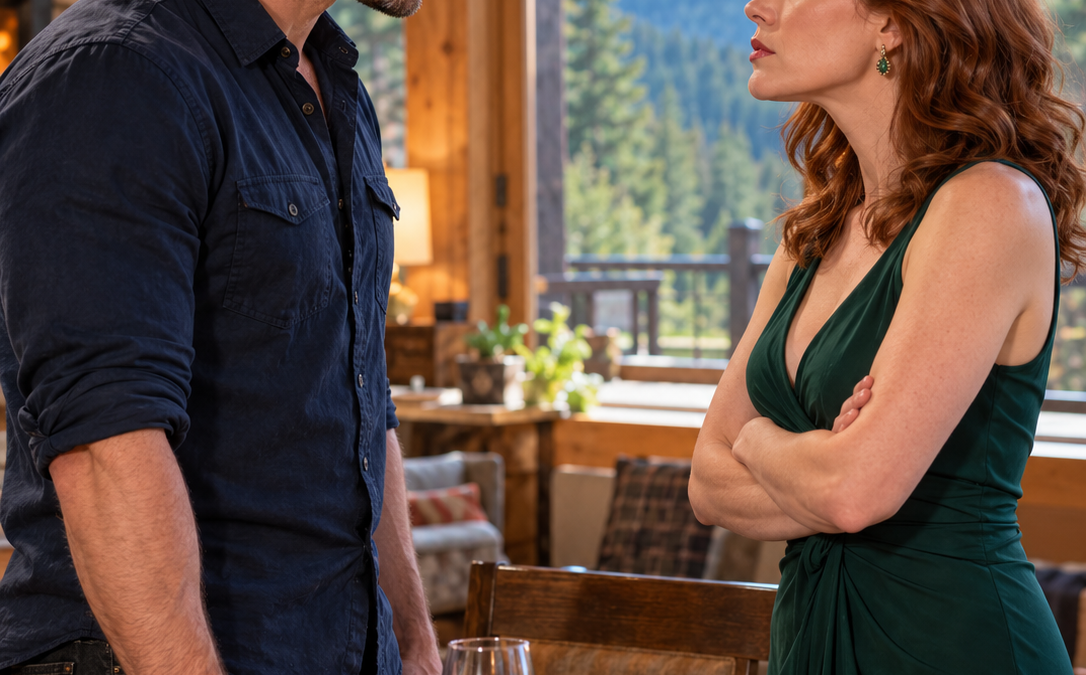
Matthew Bruce ran his calloused fingers along the grain of the oak plank, feeling for imperfections that lesser craftsmen might miss. The workshop smelled of sawdust and linseed oil. In a sense, those familiar scents had replaced the metallic tang of gun oil and cordite that had once defined his world. Three years had passed since he’d hung up his military fatigues and picked up a carpenter’s tools, trading the chaos of covert operations for the predictable rhythm of measure twice, cut once.
The remote cabin workshop in the Cascade Mountains of Washington State was his sanctuary. Angie had called it rustic when they first moved there, though he suspected she’d meant primitive. The nearest neighbor was five miles away down a winding dirt road, and cell service was spotty at best. For Matthew, the isolation was perfect. After fifteen years in the Special Air Service, conducting operations in places that didn’t officially exist, he craved the silence.
“Matt, you out there?”
Angie’s voice carried across the clearing from the main cabin. She stood on the porch, a phone pressed to her ear, gesturing animatedly. Even from a distance, he could see the tension in her shoulders. He set down his plane and walked toward the house, noticing how she turned away when she saw him approaching.
Their marriage had grown strained over the past year. Conversations had become shorter, and her visits to her father in Seattle had grown more frequent. Matthew had attributed it to the difficulties of adjusting from the urban comforts of her previous life to what she called the middle of nowhere.
“Everything all right?” he asked as she ended the call.
Angie startled, then forced a smile. “Just Dad. You know how he worries.”
Her father, Gerald Doyle, was a Washington State senator with political ambitions that stretched all the way to the governor’s mansion. Matthew had never warmed to the man’s calculated charm or his barely concealed disdain for what he saw as his daughter’s downward mobility.
“He wants us to visit more often,” Angie continued, tucking a strand of auburn hair behind her ear. It was a nervous habit Matthew recognized. “Says I’m wasting away up here.”
Matthew studied his wife’s face. In the SAS, reading microexpressions had been a survival skill. The slight tightening around her eyes, the way she avoided direct eye contact—these were tells he’d learned to recognize during hostile interrogations. But this was Angie, the woman who’d waited for him through deployments, who’d promised to build a new life with him.
“We were just there two weeks ago,” he said carefully.
“I know, but…” She paused as her phone buzzed with a text. Her face darkened as she read it. “I need to go inside. This work stuff has given me a headache.”
Work stuff. Angie didn’t work. Not since they’d moved to the mountains. Her father provided a generous monthly allowance that covered their modest expenses, something that had begun to chafe at Matthew’s pride. He’d suggested she might enjoy helping with his carpentry business, but she’d dismissed the idea with barely concealed horror.
Matthew watched her retreat into the cabin, then returned to his workshop. The oak plank waited on his workbench, and he picked up his tools with renewed focus. Woodworking demanded presence, attention to detail. Unlike his former profession, mistakes here could be sanded away. Joints could be recut. Projects could be started over.
As evening approached, he cleaned his tools and secured the workshop. The ritual was militarily precise. Every tool went into its designated place, wood was properly stored, and the bench was swept clean. Old habits died hard, even in civilian life.
Inside the cabin, Angie was cooking dinner, moving around the kitchen with distracted efficiency. She’d changed into a dress he didn’t recognize, something too formal for their usual quiet evenings. The table was set with their good china, and candles were burning.
“Special occasion?” he asked.
“Can’t a wife make a nice dinner for her husband?”
But her smile felt rehearsed, as if she were performing a role she’d grown tired of playing.
They ate in relative silence, making small talk about his current project, a custom dining set for a client in Seattle. Angie nodded at appropriate intervals, but her mind seemed elsewhere. When her phone buzzed again, she excused herself to take the call in the bedroom.
Matthew cleared the dishes, listening to the muffled sound of her voice through the closed door. He couldn’t make out the words, but her tone was urgent, almost conspiratorial. When she emerged twenty minutes later, her face was flushed.
“Everything okay?” he asked again.
“Fine. Just family stuff.” She moved to the window, gazing out at the darkening forest. “Matt, do you ever regret leaving the military?”
The question caught him off guard. “Why do you ask?”
“Just wondering if you miss the excitement, the importance of what you were doing.” She turned to face him. “Don’t you feel wasted up here, making furniture, when you could be making a real difference?”
Matthew chose his words carefully. “I’ve seen enough of the world’s problems. Building something lasting, something beautiful—that feels important to me now.”
Angie’s expression shifted, something like disappointment flickering across her features. “But don’t you miss being respected? Being somebody who mattered?”
The words stung more than she probably intended. Or perhaps exactly as much as she intended.
Matthew had been somebody who mattered once, a ghost who’d helped shape geopolitical events from the shadows. But that life had demanded pieces of his soul he wasn’t willing to sacrifice anymore.
“I matter to my clients,” he said quietly. “I matter to you. That’s enough.”
She looked away. “Of course. I didn’t mean…”
Her phone buzzed again. This time she ignored it, but the device’s insistent chiming filled the sudden silence between them.
“You should answer it,” Matthew said. “Sounds urgent.”
“It’s nothing that can’t wait.”
But her hand moved instinctively toward the phone before she stopped herself.
That night, as Angie slept beside him, Matthew stared at the ceiling and listened to the forest sounds outside their window. Somewhere in the darkness, an owl called to its mate. The sound was lonely, echoing off the mountains that had become his refuge.
He’d chosen this life deliberately, trading purpose for peace. But watching his wife’s growing discontent, feeling the widening distance between them, he wondered if some choices couldn’t be sustained forever. Some people were built for excitement, for the constant stimulation of crisis and drama. Angie, he was beginning to realize, might be one of them.
The phone on her nightstand lit up with another message. In its blue glow, Matthew caught a glimpse of her face, peaceful in sleep but somehow younger, as if she were dreaming of a different life entirely.
Chapter 2: Ghost of Afghanistan
Morning brought the familiar routine: coffee before dawn, a quick survey of the property’s perimeter, then an hour of physical training that kept his body combat-ready despite his civilian status. Matthew told himself the habits were simply discipline. But on mornings like this, when Angie’s phone had buzzed with messages until well past midnight, the old instincts felt less like habit and more like preparation.
The property encompassed forty-seven acres of dense forest, with natural choke points and clear sight lines he’d identified within days of moving there. Not because he expected trouble, but because assessment had become automatic after fifteen years of staying alive in hostile territory. The cabin sat in a natural depression, invisible from the main road while offering excellent defensive positions in the surrounding timber.
“You’re up early.”
Angie appeared on the porch in her robe, steam rising from a coffee mug. She looked tired, the shadows beneath her eyes suggesting she’d slept as poorly as he had.
“Same time as always.” Matthew finished his push-ups and stood, noticing how she watched the tree line rather than looking at him. “You okay? You seemed restless last night.”
“Bad dreams.” She shrugged, but her fingers worried the edge of her robe. “I keep thinking about moving back to Seattle, at least part-time. Dad could help you get some real work. Government contracts, maybe corporate security. You’re wasting your skills out here.”
There it was again, the suggestion that his current life was somehow lesser. Matthew accepted the coffee she offered but studied her face over the rim of his mug.
“I thought you liked the quiet life.”
“I thought I did, too.” Her voice carried a note of genuine sadness. “But I feel like I’m disappearing up here, Matt. Like we both are.”
Before he could respond, a vehicle approached down their private road, unusual for such an early hour. Matthew’s body shifted automatically into a more alert posture as a black SUV emerged from the trees. Official plates, government tags visible even at a distance.
“Expecting someone?” he asked, but Angie had already retreated into the cabin.
Two men emerged from the vehicle. One was tall and lean, with the bearing of someone in the military or law enforcement. The other was broader, older, wearing an expensive suit that looked out of place in the wilderness. Matthew recognized the type: bureaucrats who issued orders from air-conditioned offices to people who carried them out in considerably less comfortable circumstances.
“Matthew Bruce?” The taller man approached with credentials already extended. “Special Agent Curtis Tomkins, FBI. This is Deputy Director Roland Griffin. We’d like a few minutes of your time.”
Matthew examined their identification carefully. Old habits. Then he nodded toward the porch.
“Coffee?”
“This isn’t a social call,” Griffin said, settling into one of the wooden chairs Matthew had crafted the previous summer. “We need to discuss your recent activities.”
“My recent activities involve oak planks and dovetail joints.” Matthew remained standing, a subtle power play he’d learned during military briefings. “What’s this about?”
Tomkins produced a tablet, swiping to display photographs. “Three weeks ago, arms dealer Victor Klov was found dead in his Belgrade safe house. Two weeks ago, human trafficker Dmitri Petrov died in a car bombing outside Prague. Last week, Hassen Al-Rashid, whom we’ve been tracking for terrorist financing, suffered a fatal accident in Marseilles. Seeing a pattern?”
Matthew kept his expression neutral despite the recognition flickering through his mind. All three men had been targets he’d pursued during his SAS career, high-value individuals who’d somehow slipped through official channels.
“Sounds like someone’s having a run of bad luck.”
“Bad luck?” Griffin’s smile was thin and humorless. “Each death was made to look accidental, but forensic analysis suggests professional execution. The kind of precision work your former unit specialized in.”
“My former unit is classified.”
“Not to us.” Tomkins leaned forward. “We know about the Prometheus Task Force, Matthew. Off-the-books operations, deniable assets. What we don’t know is whether you’re conducting unauthorized executions as a private citizen.”
The accusation hung in the morning air like gunpowder smoke. Matthew had heard whispers about his old targets meeting unfortunate ends, but he’d assumed other agencies were cleaning house. The idea that someone suspected him of vigilante justice was both absurd and oddly flattering.
“I’ve been building furniture for three years,” he said finally. “Check my client records, my bank statements, my travel history. I haven’t left Washington State except for supply runs to Seattle.”
Griffin and Tomkins exchanged glances. The tablet reappeared, this time displaying financial records.
“Your wife makes regular trips to Seattle, sometimes to Portland, occasionally to Vancouver. Always alone, always paying cash for travel expenses.”
Matthew’s blood chilled, but he kept his voice steady. “Angie visits her father. He’s a state senator, Gerald Doyle. You can verify that easily enough.”
“Oh, we have.” Griffin’s smile turned predatory. “Senator Doyle is very concerned about these visits. Apparently, your wife has been asking unusual questions about her inheritance, about offshore accounts, about what might happen to family assets if her father faced legal troubles.”
The implications crashed over Matthew like a cold wave. Angie’s growing discontent, her frequent trips, the late-night phone calls—suddenly everything took on a different cast.
But before he could process the full scope of what the agents were suggesting, Tomkins delivered the knockout blow.
“We’re also investigating Senator Doyle for connections to several defense contractors currently under federal scrutiny. Seems there might be some question about how certain sensitive contracts were awarded.” He paused, watching Matthew’s reaction. “Contracts that would have required someone with your specific skill set to execute.”
“You think I’m working for my father-in-law?” Matthew couldn’t keep the disbelief from his voice.
“We think someone is,” Griffin said. “Someone with access to classified intelligence, professional training, and personal motivation. Someone who might be very concerned about protecting Senator Doyle’s reputation and financial interests.”
Matthew set down his coffee mug with deliberate care. The morning had shifted from routine to nightmare with devastating efficiency.
“Gentlemen, I need to be very clear about something. I’m not conducting operations for anyone. I am not killing arms dealers or terrorists or anyone else. I am building furniture in the mountains and trying to live a quiet life.”
“Then you won’t mind if we monitor your activities for a while,” Tomkins said, standing. “Standard surveillance, nothing intrusive. Just making sure our assumption is correct.”
After they left, Matthew stood alone on his porch, watching the dust settle on the empty road. Inside the cabin, Angie was conspicuously absent from the living areas, though he could hear her moving around in the bedroom.
The pieces of a much larger puzzle were beginning to arrange themselves in his mind, but the picture they formed was one he wasn’t ready to accept. His wife, the woman he’d built this life with, might be connected to activities that put them both in federal crosshairs. Worse, she might be positioning him as a scapegoat for crimes he hadn’t committed.
Matthew walked slowly back to his workshop, but instead of picking up his tools, he opened a locked cabinet hidden behind a false panel. Inside, wrapped in oiled cloth, lay items from his former life: a secure satellite phone, untraceable currency, identity documents that would stand up to casual inspection.
He kept these tools not out of paranoia, but from experience. In his line of work, burned bridges had a way of rebuilding themselves, and former enemies had long memories. What he hadn’t expected was that the greatest threat might come from within his own home.
The satellite phone powered up with a familiar startup sequence. Matthew hesitated, then dialed a number he’d memorized but never thought he’d use again.
“Ghost Protocol,” a crisp British voice answered after two rings.
“This is Carpenter,” Matthew said, using his old call sign. “I need to speak with the colonel.”
Chapter 3: The Overheard Conversation
That evening, Matthew worked late in his shop, ostensibly finishing a set of kitchen cabinets, but actually testing the secure communication system he’d thought was permanently retired.
The satellite phone had connected him to Colonel James Morrison, his former commanding officer, who’d confirmed Matthew’s worst fears. Someone was indeed eliminating targets from their old operations, and the killings bore hallmarks of Prometheus training.
More troubling, Morrison had mentioned recent intelligence chatter about a possible leak within U.S. political circles, someone selling classified information about terminated SAS operations to interested parties. The targets being eliminated weren’t random. They were potential witnesses to activities that certain powerful people wanted permanently silenced.
“Your name’s come up in some uncomfortable conversations,” Morrison had said. “Watch your back, Carpenter. Someone’s playing a very dangerous game, and you might be the intended loser.”
Matthew secured his tools and headed toward the cabin, noticing that Angie had turned off most of the lights earlier than usual. Her car was still in the driveway, but she might have gone to bed early, another recent habit that didn’t fit her usual patterns.
As he approached the house, he heard her voice through the partially open kitchen window. She was speaking quietly, but in the mountain stillness, sound carried farther than most people realized.
“I’m tired of pretending this marriage means something,” she was saying. “Three years I’ve been stuck in this backwoods nightmare while he plays with wood scraps.”
Matthew froze beside the window, old instincts keeping him motionless in the shadows.
“I know, Daddy. I know.” A pause, presumably while she listened. “He’s exactly what you said, a washed-up military reject who thinks building birdhouses makes him important.”
The words hit harder than enemy fire ever had. Matthew had faced death in a dozen countries, but hearing his wife’s casual contempt felt like a different kind of ambush entirely.
“The FBI visit spooked him,” Angie continued. “I could see it in his face when they left. He’s starting to put the pieces together, which means we need to accelerate the timeline.”
Another pause. When she spoke again, her voice carried a cold calculation that Matthew didn’t recognize.
“Yes, I’m sure. He keeps his old gear hidden in the workshop. I found it months ago. When they find his body, there’ll be enough evidence to convince anyone he was the killer. A disturbed veteran who couldn’t adjust to civilian life finally snapped and had to be stopped.”
Matthew’s hands clenched involuntarily. The woman he’d married, the woman he’d trusted with his vulnerabilities and his genuine desire for a peaceful life, was planning his murder.
“How long until your people get here?” Angie asked. She listened for a moment. “Tomorrow night? Perfect. I’ll make sure he’s in the cabin. Maybe I’ll cook him one last nice dinner. Might as well play the grieving widow role to the end.”
She laughed, a brittle, humorless sound.
“Don’t worry about the local sheriff. Deputy Foster’s been on your payroll for two years. He’ll corroborate whatever story we need. Former SAS operative goes paranoid, threatens his wife, forces responding officers to use lethal force. Case closed.”
Matthew felt the old combat calm descending over him, the mental state that had kept him alive through countless operations. Emotion was a luxury he couldn’t afford now. This was tactical assessment time.
“I don’t care what you have to pay them,” Angie was saying. “Just make sure it looks like a bear attack initially. We need time to plant the evidence before anyone with real investigative skills gets involved.”
A bear attack. The irony would have been amusing if it weren’t so deadly. Matthew had chosen this location specifically because of the local bear population, natural cover for the kind of defensive preparations that might otherwise raise questions.
“He bought this cabin for the isolation,” Angie continued. “Little did I know how perfectly it would serve our purposes. No witnesses, no cell service, no one to hear anything until we’re ready for them to.”
She was wrong about that. Matthew realized she’d never understood what he’d really been doing during their long talks about property selection and security measures. The isolation wasn’t just for peace of mind. It was a tactical advantage.
“One more thing, Daddy,” Angie said, her voice dropping even lower. “After this is over, I want you to make some calls. That FBI investigation into the overseas hits—I want to make sure they know Matthew had access to your classified briefings. Plant the idea that he was using your political intelligence for target selection.”
The scope of the betrayal was breathtaking. Not only had Angie been feeding information to her father about Matthew’s background and capabilities, but they were planning to use his legitimate access to classified information as evidence of guilt for crimes he’d never committed.
“I’ve already copied his workshop keys,” she said. “Your people can plant whatever evidence you need. Just make sure the forensics are convincing.”
Matthew backed away from the window, his mind racing through tactical possibilities. Tomorrow night meant approximately twenty hours to prepare against professional killers in terrain they’d have time to scout, with local law enforcement compromised.
Under normal circumstances, the smart play would be immediate extraction, disappearing into the network of safe houses and false identities he’d built during his active years. But these weren’t normal circumstances.
Angie and her father had turned his new life into an elaborate trap, and running would only confirm their narrative about a disturbed veteran on the run. More importantly, running would mean they’d won.
The woman who’d shared his bed for three years while planning his death would inherit his assets, collect on his life insurance, and probably cash in on book deals about living with a dangerous, unstable former operator.
Matthew made his way silently to the workshop, where he activated security measures he’d installed but hoped never to use. Motion sensors, cameras, perimeter alarms—all disguised as routine homesteading equipment but actually military-grade surveillance.
The satellite phone connected him to another old number.
“Phoenix Services,” a gravelly American voice answered.
Travis Rogers had left the Army Rangers five years earlier to start a private security company, but he still owed Matthew favors from their joint operations in Syria.
“This is Carpenter. I need immediate consultation on a home security upgrade.”
“Carpenter? Thought you’d gone full civilian.” Travis’s tone sharpened with professional interest. “What’s the threat assessment?”
“Multiple hostiles tomorrow evening. Terrain advantage to defenders, but attackers will have local law enforcement support.”
“Jesus. You need extraction.”
Matthew looked through the workshop window toward the cabin, where his wife was finishing arrangements for his murder.
“Negative. I need this handled locally and permanently.”
“Copy that. What kind of consultation are we talking about?”
“Full defensive package. And Travis, bring the kind of equipment that makes a statement about what happens to people who betray their own.”
“Roger. See you by dawn.”
As Matthew began his own preparations, he reflected on the bitter irony of the situation. Angie had called him a washed-up loser, too damaged for civilized society. Tomorrow night, she would discover exactly how accurate that assessment was—and why it made her plans so fatally flawed.
The carpenter was about to remember how to be a soldier. And soldiers, when cornered by traitors, didn’t build furniture. They built body counts.
Chapter 4: The Arsenal
Dawn brought Travis Rogers and a truck full of equipment that would have made a small nation’s military envious. Matthew watched from his workshop as his old comrade unloaded crates marked with legitimate camping supply labels that concealed considerably more lethal contents.
“Fancy setup you’ve got here,” Travis said, surveying the property with professional appreciation. “Good sight lines, natural choke points, plenty of cover. You always did have an eye for tactical real estate.”
“I was planning for bear encounters,” Matthew replied dryly.
“Different kind of predator now.” Travis opened the first crate, revealing military-grade night vision equipment. “So, what’s the full situation? And don’t leave anything out. I need to know what we’re really dealing with.”
Matthew briefed him on everything: the FBI visit, Angie’s betrayal, the timeline for the attack. Travis listened without interruption, occasionally nodding as details clicked into place.
“Your wife’s father, Senator Gerald Doyle,” Travis said when Matthew finished. “I’ve heard that name in some interesting contexts. Word is he’s been facilitating contracts for some very questionable private military companies. The kind that operate in gray areas and don’t ask inconvenient questions about rules of engagement.”
“Meaning?”
“Meaning the people coming for you tomorrow night won’t be standard hired muscle. They’ll be professionals with government training and non-attribution equipment.”
Travis pulled out a tablet showing satellite imagery of the surrounding area.
“I’ve been monitoring communications since your call. There’s a four-man team staged at a motel twenty miles south. Ex-Delta, based on their equipment signatures.”
Former Delta Force operatives represented a significant escalation from local muscle. These weren’t thugs who could be intimidated or misdirected. They were elite soldiers who had trained for exactly this kind of operation.
“Any idea about their approach route?” Matthew asked.
Travis manipulated the tablet display, highlighting terrain features. “Only one logical insertion point if they want to maintain stealth. The old logging road that connects to your eastern boundary. They’ll probably establish overwatch positions here and here.”
He indicated two ridgelines, then traced a route toward the cabin.
“They’ll move on the cabin after full dark.”
Matthew studied the tactical display, overlaying it with his mental map of the property’s defensive preparations.
“What about extraction? They’ll need a way out after the job’s done.”
“Same route, most likely. Fast vehicles staged at the logging road junction. Quick exfiltration to the interstate.” Travis looked up from the tablet. “But here’s what interests me. Your wife’s timeline suggests they’re not planning a quick hit-and-run. The bear attack cover story requires time to stage the scene, plant evidence, coordinate with compromised local law enforcement. Which means they’ll be staying on-site for hours after the initial assault.”
“Exactly. And that gives us opportunities they’re not expecting.”
Matthew felt the familiar tactical clarity settling over him, the mental state in which emotion retreated and pure operational logic took control. This wasn’t personal anymore. It was a professional problem requiring professional solutions.
“What kind of firepower are we talking about?”
Travis grinned, the expression predatory in its intensity. “Full spectrum. I brought toys that haven’t been field-tested yet. Call it a beta program for Phoenix Services.”
He opened another crate, revealing weapons that belonged in a specialized warfare museum: modular sniper systems, close-quarters battle packages, an electronic warfare suite, and some experimental items that didn’t officially exist.
“Experimental?” Matthew asked.
“Remember those Syrian operations where we needed to eliminate targets without leaving forensic evidence? I’ve been developing some interesting solutions for clients who require complete deniability.”
Matthew examined the equipment with appreciation for both its lethality and sophistication. This wasn’t military surplus or modified civilian gear. This was cutting-edge warfare technology designed for operators who couldn’t afford to leave witnesses or evidence.
“There’s something else,” Travis said, his tone shifting to serious concern. “I ran background checks on your wife and her father while driving up here. Gerald Doyle isn’t just selling classified information. He’s been facilitating the elimination of former SAS personnel who might pose problems for his business relationships.”
The revelation hit Matthew like a physical blow.
“How many others?”
“At least six that I can confirm. All former Prometheus Task Force members. All died in seemingly unrelated accidents over the past two years.”
Travis pulled up files on his tablet. Car crashes, climbing accidents, diving mishaps. When viewed individually, the deaths seemed like unrelated tragedies. But together, they revealed a disturbing pattern.
“When you look at the pattern,” Travis continued, “it becomes clear someone’s been systematically eliminating people who knew about certain operations.”
Matthew stared at the names and photographs of his former comrades. Good men who’d served their country with distinction, now dead because they possessed inconvenient knowledge about activities Gerald Doyle wanted hidden.
“Why frame me instead of just killing me?”
“Because you married his daughter. That gives them access to your methods, your background, your psychological profile. They’ve been studying you for three years, learning how you think and operate.”
Travis closed the tablet, his expression grim.
“But I think there’s another reason. Doyle needs a scapegoat for all the other deaths. Frame you as a rogue operator, and suddenly all those accidents become part of a disturbed veteran’s killing spree.”
The scope of the conspiracy was staggering. Not only were they planning Matthew’s death, but they intended to use it to close the books on a much larger criminal enterprise. His murder would provide cover for multiple assassinations and ongoing treason.
“Any chance we can take this to legitimate authorities?” Matthew asked.
“FBI’s already suspicious of you. Local law enforcement is compromised, and Doyle has enough political connections to muddy any investigation for years.”
Travis shook his head. “This needs to be handled off the books, with permanent solutions.”
Matthew spent the rest of the morning familiarizing himself with Travis’s equipment while his friend established electronic surveillance of the approaching threat. By afternoon, they had a complete picture of the enemy’s capabilities and intentions.
The four-man team consisted of former Delta Force operators now working for a private military company called Aegis Solutions, a firm with documented connections to Gerald Doyle’s political network. Their leader, Anthony Stratton, had a reputation for efficient problem-solving and complete discretion.
“They’re planning a complex operation,” Travis reported from his monitoring station. “Initial assault at 2200 hours, with staged evidence planting to continue until dawn. They’ve got local Deputy Foster standing by to provide the official response at six, discovering the crime scene and corroborating the cover story.”
“What about Angie?”
“She’s supposed to be away visiting a friend in Seattle. Perfect alibi. But according to their communications, she’ll actually be staged at a motel thirty miles north, waiting for confirmation before returning to play the grieving widow.”
Matthew felt something cold and final settle in his chest. His wife had planned every detail of his death with clinical precision, down to ensuring she had witnesses to her supposed absence during the murder.
“Travis,” he said quietly, “I want them all. Not just the shooters. Everyone involved in this conspiracy.”
His friend looked up from the equipment displays, recognizing something in Matthew’s voice that had been absent for three years.
The carpenter was gone. What remained was the weapon Gerald Doyle had tried to use against his own daughter’s husband.
“Roger that, Carpenter,” Travis said. “Let’s show these amateurs what happens when they try to play soldier with actual soldiers.”
Chapter 5: The Gathering Storm
While Travis coordinated with additional Phoenix Services personnel arriving throughout the day, Matthew made his own preparations, both tactical and psychological. The hardest part wasn’t planning the defense. It was accepting that the woman sleeping twenty feet away had spent three years studying his vulnerabilities in order to destroy him.
Late afternoon brought an unexpected complication: a phone call from Gerald Doyle himself.
“Matthew, son, how you doing up there?”
The senator’s voice carried its usual political warmth, but Matthew now heard the calculation beneath it.
“Fine, sir. Just working on a commission piece.”
“Excellent. Excellent. Listen, I wanted to reach out because Angie mentioned you seemed a bit stressed after that FBI visit. Want you to know I’m making some calls, seeing if I can clear up any misunderstanding.”
The irony was breathtaking. Doyle was calling to offer help with an investigation he’d orchestrated, playing the concerned father-in-law while finalizing arrangements for Matthew’s murder.
“I appreciate that, Gerald, though I’m not sure why they’d be interested in a carpenter.”
“Oh, you know how these federal agencies operate. They love to chase shadows and make busywork for themselves.”
A pause followed before the senator continued.
“Speaking of which, I don’t suppose you’ve heard from any of your old military colleagues recently? Angie mentioned you might have received some concerning communications.”
There it was, the fishing expedition. Doyle wanted to know if Matthew had contacted former SAS personnel who might complicate the evening’s operation.
“No, sir. Most of the guys I served with have moved on with their lives. We don’t really keep in touch.”
“Probably for the best. I imagine some of those relationships could be complicated, given the nature of your former work.”
Matthew caught Travis’s eye across the workshop. His friend was monitoring the conversation and had activated recording equipment. Everything Doyle said was being preserved for potential future use.
“Is there something specific I should be concerned about?” Matthew asked.
“Not at all. Not at all. Just a father-in-law looking out for his daughter’s husband. You take care of yourself up there, son. And give my love to Angie.”
After ending the call, Matthew sat in silence for several minutes. Gerald Doyle had just wished him well while knowing that in six hours, professional killers would be moving through the forest to end his life.
“Cold bastard,” Travis observed. “But that recording might be useful later. He essentially confirmed foreknowledge of the FBI investigation and expressed unusual interest in your former military contacts.”
“Later assumes we survive tonight,” Matthew said.
“We’ll survive.”
Travis’s confidence was absolute.
“I’ve been doing this for fifteen years, and I’ve never lost a client yet. Though I should mention Phoenix Services has some additional capabilities for this operation.”
“Meaning?”
“Meaning I brought more than just equipment.”
Travis activated a secure radio. “Blackbird, this is Phoenix Base. Status report.”
“Phoenix Base, Blackbird in position. No movement detected on target approach routes.”
“Copy. Hammer, Phoenix Base.”
“Hammer. Overwatch established. All equipment green.”
“Ghost, Phoenix Base.”
“Ghost. Electronic warfare suite active. Enemy communications under surveillance.”
Matthew stared at his friend. “You brought a full team.”
“Three additional operators, strategically positioned since this morning. We’ve got sniper overwatch, electronic intelligence, and mobile assault capability.”
Travis grinned.
“Did you really think I’d let you face Delta Force operators with just the two of us?”
Relief flooded through Matthew, followed immediately by tactical appreciation for Travis’s thoroughness.
“What’s the setup?”
“Hammer is Curtis Tomkins. Yeah, the same FBI agent who visited you yesterday. Turns out he’s been conducting his own investigation into Gerald Doyle and suspected something like this might happen. When I contacted him through back channels, he volunteered for unofficial support.”
The revelation was stunning. The FBI agent who’d questioned Matthew about overseas assassinations was now positioned to help defend him against domestic ones.
“Blackbird is Evan Hall, former Marine Force Recon. He’s got the eastern approach covered from a high position that’ll give him overlapping fields of fire with the main cabin. Ghost is Oscar Donahue, Army Special Forces communications specialist turned private contractor. He’s been monitoring enemy transmissions all day and can disrupt their coordination when things get interesting.”
Matthew felt the familiar pre-combat mixture of fear and anticipation settling over him. But this time, instead of facing the enemy alone, he had a team of professionals watching his back.
“What about Angie?”
Travis’s expression hardened. “That’s more complicated. She’s technically a civilian, even if she’s complicit in conspiracy to commit murder. Federal prosecutors would want her alive for testimony against her father’s network.”
“And if she resists arrest?”
“Then she becomes a tactical problem requiring a tactical solution.”
Travis met Matthew’s eyes.
“But that decision is yours to make. She’s your wife.”
Matthew considered the woman who’d promised to love and honor him while secretly planning his death. The woman who’d studied his habits, his vulnerabilities, his genuine desire for peace, and turned them all into weapons against him.
“She stopped being my wife the moment she chose her father’s money over my life,” he said finally. “Treat her like any other hostile asset.”
As evening approached, Matthew made one final check of the cabin’s defensive preparations. He’d spent months installing what appeared to be routine homesteading equipment but was actually a sophisticated defensive network: motion sensors disguised as weather-monitoring devices, cameras hidden in birdhouses, and automated systems that could seal doors and windows with the push of a button.
The kitchen where Angie had planned his last meal was now a command center with hardened communications and direct access to the workshop through a concealed tunnel Matthew had excavated during their first winter. The cabin’s innocuous appearance masked defensive capabilities that would surprise attacking forces expecting to face an isolated, unsuspecting target.
At 2000 hours, Matthew received a text from Angie.
Having dinner with friends in Seattle. We’ll be late getting home. Don’t wait up. Love you.
Love you.
The casual cruelty of those words, sent while she knew killers were already moving into position, crystallized Matthew’s resolve. Whatever happened tonight, Angie would face consequences for her betrayal.
“Enemy movement detected.”
Oscar’s voice crackled through the radio.
“Four individuals approaching from the east. Professional spacing and noise discipline. ETA to objective area, thirty minutes.”
Matthew checked his equipment one final time: night vision, communication gear, a weapon selected for close-quarters engagement. The carpenter’s tools were secured, replaced by implements designed for a very different kind of precision work.
“Phoenix team, this is Carpenter,” he said into his radio. “Remember, these people killed at least six of my former teammates. I want clean shots and permanent solutions. No prisoners, no mercy, no evidence left behind.”
“Copy that, Carpenter,” came Travis’s reply. “Time to show them what happens when civilians try to play military games with actual military personnel.”
Outside, full darkness was falling over the mountains. In that darkness, professional killers were moving through terrain they thought they understood, approaching what they believed was an easy target.
They were about to discover that sometimes the hunted became the hunter.
Chapter 6: The Trap Is Set
At 2130 hours, the enemy reached the perimeter of Matthew’s property, moving with the disciplined silence of elite operators. Through his electronic surveillance network, he watched four figures advance through the forest using military formations and communication protocols.
“Visual confirmation on all targets,” came Curtis Tomkins’s voice through the radio.
The FBI agent’s sniper position provided overwatch of the eastern approach.
“Professional gear, suppressed weapons, night vision equipment. These guys came ready for war.”
“Copy that, Hammer,” Matthew replied from his position in the cabin’s fortified kitchen. “Ghost, what’s their communication status?”
“They’re using military-grade encrypted radios,” Oscar Donahue reported from his electronic warfare position. “But I’ve been passively monitoring their frequencies all day. When you give the word, I can jam their communications and feed them false intelligence.”
The attackers had paused at the property’s natural boundary, conducting final reconnaissance before the assault. Through night vision scopes, Matthew could see Anthony Stratton directing his team with hand signals, positioning them for what they clearly expected to be a straightforward elimination.
They had no idea they were walking into a kill box prepared by someone who’d spent three years studying every inch of this terrain.
“Blackbird, report,” Travis radioed from his mobile position.
“Two hostiles moving toward the cabin’s rear approach,” Evan Hall responded. “Third target establishing overwatch on the ridge. Fourth target, presumed team leader, advancing on the front approach.”
Matthew smiled grimly. The attackers were following exactly the route he’d anticipated, using terrain features that appeared tactically sound but actually channeled them into predetermined kill zones.
“Phoenix team, initiate phase one,” Matthew commanded.
Oscar immediately activated his electronic warfare suite, jamming the attackers’ radio frequencies while broadcasting false heat signatures to confuse their thermal imaging equipment. Simultaneously, Matthew triggered hidden lighting systems that would temporarily blind anyone wearing night vision gear.
The effect was immediate and devastating. Through his surveillance cameras, Matthew watched as the four attackers stumbled in sudden confusion, their carefully coordinated assault dissolving into individual panic as their technological advantages disappeared.
“Contact left!”
Anthony Stratton’s voice was audible even without radio intercept as his night vision equipment overloaded from the unexpected illumination. The team leader fired blindly toward the cabin, his suppressed rifle chattering in fully automatic mode.
“Travis, you’re clear for mobile assault,” Matthew radioed.
He activated the cabin’s defensive lockdown. Steel shutters deployed across windows, reinforced doors sealed automatically, and the structure transformed from a rustic home into a military bunker in seconds.
Through external cameras, he watched Travis emerge from concealment like a force of nature, moving with the fluid precision of a special operations veteran. The former Ranger’s approach was a textbook example of close-quarters battle tactics, using darkness and confusion to close the distance before engaging.
The first hostile went down without ever seeing what killed him. A knife, thrown with lethal accuracy while Travis was still twenty meters away, struck its target. The man simply collapsed, his weapon clattering uselessly to the ground.
“One down,” Travis reported calmly, already moving toward his next target.
Matthew shifted his attention to the northern approach, where two attackers were attempting to regroup and establish communication with their team leader. These men were well trained, but they’d prepared for a simple assassination, not a complex tactical engagement against prepared defenders.
“Hammer, you have shots on the ridge position?” Matthew asked.
“Affirmative,” Curtis Tomkins replied. “Target is attempting to establish communications. Range four hundred meters. Clean line of sight.”
“Take the shot.”
The suppressed rifle’s report was barely audible, but through his scope, Matthew saw the hostile on the ridge suddenly jerk and fall backward.
Curtis had chosen a nonlethal shot, wounding rather than killing, which meant they might have a source of intelligence later.
“Target down, but breathing,” Curtis reported. “He’s not going anywhere, but he might have useful information.”
That left two hostiles near the cabin’s rear approach, now completely cut off from their support and facing an unknown number of defenders. Matthew watched them through thermal imaging as they attempted to establish a defensive position, using his woodshed for cover.
“Poor choice of cover,” he murmured, then activated one of his more creative defensive measures.
The woodshed exploded outward in a controlled blast that scattered lumber and revealed the two attackers’ positions to Travis, who was approaching from their blind side. The explosion wasn’t intended to kill. Matthew had designed it as a distraction and concealment-removal system.
“Beautiful,” Travis commented as he acquired both targets, flushing them out like rabbits.
The engagement that followed lasted less than thirty seconds. Both attackers were professional soldiers, but they’d been isolated, confused, and outmaneuvered by defenders who controlled every aspect of the battlefield.
When the gunfire stopped, Travis was standing over two bodies while scanning for additional threats.
“Area secure,” he reported. “All hostiles neutralized except for Hammer’s prisoner.”
Matthew emerged from the cabin’s fortified position, noticing how his peaceful mountain retreat had been transformed into a combat zone. The defensive preparations he’d installed just in case had proven their worth against professional killers.
“Outstanding work, everyone,” he radioed his team. “But this is just phase one. We still need to deal with the people who sent them.”
Through his secure communication system, he could hear Gerald Doyle’s conspirators attempting to contact the failed assault team. By dawn, they would realize something had gone catastrophically wrong with their carefully planned operation.
“What’s the plan for phase two?” Travis asked, checking his equipment while scanning the tree line for additional threats.
Matthew looked toward the lights of Seattle glowing on the distant horizon, where his wife was waiting for confirmation of his death and his father-in-law was preparing to implement the cover story that would frame a dead man for multiple murders.
“Phase two,” Matthew said quietly, “is when we take the war to them.”
The carpenter had successfully defended his home. Now it was time for the soldier to collect on debts owed in blood.
Chapter 7: The Hunter Becomes the Hunted
By midnight, Matthew’s team had secured the battlefield and interrogated their surviving prisoner. Anthony Stratton’s wounded teammate, Jason Bennett, proved surprisingly cooperative once Curtis Tomkins explained the federal charges he would face for conspiracy to commit murder.
“Doyle’s been running this operation for two years,” Bennett revealed while Oscar treated his shoulder wound. “We’ve eliminated seven former SAS personnel, three CIA contractors, and two military intelligence analysts. All people who knew about classified operations that Doyle was selling to foreign buyers.”
The scope of the treason was staggering. Gerald Doyle hadn’t just betrayed his daughter’s husband. He’d orchestrated a systematic elimination of American intelligence assets to protect his criminal enterprise.
“What about tonight?” Matthew asked. “What was supposed to happen after you killed me?”
“Plant evidence in your workshop linking you to all the overseas hits. Stratton had documentation that would make you look like a rogue operator conducting revenge killings. Your wife would confirm your increasingly unstable behavior, and Deputy Foster would corroborate the cover story about a mentally disturbed veteran.”
Travis looked up from the tactical maps he’d been studying.
“Speaking of which, we need to deal with Foster before he realizes the operation failed.”
Deputy Jay Foster was scheduled to discover Matthew’s body at six, then coordinate with federal investigators to establish the official narrative. His corruption made him a loose end that could unravel the entire conspiracy if handled incorrectly.
“I have an idea about that,” Curtis Tomkins said. “Foster doesn’t know I’m involved in tonight’s operation. What if he gets an anonymous tip about suspicious activity at the Doyle property?”
Matthew smiled grimly. “You want to turn the investigation around on them?”
“Exactly. Foster arrives here expecting to find your body and evidence of terrorist connections. Instead, he finds dead assassins and proof of a conspiracy involving his patron. Force him to choose between covering for Doyle or cooperating with federal authorities.”
It was an elegant solution that would either eliminate Foster as a threat or convert him into an asset. Either way, the conspiracy would lose a crucial component.
“What about Angie and her father?” Travis asked.
Matthew had been considering that question since the shooting stopped. His wife and father-in-law were the architects of this betrayal, but they were also high-profile targets who couldn’t simply disappear without triggering major investigations.
“They need to face justice,” he said finally. “But it has to be legal justice, with evidence that will stand up in federal court.”
“Then we need to get them on record,” Oscar suggested. “Confessions, evidence of coordination, proof of their role in multiple murders.”
Curtis nodded in agreement. “If we can get them talking about tonight’s operation, admitting their involvement, that gives us prosecutable evidence.”
Matthew felt a cold satisfaction settling over him.
“I think I know how to arrange that. Angie is expecting a call confirming my death. What if she gets a different kind of call instead?”
He activated his secure satellite phone and dialed a number he’d memorized but hoped never to use: the emergency contact for Gerald Doyle’s office.
“Senator’s residence,” a crisp voice answered despite the late hour.
“This is Matthew Bruce. I need to speak with the senator immediately. It’s an emergency regarding his daughter.”
Minutes later, Gerald Doyle’s voice came on the line, and Matthew could hear the confusion and growing alarm in his tone.
“Matthew, what’s happening? Where’s Angie?”
“That’s what I’m trying to figure out, sir. I just got back from Seattle and found signs of a break-in at our cabin. Angie’s car is here, but she’s nowhere to be found. There are… there are indications of violence.”
The lie was carefully constructed to trigger Doyle’s protective instincts while forcing him to reveal his knowledge of the evening’s true events.
“Violence? What kind of violence?” Doyle’s voice sharpened with what sounded like genuine concern.
“Bullet holes, blood, signs of a struggle. Gerald, I think someone came after us. Someone who knew our routines, our security measures.”
Matthew let desperation creep into his voice.
“I need to know if you’ve received any threats, any indication that your political enemies might target your family.”
There was a long pause before Doyle responded, and when he did, his tone had shifted subtly.
“Matthew, I want you to listen to me very carefully. Leave the cabin immediately and drive to the nearest police station. Don’t touch anything. Don’t investigate further. Just get out of there.”
“But what about Angie? I can’t just leave if she might be—”
“Angie is safe,” Doyle interrupted, then seemed to realize his mistake. “I mean, I’m sure she’s safe. She’s probably just somewhere else.”
“How can you be sure?” Matthew pressed. “Gerald, do you know something about what happened here tonight?”
Another pause, longer this time. When Doyle spoke again, he’d regained his political composure, but the damage was done.
“I don’t know anything specific. I just think you should let professionals handle this situation.”
Matthew activated the recording function on his secure phone.
“Professionals like the team that tried to kill me an hour ago?”
Silence stretched across the connection. When Doyle finally spoke, his voice was barely above a whisper.
“What are you talking about?”
“Four men, professional military equipment, coordinated assault on my property. They’re all dead now, Gerald. And one of them was very talkative before he died.”
“You’re lying.”
But Doyle’s voice carried the hollow tone of a man whose carefully constructed plans had collapsed.
“Jason Bennett, formerly Delta Force, currently employed by Aegis Solutions. He told me everything, Gerald. About the other killings, about the classified information you’ve been selling, about tonight’s operation.”
Matthew let steel enter his voice.
“About my wife’s role in planning my murder.”
The phone connection crackled with static, but he could hear Doyle’s labored breathing on the other end.
“I want to make you an offer,” Matthew continued. “You have one hour to turn yourself in to federal authorities. Bring Angie with you. Cooperate fully with the investigation, and maybe you can avoid the death penalty for treason.”
“And if I refuse?”
Matthew looked around at his team, professional warriors who’d just eliminated a squad of assassins with clinical efficiency.
“Then I come for you both tonight, and I won’t be nearly as merciful as the federal justice system.”
He ended the call and turned to face his assembled allies.
“Curtis, how long do you need to coordinate with your FBI colleagues?”
“Twenty minutes to get a task force mobilized. They’ve been building a case against Doyle for months. Tonight’s evidence should be enough for arrests and seizure of assets.”
“Travis, can Phoenix Services provide security for the arrest operation?”
“Already on it. Got additional teams en route to Seattle.”
Matthew felt the familiar weight of command settling on his shoulders. For three years, he’d tried to leave this life behind, but sometimes the past demanded one final accounting.
“Gentlemen,” he said quietly, “let’s finish this.”
Chapter 8: Reckoning
Gerald Doyle’s luxury estate in the exclusive Highlands district of Seattle was surrounded by FBI vehicles and tactical teams within forty-five minutes of Matthew’s ultimatum.
The senator had underestimated both the speed of the federal response and the extent of evidence his failed operation had provided.
Matthew rode in the command vehicle with Curtis Tomkins, watching through night vision scopes as tactical teams positioned themselves around the property. Travis and his Phoenix Services operators provided overwatch from strategic positions, ensuring no escape routes remained open.
“Movement in the main house,” reported one of the tactical leaders. “Two individuals, probably our primary targets.”
Through encrypted communications, Matthew could hear the FBI coordination. Years of investigation into Gerald Doyle’s activities had finally culminated in actionable intelligence, and federal prosecutors were preparing charges that included treason, conspiracy to commit murder, and violations of espionage statutes.
“There.” Curtis pointed toward a window on the second floor, where two figures were visible in silhouette. “That’s probably Doyle and your wife.”
Matthew studied the building through binoculars, noting escape routes and defensive positions. The estate was impressive, but built for comfort, not security. Against a coordinated federal assault, resistance would be futile.
His secure phone buzzed with an incoming call.
Angie’s number.
“Answer it,” Curtis advised. “But keep them talking. We need an admission of guilt on record.”
Matthew activated the recording function and answered.
“Hello, Angie.”
“Matt!” Her voice was shaky, desperate. “Thank God you’re alive. Daddy told me what happened at the cabin. Are you hurt?”
The performance was masterful. Concern, relief, fear—all perfectly calibrated. If Matthew hadn’t heard her planning his death twelve hours earlier, he might have believed it.
“I’m fine. Four professional assassins are dead, and their employer has been very cooperative with federal investigators.”
Silence stretched across the connection. When Angie spoke again, the facade had cracked.
“What do you want?”
“Justice. For my murdered teammates. For the classified information your father sold. For three years of lies and betrayal.”
“I never betrayed you.”
But her voice lacked conviction.
“Really? Because I have recordings of you planning my death, discussing how to frame me for murders I didn’t commit, calling me a washed-up loser while arranging for assassins to kill me.”
Another pause.
“Then you don’t understand the pressure I was under,” she said. “Daddy said if I didn’t help, we’d all go to prison. I was trying to protect us.”
“Protect us?” Matthew’s voice turned cold. “You called me pathetic. You said our marriage meant nothing. You planned to cash in on my life insurance and write books about living with a dangerous veteran.”
“That wasn’t… I didn’t mean…” Her voice broke. “Matt, please. We can fix this. I’ll testify against Daddy. Tell them everything. We can start over.”
Matthew looked at the tactical teams surrounding the estate, at the federal agents preparing to arrest the woman he’d once loved.
“Some things can’t be fixed, Angie. Some betrayals are permanent.”
“Sir,” Curtis interrupted quietly. “We’re ready to move. Do you want to be part of the arrest team?”
Matthew considered the offer. There was a certain poetic justice in personally arresting the wife who’d tried to murder him, but that would make this about revenge rather than justice.
“Negative. This needs to be clean, legal, by the book.”
He keyed his radio.
“All teams, you are authorized to proceed.”
The coordinated assault began with flashbang grenades and breaching charges. FBI tactical teams flowed through the estate’s entrances with practiced precision, encountering no resistance from targets who’d never expected their private war to reach their doorstep.
“Federal agents! Get on the ground! Hands visible!”
Through the communication network, Matthew heard the systematic clearing of rooms, the securing of evidence, the formal reading of rights to Gerald Doyle and Angie Bruce.
Three years of marriage and family dinners had ended with federal handcuffs and charges that carried potential death sentences.
“Both targets secured,” reported the tactical leader. “No resistance, no injuries.”
Matthew felt a curious emptiness as the operation concluded. For months, he’d lived with growing suspicion and dread, sensing that his peaceful life was built on unstable foundations. Tonight had confirmed his worst fears while simultaneously resolving them with devastating finality.
“Status report,” Curtis requested through his earpiece.
“Senator Gerald Doyle and Angie Bruce are in federal custody,” came the response. “Preliminary search has revealed extensive documentation of the conspiracy, including contracts with Aegis Solutions, payments to Deputy Foster, and communication records with eliminated intelligence assets.”
Travis approached from his overwatch position, his equipment secured and ready for extraction.
“How are you holding up, Carpenter?”
Matthew considered the question seriously. His wife was in federal custody for conspiracy to commit his murder. His father-in-law faced treason charges that would likely result in life imprisonment or execution.
His quiet mountain retreat had been transformed into a battlefield, and his carefully constructed civilian life had been revealed as an elaborate trap.
“I’m alive,” he said finally. “My enemies are defeated, and justice is being served. That’s more than many soldiers get.”
“What’s next? Phoenix Services could use an operator with your skill set.”
Matthew looked toward the distant mountains where his cabin waited, scarred by combat but still standing. The workshop where he’d found peace in creating furniture rather than destroying enemies. The life he’d built not as an escape from his past, but as a testament to the possibility of change.
“I think I’ll go back to carpentry,” he said. “But maybe I’ll expand the business, take on some security consulting work for people who need protection from the kind of predators we dealt with tonight.”
Curtis appeared beside them, tablet in hand, displaying preliminary evidence from the estate search.
“This is going to be a massive federal case. Multiple murder charges, treason, conspiracy, corruption of federal officers. Your testimony will be crucial for prosecution.”
“I’ll testify,” Matthew confirmed. “But after that, I want to disappear back into civilian life.”
“Understood. Though I should mention the FBI could use consultants with your particular expertise. There are other networks like Doyle’s operating in political circles.”
Matthew smiled grimly.
“Maybe. But tonight proved something important. You can take the soldier out of the war, but when war comes to the soldier’s home, the training never really goes away.”
As dawn broke over Seattle, federal agents led Gerald Doyle and Angie Bruce to waiting vehicles. The senator maintained his political composure even in handcuffs. But Angie looked broken, defeated, finally understanding the consequences of betraying someone who’d spent fifteen years learning to survive betrayal.
Matthew watched from the command vehicle as his former life was loaded into federal custody. Tomorrow, there would be debriefings, testimony, legal proceedings that would expose the full scope of the conspiracy.
But tonight, the immediate threat was neutralized, and justice was beginning its slow but inexorable process.
The carpenter could return to his mountains. The soldier could rest, his duty finally complete.
Chapter 9: New Foundations
Six months later, Matthew stood in his expanded workshop, watching a team of craftsmen put the finishing touches on a custom security installation for a federal safe house.
The carpentry business had evolved considerably since the night his old life had caught up with him, but the fundamental satisfaction of building something lasting remained unchanged.
The federal trials had concluded with devastating efficiency. Gerald Doyle received three consecutive life sentences for treason, conspiracy to commit murder, and violations of espionage statutes.
Angie had cooperated with prosecutors in exchange for a twenty-five-year sentence, a decision that had earned her father’s eternal resentment but spared her the death penalty.
Deputy Jay Foster had proven more valuable alive than dead, providing testimony that unraveled corruption networks spanning three states. His cooperation had reduced his sentence to fifteen years, though his law enforcement career was permanently over.
The surviving members of the assassination team faced federal murder charges, with Jason Bennett receiving a reduced sentence for his cooperation. Aegis Solutions had been dissolved, its assets seized, its leadership facing their own trials for conspiracy and racketeering.
“Mr. Bruce.”
A voice interrupted his thoughts.
Curtis Tomkins approached through the workshop, now wearing civilian clothes rather than FBI tactical gear.
“The perimeter sensors are installed and tested. Your property is officially the most secure private residence in Washington State.”
Matthew nodded appreciatively. Curtis had taken extended leave from the FBI to coordinate security improvements for the cabin, establishing detection systems that would prevent any future surprise visits from hostile actors.
“Any word from Travis?”
“Phoenix Services completed the installation in Colorado yesterday. Your friend is building quite a reputation for residential security consulting.”
Curtis grinned.
“Seems there’s considerable demand for protection services designed by people who actually understand the threats.”
The Phoenix Services expansion had been an unexpected consequence of the Doyle conspiracy trials. Media coverage of the assassination attempts had revealed how vulnerable former intelligence personnel could be to private military contractors, leading to increased demand for professional protection.
Matthew had declined offers to join the company formally, but he provided consulting on defensive architecture and threat assessment. The work combined his construction skills with tactical knowledge, creating something genuinely new rather than simply returning to his old profession.
“There’s something else,” Curtis continued, producing a tablet displaying surveillance footage. “We’ve been monitoring communications related to the Doyle network, and there are indications that other political figures might be operating similar schemes.”
Matthew examined the intelligence summaries: names, financial transactions, communication patterns, the familiar signatures of conspiracy and corruption.
Part of him felt the old operational instincts stirring, the desire to hunt down threats and eliminate them permanently. But another part remembered the peace he’d found in creating rather than destroying, in building furniture that would last generations rather than eliminating enemies who would quickly be replaced.
“What kind of response are you planning?” he asked.
“Official federal investigation, completely legal and transparent. No off-the-books operations, no private military contractors, no unauthorized surveillance.”
Curtis met his eyes.
“We learned some important lessons from the Doyle case.”
Matthew appreciated the distinction. The Carpenter’s War had been fought in self-defense, with clear legal justification and federal support, but it had also demonstrated the dangers of operating outside legal channels, even when facing enemies who showed no such restraint.
“If you need consulting on security measures or a threat assessment, I’m available,” he said finally. “But I’m done with the operational side. That chapter of my life is closed.”
Curtis nodded, understanding.
“What about personal concerns? Doyle had connections to international networks that might want revenge for his capture.”
It was a legitimate worry. Gerald Doyle’s treason had involved foreign buyers who’d lost significant investments when his network collapsed. Some of those buyers had resources that could make them dangerous enemies.
“The property security should handle most conventional threats,” Matthew replied. “And I’ve made some additional preparations.”
Those preparations included a network of former military personnel who’d settled throughout the Pacific Northwest, creating an informal early warning system for potential threats.
Travis had coordinated the network through Phoenix Services, ensuring that any hostile activity targeting former intelligence assets would trigger an immediate response.
Matthew had also established relationships with local law enforcement—the legitimate kind—who understood the unique security concerns facing former special operations personnel. The corruption that had compromised Deputy Foster had been eliminated, replaced by professional officers who took the protection of federal witnesses seriously.
“What about your personal life?” Curtis asked. “Any plans for rebuilding that aspect?”
Matthew considered the question while examining a half-finished rocking chair on his workbench. The piece had been commissioned by a young couple expecting their first child, a project that represented hope and continuity rather than the violence that had defined too much of his recent experience.
“I’m taking it slowly,” he said. “Learning to trust again. To believe that people might value what I build rather than what I can destroy.”
There had been tentative social connections in recent months. A woman who ran a gallery in Seattle had begun featuring his furniture, appreciating the craftsmanship while knowing nothing of his military background.
A former nurse who’d moved to the mountains for similar reasons had shared coffee and conversation with him about the challenges of rebuilding civilian lives after trauma.
Nothing serious yet, but possibilities that felt genuine rather than calculated. Relationships based on shared interests and mutual respect rather than the strategic considerations that had apparently motivated Angie’s original attraction to him.
“The important thing is that you have choices now,” Curtis observed. “The threats have been eliminated, the legal issues resolved. You can build whatever kind of life you want.”
Matthew looked around his workshop, expanded but still recognizably the space where he’d found peace after years of war. Tools arranged with military precision. Projects in various stages of completion. The honest smell of wood and oil and human craftsmanship.
Through the window, he could see the clearing where Travis and his team had eliminated the assassins sent to kill him. The ground had been restored, the damaged vegetation replanted, but Matthew would always remember what had happened there.
The night when his past had finally caught up with him, and he’d discovered that some skills never truly faded.
“I think I’ll keep building furniture,” he said finally. “But maybe I’ll specialize in pieces for people who need it most. Veterans transitioning to civilian life, families displaced by violence, anyone who understands that sometimes you have to start over completely.”
It was fitting work for someone who’d learned the hard way that destruction was easy, but creation required patience, skill, and genuine hope for the future.
Curtis gathered his equipment and prepared to leave.
“If you ever change your mind about consulting work, the offer stands. There are a lot of good people who could use protection from predators like the ones we eliminated.”
“I’ll keep that in mind,” Matthew replied. “But for now, I’m exactly where I need to be.”
After Curtis left, Matthew returned to work on the rocking chair, feeling the familiar satisfaction of wood responding to skilled hands.
Outside, the mountains rose in their eternal silence, offering both protection and perspective. The Carpenter’s War was over. The battles had been won, justice had been served, and the future stretched ahead with infinite possibility.
For the first time in years, Matthew Bruce was truly free to build the life he wanted rather than defending the life others had tried to destroy.
That was victory enough.
Share your thoughts in the comment section. Thanks for your precious time. If you enjoyed this story, please make sure you subscribe to this channel. That would help me a lot. Click on the video you see on the…
Cho đến nay, cuộc hội thoại này có hữu ích với bạn không?








