I defended my youngest after he burned down his brother’s dream beach house wedding, and now my firstborn says I was never truly his mother.
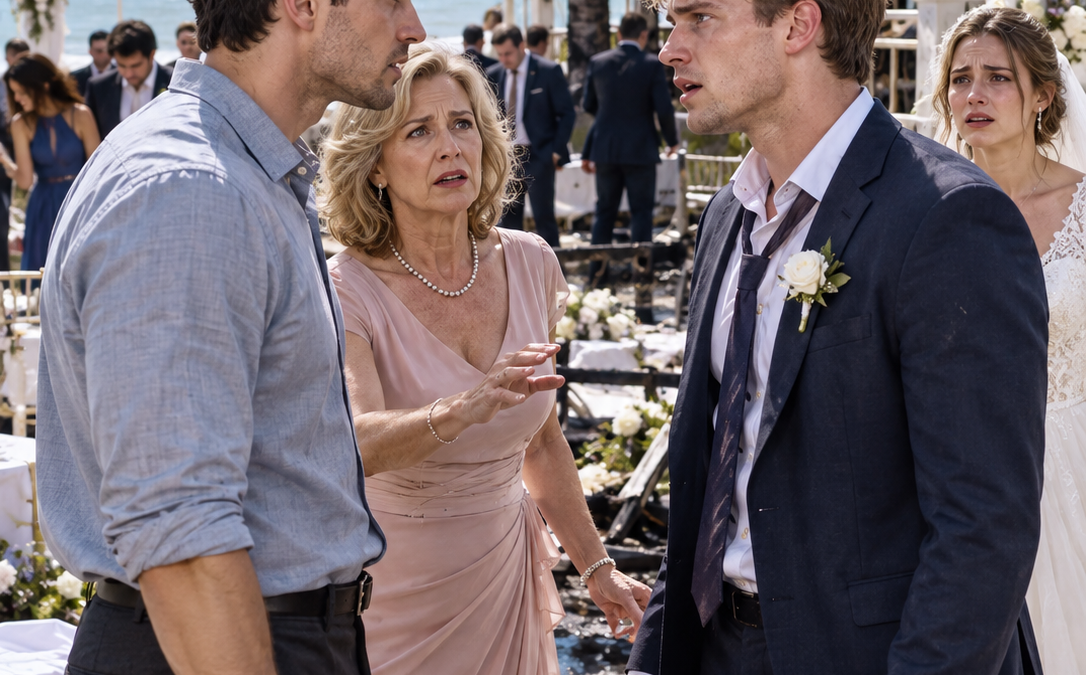
I defended my youngest after he burned down his brother’s dream beach house wedding. And now my firstborn says I was never truly his mother.
Before we go on, make sure to subscribe to the channel and let us know in the comments which city you’re watching from.
I was the mother who wanted to keep her family together, and I ended up tearing it apart. Not out of hate, but out of misguided love. Out of silence. Out of fear.
I have two sons. Dante, the older one, is thirty. Gail, the younger, is twenty-five. I raised them both with the same hands, but not with the same heart.
I don’t want that to sound cruel. I just want to be honest.
I had always felt something different when it came to Gail. When he was a child, he almost died. He needed help to breathe. His life depended on wires, machines, and constant care, and from that moment on, I saw him as fragile—even long after he stopped being fragile. I became his shield, his interpreter, his defender, even when he no longer needed one.
Dante was the opposite. He was mature before his time, responsible and quiet, almost invisible when it came to his emotions. He never seemed to need help. He never allowed himself to fall apart. And without realizing it, I began taking that strength for granted. I treated him as though he would always be fine, as though he didn’t have the same right to fail that everyone else did.
A few years ago, Dante accomplished something I truly admired. After working like a madman and saving every penny he could, he bought a house on the beach. It wasn’t some tiny little place, either. It was a beautiful property facing the ocean, with a garden, a deck, and enormous windows overlooking the water. It was his pride.
When he finished remodeling it, he invited us over. I remember wrapping my arms around him and saying, “I’m so proud of you.”
Looking back, I think that may have been the first time I ever said those words to him so directly.
Then came my husband’s birthday. We make a big event of it every year. We rent a hall, and cousins, uncles, aunts, even neighbors show up. That year, in the middle of a toast, Gail rose to his feet, lifted his glass, and made an announcement.
“We want to share something with everyone. We’re getting married.”
He wrapped an arm around Noelia, his girlfriend of many years.
The room erupted. There was applause, shouting, hugs, spontaneous toasts. It was a beautiful moment. My husband cried. I cried too. Everyone was thrilled.
Even Dante went over, hugged his brother, and said, “Congratulations, brother. You deserve it.”
And then Gail did something he should never have done.
Still holding his glass in the air, he turned toward Dante and said, “Since we’re all here together as a family, I wanted to take the opportunity to ask you for something special. Brother, would you lend us your beach house for the wedding?”
An uncomfortable silence settled over the room.
Everyone looked at Dante.
He blinked, and his smile faltered just slightly.
“Well,” he said carefully, trying not to sound abrupt, “we could talk about it later, right?”
“Come on, he’s your brother!” somebody shouted from the back.
“What a great gesture that would be.”
“You’re a great guy, Dante.”
Suddenly, the room became a theater of social pressure. There was laughter, applause, hands clapping him on the back. My husband encouraged him too, and out of pure reflex, I joined in.
“It would be beautiful,” I said. “The house is perfect, and Gail is so excited.”
Dante swallowed hard. Then he raised his glass with a half smile.
“Let’s talk about it at home. But yes. Probably yes.”
Everyone applauded.
Gail hugged him. People called Dante the best brother in the world, and for a few minutes, it felt as though family love had covered everything like a warm blanket.
But there was something almost no one noticed.
I did.
The look on Dante’s face wasn’t anger. It was resignation—the expression of someone who already knows he is about to lose something and realizes there is no graceful way to stop it.
A few days later, Dante met with us again, this time without an audience. He explained that he was willing to lend Gail the house because he understood that a wedding was a once-in-a-lifetime event. But he had hosted events there before, and there had been problems: broken things, damaged furniture, people drinking too much.
“I’m only asking for one thing,” he said. “No hard alcohol. You can toast, of course, but no getting drunk. I’m saying this from experience. It always ends badly.”
Gail nodded immediately.
“Of course, brother. Don’t worry. It’ll be elegant. I swear.”
I reassured Dante too.
“Don’t worry. We’ll take care of it as if it were our own.”
A few days later, Dante sent us a document. It wasn’t anything complicated or overly legal, just a written list of basic conditions: a maximum of sixty guests, which areas could be used, cleaning requirements, and a clause prohibiting excessive alcohol consumption.
But he had added something else.
At the bottom, under “Wedding Gift,” he had written that he would pay for the full catering service for all sixty guests.
Gail cried when he saw it. He hugged Dante and told him he was the best brother anyone could ask for. We all celebrated, and somewhere inside me, I thought that maybe—just maybe—this time we were doing things right.
How stupid I was.
From the beginning, a small voice inside me had warned that we were pushing our luck. Dante had said yes because he felt obligated, not because he truly wanted to. But surrounded by flowers, menus, dresses, and wedding preparations, no one wanted to listen to that voice.
At first, the wedding was perfect.
The sky was clear. A sea breeze carried that salty smell that makes you feel as if everything in the world is going to be all right. Dante’s house—the home he had built through years of work and sacrifice—looked as though it belonged on a postcard.
White lights were strung between the palm trees. The tables were decorated with seashells and white flowers. Soft music floated through the conversations.
Gail looked radiant. Noelia looked beautiful. And I could think of nothing except how proud and happy I felt.
I even remember thinking that when Dante came back later, I would tell him again how grateful I was.
That never happened.
Dante stopped by before the ceremony began. He was still wearing his work clothes because he had to deal with an emergency, but he promised he would return in time for the toast. Before leaving, he kissed me on the cheek and gave me one last gentle but firm warning.
“Remember the thing about the alcohol, please.”
“Of course, son. Everything’s under control.”
That was what I told him.
I lied.
Or maybe, more accurately, I lied to myself.
The ceremony itself was magical. There were tears, laughter, applause. Gail and Noelia promised each other eternal love with the ocean behind them while all of us applauded as though nothing in the world could break that moment.
Then, just after the ceremony, while the newlyweds were taking photographs in the garden, I saw Gail slip through a side door wearing the unmistakable expression of a person pretending he wasn’t doing anything wrong.
I followed him.
He was opening the trunk of a car. Inside was a huge box. When he lifted it, glass clinked against glass.
“What’s that?” I asked.
“Nothing, Mom. DJ stuff.”
He answered too quickly.
I raised an eyebrow.
Gail sighed, defeated, and opened the box.
Vodka. Whiskey. Rum. Gin. Wine.
It looked like a portable liquor store.
“Ma, seriously,” he said. “Are we going to have a wedding without a little party? Don’t give me a hard time. It’s my day. Nothing’s going to happen.”
I froze.
I knew it shouldn’t happen.
It was the only rule. The only one.
But then I looked at his face. That combination of pleading and certainty. That smile he had always used to break through every boundary I tried to set for him.
And just like so many times before, I gave in.
I nodded.
That was the moment I signed the sentence for everything that came afterward.
At first, the alcohol circulated discreetly. A hidden glass here, another there. Then bottles began appearing on the tables. Cousins toasted. Uncles laughed too loudly. My husband was already a couple of drinks in, hugging a stranger as though they were brothers separated at birth.
The music grew louder. The laughter grew louder. Responsibility quietly disappeared.
The party dissolved into a kind of cheerful chaos.
One of Gail’s friends jumped into the Jacuzzi wearing his suit. Two aunts nearly passed out after too much Prosecco. Noelia’s mother threw up near the dessert table.
Then Noelia’s brother, his words slurring from the rum, had what he believed was a brilliant idea.
“Fireworks!” he shouted. “This deserves an explosion!”
“No. No, no, no,” I said immediately. “That is not a good idea.”
“Relax, mother-in-law. It’s all under control.”
He was already staggering toward the car, where he pulled out a box of sparklers and rockets.
What happened next happened fast.
Very fast.
One rocket went wrong.
It shot sideways and struck a dry palm tree.
The tree ignited like a torch.
Then the fire spread.
The awning caught. The grass caught. Flames reached one of the living room curtains through a partially open door.
Screams replaced the music.
One uncle tried to put out the fire with wine. Another came running with an ice bucket. I was shouting people’s names and looking desperately for fire extinguishers. I saw Noelia trip over her dress. Gail was struggling to connect a hose.
There was smoke everywhere.
Confusion everywhere.
The firefighters arrived about fifteen minutes later. By then, there wasn’t much left for us to do except stand back and watch.
Fortunately, nobody was hurt.
But part of the garden was destroyed. So was the deck, one side wall, and a section of the kitchen.
The house looked wounded.
And I knew exactly what we had done.
Gail sat in a corner in shock. Noelia was crying and repeating, “This can’t be happening. This can’t be happening.”
Then Dante arrived.
He walked onto the property still wearing his work uniform. He saw guests leaving with their heads lowered. He saw the burned debris, smelled the smoke, saw the puddles of black water.
“What happened?” he asked.
His voice was calm.
That was the worst part.
“It was an accident,” I said quickly. “Someone brought fireworks, but everything’s fine. Nobody got hurt. The insurance will surely cover it.”
Dante didn’t answer.
He walked through the house. He inspected the damage. He checked the cameras.
Then he came back outside with his lips pressed into a thin line. He looked directly into my eyes and asked the question none of us wanted to hear.
“Did you bring alcohol?”
Silence.
“Did you bring alcohol?” he repeated.
Gail swallowed.
He didn’t answer.
“It was the only rule,” Dante said quietly.
Then his voice exploded.
“IT WAS THE ONLY RULE!”
And there, in front of everyone who remained, he said it.
“It’s over. Everybody out. This wedding is over. Get out of my house.”
We did.
Nobody argued.
Nobody looked back.
I thought that was the end of the problem.
It wasn’t.
That was only the beginning of the real fire.
Two days later, Dante appeared at our front door. He didn’t come to scream. He didn’t come to fight. He didn’t come to throw accusations around the room.
What he brought was more dangerous than any of that.
He carried a folder.
Inside were an architect’s estimate, damage reports, material quotes, high-resolution photographs, and detailed repair costs. On the front page was a number printed in bold:
$40,728.63.
“This is what it costs to repair the house,” he said, placing the folder on our dining room table.
Gail had come downstairs in his pajamas. He stared at the number as if someone had just slapped him awake.
“Are you serious?” he asked with a nervous half laugh.
Dante looked at him.
“What do you think?”
Gail flipped through the pages as if they were part of some elaborate joke.
“Over forty thousand dollars? Are you crazy? For some plants and a wall?”
That was when I intervened.
I told Dante he was exaggerating. I said the insurance would cover the damage. I said that even if it didn’t, surely we could find a more realistic solution.
Dante didn’t flinch.
He pulled another document from the folder and placed it carefully in front of me.
It was the insurance report.
A section had been highlighted in yellow.
Evidence of alcoholic beverages had been found on the property. The client had violated the signed use agreement. Therefore, the claim was excluded from coverage.
There were cameras.
The insurance company had reviewed the footage.
They had seen Gail carrying in the alcohol.
Dante looked at us one by one.
“This isn’t an interpretation. It’s literal.”
Gail stood.
“I didn’t do it on purpose. It was my wedding, damn it. It was a celebration. We didn’t know this was going to happen.”
“I warned you.”
For the first time, Dante raised his voice.
“I told you clearly. You signed it. It was the only thing I asked for.”
“You’re resentful,” Gail shot back. “You’re inflexible. You didn’t care. It was my day. You wanted everything to go wrong from the beginning. You didn’t think about me for half a second.”
Dante stared at him.
“This wasn’t a mistake. It was a betrayal.”
I tried to calm them down.
I begged them not to hurt each other any more than they already had. I told them to leave it as what it was—a terrible memory, an accident. I told Dante to put himself in his brother’s shoes. I said this was not the time to fight over money.
That was when Dante looked at me in a way I had never seen before.
There was sadness in his eyes.
Anger.
Disappointment.
“Again,” he whispered.
“What?”
“Again, you’re on his side. Like always.”
“I’m not on anyone’s side, son. I just don’t want this family destroyed any more than it already is.”
“Do you know what destroyed this, Mom?”
His voice was quiet.
“It wasn’t the fire. It was everything before it. Years of you justifying him. Protecting him. Making me feel like I was the useful son, but never the loved one.”
Something inside my chest seemed to crack.
“Dante—”
“Do you want me to tell you when I first knew this wasn’t fair? When he broke Grandma’s vase and you said, ‘It’s okay. He’s learning.’ Do you know what happened when I broke a glass while washing dishes? You yelled at me. You said, ‘You’re always distracted.’”
I couldn’t speak.
Because I remembered.
And it was true.
His eyes were wet now, though he refused to cry.
“And now it happens again. They betray me. They destroy my house. They leave me with almost forty-one thousand dollars in damage. And when I come here to ask for what’s fair, somehow I’m the bad guy.”
“It’s not that, son.”
“Then what is it?”
“It was his wedding. It’s once in a lifetime. Poor Gail—”
Dante stared at me.
“And what am I?”
Gail lowered his head.
Noelia had been listening from the stairs. She didn’t say a word.
Dante took a deep breath and picked up his folder.
“This isn’t over. If you don’t pay, I’m going to do what I have to do. And I won’t enjoy doing it. I’ll do it because I’m tired of being the one who swallows everything in silence.”
Then he left.
We convinced ourselves he would calm down.
We told ourselves he was hurt and angry, that after a few days he would cool off.
He didn’t.
Two weeks later, the summons arrived.
Dante had formally sued his brother for property damage and breach of contract.
The day Gail received the envelope, he opened it, read it, and let it fall to the floor. Then he looked at me as if he were waiting for me to say something in his defense.
And, of course, I did.
“He can’t be this cruel. You’re his brother.”
“Cruel?”
Noelia’s voice came from the other side of the dining room.
“What’s cruel is that you’re more worried about the lawsuit than about the mess we caused. Because if you don’t fix this, Gail, I can’t go on.”
That was when I finally began to understand that what had burned that night wasn’t only a house.
It was respect.
It was trust.
It was the relationship between my sons.
It was the balance of our entire family.
And worst of all, it was the truth—the truth I had refused to see for years.
Dante wasn’t exaggerating.
His demand was fair.
And maybe I was the person who had failed the most.
But I wasn’t ready to admit that yet. Not completely. Not in front of Gail. Not in front of Noelia or my husband.
Not even in front of Dante.
After the lawsuit, the shouting stopped.
There were no more dramatic arguments, no more insults.
There was only silence—a thick silence that settled over all of us like a damp blanket.
The family didn’t explode.
It fell apart piece by piece.
The first few weeks were the worst. Gail became a shadow of himself. He barely spoke. He ate without looking at anyone. When he spoke to Noelia, they whispered. When they argued—and they argued often—they did it behind closed doors.
But our walls weren’t thick enough.
“You have to solve this now,” I would hear her tell him. “I’m not starting my married life being sued by your brother. Do you understand what that means?”
“And what do you want me to do?” Gail would answer, his voice breaking. “Go into debt for the rest of my life over something that wasn’t even that serious?”
“It wasn’t serious because nobody died. But you could have destroyed more than a house, and now you’re destroying everything between us.”
I would listen from my room, my heart aching because I knew the fire had never really gone out.
Now it was burning inside each of us.
Dante, meanwhile, disappeared.
He stopped answering messages. He didn’t take our calls. He stopped coming to family gatherings. We heard about him only through the lawyer and through indirect comments that began slipping into every lunch, every dinner, every birthday.
Someone would ask, “Hey, Dante isn’t coming?”
An aunt might answer with a sneer, “He’s probably busy counting his money or figuring out which brother he can sue next.”
There would be awkward laughter.
Then silence.
Then people would look at me.
I didn’t laugh.
But I didn’t defend him, either.
Not always.
Sometimes I did.
“I understand him,” I would say. “It was his house. The only thing he asked was that they not ruin it.”
“But that’s his brother.”
“How can you sue your own brother?”
And so the family divided.
There was Team Gail and Team Dante. There were the people who said, “Poor Gail. It was his wedding,” and the people who said, “Dante is within his rights.”
And there I was in the middle.
Always in the damned middle.
My husband tried to mediate, but he never had the words.
“They’ll get over it,” he told me. “They’re brothers. Blood is thicker than water.”
Maybe.
But when blood boils, it burns too.
One afternoon, Dante sent me a message.
It said, “Thanks for continuing to invite me to gatherings where people call me an exaggerator behind my back. Don’t worry. I get it now.”
I read that message twenty times.
I never replied.
I couldn’t.
Anything I said would have sounded false, because what he wrote was true.
Months passed.
The legal process moved forward slowly and relentlessly, like a countdown with no visible clock.
Noelia began spending days at her sister’s house. She said she needed space. Gail started missing work. He would shut himself in his room for days and come downstairs looking lost. Sometimes he barely ate.
And I began to hate the woman I saw in the mirror.
Because by then, I knew.
None of this was really about one party. It wasn’t about a box of liquor or one misfired firework.
It was about years of emotional imbalance.
Years of, “Let him be. He’s the youngest.”
Years of, “You’re stronger, Dante.”
Years of, “You understand things better.”
I had spent a lifetime making one son feel as though he needed to be protected and the other feel as though he needed no one.
I had made one indispensable and the other replaceable.
Eventually, I tried what I thought might be our last chance.
I called Dante.
I asked him to come over and talk. I told him maybe there was still something left to save.
He agreed on one condition.
“Just you and Gail. Nobody else. Not Noelia. Not Dad. No lawyers.”
That afternoon, I made coffee. I put flowers on the table. I went over every sentence I thought I wanted to say.
Gail came downstairs tense and silent.
Dante arrived on time, dressed as neatly as always, but there was no smile on his face. Nothing warm. Nothing familiar.
He sat across from us. He didn’t ask for coffee. He didn’t make a joke.
“I didn’t come here to reconcile,” he said. “I came here to close this.”
And in that moment, I understood that whatever was about to happen would not be an ordinary conversation.
It would be a sentence.
What was about to break wasn’t merely the legal connection between two brothers. It was something much deeper—something that might already have been broken long before the wedding.
Dante had arrived on time, as always. Gail had been five minutes late, as almost always.
And I was in the middle.
As always.
Nobody sat comfortably.
Nobody smiled.
Nobody began with, “How are you?”
The silence between us was heavier than all the words we had kept buried for years.
I finally spoke first.
“Thank you for coming, son. I know this isn’t easy.”
“I didn’t come because it’s easy,” Dante replied without hesitation. “I came because I want to make things clear.”
Gail snorted.
“Clear? After six months of lawsuits, lawyers, and dividing the family in two?”
“Don’t talk to me about dividing the family, Gail.”
Dante’s voice tightened.
“You want to talk about division? How about Mom always being on your side? Even when you hid cake under your bed and I got blamed for the crumbs?”
Gail rolled his eyes.
“That again? You’re thirty years old, Dante. Get over it.”
“It’s not about the damn dessert, Gail. It’s about the fact that the dessert was the first time I understood there were favorites in this family—and I wasn’t one of them.”
“You really think all of this is about favoritism?” I asked quietly.
Dante looked at me.
“No, Mom. I don’t think it. I know it.”
He leaned forward.
“You watched me break my back working to buy that house. And what did you do when he set it on fire? You hugged him. You told him it would pass. You told him it was an accident. But me? You asked me to forgive him as if my pain didn’t matter.”
I went silent.
I had no answer.
Because somewhere deep inside, I knew he was right.
“Do you want to know the worst part?” Dante continued, calmer now. “It wasn’t the house. It wasn’t even the fire. It was that nobody apologized. Nobody looked me in the eyes and said, ‘We screwed up, and it was our fault.’ All I got were excuses. ‘Come on, brother. It was his day. You have to understand.’”
Gail looked at him, anger barely contained.
“And what do you want from me? You want me ruined because of something we did by accident? You want me to sell my car? Go into debt up to my neck just to rebuild your damn perfect house?”
“I want you to be an adult,” Dante said. “I want you to take responsibility. That’s what I did when nobody handed me anything. You, on the other hand, destroy things and expect Mom to save you.”
“As always.”
“Enough,” I interrupted. “Please. No more.”
But there was no stopping them now.
“Do you know why I sued you?” Dante asked his brother. “Because I got tired of being the one who puts up with everything. The one who stays quiet. The one who understands. The one who is never anybody’s priority.”
“And what did you gain?” Gail asked.
His anger had cracked now. His voice sounded broken.
“What did you gain, huh? Seeing me ruined? Noelia leaving me? Me moving back in with Mom? Is that what you wanted?”
“No.”
Dante’s answer came without hesitation.
“But at least now you know what it feels like when nobody is looking out for you.”
That was where I broke.
The tears came before I could stop them.
“Please, Dante. Please. Can’t you forgive him? Can’t we leave this behind?”
Dante looked at me.
There was no warmth left in his eyes.
Only years of exhaustion.
“You want me to forgive him? After everything that happened? After everything you allowed?”
I opened my mouth.
“He’s your brother.”
Dante stared at me.
“No, Mom. He’s your son.”
Silence.
Gail stood.
He looked at his brother and said something I hadn’t expected.
“I’m not the victim in your story. But you’re not the martyr either.”
Dante smiled, but there was no joy in it.
“You’re right. I’m not a martyr. I’m just someone who finally learned not to stay where he isn’t wanted.”
Then he left.
He didn’t shout.
He didn’t slam the door.
He didn’t break anything.
He simply walked out.
And something else walked out with him.
Something that never came back.
A week later, the court ruling came.
Dante won.
Gail was ordered to pay for all the damage.
There was no escape from it.
And I—the woman who had spent three decades trying to hold her family together—had somehow managed to break it into a thousand pieces.
My husband still said, “They’ll get over it. Give them time.”
But this time, I knew they wouldn’t.
Because fire isn’t always extinguished with water.
Sometimes it keeps burning quietly.
In every memory.
In every thought that begins, I could have done something.
In every excuse that begins, But he was my son.
Since Dante left, everything has felt ruined, though none of us wants to admit it.
Not Gail, who moves through the house like a defeated ghost.
Not my husband, who keeps serving lunches as though plates of food can cover the silence.
Not me, who still insists on calling this family mausoleum a home.
We never talk about the lawsuit.
We never talk about the judgment.
We simply accept it the way people accept a death—with lowered voices, bowed heads, and an unwillingness to look directly at the wound.
Dante never came back.
He didn’t call.
He didn’t ask about his father.
He didn’t ask about me.
And I don’t blame him.
When the final payment was made, Gail transferred it into the designated account without a word. No message. No note. No apology.
As though paying the debt might save him from something.
As though fulfilling a legal obligation could make him innocent.
It didn’t.
And he knows that.
Since then, Gail has barely seemed like a person. He is a shell. He walks. He breathes. Sometimes he eats.
But there is no light in him anymore.
Noelia left as soon as the judgment became final.
She didn’t even cry.
She only said, “This is not what I want for my life.”
Then she packed her things.
Gail let her go because, deep down, he knows he was the one who pushed her out the door.
One night, my husband asked if I thought Dante would ever forgive us.
“No,” I said.
“What if you call him?”
“He doesn’t want me to call.”
“What if you insist?”
I looked at my husband.
“I’ve been insisting for thirty years. I always asked Dante to understand. To endure. To be the mature one. And now that he finally stopped doing that, the only thing left for me is to accept that he chose not to choose us anymore.”
Our family didn’t split apart with screaming.
It split apart in silence.
Now there are cousins who no longer invite other cousins. Uncles hold separate gatherings. Every group chat, every birthday, every toast carries an absence nobody dares to name but everyone can feel.
Dante.
His beach house was rebuilt.
I saw pictures on social media from a distance, through a profile I’m not even sure he knows I can still see.
They restored everything.
The house looks perfect.
Maybe even more beautiful than it did before.
But it isn’t ours anymore.
The truth is, it never was.
It was his.
We invaded it.
And we broke something in him that cannot be repaired with money, lumber, paint, or new walls.
I don’t have redemption waiting for me at the end of this story.
I don’t have a moral that magically makes everything meaningful.
I don’t have a second chance hidden in the final line.
All I have is this lump in my throat called guilt, and one certainty that refuses to leave me:
I was a mother who believed she was doing the right thing, and somehow I became the spark that lit the fire.
I don’t justify myself.
I don’t ask anyone to understand.
And I don’t expect people in the comments to comfort me by saying, “You did the best you could.”
No.
I didn’t.
And that is what hurts the most.
Because if there is anything worse than losing a son, it is knowing that he left because you pushed him away without meaning to—and that you didn’t even realize what you were doing until it was too late.
Comment One:
“It’s not that you were the bad guy. It’s that you were cruel while disguising it as motherhood. You emotionally abandoned Dante his entire life.”
Narrator’s Response:
“I never wanted to abandon him. I honestly believed he didn’t need me as much. I thought he could handle things on his own. It wasn’t cruelty in my mind. It was ignorance. Although now I understand that ignorance can hurt just as much.”
Comment Two:
“The way you keep treating Gail like a victim even after he destroyed Dante’s life is disgusting.”
Narrator’s Response:
“I didn’t see Gail as a victim. I saw him as someone fragile. What I never understood was that by protecting him so much, I was crushing the other one. It’s difficult for me to read that, but maybe it’s true.”
Comment Three:
“It’s pathetic that you’re still looking for excuses. This wasn’t one mistake by a mother. It was emotional neglect sustained for decades.”
Narrator’s Response:
“I’m not trying to make excuses. I’m trying to explain how I experienced it. I know explaining it doesn’t change what happened. For years, I genuinely believed I was keeping the peace without realizing who I was leaving behind.”
Comment Four:
“How convenient that you cry now, when you have neither of them. But you never cried for what you did to Dante.”
Narrator’s Response:
“I cried for Dante many times. I just never showed him. And that was another mistake. I never told him how I felt. I never said, ‘I need you.’ He never knew how much it hurt me to lose him.”
Comment Five:
“‘He was my son’ is no excuse. Dante was your son too. You simply decided to forget about him every time Gail did something wrong.”
Narrator’s Response:
“Dante was always my son. I just convinced myself that he was strong—stronger than he really was. I didn’t forget him, but I took him for granted. And maybe, in the end, that is almost the same thing.”
Comment Six:
“They don’t hate you because of a fire. They hate you because you tried to play judge and mother at the same time, and you failed at both.”
Narrator’s Response:
“Maybe I did try to be the judge. I thought a mother’s job was to maintain order, keep everyone calm, and mediate every conflict. What I failed to see was that I kept tipping the scales toward the same side.”
Comment Seven:
“And you still wonder why Dante doesn’t want to see you. You betrayed him too. It wasn’t only Gail.”
Narrator’s Response:
“I know now that I was part of that betrayal, and that my silence probably hurt him more deeply than many of the things I actually said. I never imagined I could lose one son while trying so hard to save the other.”
Comment Eight:
“It’s awful seeing how much you still struggle to admit Gail was at fault. You’re protecting him even while telling this story.”
Narrator’s Response:
“Gail was at fault. Of course he was. He was responsible for much of what happened. If I still sound as though I’m protecting him, it’s because I spent so many years doing it that I don’t know how to stop. It became a habit—a habit that destroyed my family.”
Comment Nine:
“Dante didn’t cut you off because he was resentful. He did it to survive. You were a constant wound.”
Narrator’s Response:
“It hurts to read that because maybe you’re right. I never thought I could become a wound in my own son’s life. By the time I finally understood that I was hurting him, he had already been bleeding for years.”
Comment Ten:
“Your story doesn’t inspire pity. It inspires anger, because there are thousands of mothers like you who hurt their children and then justify it by saying, ‘I did it with love.’”
Narrator’s Response:
“Love isn’t enough when you love someone badly.
And I loved badly.
I’m not saying that to justify myself. I’m saying it because I’m still learning how to accept the fact that I caused the damage.”








