I came out of the clinic on my cane. A colonel stood at my car, phone up, filming. “Faking a limp for a hero’s spot. Disgusting.” The MP he called read my plate. Then read it again. The colonel kept filming. “Sir, you’ll want to stop recording.”
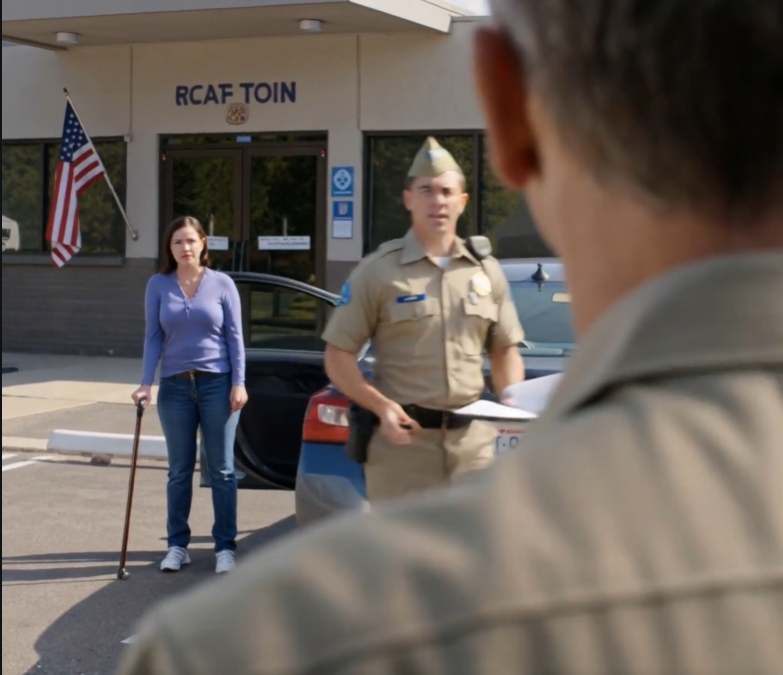
“This vehicle,” the colonel said.
He did not lower the phone.
“Parked in a reserved space. Medal of Honor. I’d like you to check the plate and write the driver up for misuse of a reserved space. And I’d like you to note that she’s been feigning an injury to justify it.”
The sergeant looked at me. He looked at the cane. Something in his face tightened and then deliberately relaxed. A man putting his own opinion away for later.
“Ma’am,” he said, “is this your vehicle?”
“Yes.”
He walked to the back of the car and looked down at the license plate.
Colorado issues a particular plate. It has the medal on the left side, the star and the wreath on the light-blue ribbon, and across the bottom it says MEDAL OF HONOR in small capital letters. You do not get one by asking. The state wants paperwork, and the paperwork has to come from the federal government, and the federal government is not in the habit of making mistakes about that particular list.
There are not very many people on it.
Sergeant Winn read the plate. He took a small notebook out of his cargo pocket and opened it, but did not write anything in it. Then he read the plate again.
I watched him do it. I watched him look at the numbers, then at the little medal on the left side of the plate, then at the cane, and then, very briefly, at me. I watched him close the notebook.
The colonel was still talking. He was saying something about integrity, about how this was exactly the kind of thing that eroded the trust of the American people. And he was saying it to his phone.
Sergeant Winn straightened up. He did not walk toward me. He walked toward the colonel, stopped a respectful distance from him, and lowered his voice.
“Sir,” he said, “you’ll want to stop recording.”
The colonel looked at him over the top of the phone.
“Excuse me?”
“Sir, I’m asking you to stop recording. Respectfully.”
“I’ll record whatever I want, Sergeant. It’s a public parking lot on a federal installation, and that woman is committing a fraud in front of a hospital full of wounded soldiers. Write her up.”
The sergeant did not move. I saw his jaw work once. There are only so many ways a twenty-six-year-old sergeant can tell a colonel no, and he was looking for one he could live with afterward.
So I helped him.
That is the only thing I did in that parking lot. I want to be precise about it, because later a lot of people would say a lot of things about what happened there, and very few of them had been standing on the asphalt.
“It’s my car, Sergeant,” I said. “The registration is in the glove box.”
Winn turned and looked at me, and for a second I saw something in his face that I had not seen pointed at me in a long time, and had not missed.
Then he nodded.
“Yes, ma’am,” he said. “That won’t be necessary, ma’am.”
“Sergeant,” said the colonel.
“Sir,” said Winn, “there’s no violation here. The vehicle’s properly registered to the space.”
“You haven’t checked anything.”
“Sir, I’ve checked the plate.”
I opened my door. Getting into a car with a bad hip is a procedure, and I did the procedure. Cane in first, across the passenger seat, then the right leg, then the long, slow pivot of the left.
The colonel turned the phone to follow it. I let him.
I put the key in. The pine tree swung.
“We’re not finished,” the colonel said.
He said it to me this time, through the half-open window, and it was the first thing he had said directly to me since he had told me he did not want to hear it.
“I’m posting this. People are going to see what you are.”
“Yes, sir,” I said.
I put the car in reverse. Winn stepped back and moved his own vehicle so I could get out, which he did not have to do. And as I rolled past him, he did a thing with his right hand that was not quite a salute, because he was in a parking lot and I was in a Subaru and there are rules about these things.
It was more of a touch to the brim of the patrol cap, a small, private thing. I nodded to him.
In my rearview mirror, the colonel was still standing beside the empty space, still holding up the phone, still talking. The woman with the car seat had not moved. The old man on the bench by the pharmacy had stood up.
It started to rain at the gate. Big drops, far apart, the kind that sound like somebody tapping on the roof to get your attention. I did not turn the wipers on for almost a mile. I wanted to see how long I could go without doing anything at all.
Before I go back to the beginning, for the commute or a long shift, I made an audiobook called The Woman Nobody Saluted. Eight stories over twelve hours, no ads, and five never told on this channel. Scan the code on your screen or use the link in the description at dressbluestories.com.
I have a rule about my phone after a bad day. The rule is that I do not look at it. The rule has never once worked.
My quarters on Fort Carson are a two-bedroom duplex on a street named after a general nobody on the street could tell you anything about. I have lived there for four years. I have a couch I bought used from a captain who was moving to Germany, a kitchen table with one short leg that I fixed with a folded commissary receipt, and a refrigerator with nothing on the door.
People who visit always notice the refrigerator. They expect magnets. I have never been sure what I would put under them.
That evening, I leaned the cane against the counter, filled a gallon bag with ice, and sat on the couch with the bag on my hip and the phone face down on the cushion beside me. The rain had stopped. Through the window, the mountain had gone pink at the top, the way it does, as if somebody had decided the day deserved a better ending than it had earned.
I am an explosive ordnance disposal technician. I have been one for nineteen years.
These days, that mostly means I am the operations sergeant for an EOD battalion, which is a job that consists of schedules, training calendars, range requests, vehicle readiness reports, and telling very talented young people that no, they may not go to the competition in Florida unless somebody covers their response cell.
I am a master sergeant. I am thirty-eight years old.
I have a left hip that was put back together in 2012 by a surgeon in Germany whose name I have never been able to pronounce correctly, and taken apart and put back together again last year by a different surgeon in Colorado whose name I can pronounce just fine. It has not loved either of them.
Since the spring, I have been in the medical evaluation board process, which is the Army’s careful, paperwork-heavy way of asking whether you can still do the job and then waiting several months to tell you what you already know.
That is who I am on most days. That is who I prefer to be. I am the woman who sends the range requests. People come to my desk because the range requests get approved.
There is another fact about me, and I have arranged a good part of my adult life so that it stays behind the first ones.
In May of 2014, in the East Room of the White House, the President of the United States put the Medal of Honor around my neck.
It is in the second drawer of my dresser now, in its blue case, under a stack of winter physical training shirts. I take it out when I am ordered to. In twelve years, I have been ordered to eleven times. I have worn it once without being ordered, at a funeral.
And that is not a story for today.
I did not want the plate. I want to say that plainly, because later people would assume it was some kind of statement. It was not.
The state sent a letter after the ceremony offering it, and I put the letter in a drawer. Then the mother of a man I had once dragged out of a ditch called me on the phone and asked if I had gotten the letter.
“Yes,” I said.
She asked if I was going to get the plate.
“Probably not,” I told her.
She was quiet for a moment. Then she said, “Megan, I want people to see it on the road. I want them to see it and think about Cole.”
So I got the plate.
I have driven around with it for twelve years. Most people never notice it. The ones who do usually think it is a veteran’s plate of some kind, and they give me a thumbs-up at stoplights, and I give them one back. That has always been the right size for it.
The phone buzzed against the couch cushion at 1940. I did not look. It buzzed again at 1942, and then it buzzed in a way that was not one buzz but a long, continuous shiver, the way a phone does when it is no longer receiving messages so much as being rained on.
I turned it over.
The first message was from a staff sergeant on my team. It said, “Master Sergeant, are you okay? Is this you?” There was a link.
The second was from a chief warrant officer I had served with at Fort Campbell. It said, “Megan, call me.”
The third was a number I did not know. It said simply, “Sorry this happened to you, ma’am.”
There were forty-six more.
I did not open the link. I did not need to. I put the phone face down again, and I sat there with the ice going to water on my hip and watched the pink go out of the top of the mountain.
At 0600 the next morning, I was at my desk in the battalion headquarters, because that is where I am at 0600, and the coffee maker was making the noise it makes when someone has put in too much water.
Command Sergeant Major Yolanda Briggs was standing in my doorway with her arms crossed. She is forty-seven, from Mobile, Alabama, and she has been a bomb technician as long as I have been alive as a soldier, or nearly.
She is one of perhaps six people on Fort Carson who knew before that week what was in the second drawer of my dresser. She did not find out because I told her. She found out because she is a command sergeant major, and she reads everything.
“Eleven thousand shares,” she said.
“I haven’t watched it.”
“I have. Twice. Once for content, and once to make sure I wasn’t imagining his face.”
She came in and sat down in the chair across from my desk, which she never does. She is a doorway person.
“Megan, the battalion commander is going to call you in at 0800. He’s going to ask you something, and you’re going to say no. I can tell from your face.”
“What’s he going to ask?”
“Whether you want to file a complaint. Equal Opportunity, Inspector General, the whole menu. He’ll back you on any of it. So will I.”
“No.”
She nodded slowly, as though I had confirmed something she had already written down.
“Thought so. You want to tell me why?”
I looked at the training calendar on the wall. There were four colors on it. I had chosen the colors.
“Because then it’s mine,” I said. “Right now, it’s his.”
September 14, 2012, was a Friday, though in Kandahar Province, that did not mean much.
I was twenty-four years old and a sergeant, the junior member of a three-person EOD team attached to a route-clearance platoon. Our job was Highway 1 through Maiwand District, a strip of cracked asphalt between grape fields and mud walls that the enemy treated as a mailbox. Every few days, they left something in it, and every few days, we went out and opened the mail.
Route clearance moves slowly on purpose. The Husky goes first, a narrow, tall vehicle with a ground-penetrating radar panel slung under its belly and one soldier sitting high in the cab. Behind it comes the Buffalo, a great armored box with a long mechanical arm for digging at things you do not want to touch with a hand.
Behind them comes everyone else, at walking pace, in the heat, for ten or twelve hours at a time.
Specialist Danny Ror was driving the Husky that morning. He was twenty-four, from Grand Junction, and he sang in the cab. Not well. He had a radio voice for the platoon net and a terrible voice for everything else, and we could sometimes hear him through the hull when he forgot to key off.
At 0950, the Husky found the thing it was looking for, the way Huskies sometimes do, which is by driving over it.
I remember the sound as a kind of pressure more than a sound. The Husky’s front end came up and came down crooked, and the cab was on its side in the drainage ditch beside the road, with smoke coming out of the engine compartment.
Danny Ror was not singing anymore.
Then the fire started from the grape field on the north side. Not heavy enough.
Staff Sergeant Cole Hadley was our team leader. He was twenty-nine, from Ohio, very tall, with a laugh like a screen door slamming. He looked at the ditch for about four seconds. I have thought a great deal about those four seconds.
Then he said, “I’m going down there. Thorne, stay in my feet.”
What that means is that he would walk first, sweeping, and I would follow exactly where his boots had been, because ground that has carried one man’s weight is ground you can trust a little more than ground that has not.
A little.
He made eleven meters. I was four steps behind him, in his feet. On the twelfth meter, he stepped on a pressure plate that the detector had not heard, because some of them are made with almost no metal at all, and that is the point of them.
I do not remember being thrown.
I remember lying on my side on the edge of the ditch, with grit in my teeth and a very clear, very calm sense that something in my lower body had come apart, that Cole was gone, and that Danny Ror was still sixty meters away in a ditch that had been seeded for exactly this.
The platoon sergeant, Sergeant First Class Mike Sorenson, was on the radio behind me, calling for the medevac and the quick reaction force and screaming my name.
I did not answer him.
I was busy counting.
I could not stand, so I did not try.
I took the probe out of my kit, a thin rod of nonmetallic material about a foot long, and lay on my stomach. I started to clear the ground in front of my face the slow way, the way they teach you in school in Florida and then tell you that you will probably never have to do for real.
You push the probe into the dirt at a shallow angle, thirty degrees, gently, every few centimeters in a line, and you feel for anything that is not dirt. Then you move your body forward into the space you have cleared.
Then you do it again.
I counted every push. Counting was the only thing I owned.
It took me thirty-six minutes to cover the sixty meters. I found three more pressure plates on the way. I marked each one with a chem light from my vest and went around it.
Bullets went over me a few times. I did not care about them in the way you would expect. They were not my problem.
The ground was my problem.
When I reached Danny, he was conscious and very pale, and his legs were badly hurt. The first thing he said to me was, “Meg, you’re on your belly.”
“I’m aware,” I told him.
I put a tourniquet on each of his legs and wrote the time on his forehead with a marker, because that is what you do. Then I turned around in the ditch, took hold of his vest by the drag handle, and pulled him backward along the lane I had made, one meter at a time, on my elbows, with my pelvis broken in two places.
It took longer going back. I was more careful going back. I was carrying more.
Sorenson and two others met us at the eleven-meter mark. That was the place where the lane I had cleared ran into the footprints Cole had left. I made them stay off my lane until I had marked it with the last chem light.
I went back for Cole after that. They told me not to. I went anyway.
I will not tell that part.
Some things are owned by the people who are not here to tell them.
I woke up in Germany two days later with a surgeon whose name I could not pronounce standing at the foot of my bed.
The award took a year and a half. These things take a long time because a great many people have to agree that what you did was what you did, and they are right to be careful.
In May of 2014, I flew to Washington with my mother and my sister and stood in the East Room on a hip that had been rebuilt with titanium and stubbornness. The President said kind and accurate things.
Danny Ror sat in the third row in his wheelchair, wearing a suit his mother had bought him for the occasion. And when the medal went around my neck, he was the only person in the room I looked at.
Afterward, at the reception, he caught my sleeve as I went past.
“Don’t let them make you a poster, Meg,” he said.
“I won’t.”
“They’re going to try.”
He was right. They tried.
For about eighteen months, I was flown to things. I stood next to people at things. I was asked to smile at things.
I spoke at a convention in Las Vegas where a man in a suit introduced me as a true American hero and a real-life action figure, and four thousand people applauded.
I stood at the podium and said, “Staff Sergeant Cole Hadley walked first.”
Then I could not say anything else for some time. The man in the suit came and took my elbow, and the audience applauded again because they thought it was part of the show.
The poster I could leave. I asked to go back to my company, and the Army, to its credit, let me.
What I could not leave was what came with me.
There was a staff sergeant in that company, a decent technician and a man who made jokes at the table in the team room. In my first week back, he made one.
Somebody had asked me how my hip was, and before I could answer, he said from the other end of the table, smiling, “Nice to have the right paperwork.”
Nobody laughed. That was almost worse. They all looked at their coffee.
He did not mean the hip. He meant that I was a woman and that I had a medal very few people have, and that in his arithmetic, the two facts belonged together in a particular order.
He was not the only person who did that arithmetic. He was only the first one who said it out loud where I could hear.
I learned something that week that I had not learned in the ditch. Being doubted is a weight you can carry. Being looked at is different.
Being looked at means everyone gets to decide what you are, and the deciding never stops, and you are never once consulted.
So I stopped wearing it anywhere I was not ordered to. I stopped going to the things. I took the range requests and the training calendars and the vehicle readiness reports, and I made myself very useful and very ordinary.
And for twelve years, that worked nearly perfectly, except for the plate, which I kept because Danny’s mother asked me to, so that people would see it on the road and think about Cole.
People saw it on the road.
And one hot afternoon in September, one of them got out his phone.
I did watch it eventually. Briggs was right about his face.
It was two minutes and fifty seconds long. He had posted it at 1810 to his own public page, the one with his official photograph and his unit crest and a header picture of himself on a horse at some cavalry event.
Under it, he had written: “Stolen valor at the post hospital today. Medal of Honor parking. Fake limp. This is why we can’t have nice things. Share this so she’s recognized wherever she goes.”
He had tagged six pages. I knew some of the names. They were the pages that hunt stolen valor, men who wear medals they did not earn, Ranger tabs from a website, war stories from a movie.
Some of those pages are run by serious people who do careful work. Some are run by people who like to be angry and have found a respectable place to do it. All of them have a great many followers.
The colonel’s name was Bradley Ashford. I learned that from the post. He had taken command of a sustainment brigade on the other side of the installation in July.
I had never met him. I had never been in his building. Our two units did not have very much to do with each other, which, on a post of twenty-five thousand soldiers, is the normal condition of things.
By the time I watched it, the video had been viewed 410,000 times.
The comments during the first part of the night were about what you would expect. People called me a name I will not repeat here. People wanted the plate traced. People wanted me reported to my command, to the state of Colorado, to the Department of Justice, and, in one case, to God.
Somebody had zoomed in on the plate and posted the number. Somebody else had found the make and model of the car and was offering a reward for my address.
Then, at 0610, a man named Walt posted.
I knew the name. Almost everybody in uniform knows the name.
Walt Costic is a retired Marine gunnery sergeant, sixty-three years old, who has run the largest of those pages for fifteen years from a house outside Jacksonville, North Carolina. He has exposed something like four hundred people.
He has a reputation, even among people who find the whole business distasteful, for one thing. He checks first.
He calls the record centers. He reads the citations. He waits.
He has been wrong, as far as anyone knows, twice in fifteen years. Both times, he posted the correction at the top of his page and left it there for a month.
The colonel had tagged him at 1810. Costic had waited twelve hours.
His post was short. It had three pictures.
The first was a still from the colonel’s video of the back of my car, showing the plate. The second was a screenshot of the Colorado Department of Revenue page explaining what you have to submit to the state before they will issue that plate, which is a copy of your federal citation, and nothing else will do.
The third was a still from a video that had been sitting on a government website since May of 2014. It showed a twenty-six-year-old staff sergeant in a blue dress uniform standing in the East Room of the White House.
She had a cane in her right hand.
The wrong hand.
Under the pictures, Costic had written: “We verified this is Master Sergeant Megan Thorne, United States Army. Highway 1, Maiwand District, Afghanistan, September 14, 2012. Read the citation. Then read it again. Colonel Ashford, you tagged us. We came. Take it down.”
He had linked the citation.
By 0700, the comments had turned. I watched it happen in real time, sitting at my desk with my coffee going cold, the way you might watch weather come across a valley.
The people who had wanted my address began to apologize. Then they began to want his. Somebody found the photograph of the colonel on the horse and began to do things to it.
The shares that had been carrying the video out into the world with my face on it began carrying it back again with his. And all of them, everyone, now had my name.
That was the part I had not thought through, sitting on my couch the night before with the ice on my hip. I had thought the worst thing that could happen was that strangers would believe I was a fraud.
I had been doubted before. I could carry that.
What I had not considered was that the people who came to defend me would have to say who I was to do it. That they would mean well. That they would be right.
And that the second drawer of my dresser, which I had kept closed for twelve years, would be open now in a few hundred thousand kitchens, and I could not shut it from here.
At 0731, the colonel edited his post. He did not take it down. He added a line at the top in capital letters that said, “UNDER REVIEW.”
Briggs, reading it over my shoulder, made a sound I had never heard a command sergeant major make.
By 1000, everyone needed something from me. The battalion commander called me in, as Briggs had predicted, and asked whether I wanted to file a complaint.
“No, sir,” I said.
He looked at me for a long time.
“All right.”
Then he told me the division’s public affairs office had called, and the brigade’s public affairs office had called, and somebody from the garrison had called, and a reporter from the Gazette was at the main gate asking the guards whether they knew me.
“They didn’t, sir,” I said.
“They do now,” he replied.
The brigade public affairs officer was a major named Heather Quist. She came to my office at 1100 with a notebook and the bright, exhausted manner of a woman who had not slept and had decided not to mention it.
She was very kind. I want to say that because what she asked was not kind, and she knew it.
“We’d like to propose something that closes this out for everyone,” she said. “A handshake photo. You and Colonel Ashford in front of the brigade colors, maybe with the division commander. The colonel would say a few words. Thank you for your service. Apologize for the misunderstanding. Thirty seconds. It would take the temperature down.”
“For whom, ma’am?”
She looked at her notebook.
“For everyone, Master Sergeant.”
“I’m not angry, ma’am. I don’t have a temperature. The internet does.”
“Yes, ma’am.”
“The internet wasn’t invited,” I said. “I didn’t invite it.”
She closed the notebook. She did not argue. She said she understood, that she would tell the colonel, and that the offer would stay open.
She stopped in the doorway and said more quietly, “For what it’s worth, I told him to take it down at 1900 last night.”
Then she left.
At 1300, the brigade deputy commander came.
Lieutenant Colonel Daniel Shaw was forty-four, with a farm kid’s hands and a face that looked as though it had been asked to carry other people’s decisions for most of a career.
He had brought two coffees from the shop on the corner by the post exchange. He did not ask how I took mine. He had brought it black, and he was right. I did not ask how he knew.
“He’s not a bad man,” he said, sitting down.
“I haven’t said he was, sir.”
“No, you haven’t said anything. That’s what’s driving him crazy.”
He turned the coffee cup a quarter turn on my desk.
“Can I tell you something? In 2019, at Fort Bliss, he took command of a battalion. There was a man on the stage at the ceremony, a retiree the community had brought in as a guest of honor. Ranger tab, Silver Star, combat stories. The colonel, a lieutenant colonel then, hugged him on the stage.”
Shaw paused, looking down at his coffee.
“There’s a photo. Big photo, front page of the post paper. Three weeks later, it turned out the man had never been to Ranger School, never been overseas, never been anything. Costic’s page did that one, actually. And for two years, every time Ashford walked into a room at Bliss, somebody had that photo on their phone.”
I said nothing.
“I’m not making excuses for him,” Shaw said.
“Yes, sir, you are.”
He looked at me. Then he laughed, short and surprised, the way people laugh when they have been caught at something they knew they were doing.
“Yes,” he said. “I suppose I am.”
He finished his coffee.
“He wants to meet you. Not for a photo. Just to talk. I think he wants to apologize.”
“Does he want to apologize, sir, or does he want to have apologized?”
Shaw did not answer that. He stood up, threw the cup in my trash can, and said he would get back to me.
At 1530, my phone rang. It was Danny Ror.
He is thirty-eight now, like me. He lives in Grand Junction on the Western Slope with a wife and two dogs and a pair of prosthetic legs that he names after country singers.
He owns a small-engine repair shop. He does not post on the internet very much because he says he sees enough fools in the shop.
“Meg,” he said, “I want to post the photo.”
“Which photo?”
“You know which photo. Me in the hospital in Landstuhl, with what’s left of my legs, with a caption something along the lines of, ‘This is what the colonel’s fake limp carried sixty meters.'”
“No.”
“Meg, he called you a fraud in front of half a million people.”
“Four hundred and ten thousand.”
“It’s six hundred now. Don’t do that. Don’t count at me.”
I could hear the shop behind him, an air compressor cycling.
“My mother is so angry she can’t sit down,” he said. “She wanted people to see that plate and think about Cole. You know what they’re thinking about now? Some colonel’s face.”
“I know.”
“So let me fix it.”
“It isn’t yours to fix,” I said. “It isn’t mine either. That’s the trouble with it.”
He was quiet for a while. The compressor stopped.
“You always did that,” he said finally. “In the ditch. I said you were on your belly, and you said you were aware. You never once let anybody help you carry anything.”
“I let you,” I said. “I let you be carried.”
He laughed then, which was what I wanted. Then he swore softly, which I will not repeat.
“Okay, okay, Meg. No photo. But if he doesn’t take it down by Monday, I’m driving over the pass.”
“All right,” I said.
I hung up and sat in my office with the training calendar in its four colors. I understood that I had been asked in one day by four different people, all of whom meant well, to do something with this.
Make a complaint. Make a photo. Make an apology possible. Make a post.
Every one of them was asking me to take a mess that a stranger had made in a parking lot and make it mine publicly, then carry it somewhere.
I had carried enough out of ditches.
I called Shaw back at 1610. I said I would meet the colonel.
One meeting, in his building, in a room with a door, with Command Sergeant Major Briggs present. No cameras. No public affairs. No photographs of any kind.
“He’ll agree to that,” Shaw said.
“I know he will, sir,” I replied. “It’s the only thing he hasn’t been asked to do yet.”
The meeting was set for Tuesday the eighth at 1500.
Monday was Labor Day. I spent it doing nothing, which I am bad at. On Tuesday morning, I went to physical therapy because the appointment had been on the calendar for a month, and I am not a person who cancels things.
Captain Anna Lucero is a physical therapist, thirty-three, from Albuquerque, with a voice that never rises and hands that can find the exact place you have been lying to yourself about.
She had watched the video. Everyone in the building had watched the video. She did not mention it.
She put me on the table, moved my left leg through its range, wrote numbers on a clipboard, and frowned at them.
“You’ve been pushing it,” she said. “You walked from the far end of the lot again this morning.”
“I parked in a regular space, ma’am.”
“I know where you parked, Master Sergeant. I watched you come in.”
She set the clipboard down.
“I’m going to tell you something you already know, and then I’m going to write it down because the board is going to read what I write. You can keep pushing it. It will keep answering. It will answer a little less every time. That is the whole story of this hip from here.”
“Yes, ma’am.”
“Your election form for the board is due Friday.”
“I know.”
“Are you going to fight it?”
The medical evaluation board had found what everybody knew it would find. The next step was mine.
I could accept the finding and go to the physical evaluation board and, in a few weeks, retire. Or I could contest it and ask to stay, and spend six months arguing that a hip that could not walk forty-one steps without a cane was fit for a job that, on paper, still sometimes involved walking into places other people were running out of.
“No, ma’am,” I said. “I’m not going to fight it.”
She nodded. Then she did something she had never done in a year of appointments. She reached over, put her hand on my shoulder, and left it there for a second.
Then she picked the clipboard back up and told me to give her ten more leg raises. I gave her ten.
At 1400, I went out to my car, which I had parked at the far end of the hospital lot in a regular space under a light pole. I sat in the driver’s seat with the door open and the heat coming in.
I opened the glove box.
The registration was in a clear plastic sleeve with the insurance card. Colorado vehicle registration. A gray Subaru. The plate number.
And a name.
It was the one thing I had offered him in the lot. He had not wanted it.
I looked at it for a while. Then I took it out of the sleeve, folded it once along the crease it already had, and put it in the breast pocket of my uniform.
I took the election form out of my bag, the one Lucero had reminded me about, and signed it on the steering wheel. I dated it September 8, 2026.
I had been carrying that form around for three weeks. It was not a dramatic decision.
That is the truth of most of the ones that matter. I had known for a long time what I was going to do. The parking lot had only made me tired of pretending I did not.
The Sustainment Brigade headquarters is a long, low building of tan brick on the east side of the installation, built in the 1980s by someone who believed that windows were a security risk.
Briggs met me in the parking lot at 1450. She looked at the cane and then at the distance to the front door, which was considerable, and said nothing about either.
“You want me to do any talking?” she asked.
“No, Sergeant Major.”
“You want me to do any looking?”
“Yes, please.”
She nodded. “I can do looking.”
Shaw met us inside the door and walked us down a hallway lined with photographs of former brigade commanders, a row of men in a row of frames, getting younger and more faded toward the end.
The conference room was at the far end of the hall. It had a long table of fake walnut, twelve chairs, a flag on a stand in the corner, a television on the wall that was turned off, and one window, small and high, through which you could see a rectangle of very blue sky.
Colonel Ashford was standing at the head of the table. He was in the same green uniform.
He had a laptop open in front of him and a legal pad beside it covered in handwriting. He was taller than I had understood from the parking lot, and older around the eyes. He looked as though he had not slept since Thursday, which I suspect he had not.
He did not have his phone out. I noticed that it was face down on the table beside the laptop.
“Master Sergeant Thorne,” he said.
“Sir.”
“Please, sit down. Sergeant Major. Dan.”
He gestured at the chairs.
Shaw sat to his right. Briggs sat at the far end of the table near the door, where she could see everybody’s face.
I took the chair directly across from the colonel and leaned the cane against the table edge where both of us could see it.
He sat. He put both hands flat on the legal pad. I recognized the gesture. I do it myself.
“I prepared some remarks,” he said. “I’m not going to read them. I think you’d know if I read them.”
“Yes, sir.”
“I want to tell you why I did it. Not as an excuse. Dan tells me you’ll think it’s an excuse.”
He glanced at Shaw, who did not move.
“In 2019, at Fort Bliss, a man stood on my stage at my change of command in a Ranger tab he never earned and a Silver Star he bought online. I hugged him in front of eight hundred soldiers and their families. The post paper ran the photograph on the front page.”
He looked down at his hands.
“When it came out what he was, my soldiers put that photograph on the screen in the dining facility as a joke. It stayed up for a week. I deserved some of that. I hadn’t checked. I promised myself I would never be the man who didn’t check again.”
He stopped and looked at the laptop.
“So I checked,” he said. “I thought I checked. I saw a woman come out of a clinic with a cane, getting into a car in that space. And I thought, I know this one. I’ve seen this one. I saw her before she saw me. I had it figured before she reached the bottom of the ramp.”
“Yes, sir,” I said. “I know. I watched you figure it.”
He flinched very slightly. Briggs, at the end of the table, did her looking.
“Sergeant Winn,” the colonel said, “told me to stop recording. I want you to know that he told me twice. I’ve written him a letter. He’s going to get a commendation if I have anything left to give one with.”
“He’s a good sergeant, sir.”
“He is.”
The colonel took a breath.
“Master Sergeant, I read your citation on Friday morning at 0615, when that man in North Carolina posted it. I read it three times. I have been in the Army twenty-seven years. I have never been to the place you were. I have never done anything in my life that is in the same language as that piece of paper.”
He paused.
“And I stood in a parking lot and called you a fraud. And I filmed it, and I posted it, and I asked strangers to make sure you were recognized wherever you went.”
He stopped again.
“They are. You are. I did that.”
“Yes, sir.”
“I want to make it right.”
“How, sir?”
He glanced at Shaw again. After a moment, Shaw slid a single typed sheet across the table toward me.
It had a heading on it in bold: PROPOSED JOINT STATEMENT.
“Public affairs drafted this,” the colonel said. “But that’s not the important part. The important part is that I want to record a video. Me speaking, apologizing to you by name for what I did. It would go up in the same place the first one did. Same tags. Same reach. I owe you the same reach.”
I looked at the sheet without picking it up. Then I reached into the breast pocket of my uniform and took out the registration I had put there at 1400.
I unfolded it along its crease and laid it on the fake walnut, on top of the joint statement. I turned it around so it faced him.
“Sir,” I said, “in the parking lot, I told the sergeant this was in my glove box. I’d like you to read the name on it.”
He looked at it. He did not pick it up either. Then he did, carefully, by the edges, the way you hold something you are afraid of smudging.
“Out loud, please, sir.”
His voice did not come out the first time. He cleared his throat.
“Thorne,” he said. “Megan A. Thorne.”
“Thank you, sir.”
The room was very quiet. I could hear the ventilation in the ceiling. I could hear Shaw breathing through his nose.
The rectangle of sky in the high window had a single cloud moving across it slowly, from left to right.
“That was all it would have taken,” I said. “Not the citation. Not the man in North Carolina. Not the White House. One piece of paper in a glove box that I offered you, sir, and you didn’t want because you had already decided what I was.”
He did not speak.
“I’m not asking you to understand what I did in 2012. I’m asking you to understand what you did on Thursday. You didn’t fail to check. You refused to.”
He put the registration down. His hands were not steady.
He put them flat on the legal pad again, and they still were not steady. Then he took them off the pad and put them in his lap, where I could not see them.
“Yes,” he said.
“I’d like two things, sir.”
“Anything.”
“I’d like you to take the post down yourself. Now. Here.”
He did not hesitate.
He turned the laptop toward himself and typed something. Then he turned it around so I could see the screen.
I watched him go to his page and find the post with the capital letters at the top that said UNDER REVIEW.
I watched him click the three dots, click Delete, and click the box that asked if he was sure.
It took him three tries to click the box. His hand kept missing it.
Then the post was gone.
Just a gap in his page where it had been, and above the gap, a photograph of him at a brigade run in August, smiling with a flag.
“The second thing,” I said.
“Yes?”
“Don’t record the apology.”
He looked up.
“Sir,” I said, “you filmed enough of me.”
He sat back in his chair as if I had pushed him, though I had not raised my voice and I had not moved.
Shaw looked at the table. Briggs looked at the colonel.
I picked up the registration, folded it along its crease, and put it back in my pocket. I left the joint statement where it was.
“Then how do I make it right?” he asked.
It was not a colonel’s question. It was a man’s question. And for the first time since the parking lot, I felt something for him that was not nothing.
“I don’t know that you do, sir,” I said. “I think you just stop. I think you stop filming people in that lot. And I think you carry it. That’s what most of us do with the things we can’t make right.”
I stood up. It took a moment. The hip does not like fake-walnut chairs.
I took the cane from the edge of the table. The colonel stood too, out of reflex. Shaw stood, and Briggs stood by the door and opened it for me.
“Master Sergeant,” the colonel said.
I stopped.
“I’m sorry.”
“I believe you, sir,” I said.
That was true. I had believed him for some time.
It just was not the part that mattered.
The hallway back to the front door was very long, lined with all those men in all those frames. Briggs walked beside me on my left, on the bad side, without being asked.
I walked it slower than I needed to. Not for show. Because I could.
And because, for the first time in five days, nobody was holding up a phone to see how I did it.
The commanding general ordered an inquiry on Wednesday morning. I did not ask for it. I would have asked him not to if anyone had asked me, and nobody did, which I have since decided was the correct way to handle it.
An inquiry in the Army is an investigation under a regulation with a number, run by an officer appointed from outside the chain of the man being investigated. It is slow and thorough and polite, and it reads everything.
The officer appointed was a colonel from the division staff whom I never met. She did not interview me. She did not need to. The parking lot had been filmed.
What she found, I learned from Briggs on the twenty-eighth of September at 0740, in my doorway, with her arms crossed and her voice gone very flat.
“Two other people,” she said.
“What?”
“He’d done it before, Megan. In August. Same lot. Twice.”
She came in and sat down in the chair, which made twice in one month.
“A specialist with a disability placard on her mirror parked in an accessible space. He filmed her getting out of her car without a limp and posted it to a smaller page. She has a seizure disorder. You can’t see a seizure disorder from a phone.”
Briggs paused before continuing.
“And a spouse. A woman whose husband had brought her for chemotherapy. He parked in a wheelchair space because the wheelchair was in the trunk and she was walking to get it. Ashford didn’t post that one. He showed it around his headquarters. Said something about entitlement.”
I sat for a while without saying anything.
“He’s been relieved,” Briggs said. “Loss of confidence. Effective today. The division commander signed it this morning. He’ll get a written reprimand on top of it, and that’s the end of his career, and he knows it.”
I had expected to feel something about that. Satisfaction, or the absence of it.
What I felt instead was a kind of slow, cold weight in my stomach that took me a minute to name.
It was the specialist.
I thought about the specialist getting out of her car in August, not knowing she was being filmed, finding out later the way I had, from a link a friend sent.
Nobody had come to verify her. Nobody runs a page for invisible conditions.
There had been no Walt for her. There had been only the colonel and the phone and whatever the people in his headquarters had decided she was.
“I didn’t do that,” I said. “That inquiry. That was the other two.”
“No,” said Briggs. “That was all three of you. Yours was just the one that got loud enough.”
She stood up.
“He’d have kept doing it, Megan. You know that. He was doing it because he’d been the fool once, and he decided the cure was to make sure somebody else was always the fool before he could be. You don’t get to take credit for stopping it, but you don’t get to pretend you didn’t.”
She left. I sat at my desk and looked at the four colors on the training calendar for a long time.
Walt Costic called me that afternoon. I do not know how he got the number. I suppose he checked.
He had the voice I expected, gravel and Carolina, and he did not waste much of it.
“Master Sergeant,” he said. “I owe you an apology.”
“You verified, Gunny. You were the only one who did.”
“I verified, and then I put your name on the internet in front of six hundred thousand people without asking you first, because I was angry at the colonel and I wanted to be right fast.”
He paused, but only briefly.
“I’ve exposed four hundred and twelve liars in fifteen years. I have never once, not one time, thought about what it costs the real ones when I go to bat for them. Thought about it all week. I’m thinking about it now.”
He stopped.
“I took your name out of the post Monday. I know it doesn’t matter anymore. I did it anyway.”
“It matters, Gunny.”
“Does it?”
“It does to me,” I said. “That’s who it’s supposed to matter to.”
He was quiet a moment. Then he said, “Semper Fidelis, Master Sergeant,” which Marines say to soldiers when they mean it, and hung up.
I wrote Sergeant Tobias Winn a note, a real one, on paper, the way my mother taught me.
I said that he had read the plate twice when once would have been easier, and that he had asked a colonel to stop when it would have been easier to write me up, and that both of those things were harder than they looked from the outside.
I knew because I had once been a young sergeant with a colonel in front of me, too.
I signed it with my name and nothing else.
Briggs dropped it off at the Provost Marshal’s office. I heard later that he had it pinned to the board in the MP patrol room, which embarrassed me and which I did not ask him to take down.
On the first of October, there were new signs on the doors of the orthopedic clinic and the pharmacy and the main entrance of the hospital. White laminated signs, small black letters.
They said, “Out of respect for our patients, no photography or recording on hospital grounds.”
The old man in the Vietnam veteran cap was on the bench again by the pharmacy the morning I saw them. He saw me reading the sign.
He lifted his white paper bag a few inches off his knee, the way you might lift a glass.
Here’s what it cost.
It cost me the commissary. I do not mean that I stopped going. I mean that I stopped being able to go there and be a woman buying eggs.
The week after the inquiry, a man in the cereal aisle stopped his cart beside mine and looked at me, then looked at the cane, and his face did the thing that faces do when they have seen you on a screen.
He was polite. He asked if he could take a picture with me. He asked.
I said yes because he asked.
He put his arm around my shoulders for the photograph, and his wife took it with her phone, and he thanked me for my service.
Then they went on toward the dairy section, and I stood in the cereal aisle and could not remember what I had come in for.
It cost me the far end of the lot.
I still park there. I do not think I will ever park in that first space again, though it is mine, though the state of Colorado and the federal government and the Department of the Army all agree it is mine.
But even at the far end under the light pole, people knew the car now.
A woman knocked on my window once while I was eating a sandwich and asked if I was all right.
I was.
I was eating a sandwich.
It cost me twelve years of being nobody in particular, which was the thing I had built carefully, the way you build anything that has to hold weight.
A man with a phone had taken it apart in two minutes and fifty seconds.
No inquiry and no relief of command was ever going to put it back together.
And it cost the colonel his career, which I had not asked for and was not going to pretend to mourn, and which I was also not going to pretend I had nothing to do with.
Briggs was right about that.
I sat with all of it in the evenings on the couch with the ice on my hip. I thought a good deal about the difference between being right and being whole.
I had been right in the parking lot. I had been right in the conference room. I would be right in every account anybody ever wrote of it.
And none of that had given me back the second drawer of my dresser, closed, with the winter shirts on top.
One night near the end of September, I opened the drawer. I took out the blue case and opened it and looked at the medal for a while in the lamplight.
I have never liked looking at it. It is beautiful, and that has always seemed wrong to me.
What it is about was not beautiful.
Cole Hadley walking first was not beautiful. Danny’s legs were not beautiful. Thirty-six minutes on my belly in the dirt was not beautiful.
But I looked at it, and I thought about how the colonel had wanted people to recognize me wherever I went.
And now they did.
The only thing I had any power over anymore was what they were recognizing.
I closed the case and put it back.
Not under the winter shirts.
On top of them.
Then I got out a sheet of paper and wrote a letter to Judy Ror in Grand Junction.
I told her everything in order, the way I would write an after-action report, because that is the only way I know to tell anything long.
I told her about the parking lot and the sergeant and the man in North Carolina and the conference room and the registration. I told her about the specialist with the placard and the woman with the wheelchair in her trunk.
I told her people were looking at the plate now, all over the post, and some of them were thinking about the colonel and some were thinking about me, and I did not know how many of them were thinking about Cole.
At the end, I wrote, “The plate stays. You asked me to keep it so people would see it on the road. I am going to keep driving it until they see the right thing.”
The colonel’s letter came on the thirtieth of September, two days after his relief, in a plain white envelope with my name handwritten on the front and no return address.
Shaw brought it over himself.
He stood in my doorway and held it out.
“He asked me to make sure it got to you,” he said. “He didn’t ask me to make sure you read it.”
“Thank you, sir.”
“For what it’s worth,” Shaw said, “he’s not fighting any of it. Not the relief, not the reprimand. His lawyer told him he could contest the inquiry’s findings on the August videos. He said no.”
He hesitated.
“He’s going home to Kansas in November. He asked if there was anything he could do for you before he goes. I said I’d ask.”
“There isn’t, sir.”
“That’s what I told him you’d say.”
I read the letter that night. It was two pages, handwritten on lined paper torn from the legal pad I had seen on the table.
I will not repeat what was in it.
It was his, and it was honest, and it was not addressed to the internet. He did not ask for anything.
That was the part that mattered.
Near the end, he wrote that he had found the specialist’s phone number through the inquiry officer and had called her and apologized. She had hung up on him.
He wrote that he thought she was right to.
I wrote one line back. I put it in an envelope and addressed it to him, care of the brigade, and Briggs walked it over.
The line said, “Stop filming people at the clinic. That’s all I need from you.”
I did not sign it with a rank. I just signed it Megan.
My physical evaluation board results came back the same week.
Medically retired, effective in December, with terminal leave beginning on the second of October.
The battalion offered me a retirement ceremony. There is a script for those, and a cake, and a flag that has been flown over something. The battalion commander says kind and accurate things.
The division offered something larger with the general. Quist called and said carefully that the division would understand if I preferred something small.
I said I preferred nothing. I said it as kindly as I could.
I said that I had stood in front of enough rooms and that I would like to leave this one the way I had arrived, which was in a gray car through the main gate on a weekday morning.
Briggs and the battalion commander came to my office at 0700 on the second of October, anyway.
They brought a cup of coffee and a plain shadow box with my rank and my unit crest in it and nothing else.
No medal.
Briggs had made sure of that.
They did not make a speech. The battalion commander shook my hand.
Briggs did not.
She put her hand flat on the side of my face for about one second, the way my grandmother used to.
Then she took it away and said, “Get out of here, Thorne. Go somewhere with a flat parking lot.”
I cleaned out my desk. It took eleven minutes.
The training calendar I left on the wall. Somebody else would choose the colors now.
The gate was busy at 0800. The inbound lane was stacked with morning traffic. The outbound lane was almost empty.
The guard on the outbound side was a young specialist, very young, with her patrol cap pulled down low against the sun.
I slowed for her.
She looked at the car and then at the plate, and I saw her face do the thing, the thing I had seen in the cereal aisle and the clinic lot and a dozen other places that month.
Then she did something I did not expect.
She stepped back from the lane and stood at attention and saluted.
Not the car.
Me.
She held it until I was even with her.
There are rules about these things. I was in a Subaru. I was in uniform, technically, for one more day.
I returned it from the driver’s seat, which is not regulation and which I have decided I do not care about.
Then I was out on Highway 115 with the mountain in my mirror, heading north toward Interstate 25 and the long road west over the passes to Grand Junction.
Danny Ror had told me there was a guest room and two dogs and a pair of legs named Waylon and Merle that would be very glad to meet me.
Danny called somewhere past Georgetown while I was climbing toward the tunnel with the trucks.
“You out?” he said.
“I’m out.”
“No ceremony?”
“No ceremony.”
“My mother read your letter,” he said.
I could hear the road beneath my tires and the trucks shifting gears around me.
“She read it at the kitchen table, and then she went out to the garage and sat in her car for an hour. Didn’t drive anywhere. Just sat. When she came back in, she said to tell you that Cole would have hated the colonel and liked the sergeant, and that you should come for supper on Sunday, and that she’s making the pot roast, which she only makes for funerals and people she approves of.”
“Which one am I?”
“She didn’t specify,” he said. “I’d come hungry either way.”
I laughed alone in the car, going up the long grade with the window cracked and the cold coming in off the snowfields.
And I did not count anything for several miles.
I stopped at a rest area in Glenwood Springs around one in the afternoon. The canyon was gold with aspens at the top, and the river was low and green.
The lot was nearly empty.
There was a space right by the door with a little blue sign.
I parked at the far end of the lot on purpose.
I got out, cane in my right hand, the wrong hand, and walked the distance.
It was fifty-three steps.
I counted.
I am going to keep counting.
But for the first time in a long time, I was counting because I wanted to know, and not because somebody was watching.
I have thought a great deal since then about the man with the phone.
Not the colonel.
The man with the phone.
There is one in every parking lot now. Sometimes it is a colonel. Sometimes it is a stranger.
Sometimes, if I am honest, it is me on a bad day, looking at somebody and deciding what they are before they reach the bottom of the ramp.
So I want to say something to you.
If you have ever been on the other end of that, if you have ever had to prove your pain to someone who could not see it, if you have ever been told your limp was too much or your limp was not enough, if you have ever been the woman in uniform somebody decided was wearing a costume, or the veteran somebody decided was a fake, or the person in the accessible space who did not look the way someone expected sick to look, you do not owe anyone your proof.
Not in a parking lot. Not on a phone. Not anywhere.
The people who need to know what you carried already know, or they will find out the honest way, by asking.
The ones who would rather film you than ask you were never going to believe the paper in your glove box anyway.
Keep the paper anyway.
Keep your truth folded along its crease where you can reach it.
You may never need to lay it on a table, but if you ever do, lay it down quietly and ask them to read it out loud.
Then go home.
And to whoever is holding the phone, put it down for one second.
Ask first.
It costs you almost nothing.
For the person in front of you, it might be everything they have spent years keeping in a drawer.
I still drive the gray car. The plate is still on it.
Most people still think it is some kind of veteran’s plate and give me a thumbs-up at stoplights, and I give them one back.
That has always been the right size for it.
Park where you need to. Walk when you can.
And when somebody tells you who you are before you have opened your mouth, you are allowed to say nothing at all.
Get in your car and—








