I came home late from my hospital shift during a blizzard. Dad had locked the door: “Curfew is 10. Rules are rules.” I slept in my car at -12°F. On the drive in, I’d stopped for a man in a snowbank. The next morning, a news crew was on our lawn. Mom opened the door in her robe and heard the reporter ask: “Is this where the nurse who slept in her car lives?”
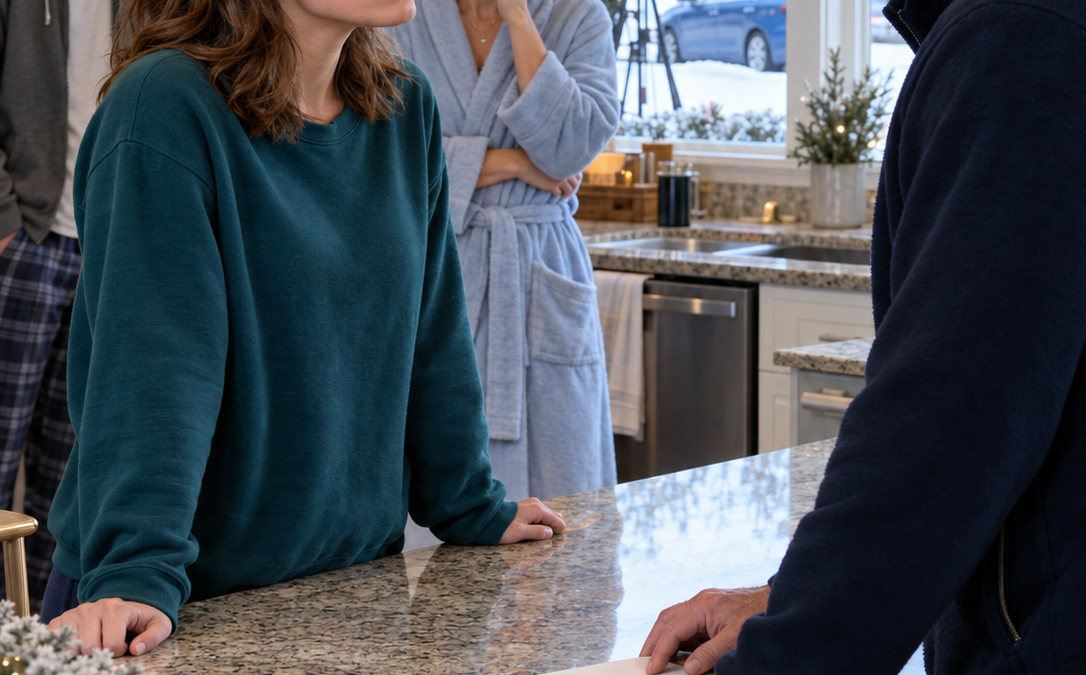
“I’m sorry, Dad. I couldn’t leave. They needed me.”
I said it out loud twice, the way I used to practice lines for school plays.
Highway 10 was closed, so I took County Road 75 toward Sauk Rapids, driving thirty miles an hour behind a wall of blowing snow. About fifteen minutes out, my headlights caught something orange blinking beneath a drift in the ditch.
It was a pair of hazard lights, nearly buried.
A sedan had gone nose-first into the ditch, and snow had piled over the back window. I pulled onto the shoulder, turned on my own hazard lights, and called 911 before I did anything else.
You learned that in your first week of nursing school. You do not make two patients.
Then I climbed down.
A man was sitting at the bottom of the ditch beside the driver’s door, his back against the tire. He was in his seventies, with a white mustache and blood frozen on his forehead. His left wrist was bent at an angle wrists weren’t supposed to bend.
“Deer,” he said through chattering teeth. “Went for the deer, then I went for the ditch.”
His name was Walt. He had tried to dig his car out, slipped, and couldn’t climb back up the slope with one good hand. His car had died.
I braced my boots in the snow and let him use me like a fence post. We crawled up together, one inch at a time.
I got him into the passenger seat of my car, where the heater was still blowing. His coat was soaked through at the shoulders, so I pulled it off him and wrapped him in mine. Then I tucked the silver emergency blanket from my trunk around his legs.
I didn’t rub his hands. You never rub them.
I just kept him talking.
He told me his wife’s name was Joanie. He told me he had driven a county plow for thirty-one years.
“I used to clear this road,” he said, and laughed until he coughed.
Then I went back out into the wind and dug the snow out of my own tailpipe because I had parked tight against the drift.
When I got back in, he asked what I’d been doing.
“Making sure we don’t breathe the exhaust,” I said.
He nodded slowly.
“Good girl. Joanie would like you.”
A state trooper named Hansen arrived at 11:20, and the ambulance came at 11:38, delayed by the unplowed road.
I gave the paramedic my report the way I would at work: the time I’d found Walt, how long he’d been outside, the wrist, the cut, and how cold his hands had felt.
Trooper Hansen took my name and number for his report.
“If his family wants to reach me,” I said, “that’s fine.”
They lifted Walt onto the stretcher, and my coat went with him. I didn’t ask for it back. He needed it more than I did.
For the first time all night, I hadn’t thought about the clock.
Then I got into my car, and the dashboard said 11:55.
I drove the last ten minutes home telling myself that my father would understand.
I had stopped for a man in a ditch. A man’s life was not a curfew violation.
I believed that all the way up Larksburg Court, all the way up the front steps, and all the way until the chain caught.
You already know how that part went.
At 12:20, sitting in the driveway with the engine running, I called my father.
It rang five times and went to voicemail.
I called again.
Voicemail.
I called my mother, and she didn’t pick up either.
But at 12:31, a text came through.
I’m so sorry, honey. Please keep the engine running. Your father is firm on this. Doors open at 6.
I read it three times.
The third time, I understood what it meant.
My mother was awake. My mother knew. And my mother had decided to go back to sleep.
I sat with that for a while, watching my breath fog the windshield. Then I did the math the way I always did, as if the right numbers could somehow make it make sense.
Eighteen months earlier, I had graduated with a nursing degree and $38,000 in student loans. My father had sat me down at the kitchen table and offered what he called the deal.
Live here. Save your money. Follow the rules.
I paid $600 a month in board on the first, no exceptions. I paid him another $150 a month toward the blue Corolla, which was still in his name and on his insurance.
The rules were printed, laminated, and stuck to the refrigerator with a magnet from his school.
Curfew at ten. Eleven on Saturdays.
No locked bedroom doors.
Phone location shared at all times.
Guests approved forty-eight hours ahead.
And at the bottom, underlined:
Doors open at six.
My brother Tyler was twenty and lived under the same roof, and none of those rules had his name on them.
He worked at a tire shop, took classes at the community college, and came and went like weather.
When I asked about it once, my father didn’t even look up from his grading.
“Your brother isn’t the one who will be walking to a car alone at night.”
I had stopped asking after that.
Sitting in the driveway now, I thought about calling a third time. But calling a third time would have been begging, and begging had never worked in our house.
So I turned off the engine to save gas, pulled my knees up inside my scrubs, and listened to the wind.
And I thought about the porch swing.
I was seventeen that October, the stage manager for the fall play at the high school.
Our last dress rehearsal ran long, and then the director’s car wouldn’t start in the parking lot. A freshman named Ava was still waiting for her ride. She was fourteen years old, standing alone under the one working light. Her parents were forty minutes away.
I couldn’t leave her there.
Nobody should have had to tell me that, and nobody did.
I waited with her until her mother’s minivan pulled in, and then I drove home as fast as I dared.
I walked up the front steps at 10:40.
The door opened three inches and stopped against the chain.
I knocked softly, just once.
The light in my parents’ bedroom window went out.
That was the answer.
It was thirty-eight degrees.
I found the plastic tarp my father used to cover the patio furniture, wrapped myself in it, and lay down on the porch swing. Every time I moved, the chains creaked, so I tried not to move.
I watched my breath and counted the cars that passed.
There were four.
At six in the morning, I heard the chain slide.
My mother opened the door with red eyes and handed me a mug of hot cocoa without looking at my face. My father was already at the breakfast table with his coffee and the newspaper, as if it were any other Saturday.
“Consistency is love, Kayla,” he said. “The world doesn’t make exceptions, so neither do I.”
Then he told me again about his brother, Danny.
Danny was nineteen when he drove into a tree at one in the morning coming home from a party. My father was seventeen. Their parents had never set a single rule.
“Rules are how I keep you alive,” he said, and turned the page.
I got bronchitis that week and went to rehearsal anyway, coughing into my sleeve. Nobody in my family mentioned that night again.
Ava gave me a thank-you card on opening night. I hid it in my desk drawer because it felt like proof of a crime.
And I made myself a promise I kept for seven years.
I would never be late again.
Now I was twenty-four. I had a license that said I could keep people alive, and I was still on the wrong side of that chain.
I started going over the night the way I’d go over a chart, looking for my mistake.
That was my habit. I had built a whole life out of not making mistakes.
Straight A’s. Home early. Apologizing before anyone could be disappointed in me.
I had become a nurse partly because it was work my father couldn’t find fault with.
At my pinning ceremony, he hugged me and said, “I’m proud of you.”
Then he stepped back and added, “Now don’t get a big head.”
I have always remembered the second half better than the first.
Four months earlier, Marisol had first offered me the night position. More money, more experience, real trauma cases.
I turned it down because of curfew.
And when I told my father, he said, “Good choice.”
There was one thing I’d never told him.
I had a savings account at a different credit union, and it held $5,200.
My plan was to leave in June, once I had enough for a deposit and a car that was actually mine.
I sat in the freezing car, going over every step of the night.
The text at 8:15. The stop for Walt. The report. The drive.
And slowly, almost against my will, a thought came through.
I had done every single thing right tonight.
My phone buzzed again.
It was the number I didn’t know.
Hi, I’m Walt’s daughter, Dana. The trooper gave me your number. Dad’s in the ICU. He’s stable. The doctor said if you hadn’t stopped, they’d have found him in the morning. I don’t even know your name.
I stared at the screen for a long moment, then answered the way I would have answered a family member at work.
Short. Calm. Useful.
My name was Kayla. I was glad he was stable. I asked whether they had set his wrist yet and whether his temperature was coming up.
She wrote back fast, with typos.
They were warming him slowly. The wrist was broken in two places. He kept asking about the nurse in the blue scrubs.
I smiled at that, alone in the dark.
Then I made a plan, because plans were what I had.
I would run the engine for ten minutes every hour, with the driver’s window cracked a finger’s width for air.
I set an alarm on my phone for every fifty minutes so I could get out and check the tailpipe before each start, in case the wind had drifted snow back over it.
I knew the signs of carbon monoxide poisoning the way other people knew song lyrics.
Headache. Dizziness. Nausea.
Every time the engine ran, I checked myself like a patient.
Do you know where you are?
Yes. Larksburg Court. My own driveway.
What’s the date?
I knew that, too.
I just couldn’t quite believe it.
My scrubs had been damp at the knees from the ditch, and now the damp spots were going stiff. I pushed my hands into my armpits and tucked my chin into my collar.
When the engine was off, the car ticked as it cooled, and I counted the ticks to have something to count.
At one o’clock, Dana texted again.
Are you home safe? Are you warm?
I looked at the dark front window of the house I had grown up in.
I typed:
Yes, home. Get some rest. Thank you for letting me know about your dad.
Then I put the phone face down on my leg.
It was the first lie I told that night, and I told it to protect my father, to a stranger who had done nothing but say thank you.
At 1:20, headlights swept across my rearview mirror.
Tyler’s red pickup rolled up the street and turned into the driveway beside me.
He didn’t look over.
Before he could even reach for the remote on his visor, the garage door started to rise.
I leaned forward.
Through the side window of the house, I could see the kitchen light was on, and my father was standing next to the button by the mudroom door in his robe, with a mug in his hand.
He had been sitting up.
He had been sitting in the kitchen, forty feet from my car, the whole time.
The garage door came down behind my brother’s truck.
Three minutes later, the kitchen light went off.
I texted Tyler.
Can you open the front door? I’m in the driveway.
His answer came at 1:24.
Dad said not to. He’s sitting in the kitchen. I asked permission to wait out the roads at Jake’s before ten. Sorry, sis.
I read it twice.
Then I put my thumb over my father’s name in my contacts and held it there.
I could call him. He was awake. He would pick up this time because now he knew that I knew.
I imagined his voice, calm and reasonable.
You know the rule, Kayla. You’ll come in at six.
I took my thumb away.
I didn’t cry. My eyes were too cold to do anything useful, and I was too tired to waste the heat.
At 1:48, my phone buzzed again.
My dad keeps asking if the nurse got home okay. He won’t settle until I tell him. He says you gave him your coat.
I looked at the message for a long time.
I thought about Walt in a hospital bed, seventy-one years old with a broken wrist, refusing to sleep until he knew a stranger was safe.
I thought about my father standing by the garage button in his robe.
I was too tired to lie a second time.
I’m in my car in my parents’ driveway, I typed. My dad locked me out. Curfew. I’m okay. Engine’s on. Pipe’s clear.
I hit send before I could change my mind.
Her answer came in under a minute.
What’s the address? Don’t argue with me.
At ten minutes after two, someone knocked on my window, and I nearly jumped out of my skin.
A woman in a long purple parka stood there with her hood up over pajama pants and snow boots, holding a thermos in one hand and a bundle in the other.
I cracked the door.
“Kayla, I’m Dana.”
She pushed the bundle at me.
It was my coat, folded, and on top of it an olive-green wool blanket that smelled like cedar and pipe tobacco.
“The ICU nurse gave me your coat. And that’s Dad’s old army blanket. He made me promise to bring it.”
Then she handed me the thermos.
The coffee was too sweet and very hot, and it was the best thing I had ever tasted.
“Come home with me,” she said. “I’ve got a couch and a furnace.”
I shook my head.
“If I leave, it turns into a bigger thing.”
Dana looked at me like I’d said something in another language.
“Honey, it’s already a big thing. It’s twelve below.”
But she didn’t push.
She climbed into my passenger seat, the same seat where her father had sat three hours earlier, and stayed for twenty minutes.
She told me Walt had woken up enough to complain about the hospital coffee. She told me about her bakery in Sartell.
Mostly, though, she looked past me at the dark house.
When she finally left, she said, “Somebody should know about this.”
And she wasn’t talking to me.
I slept in pieces after that, under Walt’s blanket, waking to the alarm every fifty minutes to dig out the tailpipe and run the heat.
The temperature on my dashboard bottomed out at twelve below a little after three.
At exactly six o’clock, I heard the chain slide off the front door.
I climbed out of the car, stiff as an old woman, and walked up the steps.
My father stood in the doorway in his robe, holding his coffee, already showered and shaved.
He stepped aside to let me in.
“Good morning,” he said. “Now you know the rule holds.”
The house was warm.
It smelled like coffee and the vanilla candle my mother kept on the counter.
It smelled like nothing had happened.
I told him about Walt in four sentences, the way I’d give a report.
Held over. County 75. The ditch. The ambulance.
He listened, nodding.
“Then you should have called before ten and asked.”
“I texted at 8:15,” I said. “You read it.”
He set his mug down.
“You informed me, Kayla. That’s not the same thing.”
I looked at him for a long second.
“Tyler came in at 1:20.”
He didn’t even pretend not to know.
“Your brother called before ten and asked permission to wait out the roads at a friend’s house. He asked. You announced. There’s a difference between asking and announcing. That’s the whole lesson.”
Then he said the thing he always said.
“Rules are how I keep you alive.”
Through the window behind him, I could see my car in the driveway, with a fresh crust of snow already forming around the tailpipe.
Rules are how I keep you alive.
He had said it about Danny, and maybe once, a long time ago, it had even been true.
But nobody had kept me alive last night except me and a man with a broken wrist who sent his blanket.
My father hadn’t been protecting my life.
He’d been protecting the rule.
And the rule wasn’t about safety, because the boy who came home at 1:20 was let in through the garage.
The rule was about whether I said please.
I didn’t argue.
There was nothing left to argue about.
I just went upstairs.
I turned the shower as hot as it would go. When the water hit my fingers, they burned like I’d dipped them in boiling oil, and I knew exactly why, because rewarming always hurts before it helps.
Both of my knees were purple from the ditch.
I stood under the water until the burning stopped.
Then I sat on the edge of my bed in a towel and opened my banking app.
$5,200.
A used car, maybe $4,000.
A deposit, maybe $800.
I had been telling myself June for a year.
I asked myself why June, and I couldn’t come up with one reason that wasn’t about my father’s approval of the timing.
Before I could think too hard about that, I texted Dana.
How is he?
She answered right away, as if she hadn’t slept either.
Temp’s almost normal. He ate half a pudding and called the night nurse sweetheart.
Then a second text came.
He says the nurse who saved him had better be sleeping in a real bed right now.
I looked around my bedroom, at the quilt my grandmother made, at the framed nursing school diploma my father had hung himself a little crooked over my desk.
It was a real bed.
It had been waiting for me all night, thirty feet from where I’d been sitting behind a chain.
I wrote back.
I am now. Tell him thank you for the blanket. I’ll bring it back.
Her answer made me smile.
He says keep it. He says it’s been to worse places than your driveway.
Then I opened my work email.
The internal posting for the night position was still up, and it closed on Monday.
I wrote to Marisol before I could talk myself out of it.
Is the night position still open? If it is, I’d like it.
I sent it at 6:38 in the morning.
On my way back from the bathroom, I passed the kitchen.
My father had taken the note off the storm door and dropped it in the trash can under the sink. I could see the corner of it folded, his neat assistant-principal handwriting showing through.
I didn’t take it out.
I didn’t need a piece of paper to remember what it said.
I lay down under my own quilt and slept as if someone had unplugged me.
The doorbell woke me at 8:45.
Then it rang again.
I heard my mother’s slippers on the hallway floor, the click of the deadbolt, and a gust of cold air that came all the way up the stairs.
I got up and went to the landing in my sweatshirt.
From there, I could see the front door and the top of my mother’s head.
She was wearing her pale-blue bathrobe, her hair still in its clip, holding the collar closed at her throat.
On the front step stood a woman in a red parka with a microphone, and behind her was a man with a camera on his shoulder.
A white van with a big seven on the side was parked at the curb.
The woman smiled politely.
“Good morning, ma’am. I’m Nina Alrech with Channel 7. Is this where the nurse who slept in her car lives?”
My mother didn’t answer.
Her hand tightened on her collar.
Then she turned around and looked straight up the stairs at me, the way you’d look at a child who had just broken something expensive.
Nina kept going, still polite.
“There’s a post on the Facebook page for Brandt’s Bakery in Sartell. It’s been shared more than three thousand times since early this morning. Walt Brandt’s family wants to thank the nurse who saved him on County 75 last night. They’d love for her to say a few words.”
Across the driveway, our neighbor Gloria Hogan stood holding a shovel.
Not shoveling.
Just standing there.
My father appeared behind my mother, fully dressed now in his pressed slacks and his school fleece.
“Good morning,” he said in his principal’s voice, warm and firm. “There’s been some kind of misunderstanding. My daughter isn’t available right now.”
Nina looked past him, up the stairs, and saw me on the landing.
She didn’t say anything about it.
She just nodded once.
“We’ll be right out here,” she said.
My father closed the door halfway and spoke through the gap.
“Give us a few minutes.”
Then he shut it the rest of the way, slid the deadbolt, and turned toward the stairs.
He didn’t look at me.
He just said, “Kitchen.”
We stood around the island.
My mother pulled her robe tighter. Tyler leaned in the hallway doorway with his hands in his pockets, trying to be furniture.
My father spoke slowly, like he was dictating a memo.
“Here’s what happened. The lock froze in the storm. You didn’t want to wake the whole house, so you chose to wait in the car until morning. You’re going to go out there, thank them for the attention, and talk about the man. That’s it. Nothing else.”
My mother reached across the island and touched my wrist.
“Please, honey. Your father has parents at that school. You know how people are. They’ll twist it into something it wasn’t.”
Then my father reached into the pocket of his fleece and took out an index card.
He slid it across the granite toward me.
He had written my lines down.
Three of them, numbered in the same neat blue handwriting that had been taped to the storm door twelve hours earlier.
One: Thank you to the Brandt family and to Channel 7.
Two: The front door lock froze during the storm, and I chose not to wake my family.
Three: I’m just glad Mr. Brandt is going to be okay.
I stared at the card.
I recognized the pen.
It was the blue felt-tip he used to sign detention slips.
He had sat down that morning after my shower, after I fell asleep, and written me a script while the camera crew was still on the highway.
“The lock didn’t freeze,” I said. “The chain was on.”
My father’s voice dropped, the way it used to when I was little and had spilled something.
“Let me be very clear. The car you slept in last night is in my name. The roof you’re standing under is mine. Think hard about what you want to keep.”
Then, because he always did, he brought up Danny.
“I have stood at the grave of a nineteen-year-old who had no rules. You don’t get to make me the villain for keeping you safe.”
I looked at my mother.
My mother was looking at the countertop.
Outside, through the window over the sink, I could see the camera tripod in the snow.
“I need five minutes,” I said.
Then I went upstairs with my phone.
I called Dana.
She answered on the first ring, and she was already apologizing.
She had written the post at ten minutes to seven that morning, still furious, sitting in the ICU waiting room.
She had thanked me, and then she had written the rest of it.
The curfew. The chain. The twelve-below temperature.
When the station messaged her, she had given them my street.
“I should have asked you first,” she said. “I know that. I’m sorry.”
I closed my eyes.
“You didn’t say anything that wasn’t true,” I told her. “But from here on, I decide what I say about my own life.”
She was quiet for a second.
“Yes, ma’am. That’s fair.”
Then her voice softened.
“Dad’s awake for real. They’re moving him downstairs this afternoon. He wants to see you.”
After we hung up, I sat on my bed and looked at the coat Dana had brought me in the middle of the night.
A stranger had carried it out of an ICU and driven it across town at two in the morning so I wouldn’t freeze.
My own mother had texted me from thirty feet away to keep the engine running.
I thought about the lines my father had written for me.
The lock froze.
I chose to wait.
They were short and easy, and saying them would have made my whole family comfortable by lunchtime.
I had said easier lies for him my whole life without anyone even asking.
But I had already told one lie for him last night, and it had sat in my stomach like a stone.
I put on the coat and went downstairs.
My father was waiting at the bottom of the stairs.
“Well?”
I zipped the coat up to my chin.
“I’m going to talk about Walt,” I said.
Then I walked past him to the front door.
I felt him behind me the whole way, but he didn’t stop me.
He couldn’t, not with a camera thirty feet from the porch.
The cold hit my face like a slap, and it felt clean.
Nina Alrech met me halfway down the driveway and shook my hand with her glove off. Up close, she was younger than she’d looked, maybe thirty, with tired eyes and snow on her eyelashes.
“Thank you for coming out,” she said. “We’ll keep it short. Just tell me what happened on County 75.”
So I told her.
I told her about the hazard lights under the drift and how I called 911 before I climbed down because a rescuer who gets hurt becomes a second patient.
I told her about Walt’s wrist and how he laughed when he said he used to clear that road.
I told her that if you ever get stuck in a storm, stay with your car and keep the snow out of your tailpipe because the exhaust can kill you faster than the cold.
Then I said what I most wanted on the record.
“Three of our night nurses drove through that storm last night to get to work. Nobody’s putting them on the news. They should be.”
The cameraman, who hadn’t said a word yet, actually smiled.
Then Nina lowered the microphone a few inches and looked straight at me.
“Dana Brandt says you were locked out of the house last night over a ten o’clock curfew and that you slept in your car. Is that true?”
Behind me, I heard the storm door creak.
I turned my head and saw my father on the front porch, arms folded in his school fleece.
My mother was behind the glass.
Gloria was still in her driveway with her shovel.
I looked at my father for two full seconds.
He gave me the smallest nod, the one he used to give me from the bleachers before a free throw.
Go ahead. Say your line.
I turned back to Nina.
“Yes,” I said. “I got home at ten after twelve, and the chain was on. I’m not going to talk about my family on television. I’d rather talk about Walt.”
My voice came out level, the way it does when I hand off a patient at shift change.
I didn’t add anything.
I didn’t need to.
Nina nodded slowly and didn’t push, which I will always be grateful for.
Behind me, the storm door closed.
It didn’t slam.
My father had never slammed a door in his life.
It just clicked shut, quiet and final.
And somehow that was worse.
The cameraman panned slowly over to my car, the blue Corolla with snow still packed around the bumper, and held the shot a long time.
Nina handed me her card.
“The segment runs at noon and at six,” she said. “And for what it’s worth, you did a good thing last night. Both times.”
I didn’t ask her what she meant by both times.
I walked back inside.
My father was in his den with the door closed.
My mother was wiping down a counter that was already clean.
For the rest of the morning, nobody in the house said a single word to me, and my phone would not stop buzzing.
Dana’s post had comments from people I had never met.
A woman who used to work with Walt on the county plows. A nurse from Duluth. Somebody’s grandmother in Fargo who said she was praying for me.
Then a message came from a name I hadn’t seen in years.
Ava Linkfist.
She was twenty-one now, in college in Mankato.
Is this you? You waited with me in that parking lot when I was fourteen. I never forgot it. I hope you’re okay.
I read it sitting on my bed and had to put the phone down for a minute.
A little before one, an email came back from Marisol.
It’s yours. You start February 9th. I’m proud of you, kid.
Proud of you, kid.
No second half.
No warning not to get a big head.
I wrote back.
Yes. Thank you.
Then my mother appeared in my doorway holding a laundry basket she didn’t seem to need.
“Was it really that cold?” she asked quietly, not quite looking at me.
I could have said a lot of things.
I could have shown her the purple on my knees.
I said, “It was twelve below, Mom.”
She stood there for a moment, nodding at nothing, and then she went back down the hall.
Tyler walked past my door twice and didn’t look in either time.
I got dressed, put on my coat, and took the Corolla keys from the hook.
It was still my father’s car, but it was still my afternoon, and I had somewhere to be.
I drove back to the hospital in St. Cloud, along the same road I had driven home on. The plows had cleared it down to bare pavement.
Walt had been moved to a step-down unit on the fourth floor.
He was sitting up in bed with his left arm in a heavy cast to the elbow and a bandage taped across his forehead, eating red Jell-O with grim concentration.
Dana was in the chair by the window.
When he saw me, he put down his spoon.
“Blue scrubs,” he said. “Without the scrubs. You clear tailpipes for a living now?”
I laughed.
It came out of me so suddenly that I had to put my hand over my mouth, and I realized it was the first time I had laughed in almost twenty-four hours.
He patted the edge of the bed with his good hand.
“Sit. Dana tells me you had a worse night than I did.”
“I didn’t break anything,” I said.
“You gave away your coat in a blizzard,” he said. “That’s not nothing.”
Then he told me about the plows.
Thirty-one years on county roads, most of them at night while everybody else slept.
“You know what I learned out there? The road doesn’t care whose rule it is. A drift is a drift. You either clear it, or somebody freezes.”
He looked at me over his reading glasses.
“In this state, they’ll fine you if you drive past somebody in trouble and don’t at least call it in. Did you know that? Minnesota says you have to stop. Your father’s house says you have to be home by ten. Seems to me you only broke one of those, and it was the smaller one.”
Dana leaned forward in her chair.
“Okay, I’m just going to say it. Dad owns a duplex in Sauk Rapids, ten minutes from your folks. The upstairs has been empty since my mom died. The doctor wants somebody close by when he goes home in that cast, at least six weeks, and he won’t let me move in because he says I hover.”
Walt grunted.
“She hovers.”
Dana ignored him.
“The last tenant paid seven-fifty. No deposit. Please.”
I looked down at my hands.
They still ached from the cold.
“I’d pay the deposit,” I said. “And I need to think about it.”
Walt nodded like that was the right answer.
“Thinking’s good. Just don’t do it in a driveway.”
I got home at two minutes to six.
The television in the living room was already on, tuned to Channel 7, and my whole family was sitting in front of it like it was a funeral.
Nobody looked up.
The segment was ninety seconds long.
A photo of Walt in his hospital bed, giving a thumbs-up with his good hand.
Dana standing outside her bakery, saying the nurse had saved her father’s life.
Me in my driveway, talking about tailpipes.
Then my own voice filled the room.
“Yes. I got home at ten after twelve, and the chain was on.”
My father picked up the remote and turned the television off in the middle of my next sentence.
His phone buzzed on the coffee table.
He read it, and his jaw went tight.
“Kitchen,” he said. “All of you.”
He sat at the head of the table.
He put his phone face down beside his placemat, the way he did in staff meetings when he wanted everyone to know he had information they didn’t.
My mother sat to his right. Tyler sat at the far end.
I stayed standing until he pointed at a chair.
“That was Dr. Kessler,” he said.
Dr. Kessler was his principal.
“She asked whether I’d prefer to sit out the Character Counts assembly on Monday.”
He paused.
“Sit out. Three parents have called the school today. Three.”
He let that hang.
Then he turned his phone over and read from the screen in a flat voice.
“‘Is this the same Mr. Mercer who gives kids lunch detention for being two minutes late to homeroom?'”
He scrolled.
“‘Somebody should check on that girl.'”
He set the phone down, screen up, so we could all see the bakery’s logo at the top of the post.
“Twenty-six years I’ve spent in that building teaching other people’s children that actions have consequences. And in one morning, my own daughter has made me a joke in the comments of a cupcake shop.”
He looked at me as if I’d written every comment myself.
“So this is what’s going to happen tonight. You’re going to post on that bakery’s page. You’re going to say the story got exaggerated. The lock froze. You chose to stay in the car, and you’re going to apologize to this family.”
He paused again.
“Or you can move out by next Friday, and the car stays here because it’s mine.”
My mother’s hands were folded so tightly on the table that her knuckles had gone white.
Tyler was picking at his thumbnail.
Then my father’s voice did something I had heard maybe twice in my life.
It cracked.
“I sat at Danny’s funeral when I was seventeen years old. I watched my mother try to climb into the ground after him. Do you understand that? Everything I have ever done in this house, every rule on that refrigerator, is so I never have to stand at one of those again.”
He believed it.
That was the hardest part.
He believed every word.
And it still didn’t explain the garage.
I didn’t argue about the rules.
I had spent my whole life arguing about the rules, and the rules had never been the point.
I turned in my chair away from my father and looked down the table at my brother.
“Tyler,” I said, “what time did the garage open for you last night?”
My father’s hand came down flat on the table.
“That’s irrelevant.”
I didn’t look at him.
“I’m asking him.”
Tyler’s face went red from the collar up.
He looked at our father, then at our mother, then at the salt shaker like it might have an answer.
The refrigerator hummed.
The clock over the stove ticked.
The same clock I’d checked at ten every night for eighteen months.
“One-twenty,” Tyler said finally, very quietly. “Dad was in the kitchen. He opened it before I even hit the button.”
My mother turned her head slowly toward my father.
I watched her face change, the way a patient’s face changes when the doctor finally says the word everyone in the room has been avoiding.
“You were up,” she said.
It wasn’t a question.
“You told me you’d turned your phone off and gone to sleep. You told me there was nothing anybody could do until six.”
My father straightened his placemat.
“Tyler asked permission. Kayla didn’t, Linda. That is the entire point. That has always been the entire point.”
His voice was steady again.
He had found his footing in the rule.
“She was holding a stranger’s head out of a ditch.”
“Rick.”
My mother said his name so quietly that Tyler leaned forward to hear.
“And you sat in this kitchen and watched her car through that window. And you let him in.”
My father opened his mouth.
My mother put both her hands flat on the table, the way you’d brace yourself on a moving bus.
“Nobody in this house is posting anything,” she said. “Nobody.”
It was the first time in my entire life I had heard my mother finish a sentence after my father had started one.
He looked at her as if she were a stranger who’d wandered into his kitchen.
For a long moment, nobody moved at all.
Then my father sat back in his chair.
He took off his glasses and rubbed the bridge of his nose.
And when he spoke again, his principal’s voice was gone.
He sounded tired.
He sounded almost kind.
“Fine,” he said. “Fine. Maybe the rule was too tight for your schedule. Eleven, then, for you. Midnight on work nights, as long as you text before ten. We’ll write it down so there’s no confusion. Nobody posts anything. Dr. Kessler forgets about it by spring, and we all move on.”
My mother looked at me, and I could see what she wanted more than anything in the world.
She wanted this to be over.
She wanted dinner on the table and everyone in their own beds by ten.
My father stood up, went to the refrigerator, and took down the laminated rules from under the school magnet.
He laid the sheet on the table in front of me, uncapped the same blue felt-tip pen, and drew a single neat line through the number ten.
Above it, he wrote eleven.
Then, in the margin:
Work nights: 12, with text by 10.
He turned the sheet around so it faced me and set the pen beside it.
It was the most he had ever moved on anything in my entire life.
I knew that, and so did my mother.
“Eleven is fair, honey,” she said softly. “Isn’t it? Eleven is fair.”
Tyler had gone completely still at the end of the table, the way he used to when we were small and a storm was passing over the house.
And I wanted it, too.
That’s the part I don’t like to admit.
For a few seconds, I wanted it so badly that my eyes stung.
I did the math without meaning to.
Six hundred a month instead of seven-fifty.
No car to buy.
My mother down the hall.
No being the daughter who walked out on her family in front of the whole town.
I could feel my head starting to nod.
It would have been so easy to be good again.
Then my father added one more sentence.
“I’m willing to allow that.”
Allow.
I heard the tape coming off the storm door.
I heard the chain.
I saw him in the window in his robe, with his hand next to the button.
I reached up and lifted my hospital lanyard over my head.
The badge swung against my chest and then lay flat on the table.
Hanging from the clip was the house key I’d had since I was twelve.
I worked it off the ring with my thumbnail and set it down next to my father’s placemat.
Then I took the Corolla key out of my coat pocket and set it beside the first one.
“It’s in your name,” I said. “Keep it.”
My father stared at the two keys.
“It was never about the hour, Dad. You sat in that kitchen and decided I should be cold so you could be right.”
I looked at him.
“Rules are rules. So here’s mine. I don’t sleep anywhere I can be locked out of.”
He found his voice.
“And where exactly do you think you’re going to go at this hour with no car?”
I picked up my phone and called Dana right there at the table, with all of them watching.
She answered on the second ring.
“Is that upstairs still empty?” I asked.
There was a beat of silence, and then I heard her grab her keys.
“Keys under the mat. I’m coming to get you. Twenty minutes.”
I said thank you and hung up.
My father pushed back his chair and walked out of the kitchen without another word.
A moment later, I heard his den door close.
It didn’t slam.
It never did.
I packed in forty minutes.
Two suitcases. Three cardboard boxes from the basement. My nursing textbooks. Ava’s card from my desk drawer. And Walt’s army blanket, folded on top.
When I carried the first box into the hall, Tyler was standing there.
He didn’t say anything.
He just took it out of my hands and carried it out to the front porch.
Then he came back for the next one, and the next.
When Dana’s headlights swung into the driveway, he loaded every box into her SUV in silence.
At the very end, he hugged me with one arm, quick and awkward, the way he used to when we were kids and Dad was watching from the window.
My mother was waiting at the front door, holding my coat open for me, even though I was already wearing one.
I didn’t point that out.
She hung it over my arm instead.
“Text me when you’re inside,” she said.
Her voice shook.
I looked at her for a long moment, at the pale-blue robe she had answered the door in that morning, at the clip still in her hair.
“I will,” I said. “I’ll be inside.”
Then I walked out the front door, and nobody stopped me.
Behind me, the brass chain hung loose against the frame, swinging a little in the cold.
Nobody reached up to slide it shut.
Gloria Hogan raised her hand to me from her front window.
I raised mine back.
The key was under the mat, just like Dana said.
The upstairs of Walt’s duplex smelled like dust and old radiator heat, and someone had left a jar of peppermints on the kitchen counter.
“Joanie,” I guessed.
I texted my mother at 9:40.
I’m inside.
She wrote back.
Good. I love you.
I slept that night on a bare mattress under Walt’s army blanket, and I didn’t set a single alarm.
Walt came home from the hospital three days later.
Dana drove him, and I met them at the curb and helped him up the porch steps, his cast propped on my shoulder, the same way he had leaned on me in the ditch.
“Look at that,” he said. “We’re a team.”
In the weeks after, things settled into their new shapes.
My father kept his job, of course.
Nobody gets fired for being a hard father, and nobody should have expected that.
But he didn’t lead the Character Counts assembly that Monday, and from what Tyler told me, he hasn’t been asked to lead one since.
He never posted anything, and he never asked me to again.
The neighbors on Larksburg Court started waving at my mother in a different way, slower and kinder, and Gloria Hogan began bringing her the mail when it snowed.
I bought a 2011 Subaru Forester from a used lot in Sartell for $4,100 of my own money.
I paid the deposit with my next paycheck and signed a real lease with Dana at the bakery counter.
My mother started coming by every Tuesday afternoon with a casserole dish and her reading glasses on a chain around her neck.
The first time, she stood at the bottom of my stairs and asked if she was allowed up.
I told her she didn’t need permission.
I had one condition.
“Come as yourself, Mom, not as his messenger.”
She has kept it every single week.
Tyler texts me sometimes, mostly memes, but one night in February, he wrote:
I should have opened the door. I’m sorry.
It was the first time he had ever apologized for anything in a full sentence.
My father texted me exactly once.
Sunday dinner, if you want.
I wrote back:
When you can tell me what happened that night, in your own words, I’ll come.
He never answered.
I’ve learned to leave that space empty.
My first night shift started on February 9th, but the one I remember is six weeks later, at the beginning of March.
A light snow was falling at twenty after six in the evening.
Soft and slow, the kind that doesn’t mean any harm.
I came down the outside staircase in my blue scrubs, with my badge on its lanyard and a single key hanging from the clip.
Walt’s army blanket was folded on the backseat of my car.
He had refused to take it back so many times that I’d stopped asking.
Before I got in, I crouched behind the bumper and scraped the snow out of my tailpipe with my glove.
I didn’t do it to survive anymore.
I just did it the way you lock your car or check your mirrors.
Walt was on his downstairs porch in a lawn chair, wrapped in a parka, with a lamp plugged in beside him and a weather radio crackling on his knee.
The cast was gone, replaced by a brace he complained about to anyone who would listen.
“County 75’s plowed,” he called down to me. “I checked.”
“You’re not supposed to be checking roads, Walt.”
“I’m retired, not dead,” he said. “Drive safe, Kayla.”
I laughed and told him to go inside before he froze.
He told me to mind my own business, which is how we say good night in that house.
Then I backed out into the street and drove toward St. Cloud.
At the exact hour I used to race home so I wouldn’t be locked out, I was driving away.
And nobody was waiting by a window to decide whether I deserved to come back.
I worked twelve hours that night.
A boy with a broken arm from sledding.
A grandmother with pneumonia who held my hand and called me Joanie by mistake, which made me smile for the rest of my shift.
Two car accidents on Highway 10.
Nobody badly hurt.
Marisol brought me a cinnamon roll from Dana’s bakery at three in the morning and said, “Look at you, owning the night.”
At 7:30, the sky over the parking lot was turning pink and gold.
I drove home with the heat blasting and the radio low, and the plows had already been through.
Walt’s kitchen light was on downstairs.
I could smell his coffee before I reached the top of the stairs.
I took the key from my lanyard and put it in the lock.
It turned.
I pushed.
And the door swung open all the way, with no chain behind it.
Nobody was standing in the doorway with a mug and a lesson.
Nobody had been sitting up in the dark deciding whether I’d asked nicely enough.
There was just my kitchen, my coat hook, a jar of Joanie’s peppermints on the counter, and the morning light coming in across the floor.
I stood there for a second longer than I needed to.
The way you stand in the first warm room after a long, cold night.
The door opened all the way.
It was nobody’s rule but mine.
If you were in my place, would you have taken the eleven o’clock deal and stayed, or set the keys on the table like I did?
Tell me in the comments, and stay with me for the next…








