HR reassigned me to the lobby. The founder froze: “Who put you here?” I smirked: “Ask your son.”
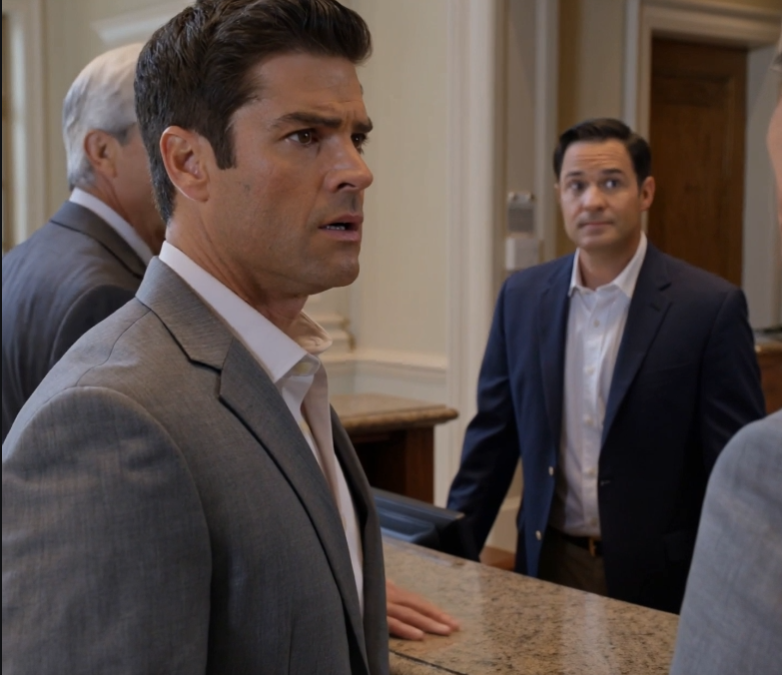
“Your compensation and benefits are unaffected during this transitional period, Conrad.”
“That doesn’t address the contractual breach,” I replied. “You’ll have my formal written notice before noon today. That starts the cure clock.”
He cleared his throat.
“We hope you’ll view this as an opportunity to interface with our external partner ecosystem at the touchpoint level.”
I picked up the new badge. It read:
Conrad Blythe. Visitor Services Department.
I looked at him one more time.
“Who approved this directive?”
He hesitated just long enough to tell me everything I needed to know.
“The instruction originated from the family office.”
There it was.
Three weeks earlier, our founder and Executive Chairman, Harrison Morrow, a sixty-seven-year-old industrialist who had built Meridian from a regional trucking operation into a global logistics empire, had appointed his twenty-six-year-old son, Landon Morrow, as Chief Innovation Officer.
Landon had spent the previous four years running a boutique tech accelerator in Austin with a portfolio of mostly pre-revenue startups. He had no background in freight operations, carrier contracting, fuel hedging, or any of the twelve disciplines that made Meridian function at scale.
Ten days after Landon’s appointment, he had brought in his college roommate, a thirty-two-year-old named Saurin Doll, as Vice President of Strategic Vendor Realignment. It was a title Landon had apparently invented himself.
Saurin’s prior experience consisted of managing a small online retail brand and a brief stint in commercial real estate. Yet within one week, he had been granted access to our proprietary carrier pricing database, our route optimization algorithms, and the confidential bid parameters for Project Horizon, our $3.1 billion domestic freight corridor expansion initiative.
I had done what any senior executive with fiduciary responsibilities was obligated to do.
I submitted a formal risk memorandum to Harrison, our CEO, Diane Corbett, and General Counsel Reeves Alston.
My executive summary was direct:
“Saurin lacks the operational background and security clearances required for his assigned scope. His unmonitored access to Project Horizon pricing architecture and carrier network data creates material exposure under federal trade secret statutes and our existing nondisclosure agreements with carrier partners.”
Four days later, my calendar access to all Project Horizon briefings was revoked.
One week after that, Philip Hartley handed me a visitor services badge and explained it with corporate poetry.
I stood up, buttoned my jacket, and told him I’d be at my new post by 8:30.
He blinked. He had clearly expected resistance, anger, or a threat.
I gave him none of those things.
Twenty years of corporate work teaches you something fundamental. When someone designs an insult to provoke you, your silence is the only weapon they cannot predict.
My new supervisor was a woman named Dorothy Paige, Manager of Administrative Services. She was in her late fifties, ran a tight operation, and handed me a laminated protocol guide with the patient authority of someone who had seen stranger things.
“You may have handled nine-figure deals upstairs, Mr. Blythe,” she said, “but down here, we follow standardized check-in procedures. Everyone does.”
“Standardized procedures are what keep complex systems from collapsing,” I told her. “I have no issue with that.”
She handed me a navy blazer from the supply closet. It fit tightly across the shoulders.
I put it on anyway.
For the first two days, colleagues walked past the desk without making eye contact. By Wednesday, a junior analyst from our revenue team dropped a courier package on my counter without looking at me and said, “Suite 34, whenever.”
Someone from the marketing floor stopped to ask whether guest services could recommend a good lunch spot nearby.
I discovered something that no one who banishes a person to a lobby ever thinks about.
The lobby is the central nervous system of a corporate building.
Every courier, every external consultant, every legal messenger, every outside vendor passes through it. You see everything. You hear everything. And if you are patient enough and methodical enough, the lobby tells you exactly what is happening inside the company.
By my fourth day, I had noticed a pattern.
Three separate sealed envelopes had been delivered to Saurin Doll through our main reception counter, each originating from an entity called Blue Meridian Consulting LLC.
The name registered with me immediately.
I had encountered it eighteen months earlier during a competitive intelligence briefing. Blue Meridian was a data advisory firm whose principal, a man named Reston Caulfield, had spent twelve years managing strategic intelligence for Apex Freight Systems, our largest domestic competitor.
I logged every delivery, timestamp, courier company, license plate, and recipient signature.
Every single one.
The trap had already been set by the people who thought they’d buried me.
What they hadn’t realized was that they’d placed me at the exact location where their secrets were physically entering the building.
On day eight, everything changed.
It was a Thursday afternoon, just past 2:30. I was processing a vendor visitor request when the lobby’s energy shifted in the way it only does when someone significant is approaching.
Security personnel straightened. The front desk phone rang twice and went quiet.
Through the glass panels facing the main drive, I watched a line of black SUVs pull up beneath the covered entrance.
Harrison Morrow was coming in for an unannounced walkthrough.
He came through the revolving doors with our CEO, Diane Corbett, at his shoulder, General Counsel Reeves Alston, two board members, and, behind them, Landon Morrow and Saurin Doll, talking quietly to each other with the easy confidence of men who believed everything was under control.
Harrison Morrow was sixty-seven, but he moved like someone twenty years younger. He had built Meridian with his hands, not just his capital, and it showed in the way he carried himself.
His eyes swept the lobby the way they always did, scanning for operational details, for anything out of place.
They found me.
He stopped walking.
Diane Corbett nearly stepped into him. The entire entourage compressed behind him like an accordion.
For four full seconds, Harrison Morrow stood in the center of his own lobby and stared at me.
His gaze dropped to my badge, then to the navy blazer, then back up to my face.
He walked directly to my counter, leaving his entire group behind him.
Landon quickened his pace to keep up, placing his hand briefly on his father’s arm.
“Dad, the infrastructure team is waiting on forty-one. We have about fifteen minutes before—”
Harrison didn’t acknowledge him.
He placed both hands flat on the reception counter and looked at me.
“Conrad.”
“Harrison,” I said.
“What in the world are you doing behind this desk?”
I held his gaze without hesitation.
There were a dozen ways I could have answered. Long ones. Political ones. Cautious ones.
I chose four words.
“Ask your son.”
The lobby went quiet in a way that lobbies almost never go quiet.
The courier who had been sorting packages by the sidewall stopped sorting. The two visitors waiting in the seating area looked up from their phones, then immediately looked back down.
Landon’s face changed completely. The composed, confident expression dissolved into something raw and reactive.
“That is completely out of line,” he said, his voice tight. “Dad, this is exactly what I’m talking about. He’s been obstructionist since day one. HR made an operational staffing decision, and he’s turning it into a personal vendetta.”
Harrison didn’t look at his son.
He kept looking at me.
Dorothy Paige had emerged quietly from her office, and she now stood near her partition, utterly still, as if any movement might cause a structural collapse.
“Harrison,” Landon tried again. “The partnership consortium is waiting upstairs. This is not the moment.”
Harrison turned his head slowly and looked at his son.
It was not an angry look.
It was something quieter and more devastating than anger. It was the look of a man calculating whether the person he was looking at was who he had believed him to be.
Then he turned back to me, his voice dropping.
“Come upstairs, Conrad.”
“My shift runs until five,” I said, keeping my tone even. “Visitor services protocol requires continuous desk coverage until a verified relief is confirmed. I can’t leave Dorothy without coverage.”
I glanced toward Dorothy, who appeared to be considering whether to resign on the spot.
Harrison followed my line of sight.
“Dorothy, cover this desk now.”
Dorothy straightened.
“Yes, Mr. Morrow. Immediately.”
Landon stepped forward. His voice had gone from tight to brittle.
“This is theater. You’re rewarding bad behavior. Conrad’s been doing everything in his power to undermine the innovation team’s mandate since Saurin came aboard. And now he gets a personal audience with the chairman because he refuses to comply with a routine HR transfer. Dad—”
“Not another word,” Harrison said quietly, without raising his voice at all.
That was somehow worse than shouting.
We rode the elevator to the forty-eighth floor in complete silence.
Harrison, Diane, Reeves Alston, Landon, Saurin Doll, me, and the tight navy blazer.
The elevator doors opened, and Harrison turned immediately toward Philip Hartley, who was waiting in the corridor with a tablet.
“My office,” Harrison said to Philip.
Then he pointed at me.
“You too.”
Before I crossed the threshold, I stopped.
“Harrison, before we address the staffing issue, there’s a governance matter I need to put in front of you.”
Saurin’s shoulders went rigid.
It was subtle. Most people would have missed it.
Harrison didn’t.
I placed a physical log on the credenza outside the boardroom.
Eight entries over nine business days. Each one documenting a courier delivery from Blue Meridian Consulting LLC addressed directly to Saurin Doll, each bearing Saurin’s signature in the physical receipt column.
I tapped the most recent entry.
“This envelope arrived at 4:55 yesterday afternoon. Saurin signed for it at my counter personally. Blue Meridian Consulting is run by Reston Caulfield, who spent twelve years as head of competitive intelligence for Apex Freight Systems.”
I let the silence do its work.
“And Saurin currently holds unmonitored access to Project Horizon.”
Saurin laughed.
It came out wrong, too quick and too sharp.
“You’re really doing this? You were demoted to the front desk, and now you’re playing detective with courier receipts? This is embarrassing, Conrad.”
Harrison had already pushed open the boardroom door.
“Inside. All of you. Close it.”
We moved into the corner suite with the floor-to-ceiling view of Midtown Atlanta.
Harrison set the courier log on his desk and smoothed it flat.
“Start from the beginning,” he said, looking at me.
Philip Hartley made a brief attempt to redirect.
“Harrison, I think before we entertain—”
“Philip.”
Harrison didn’t look up from the log.
I walked him through it. Every piece of it.
Landon’s appointment and the reasoning behind my concern. Saurin’s installation over Project Horizon without any background verification. My formal risk memorandum, which Harrison had apparently never personally read. The revocation of my calendar access. The courier deliveries.
And then, separately, the six new external hires who had been brought into Saurin’s team over the preceding three weeks.
All processed under expedited hiring exceptions that bypassed standard background clearance protocols.
All approved by Philip Hartley, citing verbal instructions from Landon Morrow.
Landon was on his feet.
“This is a manufactured narrative from a disgruntled executive who couldn’t adapt to a new leadership dynamic. Dad, you’re going to sit here and listen to this?”
Harrison looked at his son for a long moment.
“Where is the envelope Saurin signed for yesterday?”
Saurin straightened.
“In my office. I can have my assistant retrieve it.”
“Go get it yourself. Right now.”
Saurin’s jaw tightened.
“Harrison, I am a corporate vice president. I don’t think this kind of interrogation is—”
“You’ll walk to your office and bring back that envelope,” Harrison said. “Or you’ll be escorted from this building by security. Those are your two options.”
Saurin set his jaw and walked out.
Harrison picked up his direct line.
“Reeves, get in here and call Naomi Hurst from Information Security and whoever’s running Internal Audit right now. Tell them I need them on forty-eight immediately.”
Landon dropped into a chair, running both hands through his hair.
He said nothing else.
Whatever script he’d been working from had run out of pages.
Twelve minutes passed.
Then Reeves came back in, flanked by Naomi Hurst and a compact, precise woman named Sana Crest from Internal Audit. Naomi had an encrypted laptop tucked under her arm.
Reeves’s phone buzzed. He looked at the screen, and his expression shifted in a way that told me something was wrong before he said a word.
“Harrison. Building security just flagged Saurin Doll leaving through the loading dock exit on the lower level. He used his access card four minutes ago. His vehicle is not in the parking structure.”
Landon looked up from the table. Something crossed his face.
Not surprise. Something closer to the feeling you get when you finally understand that the ground you’ve been standing on was never solid.
I looked at Naomi Hurst.
“Can you run a forensic audit on Saurin’s system access for the past two weeks? Specifically, any data movement involving Project Horizon’s carrier pricing models or bid parameters.”
Naomi looked at Harrison.
“I need direct authorization from the executive chairman to initiate an emergency forensic review on a corporate officer account.”
“You have it,” Harrison said. “Organize everything.”
What Naomi and Sana uncovered over the next three hours was methodical and catastrophic.
During the preceding nineteen days, four user profiles assigned to Saurin’s Strategic Vendor Realignment unit had extracted extraordinary volumes of data from Project Horizon’s secure repositories during off-hours. The extraction volume exceeded normal analytical patterns by more than twenty times.
Targeted files included our proprietary carrier rate negotiation models, route optimization algorithms, and the confidential bid thresholds we had developed for our three largest southeastern corridor contracts. These were contracts currently in final negotiation with carriers who also competed directly with Apex Freight Systems.
Internal Audit’s review of the six expedited hires destroyed what remained of the cover story.
Three had submitted employment histories that did not withstand verification. One listed a logistics management degree from a university that had no record of his attendance. Two had legitimate credentials, but financial records showed that a private consulting entity registered to Saurin in Delaware had paid a combined $64,000 to both of their former employers in the weeks before they were brought into Meridian.
Every single expedited clearance exception had been signed off by Philip Hartley, citing direct verbal instructions from Landon Morrow.
Reeves Alston called outside counsel at nine that evening. By 10:15, he was on the phone with the FBI field office in Atlanta.
Project Horizon’s data involved ongoing negotiations with federally regulated carriers across multiple states. The unauthorized extraction and intended transfer of proprietary commercial data at that scale triggered liability under the federal Defend Trade Secrets Act and wire fraud statutes.
At 12:40 in the morning, Naomi’s endpoint monitoring system flagged an alert.
A corporate laptop assigned to Saurin’s unit had authenticated onto an external cellular network and was traveling north on I-85 toward Hartsfield-Jackson Airport.
Reeves transmitted the device serial number, travel data, and forensic telemetry to the FBI liaison.
We did not chase anyone. That was not our function.
Our function was documentation, chain of custody, and providing investigators with information that would hold up in federal court.
At 2:17 in the morning, federal agents met Saurin at the International Departures Terminal.
In his carry-on, they recovered two encrypted solid-state drives containing unredacted carrier pricing models, bid threshold documents, and route optimization source code for Project Horizon, along with a one-way ticket to Copenhagen.
Forty minutes later, an unauthorized remote wipe command was initiated, targeting Meridian’s central email archive server. The command originated from a residential IP address registered to Saurin Doll’s leased apartment in Buckhead.
The attempt was blocked automatically by our security infrastructure. It was also logged as a federal offense involving the intentional destruction of corporate records under Title 18 of the United States Code.
By four in the morning, Saurin’s four team members were on investigative suspension, their credentials permanently revoked. Philip Hartley was placed on immediate administrative leave pending a formal board review.
And Landon Morrow’s access to Meridian’s executive systems, strategic briefings, and corporate facilities was suspended by unanimous resolution of the independent audit committee, which had convened an emergency virtual session at 2:30 that morning.
The most damning document emerged from Philip Hartley’s quarantined email archive.
It was a message sent three weeks earlier by Landon Morrow from his official corporate account. The language was plain enough that no interpretation was required.
“Conrad Blythe is going to keep blocking Saurin’s access with risk memos until someone stops him. We cannot run the vendor realignment with him auditing every move. Get him out of procurement before the next data access cycle. Put him somewhere visible so the rest of the senior team understands that the old guard doesn’t run this company anymore.”
Philip had replied within the hour.
“Visitor services desk on ground floor is temporarily understaffed. We can position it as an executive brand presence initiative.”
Landon’s response was a single word.
“Perfect.”
At 4:30 in the morning, Harrison Morrow came into the conference room where the independent investigation team had been working.
He looked like a man who had aged a decade between sunset and sunrise.
His suit jacket was draped over his forearm. He stood at the window for a long moment, looking down at the city lights.
“Was Landon directly involved in the data theft?” he asked.
His voice was steady, but there was something underneath it that I recognized as grief.
I answered him honestly.
“He orchestrated the removal of the oversight mechanism that would have caught it. Whether he understood the full extent of what Saurin was planning for Apex, or whether he was being used by someone he trusted, that’s a question for federal prosecutors. The answer will matter for the charges. It won’t change what happened here.”
Harrison sat down in one of the conference chairs. He was quiet for a moment.
“I built this company over thirty-one years,” he said. “I took it public. I built the Atlanta headquarters with the original freight division revenue, and I handed my son a senior title because I believed in him and because I thought it was time.”
He paused, looking toward the windows.
“I had no idea he was running a plan that would have dismantled everything we built.”
I let the silence breathe before I responded.
“Harrison, the failure wasn’t entirely your son’s choices. It was the structural vulnerability that allowed those choices to go undetected for three weeks. When an executive can bypass background verifications, reassign a senior VP without board authorization, and grant unmonitored access to the company’s most sensitive commercial data, all through informal family authority, the system itself is the problem.”
I continued, keeping my voice level.
“Your son exploited a gap. The gap existed because your governance architecture didn’t require independent audit signoff on personnel decisions initiated by the family office.”
Harrison looked at me directly.
“What do you need, Conrad?”
I told him I needed a clean-room environment on the forty-second floor by morning because Meridian’s three largest carrier partners, the ones whose contracts were in final negotiation, were going to hear about a security incident within forty-eight hours.
And if we didn’t present them with forensically verified, uncompromised bid documentation before that happened, we were going to lose contracts worth over $900 million in annual revenue.
He authorized everything I asked for before 5:00 a.m.
Because Meridian was publicly traded on the New York Stock Exchange, the crisis could not be contained internally.
At nine the following morning, our securities counsel filed a Form 8-K with the SEC, reporting an active internal investigation into unauthorized data access, the suspension of relevant personnel, and ongoing coordination with federal law enforcement.
Meridian shares dropped 6.8% by midday.
Our carrier partners began making inquiries.
The next forty-four hours were the most focused work I have ever done in my professional life.
I assembled a team of eleven senior analysts who had never reported through Saurin’s department, built an isolated digital environment with multifactor authentication on every file access event, and rebuilt Project Horizon’s carrier pricing framework from original supplier contracts, freight index data, and raw route telemetry.
We documented every assumption. Every data point had a source citation that could survive external scrutiny.
When we presented the rebuilt framework to our three major carrier partners on a secure video call, their legal teams spent two hours cross-examining our methodology.
I answered every question with the underlying documentation on screen.
At the end of the session, the senior representative from our largest partner said, “Meridian has demonstrated exactly the kind of institutional discipline we need to see from a long-term logistics partner. We’re prepared to move forward.”
Losing that contract would have cost over two hundred people their jobs at the regional division level.
I mention this not for credit, but because it’s the part that matters most and gets mentioned least in stories like this one.
The people who design the betrayal rarely think about the people on the manufacturing floor whose 401(k)s carry company equity.
The work you do in the forty-four hours after the crisis is for them, not for yourself.
Three weeks later, federal prosecutors unsealed a criminal complaint charging Saurin Doll and Reston Caulfield of Blue Meridian Consulting with conspiracy to commit theft of trade secrets, wire fraud, and obstruction of justice.
Digital forensics established that Saurin had been negotiating a private equity stake in Apex Freight Systems in exchange for Project Horizon’s carrier pricing architecture and route optimization models.
Confronted with a federal chain of custody that was airtight, Saurin entered a guilty plea within sixty days, facing up to seven years in federal prison.
Landon Morrow’s legal exposure was narrower but significant.
Prosecutors concluded that he had knowingly created the conditions for the theft without being a direct participant in the data transfer. He entered a negotiated agreement involving a substantial financial penalty, a five-year bar from serving as an officer or director of any publicly traded company, and community restitution.
The trust fund didn’t protect him from the federal statute.
It never does.
Philip Hartley was terminated for cause by the board. His severance package was nullified under the executive agreement’s forfeiture provisions, which voided benefits upon a finding of willful misconduct.
His career in human resources leadership was over.
Four weeks after the emergency investigation concluded, I received a calendar invitation to the boardroom on the forty-eighth floor.
When I walked in, the full board of directors was seated in formal session.
Our CEO, Diane Corbett, sat to the right of the lead independent director, a woman named Josephine Aldren, who had spent thirty years as a federal judge before transitioning to corporate governance work.
Harrison Morrow was present as well, but he had moved away from the head of the table. He sat in a standard director’s chair like everyone else.
Josephine gestured toward the seat across from her.
“Please sit down, Conrad.”
I sat.
“We have two significant announcements,” she said. “First, Harrison Morrow has formally tendered his resignation as executive chairman. He will retain his equity interest as the company’s founding shareholder, but the chairmanship transitions immediately to an independent director governance structure.”
She paused before continuing.
“Second, Diane Corbett has informed the board of her retirement at the close of the fiscal year.”
Josephine slid a leather-bound document across the table toward me.
“The board has voted unanimously to offer you the position of President of Meridian Logistics Group, with immediate succession to Chief Executive Officer upon Diane’s departure.”
Everyone in the room was watching to see what I would do with it.
Some of them were expecting gratitude. Some were expecting relief. A few may have been expecting me to sign it on the spot.
I slid it back across the table.
The room went very quiet.
Josephine looked at me.
“May I ask why?”
“Because you’re trying to solve a structural problem with a symbolic appointment,” I said.
I let that settle before I continued.
“Meridian suffered a catastrophic breach because informal authority, family proximity to the chairman, was able to override documented governance controls with no checks and no friction. Your instinct now is to take the person who exposed that failure and give him the top seat.”
I looked around the table.
“That doesn’t fix the vulnerability. It replaces one trusted individual with another trusted individual. And the next time the trusted individual happens to have bad judgment or a blind spot, the same gap is still there.”
Josephine leaned forward slightly.
“What are you proposing instead?”
I opened my notebook.
I outlined the creation of a Chief Risk and Compliance Officer position, reporting administratively to the CEO but with a direct, independent reporting line to the board’s audit committee, bypassing executive management entirely.
This officer would hold statutory authority to initiate a mandatory fifteen-business-day review pause on any personnel appointment, data access expansion, or strategic partnership that carried material regulatory exposure.
The pause would require a documented vote to override.
No single executive, no family office, and no informal instruction could circumvent it.
“I would take that role,” I said. “Not the presidency.”
Diane looked at me for a long moment.
“That’s not a reward, Conrad. That’s deep structural surgery.”
“Surgery is what the patient actually needs,” I said.
The board voted unanimously to establish the position.
My compensation was restructured at a $310,000 base salary with a 70% incentive target and a direct equity stake.
But the provision I cared about was the unmediated reporting line to the independent audit committee.
That was the thing with actual weight.
I chose an office on the twenty-third floor, high enough to see Midtown, low enough to maintain a clear sight line to the lobby entrance.
Over the following two years, Project Horizon completed its first two major corridor deployments on schedule, restoring full carrier partner confidence and driving a 14% improvement in domestic freight revenue.
Internal compliance incident rates dropped to the lowest level in Meridian’s recorded history.
When our governance model was cited in a Harvard Business School case study on post-breach institutional reform, I sent Dorothy Paige a copy with a handwritten note.
I eventually left Meridian to establish Blythe Governance Partners, an advisory firm specializing in fiduciary risk architecture and trade secret protection for publicly traded companies.
Meridian was our founding client.
Three of our other early clients had gone through similar crises. Different industries, different names, but the same underlying structure.
Informal authority. Insufficient friction. A compliance function that was advisory rather than statutory.
On my last morning at Meridian, I rode the elevator down to the ground floor.
Dorothy was at the reception counter, briefing a new front desk associate. She looked up when I crossed the lobby.
“Leaving us properly this time,” she said.
“Outside perspective from here on,” I told her. “You’re in better hands than ever.”
She extended her hand, and I shook it.
In the top drawer of my consulting office desk, I keep one artifact from my years inside corporate life.
It is a laminated badge that reads:
Conrad Blythe. Visitor Services Department.
Printed on the same card stock as every other ground-floor access credential.
I don’t frame it.
I keep it in the drawer, and I look at it on the days when a client’s board tries to convince me that a governance rule can be bent just this once because the person bending it can be trusted.
That badge is a permanent record of what corporate trust without structural accountability actually costs.
An executive title is something a company gives you.
Your integrity, your professional discipline, and the willingness to log every courier delivery and wait patiently until the truth walks through the front door—those belong to you alone.
No amount of corporate reorganization can ever reach them.








