For five months, I cared for my paralyzed husband while his mom and sister treated him like he was already dead. They spent his money in front of him. His sister even said, “What’s he going to do, tell on us?” At 1:07 a.m., his fingers moved. Then he whispered, “Check my safe… They’ve been lying to you.”
My name is Irene Griffin. I am thirty-five years old. For five months, I cared for my paralyzed husband while his mother and sister treated him as if he were already dead.
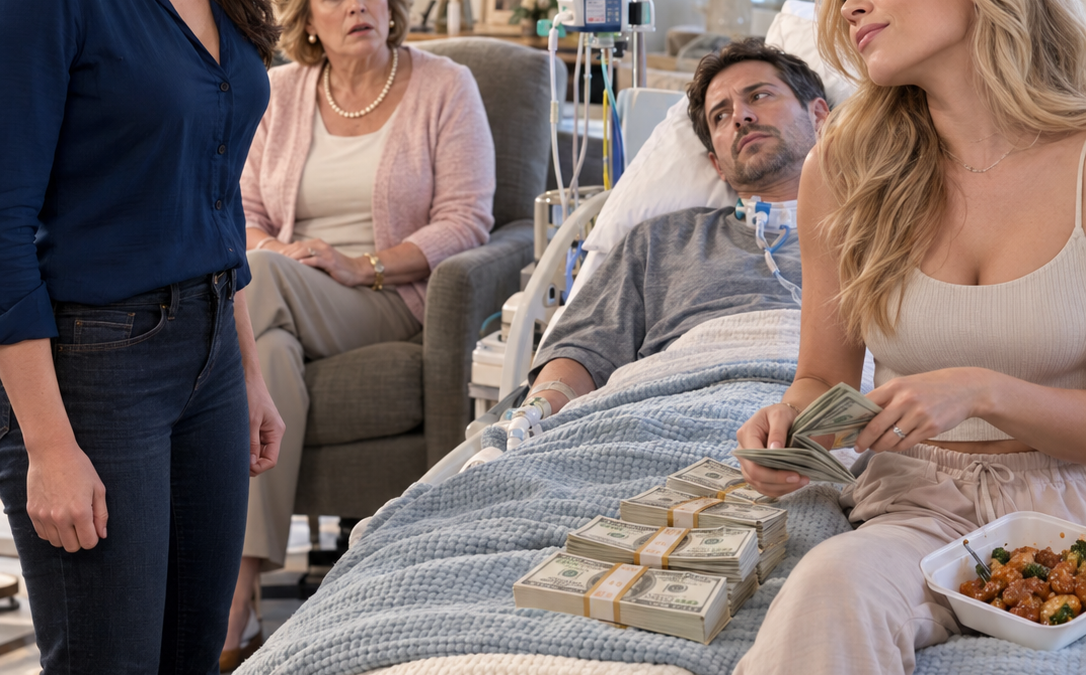
They moved into our house. They put his hospital bed in the living room. Then they spent his money right in front of him. His sister sat on the edge of that bed, counted cash across the blanket covering his legs, and ate his favorite takeout while the feeding pump clicked beside her.
“He can’t taste it anyway,” she said.
When I told her to stop, she laughed.
“What? What’s he going to do? Tell on us?”
I worked nights. I turned him every two hours. I checked his skin, his feeding tube, his breathing. I believed I was protecting him.
I did not know they had been lying to me the entire time.
Then, one night after my shift, his fingers moved.
His hand closed around mine.
A few minutes later, he whispered, “Check my safe. They’ve been lying to you.”
They thought a man who could not speak could not hear.
They were wrong.
And that safe was going to prove it.
Before I take you back to the beginning, please like and subscribe. Tell me in the comments where you’re watching from and what time it is. I love reading those.
To understand that safe, you have to know the man who locked it.
Owen Griffin was a journeyman electrician with fourteen years in the union and a habit of printing things. Pay stubs. Warranties. The receipt for a toaster. Anything he considered even remotely important ended up on paper.
I used to tease him about it.
“Paper doesn’t crash,” he’d say.
Our house was on the north side of Springfield, Missouri. Two stories, a small yard, and an attached garage that belonged to Owen in every way except on the deed. He spent most weekends out there.
That was where I usually found him, bent over a 1972 Honda CB350 he had bought as a rusted frame from a farmer outside town.
He was restoring it for me.
Our anniversary was in June. He thought I didn’t know.
I knew.
The gas tank sat on his workbench with a strip of masking tape across it that read, IRENE PAINT.
Under that workbench, bolted to the concrete floor, was a heavy fireproof safe.
I called it his vault.
“What do you even keep in there?” I asked once.
“Titles,” he said. “Grandpa’s watch.”
Then, after a second, he added, “Things I’d rather not think about.”
I laughed. I thought he meant taxes.
I caption live television for a living. Real time, word for word, at a little over two hundred words a minute. I worked from home Sunday through Thursday, eight at night until one in the morning Central Time, covering late news broadcasts from the West Coast.
It is a strange job. You spend five hours a night listening harder than anyone else in the room, and nobody ever knows you were there.
Owen understood that about me. He was the only person who ever asked what I had heard.
The one thing he did not talk about was his sister.
Amber was eight years younger than Owen. Their father died in 2011, when Owen was twenty-three and Amber was fifteen, and somewhere in that year Owen became the person who always picked up the phone.
He picked up at dinner. He picked up at two in the morning. He once picked up in the middle of a toast at our own wedding.
When I found Amber’s name on a grocery receipt paid with Owen’s card, he only shook his head.
“Amber knows my PIN. Don’t ask.”
So I didn’t.
On Friday, October 17, I finally did.
I had opened our joint savings account to see whether we could afford a new water heater, and twelve hundred dollars was gone. Transferred two days earlier. No note. No explanation.
Owen was standing at the kitchen counter when I turned the laptop toward him.
He stared at the screen for a long time.
“I was going to tell you this weekend.”
“Tell me what?”
“All of it. I just need—”
His phone buzzed facedown on the counter.
12:18 a.m.
He turned it over, and something in his expression closed.
He answered.
He listened.
Then he said quietly, “Stay inside. Don’t drive. I’m coming.”
He hung up and grabbed his keys.
“Owen—”
“I have to go.”
He was already moving toward the door.
“I’ll tell you everything when I get back.”
The door shut.
His truck backed out of the driveway. I stood there and watched the headlights turn north, which made no sense to me. Nothing we had was north.
I sat at the kitchen table and waited to be angry.
Mostly, I was tired.
I texted him once.
Where are you going?
The message showed as delivered.
He didn’t answer.
Owen never texted while driving. I knew that. I sat there anyway, staring at the screen.
At 2:10 a.m., my phone rang.
It was a Missouri State Highway Patrol trooper.
There had been a single-vehicle crash on Highway 13, about fourteen miles north of Springfield. They thought a deer had been involved.
My husband had been taken to the trauma center in town.
“Is he—?”
“Ma’am, you should get to the hospital.”
I called his mother from the car at 2:25.
Denise lived in Nixa, about fifteen miles south of us. She told me she would meet me there.
She walked into the emergency department at 2:55 in the morning with her hair done, lipstick on, and a cardigan buttoned all the way to her throat.
The first thing she said was not, “Is he alive?”
It was, “Is he talking? Did he say anything?”
I didn’t know.
Nobody told us anything for another hour.
While we waited, a nurse brought me a plastic bag containing Owen’s things. His wallet. His wedding ring. His phone, its screen spiderwebbed and dead.
“The 911 call came from his phone,” she said gently. “A woman made it. She was gone by the time EMS arrived. Probably somebody who stopped and got scared.”
A woman.
I held that bag in my lap and did not let myself finish the thought.
Dr. Ellen Voss came out a little before five.
“Severe traumatic brain injury,” she said.
Diffuse axonal injury. The damage wasn’t concentrated in one place. It was everywhere in small, devastating ways.
He was on a ventilator.
He had not woken up.
“It could be months,” she told us. “It could be never. We won’t know for a long time.”
They let me see him at six.
His face was swollen, and his hair was matted with dried blood on one side. There were so many tubes that I didn’t know where I was supposed to touch him.
A nurse took my wrist and gently placed my hand on his forearm above the IV.
“You can talk to him,” she said. “Some of them hear more than we think.”
I didn’t.
I didn’t know what to say to a man I had just watched walk out the door.
Amber arrived at nine that morning wearing a gray hoodie zipped to her chin and sunglasses she did not take off inside.
“My phone was dead all night,” she said before anybody asked. “I was asleep.”
Later, in the hallway outside the ICU, Denise took my arm.
“He called Amber tonight,” she said. “She said before he left that he needed to get away from you.”
I didn’t argue.
I didn’t have anything to argue with.
We had fought. He had left. He had driven into the dark, and now he was lying behind glass with a tube down his throat.
Denise squeezed my arm once, the way you might comfort a stranger at a funeral.
“Whatever happens now,” she said, “you owe him.”
I carried that sentence for five months.
I never once asked her to prove it.
Owen spent three weeks in the ICU. On October 27, doctors performed a tracheostomy so he could breathe without a tube running down his throat, and they placed a feeding tube directly into his stomach.
They called it a PEG.
I learned a lot of new words that fall.
The week before, on October 22, I drove to a tow yard in Bolivar to retrieve Owen’s belongings from his truck. The insurance company needed photographs.
The truck sat at the back of the lot, crushed along the driver’s side, its windshield white with cracks.
The owner was a heavy, quiet man named Hank Duffy. He walked out with me and stood with his hands in his pockets while I took pictures.
“Both bags went,” he said, nodding toward the dashboard. “Passenger bag only fires if the seat reads weight. Must’ve had something heavy there.”
I thought about Owen’s tool bag.
Then I found it locked in the box in the truck bed, where it always was.
I wrote that down on the insurance inventory.
Tool bag. Truck bed box.
I took fourteen photographs.
I did not look at them again for five months.
Back at the hospital that week, Amber reached across me for a cup of coffee, and the collar of her shirt slipped sideways.
There was a bruise across her right collarbone, a long diagonal stripe already yellowing at the edges.
She saw me looking and pulled the shirt back into place.
“Moving boxes,” she said.
I nodded.
I was too tired to wonder why a moving box would leave a bruise like a seat belt.
On November 7, they transferred Owen to a long-term acute care hospital to wean him from the ventilator.
On November 24, he breathed on his own.
The nurses clapped.
I cried in the parking garage.
Then the insurance company denied inpatient rehabilitation.
The letter said he could not participate in three hours of therapy a day.
They weren’t wrong.
He could open his eyes. Sometimes they tracked movement across the room. Sometimes they did not.
The diagnosis on his discharge paperwork was minimally conscious state.
There were two choices.
A nursing facility or home.
I brought him home on December 12.
Denise was waiting in our driveway with a suitcase.
“You work nights,” she said. “I’ll take days. That’s what family does.”
I was so grateful I almost cried again.
I wanted Owen’s hospital bed in the dining room. It was quieter there, and I could hang a curtain across the doorway.
Denise stood in the middle of the house with her hands on her hips.
“Living room,” she said. “So everyone can see him.”
I didn’t argue.
I had stopped arguing with her in October.
So that became our life.
A hospital bed in the middle of the living room. A feeding pump on a pole, clicking every few seconds through the day and night. A suction machine. A turning schedule taped to the refrigerator because a man who cannot move can develop pressure sores quickly if nobody moves him.
I captioned the news at the dining table from eight until one, ten feet from Owen’s bed.
At one in the morning, I turned him, checked his tube, checked his skin, and made sure he was positioned correctly. Then I slept on the couch with alarms set for three and five.
At eight in the morning, Denise came downstairs and I went upstairs to sleep until two.
Some nights, when I turned Owen, his eyes followed me across the room.
I noticed something else, too.
They never followed his mother.
Every morning, before Denise came downstairs, I washed his face with a warm cloth and shaved him with the electric razor he had always hated.
I told him about the news I had captioned.
A wildfire in Oregon. A car chase in Los Angeles. A city council fight in Fresno over a dog park.
I did the voices.
Nobody laughed.
I kept doing them anyway.
A few days after we brought him home, Denise sat across from me with a legal pad.
“You’re drowning, honey,” she said. “Let me carry the boring part.”
She had handled payroll for the school district for thirty-one years. She knew forms.
She offered to take care of Owen’s short-term disability claim through the union, his mail, and the insurance calls.
She needed his ID to make copies.
I handed her his wallet.
His debit card was inside.
I didn’t think about that.
A couple of days later, she asked very casually, “Do you know the combination to Owen’s safe? For the paperwork?”
“No. He never told me.”
“And his phone?”
“Dead. The screen’s cracked. I don’t know his passcode.”
She nodded.
I remember thinking she looked relieved.
I thought it was relief at having one less thing to deal with.
The changes were small at first.
“Owen always hated the news,” Denise said one evening, and turned the television so it faced the couch instead of his bed.
Always hated.
Past tense.
He was lying six feet away.
Then there was a new television, a sixty-five-inch model mounted on the living room wall.
I didn’t ask who paid for it.
I assumed Denise had.
On December 20, Amber moved in.
She had been evicted from her apartment.
She took Owen’s upstairs office, the room with his framed union certificate hanging on the wall.
The garage-door remote had been clipped to the visor in Owen’s truck, so it was gone. Anyone going into the garage now had to walk through the living room, directly past Owen’s bed.
Amber did it with earbuds in her ears and her eyes on her phone.
She never looked at his face.
Not once.
“It’s weird talking to him,” she said when I asked her to say hello. “It’s like talking to a couch.”
On Christmas Eve, Owen’s foreman, Travis Colb, came by with a card from the men at the union hall. Twenty-three signatures and six hundred dollars in cash.
He stood beside Owen’s bed for a long time with one hand resting on his shoulder.
On his way out, he said, “At least the disability’s been paying out. Our plan kicks in after a week.”
“Denise says it’s still pending.”
Travis frowned.
“Pending? Mine hit in eight days when I broke my wrist.”
He left it there.
I closed the door behind him.
Eight days.
It had been more than two months.
By January, my savings account was almost empty.
The mortgage was $1,640 a month. My paycheck covered most of it and almost nothing else.
When I asked Denise about Owen’s disability claim, she didn’t even look up from her crossword puzzle.
“They denied it. I’m appealing.”
“Denied it? Why?”
“Paperwork, Irene. It’s always paperwork. Let me handle it.”
On January 8, I called my mother in Joplin.
My parents are not wealthy people. My father spent thirty years working for the railroad.
By that afternoon, however, a notification appeared on my phone.
Incoming transfer: $4,000. T. Brennan.
My mother called a few minutes later.
“Denise told us about the fight,” she said.
I closed my eyes.
“The night of the accident.”
I had never told my parents about the fight. I had been too ashamed.
Denise had.
“Maybe this is your chance,” Mom said carefully, “to make things right with his family. Don’t start a war while he’s lying there.”
Two days later, I was taking out the kitchen trash when a receipt stuck to the lid.
An ATM slip from a gas station on Kearney Street.
Five hundred dollars.
The card number ended in four digits I knew by heart because they were printed on the card I had handed Denise in December.
There were two more slips at the bottom of the bag.
I laid all three on the kitchen counter.
Denise looked at them, then at me.
“Groceries. Supplies. You think gauze is free?”
“We get his supplies through insurance.”
“Do you want to see the receipt for every diaper, Irene?”
I didn’t answer.
I was staring at the bottom of one slip, where the ATM had printed the account’s remaining balance.
It wasn’t small.
Money was going into that account every week.
If his disability claim had been denied, where was it coming from?
On Monday, I drove to Owen’s bank and waited forty minutes to sit across from a young man in a blue tie.
“I’m his wife,” I said. “I just want to see the balance. I want to know where his money is going.”
He was sympathetic.
He was also very clear.
“You’re not on this account, Mrs. Griffin. Without a power of attorney or a guardianship order, I can’t share anything. I’m sorry.”
Owen had never signed a power of attorney.
We were thirty-seven and thirty-four when he crashed.
Nobody thinks about that at thirty-seven.
I drove home with nothing.
Every afternoon before my shift, I did the exercises the home physical therapist had taught me.
Arms, then legs, then hands.
I bent each joint slowly so it wouldn’t stiffen.
His right hand was always the tightest. I opened his fingers one at a time against my palm and told him, “There you go.”
That same week, Amber had a new phone.
Denise had a new recliner parked beside Owen’s bed, facing the new television.
On Friday, January 16, I came downstairs a little after four in the afternoon. Friday was my night off, and I had slept late.
Amber was sitting on the edge of Owen’s bed.
She had an envelope full of cash in her lap and was counting twenties into small stacks on the blanket over his legs.
In her other hand was a takeout box of Springfield-style cashew chicken from the place on Glenstone.
Owen’s favorite.
He used to order it every payday.
Beside her, the feeding pump clicked.
She saw me looking and held up the box.
“He can’t taste it anyway,” she said.
From the recliner, Denise laughed.
A drop of brown sauce landed on the blanket beside Owen’s hand.
“Stop,” I said.
Amber laughed too.
She didn’t even stop counting.
“What’s he going to do? Tell on us?”
Denise stopped laughing.
Instantly.
As though somebody had pulled a plug.
“Amber,” she said, sharp and low.
Amber rolled her eyes and shoved the money back into the envelope.
Denise turned toward the television.
Nobody said anything else.
I looked at Owen.
His eyes were open, and there was moisture gathered at the corners. One thin line ran toward his ear.
Denise saw me notice it.
“Eyes water,” she said without looking away from the screen. “It’s the air in here.”
That night at eleven, I sat at the dining table with my laptop while Owen breathed slowly in the darkness behind me.
I opened a blank document.
I named it OWEN NOTES.
I typed the date, the time, and who had been in the room.
Then I typed exactly what Amber had said, word for word, the way I would have entered it if it had come across my screen at work.
January 16, 4:30 p.m. Amber on Owen’s bed counting his cash. “What’s he going to do? Tell on us?”
Then the rest.
“He can’t taste it anyway.”
Eyes water. “It’s the air in here.”
“It’s like talking to a couch.”
I don’t know why I did it.
That is simply what I do with words that matter.
I write them down.
It was the first time I documented something they said.
It was not the last.
The next morning, a man wearing a Carhartt jacket rang our doorbell.
Amber let him in and walked him through the living room, past Owen’s bed, and into the garage.
I followed.
Owen’s tools had been spread across the workbench and the floor. His drills. His meters. His hand tools. His Klein tools, his initials engraved into the handles.
OG.
“What are you doing?”
Amber didn’t turn around.
“Selling them.”
“Those are his.”
“Mom said we need the money.”
“He’s going to need those.”
She shrugged.
“He’s not going to need them.”
The man in the Carhartt jacket looked at me, then at the floor.
He paid cash and carried out a box of power tools.
On his way back through the living room, he stepped around the feeding-pump pole without looking at the man attached to it.
Amber sold everything in three lots over two Saturdays.
Six thousand eight hundred dollars.
Every buyer walked past my husband’s bed on the way in and passed it again on the way out.
I stood in the doorway each time.
Once, I said, “Stop.”
Nobody listened.
After that, I did not say it again.
I’m not proud of that either.
The night after the second sale, a text came from Travis.
Saw Owen’s Klein tools on Marketplace. That right?
I stared at the message for a long time.
I didn’t answer.
I didn’t know how to explain that I had stood inside my own garage and let it happen.
Instead, I opened the listing.
The pictures had been taken right there on Owen’s workbench.
And in the background of every single photograph, half hidden in shadow, was the red frame of his motorcycle.
On February 3, a pulmonologist removed Owen’s trach.
He had been breathing independently for more than two months, and his airway was strong enough. They placed a square of gauze over the opening in his neck and told me it would close on its own within a week or two.
Denise came to that appointment.
She almost never came to appointments.
“So he could talk now?” she asked.
The doctor kept typing.
“Physically, someday, maybe. That depends on the brain, not the airway.”
Denise went pale.
I mean that literally.
The color left her face.
She did not say another word during the entire drive home.
I thought she was overwhelmed.
I thought it was hope, and hope scared her.
Since January 12, a speech therapist named Jodie Carver had been coming to the house twice a week.
She was young and patient, with a laminated letter board and a way of speaking to Owen as if he were simply taking a little longer to answer.
“Blink once for yes,” she would say.
Some days he did.
“Some days I swear he’s with me,” Jodie told me once while packing her bag.
In the middle of February, Jodie stopped coming.
“Agency’s short-staffed,” Denise said.
On February 22, Amber turned thirty.
They held the party in the living room. A grocery-store cake, a few of Amber’s friends, and a silver balloon shaped like the number thirty, which somebody tied to the rail of Owen’s hospital bed.
Denise gave Amber a pair of AirPods.
Later, I found the receipt in the kitchen drawer.
The last four digits matched Owen’s card.
They sang Happy Birthday while standing in a half circle around his bed.
Nobody looked at him.
“Best birthday in years,” Amber said when the party was over.
She tapped the bed rail as she passed.
“Thanks, big brother.”
She was smiling.
She was not looking at him.
A few days later, I found a brochure on the kitchen counter.
Glossy paper. White lilies on the front. The name of a funeral home in Nixa.
Inside, Denise had written payment plan in blue ink.
She had circled a price in red.
I held the brochure up when she entered the kitchen.
She didn’t blush.
She didn’t hesitate.
“Being prepared isn’t a crime,” she said. “I buried his father.”
She had never talked to me about Doug Griffin.
I knew he died in 2011.
I knew it had been a car accident.
That was all.
She sat at the table.
“He drank,” she said. “For twenty years, he drank. I kept everything together. I called his boss when he couldn’t get out of bed. I kept that house running. And one night he drove into a bridge pillar on the way home from a bar, and I got a phone call just like you did.”
She took the brochure from my hand and folded it in half.
“I already lost one of them to a bottle,” she said. “I know how this ends.”
One of them.
Owen didn’t drink.
Not really.
A beer at a cookout.
I noticed the words, then let them go because she was a widow, and I was tired, and it was easier to feel sorry for her.
On February 26, I found a letter she had left on the table.
It was addressed to Owen from the home health agency, and it had already been opened.
Discharged from speech-language pathology services at family’s request, February 13, 2026.
I called the agency from the garage, where nobody inside the house could hear me.
“His mother called and declined further visits,” the woman told me. “She’s listed as the daytime contact on his intake.”
I thanked her and hung up.
I stood there for a long time with one hand resting on the cold hood of my car.
Then I did something I am not proud of.
I went through the recycling.
Near the bottom was the torn corner of an envelope with the logo of the union’s insurance carrier.
Most of the words were gone.
The ones remaining said:
SHORT-TERM DISABILITY PAYMENT ISSUED.
I called the benefits office the next morning.
“I’m sorry, ma’am,” the man said. “We can only discuss a claim with the member or an authorized representative.”
“The member can’t talk.”
“I understand. I’m sorry.”
That night, I put the torn envelope on the counter in front of Denise.
“The claim was denied,” I said. “You said it was denied.”
She barely looked at it.
“That’s an old envelope. Don’t go through the trash like a raccoon.”
“And Jodie? You told me the agency was short-staffed.”
“He’s exhausted. Irene, you’re torturing him with those cards. Let him rest.”
The next week, my mother called.
Then Denise called my mother.
Then my mother called me again.
They said almost exactly the same thing.
Come home for a few days.
“Denise says you look like a ghost,” Mom told me.
I did look like a ghost.
I took four days off and drove to Joplin on Thursday, March 5, an hour and fifteen minutes down I-44.
I slept twelve hours the first night.
My mother made pot roast.
My father fixed a hinge on the guest-room door that had squeaked since I was in high school.
“Let his mother have him for a few days,” Mom said on Friday. “She already lost a husband.”
On Saturday, Denise texted me a photograph of Owen asleep, afternoon light on his face.
Resting peacefully. ❤️
My father walked me to my car on Sunday afternoon.
“You call me if you need anything,” he said.
He didn’t ask what I might need.
I didn’t tell him.
I drove home that evening.
The first thing I noticed when I entered the garage was the space.
It felt empty.
Owen’s motorcycle was gone.
There was nothing left but a dark rectangle on the concrete where it had stood for two years, outlined in old oil.
Amber appeared in the doorway behind me holding a can of seltzer.
“Sold it for parts,” she said. “We needed supplies.”
“For parts?”
“No title. Guy gave me thirty-nine hundred.”
I turned toward the workbench.
Something was wrong with the safe.
Fresh scratches marked the paint along the edge of the door. Deep, bright silver gouges.
A flathead screwdriver lay on the bench beside it, its tip bent sideways.
“It was already like that,” Amber said.
Then she went inside.
I walked into the living room and knelt beside Owen’s bed.
His eyes were open.
They were not on me.
They were fixed on the garage door.
Someone had wanted what was inside that safe badly enough to try to force it open.
On Tuesday night, March 17, I signed off at one in the morning after the final West Coast news broadcast.
The house was dark.
Denise and Amber were asleep upstairs.
The only light came from the microwave clock and the little green screen on Owen’s feeding pump.
At 1:05, I turned Owen onto his left side the way I had done hundreds of times. One hand on his shoulder, the other on his hip. Roll him toward me. Tuck the wedge pillow behind his back.
I checked his heels.
I checked the place on his neck where the trach had been, even though it had healed weeks earlier.
Then I sat on the edge of the bed, held his right hand, and told him about the motorcycle.
I told him I was sorry.
Sorry that I had left.
Sorry that I had let them sell his tools.
Sorry that I had stood in the doorway of our own garage like a guest.
I was still holding his hand when it closed around mine.
I stopped breathing.
It wasn’t a twitch.
I knew his twitches.
This was slow.
Deliberate.
His fingers folded around mine.
Then they loosened.
Then they closed again.
Twice.
I looked at the microwave clock.
1:07.
“Owen.”
My voice came out as almost nothing.
“Owen, if you can hear me, squeeze once. Just once.”
A long second passed.
He squeezed once.
I put my free hand over my mouth.
His lips moved.
Barely.
I leaned down until my ear was almost touching his mouth.
I felt his breath before I heard anything.
It was not quite a voice.
It was air shaped into words.
“Check my safe.”
A long pause.
His chest rose and fell twice.
“They’ve been lying to you.”
I stayed bent over him, frozen.
“Who?” I whispered. “Owen, who?”
His eyes moved.
Not toward me.
Upward.
Toward the ceiling.
Toward the rooms above us where his mother and sister were sleeping.
“I don’t know the combination,” I said. “You never told me.”
His lips moved again.
It took him a long time and another breath.
“We met.”
September 3, 2016.
Labor Day weekend.
A cookout at a friend’s house.
He had spilled an entire plate of baked beans onto my sandals and spent the rest of the afternoon apologizing.
Nine. Three. Sixteen.
I nodded.
I could not speak.
We worked out the rest using his hand.
“Does your mom know you can hear?”
Two squeezes.
No.
“Do you want me to keep it from them?”
One squeeze.
Yes.
Then I asked the question I was afraid to ask.
“Have you heard everything since you came home?”
A pause longer than the others.
One squeeze.
“The tools?”
One.
“The cashew chicken?”
One.
“The brochure?”
My voice broke.
“Even the brochure?”
One.
I lowered my forehead onto the blanket beside his hand and cried without making a sound because I did not want to wake anybody upstairs.
He had been lying right here.
He had heard all of it.
Every buyer who walked past his bed.
Every joke.
Every time his mother talked about him as though he were a memory.
And every night I had turned him, checked his skin, and told him stories about my shift.
I had never once asked him a question he could answer.
When I could breathe again, I went to my laptop and opened OWEN NOTES.
March 18, 1:07 a.m. Owen squeezed my hand.
It was the first line in that file that was not something somebody else had said.
The next night, after my shift, I turned him and held his hand again.
I was almost afraid to ask.
“Are you still there?”
One squeeze.
“Are you in pain?”
Two.
No.
His lips moved.
I leaned closer.
“Rene?”
Nobody had called me that in five months.
I laughed and cried at the same time, very quietly, with my face against his shoulder.
I did not open the safe that night.
I was afraid that if I left his side, I would come back and discover none of it had happened.
After that, I couldn’t find an opportunity.
Amber had started vaping in the garage late at night with the side door cracked open. Wednesday night, she stayed out there until almost two. Thursday too. The whole garage smelled like watermelon candy.
On Thursday, I went to get a clean sheet from the dryer and found her sitting on a step stool beside the workbench, less than a foot from the safe.
“Why are you hovering?” she asked. “Go to bed, Irene.”
During the day, I acted normal.
It was the hardest thing I had ever done.
I made coffee.
I said good morning to Denise.
I did not look at Owen too long when she was in the room.
And he gave them nothing.
When his mother leaned over the bed to straighten his blanket, his eyes stayed flat and distant.
He had been practicing that for months.
I simply had not known.
On Wednesday morning, Denise stood at the foot of Owen’s bed drinking coffee and talking on her phone.
“No, April is fine,” she said. “After his birthday. That’s better, actually.”
I thought she was planning a cake.
On Thursday afternoon, I called Dr. Voss’s office from my car in a Walmart parking lot and asked for the earliest appointment available.
March 30.
Dr. Voss herself called me back an hour later.
“Emergence around five months does happen,” she said. “Not often, but it happens. Write down everything you see.”
I almost laughed.
“I’ve been doing that.”
Friday was my night off.
At ten, Denise took her sleeping pill the way she did every night and went upstairs.
At 11:40, Amber’s headlights swept across the living-room wall.
She was going out.
I waited until the sound of her engine disappeared.
Then I picked up a flashlight.
The garage was cold.
I did not turn on the overhead light.
I aimed the flashlight at the floor and knelt in front of the workbench.
The safe’s dial was stiff.
My hands were shaking.
Right to nine.
Left, passing it once, to three.
Right to sixteen.
I pulled the handle.
Nothing.
I tried again, slower.
Nine.
Three.
Sixteen.
The handle turned.
The door swung open.
A tiny flake of paint loosened by Amber’s screwdriver fell onto the concrete.
The first thing I saw was Owen’s grandfather’s pocket watch in a small velvet pouch.
Leonard Griffin’s watch.
Owen had shown it to me once, the night we got engaged.
Beneath it was a thin folder.
Inside was the title to the motorcycle.
I sat back on my heels.
That was why Amber had sold the bike for parts.
That was why she had only gotten $3,900.
You cannot legally register a motorcycle without its title.
She had sold something she could not prove she owned.
And she had tried to break into the safe to get that proof.
Beside the title was an envelope containing two thousand dollars.
On the front, in Owen’s block capital letters, it said:
IRENE’S PAINT.
Then there was a blue spiral notebook.
A large brown envelope.
And a folded letter with one word written on the outside.
Rene.
Only Owen called me that.
I did not open the letter first.
I couldn’t make myself.
I opened the notebook.
It was a ledger.
Page after page of dates and amounts in Owen’s handwriting, going all the way back to February 2022.
Every line was Amber.
Rent.
Car repairs.
A phone bill.
Then, in March 2023:
DUI attorney — $6,500.
Court costs and fines.
Ignition interlock installation and monthly service.
Intensive outpatient treatment program — $8,200.
Probation fees.
Credit-card payoffs.
On the final page, he had added everything together and circled the total.
$38,900.
Tucked inside the back cover were six small notes torn from a legal pad, all written in Amber’s looping handwriting.
Every one said almost the same thing.
I’ll pay you back by summer. Promise. A.
The last entry in the ledger was dated October 15, 2025.
Two days before the crash.
Amber rent — 1,200 from joint.
Underneath, Owen had written a sentence and underlined it twice so hard that the pen tore through the paper.
LAST TIME. TELL IRENE.
I read it three times.
The twelve hundred dollars.
The fight in the kitchen.
I was going to tell you this weekend.
He had been paying for his sister’s DUI for three years.
He had paid her rent.
Some of it had come from our money.
And all of it had happened behind my back.
I remembered Saturdays in 2023 when Owen told me he was picking up side jobs.
The summer he claimed his truck needed a transmission, though I never saw the bill.
The way he stepped onto the porch whenever his phone rang after nine.
I had noticed every one of those things.
I simply had never written them down.
I sat on the cold garage floor and did not know which one of them I was angrier with.
For a moment, I imagined going upstairs, turning on Denise’s bedroom light, and throwing the notebook onto her bed.
I didn’t.
I had been angry in October.
It had cost me five months.
This time, I wanted to know everything before anyone knew that I knew.
The brown envelope was heavy.
Inside were screenshots of text messages printed on cheap office paper.
The print date in the corner read October 14, 2025.
They were all from Denise.
Don’t tell Irene.
She’ll make you choose.
Your father would want you to take care of your sister.
One message from August 2024 made me read it four times.
Family first. Wives come and go.
Under the screenshots was a photocopy of a court document.
Amber’s probation conditions.
Three years of supervision through November 2026.
No alcohol consumption.
Ignition interlock required on any vehicle she drove.
I didn’t yet understand why Owen had kept that paper.
I only knew he had printed all of it the day before he wrote the final ledger entry.
He wanted me to see everything together.
I thought about every Thanksgiving at Denise’s house.
How she always seated Owen beside her and put me at the far end of the table next to Amber.
How she would pat his hand and say, “My son takes care of his family.”
I used to think it was pride.
It was a job description.
Finally, I unfolded the letter.
Rene,
If you’re reading this, I lost my nerve or something went wrong.
I’m writing it down because I’m a coward about saying it out loud and because paper doesn’t crash.
I’ve been paying for Amber for three years. Everything is in the notebook. Mom asked me not to tell you. She said you’d make me choose, and I was scared you’d be right to.
I’m done.
The rent this week was the last time.
I’m telling you this weekend. All of it.
If I lose my nerve, the combination is the night we met. Open it and read everything.
And if anything ever happens to me, don’t let Mom handle the money. She’ll do it for Amber. She always has.
I’m sorry I made you the last to know.
O.
I held that letter against my chest for a long time.
He had not driven away from me that night.
He had been standing in our kitchen, trying to tell me the truth, when the phone rang.
The combination was not something he had invented while lying helpless in bed.
He had chosen it months earlier.
For me.
And his mother had looked me directly in the eye in that hospital hallway and told me he had called Amber because he needed to get away from me.
I put everything back inside the safe except the letter.
Then I closed the door and spun the dial.
It was 1:30 when I returned to the living room.
Owen was awake.
I knelt beside the bed and held up the letter so he could see it.
“You were going to tell me?”
One squeeze.
“The night of the crash. The phone call. Was it Amber?”
One.
“Were you going to get her?”
One.
The microwave clock read 1:41.
The feeding pump clicked.
I thought about the bruise across Amber’s collarbone.
The passenger airbag.
My phone was dead all night.
Stay inside. Don’t drive.
“Owen,” I said. “Was she in the truck?”
He did not move for so long that I thought he had fallen asleep.
Then his hand tightened around mine.
Once.
Five months of guilt.
And it had never been mine.
I did not sleep that night.
I sat at the dining table with my laptop and did the only kind of investigating I knew how to do.
Owen’s phone line was part of our family plan, and the account was in my name.
Every bill from the previous two years was still available as a PDF.
I downloaded October.
At the back of the statement was a section most people probably never read.
Itemized call detail.
Every call.
Every number.
Every minute.
I scrolled to October 18.
12:18 a.m. — Incoming. Amber’s number. Four minutes.
12:41 a.m. — Incoming. Amber’s number. One minute.
1:26 a.m. — Outgoing. 911. Two minutes.
1:29 a.m. — Outgoing. Denise’s cell. Three minutes.
I read that final line until the numbers stopped looking like numbers.
At 1:29 in the morning, my husband had been unconscious in a ditch beside Highway 13.
Somebody used his phone to call his mother.
I did not call Denise until 2:25.
She walked into the emergency department at 2:55 wearing lipstick and asking whether Owen could talk.
She had not come from bed.
She had already been out.
And Amber had not been asleep.
Her phone had been dead, just as she claimed.
That was why she had used Owen’s.
Then I remembered the pictures.
I went through my camera roll to October 22 and found the fourteen photographs from the tow yard.
I zoomed in on the dashboard.
The driver’s airbag hung limp over the steering wheel.
On the passenger side, the second airbag hung white and deflated.
Passenger bag only fires if the seat reads weight.
I opened the insurance inventory I had typed that day.
Tool bag — truck bed box.
There had been nothing heavy on that passenger seat.
Except a person.
In the third photograph, on the passenger floor mat, was a black hair tie.
I have kept my hair short since college.
I closed the laptop and sat in the dark.
For the first time since October, I was not tired.
I was completely awake.
Owen was asleep.
His right hand lay open on the blanket where I had left it.
I wanted to wake Denise.
I wanted to put that phone bill in her face.
But a whisper from a man everybody believed was gone would not stand up against a mother who had been telling the same story for five months.
I needed somebody they could not argue with to say Owen was really back.
So I waited until Monday.
On Monday, March 30, I took Owen to Dr. Voss.
We went in a wheelchair van.
I told Denise it was a routine follow-up appointment.
She waved one hand without looking away from her phone.
“Waste of a morning.”
In the exam room, Dr. Voss asked Owen to squeeze her hand.
He did.
She asked him to look at the door.
Then the window.
Then me.
He did all three.
She held up two fingers.
“How many?”
Owen’s lips moved.
“Two.”
Dr. Voss sat back in her chair.
Then she removed her glasses.
“He’s out of it,” she said. “The minimally conscious state. He’s following commands consistently. He’s oriented. This is real, Mrs. Griffin.”
She wrote it up that afternoon on letterhead and signed it.
She reopened his speech-therapy referral and listed my name as the only contact.
Then I quietly asked whether someone in his condition could have been aware for weeks before anybody noticed.
“Months, sometimes,” she said. “The brain can come back before the body does.”
That night after my shift, Owen told me what had happened.
It took almost an hour.
A few words.
Rest.
A few more.
“She was drunk.”
A breath.
“Couldn’t drive.”
“Because of the interlock?”
One small movement.
Yes.
I remembered the probation document from the safe.
No alcohol.
Ignition interlock required.
That was why Owen had printed it.
“Deer,” he whispered.
His eyes closed for a moment.
“I swerved.”
Then she called 911.
A long pause.
“Then she ran.”
Finally:
“Mom came.”
I didn’t say anything.
I only held his hand while he breathed.
Then he said, “I’ll tell them.”
“You don’t have to.”
“I can.”
“Me.”
His fingers tightened.
“Me.”
On Thursday, April 2, my phone rang.
The number was from Nixa.
“Hi, this is the admissions coordinator at Meadowbrook,” a friendly woman said. “I’m calling to confirm Mr. Griffin’s admission on Monday, April 13. His mother said you’d have the insurance card. We’ll also need the spouse’s signature on the consent.”
I sat down on the edge of the bathtub.
“His mother arranged this?”
“Oh, yes. She said the family had already agreed.”
April 13.
The Monday after Owen’s birthday.
After his birthday. That’s better, actually.
On Saturday, my mother called.
“We’re coming up next Saturday for Owen’s birthday,” she said. “Denise invited us.”
Then, more carefully, “Honey, just keep an open mind, okay?”
So that was the plan.
A birthday party.
Everybody in one room.
My own parents on Denise’s side of the table.
And once they had talked me into signing, Owen would be in a bed in Nixa, far away from me and far away from anybody who might hear him say a word.
On Monday, April 6, I held Owen’s phone where he could see it.
I had charged it that morning.
The cracked screen lit up and asked for a passcode.
He whispered the digits one at a time.
His banking app opened.
I scrolled through five months of transactions in silence.
Five-hundred-dollar ATM withdrawals.
The television.
The recliner.
A phone.
AirPods.
Twenty-two short-term disability deposits of $780 each.
Every one of them had been paid.
Every one of them had been drained.
Plus $9,600 Owen had saved over three years.
$26,760.
The remaining balance was $112.
“Lock it,” Owen whispered.
There was a small switch in the app.
I pressed it.
Beside his debit card, one gray word appeared.
LOCKED.
On Thursday, Denise returned from Walmart empty-handed.
Her card had been declined.
I heard her in the kitchen talking low and fast to Amber.
“We need that bed Monday.”
That night, I built a folder.
The October phone bill.
The tow-yard photographs.
The bank history.
Dr. Voss’s letter.
Every page of OWEN NOTES, printed out with every quotation and every date.
Owen asked me to text Travis from my phone.
He dictated one word at a time.
Come Saturday. Bring my Kleins if you have them.
I looked at him.
“Why would Travis have them?”
The corner of his mouth moved.
Almost a smile.
“He’s Travis.”
Then I asked the question I had been holding all week.
“Are you sure? We could stop the party. I could tell them to leave tomorrow.”
Owen shook his head.
It was the smallest movement I had ever seen him make.
“Let her,” he whispered, “throw the party.”
Before I tell you what happened at that party, I want to know something.
What do you think Owen said first?
Tell me in the comments.
On Saturday, his mother threw him a birthday party.
She had no idea he would be the one making the toast.
Denise bought blue and silver balloons and tied them to the rail of Owen’s bed and the backs of the dining-room chairs.
There was a chocolate sheet cake on the table that said HAPPY 38TH OWEN in blue icing, with two candles shaped like a three and an eight.
The paper plates had little pickup trucks printed on them.
My parents drove up from Joplin.
My mother hugged me a little too long and avoided my eyes.
My father shook Owen’s hand even though Owen couldn’t shake back. He held it for a second before letting go.
Denise’s older sister, Paula, drove up from Ozark carrying a casserole.
She sat in the new recliner, patted Owen’s arm, and told him he looked good.
Travis arrived last.
He was carrying a large gray plastic tote, the kind people keep in a garage.
He set it beside the garage door without saying anything, then came over and shook my hand.
Denise moved through the room like a hostess.
She refilled drinks.
She called Owen “our boy.”
She told Paula he had always loved chocolate cake.
Again, past tense.
Beside the cake, facedown on the table, was a single sheet of paper.
I knew what it was without turning it over.
Amber stood near the kitchen holding a red plastic cup, laughing at something on her phone.
Owen lay perfectly still, exactly the way he had practiced.
His eyes were half closed.
I sat beside him and held his hand beneath the blanket where nobody could see.
At 3:30, Denise tapped a fork against her glass.
“Before we do cake,” she said, “we need to talk about what’s best for Owen.”
The room went quiet.
“Irene has been incredible,” she continued, smiling at me. “But look at her. She’s exhausted. She works all night. She doesn’t sleep. Nobody can do this forever.”
She placed one hand flat on the sheet of paper.
“There’s a bed ready for him in Nixa on Monday. It’s a good place. Nurses around the clock.”
She took a breath.
“He’s not coming back to us. The Owen we knew is gone. We have to accept that.”
“It’s what he’d want,” Amber said.
My mother reached for my hand.
“Honey, it’s not giving up.”
Everybody was looking at me.
I let them.
“Are you sure he’s not coming back?” I asked.
Denise’s voice softened.
“I’m his mother, Irene. I know.”
“Then you won’t mind if he answers.”
Nobody moved.
I knelt beside the bed so my face was level with Owen’s.
“Owen,” I said, “do you want to go to Nixa on Monday?”
His eyes opened all the way.
His lips parted.
It took a second.
His voice was rough and low. It seemed to come from somewhere deep inside his chest.
But in that silent room, everybody heard it.
“No.”
Paula dropped her plate.
The casserole slid onto the carpet.
Denise did not move.
“That’s a reflex,” she said. “That’s—it’s a reflex. They make sounds.”
Owen turned his head.
Not much.
Only a few degrees.
Toward his mother.
“Mom,” he said. “I heard you.”
Denise sat down hard in one of the dining chairs.
Then she immediately stood again.
“He’s confused,” she said. “It’s the brain injury. He doesn’t know what he’s saying. He doesn’t even know where he is.”
Then she turned toward me, and her voice changed.
“She’s been coaching him. Look at her. She’s been in here every night whispering to him. Of course he says what she wants.”
I opened my folder and placed Dr. Voss’s letter on the table beside the cake.
“March 30,” I said. “He is out of the minimally conscious state. He follows commands. He is oriented. It’s signed.”
Travis folded his arms.
“Coaching him to say no to a nursing home? Come on, Denise.”
For a moment, nobody spoke.
Then my father, who had probably said fewer than ten words since arriving, said quietly, “Let the man talk.”
Denise took a breath.
“Fine. Fine. He’s awake. Thank God. But whatever I spent, I spent on his care. Every dollar.”
I placed the next pages on the table.
His bank history.
The ATM withdrawals.
The television hanging on the wall behind her.
The recliner Paula was sitting in.
The AirPods.
The phone.
“Twenty-six thousand seven hundred sixty dollars,” I said. “His disability was never denied. It paid every single week. Twenty-two times.”
Paula stood up from the recliner as though the seat had suddenly become hot.
My mother turned toward Denise.
“You told us the claim was denied,” she said quietly. “We sent her four thousand dollars.”
Denise opened her mouth.
“Mom said it was fine,” Amber blurted.
Too loud.
“She said it was his money anyway. It was for the house.”
“Amber.”
Denise said her name exactly the way she had said it in January.
Travis crossed the room to the gray tote beside the garage door and flipped open the lid.
He reached inside and lifted out one of Owen’s tools.
The engraved initials caught the light.
OG.
“I bought your tools off Marketplace, man,” he said to Owen. “Recognized the initials. They’ve been sitting in my shop since January. I was just waiting to give them back.”
Owen’s eyes filled.
He stared at Travis for a long time.
Then he looked at his sister.
“What’s he going to do?” he said slowly.
One word at a time.
“Tell on us.”
Amber went white.
Owen let the silence sit.
“I’m telling,” he said.
Nobody breathed.
I took the printed pages of OWEN NOTES from my folder and read one line exactly the way I would have read anything on the air.
Flat.
Precise.
“January 16, 4:30 p.m. Amber on Owen’s bed, counting his cash.”
I didn’t read the rest.
Everybody in the room had just heard him say it himself.
Then Owen looked at me.
“Irene.”
A breath.
“October.”
Another.
“Tell them.”
I pulled out the final pages.
“The night of the crash,” I said. “Denise told me Owen called Amber. She said he told Amber he needed to get away from me. She told my parents the same thing.”
My mother covered her mouth.
“This is Owen’s phone bill from October.”
I placed it on the table and touched each line with my finger.
“12:18 a.m. Amber called him. Not the other way around.”
I moved my finger.
“1:26 a.m. Somebody called 911 from Owen’s phone while he was unconscious.”
Then:
“1:29.”
I looked at Denise.
“Somebody called you from his phone. Three minutes.”
I placed the tow-yard photographs on the table.
“The passenger airbag deployed. It only does that if somebody is sitting in the seat.”
Then the picture of the floor.
“And this was on the passenger side.”
The black hair tie.
Paula studied the photograph.
Then she looked at her sister.
“Denise,” she said. “You were there?”
Nobody answered.
The balloon tied to Owen’s bed rail slowly turned in the air coming from the vent.
Then Amber broke.
“I called 911. I called.”
She was crying now, the red plastic cup shaking in her hand.
“The deer came out of nowhere, and he wasn’t moving, and I didn’t know he was hurt that bad. I didn’t know. I called them.”
Owen’s voice was barely louder than breath.
“You left.”
Amber stopped.
“If they found me, I would’ve gone to jail.”
She stared at the carpet.
“I was on probation. I’d been drinking. I would’ve gone to jail.”
“Owen—”
Denise stepped in front of Amber as if her daughter were still fifteen.
“She would have gone to jail!”
It was a shout.
The only time I had ever heard Denise raise her voice.
“I already lost one of them to a bottle. I was not going to lose another one. So yes, I went and got her. I got my daughter. Any mother would.”
“And then you told his wife it was her fault,” Paula said.
Denise turned.
“You hid Doug’s bottles for twenty years, Denise,” Paula said.
Her voice was flat and tired.
“You called his boss for him. You lied for him every Thanksgiving. Look where that got him.”
Denise had nothing to say.
My mother was crying.
She came around the table and took both my hands.
“We told you to make it right,” she said. “We told you to keep the peace, and it was never yours to make right.”
She squeezed my hands.
“Oh, Irene. It was never yours.”
My father stood beside the window with his back to the room.
Owen spoke next.
“Mom.”
A breath.
“Amber.”
He waited until both of them looked at him.
“Leave tonight.”
Denise shook her head.
“Owen. Honey—”
“Tonight.”
I didn’t raise my voice.
I didn’t have to.
“Your keys,” I said, holding out my hand. “His card is locked. His mail is being forwarded to me on Monday. I’m calling Meadowbrook and canceling the bed.”
Amber put her key on the table first.
Denise stood there for a long time.
Then she reached into her purse and placed hers beside it.
Next to the cake nobody had cut.
Next to the consent form nobody had signed.
Owen wasn’t finished.
He looked at his sister and took his time.
“Thirty days,” he said.
A breath.
“Treatment. Real treatment.”
“Okay,” Amber whispered.
“You pay it back. All of it.”
“Okay.”
“You drink again…”
A long breath.
“I call your probation officer. Myself.”
She nodded without looking up.
Denise picked up her purse.
At the front door, she turned around.
“After everything I’ve done for you,” she said.
Owen looked at her.
He didn’t look angry.
He looked tired.
And very clear.
“I know,” he said. “I heard all of it.”
They left.
I heard two car doors.
Two engines.
Then nothing.
Paula got down on her knees and began scraping casserole out of the carpet without saying a word.
My mother went to the sink and washed plates that were already clean.
Travis pulled a chair beside Owen’s bed and quietly started telling him which tools were inside the tote.
My father went into the garage.
I found him there a few minutes later, standing over the dark rectangle on the concrete where the motorcycle used to be.
He didn’t say anything.
He simply put one arm around my shoulders the way he had when I was little.
When I returned to the living room, Owen caught my hand.
“Get my bike back,” he whispered.
On Monday, I called Meadowbrook and canceled the bed.
The woman there was kind.
“Families change their minds all the time,” she said.
I didn’t explain.
On Saturday, April 18, Denise and Amber returned to the house one final time to sit at our kitchen table.
Paula came too.
She had offered to be a witness.
It wasn’t a courtroom.
It was two sheets of paper I had typed myself.
$26,760 from Owen’s account.
$3,900 to buy back his motorcycle.
$2,900 to repay Travis for the tools he had purchased with his own money.
$33,560 in all.
Denise would pay four hundred dollars per month from her pension beginning May 1.
Amber would pay one hundred fifty dollars beginning May 15.
The bank could not recover any of the money.
Every withdrawal had been made using Owen’s card and Owen’s PIN.
As far as the bank was concerned, Owen had made the withdrawals himself.
Denise signed without reading.
Amber read every word.
On her way out, she stopped beside the bed.
Owen was sitting up now, supported by pillows.
“I’m sorry,” she said.
He looked at her for a long time.
“Show me,” he said. “Then say it again.”
She started her treatment program on May 4.
Paula told the rest of the family what had happened at the birthday party, and by the end of April, Denise was no longer teaching Sunday school at her church.
She is not allowed to visit Owen until she goes to counseling.
So far, she has not gone.
On the refrigerator, where the turning schedule used to hang, I taped the repayment schedule.
Denise’s first check arrived on May 1.
Exactly four hundred dollars.
Nothing written on the memo line.
Finding the motorcycle was easier than I expected.
Amber still had the buyer’s number in her phone, and she gave it to me without being asked.
His name was Kyle Barlow.
He lived in Ozark.
He had spent two months trying to register a 1972 Honda for which he had no title.
When I told him I had the title, he laughed out loud.
“Lady,” he said, “you can have it back.”
On Saturday, May 9, the motorcycle rolled back into our garage over a wooden ramp my father had built the weekend before.
The ramp ran from the living-room doorway down to the concrete so Owen’s wheelchair could reach the place where his tools were.
My mother tried to give me back the four thousand dollars.
I tried to give it back to her.
Neither of us would take it.
“Consider it what we owed you,” she finally said.
Now she drives up every other Saturday so I can sleep.
One of those Saturdays, she sat beside me on the back step with a cup of coffee.
“I believed her because it was easier,” she said. “Easier than believing a mother could do that to her own son.”
Owen began outpatient therapy on April 20.
Three days a week.
Speech therapy with Jodie again.
She cried when she saw him, then made him work twice as hard.
On May 12, he passed his swallow study.
Four days later, I brought home a box of cashew chicken from the place on Glenstone and cut it into tiny pieces on his tray.
He took one bite.
Then he closed his eyes.
“I can taste it,” he said.
On May 19, he stood between the parallel bars for forty seconds with a therapist on either side of him.
He was shaking.
And furious that it wasn’t longer.
We fought too.
I was angry about the notebook.
About three years of our money.
About his secrets.
We started seeing a counselor by video on April 28, and some of those sessions were hard.
There are no private accounts anymore.
Everything is in both our names.
“I kept one secret to protect her,” Owen told the counselor once. “It nearly cost me you.”
I believe him.
I am still learning to trust him again.
Those two things can both be true.
If you have ever carried blame that somebody else handed you, I hope this story reminds you to check the story against the behavior.
Tell me if it did.
And if it helped, share it with somebody who might need to hear it.
On Sunday, May 24, Memorial Day weekend, we opened the garage door and let the warm air in.
The motorcycle’s gas tank and fenders had come back from the paint shop.
Brick red.
I paid for them using the envelope marked IRENE’S PAINT.
We opened the safe together.
Owen said the old combination aloud this time.
“Nine. Three. Sixteen.”
I laughed.
So did he.
We put his letter back inside.
Then the printed pages of OWEN NOTES.
Then we changed the combination.
Three.
Eighteen.
Twenty-six.
The night he came back.
Before we closed the safe, I opened my laptop one more time and typed the final line.
May 24.
Owen looked at me.
“I told you I’d tell you everything when I got back.”
He said it in one breath.
He didn’t have to stop once.
Then I placed his hand on the motorcycle’s throttle and covered it with mine.
Together, we started the engine for the first time.
They had been right about one thing.
For five months, he couldn’t tell on them.
He just needed one night.
And someone listening.








