For 30 years, a billionaire father belittled his daughter as nothing more than a lowly “flight attendant.” At an elite high-society party, he made her the public punchline. But little did he know, she was actually a 4-star General commanding America’s strategic bomber fleet. One fateful phone call completely shattered the entire family’s arrogance…
There are two versions of Eleanor Vance.
The first exists in windowless, heavily fortified rooms deep beneath the Pentagon, where the air is strictly temperature-controlled and the steel doors lock with retinal scans. In this world, when I speak, the room stops breathing. I am General Vance, commander of Air Force Global Strike Command. I oversee the United States strategic bomber fleet and a significant portion of its airborne nuclear deterrent. When I give an order, B-2 stealth bombers slip invisibly into the stratosphere, carrying enough payload to alter the geopolitical map of the world.
Cabinet members and sitting presidents ask for my assessment before they make decisions that will echo through history. In this world, my signature moves billions of dollars. My name carries a terrifying, absolute gravity.
Then there is the second version of Eleanor. This version exists exclusively within the manicured borders of Connecticut and the minds of my family. To them, I am Ellie, the eccentric disappointment, the daughter who took the scenic route, a glorified flight attendant who manages schedules and pours coffee for the real military men.
To my father, Arthur Vance, a billionaire aerospace magnate who measures human worth in stock options and board seats, I am a quaint, embarrassing footnote to his legacy. To my brother, the golden-boy heir, I am a cautionary tale of squandered potential.
For 30 years, I allowed these two worlds to exist in parallel, separated by a firewall of my own deliberate silence. I never corrected their condescending remarks. I never wore my medals to Thanksgiving dinners. I never explained that the administrative trips that kept me away for the holidays were actually classified operations in active war zones.
People always ask me why. Why let them belittle you?
The truth is a brutal lesson I learned early in my command. The moment people realize how much power you hold, they stop seeing you. They see a ladder to climb, a threat to neutralize, or a weapon to wield.
For just a few days a year, I wanted to just be a daughter. I wanted to see exactly how my family treated someone they believed had absolutely nothing to offer them.
I got my answer.
It took three decades of discipline to build that firewall, but it only took 60 seconds in Southampton to burn it straight to the ground.
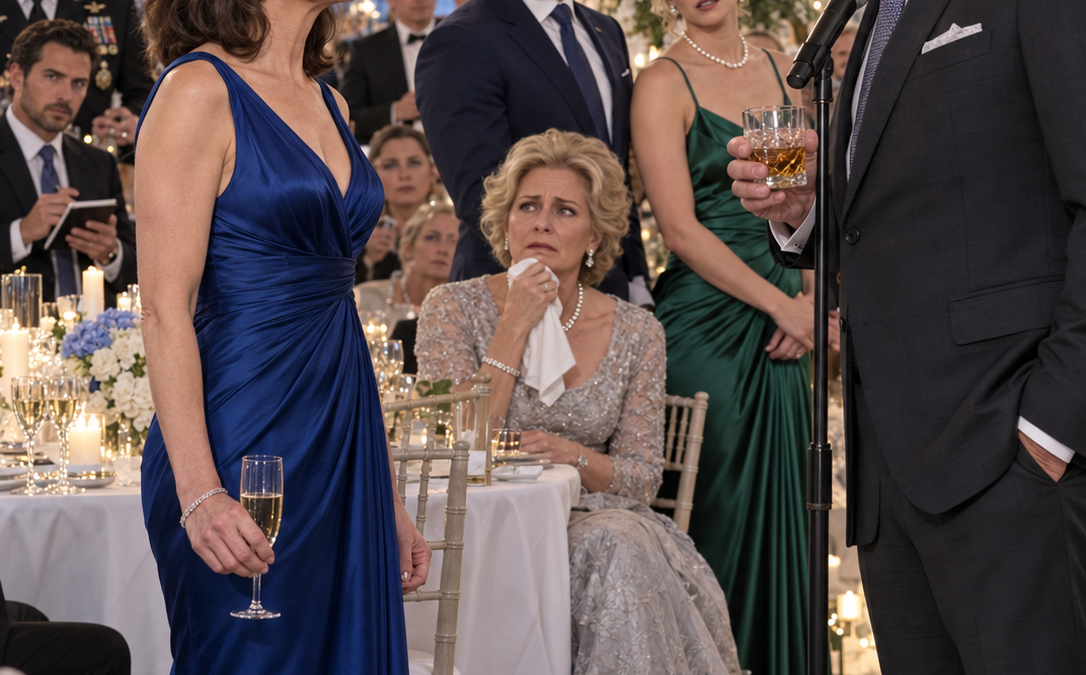
It happened on the evening of my father’s 70th birthday, beneath the glittering gold of crystal chandeliers, surrounded by 300 of the East Coast’s most powerful elites. It was the night Arthur Vance decided to use my life as a public punchline to elevate his own ego.
He didn’t know that the woman he was mocking could ground his entire corporate fleet with a single phone call. He didn’t know that a retired commander who knew my actual clearance was standing in the crowd. And he certainly didn’t know that by midnight, his empire would be permanently fractured.
But to understand the fallout, you first have to understand the silence.
The chandeliers at the Whitmore estate in Southampton threw gold light across 300 glasses of champagne, and somewhere beneath that glittering noise, I stood holding a flute I had no intention of finishing.
It was my father’s 70th birthday, and the entire East Coast elite seemed to have crammed itself onto that lawn overlooking the Atlantic. I remember thinking, right before everything fell apart, that the ocean looked calmer than I felt.
“Ladies and gentlemen.”
Arthur Vance’s voice boomed through the microphone, rich with the practiced warmth of a man who had spent 40 years convincing boardrooms he was likable.
“Tonight, I want to talk about legacy.”
He raised his glass toward my brother first. Harrison straightened his tie, flashing that easy, camera-ready smile he’d perfected since boarding school.
“My son has built more in five years than most men build in a lifetime,” Arthur said. “Harrison, you are the future of Vance Industries, and I could not be prouder.”
The crowd applauded. Harrison mouthed a thank-you, his eyes glistening with something that looked suspiciously like rehearsed humility.
Then my father’s gaze drifted toward me, and I felt my stomach tighten before he even opened his mouth.
“And of course,” he said, chuckling, “there’s Eleanor.”
Three hundred faces turned toward me at once. I kept my spine straight the way I’d trained myself to stand for 30 years, even as my pulse hammered against my throat.
“My daughter,” Arthur continued, swirling his scotch, “has always taken the scenic route in life. While Harrison was closing deals, Eleanor decided the sky was more interesting than the boardroom.”
A ripple of polite laughter moved through the crowd.
“She tells people she’s in the Air Force. What she really means is she’s an honorary flight attendant. Spends her days pouring coffee, keeping schedules, making sure the real pilots have clean uniforms.”
The laughter rose sharper this time, cutting through me like shattered glass. Someone near the bar actually clapped.
I felt my hand tighten around the champagne flute until my knuckles went white. My heart did not break quietly. It cracked loud enough that I was certain everyone could hear it, even though outwardly, I did not move.
Beside Harrison, Catherine Whitfield—Kate, his fiancée—laughed along with the room. Radiant in emerald silk, she tipped her head back, her pearls catching the light. But when her eyes found mine across the lawn, her laughter faltered midbreath.
Something in her chest seemed to drop. Her smile cracked at the edges like porcelain under pressure, and for one unguarded second, I watched genuine shame flutter across her face.
A few feet away, near the raw bar, a man I didn’t recognize stood very still, a notepad tucked half-visible beneath his blazer. His eyes weren’t on my father. They were on me, sharp and calculating, the way a hawk studies something it hasn’t decided to hunt yet.
I would later learn his name was Victor Cole.
Further back, near the edge of the tent, a silver-haired man in a dark suit stood apart from the crowd, his expression unreadable as he watched the entire exchange without laughing along with anyone else. I didn’t know his name yet, either. I would later learn it was General Thomas Holden.
My mother, Vivien, sat at the head table, her fingers curled so tightly around her napkin that her knuckles blanched white. Her eyes welled, bright and glassy, but she did not look up. She stared at the tablecloth as though the embroidered roses there might rewrite the last 30 seconds.
“Four-star general of what, exactly?” someone murmured behind me.
Another round of laughter followed, light and cruel.
My throat burned. For one dangerous second, I wanted to scream every title, every command, every sleepless night I had spent keeping thousands of airmen alive directly into my father’s smug, scotch-fed face. My hands trembled just slightly at my sides.
Instead, I set my champagne flute down on the nearest table with deliberate, controlled precision. The soft clink of crystal against linen was the only sound I allowed myself to make.
“Happy birthday, Dad,” I said, my voice steady despite the storm raging beneath my ribs.
He blinked, clearly expecting more.
“That’s it? No comeback, General?”
I held his gaze for exactly three seconds, long enough for something unreadable to flicker behind his eyes. Confusion, maybe even a flash of doubt.
Then I turned and walked across the lawn, past Kate’s stricken expression, past Victor Cole’s narrowing eyes, past my mother’s trembling shoulders, and out into the cool darkness, where the Atlantic kept crashing against the shore, indifferent to everything that had just been destroyed inside that ballroom.
The Atlantic air stung my face that night, salt and cold wrapping around me like something trying to hold me together. I didn’t cry. I hadn’t cried in front of my father since I was 12 years old, and I wasn’t about to start on his 70th birthday.
But standing there, listening to the waves crash against the rocks below the Whitmore estate, I felt something far older than that ballroom humiliation clawing its way up from my chest.
I thought about the first time I ever saw an airplane up close.
I was 11, and my school had organized a field trip to an aviation museum outside Hartford. While the other kids wandered toward the gift shop, I stood beneath the wing of a retired cargo plane, staring up at the rivets and the sheer, impossible weight of the thing. I felt something settle into my bones that never left.
That night at dinner, I announced to my family that I wanted to fly.
My father didn’t even look up from his newspaper.
“Fly what, Eleanor? Kites?”
Harrison, 14 and already insufferable, snorted into his mashed potatoes.
“She probably means those paper airplanes she keeps folding in her room.”
“I mean real planes, Dad,” I said, my voice smaller than I wanted it to be. “Air Force planes.”
My father finally lowered the paper. His eyes, the same sharp gray as mine, studied me the way he studied a failing stock.
“That’s an adorable phase,” he said. “But let’s be realistic. You’ll grow out of it.”
I did not grow out of it.
By the time I was 17, that adorable phase had become every waking thought in my head. I ran before school in the frozen Connecticut mornings. I memorized flight manuals I checked out from the library three towns over because our local branch didn’t carry them.
And the night I received my acceptance letter to the United States Air Force Academy, my hands shook so violently I nearly tore the envelope in half.
“Mom! Dad!” I screamed through the house, the letter clutched against my chest like something sacred. “I got in! I got into the academy!”
My mother came rushing from the kitchen first, flour still dusting her apron. When she read the letter, her eyes filled instantly with tears.
“Oh, Eleanor,” she whispered, pulling me into her arms so tightly I could feel her heart hammering against mine. “My brave, brave girl.”
But then my father appeared in the doorway, and the warmth in the room curdled instantly.
“Colorado Springs,” he said flatly, reading over my shoulder. “You’re serious about this.”
“I am.”
He set his coffee down with a controlled precision that somehow frightened me more than shouting would have.
“Eleanor, you have options. Real options. You could go to Georgetown. You could work alongside your brother. You could build something that actually matters.”
“This matters to me,” I said, my throat tightening, tears burning behind my eyes, though I refused to let them fall.
“It’s a phase dressed up as a calling,” he snapped. “You want to spend four years taking orders from strangers, sleeping in barracks, ruining your knees, marching in formation—for what? A uniform? A title nobody in this family will ever understand?”
“I don’t need this family to understand it.”
The words came out sharper than I intended, and I watched something flicker across his face. Not hurt, exactly, but something close to it, quickly smothered by pride.
“Fine,” he said, his voice cold as the Connecticut frost outside. “But don’t come crying to me when you realize this isn’t the life you imagined. I will not rescue you from a mistake you walked into with your eyes wide open.”
He left the room.
My mother squeezed my hand, her fingers trembling against mine.
“He doesn’t mean it the way it sounds,” she murmured, though her own eyes were glassy with unshed tears.
“Doesn’t he?”
She didn’t answer that.
Instead, three months later, the night before I left for Colorado, she crept into my room long after midnight, her silhouette barely visible in the doorway. She pressed a small velvet box into my palms, her hands shaking.
Inside was a tiny silver compass, worn smooth with age.
“This belonged to my grandfather,” she whispered, her voice cracking with emotion she rarely let herself show. “He flew cargo planes over the Hump during the war. He always said a compass means nothing until you’re brave enough to actually go somewhere with it.”
Her eyes welled over, tears slipping silently down her cheeks even as she smiled through them.
“Go somewhere, Eleanor. Go further than any of us ever dared.”
I hugged her so tightly my arms ached, memorizing the smell of her perfume and the warmth of her against the cold house that had never quite felt like home.
The next morning, my father shook my hand at the door like I was a business associate closing a disappointing deal. There were no tears in his eyes. There was no softness in his grip.
I drove to Colorado Springs with my mother’s compass tucked into my jacket pocket, and I did not look back.
Colorado Springs nearly broke me before it built me.
I remember my first morning at the academy, standing in formation at five in the morning, my lungs burning in the thin mountain air and upperclassmen screaming inches from my face about the state of my boots. I remember collapsing onto my bunk that night, every muscle in my body trembling, and wondering if my father had been right after all.
But I kept my mother’s compass tucked beneath my pillow, and every morning, I touched it before my boots hit the floor.
By graduation, I had learned something no classroom could have taught me. Leadership wasn’t about being the loudest voice in the room. It was about being the one person a terrified 18-year-old airman could trust when everything around him was falling apart.
My first real assignment took me to Edwards Air Force Base, tucked into the Mojave Desert in California, where the heat shimmered off the runways like something alive.
I was assigned to a logistics unit coordinating strategic airlift operations, moving cargo planes across continents with the kind of precision that left no room for error. It was not glamorous work. It was checklists, manifests, fuel calculations, and endless hours in windowless rooms.
But I learned every bolt and rivet of those massive airlifters, and slowly, the men who had doubted me started asking for my opinion instead of my coffee order.
It was there, three years in, that I met Diana Reyes.
She was a young captain then, sharp-eyed and unflinching, assigned to my unit after transferring in from a fighter wing where she’d been, in her own words, the only woman in a room full of cologne and ego.
We bonded instantly over shared exhaustion and a mutual refusal to be underestimated.
“You ever notice,” Diana said one night, both of us hunched over flight manifests in a break room that smelled permanently of burnt coffee, “how they call men decisive and call us bossy for doing the exact same thing?”
“Every single day,” I said, rubbing my aching eyes.
“They’re going to regret underestimating you, Eleanor. I’ve seen your numbers. You don’t make mistakes.”
“Everyone makes mistakes, Diana.”
“Sure,” she said, a sly grin spreading across her face. “But yours are smaller than theirs, and you actually fix them instead of blaming the nearest lieutenant.”
I laughed—a real laugh, the kind that cracked something loose in my chest after years of holding my spine too straight.
Diana became the family I hadn’t realized I was missing, fierce and loyal in a way my actual family never managed to be.
Over the following years, my responsibilities grew heavier than I ever imagined possible. I moved from coordinating airlift logistics to overseeing an entire wing of airborne early warning and control aircraft, the flying radar stations that tracked threats across oceans before they ever became visible on the ground.
Eventually, I was given command of a bomber wing overseeing some of the most advanced stealth aircraft in the United States arsenal, machines capable of slipping past enemy radar like ghosts.
I held, quite literally, the lives of thousands of airmen in my hands. Every decision I made rippled outward across continents.
And yet, every time I flew home to Connecticut for a holiday, I became invisible again.
My father asked about Harrison’s quarterly earnings before he asked me a single question about my work. My mother would squeeze my hand under the dinner table, a silent apology for a conversation that never came.
I stopped expecting it.
There is a particular kind of grief in releasing a hope you’ve carried your entire life. And I grieved it quietly, somewhere between promotions, somewhere between deployments, somewhere between Diana telling me I deserved better and me insisting I was fine.
The night before my father’s 70th birthday party, Diana called me at my hotel in Manhattan, her voice tighter than usual.
“Eleanor, this is probably nothing,” she said, “but I got a strange message today. Someone claiming to be a financial journalist, asking very specific questions about your service record. Dates, deployments, your current command.”
My stomach tightened.
“Did they say why?”
“No, but Eleanor…” She paused, and I could hear her frowning through the phone. “Whoever this is, they already know more about you than a random reporter should.”
I told her not to worry about it, that reporters sniffed around senior officers all the time, that it was probably nothing.
But as I stood in that hotel room, staring out at the Manhattan skyline glittering against the dark, I felt something cold settle low in my stomach, a feeling I had learned over 20 years of command never to ignore.
I didn’t sleep much that night in Manhattan, and by the time my plane touched down near the Pentagon the following afternoon, my mind was already buried in briefings, operational reports, and a stack of classified folders waiting on my desk.
I tried to push Diana’s warning to the back of my mind. I had bigger responsibilities than one curious reporter.
I had no idea that 300 miles away in Connecticut, my father’s entire world was about to collapse.
I learned what happened next only later, pieced together from my mother’s trembling retelling and Diana’s own investigation.
The morning after the party, Arthur Vance was sitting in his study, nursing a hangover and a lingering sense of triumph, when his phone rang with a name he hadn’t seen in years.
“Thomas,” my father said, surprised, answering on the second ring.
General Thomas Holden, retired commander of United States Strategic Command, had been one of the guests at the party the night before, a quiet, silver-haired man who’d stood near the back during my father’s speech.
“Arthur,” Holden said, his voice clipped and cold in a way that made my father sit up straighter. “We need to talk about what you said last night about your daughter.”
My father laughed, already reaching for his coffee.
“Oh, Eleanor? Come on, Tom. It was a joke. She takes everything far too seriously. Always has.”
“Do you actually know what your daughter does for a living, Arthur?”
“She’s in the Air Force,” my father said, a note of impatience creeping into his voice. “Something administrative, I assume. Scheduling, logistics, that sort of thing.”
There was a long pause on the line, long enough that my father actually pulled the phone away to check if the call had dropped.
“Your daughter,” Holden said slowly, each word landing like a hammer, “is a four-star general. She commands Global Strike Command. She has operational authority over this nation’s strategic bomber fleet and a significant portion of our airborne nuclear deterrent.”
My father’s first instinct, by his own later admission, was flat denial.
“That’s absurd,” he snapped, his hand tightening around his coffee mug. “I would know if my own daughter held that kind of rank. There’s some mistake, Tom. Maybe you’re thinking of someone else.”
“There’s no mistake,” Holden said. “I served alongside officers who trained under her. I’ve read after-action reports with her signature on them. Arthur, I watched you call a four-star general a cook in front of 300 people in Southampton.”
My father’s denial cracked slowly, piece by piece, as Holden continued listing details: her academy class, her early postings at Edwards, her promotion boards. Facts far too specific for any mistake or coincidence.
By the time Holden finished speaking, my father later told my mother, his hands had started shaking so badly he nearly dropped the phone.
“Why wouldn’t she tell me?” he finally asked, his voice hollow.
“Maybe,” Holden said, his tone softening only slightly, “because every time she tried, you weren’t listening.”
The line went dead.
My father sat in that study for nearly an hour, according to my mother, staring at nothing, his face the color of old ash.
Meanwhile, that same afternoon, I was reviewing satellite imagery in my office at the Pentagon when my secure line buzzed. Diana’s name flashed on the screen.
“Eleanor, I did some digging on that reporter,” she said, skipping any pleasantries. “His name is Victor Cole. Financial journalist. Mostly covers defense contracting and aerospace manufacturing. And Eleanor, he’s not just asking about your service record anymore.”
My stomach dropped.
“What else?”
“He’s looking into Vance Industries. Specifically, a bid your father’s company submitted for a components contract tied to the Palmdale manufacturing sector. The kind of contract that technically falls within the broader oversight umbrella of Global Strike Command.”
I set down the folder in my hands very slowly, my fingers suddenly cold.
“Diana, I have had zero involvement in procurement decisions regarding that contract. I didn’t even know my father’s company was bidding on anything connected to our branch.”
“I believe you,” Diana said immediately. “But a reporter digging for a conflict-of-interest story doesn’t care what you knew. He cares what it looks like.”
My heart began pounding against my ribs, loud enough that I could hear it in my own ears. Even the appearance of a conflict, even one I had no knowledge of, could become a story that painted me as something I had spent my entire career refusing to be: someone who used her position for personal or family gain.
“I need to recuse myself from anything even tangentially connected to that contract,” I said, already reaching for my phone. “Immediately. In writing. Today.”
“Already drafting the memo,” Diana said, and I could hear the fierce loyalty in her voice even through the phone. “You didn’t do anything wrong, Eleanor.”
“It doesn’t matter what I did,” I said, my voice tight with a fury I rarely let myself feel. “It matters what it looks like, and I will not let my father’s company put a shadow over 30 years of my career.”
My phone buzzed again before Diana and I had even finished talking.
This time, the screen read a name I hadn’t expected to see for days, if ever again.
Dad.
My thumb hovered over the screen, my chest tightening painfully as the laughter of 300 guests echoed somewhere in the back of my memory.
Then, with my heart hammering, I answered.
“Eleanor,” my father said.
His voice sounded nothing like the man who had humiliated me on that stage. It sounded small, broken, afraid.
The town car dropped me at the corner of 72nd and Fifth after I told the driver to stop. I wanted to walk the last block. I wanted my legs to remember what it felt like to choose something, even something this small, before I walked into a room that had spent 30 years deciding things for me.
My father was sitting in the library when I came in, and he did not look like the man who had mocked me in front of 300 people four nights earlier. His shoulders were curled forward. His hands, folded on his knee, would not stay still.
I watched his fingers tap once, twice, then grip the armrest like he needed something solid to hold.
“Eleanor.”
His voice cracked on the second syllable.
“Tom called me again this afternoon. He told me what you command. He told me what you’re responsible for.”
He swallowed hard.
“I didn’t know. I swear to God, I didn’t know.”
“You didn’t ask,” I said.
My own voice came out steadier than I felt, though my pulse was hammering so hard I could feel it in my throat.
“For 30 years, Dad, you didn’t ask.”
My mother rose from the window seat so fast her teacup rattled against its saucer.
Arthur let her speak.
Vivien’s eyes were wet, shining under the lamplight, and when she looked at me, her chin trembled like she was fighting not to break apart right there.
“I have waited 22 years to hear someone in this house say that out loud.”
Harrison appeared in the doorway then, still in his suit from dinner, his tie loosened. I could tell from his face—pale, jaw tight—that he had been standing on the stairs longer than he wanted to admit.
“I heard,” he said quietly.
For the first time in my memory, my brother would not meet my eyes straight on. His hands were shoved deep in his pockets, and when he pulled one out to rub the back of his neck, I saw it was shaking.
“Ellie, I heard everything. The command, the oversight review, all of it.”
“Then you heard the part that matters,” I said, turning fully toward him, my chest tight with something I didn’t have a clean word for. Not anger anymore. Something closer to grief.
“Vance Industries has a bid in front of a board that answers two levels removed to my command. I won’t let anyone say I protected this family at the expense of my integrity. So, as of this morning, I filed for recusal in writing, effective immediately.”
Arthur’s head snapped up.
“Eleanor, you don’t have to—”
“I do,” I said, and my voice finally broke just slightly on the second word. “Because unlike this family, I don’t get to decide the rules only apply when they’re convenient.”
Kate stepped out from behind Harrison then, her evening dress still creased from the car ride over. For a woman I barely knew, her eyes were glassy with tears she didn’t bother hiding.
“I owe you an apology,” she said, her voice unsteady. “At the party, I laughed. God help me, I laughed when your father said that about you, and I have not been able to sleep since. I’m sorry, Eleanor. I am so sorry.”
I felt my throat tighten, my eyes stinging, but I didn’t let myself cry. Not yet. Not here.
“Thank you,” I said softly, and meant it.
My father stood up slowly, like his knees had forgotten how. He took one step toward me, stopped, then took another.
“I called you an admiral’s assistant to a room full of people,” he said, his voice splintering. “And you commanded nuclear bombers while I called you a flight attendant. I don’t know how to carry that, Eleanor. I don’t know how to fix 30 years in one night.”
“You don’t fix it in one night,” I said.
And this time, I let the tears come, hot and sudden, tracing down my cheek before I could stop them.
“You fix it by showing up tomorrow. And the day after that.”
He reached for my hand. His grip was weak, trembling, nothing like the man who had once shaken hands with senators without blinking.
“Then let me start tomorrow,” he whispered.
I didn’t answer right away. I just let him hold my hand, my own fingers curling around his. Both of us shaking, neither of us ready to let go.
Four months after that night in the library on Fifth Avenue, I stood backstage at the National Security Leadership Forum in Midtown Manhattan, listening to my own introduction echo through a ballroom full of people who, this time, knew exactly who I was.
“Please welcome General Eleanor Vance, commander of Air Force Global Strike Command,” the announcer said.
The applause that followed rose so loud it rattled something loose in my chest.
Diana Reyes found me in the wings before I walked out, her uniform crisp, her eyes bright.
“Four years we worked together, and I still get chills watching you walk into a room like you own it,” she said, squeezing my shoulder. “You earned every bit of this, Ellie.”
“We earned it,” I said, and I meant it.
She had carried half my career on her own shoulders without ever asking for the credit.
When I stepped onto the stage, I found my family in the third row. My father sat with his hands folded tightly in his lap, and when our eyes met, he nodded once, small and deliberate, nothing like the man who used to look through me at dinner tables.
My mother, Vivien, had her hand pressed against her heart, tears already sliding freely down her cheeks, not bothering to hide them anymore.
Harrison sat beside Kate, his fingers laced through hers, and when he caught my eye, he mouthed two words.
“Proud of you.”
After the keynote, a journalist I recognized immediately approached me near the reception tables.
Victor Cole extended his hand, and for the first time since that birthday party, where I’d first noticed him scribbling in his notepad, he looked nervous.
“I owe you an explanation,” he said. “I started investigating your family’s company because I thought I’d found a story about influence and favoritism. What I found instead was a four-star general who recused herself from a federal contract the moment she sensed even the appearance of a conflict, without anyone forcing her to.”
He held up a folded magazine.
“I wrote a different story than the one I set out to write.”
He handed me the piece.
The headline read, “The General Who Chose Integrity Over Family.”
I felt my eyes sting, my throat tightening as I read the closing line he’d written about me.
A woman who had spent 30 years being underestimated by the one man whose approval she never stopped quietly hoping for.
“Thank you,” I said, my voice cracking just slightly, “for telling it honestly.”
Later that night, my father found me alone near the window. The city lights spread out below us like a runway stretching into the dark. His hands were trembling again, the way they had been since the night in the library.
“I used to think strength meant never being questioned,” he said. “You taught me it means being questioned your whole life and still doing the right thing anyway.”
He reached into his jacket pocket and pulled out something small.
The silver compass.
My great-grandfather’s compass, the one my mother had given me the night I left for the academy.
“Your mother told me what this meant to you. I think it’s time you carried it where everyone can see it, not just in a drawer by your bed.”
I took it from his open palm, my fingers closing around the cool metal, and for the first time in my life, I let myself cry in front of him without turning away.
Three years later, the flight line at Barksdale Air Force Base remains my favorite place at dawn.
As the B-2 bombers rest on the tarmac like sleeping leviathans in the early light, I stand in the crisp air, finally feeling a profound, quiet peace I spent most of my life chasing.
My father calls me every Sunday now. His booming, performative monologues have been replaced by the hesitant, gentle questions of an old man learning a new language. He asks about my stress levels and the well-being of my airmen, not my security clearances.
We aren’t magically healed. Thirty years of casual dismissal leaves deep scars, but we are building something real.
Even my brother Harrison now leads Vance Industries with a measured humility he learned the hard way.
As my friend Diana, who now wears her own general stars, told me recently, “You didn’t just survive them, Ellie. You changed them.”
Beneath my uniform, I wear my great-grandfather’s silver compass, a physical reminder of the promise I made as a terrified teenager leaving Connecticut: Go further than any of us ever dared.
For decades, I believed going further meant achieving enough heavy stars until the people who doubted me were forced to look up. I thought validation was the ultimate destination.
I was wrong.
The true altitude of my career wasn’t commanding the nation’s nuclear deterrent. It was reaching the unshakable realization that I no longer needed my father, or anyone else, to validate the airspace I occupied.
Enduring power never needs to announce itself. It is the silent, steady pulse of knowing exactly who you are and keeping your integrity intact.
A young airman walks past and snaps a sharp salute.
“Good morning, General.”
“Good morning,” I reply.
Tracing the hidden compass through my shirt, I walk out onto the flight line, entirely myself.








