At the courthouse door, my dad told security: “She’s just a clerk. Leave her at the public entrance.” They walked in for my brother’s federal swearing-in. I showed my credentials: United States District Judge. The marshal stood: “All rise for the Honorable Claire Shepherd!” My dad’s phone fell out of his hand.
And when the President nominated me to the federal bench, a process that included an FBI background investigation, a Senate Judiciary Committee hearing, and a formal floor vote, Raymond Shepard told his retired officer friends at their monthly breakfast that Clare was still working in the legal field.
Nothing too exciting.
I had never corrected him.
There were professional reasons. Federal judges operate under codes of conduct that had cultivated in me a deep habit of letting the institution speak for itself rather than promoting my own position. My nomination had also included a confidentiality period during vetting when I was advised not to discuss the appointment publicly until after Senate confirmation. I had observed that period, and by the time I was sworn in, I had simply continued the silence out of professional conditioning.
But if I am being honest, and here, looking back, I can be, the real reason was simpler and more uncomfortable.
I wanted to know if he would ever ask.
Eleven years of my professional life. Eleven years of federal courthouses, case files, and oral arguments before circuit panels. Eleven years during which I moved from clerk to prosecutor to judge, during which my name appeared in federal legal databases, during which bar associations published my profile in their quarterly journals and law schools invited me to guest lecture.
All of it publicly accessible. None of it classified.
Raymond Shepard, who had spent thirty years with military clearances I still don’t know the full details of, had never once looked up his own daughter’s name in a public legal database.
He had decided what I was, and that was easier for him than looking at who I actually was.
Nathan’s federal bar admission ceremony was scheduled for a Thursday in November at the courthouse on Golden Gate Avenue. Being admitted to practice before the United States District Court for the Northern District of California is a formal milestone. Attorneys apply, meet the court’s requirements, take an oath, and are formally welcomed into federal practice in a ceremonial session. For new Assistant United States Attorneys, in particular, it carries weight. It is the moment you officially become an officer of the court.
Nathan had just been hired as an AUSA. Raymond treated this as a four-star occasion.
He called me three weeks before the ceremony. He was driving up from Sacramento and knew I was up in the city for work. He asked if there was room for me to join them as a plus-one guest. He had cleared it with Nathan. There was a space available in the public gallery.
I said yes.
What Raymond had not bothered to find out, what eleven years of incuriosity had kept perfectly hidden from him, was that the Northern District ceremonial admission sessions were presided over by a sitting judge on a rotating assignment.
That month, the rotation was mine. I was the presiding judicial officer for Nathan’s ceremony.
I had known this for six weeks. I had reviewed the session protocol, confirmed the attorney roster, and cleared my calendar. I did not mention any of this to Raymond.
The morning of the ceremony, I came downstairs in the dark charcoal wool suit I wear on formal hearing days. Structured, precise, the kind of clothing that reads clearly to anyone paying attention and is merely plain to anyone who isn’t.
Over it, I put on the long navy wool coat I’d bought in Boston during my clerkship years. Heavy and entirely unremarkable-looking. The kind of coat that says commuter, not judge.
Raymond was already in the driveway in his silver SUV, wearing his best blazer and the small American flag pin he reserved for occasions he considered distinguished. Nathan was in the passenger seat in a new suit, his admission paperwork in a leather portfolio balanced on his knees.
I got in the back.
The drive from Sacramento runs about two hours on I-80, through the coastal hills and down toward the bay. The morning was overcast, the flat gray light of a Northern California November that makes San Francisco look colder and quieter than it is. I watched the fog sitting low on the water as we crossed the Bay Bridge.
Raymond talked for most of the drive.
He had spent the previous three weeks, it emerged, conducting what I can only describe as a coordinated reputation campaign on Nathan’s behalf. He had called former colleagues at the Pentagon. He had emailed officers from his old unit who now worked in federal consulting roles around the Bay Area. He had arranged a lunch after the ceremony with board members from two veteran advocacy organizations that occasionally collaborated with the U.S. Attorney’s Office.
Raymond had effectively turned his son’s bar admission into a networking operation, and he was managing it with the focused energy of someone running logistics for a field exercise.
“U.S. Attorney Peterson is going to be there,” Raymond said, catching my eyes in the rearview mirror somewhere near Fairfield. “Tom Peterson. I was in contact with his chief of staff last year. Good man. Peterson knows Nathan is coming in. He’s aware of the family.”
I looked out the window at the hills.
“You should really make an effort to be unobtrusive today,” Raymond continued.
His tone shifted into something instructional, the voice he used when he was preparing to say something he considered helpful.
“These ceremonies have senior officials, federal judges, career attorneys. The kind of professionals Nathan is going to be working with for the rest of his career. There’s a certain caliber of person in that room, and a desk position at a nonprofit is perfectly respectable, Clare. But it’s not the same tier. So just let Nathan have the day. Stay in the background.”
Nathan said nothing from the front seat. He was on his phone, reviewing something on the screen. He didn’t look up.
I rested my fingers against the small leather credential holder in my inside coat pocket and watched California move past the window.
The federal courthouse on Golden Gate Avenue is a nineteen-story building with a marble lobby, courthouse security that is thorough and unhurried, and a side entrance reserved for judges, senior court officers, and authorized judicial staff.
The two entrances serve clearly different populations. The judicial entrance connects directly to the private elevator banks and the ceremonial courtroom suites on the upper floors.
Raymond pulled into the reserved judicial parking area because Nathan’s AUSA paperwork included a vehicle authorization. Raymond used it without apparent hesitation. He was good at using authorizations that technically belonged to someone else.
At the glass doors of the judicial entrance, a uniformed federal security officer stepped forward. He was a large man with the careful, practiced stillness of someone trained to read people in seconds.
“Good morning,” Raymond said, holding out Nathan’s admission documentation with the easy confidence of a man who had walked through official entrances his entire adult life. “Colonel Raymond Shepard, retired. My son Shepard is being admitted to the federal bar this morning. We’re guests of the U.S. Attorney’s Office.”
The officer ran the paperwork through his scanner.
“Nathan Shepard. Yes, sir. You’re both on the authorized guest list.”
He held the door.
Raymond walked through with Nathan beside him. Then the officer’s eyes moved to me.
“And this is?”
Raymond glanced back.
The look on his face was the one I had seen my entire life. A faint, reflexive diminishment, the expression of someone noting a minor footnote.
“My daughter,” he said. “She came along to observe. She’s not on any official list. She works at a legal services office, general staff. She can use the public entrance on McAllister. That’s fine. She doesn’t need access in here.”
Nathan adjusted the strap of his portfolio bag. He did not turn around.
The officer looked at me steadily.
“Ma’am, if you’re not listed as an authorized guest, I’ll need to direct you to the public entrance. The general gallery has open seating.”
“Of course,” I said.
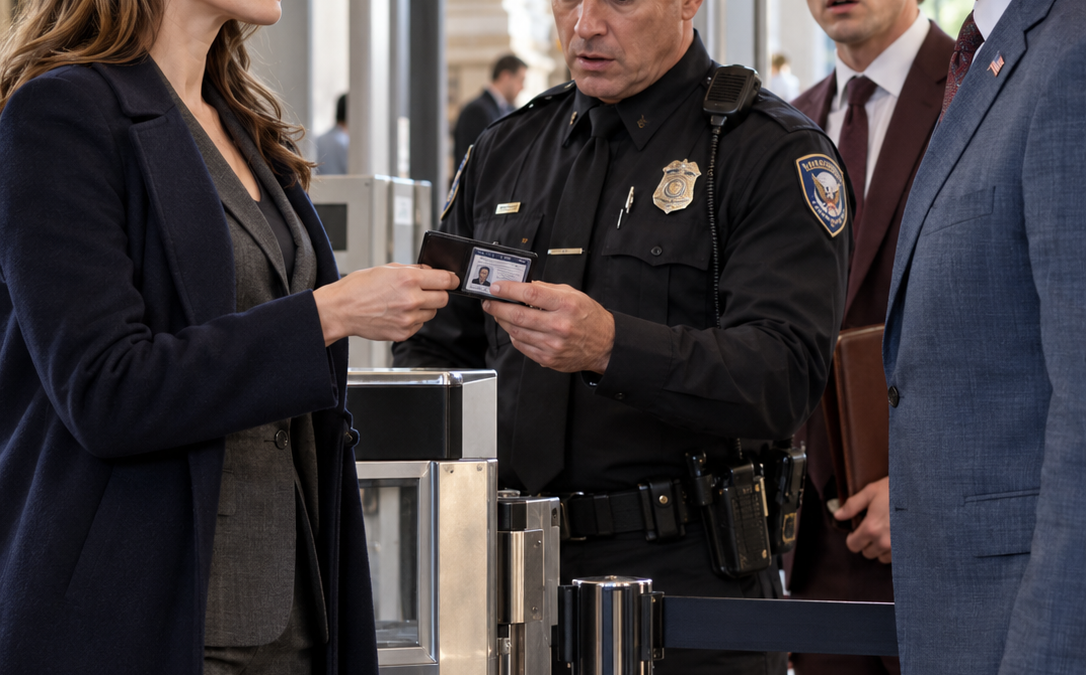
I reached into the inside pocket of my navy coat.
I removed my credentials, a government-issued federal judicial ID card bearing the seal of the United States District Court for the Northern District of California, my photograph, my full name, and my title in clean, official type.
I placed it in his palm.
The officer took it the way security officers take ID cards, with practiced efficiency, not expectation.
His expression held its professional neutrality for exactly three seconds.
Then he looked up at me, back at the card, and finally at his terminal.
He swiped it.
The screen did not simply process my identity. A clear, distinct priority chime sounded, the kind that activates only for judicial officers and senior court officials with restricted-access clearance.
The terminal display shifted to a solid federal-blue field with the court’s seal and a single line of text.
United States District Judge. Judicial Officer. Unrestricted Court Access.
The officer straightened completely. Every degree of relaxed posture resolved instantly into something formal.
“Your Honor.”
His voice had changed entirely.
“I sincerely apologize. Please allow me to escort you to the judicial officer entrance.”
He spoke into his radio in a brief, low exchange.
Two additional court security officers appeared from an interior corridor within seconds and moved quietly into position on either side of me.
Raymond had turned at the sound of the chime.
He was standing six feet past the security threshold, his blazer straight, his flag pin in place, looking at me with an expression I had never seen on his face in thirty-six years.
His mouth was slightly open.
Nathan was beside him, his admission portfolio held in both hands, very still, recalibrating something in real time.
I unbuttoned my navy coat. I slid it off my shoulders and folded it over my left arm.
Beneath it, my charcoal suit was precisely what it had always been: the attire of someone who appears in federal courtrooms professionally and regularly.
The small judicial officer’s lapel pin caught the lobby’s fluorescent light for a moment.
“Thank you,” I said to the security officer, in the same tone I use when a clerk tells me the courtroom is ready.
I walked with the escort toward the judicial corridor.
I did not look back at Raymond.
The ceremonial courtroom on the fourteenth floor is a formal space. Dark wood paneling, the federal seal mounted above the bench, gallery seating with polished oak rails, and a bench elevated precisely enough above the courtroom floor that the judge’s position says, without any additional ornament, exactly who holds authority in that room.
By the time the marshal opened the session, approximately ninety people filled the space. New admittees sat in rows of padded chairs facing the bench, their sponsors and families arranged in the gallery behind the bar.
U.S. Attorney Thomas Peterson was in the front row of the gallery, flanked by two senior supervisors. Chief Judge Sandra Merritt of the Northern District was present as an invited observer.
She did not preside today.
This session was mine.
Raymond had made his way to the third row of the gallery. His guest authorization remained valid. The security officer had not revoked it, and I had not asked him to.
Raymond was sitting with his blazer straight, his flag pin visible. The veteran advocacy board member he’d arranged lunch with was seated beside him.
I was later told that Raymond had been mid-sentence, telling a story about Nathan’s time at Georgetown Law, when the marshal spoke.
The heavy ceremonial doors at the rear of the courtroom swung open.
“All rise.”
Ninety people stood.
“The Honorable Clare Shepard, United States District Court Judge for the Northern District of California.”
I walked through the doors.
I have done this hundreds of times. The cadence is always the same. Through the door, down the center aisle, up to the bench. The room holds itself until you are seated.
I learned in my first month on the bench that the most important thing a judge does when entering a courtroom is move at exactly the speed of someone who belongs there completely.
Because you do.
I moved at that speed.
In my peripheral vision, I registered the moment Raymond understood.
He had been mid-sentence. I know this from what Chief Judge Merritt told me afterward, because she could see his face clearly from where she sat.
The instant the marshal announced my name, Raymond stopped speaking. His neighbor apparently said something in response to whatever story Raymond had been telling.
Raymond did not answer.
His head turned toward the center aisle. He watched me walk to the bench. He watched me sit. He watched ninety people settle back into their chairs in a single, unified motion.
I adjusted the microphone.
“Good morning,” I said. “We are here today to formally admit a distinguished group of attorneys to practice before the United States District Court for the Northern District of California. Admission to this court is both a privilege and a professional responsibility, and I am honored to preside over this ceremony.”
I worked through the session by the book.
I administered the oath of admission to the full group. Nathan took it standing in his row alongside eleven other new admittees, right hand raised, eyes forward.
I spoke about the ethical obligations of federal practice, the standards the Northern District holds its officers to, and the weight of public trust that comes with appearing before a federal bench.
I did not look at Nathan differently from any other person standing in that courtroom.
After the oath, I invited U.S. Attorney Peterson to address the room.
He came to the podium, a trim, measured man in a charcoal suit, and began his remarks.
“Judge Shepard,” he said with a brief, genuine nod toward the bench, “thank you for presiding today. I’ve had the privilege of appearing before you on two significant matters in the past eighteen months, and there is no one I would rather see welcoming our newest AUSAs to federal service.”
Behind me and to the left, in the third row of the gallery, I later learned that Raymond Shepard reached for the armrest of his chair.
The session concluded forty minutes after it opened.
I signed the admission documents at the bench, thanked the marshal and the courtroom clerk, and descended.
I had taken perhaps a dozen steps toward the side corridor when I heard my father’s voice behind me.
“Clare.”
I stopped and turned around slowly.
Raymond was standing at the edge of the judicial well, the restricted area in front of the bar rail. A court security officer was already moving toward him with a raised hand.
I lifted two fingers slightly, and the officer held his position.
Raymond looked different from the man who had been in the driver’s seat four hours ago. His blazer seemed too large on his frame. The flag pin on his lapel looked small against the backdrop of the federal seal on the courtroom wall behind him.
“I didn’t know,” he said.
His voice had no volume left in it.
“Clare, I had no idea. Any of this.”
He stopped. Then he began again.
“Why didn’t you tell me? If you had just explained what you were doing, I would have been proud of you. I would have supported this. We’re family. A father deserves to know these things about his daughter.”
I looked at him steadily.
I had spent eleven years composing the answer to this question in quiet moments. In the silence of my office after the last clerk had gone home. In the space between the end of a long hearing and the beginning of sleep.
I had turned it over the way you turn over a complicated piece of evidence, looking at it from every angle until you know it exactly.
“You didn’t need to know my title to treat me with basic respect,” I said. “You had eleven years to ask what I was doing. You never asked once.”
He opened his mouth, then closed it.
“This morning, you told a federal security officer that I work an administrative job and belong in the public gallery. Not because you had any evidence that was true, but because you decided eleven years ago what I was capable of, and it was easier to hold on to that than to look at what was actually in front of you.”
“Clare, I—”
“You drove three hours to be in the front row for Nathan’s ceremony,” I said. “That’s a good instinct. Hold on to it. Just apply it with your eyes open next time.”
Nathan appeared at Raymond’s shoulder.
He had his admission certificate in one hand, rolled carefully, and his face had a quality I had not seen from him since we were very young.
A genuine quiet, unperformed and without calculation.
He wasn’t managing the room. He was simply in it.
He looked at me for a long moment.
“Congratulations, Your Honor,” he said.
He meant it. That was clear.
And because it was clear, I accepted it.
Raymond inhaled slowly. It was the breath of someone absorbing something too large to process quickly.
“I am proud of you,” he said finally. “Whatever you think of me right now, I need you to know that I am proud of you.”
I considered that honestly.
I thought about the backyard party with the catered buffet. I thought about the card that arrived in the mail after Harvard. I thought about eleven years of holiday dinners where Raymond explained my career to relatives as something too modest to elaborate on.
“Pride is easy once the room already knows,” I said quietly. “It costs nothing at that point.”
I pulled my navy coat back over my shoulders and gave him a small, final nod. The nod of someone who has said what needed to be said and is finished.
U.S. Attorney Peterson caught me near the corridor entrance.
He shook my hand with the easy warmth of a professional peer, asked about the schedule for a complex financial fraud case coming to my courtroom in January, and mentioned that Nathan’s first week of onboarding had already produced solid preliminary research on a pending matter.
He said this without any awareness that he was saying it for Raymond’s benefit.
He was simply talking to me as he always did, judge to prosecutor, colleague to colleague.
Raymond was standing six feet away.
I don’t know what it was like for him, watching his son’s boss speak to his daughter that way. Not with deference, not with condescension, but with the straightforward professional ease that only exists between people who consider each other peers.
I don’t know if it confirmed something for him or simply cracked open something he’d been keeping shut for a long time.
What I know is that he was quiet for the rest of the afternoon.
Nathan walked me to the courthouse garage elevator when it was time to leave.
“I didn’t know the details,” he said when we were alone in the corridor.
His voice was low and even.
“I knew you were doing something in law. I didn’t push past that.”
He paused.
“I should have.”
“You should have,” I agreed.
I said it without anger because there wasn’t much left.
“But you can start now.”
He nodded.
He wasn’t making excuses. I appreciated that more than any apology he could have offered.
“Are you okay?” he asked.
I thought about it the way I think about things from the bench. Not with the first answer, but with the one that’s actually true once the reflexive ones have been set aside.
“Yes,” I said. “Today was a good day for the court.”
He almost smiled.
“It was a good day for you.”
“For the court,” I said again.
And I meant it.
Because the part of the afternoon that mattered most to me wasn’t the look on Raymond’s face in the gallery. It was the forty minutes I had spent at that bench administering an oath to people choosing to dedicate their professional lives to federal public service.
That is the work. That is what I get to do.
The rest was weather.
Two weeks after the ceremony, Nathan submitted a formal development plan to his supervisor at the U.S. Attorney’s Office, outlining his intent to build his caseload through complex financial litigation rather than pursuing the high-visibility assignment he had originally lobbied for.
His supervisors approved it.
He sent me a brief email with no commentary, no explanation, just a note that he’d made the shift and why.
I replied with two words.
“Good start.”
Raymond called on a Sunday in December.
He didn’t have a stated reason for calling, or if he did, he abandoned it somewhere in the first thirty seconds.
He asked about my caseload in a general way. He asked if the drive from my apartment to the courthouse was manageable in winter traffic. He asked if I needed anything.
I told him the caseload was what it was, the commute was fine, and I didn’t need anything.
Then I asked how his veteran advocacy work was going, and he told me.
We talked for forty minutes in a way we had never quite managed before.
Not because everything between us was repaired. Not because eleven years of diminishment had been undone by one afternoon in a federal courtroom. But because something small and real had shifted.
He was talking to me carefully, the way you talk to someone when you’ve just understood that you didn’t know them as well as you were certain you did.
It wasn’t everything. I will not pretend it was.
But it was the first honest conversation we’d had in over a decade.
And I have found in the years since that honest conversations compound. They build on each other the way good precedent builds slowly, case by case, until a body of law exists where before there was only assumption.
There is something that happens in a courtroom when the marshal calls for order and everyone rises.
It happens every session, twice a day on days I hold hearings.
The gallery stands. The parties stand. The attorneys stand.
It is procedural, embedded in the formal ritual of the institution, not a personal tribute to me as an individual.
I know this. I have always known this.
But I thought about it on the drive home along I-80 that November evening, navigating north through the gray light with my navy coat folded on the passenger seat and my credentials back in their leather holder in my bag.
All those years of Raymond building his picture of me.
A daughter somewhere in an office, capable of administrative work. Not someone the important rooms should bother with. Not someone the kind of people he admired would ever stand for.
He was so certain of it that it never occurred to him to look underneath it.
He was so busy deciding what I was that he never noticed what I was becoming.
That is the thing about real authority, about the kind that is earned in courtrooms and case files and the slow accumulation of trust and competence over years.
It does not announce itself at family dinners.
It does not insist on being recognized at the holidays or correct the record at every gathering where someone gets the story wrong.
It moves through the world without requiring validation from anyone who has decided in advance not to see it.
And when the moment comes, when the doors open and the marshal calls and the room rises, it simply walks to the bench and begins.
I have been doing that for two years.
I will do it again tomorrow.
The work does not wait for anyone to catch up, and it does not stop when they do.








