At my sister’s engagement dinner, my sister looked at Grandma’s old dress and laughed: “You both look cheap. Please leave before my friends notice.” Mom nodded. Dad opened the door. Grandma had raised me since they abandoned me at three. I took her hand: “Come on, Grandma. Let’s leave them with what they actually paid for.” My sister’s smile vanished. Then three guests stood up at once…
My name is Anne Bender. I’m thirty-two.
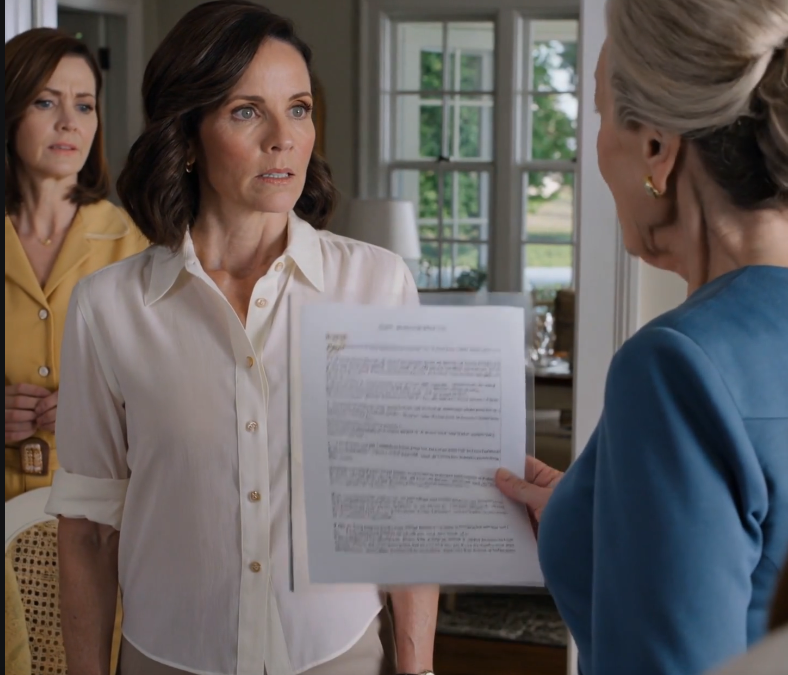
At my sister’s engagement dinner, she looked at my grandmother’s old blue dress and laughed.
“You both look cheap. Please leave before my friends notice. They’ll think this is where I come from.”
My mother nodded. My father opened the door. The last time he’d opened one for me, I was three, and he was walking out.
They left me with Grandma. She raised me. She didn’t argue that night, either. She just stood.
I took her hand. “Come on, Grandma. Let’s leave them with what they actually paid for.”
My sister stopped smiling. My mother’s face went white.
We were four steps from the door when the first chair scraped back. Then the second. Then the third.
For twenty-nine years, they had told the room who belonged there.
That night, the room answered back.
If you’re settling in for this one, tell me where you’re listening from. I read every note.
The first time I saw that ring, it was two inches wide on my phone screen behind the counter of the Cudahy post office. It was the day after Christmas.
The day after Christmas is the worst day of the year at a post office window. Everyone is returning something: sweaters in the wrong size, a blender nobody asked for, a box of frozen steaks that should never have been mailed in the first place.
By eleven, the line was out the door. By one, I had eaten half a granola bar standing up in the back room beside a cart of undeliverable packages. That was when I opened Instagram and saw my sister.
Whitney is my younger sister. She’s twenty-eight.
We share two parents and almost nothing else. We don’t call each other. We don’t text except on birthdays, and even then, the messages are always about the same length, as if we agreed on a word limit a long time ago and never mentioned it.
She had posted a photograph on Christmas morning. Her left hand rested on a man’s shoulder, a Christmas tree blurred behind them, and on her finger was a ring.
The caption said, “He proposed on Christmas Eve with my great-grandmother’s ring. Some things are meant to stay in the family.” Then a red heart.
I zoomed in.
A small round stone. An old six-prong setting, worn a little flatter on one side, the way metal gets after it’s been knocked against a kitchen counter a few thousand times.
It bothered me. I couldn’t say why.
I looked at it the way you look at a face in the grocery store that you’re sure you’ve seen somewhere. You can’t place it, and you go home with the feeling stuck to you like lint.
Under her name, Whitney’s bio read: Realtor. Former ballerina. North Shore.
I closed the app. My thumb stayed on the screen a second too long.
I live on the second floor of a duplex in Bay View, on the south side of Milwaukee. It’s the kind of house people here call a Polish flat.
My grandmother bought it in 1972 with my grandfather, and she has lived downstairs ever since. I’ve rented the upstairs from her since 2018.
Six hundred fifty dollars a month. She won’t take more, and she won’t take less. I’ve tried both.
Her name is Rosemary Walsh. Everyone calls her Rosie. She’s eighty-three.
She worked the register at Lake View Foods for thirty years, and she still counts change back into your palm as if a store manager is watching. She hums when she washes dishes. She does the Sunday crossword in pen.
She numbers things in pencil.
Recipe cards. Coupons. The backs of photographs.
If you give her a birthday card, there will be a small number written on the back of the envelope by the end of the day, and you will never know what it means.
Her left hand has no rings on it. It hasn’t for as long as I can remember. But on her ring finger, there’s a pale band of skin, a little lighter than the rest, like a shadow that forgot to leave.
On the mantel in her living room, there was a photograph from June of 1964. My grandfather was in his Navy dress whites. My grandmother stood beside him, twenty-one years old, laughing at something outside the frame.
Her left hand rested on his arm.
There was a ring on it.
When I was four, I asked her where that ring went. She told me she’d lost it in the garden.
I believed her for twenty-eight years.
Out in the shed, behind the snow shovel, there’s a small garden trowel with a red plastic handle. It’s mine. I hadn’t touched it in a long time.
On January tenth, Whitney texted me.
Engagement dinner. Feb. 7. 7:00 p.m. The Lakeshore Room. Spencer insists on meeting Grandma. Business formal.
Four minutes later, a second message came through.
Also, please make sure Grandma dresses appropriately. The Hales are very traditional.
I read both messages out loud at Grandma’s kitchen table.
She didn’t say anything. She got up, went to her bedroom, and came back with a garment bag I had seen maybe twice in my life.
Inside was a dress the color of deep water: cobalt-blue wool crepe, fitted at the waist, with three covered buttons at each wrist.
It was her going-away dress.
In 1964, a bride changed out of her wedding gown before she left the reception, and this was what my grandmother had changed into.
She had worn it one other time that I knew of. On my first day of kindergarten, in September of 1999, she walked me to the school door in that dress.
Near the hem, there’s a faint purple mark.
Grape juice.
I was five, and I hugged her with the cup still in my hand.
“Appropriate,” Grandma said, smoothing the skirt flat with her palm.
She didn’t say whose.
On February fifth, two days before the dinner, my mother called her.
I was coming down the back stairs with a basket of laundry when I heard Grandma say, “Hello, Kathleen,” in the voice she uses for telemarketers.
My mother had not called that house in months.
I heard only Grandma’s half of the conversation. Something about ice. Something about the steps at the restaurant, and her age, and how long the night would be.
“My knees have been to worse parties than yours, Kathleen,” Grandma said.
Then she hung up.
She didn’t look at the phone afterward. She looked at the photograph on the mantel.
My mother had never once worried about Grandma’s knees, so I wondered what she was really worried about.
The Lakeshore Room is the kind of restaurant where someone takes your coat before you’ve finished taking it off.
On the night of February seventh, it had snowed all afternoon, and the parking lot was a sheet of gray slush. Grandma held my arm across it.
She had left her cane in the car.
“Canes make people talk to you like you’re a houseplant,” she says.
The private dining room had four round tables, white linen, and a wall of windows facing the lake, which at that hour was just black glass.
Thirty-two place cards.
Ours were at the table nearest the kitchen door. Every time a server came through, the door swung open and let out a breath of heat and garlic butter.
“Good seats,” Grandma said. “We’ll get the bread first.”
Across the room, my sister stood beside a tall man in a navy suit.
Spencer Hale.
He had a kind, slightly nervous face—the face of someone who reads all the instructions before he assembles the furniture.
Near them were his parents, Doug and Ellen, and a very straight-backed older woman with white hair pinned up in a twist.
My parents were working the room.
My mother, Kathleen, wore champagne silk and went around touching elbows and laughing half a second early at every joke. My father, Glenn, held a drink he wasn’t drinking.
Ten minutes after we sat down, my aunt Colleen came in with snow on her shoulders.
She’s my mother’s younger sister. She lives in Madison, eighty miles west, and I-94 had been bad all day.
She dropped into the chair beside Grandma. Grandma kissed her cheek.
Then Colleen leaned toward me.
“Does Kathleen know Mom came?” she asked quietly.
Before I could ask what she meant, the white-haired woman at the Hale table put down her fork and stared at Grandma.
When the salad plates were cleared, I went to the small bar in the corner to get Grandma a club soda with lime.
My mother was standing there with a silver-haired man in a gray suit. He’d been introduced earlier as Victor Lindfist, a jeweler in Cedarburg and an old friend of the Hales.
Whitney had called him the man who made the ring fit.
“Your grandmother Ruth’s ring, you said?” he was asking my mother. “From before the war?”
“Yes,” my mother said quickly. “Ruth and James. Before the war.”
Victor turned his glass of sparkling water a quarter turn on the bar, the way you might adjust a stone beneath a loupe.
His forehead creased just slightly.
Then my mother saw me, and her smile came back on like a porch light.
“Anne. You made it.”
I didn’t know anyone named Ruth.
I didn’t think much about it.
Not then.
When I got back to our table, the white-haired woman was still watching Grandma. Grandma was humming under her breath the way she does when she’s nervous and pretending not to be.
The woman’s hand went slowly to her own throat.
After dessert, my sister started making her way around the tables.
It’s something people do at these dinners. You stop at each table. You thank everyone for coming. You let them see the ring.
Whitney had two friends with her, both blonde, both in black, both holding their phones like tiny purses.
My mother followed one step behind.
Spencer was across the room with his father.
Ours was the last table.
Whitney stopped behind my chair and rested her left hand on the back of it.
“Hi,” she said to the table in general. “Thanks for coming.”
The ring was a hand’s width from Grandma’s face.
Grandma looked at it.
Then her right hand moved to her left, and her thumb found the pale band of skin on her ring finger, the way your tongue finds a missing tooth.
She leaned toward me. Her voice was barely there.
“Annie. That’s Jim’s ring.”
I looked at the six prongs, at the one side worn flatter than the rest.
I thought of the photograph on the mantel and the young hand resting on my grandfather’s sleeve, and I knew she was right in the same way you know your own handwriting.
Grandma didn’t get up.
She just held out her hand, palm up, the way she used to when I was little and had a splinter.
“May I see it, dear?”
Whitney pulled her hand off my chair as if the chair were hot.
Her friends were watching.
Her eyes went from Grandma’s open hand to Grandma’s dress—the cobalt blue, the covered buttons, the faint mark near the hem—and she laughed.
Not loudly.
The kind of laugh that’s meant to sound like it slipped out by accident.
“You both look cheap,” she said. “Please leave before my friends notice. They’ll think this is where I come from.”
Her friends had already noticed.
One of them studied the tablecloth. The other studied her phone.
My mother was standing right behind Whitney. She nodded—not slowly, not as if she were thinking something over, but fast, as if she had been waiting for someone to say it.
My father set his glass down on the nearest table, crossed the room, and opened the door.
It was a heavy door with a brass handle.
He held it the way a doorman would, arm out, eyes fixed somewhere above our heads.
Grandma didn’t argue.
She reached for her purse.
That was worse.
She stood. I stood with her and held her cardigan open so she could get her arms into it.
Then I took her hand.
It was shaking.
Not a lot.
Enough.
“Come on, Grandma,” I said. “Let’s leave them with what they actually paid for.”
I didn’t plan to look at the ring when I said it.
I did anyway, just for a second.
My mother’s face went white.
Not pale. White, as if something had been drained out of it.
She reached for Whitney’s wrist and pulled her hand below the edge of the table, out of sight.
Whitney looked at me.
Then she followed my eyes down to her own hand.
Her smile went away.
I don’t think she knew why yet. I think she only knew that her mother was afraid, and she had never seen that before.
We were four steps from the door when the first chair scraped back.
It was the white-haired woman from the Hale table.
She was on her feet, one hand on the back of her chair.
“Rosie Walsh,” she said. Her voice carried. “You sang in that dress at the Great Lakes dinner in 1965.”
Then the second chair.
Victor Lindfist, the jeweler, his napkin still in his hand.
“Kathleen,” he said, not unkindly. “You told me that ring was from before the war. It’s engraved June 1964.”
Then the third.
My aunt Colleen, at our own table, standing so fast her water glass tipped over and rolled.
“Kathleen.”
She didn’t raise her voice.
“Does Anne know about the envelopes?”
Nobody at the other tables moved.
A server stood in the kitchen doorway holding a coffee pot and didn’t come in.
My mother recovered first.
She always does.
“My mother gets confused,” she told the room with a small, sad smile, like someone apologizing for the weather.
Grandma looked across the room at the white-haired woman.
Something passed over her face that I had never seen before.
It looked like being twenty-two.
“Sit down, Franny,” she said gently. “It’s their night.”
And then we left.
My father was still holding the door.
I had no idea what envelopes Colleen meant.
Grandma did.
I felt it in her hand.
Outside, the cold hit like a slap. I got Grandma into the passenger seat of my Corolla and was scraping the windshield when I heard footsteps crunching behind me.
It was Spencer.
No coat. His breath came out in white clouds.
“Mrs. Walsh,” he said. “I’m sorry. I’m so sorry about what happened in there.”
He glanced at me, then back at her through the open door.
“Can I ask you something? The ring. Was it yours?”
Grandma looked up at him for a long moment.
I think she was deciding whether he deserved the truth or just a polite answer.
“It was mine,” she said.
“What it is now, you’ll have to ask your fiancée’s mother.”
He stood there holding his car keys, though he wasn’t going anywhere.
Then he nodded once and walked back toward the restaurant.
He didn’t look like a man going back to a party.
We took I-794 south over the Hoan Bridge.
The lake was on our left, black and enormous.
Grandma unclipped her earrings, the pearl clip-ons she has worn to every wedding and funeral since the Carter administration, and held them in her palm.
They clicked together every time the tires hit a seam in the bridge.
For a long time, she didn’t say anything.
Then she did.
“I gave it to her,” she said.
I kept my eyes on the road.
“February of ’97. Your father’s roofing business went under that winter. They lost the house in Brookfield. Your mother was four months along with Whitney. They needed a deposit for an apartment, and I didn’t have it. Not in cash.”
She turned the earrings over in her palm.
“So I took off my ring and gave it to her to sell. I told her to get the apartment, get on her feet, and come back for you.”
“By when?”
“Memorial Day. She said, ‘Memorial Day, tops.’ I remember because she said it like it was a joke.”
“And you thought she sold it.”
“She told me she got nine hundred dollars for it at a pawn shop on Greenfield Avenue,” Grandma said. “I had no reason not to believe her.”
The earrings clicked together.
She didn’t say anything about envelopes.
I noticed she didn’t.
By the next morning, my mother had written a new version of the night.
There’s a group chat on my mother’s side of the family. Cousins. A few second cousins. An uncle in Arizona who only posts pictures of his tomatoes.
I’m in it because nobody ever took me out.
Before eight in the morning, my mother posted a long message.
Last night, Mom had a hard moment. She gave me that ring years ago so Whitney could have it someday. Victor misunderstood. I said it was Whitney’s grandmother’s ring. Now Mom’s confused and thinks it was taken. Anne encouraged it. We’re heartbroken.
Three broken-heart emojis.
I read it twice.
The second time, I saw what she had done.
The grandmother named Ruth was gone. The ring from before the war was gone.
Overnight, my mother had stopped lying about whose ring it was and started lying about why she had it.
Whitney posted an Instagram story that afternoon.
A candle. A blanket. A mug of tea.
Some people can’t stand to watch you be happy.
On Monday, a woman from Grandma’s church called to ask very gently how Grandma’s memory had been lately.
By Wednesday, two cousins had texted me to say they were praying for us. One of them sent a link to an article about early signs of dementia.
At work, I sold stamps and weighed packages and told a man that no, he could not mail a lithium battery to his nephew in Tucson.
I was very calm.
I’m always calm at the window.
It’s the rest of the day I have trouble with.
I understood the plan by then.
If Grandma was confused, nothing she remembered would count.
On Thursday night, I asked her.
We were at her kitchen table with the radio off, which is how I knew she was listening.
“Grandma, what did Aunt Colleen mean? What envelopes?”
She folded the dish towel in thirds and set it on the counter.
“Some things I paid for so you’d never have to carry them,” she said.
“That’s not an answer.”
“It’s the one I’ve got.”
Later, when I came down to say good night, her bedroom closet was open.
She was on her tiptoes—which she’s not supposed to do with her knee—pushing something farther back on the top shelf.
A blue tin.
The kind Danish butter cookies come in, with a painting of a church on the lid.
I knew that tin from when I was a kid. She called it her button tin, and I was never, ever allowed to touch it.
She had used that word.
Paid.
I’d used it first at the restaurant.
I just hadn’t known what I was saying.
My first memory is snow.
I was three. I know that because it was February of 1997, a few weeks after my birthday, and there’s a photograph of me from that birthday wearing a paper crown.
In the memory, I’m standing on Grandma’s front porch in a puffy pink coat.
There’s a silver sedan at the curb packed so full of cardboard boxes that the back window is just brown.
My father is standing beside the driver’s door with his hand on top of it.
I remember his glove.
Brown leather.
I remember that he didn’t take it off to hug me because he didn’t hug me.
He just opened the door and got in.
My mother was already in the passenger seat. She rolled her window down a few inches.
“Just till we’re on our feet, Mom,” she called. “Memorial Day, tops.”
Memorial Day came.
Then the Fourth of July.
That summer, my sister was born.
I met her on Christmas Eve.
She was five months old and wearing a red velvet dress, and my mother held her the whole time we were there.
When I was four and asked about the ring, and Grandma told me she’d lost it in the garden, I decided I would find it.
It became a thing between us.
On certain days, Grandma would come to the back door and hold out the red-handled trowel.
“Go dig for Grandma’s ring, sweetheart. Today feels lucky.”
Those days didn’t come often. Maybe six times over the years, always when it was warm enough to dig.
The first one I remember clearly was in April of 2001.
I was seven.
I dug along the back fence for what felt like hours, and I found a rusted bottle cap.
I carried it inside in both hands like it was a diamond.
Grandma turned it over in her fingers and said it was the best treasure anybody had ever found in that yard.
I kept it in my plastic jewelry box for years.
What I remember about those days, besides the digging, are the small things.
The sound of a car idling out front. A car door.
Through the kitchen window, a woman’s voice I couldn’t make out.
Once I asked who it was, and Grandma said it was a lady from church collecting for something.
I never found the ring.
I stopped looking when I was twelve.
But I never stopped wondering why she only sent me outside on certain days.
When I was nine, a girl in my class started ballet, and I wanted to go, too.
I asked Grandma at dinner.
She put her fork down and was quiet a second too long.
“Not this year, sweetheart,” she said.
Then she got up, turned on the cream-colored radio that sat on top of the refrigerator, and taught me to waltz on the kitchen linoleum.
She counted under her breath.
“One, two, three. One, two, three.”
Her slippers whispered across the floor.
We did that a lot after that.
I never did take ballet.
In the spring of 2008, when I was fourteen, my mother invited us to Whitney’s dance recital.
Whitney was ten.
She was a snowflake, and she was very good.
We sat in the back row because we got there late, because Grandma had worked until four.
Afterward, in the lobby, my mother introduced us to another mother holding a bouquet of grocery-store roses.
“This is my mother,” she said. “And this is…”
A pause.
A very small one.
“Mom’s girl.”
I thought not this year meant we were poor.
I was half right.
On February seventeenth, a letter came for Grandma.
Real paper. Real ink. A return address in River Hills.
I work at a post office, so I notice things I don’t need to notice.
A North Shore postmark. A proper first-class stamp, not a printed label. Handwriting that leaned hard to the right like it was walking into the wind.
Grandma read it at the kitchen table.
Then she read it again.
Then she went to the phone.
“Franny,” she said. “It’s Rosie.”
That Saturday, she asked me to drive her to a diner on Oklahoma Avenue.
She didn’t ask whether I thought it was a good idea. She told me what time to have the car warm.
Frances Hale was already in a booth when we arrived.
Up close, she was small and fierce, with the same straight back I had seen across the restaurant.
They talked for two hours.
I mostly listened.
In the sixties, Frances and her husband Walter had been stationed at Great Lakes with my grandparents. The two young wives had lived in the same drafty apartment building in North Chicago, sharing a clothesline and a coffee pot.
When my grandparents married in Milwaukee, Frances was one of the bridesmaids.
“I still have the pictures,” she said. “Every one of them.”
Then her face changed.
“Rosie. Kathleen told Ellen you’re not well. She said your mind is going.”
Grandma stirred her coffee.
“What do you think?”
“I think you seem perfectly well to me,” Frances said. “You still can’t hit that high note.”
And right there in the booth, over two cups of decaf, the two of them started humming an old Patsy Cline song badly and laughing so hard that the waitress stopped refilling our water and just stood there smiling.
If you have a grandmother who still hums the songs she loved at twenty, give this a like for her.
Mine would pretend not to care.
She’d care.
When we got up to leave, Frances held Grandma’s coat for her.
Then she asked a question softly, as if she’d been holding it all morning.
“Rosie, did Jim’s ring ever come home?”
Grandma looked at me.
She didn’t answer.
A week later, on the last Saturday in February, I came home from a half shift and found my mother’s white SUV parked in front of the house.
She was coming down the front steps as I came up.
Camel coat. Leather gloves. The kind of perfume that arrives before you do.
“Anne,” she said. “I was just checking on Mom.”
On the kitchen table was a glossy brochure for a place called Heritage Meadows Senior Living.
On the cover, a woman with perfect white hair was laughing at a watercolor painting of a sailboat.
Stuck to the brochure was a yellow sticky note in my mother’s handwriting.
Memory consult. May 20. 10:00 a.m. I made the appointment for you.
“You made her an appointment?”
“With a neurologist. The waitlists are months long, Anne. Someone in this family has to be realistic.”
She adjusted her glove.
“You can’t see it because you’re with her every day.”
She had kissed Grandma’s cheek on her way out.
I’d seen it through the window.
Grandma didn’t kiss her back.
The next morning, I came downstairs with Grandma’s pills and stopped in the middle of the living room.
On the mantel, where the wedding photograph had stood for as long as I’d been alive, there was a clean rectangle in the dust.
Everything around it had a soft gray film.
Inside the rectangle, the wood was bright.
“Grandma, where’s the picture?”
She was in her chair with the crossword.
She didn’t look up.
“Your mother took it. She said she’d have it restored. A wedding gift for Whitney.”
“Restored?”
“She’s never restored anything in her life,” Grandma said.
Then she put down her pen and looked at the empty space for a long time.
That photograph was the only thing in the world besides her own memory that showed that ring on her hand.
And her memory had just become a medical question.
“I need a week to think, Annie,” she said finally. “Don’t ask me anything until then.”
I didn’t.
It was the longest week of my life.
I went to work. I sold stamps. I told a woman her passport photo couldn’t have a smile in it.
Every evening, I came home and looked at the rectangle on the mantel.
And every evening, Grandma watched me look at it.
The following Saturday, I came downstairs at nine, and the blue tin was on the kitchen table.
Grandma was sitting behind it with her hands folded.
She had put on lipstick.
I don’t know why that’s the detail I remember most.
“You read everybody else’s paper for a living,” she said. “Read mine.”
I opened the lid.
There were no buttons.
There were stubs.
Dozens and dozens of them.
Thin paper slips. The customer receipts that come with a U.S. Postal Service money order.
I’ve handed thousands of them across my counter. I know exactly what they look like new.
These were soft with age, rubber-banded in bundles by year.
Every one had the same amount printed on it.
$200.
And on the back of every one, in soft pencil, in Grandma’s round handwriting, there was a number, a month, and a letter.
Number one. April 2001. K.
Number two. May 2001. K.
All the way down.
I didn’t need to ask who K was.
I’m not a detective.
I’m a window clerk.
But a window clerk knows how to read a receipt.
The first stub had been issued in ZIP code 53207, Bay View, at the post office six blocks from our house.
Every one after it came from the same office, once a month for almost eleven years.
The last one was number 130.
January 2012.
The month I turned eighteen.
Underneath the bundles, stuck flat to the bottom of the tin, was a yellow sticky note.
The glue had died years ago.
I recognized the handwriting before I read the words because I had seen the same loops a week earlier on a note about a memory consult.
Make them out to me, not Glenn. PO Box 318.
I know what a P.O. box means.
I rent them.
People get one for a small business, or because they move a lot, or because they want their mail to go somewhere nobody else in the house will see it.
One hundred thirty times two hundred dollars.
Twenty-six thousand dollars.
I did the math without meaning to.
It’s a habit.
The first stub was dated April 2001.
I was seven.
I remembered April 2001.
Some of the stubs had a small star drawn beside the month.
I went through them and counted six, all in spring or summer.
I laid those six out in a row on the table.
Then I looked at Grandma.
“These are the days,” I said. “The lucky days.”
She didn’t pretend not to understand.
“Those were the days she came,” she said. “The other months I mailed them. Those months, she drove down and picked it up herself. Usually because she wanted to remind me.”
“Remind you of what?”
Grandma looked at her hands.
“That I didn’t have any papers on you, Annie. Just a notarized letter so I could sign you up for school and take you to the doctor. That was all. You were theirs. They could have come and gotten you any afternoon they wanted.”
She took a breath.
“In April of 2001, your mother sat right where you’re sitting. She told me Glenn had been promoted, and they had a bigger place now, and they were ready to take you home.”
“And then?”
“And then she said, ‘Unless.’”
“Unless what?”
“Unless I paid her two hundred a month for your expenses.”
Grandma said the word as if it tasted bad.
“I couldn’t afford a lawyer, and I couldn’t afford to find out whether she meant it. So I paid.”
I thought about a seven-year-old with a red-handled trowel digging along a fence while an engine idled out front.
“You sent me outside,” I said.
“I didn’t want you to hear your mother put a price on you.”
My hands were flat on the table.
I don’t remember putting them there.
“Did she ever ask for me?” I said. “Even once? To actually take me?”
“No.”
Grandma looked at me.
“She never once asked for you. She only asked for money.”
Money Grandma could find.
For seven years, she had worked every Sunday shift at Lake View Foods.
After she retired, she ironed shirts for two neighbors at two dollars a shirt.
I had always thought she just liked to keep busy.
After she went to lie down, I sat with the tin for a long time.
I counted the stubs again because counting is what I do when I don’t know what else to do.
One hundred twenty-nine.
I counted a third time.
One hundred twenty-nine.
I went through the numbers in order.
Number 126. September 2011.
Then 128. November 2011.
In between, where number 127 should have been, there was a small index card folded in half.
On it, in pencil, was a single letter.
C.
October 2011.
That was the month Grandma had her left knee replaced. She’d been in St. Luke’s for four days.
At the restaurant, I had told my family to keep what they had paid for.
I thought I was talking about a dinner.
I thought I was talking about a ring.
They hadn’t paid for anything.
They had been paid.
I didn’t cry.
Not then.
I took out my phone and photographed every stub, front and back.
All 129 of them, plus the sticky note and the index card.
It took almost an hour.
Then I put everything back in the tin exactly the way she’d packed it and set it on the shelf where it belonged.
Then I called Madison.
“Colleen,” I said. “Who has number 127?”
On the other end, there was a long silence.
The next Saturday, I drove the eighty miles to Madison.
Colleen lives in a small yellow house on the east side with a dog named Biscuit and too many plants.
She had coffee ready.
Neither of us drank it.
She went to her bookshelf, took down an old Bible with a cracked spine, and opened it near the back.
Tucked inside was a single money-order stub.
$200.
Bay View.
October 2011.
The number on the back wasn’t in Grandma’s round pencil.
It was in Colleen’s handwriting, slanted and quick.
Number 127. October 2011.
“Mom was in the hospital,” Colleen said. “She called me from her bed and asked me to drive in, go to the post office on Kinnickinnic, buy a two-hundred-dollar money order, and mail it to a P.O. box. She wouldn’t say why. She said, ‘Just do it, Colleen. It’s important.’”
“And you saw the name.”
“I filled it out myself. I saw the name.”
She shook her head.
“When Mom got home, I asked her. She told me everything. I didn’t sleep for a week.”
“Thanksgiving,” I said.
I was remembering Thanksgiving of 2011.
That was the last one Colleen had spent in the same room as my mother.
“I waited until the dishes,” she said. “I got her alone in the kitchen, and I asked her how she could take money from Mom for her own child. You know what she said?”
I waited.
“She said Mom offered. ‘Mom always pays for what she wants.’”
Colleen’s mouth twisted.
“Then she went back out and served the pie.”
Biscuit put his head on my knee.
I scratched behind his ears because I didn’t know what else to do with my hands.
“She always wanted that ring, you know,” Colleen said quietly. “When we were girls, she used to try it on when Mom was in the shower. She’d stand in front of the bathroom mirror, turning her hand back and forth.”
“Why didn’t you tell me?” I said. “All these years?”
She looked down the same way Grandma had.
“Because Mom made me swear. She said you’d grown up thinking you were wanted, and she wasn’t going to let anybody hand you a bill for it. She said, ‘It’s paid, Colleen. It’s over. Leave it alone.’”
On the drive home, I counted again in my head.
One hundred thirty.
Every one of them was accounted for now.
Except the ones nobody wrote down.
On March thirtieth, my mother texted me for the first time in two years.
Easter brunch at noon. Let’s fix this before it goes any further. Just you. Mom doesn’t need the stress.
Just you was on a line by itself.
I showed it to Grandma.
She read it twice.
Then she went to the bedroom, came back with the tin, and took out a single stub.
Number one.
April 2001.
She pressed it into my palm and closed my fingers around it.
“Only this,” she said. “Don’t give her the whole store.”
My parents’ house is a two-story Colonial with black shutters and a red front door.
It’s thirty-five minutes from Bay View.
I’ve been inside it maybe twenty times in my life, almost always at Christmas.
The front hallway is lined with photographs.
I had never really looked at them before.
That day, I counted nine frames.
Whitney at five in a pink leotard.
Whitney at eight in a tutu.
Whitney at ten as a snowflake.
Whitney at thirteen en pointe, arms in a perfect circle above her head.
Nine years of ballet climbing the wall toward the stairs.
There were no pictures of me in the hallway.
I didn’t expect any.
I noticed anyway.
Brunch was ham, a spinach quiche, and a ceramic basket of painted eggs in the middle of the table.
My father carved.
Whitney sat across from me, very straight, her left hand in her lap.
Spencer sat beside her.
He looked as if he hadn’t slept well in weeks.
My mother waited until the coffee.
“We want to move past this,” she said. “All of us. Whitney wants you in the wedding, Anne. As a bridesmaid.”
Whitney didn’t look like she wanted that, but she didn’t say otherwise.
“All you’d have to do,” my mother went on, “is talk to Ellen and Doug. Just explain that Mom’s been confused lately, that things got mixed up. They’d hear it better from you.”
So that was the price.
I reached into my coat pocket, took out the stub, and set it on the tablecloth beside the basket of eggs.
A small slip of thin paper.
$200.
Bay View.
April 2001.
My mother looked at it.
For a fraction of a second, something moved behind her face.
Then it was gone.
“Mom bought a money order,” she said lightly. “So?”
Whitney frowned at it as if it were a word in another language.
My father didn’t frown.
He was staring at the amount printed in the corner.
Two hundred.
He didn’t blink.
It was Spencer who spoke.
“Two hundred dollars for what?”
It was a simple question.
An engineer’s question.
Nobody at that table answered it.
“Ask her what it bought,” I said.
Then I stood up.
My father stood, too, but he didn’t move toward the door.
He followed me outside.
I was unlocking my car when he caught up.
He put his hand on top of my driver’s door the same way he had in 1997, on a different door in different weather.
It wasn’t snowing this time.
It was April.
The forsythia along the driveway was just beginning to turn yellow.
“Two hundred,” he said quietly. “Every month?”
I looked at him.
He looked older than sixty.
He looked like a man who had just heard a number he recognized.
“Every month,” I said. “For almost eleven years.”
He didn’t say anything else.
He took his hand off the door, but he didn’t walk away, either.
When I backed out of the driveway, he was still standing there in his Easter sweater with his hands at his sides.
For the first time in my life, my father was the one who looked left behind.
He texted me on Thursday.
Can we talk? Just us.
Saturday, we met at a frozen-custard stand on Layton Avenue because it was the only place either of us could think of that didn’t belong to one of us.
It was forty-eight degrees and windy.
He bought two vanilla cones.
I didn’t want one.
I took it anyway.
We sat in his car with the heater running.
“I have to ask you something first,” he said. “The ring. Your mother told me it was her grandmother’s. Ruth. I believed her. I never once saw your grandmother wear a ring. I didn’t know.”
“I believe you,” I said.
And I did.
He turned the cone in his hand. The custard was running down onto his wrist, and he didn’t notice.
“Your mother did bookkeeping,” he said. “That’s what she told me. For a church in Brookfield. A few hours a week. Paid in cash. Two hundred a month.”
He swallowed.
“She used it for Whitney’s ballet. The tuition was just about exactly that.”
Whitney started when she was five, in the fall of 2002.
“Your mother paid it every month out of her own money, and she never let me touch it. She said it was the one thing she wanted to give Whitney herself.”
I didn’t say anything.
I couldn’t.
“Whitney quit in the winter of 2012,” he said. “She was fourteen. Your mother said the church job had ended, and we couldn’t swing it anymore. Whitney cried for a month. I thought about covering it. I didn’t. We were stretched.”
He finally looked at me.
“The church job ended the same month you turned eighteen. Didn’t it?”
“January,” I said.
He set the cone down in the cup holder.
“For almost ten years,” he said, “I thanked her for paying for Whitney’s ballet herself.”
I thought about a nine-year-old at a kitchen table asking for ballet and hearing, Not this year.
I thought about a cream-colored radio on top of a refrigerator.
One, two, three.
Grandma’s money hadn’t only kept me in Bay View.
It had put my sister on a stage.
He said he’d think about what to do.
I’d heard my father say that before, in 1997.
The next morning, I told Grandma.
She listened without interrupting.
When I got to the part about the ballet, she closed her eyes.
“I wondered,” she said. “I never knew, but I wondered.”
“Whitney doesn’t know,” I said. “She has no idea. If I tell her, it’ll wreck her. The thing she’s proudest of in her whole life.”
I stopped.
“It’s not her fault.”
Grandma opened her eyes.
“You don’t owe her the truth, Annie,” she said. “But she might.”
I didn’t know what to do with that.
I still don’t know if there was a right answer.
If the person who hurt your grandmother had never known the truth either, would you tell her anyway?
I’d really like to hear what you’d do.
I went back and forth on it for days.
In the end, my mother made the decision for me.
By then, she had figured out that the stub on her Easter table wasn’t the only one, so she did what she always does.
She told her story first.
That Tuesday, she called Ellen Hale.
On Thursday, Frances called Grandma and told her everything Ellen had heard.
According to my mother, I had been quietly taking control of Grandma’s money for years.
I was on her checking account. I lived in her house for next to nothing. I had cut her off from her real family, and now I was coaching her to accuse her own daughter of theft.
Every piece of it had a grain of truth in it.
That was what made it work.
I’ve been a joint owner on Grandma’s checking account since 2019 because her hands got too stiff to write checks, and she wanted me to pay the gas bill online.
My rent is six hundred fifty dollars a month, and a flat like mine in Bay View goes for about eleven hundred.
Grandma set that price.
Twice, I tried to pay more.
Twice, she tore up the check.
None of that mattered to a story.
That Friday night, Whitney texted me.
If you keep doing this to Mom, you will never be my sister again.
I read the last word three times.
Again.
As if I had ever gotten to be one.
On April twenty-fifth, my mother came back to Bay View.
This time, she brought a pen.
I was upstairs when I heard her car.
By the time I got down, she was sitting at Grandma’s kitchen table with a single typed page in a clear plastic sleeve.
“I just want this cleared up,” she said to me, very reasonably. “For everyone’s sake. For Whitney’s.”
Grandma slid the page out of its sleeve, put on her reading glasses, and read it aloud slowly.
“I, Rosemary Walsh, gave my wedding ring to my daughter Kathleen in February 1997, of my own free will.”
She read it again to herself.
Then she picked up my mother’s pen and signed it.
“Grandma.”
She didn’t look at me.
She handed the page back.
My mother blew gently on the ink the way you’d cool soup for a child, then slid the page into the sleeve.
“Thank you, Mom,” she said.
I think she meant it.
She looked relieved.
She hugged Grandma on her way out, and Grandma let her.
When the car turned the corner, I said, “Why?”
Grandma took off her reading glasses and folded them.
“I only signed what’s true,” she said. “She forgot to ask me what it was for.”
She watched the empty street for a moment.
“Now she’ll read it out loud.”
Two days later, Frances called.
The Hales have a lake house on Pewaukee Lake, about forty minutes west of us, and every year Frances hosts Mother’s Day brunch there.
Her son and daughter-in-law. Her grandson.
And this year, her grandson’s fiancée and her family.
“I want you there, Rosie,” Frances said.
I could hear her through the phone from across the kitchen.
“My house. My guest list.”
Grandma said yes before I could open my mouth.
Two days after that, she did something I didn’t know she’d been planning.
She called her doctor’s office and moved up her Medicare wellness visit, the free annual checkup that includes a short memory screening.
I drove her.
I sat in the waiting room with a two-year-old magazine about kitchen islands.
When she came out, she handed me a printout without a word.
28 out of 30.
“What did you miss?” I asked.
“The date,” she said. “I’m retired.”
That night, she took the cobalt dress out of its garment bag, laid it across her bed, and sat down with a needle and thread to fix a place in the hem that had started to come loose.
Her fingers are too stiff for small stitches now.
It took her almost an hour.
When she tied off the thread, she held the dress up to the lamp.
“There,” she said. “I’ll need the blue one.”
Pewaukee Lake on the second Sunday in May is still cold, but the sun comes off the water so hard it makes you squint.
The Hale lake house is long and gray with white trim, a wraparound porch, and a flagpole in the side yard.
Cars were lined up on the gravel.
About two dozen people.
We parked at the end.
I came around to help Grandma out, and she said, “I’ve got it,” then got herself out with one hand on the doorframe.
She was wearing the cobalt dress beneath her good spring coat, with her pearl clip-ons and her lipstick.
Before we reached the porch steps, the front door opened.
It was Frances.
She came down the steps herself, one careful stair at a time, and took Grandma’s arm.
“Welcome, Rosie,” she said. “Front door always.”
Inside, a long dining room opened onto the lake.
There was a buffet along the sideboard, a sheet cake that said HAPPY MOTHER’S DAY in pink script, and a table by the window for gifts.
On that table, propped on a small wooden easel, was a framed piece of calligraphy.
Gold ink on cream paper in an oak frame.
Three generations, one ring.
I didn’t have to ask who had ordered it.
Across the room, Whitney saw the blue dress and went pale.
My mother saw it, too.
She smiled.
She thought she had already won.
She waited until everyone had a mimosa.
Then she tapped a spoon against her glass and stood by the window, with the lake behind her like a backdrop.
“I just want to say a few words,” she said. “Since it’s Mother’s Day, and since there’s been some confusion lately.”
People got quiet.
Ellen Hale folded her hands.
Doug looked at his shoes.
Spencer, beside Whitney, went very still.
“This ring,” my mother said, gesturing toward Whitney’s hand, “has passed through three generations of mothers. My mother, me, and now my daughter. I know there have been rumors. I don’t want to embarrass anyone, so I’m just going to read this.”
She slid the page out of its plastic sleeve.
“‘I, Rosemary Walsh, gave my wedding ring to my daughter Kathleen in February 1997, of my own free will.’”
She lowered the page.
“Signed. My mother gave me this ring freely. I kept it safe for my daughter. That’s all this ever was.”
It was very good.
I’ll give her that.
There was even a small catch in her voice at the end.
A few people nodded.
Somebody murmured, “Oh, Kathleen.”
Grandma set down her coffee cup and stood without her cane.
“Every word of that is true,” she said.
My mother blinked.
She had expected agreement.
“I didn’t write that page,” Grandma went on. “But I signed it because it’s true. I gave you that ring. I gave it to you to sell so you could put down a deposit on an apartment. And you promised to come back for Anne by Memorial Day.”
She paused.
“That was twenty-nine Memorial Days ago.”
The room shifted.
I felt it more than I heard it.
A chair creaked.
Somebody set a glass down.
My mother turned toward the room with a gentle, pained look.
“Mom,” she said. “You know you’ve been getting confused. We’ve talked about this.”
“I took the test, Kathleen,” Grandma said. “At my doctor’s office. Twenty-eight out of thirty.”
She tilted her head.
“I only missed the date. I’m retired.”
A laugh escaped from somewhere near the buffet and was quickly swallowed.
My mother turned to me.
“She says whatever Anne tells her to say.”
I had the tin in my tote bag.
I took it out and set it on the gift table, right beside the oak frame.
I didn’t give a speech.
I opened the lid, took out the first stub, and read it the way I would read it at my window.
“53207. Bay View. April 2001. Two hundred dollars.”
I set it down.
“There are one hundred thirty of these. One every month until I turned eighteen.”
“Anyone can buy money orders,” my mother said.
“I know,” I said. “I sell them. Nobody buys one hundred thirty by accident.”
Then I took out the yellow sticky note, the one whose glue had died years ago, and laid it flat beside the stub.
I stepped back.
I didn’t read it aloud.
I didn’t need to.
Ellen Hale was standing closest.
She leaned over, read it, and straightened slowly.
Doug leaned over after her.
Then Spencer.
Make them out to me. Not Glenn. PO Box 318.
Whitney hadn’t moved.
She was looking at the tin as if it might bite her.
“Please,” she said to me, almost a whisper. “Please don’t do this in front of everyone.”
“They already noticed, Whit,” I said.
Frances had been sitting at the head of the table the whole time.
Now she stood, went to the sideboard, and came back with a large manila envelope.
She slid out a black-and-white photograph and set it beside the tin.
A wedding party outside a brick church on the south side of Milwaukee.
June twentieth, 1964.
A young sailor in dress whites.
A bride laughing.
Five bridesmaids in a row.
Then Frances laid down a second photograph from later the same day.
The bride was on the church steps, out of her gown now, waving goodbye.
She was wearing a fitted dress with three covered buttons at each wrist.
There was a ring on her left hand.
It was the same dress.
It was standing right there in the room.
“You told my family this ring came from before the war,” Frances said to my mother. “I was at that wedding, Kathleen.”
She touched the first photograph with one finger.
“Third from the left.”
Victor Lindfist, standing by the window, said just one thing.
“Before the war, you said. I asked you twice.”
My mother’s composure cracked just along the edges.
She set her glass down too hard.
“Fine,” she said. “Fine. Mom helped us. Mothers help daughters. That’s what mothers do.”
Then the front door opened.
It was my father.
He had told my mother he would drive separately.
He came in without taking off his jacket.
Under his arm was a silver picture frame wrapped loosely in a dish towel.
He walked to the gift table, unwrapped it, and set it beside Frances’s photographs.
It was the wedding picture from Grandma’s mantel.
There were fingerprints on the glass.
“It was in the back of your closet, Kath,” he said. “Behind the Christmas wrapping paper.”
My mother opened her mouth.
Nothing came out.
My father looked at the stub.
Then at the sticky note with his own name on it.
“Church bookkeeping,” he said. “For almost ten years, I thanked you for paying for Whitney’s ballet.”
Nobody said anything.
Across the table, Whitney slowly looked down at her own feet as if she were checking that they were still there.
Then she looked at me.
“Did you ever dance?” she asked.
Her voice was small.
She sounded about nine.
“In the kitchen,” I said.
She closed her eyes for a second.
When she opened them, she looked at Grandma in the blue dress.
“I told my friends,” she said. “At the dinner, I said I didn’t want them to see where I come from.”
Grandma’s face softened.
“Now they have, sweetheart,” she said. “It’s not so bad.”
Whitney took hold of the ring and pulled.
It stuck at the knuckle.
It had been sized down to fit her, and the room was warm, and it wouldn’t come.
She twisted it hard enough to leave a red mark.
Spencer reached over quietly and held her wrist steady.
She worked the ring off.
Then she walked around the table and put it in Grandma’s palm.
Grandma tried to slide it on.
It stopped at her knuckle, too, the joint thick with arthritis.
So she simply closed her hand around it and held it against her chest.
Two bare left hands side by side.
One bare for twenty-nine years.
One for about ten seconds.
My mother said the only thing she had left.
“Then what did I ever pay for?”
I looked at the gift table.
The tin.
The stubs.
The photographs.
The silver frame with her fingerprints on the glass.
And the oak frame on its little easel.
Gold ink.
Three generations, one ring.
“The frame, Mom,” I said. “You can keep the frame. You paid for that one.”
The room went silent.
Grandma put the ring in her coat pocket and buttoned the flap over it.
I closed the tin.
Frances squeezed Grandma’s arm and let her go.
We walked toward the front door.
Before we got there, my father stepped ahead of us, opened it, and held it.
Not the way he had held the door at the restaurant.
He stood off to the side.
This time, he looked at us.
Grandma paused on the threshold.
“Thank you, Glenn,” she said. “You’re getting better at doors.”
Nobody followed us out.
Nobody needed to.
What happened after that wasn’t dramatic.
It was just true.
And it kept on being true.
Spencer and Whitney postponed the wedding they had been planning.
They didn’t break up.
They started seeing a counselor together.
Frances told Grandma that Spencer had said he would buy Whitney a ring himself when they were both ready, and that it would come with a receipt.
Ellen Hale wrote Grandma a letter.
Handwritten.
She apologized for believing what she’d been told without ever asking.
Grandma read it once and put it in the drawer with her good scissors, which is where she keeps things she respects.
My mother stepped down from the women’s club where she and Ellen had served on the same luncheon committee.
She told people she wanted more time for family.
My father moved into the guest room.
He asked my mother to see a counselor with him.
As far as I know, she hasn’t said yes.
He texts me sometimes.
Short messages.
A photograph of the forsythia.
Once, just: Thinking about you.
I answer most of them.
My mother sent Grandma one text the day after Mother’s Day.
I hope you’re happy.
Grandma doesn’t text.
She had me buy her a postcard, a picture of the Hoan Bridge at sunset, and she wrote four words on the back in her round handwriting.
I put the stamp on it myself.
Not happy, Kathleen. Finished.
Then she called the number on the yellow sticky note and canceled her memory consult.
She did it from the kitchen phone, loud enough for me to hear from the stairs.
As for me, I stopped answering my mother.
Not out of anger.
I just ran out of things to say to someone who once charged my grandmother for me by the month.
I left the door open for my father and for my sister.
On my terms.
Slowly.
If you were raised by someone who never had to raise you and chose to anyway, stay with me for the last part.
This part is for them.
A few days after the brunch, Grandma held her left hand out over the kitchen table and looked at it for a long time.
“I want it on my hand, Annie,” she said. “Not in a tin.”
On the Saturday after Mother’s Day, I drove her to Cedarburg.
Victor Lindfist’s shop is on the main street, in an old limestone building with a brass bell over the door.
He came out from the back as soon as he saw us, drying his hands on a soft cloth.
He measured Grandma’s finger over the swollen knuckle twice and wrote the size on an index card.
Then he disappeared into the back.
We waited in two velvet chairs, and Grandma told him through the doorway about the time my grandfather tried to fix a leaky faucet and flooded the entire downstairs.
Twenty minutes later, Victor came out and slipped the ring over her knuckle.
It went on.
It settled into the place it had lived for more than thirty years before she took it off.
The pale band of skin disappeared beneath it as if it had only been waiting.
I took out my wallet.
Victor held up his hand.
“Spencer paid me eighty-five dollars to make it fit the wrong hand,” he said. “Somebody has already paid for this ring more than once.”
When we got home, there was an envelope in Grandma’s mailbox.
No stamp.
No postmark.
Hand-delivered.
I work at a post office.
I notice these things.
Inside was a folded program from a spring dance recital in 2008, with a paper snowflake on the cover.
There was a money order for two hundred dollars.
And there was a note in handwriting I didn’t know well yet.
You were in the back row.
I know where I come from now.
I don’t know how to be your granddaughter yet.
W.
Grandma read it twice.
Then she took a pencil from the jar by the phone, turned the money order over, and wrote on the back in her round, careful hand.
She opened the blue tin and laid it on top of the others.
“You’re not going to cash it,” I said.
“I’ll never cash it,” she said.
“That’s not what it’s for.”
The next weekend was Memorial Day weekend in Wisconsin.
That’s when you finally get to plant.
The ground is soft enough. The last frost is usually behind you. Everybody on our block is outside with flats of petunias and bags of mulch.
That Sunday morning, Grandma put on the cobalt dress.
Not for anyone.
Just because.
She turned on the cream-colored radio on top of the refrigerator and held out her hands.
And we waltzed on the kitchen linoleum, slowly because of her knee.
She counted under her breath.
“One, two, three. One, two, three.”
The ring caught the light every time we turned.
Then I went out to the shed, moved the snow shovel, and took down the trowel with the red plastic handle.
I had bought a rosebush at the garden center on Howell Avenue.
A climbing rose.
Pale pink.
I carried it to the back fence, to the spot where a seven-year-old had once dug for hours and found a bottle cap.
I dug the hole.
I wasn’t looking for anything this time.
I set the roots in, filled the soil back around them, and knelt there with dirt on my knees and the sun on the back of my neck.
Grandma came to the kitchen window and pushed it open a few inches.
“Today feels lucky,” she said.
I pressed the soil down with both hands.
Behind me, through the kitchen window, I could hear her humming.
And every few notes, I heard her ring tap against the glass.








