At 2:47 AM, I was the only one who could stop a $94,000-an-hour collapse. Then my boss tapped my shoulder.
Clifford arrived at Meridian two years before the crisis, elevated from a competing firm as the new vice president of technology operations. He was 40 years old, polished in the way that only someone who had spent 20 years in sales management rather than engineering could be polished.
Clifford wore slim-cut charcoal suits to server room walkthroughs. He scheduled meetings with vendor sales representatives at upscale steakhouses and submitted those meals to the company expense account as strategic infrastructure planning sessions. He spoke fluently about digital transformation roadmaps and cloud-native architecture. But if you sat him down in front of a live command-line interface and handed him a blinking cursor, he would stare at it the way a golden retriever stares at a ceiling fan.
The first time I understood what I was dealing with, I was standing at a whiteboard in the main engineering bullpen, explaining a multilayer failover architecture I had designed to protect CRM during high-volume holiday shipping surges.
Clifford walked in, nodded along for about four minutes, then interrupted me in front of my entire team to announce that we would be modernizing our approach by adopting a cloud migration strategy he had seen presented at an executive leadership conference in Scottsdale.
He spelled out the name of the vendor, a mid-tier company I had already evaluated and ruled out 18 months earlier due to latency incompatibility with our compliance telemetry systems.
I told him this politely.
He smiled at me, told me that my instinct to protect legacy architecture was understandable but that we needed to think bigger, and then walked back to his corner office and scheduled a demo with the vendor for the following Thursday.
I noted that exchange in my personal engineering log: date, time, attendees, exact words.
I had been doing that for years because, in 18 years of working in corporate technology infrastructure, I had learned one fundamental truth. The only person who protects a senior engineer from corporate politics is that senior engineer, and the only weapon available is documentation.
About 14 months before the crisis, Clifford came to me with a project.
Meridian’s board of directors had approved a capital expenditure for a system upgrade: new routing optimization software that would improve dispatch efficiency by roughly 20% during peak periods.
This was a legitimate upgrade, one I had actually been requesting for three years. The new routing kernel required full integration into CRM’s core processing layer, which meant a carefully staged migration over approximately six weeks, including isolated environment testing, parallel processing validation, and a controlled live deployment during our lowest-traffic window, which was always the second week of February.
I submitted a detailed migration timeline to Clifford. Fourteen pages, including a risk analysis, a rollback protocol for each phase, and a precise warning on page 11 that read:
“Attempting live deployment during Q4 peak shipping volume will create a high-probability conflict between the new routing kernel’s memory allocation protocol and CRM’s existing compliance telemetry threading. This conflict will produce a systemwide processing deadlock that will require manual intervention. Estimated recovery time under emergency conditions: three to five hours. Estimated financial exposure during that recovery window: between $282,000 and $470,000.”
I gave Clifford that document on a Tuesday afternoon.
He scanned the executive summary, set it on his desk, and told me he appreciated my thoroughness, but that the board expected the upgrade live before the end of Q4.
That was October. Peak season ran from October through January 3. The board wanted it running in time for the holiday surge.
I sat across from him and said, “Clifford, I need you to read page 11. If you push this deployment into November or December, I am formally warning you that CRM will crash, and we will not recover it in minutes. We will be looking at hours of outage in the middle of the most expensive shipping period of the year.”
Clifford did not read page 11.
He clicked a ballpoint pen and told me that I had a tendency to catastrophize risk, that the vendor had assured him the integration was straightforward, and that executive leadership needed to see results before the holiday shareholder call.
Then he said, “Philip, send me an email confirming you understand the deployment priority, and I will send you my written direction to proceed on the accelerated timeline. I want this on the record that leadership is aligned.”
“I want everything on the record,” I replied.
I went back to my desk and typed my email in three careful sentences.
“I have received your directive to deploy the routing kernel upgrade during Q4 peak shipping season. As documented in my formal migration timeline, specifically on page 11, I am reconfirming my professional assessment that this deployment poses a severe and quantifiable risk of catastrophic outage during our highest-volume period. I am proceeding under your explicit written direction.”
Clifford replied in under four minutes.
“Noted. I understand your concerns. Please coordinate with the vendor and execute by November 10th.”
I printed that email chain. I scanned it to my personal encrypted backup drive. I emailed a copy to my personal attorney, a Denver-based employment litigator named Rosemary Falconer, whom I had retained six months earlier when Clifford had passed me over for the director of infrastructure role and given it instead to his former colleague from his previous employer.
That colleague was a man named Sutton Graves, who had never worked a single day in network engineering and who spent his first four weeks at Meridian asking the junior technicians where the printer was.
I had filed a formal internal complaint about that appointment with human resources. HR had sent me a letter two weeks later advising me that the selection process had been conducted appropriately and that no further action was warranted.
I had forwarded that letter to Rosemary as well.
On November 10, Clifford’s deployment went live at eight in the evening on a Monday.
I was home eating dinner with my wife, Carol, when my emergency pager activated at 10:22 that night.
I knew before I even looked at the message.
Carol watched my face across the kitchen table. She had been married to a network engineer for 23 years. She recognized the particular stillness that came over me when something big had broken.
“What happened?” she asked.
“The thing I told him would happen,” I said.
I pushed my chair back.
I drove 40 minutes through the early November darkness to the Meridian Corporate Operations Center, a two-story industrial building on the northeast edge of the Denver Tech Center.
The parking lot was already chaotic when I arrived. I recognized three cars belonging to executives who had not been inside this building after five in the evening in the last two years. Through the glass doors, I could see people moving fast under fluorescent lights.
I badged in at 10:59.
The moment I stepped onto the operations floor, the atmosphere hit me like a physical force.
The night shift supervisor, a composed and experienced technician named Walt Osborne, cut through the noise to reach me. Walt was 61 years old, had been with the company for 28 years, and was one of the best operational monitors I had ever worked alongside. His expression was a controlled mask over what I could tell was serious alarm.
“Philip, thank God,” Walt said, lowering his voice. “The whole system is down. Went into a full deadlock at 10:18. Every trailer in the national fleet has lost telemetry. We’ve got 42 refrigerated pharmaceutical shipments—oncology medications, insulin, growth hormone for pediatric patients—that have gone dark from a compliance monitoring standpoint. The federal temperature reporting system is flagging all 42 as noncompliant because the logging timestamps have stopped.”
“How bad is the financial clock running?” I asked.
Walt exhaled slowly.
“Sutton tried to run a hard reset of the CRM processing layer about 20 minutes ago. He didn’t run a memory state capture first. The reset purged the active routing queue. We lost all live manifest data for every trailer currently on the road in 17 states. We’re now looking at a complete manual reconstruction of routing data on top of the system restore.”
He continued, “Financial operations has the penalty clock at $94,000 per hour. And if the pharmaceutical chains hit their federal compliance threshold before we restore logging, we’re looking at mandatory federal reporting and potential license suspension for three of our distribution corridors.”
“Is Clifford here?” I asked.
Walt paused for half a second.
“Clifford is in the executive suite. He’s been in there since 20 minutes after the outage started. He told the ops team to handle it.”
I looked across the floor.
Sutton Graves, the director of infrastructure, was standing near the back wall with his arms crossed, watching the technicians at their terminals with the particular expression of someone who desperately wished he could become invisible.
He had no idea what to do. None of the senior technicians would take direction from him because he had no credibility with them, and they knew it.
I walked to the primary CRM terminal, sat down, plugged in my personal diagnostic drive under the emergency access provision in Section 9 of my employment agreement, and went to work.
What followed was four hours of the most demanding technical recovery work I have ever performed.
The deadlock Clifford’s premature deployment had created was exactly the one I had documented on page 11. The new routing kernel’s memory allocation process had collided with CRM’s compliance telemetry threading during the first major volume surge of the evening, locking 12 critical processing threads in a circular dependency.
Sutton’s brute-force reset had stripped the routing queue, but it had also corrupted the indexing structure of the trailer manifest database, which meant I could not simply restore from the last checkpoint.
I had to go deeper, isolating the corrupted index sectors and rebuilding the manifest data from raw transaction logs that predated the crash. Simultaneously, I was writing a patch to surgically terminate the deadlocked threads without taking the rest of the system offline, because the pharmaceutical trailers needed telemetry restored before they crossed a federal audit threshold.
At one in the morning, I heard footsteps approaching from the direction of the executive suite hallway.
I did not turn around.
I could hear multiple people, and I could smell the particular combination of stale coffee and nervous perspiration that attaches itself to executives who have been pacing conference rooms for two hours.
“Philip.”
Clifford’s voice was direct and clipped, close behind me.
I kept my eyes on the terminal.
“How long until you have CRM restored?”
“Three hours, give or take,” I said. “I’m rebuilding the manifest index from raw transaction logs because the hard reset destroyed the checkpoint structure.”
Clifford was quiet for a moment.
Then he said, “The CEO is upstairs. He wants a timeline he can give to the pharmaceutical clients.”
I kept typing.
“Tell him there’s a 90% probability of full telemetry restoration before four in the morning. The active pharmaceutical manifests will be prioritized in the first phase. I’m 45 minutes away from getting logging back up on those 42 trailers.”
Clifford did not respond right away. I could hear him shifting his weight.
“Fine,” he said.
Then I heard him walk back toward the executive suite.
An hour and 40 minutes later, at 2:47 in the morning, the CRM restore progress reached 88%.
Every pharmaceutical trailer had full telemetry restored. The federal compliance clock had stopped with 17 minutes to spare before the threshold breach. The manifest reconstruction was 88% complete.
I needed about 45 more minutes of uninterrupted work to finalize the routing queue rebuild and bring the system fully back to operational status.
The remaining 12% was the most intricate portion: reconciling 341 manifests that had been mid-route when the system crashed, matching their last known position data to the rebuilt index without creating duplicate routing conflicts.
I was deep in that process, moving precisely through a complex sequence of reconciliation commands, when I felt a hand come down firmly on my left shoulder.
I expected Walt Osborne with a status update.
I swiveled my chair.
Standing directly behind me was Clifford Ingram.
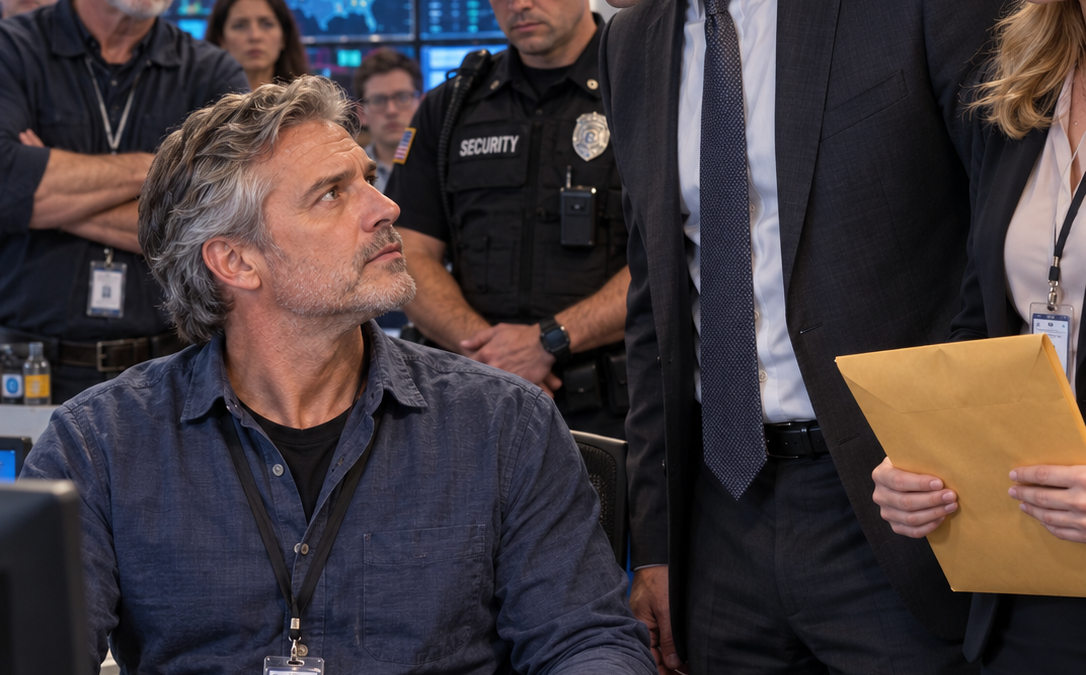
He was flanked by a woman from human resources named Doris Callahan, holding a manila envelope, and a uniformed security officer named Keith, who was staring at the floor with the particular discomfort of a man who knows he is being used as a prop in something shameful.
Clifford’s face had shifted.
The anxiety of the previous hours had been replaced by a particular brand of bureaucratic authority. Chin elevated, jaw set, the expression of a man who had made a decision and dressed it up in procedure.
“Philip Crane,” Clifford said, loudly enough for half the operations floor to hear. “Effective immediately, your employment with Meridian Cold Storage Solutions is terminated for cause. Doris will review the terms with you. Keith will escort you from the building.”
A human being can absorb a lot of information in a single moment.
In the second or two that followed, I processed several things simultaneously. We were at 88% restoration, with 45 minutes of critical work remaining. Clifford had chosen this exact moment to terminate me. Not an hour earlier, not at the beginning of the incident, but with just enough recovery completed that he could claim credit for the save if the remaining 12% got done.
And if I walked out of this building right now, nobody in this room had the technical competence to finish what I had started.
I also processed something I had learned over five decades of living and 18 years of corporate engineering. The person who loses composure in a crisis gives the other person exactly what they need.
I looked at Clifford. I looked at Doris. I looked at Keith.
Then I said, very calmly, “Understood.”
Clifford blinked.
He had prepared for anger. He had prepared for pleading. He had perhaps prepared for a scene. He had not prepared for a man who simply nodded and returned to his keyboard.
Clifford stepped forward.
“Philip, you need to step away from the terminal. You are no longer authorized to access company systems.”
I turned around one more time.
I held up one hand.
“Keith,” I said, “I want to be clear that I am not accessing anything unauthorized. I am unmounting my personal diagnostic drive, which Section 9 of my employment agreement explicitly authorizes senior engineering staff to attach during declared system emergencies for independent audit and forensic logging purposes. My attorney has a copy of that clause. I am going to take 30 seconds to execute a clean and legal unmount, and then I will leave without any further discussion.”
Keith looked at Doris. Doris looked at the floor.
Neither of them said a word.
I unmounted my diagnostic drive in three keystrokes and removed it from the terminal.
That drive held everything.
The raw CRM crash logs confirming the exact deadlock sequence I had predicted and documented. The complete system state at the time Sutton Graves executed his unauthorized hard reset. The full recovery audit trail from my four hours of work. And a timestamped record of every command I had entered between 10:59 at night and 2:47 in the morning.
I put the drive in my inside coat pocket.
I picked up my leather engineering notebook, 22 years of handwritten technical observations, meeting notes, and dated professional decisions. I picked up my laptop bag.
I stood up, turned to Walt Osborne, who was watching from across the room with an expression I will never forget, something between grief and quiet fury, and shook his hand.
“Thank you, Walt. You’ve always been the best operations monitor in this building. You know what to do from here.”
Walt gripped my hand firmly and said quietly, “I’m sorry, Philip. This isn’t right.”
“Right things have a way of finding their level,” I said.
I walked to the elevator without looking back.
The elevator doors closed.
In the mirrored interior, I could see my own reflection. A 52-year-old man in a winter coat, carrying a leather bag, walking out of a building where he had spent 18 years.
What I could not see, but what I knew with complete certainty, was what was happening back on that operations floor at the moment the elevator descended.
The CRM rebuild process, which I had architected on a zero-trust security framework requiring authenticated session continuity, had just been interrupted by the unauthorized session termination Clifford’s security escort had triggered.
The moment my badge credentials were deactivated in the HR system, the system’s integrity protocol flagged the active restoration session as unauthorized and suspended forward progress on the manifest reconciliation process, locking it into a protected validation hold that required a senior authorized cryptographic restart.
In simple terms, the moment Clifford fired me and revoked my credentials, the 88%-complete CRM restoration froze.
Nobody in that building could finish it without either restoring my access or rebuilding the reconciliation process from scratch, which would take another six to eight hours.
I sat in my car in the dark parking lot for a moment.
I called Carol.
She answered on the second ring.
“They fired me,” I said.
She was quiet for two seconds.
“Are you okay?”
I thought about it.
“Yes,” I said. “I think everything is exactly where it needs to be.”
I drove home through the empty Colorado darkness, made coffee, sat at my kitchen table, and opened my laptop.
I drafted a single email to Rosemary Falconer, my employment attorney, with the subject line: “Retaliatory Termination — Meridian Cold Storage — Tonight.”
Then I detailed the full sequence of events in chronological order. I attached my personal photograph of the original 14-page migration risk assessment, including page 11, and attached the forwarded email chain showing Clifford’s written direction to proceed and his formal acknowledgment of my professional warning.
I sent it at 3:21 in the morning.
Then I went to bed.
My phone began ringing at 5:48 in the morning.
The first call was from Clifford.
I let it go to voicemail.
The second call, 17 minutes later, was from a number I did not recognize, which turned out to be Meridian’s chief executive officer, a man named Elden Marsh.
I let that go to voicemail, too.
By seven in the morning, I had 14 missed calls, four voicemails, and a text message from Walt Osborne that read:
“They cannot finish the restoration. The system went into a protected hold when they terminated your credentials. Sutton has been trying to work around it for four hours. The pharmaceutical clients are threatening to trigger the federal audit clause. The CEO is asking if anyone has your personal cell number.”
I read the text twice.
Then I set my phone on the counter and poured a second cup of coffee.
At 7:38 in the morning, an email arrived from Elden Marsh himself.
“Dear Philip,
I have been fully briefed on the circumstances of last evening’s incidents and the events that transpired in the early morning hours.
I want you to know that this matter is being treated with the utmost urgency at the highest level of executive leadership.
I am personally requesting that you contact me directly so that we can discuss the possibility of a temporary access restoration under whatever terms you feel are appropriate, and so that we can also begin an honest conversation about the circumstances that led to last night’s situation.
This company values your 18 years of service and your expertise, and I believe we have a great deal to discuss.
Sincerely,
Elden Marsh”
I read the email three times.
Then I called Rosemary Falconer.
She had already reviewed my overnight email and was waiting.
Rosemary had been an employment litigation attorney in Denver for 27 years. She had the particular quality I most admired in legal counsel. She did not tell you what you wanted to hear. She told you what the facts supported.
“Philip,” she said without any preamble, “this is one of the clearest retaliatory termination cases I have seen in a decade. I want to walk through every piece of it.”
Over the next 30 minutes, Rosemary laid out what we had.
We had wrongful termination in violation of Colorado’s public policy protections for employees who engage in protected activity. Specifically, I had filed a formal internal HR complaint regarding a discriminatory promotion decision eight weeks before my termination, which established protected whistleblower status.
We had documented breach of contract, as Meridian’s engineering employment agreement contained explicit provisions regarding the treatment and continuity of senior technical staff during declared system emergencies.
We had a compelling quantum meruit claim, the doctrine that holds an entity legally liable for the reasonable value of professional services it accepts and benefits from but refuses to compensate.
Between 10:59 at night and 2:47 in the morning, I had single-handedly prevented approximately $700,000 in contractual penalty exposure and averted a potential federal compliance action that could have cost Meridian tens of millions in license sanctions.
I had performed those services on an emergency off-duty call. Terminating me before the restoration was complete, deliberately while the system was 88% recovered, did not relieve Meridian of that liability.
And we had something else.
Rosemary’s voice shifted slightly when she got to this part.
“Based on everything you have described,” she said, “your supervisor’s decision to deploy in peak season against your formal written warning, combined with a termination timed to precede the finish line of your own emergency recovery work, is going to look like one thing to a jury: premeditated credit theft and a cover-up. If there is any internal email traffic showing your supervisor was aware of the deployment risk and directed the concealment of your warning memo from senior leadership, that is additional exposure that a competent discovery process will surface.”
That same morning, before noon, Rosemary dispatched a formal litigation hold notice via certified courier and secure transmission to Meridian’s general counsel, the CEO, and the board of directors.
The notice required the immediate preservation of all internal communications, server audit logs, expense records, personnel files, and system telemetry data for the preceding 30 months.
Any destruction or modification of those materials would constitute spoliation of evidence and expose the company to severe sanctions.
At 11:14 that morning, my personal cell phone rang.
Rosemary had advised me not to speak with Meridian executives directly, but this call came from a number I recognized.
Walt Osborne.
I answered.
“Philip,” Walt said.
His voice was low and steady.
“I want you to know that as of about 40 minutes ago, Clifford Ingram was placed on administrative leave. The CEO was briefed this morning on the full timeline. The warning memo, the deployment directive, the termination timing. I’m not supposed to be calling you, but you deserve to know.”
“I appreciate that, Walt,” I said. “How’s the system?”
Walt was quiet for a moment.
“They brought in an outside vendor at six this morning. It took them until 10:40 to get a full understanding of the situation. They’re still working. The restoration won’t be complete until early afternoon. Two pharmaceutical clients have already triggered the federal audit clause.”
I did not say anything to that.
I just thanked Walt for calling.
The discovery phase of civil litigation has a way of doing what corporate culture never can.
It forces the paper trail into daylight.
Over the following ten weeks, Rosemary’s forensic discovery requests pulled thousands of internal communications and records out of Meridian’s servers.
What emerged was not surprising to me, but it was thorough.
Clifford had forwarded my 14-page migration risk assessment to Sutton Graves three days after I delivered it, with a private message.
“File this and keep it internal. I don’t want Palmer seeing a catastrophe memo when we need him focused on the Q4 board narrative.”
Clifford had deliberately suppressed my formal engineering warning from the CEO and the board.
The deployment had proceeded.
The crash had occurred exactly as I had documented it would.
And then Clifford had chosen 2:47 in the morning, the precise moment the recovery was 88% complete and the most visible and dangerous portion had already been resolved, to execute a termination he had been preparing for weeks.
His HR records showed that he had created retroactive performance documentation on me beginning six days after my internal HR complaint about the Sutton Graves promotion.
Notes claiming that I had demonstrated persistent resistance to leadership direction and a pattern of undermining executive authority during cross-functional meetings.
All of it fabricated.
All of it timestamped after my protected complaint.
Bradley did not exist in this story.
But Sutton Graves did.
And when Rosemary deposed him, he lasted 22 minutes before the documentary evidence made his testimony structurally impossible.
The hard reset. The manifest data loss. The admission that he had never worked in network infrastructure before joining Meridian. The admission that Clifford had told him, in the three weeks before the crisis, that I was being managed out and that Sutton should prepare to assume full operational credit for the CRM upgrade launch once the initial noise settled.
Clifford’s deposition was two hours long and ended with his attorney requesting a recess.
Twelve weeks after the night I walked out of that parking lot, Meridian’s general counsel reached out to Rosemary requesting a settlement conference.
I attended in person.
Elden Marsh, the CEO, was already standing when I walked into the conference room.
He did not sit down when I entered.
He extended his hand and said, “Philip, what happened to you was wrong, and I did not know the full truth of it until it was too late to stop it. I want this company to be accountable for that. And I want you to know that Clifford Ingram was terminated for cause four weeks ago. His performance bonuses and equity awards have been clawed back. He will not hold another senior technology leadership position at any company where our board has influence.”
I shook Elden’s hand.
I sat down.
The settlement that followed took about two hours to reach.
It was comprehensive.
Eighteen years of backloaded compensation and severance, fully paid. Full reimbursement of legal fees. A quantum meruit recovery reflecting the financial exposure I had prevented during those four hours of emergency restoration work.
A board-certified letter of professional exoneration stating, in legally binding language, that my termination had been executed improperly in retaliation for protected activity and that my 18-year professional record at Meridian was certified as exceptional.
The total monetary settlement was seven figures.
The letter of exoneration was framed in my office the week after the proceedings closed.
I keep it on the wall directly across from my desk.
Not because I need to look at it every morning to feel validated. I stopped needing other people’s validation sometime in my early forties.
I keep it there because every once in a while, a new engineer will come into my office. Someone in their late twenties or early thirties who is already navigating the particular dread of working under a supervisor who does not know half of what they know.
And they will ask me how I got through it.
I always point at that letter and tell them the same thing.
I say, “Document everything. Protect your contract. And do not let the arrogance of an insecure manager trick you into believing that because they have the title, they have the power. In a well-documented fight, the engineer who knows where page 11 is will always outlast the executive who never read it.”








