At 18, my parents called me a filthy failure and handed my brother $150K while I got kicked out with a trash bag. Twenty years later, they were standing outside my gate begging me to let them inside.
At eighteen, my parents called me a filthy failure and handed my brother $150,000 while I got kicked out with a trash bag.
Twenty years later, they were standing outside my gate, begging me to let them inside.
Hey, Reddit. So, my parents had this vision of what success looked like, and I wasn’t it.
I’m thirty-eight, male, and I run a custom construction business in Pennsylvania. But growing up outside Pittsburgh, I might as well have been the family stain they couldn’t bleach out.
My dad and mom were those Type A professional snobs who measured worth in job titles and country club memberships. Dad worked in corporate finance, convinced his position made him some kind of modern aristocrat. Mom sold luxury real estate and cared more about what the neighbors thought than her own kids.
Then there was Griffin, my younger brother by three years, who could do no wrong in their eyes.
Every dinner was the same performance. Griffin’s honor roll achievements. Griffin’s tennis matches. Griffin’s debate trophies. I’d sit there after scoring decent grades in wood shop, and they’d look through me like I was furniture. Not even good furniture. The kind you get at a going-out-of-business sale.
But here’s what they missed while celebrating Griffin: I could actually build things.
Real things.
At eight, I fixed our broken lawn mower. Took it apart in the driveway, figured out the carburetor was clogged, cleaned it, reassembled everything, and got it running better than it had in years.
Dad’s response?
“Don’t leave your tools lying around. The neighbors might think we can’t afford a repair service.”
By twelve, I was taking apart engines and putting them back together better than they started. My hands just understood mechanical systems before my brain caught up.
Mom acted like my tool belt was contagious. Dad made me sweep sawdust off the driveway before neighbors drove by. They’d rather pay someone $200 than admit I’d fixed something for free.
At fifteen, I spent a summer building a treehouse that would have made professional contractors jealous. Two stories. Real windows. Proper framing. I even ran electricity out there.
My retired engineer neighbor became my unofficial mentor. He taught me about codes, load calculations, all the stuff that separates hobby builds from professional work.
“This could pass a building inspection,” he said when I finished. “Better craftsmanship than half the additions I see going up in this neighborhood.”
The day I finished, I was pumped. Finally, I thought, I’d built something they couldn’t ignore.
Dad looked at it for maybe fifteen seconds.
“Hope you’re done playing carpenter. School starts in two weeks, and you need to focus on academics.”
Mom patted my head like I was six.
“It’s cute, sweetheart, but Griffin’s already in AP courses.”
That night, I heard them talking in the kitchen. Dad’s voice carried.
“The neighbor’s kid is taking college courses at sixteen, and ours is hammering together a glorified fort.”
Right then, I stopped caring about impressing them.
Still stings a little, if I’m being honest.
High school cemented the dynamic.
Griffin joined every college résumé activity he could. They dropped $400 on a professional tennis racket and threw him parties. Meanwhile, I worked weekends at the hardware store, saving for basic tools because asking my parents for money meant lectures about “investing in your future properly.”
When I asked for garage space to set up a workbench, the answer was a flat no.
“Too much noise. Griffin needs quiet for his studies.”
So I worked in the driveway. My tools stayed in plastic bins I had to haul out every single time.
Senior year, Griffin got early acceptance to Yale. My parents threw a party that would have made a wedding look modest. Dad gave a twenty-minute speech about Griffin’s “exceptional trajectory,” while Mom cried happy tears.
Their gift was a brand-new BMW.
Three years earlier, when I graduated, we went to a chain steakhouse.
They got me a used laptop.
I wasn’t headed to a four-year university. I’d been accepted to a technical college with a top-rated construction management program.
When I told them, Mom actually gasped like I’d announced a terminal diagnosis.
“Trade school?”
She said it like I’d chosen drugs over college.
Dad’s face hardened.
“Construction management isn’t a real degree, Nolan. You’re settling for less. This is disappointing.”
I tried explaining the job placement rates, the starting salaries, the fact that I could graduate debt-free.
None of it registered.
“We raised you better than this,” Mom said.
And I laughed.
Actually laughed.
“You raised Griffin. I just lived in the same house.”
You could feel the room go dead quiet, but I was done pretending their opinion mattered.
Two days later, Dad called me into his home office. Mom was already there, seated like this was a board meeting.
Dad slid a folded paper across his desk.
“We’ve made a decision about your living situation.”
I unfolded it.
Typed. Dated.
A formal thirty-day notice to vacate.
Like I was a tenant being evicted, not their kid.
“You’ve chosen a path we can’t support,” Mom said, her voice measured. “We think it’s healthiest if you establish independence now. Clean breaks allow for growth.”
Dad’s signature was at the bottom.
Mom’s underneath.
They’d planned this.
“You’re kicking me out.”
“We’re establishing boundaries,” Dad corrected. “You have thirty days. After that, the locks change.”
I didn’t argue. Didn’t beg.
I just folded the paper, put it in my pocket, and walked out.
That night, I called my buddy Micah and asked if his couch was available.
He didn’t ask why.
He just said, “Keys are under the mat.”
I spent the next three weeks packing my plastic bins of tools into my truck. The workbench I’d built in the garage?
I left it.
Let them figure out how to remove something bolted to their foundation.
On day twenty-nine, I set my house key on the counter.
Didn’t leave a note.
There was nothing to say.
That first month was Micah’s couch, gym showers before class, and gas station burritos for dinner. Everything I owned fit in the truck bed.
Trade school started with zero parental support, which was fine by me. I worked full-time at the hardware store, pulling doubles when possible, sleeping maybe five hours a night.
Meanwhile, Griffin’s entire Yale experience—tuition, living expenses, study-abroad trips—came fully funded.
The scoreboard never changed.
Only the numbers did.
But trade school was the first time I actually enjoyed learning.
My instructors recognized talent when they saw it. My project management instructor would stay late going over advanced techniques with me.
“You’ve got instinct for this, Nolan. That can’t be taught.”
I graduated top of my class with a job offer from a major construction firm before I even walked across the stage.
Assistant project manager at twenty-one.
My parents didn’t come to graduation.
Griffin had a tennis tournament.
I stopped expecting them to show up and started building the life I wanted.
That’s where I met Tessa.
She came by the site office one day to drop off lunch for her uncle, and I immediately fumbled my attempt to look smooth by knocking over an entire filing cabinet.
Instead of being embarrassed for me, she helped pick everything up and told me about the time she’d fallen face-first into a fountain on a first date.
We talked until her phone died.
Tessa was a nursing student working night shifts to pay tuition. She understood hustle. She understood proving yourself without a safety net.
Our first real date lasted until four in the morning, just talking about dreams.
She wanted pediatric trauma care.
I wanted my own construction company.
She never once questioned whether my goals were good enough.
She just asked what she needed to know to help.
Six months in, my parents insisted we come for Christmas dinner.
They called three times. Mom sent an email about “family obligations” and “the importance of traditions.”
I don’t know what came over me, but we went anyway.
Predictably, the entire dinner revolved around Griffin’s Yale glory.
Two solid hours of Dad grilling him about networking strategies and Mom demanding every detail about his Ivy League social life—what clubs he’d joined, what professors he’d impressed, which alumni he’d connected with.
When Griffin mentioned a Goldman Sachs internship, you’d think he’d cured cancer.
Dad actually stood up and shook his hand across the table like they were closing a business deal.
Finally, Tessa cut in.
“Nolan just got promoted to full project manager. Youngest in company history.”
Brief silence.
You could hear the clock ticking.
Mom smiled.
“Oh, that’s nice.”
Then she immediately turned back to Griffin.
“So, tell us more about the internship. Is it paid?”
In the car afterward, Tessa was heated.
“Do they always treat you like background noise? You’re the youngest project manager at one of the biggest construction firms in the state, and they didn’t ask you a single follow-up question.”
“They’ve always been like this. Nothing I do measures up to Griffin’s résumé.”
“That’s not about measurement, Nolan. That’s about them being terrible parents.”
She was right.
It should have been the last time I went back for anything.
Lesson learned the hard way.
By twenty-nine, I’d saved enough to start Nolan Steel Construction.
Just me, my truck, and a garage full of tools.
The early days were brutal. Constant stress about finding clients, covering expenses, handling every role from carpenter to accountant.
Tessa, now an RN at Children’s Hospital, basically kept us afloat financially those first eight months.
We’d gotten married the year before. Small ceremony. Dinner at our favorite spot.
My parents showed up an hour late and dipped out midmeal for a “prior obligation.”
Griffin was networking in New York.
Tessa’s family actually showed up.
Her dad, a union electrician, pulled me aside, told me I was building something real, and slipped me two grand in cash for tools.
Starting a business with zero family help sucked.
Other contractors had co-signers, borrowed equipment from family businesses, or got warm leads through Uncle Nosy’s network.
I had cold banks and colder rejections.
Three turned me down flat.
One loan officer actually laughed when I mentioned I didn’t have a co-signer.
The fourth approved me at an interest rate that felt like robbery, but it bought me a used van with 180,000 miles on it and enough gear to start taking jobs.
For the first six months, I operated out of that van.
No office. No shop.
Just me, a cell phone, and a van full of tools.
I’d quote jobs in the morning, work them until dark, then do invoicing in parking lots using the dome light.
Sundays became flyers and door-knocking in nicer neighborhoods, offering free estimates.
Most doors closed fast.
Some people looked at me like I was casing the place.
A few didn’t close.
And those few kept me moving.
I landed a kitchen renovation for a surgeon. Four-week timeline. Finished in three.
Late nights hand-cutting tile until it looked deliberate, not rushed.
He walked through when I was done, nodded once, and called six colleagues to recommend me.
After that, I leaned into high-end custom work—the kind you can’t fake, where details matter and being YouTube-certified doesn’t cut it.
Griffin, meanwhile, graduated Yale with honors and landed a position at a Manhattan investment firm making $180,000 base plus bonuses.
My parents couldn’t stop talking about it.
Same favorites.
New price tags.
Then came the dinner that torched whatever remained of our relationship.
A few years into Griffin’s Wall Street career, my parents insisted I come over. They called three times and said it was “important family business.”
Tessa flat-out refused this time, but I figured I’d hear them out and leave.
My mistake.
Over dessert, Dad raised his glass with this smug smile.
“Your mother and I have exciting news. We’ve decided to help Griffin purchase his first home. Manhattan real estate is competitive, so we’re providing $150,000 for his down payment.”
I waited for the second part.
The part where they’d help both sons.
Crickets.
My voice stayed flat.
“What about me?”
They looked confused, like they’d genuinely forgotten I might also have housing needs.
“What about you?” Dad asked.
“I’ve been saving for a house for four years. Business is growing, but we’re still renting because housing prices keep jumping faster than I can save. You’re giving Griffin $150,000, and I get nothing.”
Dad’s expression hardened.
“Griffin positioned himself for success in a demanding field. He needs to live in an appropriate neighborhood for professional advancement.”
“And what I do isn’t demanding? I work seventy-hour weeks building a business from scratch.”
Mom’s smile was condescending.
“Dear, Griffin has a real career. You chose an alternative path. We support choices, but we can’t reward everyone equally when the effort isn’t comparable.”
Something in me went cold.
Not hot.
Cold.
“Reward? You think I’m asking for a participation trophy? I’ve built a successful business without a penny from you. I’m not asking for charity. Just the same support you’re giving him.”
Dad set his glass down hard.
“Why would we subsidize mediocrity? Griffin made something of himself. He attended a top university, secured a prestigious position. You chose manual labor over intellectual achievement. You made your bed.”
That word.
Mediocrity.
After everything I’d built.
After they’d kicked me out at eighteen for choosing trade school.
After I’d clawed my way up without a penny from them.
Still mediocrity.
I didn’t raise my voice. Didn’t flip the table.
I just stood up, grabbed my jacket, and looked at my father’s smug expression, then at my mother arranging dessert forks like nothing had happened.
“We’re done here. Permanently.”
I walked out.
Didn’t slam the door.
Didn’t need to.
The next day, I blocked their numbers and deleted them from social media.
When Mom tried calling from a different number, I answered once.
“Unless you’re calling to apologize, lose my number.”
She sputtered something about respect and family.
I hung up.
Cutting them out felt like dropping weight I’d been hauling my entire adult life.
Suddenly, I had energy for things that mattered instead of wasting it on people who didn’t.
I channeled everything into work.
My three-year growth plan became a one-year sprint.
I hired my first carpenter, a talented guy with innovative ideas. Then my detail guy, a master craftsman whose precision work became our signature. Then two more guys who shared my vision for quality over quantity.
Around this time, I met Brick.
Brick was a sixty-eight-year-old contractor who’d run a successful business for forty-five years. Somehow, he saw something in me besides competition.
He started inviting me to lunch, sharing insights about business management, client relations, and navigating the industry’s nonsense.
“You’ve got the hands and the head,” Brick told me over burgers one afternoon. “That combination is rare. Most guys have one or the other.”
When Brick mentioned retirement, he made me an unexpected offer.
“I want you to buy my business when I’m ready. My son’s not interested, and I’d rather see it go to someone who’ll maintain our reputation.”
Around the same time, a property came up for sale.
Seven acres outside city limits at a suspiciously low price because the access road was wrecked and the terrain was rough.
Most buyers saw problems.
I saw potential.
It was fifteen minutes from downtown but completely secluded. Partially wooded, with a natural clearing. Half the market rate for comparable land.
The realtor thought I was crazy.
“The road alone will cost you thirty grand to fix. Permits for that grade are a nightmare.”
I smiled.
“I know a guy.”
The guy was me.
And Brick.
And about six hundred hours of weekend work.
More importantly, I could envision exactly what I wanted to build.
Not just a house.
A statement.
Proof that I’d succeeded on my terms.
Every beam. Every joint. Every finish.
My own work.
No one could take credit for it.
No one could claim they helped.
I leveraged everything to secure that land.
Tessa was nervous but supportive.
“If anyone can make that work, it’s you.”
The first year was hell.
Weekends and most nights were spent clearing land and rebuilding that access road—a three-hundred-foot steep mess that turned to mud every time it rained.
Some nights, I’d get home so tired I’d fall asleep in the truck before making it inside.
Brick lent me equipment and taught me how to run it.
My first carpenter and my detail guy showed up most Saturdays and worked for food because they’d bought into the plan.
Connections helped. An excavation hookup got me cheaper materials, and a friend helped us source reclaimed barn timber.
We hauled thirty huge beams that became the centerpiece of the great room.
Weekdays, I grew the business.
Nights, I drafted plans.
Modern and clean. Heavy on custom woodwork and smart builds.
Eighteen months in, Nolan Steel Construction was up to eight employees with a waiting list.
The road and foundation were done.
I was pulling eighty-hour weeks, tired but finally building something that was mine.
Griffin was still posting vacation flexes while needing our parents to float his housing.
Cute.
The stress didn’t stop.
A major client paid three months late, so I took out a bridge loan.
Lumber prices spiked.
Tessa’s car blew a transmission.
We handled it anyway because that’s what we did.
Two years after buying the land, a developer hired us for an eight-month whole-home renovation with a real budget and real freedom.
The finished house got featured in a regional architecture publication.
After that, the phone didn’t stop ringing.
And for the first time, we got to pick projects instead of begging for them.
Nine years after cutting contact with my parents, our home was nearing completion.
The exterior was finished—an aggressive combination of stone, steel, and cedar that looked like it had grown from the landscape while still making a bold statement.
Inside, we were working through the final details.
The business had grown to twelve employees with a reputation as one of the premier custom builders in Western Pennsylvania.
Our workshop had become a destination for clients who wanted to see craftsmanship firsthand.
Through it all, my parents remained silent.
They’d apparently decided they only had one son.
Fine by me.
Then, on a Tuesday afternoon, my phone rang.
Griffin.
We’d barely spoken in years.
“Nolan, I just drove past your property.”
His voice wasn’t shocked.
It was calculating.
“How big is this operation? What’s something like this worth?”
No greeting.
No “How are you?”
Straight to valuation.
“Why do you care?”
“I’m just saying. Seven acres, custom workshop facility. That’s not a small investment. You’re doing better than Dad thinks.”
I leaned against the workbench.
“What Dad thinks isn’t my concern, and it shouldn’t be yours either.”
“Look, I’m in town meeting a client. Mind if I swing by? I’d like to see what you’ve built.”
“No.”
Silence.
He wasn’t expecting that.
“Come on, Nolan. I’m not asking for a tour of Fort Knox. Just want to catch up.”
“You want to appraise the place for Mom and Dad?”
The answer was still no.
He tried a different angle.
“Fine. Can we at least grab coffee? There’s a Wawa off Route 30. I need to talk to you about something.”
I could’ve said no to that too.
But something in his voice—the slight crack under the finance-bro confidence—made me curious.
Not sympathetic.
Curious.
“Twenty minutes. I’m not sitting around waiting.”
The Wawa parking lot.
Very Pennsylvania.
Griffin’s BMW looked out of place next to pickup trucks and work vans. A guy in Carhartt overalls glanced at it, then at Griffin, then went back to his hoagie like he’d seen everything he needed to see.
Griffin was leaning against the driver’s door when I pulled up, looking like he hadn’t slept in days.
The suit was expensive but wrinkled. The kind of wrinkled that happens when you sleep in something because you don’t have anywhere else to be.
The watch was still flashy.
But the man wearing it looked deflated, like somebody had let the air out of the Golden Boy.
I grabbed a coffee inside.
Took my time.
Let him wait.
When I came out, he was checking his phone with that anxious compulsion people develop when their whole life is falling apart one notification at a time.
He didn’t waste time on small talk.
“The firm’s pushing me out. Not partner material. My apartment’s underwater. I owe more than it’s worth, and the co-op board is threatening foreclosure. Girlfriend’s gone. Took the furniture and the dog. And I’m on three medications just to function through a normal day.”
I sipped my coffee.
Waited.
Let the silence do the work.
“I need a landing pad,” he continued. “You need someone who understands business development. I could help you scale this operation. I’m good with numbers, strategy, client relations—the business side you probably hate doing.”
“You want a job.”
“I want an opportunity.”
I studied him.
Same Griffin who’d enjoyed being the favorite.
Same Griffin who’d never once defended me to our parents.
Now he was struggling, and suddenly he remembered he had a brother.
“I don’t trust you,” I said. “You spent thirty years on their side.”
“I wasn’t on anyone’s side. I was just benefiting.”
“Yeah. I noticed.”
He didn’t argue.
Couldn’t.
“Here’s what I’ll offer,” I said.
His face lifted.
“Nothing.”
It fell again.
“Nolan—”
“I’m not your landing pad. I’m not your backup plan, and I’m definitely not your ticket back into Mom and Dad’s good graces.”
I pulled out my phone, typed for a moment, then showed him the screen.
Three recruiters who specialized in finance backgrounds transitioning into other industries.
A temp agency that placed administrative workers if he needed cash fast.
And the name of a therapist one of Tessa’s colleagues had recommended who handled career-crisis stuff.
He stared at the screen like I’d handed him a rejection letter.
Which, I guess, I had.
“That’s it? A list of phone numbers?”
“That’s more than you ever gave me. When they kicked me out, you were at tennis camp. Never called. Never checked in. Nine years of silence, and now you want to be brothers because your life fell apart.”
I finished my coffee.
“Good luck, Griffin. Genuinely. But you’re not my problem to solve.”
I drove off and watched him shrink in my rearview mirror, still standing beside his BMW in a Wawa parking lot, holding his phone like he didn’t know what to do with it.
Didn’t feel good.
Didn’t feel bad either.
Just felt like the right call.
Two weeks later, my intercom buzzed.
Saturday afternoon.
I was in the middle of sanding down a custom mantelpiece.
I checked the camera feed.
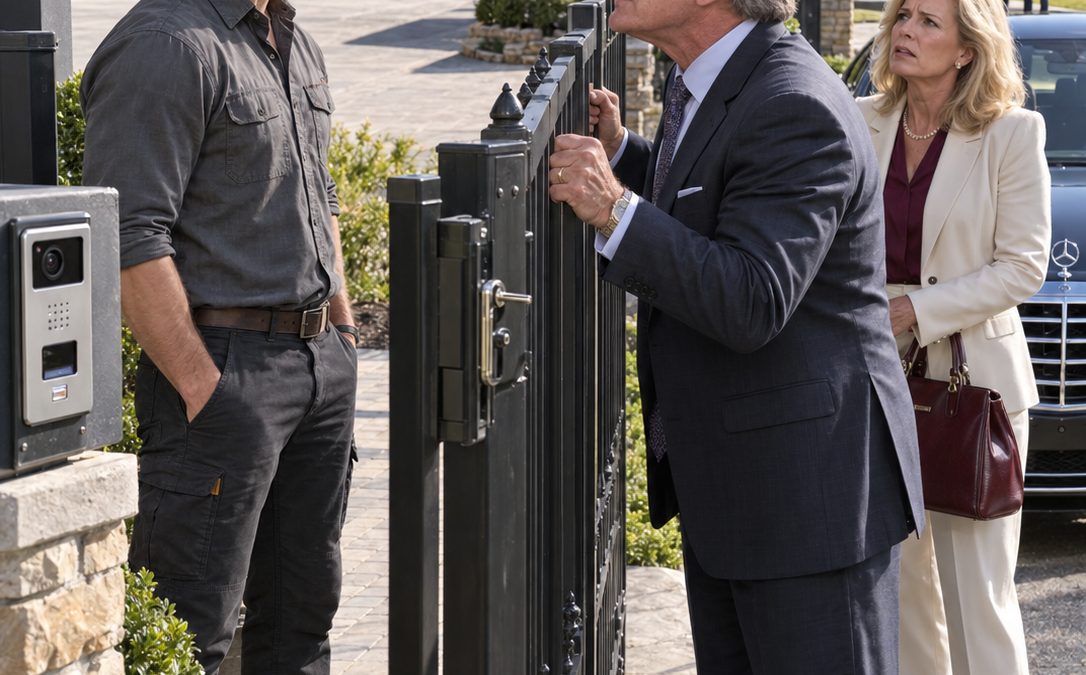
Dad’s Mercedes was at the gate.
Mom was in the passenger seat, reapplying lipstick like she was about to walk into an open-house showing.
Nine years of silence, and they just showed up like nothing had happened.
Tessa looked at the monitor over my shoulder.
“You don’t have to answer that.”
“No. But I want this documented.”
I pressed the intercom button.
“This property has audio and video recording. State your business.”
Before anyone starts screaming about consent laws in the comments, my lawyer confirmed that the signage plus the setup was fully compliant for Pennsylvania.
Moving on.
Dad’s voice crackled through, already annoyed.
“Nolan, don’t be ridiculous. We’re your parents. Open the gate and let us in.”
“I asked you to state your business.”
“We want to see the house. Griffin mentioned how impressive it is, and we thought it was time to see what you’ve accomplished. Everything you are started under our roof. The least you owe us is a tour.”
Griffin mentioned it.
Not surprised.
“The gate stays closed. If you have something to say, say it through the intercom.”
Mom leaned toward the speaker.
“Nolan, please. This is silly. We drove forty-five minutes to get here. Can’t we just come in and talk like a normal family? We gave you the discipline and work ethic that made this possible.”
“We stopped being a normal family when you handed me a typed eviction notice at eighteen. And again when you called my business mediocrity to my face while handing Griffin $150,000. You want to talk? You can do it from there.”
Dad’s face on the camera was turning red.
“We came here to reconnect, and you’re treating us like solicitors.”
“I’m treating you like people who’ve proven they can’t be trusted. You want a relationship? Here are the terms.”
I paused.
“Written acknowledgment of how you treated me. Not ‘we made mistakes.’ Specific admission that you treated me as less than for choosing my own path. Delivered through my lawyer. His card is in the mailbox at the end of the drive. No financial entanglement. No surprise visits. Everything in writing.”
“This is absurd,” Dad sputtered. “We’re not negotiating with our own son through attorneys.”
“Then we’re done here. Drive safe.”
I clicked off the intercom.
I watched on the camera as Dad argued with the speaker for another three minutes, realized I wasn’t responding, then finally got back into the car.
Mom was crying.
The calculated kind she’d perfected over decades.
They sat there for another five minutes before finally driving away.
I saved the footage, documented the time, date, and what had been said, and added it to a file I’d started keeping.
Not because I was paranoid.
Because I knew them.
Should’ve trusted that instinct more.
Three weeks later, Mom’s Facebook post went up.
“So proud of our son Nolan and his beautiful custom-built home. The family construction tradition continues. #proudparents #familybusiness #NolanSteelConstruction.”
She’d tagged my business page.
Used photos I’d never seen her take.
Aerial shots of the property.
The workshop exterior.
My company trucks at various job sites around Grand View Heights.
Client addresses were visible in some shots.
License plates.
Project details.
Even a quote from an upcoming Pittsburgh home-and-design feature that hadn’t been published yet.
Information she shouldn’t have had access to.
I did some digging.
Turns out permit records are public in Pennsylvania.
She’d pulled every permit my company had filed in the previous three years.
Addresses.
Project scopes.
Estimated values.
Easy for someone in real estate to access.
And Mom knew exactly how to work the county record system. She’d probably done it a hundred times for her own clients.
The aerial shots came from a drone photographer she worked with regularly for listing photos.
She’d told him it was for a “family surprise project.”
He didn’t charge her.
Probably thought he was doing something nice for a colleague.
The magazine quotes came from the photographer who’d shot our feature.
Mom had contacted him claiming to be Nolan’s mother and saying she wanted to surprise me with prints for my birthday.
He’d shared preview images and some interview excerpts because he thought he was helping a sweet mom do something thoughtful.
The guy felt terrible when I called.
Said he’d never do something like that again without verification.
Not his fault.
Normal people don’t assume mothers are running reconnaissance operations on their own children.
The job-site photos were more concerning.
One of my crew mentioned seeing a Mercedes parked down the street during our Grand View Heights project the previous month.
Different days.
Different times.
Always the same car.
They’d assumed it was a curious neighbor.
Luxury neighborhoods. People watch construction crews all the time.
Now I knew better.
My parents had been tailing my trucks, taking photos from public roads where I couldn’t do anything about it.
Building a dossier over weeks.
All so Mom could post on Facebook like she’d been there all along.
Like she’d supported me from day one.
Like the word mediocrity had never left her mouth.
The audacity still gets me if I think about it too long.
Client information was now publicly exposed on a post shared with her fifteen hundred friends.
Half of them real estate agents.
Our Grand View Heights clients had chosen us because we were discreet.
Now their projects were props in my mother’s desperate attempt to rewrite history.
One client called within hours.
“Nolan, why is my house on some woman’s Facebook page?”
I didn’t rage.
I went straight to the boring stuff that ruins people.
First, I got ahead of it.
I sent a professional email to every affected client explaining that a third party had obtained project information through public records and was misrepresenting her relationship with my company.
I apologized for the invasion of their privacy and offered a consultation credit toward future work.
Every single one responded with support.
Second, I made my own post.
Three hours later:
“Nolan Steel Construction was built without family financial support or involvement. Any representation otherwise is inaccurate. We take client privacy seriously and are addressing unauthorized disclosure of project information.”
One statement.
Professional.
Let them explain that one to their country club friends.
Third, I called my lawyer.
A cease-and-desist letter went out that afternoon—not just for false affiliation with my business, but citing misrepresentation that could confuse consumers, unauthorized use of my company name and trademark, and disclosure of client information obtained through deceptive means.
Fourth—and this one I’m proud of—I filed a complaint with the Pennsylvania Real Estate Commission.
Mom held an active broker’s license.
She’d used deceptive practices to obtain confidential information, then publicly disclosed client addresses and project details.
Ethics violation.
Maybe nothing would come of it, but it would sit in her file.
And her brokerage would receive a copy.
The Facebook post came down within six hours.
Facebook didn’t magically behave out of kindness.
I reported it.
Clients reported it.
And her brokerage called her the same day.
Turns out realtors don’t love liability.
Two weeks later, the Pittsburgh home-and-design feature dropped.
Eight-page spread showcasing our historic renovation project, photos of our workshop, a profile on my background that included interviews with three clients and two employees, and one line my parents couldn’t spin:
“Nolan built the business from the ground up without family support, crediting his success to mentors, his dedicated team, and his wife Tessa, a pediatric trauma nurse.”
The writer had asked about my background.
I answered it flat.
They printed it.
Not my problem if it made certain people look bad.
The magazine hit every waiting room in Grand View Heights, every country club lobby, every luxury real estate office where Mom’s colleagues flipped through it between showings.
The same colleagues who’d seen her Facebook post claiming credit weeks earlier.
Now they were reading in print that Nolan Steel Construction had been built without family support.
That the son she’d never mentioned, the one she’d kicked out for choosing trade school, had become one of the premier custom builders in Western Pennsylvania.
And that he’d publicly credited everyone except his parents.
Their carefully constructed narrative didn’t just collapse.
It detonated in the exact circles they’d spent thirty years trying to impress.
I heard later through Tessa’s network that the magazine became a topic at the country club.
People asked Mom directly, “Wait, isn’t this your son? Why does it say no family support?”
No good answer for that one.
Either you admit you didn’t support him, or you admit you lied on Facebook.
Pick your poison.
Three weeks after the magazine dropped, on a Saturday afternoon, my security cameras recorded everything.
Dad’s Mercedes pulled up to the gate.
He got out and gripped the iron bars like he wanted to tear them apart.
Ten minutes of yelling.
Threats about lawyers.
Accusations that I’d poisoned Griffin against them.
Rambling about how they’d “built me into the man I became,” how the property existed because of the values they’d instilled in me.
Mom stood beside the car looking mortified.
At one point, she tried to pull Dad’s arm.
He shook her off so hard she stumbled against the Mercedes.
My neighbor was trimming hedges across the road.
His wife came out onto the porch to watch.
A family down the road stopped their car at the end of their driveway.
Even from inside, I could see people gathering.
I didn’t engage.
Didn’t go to the gate.
Didn’t give him the satisfaction of a reaction.
I watched from the security monitor, confirmed everything was recording cleanly, then called the sheriff’s non-emergency line.
I gave them the address and plate number, calmly described the situation, and requested a deputy for a trespassing complaint.
The deputy arrived fourteen minutes later.
By then, Dad’s suit was dusty from pressing against the bars. Sweat stained his collar despite the cool weather. His tie was loosened. His hair was a mess.
He looked nothing like the composed corporate-finance guy who’d handed me that eviction notice twenty years earlier.
He tried to pull rank.
Started explaining that this was a family matter and private business that didn’t require law enforcement.
Dropped his job title.
Mentioned the country club like it was supposed to mean something.
The deputy didn’t care.
Didn’t even blink.
Clipboard came out.
Case number.
Formal warning.
Dad went quiet in that I’ve-never-been-told-no kind of way.
You could see his brain short-circuiting, trying to figure out why his usual tactics weren’t working.
Then he started sputtering about family rights, private-property exceptions for parents, quoting things that sounded like they’d come from a Google search done in the car on the way over.
The deputy actually looked bored.
He wasn’t having it.
He handed Dad a copy of the warning.
Official paperwork.
Case number and everything.
Dad stared at it like he couldn’t process what he was holding.
A man of his position.
His standing.
Being handed trespass papers by a county deputy in front of the neighbors he’d been planning to impress.
Mom was already inside the car with the door closed, face buried in her hands.
She knew what this meant for their reputation.
They drove off.
My neighbor was still watching from his porch.
So was everyone else along that road who’d heard the screaming.
Later, Tessa heard through the hospital grapevine that Mom had been bragging at the country club days earlier about “reconnecting with Nolan” and visiting his “beautiful estate” soon.
Now their neighbors had witnessed Dad screaming at a locked gate while a deputy issued him a trespass warning.
Word travels fast in those circles.
Mom’s real estate colleagues started asking questions.
Dad’s golf buddies got quiet.
The people they’d spent decades impressing now had a very different picture.
I didn’t ruin them.
I just stopped covering for them.
Their obsession with appearances did the rest.
The following months were quieter.
Better.
I hired a proper operations manager.
Someone with no family ties, no divided loyalties.
Just competence and a paycheck.
He came from a competitor who’d underpaid him for years.
Within three months, he’d reorganized our filing system, streamlined scheduling, and identified cost inefficiencies I’d been too busy to notice.
Brick officially retired that spring, selling me his client list and equipment at a fair price.
We grew to fifteen employees, with clients driving from three states away.
Griffin tried calling twice more.
I didn’t answer.
He sent a letter.
Handwritten.
Five pages.
Full of apologies and explanations about pressure from Dad.
I read it once.
Noted that it still focused on his journey.
His growth.
Not much acknowledgment of the actual harm.
Just a lot of explaining why he’d done what he’d done.
I shredded it.
He wasn’t wrong for trying.
I just wasn’t obligated to respond.
Tessa got pregnant that summer.
We didn’t tell my parents.
Didn’t tell Griffin either.
They all found out anyway.
Probably through the grapevine.
They tried visiting the hospital after the baby was born.
All three of them.
My parents and Griffin showed up together like some kind of reconciliation ambush, dressed like they were attending a charity gala instead of a maternity ward.
Security stopped them in the lobby.
I’d already put all three names on the no-visitor list.
Two nurses told Tessa they’d seen the whole thing.
Dad arguing with security about “grandparent rights.”
“This is our granddaughter. You can’t keep us from her.”
Mom crying in the waiting room, making sure everyone could see, fishing for sympathy from other families.
Griffin standing off to the side looking uncomfortable, probably realizing this wasn’t going to work but not having the spine to tell them.
Eventually, all three left after a supervisor explained firmly, professionally, and very publicly that patient wishes regarding visitors were final and that continuing to cause a disturbance would result in them being escorted out by hospital security.
The story spread through the hospital within a day.
Then through Tessa’s professional network.
Nurses and doctors who knew families in Grand View Heights.
Then back into my parents’ social circles.
Within a week, the story had made a complete loop.
The couple who’d been bragging about their successful builder son had been escorted out of a maternity ward.
Six months after my daughter was born, the business continued growing.
Twenty-three employees.
We were considering a second location.
Booked solid for three years.
Dad tried calling twice more.
Left voicemails saying they were “willing to overlook my behavior” if I was “ready to be reasonable.”
Same old conditions dressed up as olive branches.
I didn’t respond.
There was nothing to discuss.
Griffin sent another letter.
Something about wanting to meet his niece.
About how family should matter more than mistakes.
I sent it back unopened.
Returned to sender.
No explanation needed.
The gate camera caught Dad driving past twice in one week.
Never stopping.
Just slowing down, looking, then accelerating away.
The footage went into the documentation file, just in case.
My neighbor mentioned he’d seen them parked down the road one afternoon, just sitting there in their Mercedes, watching the property from a distance.
Not close enough to trigger the trespass warning.
Just close enough to look pathetic.
Two people who’d spent their entire lives obsessing over what the neighbors thought, now sitting in a parked car staring at a gate they couldn’t enter.
My neighbor said they sat there for almost an hour before finally driving away.
He felt bad for them.
I told him not to.
Last month, Mom left a voicemail.
Something about wanting to talk and “work things out” and how “life is too short for this.”
She mentioned Dad’s health.
She mentioned missing out on being grandparents.
She mentioned that they’d “reflected on things” and wanted to “move forward together as a family.”
I texted back four words.
“Send it to my lawyer.”
Haven’t heard from any of them since.
Guys, we are so close to hitting 100,000 subscribers on this channel. If you are not subscribed to the channel, please consider subscribing. It really helps us hit that 100,000 mark.








