At 13, Mom dropped me off at my aunt’s cattle ranch with a trash bag of clothes, saying, “Your sister deserves real summers. You’d only ruin them.” They never came back. Years later, Dad tried to buy that same ranch for my sister, but when the realtor showed him the owner’s name, he stopped talking. By morning, I had 88 missed calls.
My mother stopped in my aunt’s driveway in the Nebraska Sandhills and shoved a black trash bag of clothes at my chest.
“Brooke’s horse camp starts Monday. You’re not coming.”
“You said this was one summer.”
“Your sister deserves real summers. You’d only ruin them.”
I was thirteen.
The engine never shut off. I asked when they were coming back.
“August,” she said.
Then she left.
August came. They didn’t.
Not Christmas. Not graduation. Not my aunt’s funeral.
This May, my father drove six hours with a check to buy that ranch for Brooke. The realtor turned the screen. He read the owner’s name and went silent. By morning, I had eighty-eight missed calls from numbers dead since 2008.
I let them ring.
I was busy running the place they swore I would ruin.
My name is Rachel Randall. I’m thirty-two years old. If a discarded child with the keys speaks to you, comment and subscribe.
Now, let me take you back to that driveway.
Actually, let me take you back a little further than that, to a birthday, because the driveway doesn’t make sense without it.
I turned twelve in March of 2006. My grandmother Ruth was in an assisted living place twenty minutes from our house in Overland Park, Kansas. She was seventy-eight, and she couldn’t drive anymore, so my father brought her over for cake.
Brooke’s present came first. It always did.
It was a saddle. A real one. Leather, with Brooke’s initials on the skirt. Brooke was fourteen and had been riding for three years, and she cried when she saw it. My mother took a picture.
Then my grandmother reached into her purse and handed me an envelope.
Inside was one sheet of lined paper folded in three.
“Rachel, I’ve set a little something aside for you. Your dad is keeping it safe until you’re grown. Use it for real summers. The kind nobody gets to take from you. Love, Grandma.”
I didn’t know what “a little something” meant. I was twelve. I thought maybe it was a savings bond or a piece of jewelry.
My mother read the letter over my shoulder, and her face did something I didn’t have a word for yet.
Then she said, “Well, that’s sweet,” and went to cut the cake.
My grandmother told me to put the letter somewhere safe and read it again when I was older. I put it in the top drawer of my desk, under my school stuff.
She died that November.
Heart failure.
My father cried at the funeral. My mother handled the flowers.
I want to be careful about how I tell the next part, because for a long time I told it wrong.
That spring, everything in our house turned toward Kentucky. There was a summer program in Lexington, a serious one, the kind that trains kids who want to show at the national level. It cost $9,500 for six weeks, and that was before the horse.
The brochure was on the refrigerator under a magnet shaped like a horseshoe. My father talked about it the way other dads talked about college.
Brooke’s opportunity. Brooke’s shot.
One evening in April, I came downstairs to get a glass of water, and my mother was on the kitchen phone with her friend Pam. She had her back to me.
“No, it’s fine,” she said. “We’ll use Rachel’s. She doesn’t need it yet. And Brooke needs it now.”
I stood on the third step.
Then I came the rest of the way down and asked her.
It’s the only time I ever asked.
“Grandma said she left me something. Is that what you mean?”
My mother covered the phone with her hand. She looked at me for a second longer than she needed to.
“Grandma said a lot of things. Go set the table.”
That night, my parents’ bedroom door was closed for a long time. I could hear my mother’s voice through it, low and steady, and my father’s, which mostly said, “Okay.”
I didn’t hear what they decided.
I found out on the last day of school, Friday, June 8, 2007.
I got off the bus at 3:15, and the front door was already open. My room was different. My closet was open and mostly empty. The top drawer of my desk had been pulled out and dumped, all of it, into a black trash bag sitting on my bed with the top tied in a double knot.
My mother was zipping her own overnight bag in the hallway.
“We’re going to Aunt Norah’s,” she said. “One summer, while Brooke does Kentucky. That’s all it is. Get in the car.”
Brooke was standing in her doorway holding her riding helmet. She was fifteen. She looked at the bag and then at me, and she didn’t say anything at all.
I remember that more than I remember most things.
My father was in the garage. He was staying home to drive Brooke to the barn. He gave me a hug that was mostly shoulder.
“It’s just for the summer, kiddo. Norah’s got horses, too.”
She didn’t.
She had cattle.
He’d have known that if he’d been to her place in the last ten years.
You already heard what happened in the driveway. I’m not going to make you sit through it twice.
What you didn’t hear is what happened after the dust settled.
My aunt Norah was fifty-two that summer, and her knees were already bad. She picked up the trash bag anyway.
She didn’t ask me a single question. She didn’t say a word about my mother. She just carried the bag up the porch steps and held the screen door with her hip.
“Supper’s at six. Wash up. We’ll figure the rest out after.”
On the wall of the mudroom was a calendar from the feed store, the kind with a different tractor every month. Norah took a pencil off the nail next to it and wrote something in the square for June 8.
I read it later.
Diane says August.
I didn’t know it then, but she had just started keeping a record.
She’d keep it for eighteen years.
She put me in the room at the end of the hall. It had been my uncle Walt’s office before he died. There was a desk, a twin bed, and a window that looked out at the corral.
I sat on the bed with the trash bag between my feet. I untied the double knot and pulled things out one at a time: T-shirts, jeans, two pairs of shoes, my school folder, and, at the very bottom, folded in three, my grandmother’s letter.
My mother had dumped the drawer without looking.
I don’t think she knew it was in there.
I read it again, sitting on Walt’s bed.
Use it for real summers.
That was the same phrase. The exact same one my mother had used two hours earlier in the driveway.
And here is the wrong thing I told myself, because I was thirteen and I needed something to hold on to.
I decided my mother had just been quoting Grandma. That she’d meant it kindly, in her own way. That “real summers” was a family expression and I’d simply landed on the wrong side of it.
I folded the trash bag into a square and pushed it under the bed. I put the letter inside my school folder, and I lay there in the dark listening to Norah on the porch with the cordless phone, keeping her voice down.
“Diane, you said August. It’s on my calendar now.”
Four in the morning comes fast on a cattle ranch.
Norah woke me the first morning by turning the hall light on and saying my name once, not loud.
She didn’t say, “Get up.”
She just assumed I would.
And so I did.
There were 140 cows on the place then, Black Angus spread across 1,300 acres of Sandhills grass, with another 900 leased from a neighbor. Norah ran it alone with a hired man three days a week and a lot of stubbornness.
That first week, she taught me how to check water tanks, how to tell a calf that was sulking from a calf that was sick, how to walk a fence line and see the break before you got to it.
She gave me the bottle calves. There were three that year, and they were mine to feed twice a day.
She had one rule at the table.
We didn’t talk about my parents there.
Not because it was forbidden, exactly. It just wasn’t what the table was for.
“Nobody asks what you’re worth,” she told me the second or third night. “They ask if the water tank’s full. Learn the difference and you’ll do fine.”
I learned it.
I also started counting days until August.
August came around the middle of the month. My mother called. It was a four-minute call. I know because I watched the clock on the stove.
Brooke had made regionals. The show season ran into September, and they couldn’t leave now.
Did I understand?
“You understand?” she said.
And I don’t think it was a question.
A week after that, an envelope came from Kansas.
There was no letter in it.
There was one page, a form with a notary stamp from Johnson County, giving Norah Beckett temporary authority to enroll and make school decisions for the minor child, Rachel Randall.
My father had signed it.
My mother had signed it.
The stamp was dated August 20.
Norah read it standing in the kitchen and put it in a drawer.
“Well,” she said. “That settles that.”
I didn’t say what I was thinking, which was that they’d found time to drive to a notary and hadn’t found time to drive six hours.
Norah took me into Valentine the next day, bought school supplies, and registered me for eighth grade.
The secretary asked if I was Norah’s granddaughter.
“Niece,” Norah said.
And left it there.
Here is what I did with all of that, since I was thirteen and couldn’t do anything else with it.
I worked.
I did more than she asked.
If she said fill the east tank, I filled the east tank and then the west one. If she said we’d fix the corral gate on Saturday, I’d have the postholes dug before she was up.
One evening in October, she found me a mile from the house at the far end of the north pasture, splicing a fence break by myself at dusk.
I’d cut my hand on the barbed wire. I had Walt’s old work gloves on, and they were too big, and I’d cut my hand anyway.
She parked the truck and walked over.
She didn’t scold me.
She sat down on the sand next to the post and looked at the fence for a while.
“Walt used to say, ‘The land doesn’t owe anybody anything.’ He was right about that. But it works both ways, Rachel.”
She took the pliers out of my hand.
“You don’t have to earn the bed. It was already yours when I made it up.”
I nodded.
I didn’t believe her.
I was up before her the next morning anyway.
But I remember that as the first time an adult had ever told me I didn’t have to pay for something.
That Christmas, we pulled a calf together, a first-calf heifer breech in a snowstorm at two in the morning.
Norah talked me through where to put the chains and how to wait for the contraction. Then we both pulled, and the calf came out steaming and alive.
I was still shaking when Norah went back to the house and came out with Walt’s old film camera.
She took a picture of me kneeling in the straw with the calf’s head in my lap.
I didn’t know she mailed it.
She didn’t tell me.
She sent it to my father with two lines on the back, and a week into January it came back.
I saw it on the kitchen table before she could put it away.
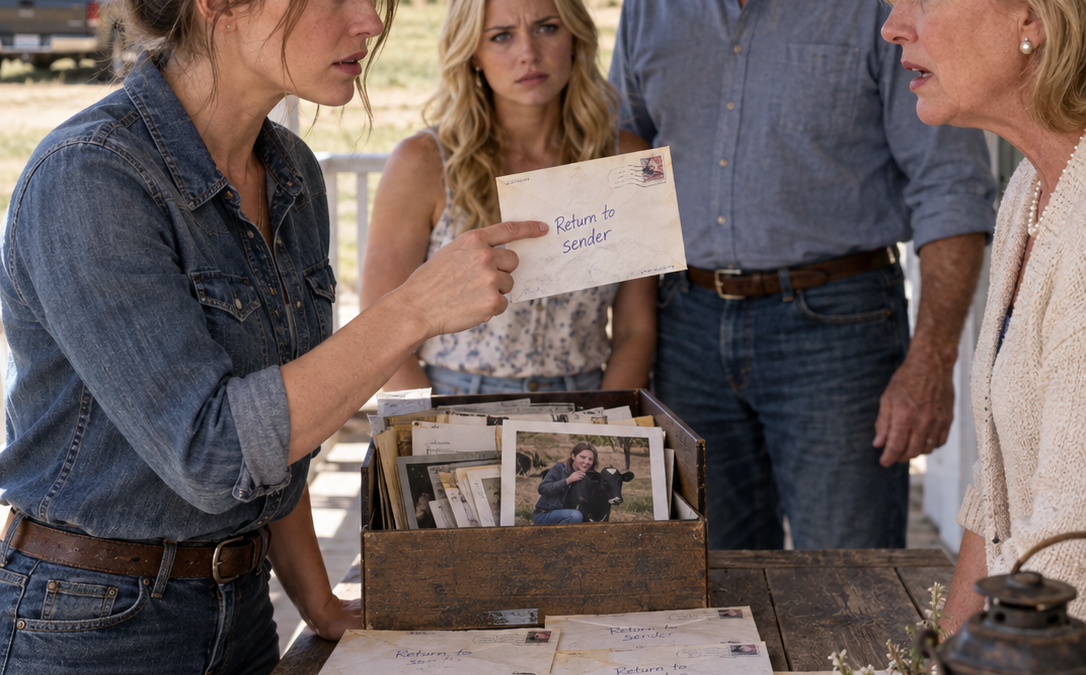
The envelope had been stamped RETURN TO SENDER by the post office, but somebody had also written it in blue pen across the front.
I knew the handwriting.
I’d seen it on a thousand permission slips.
“That’s Mom’s writing. I know it is.”
“Go wash up.”
She took the envelope into her bedroom.
There was a shoebox on the top shelf of her closet, a Justin Boots box, and she put it in there.
I saw her do it.
I didn’t ask about it.
I wouldn’t open that box for eighteen years.
The calls got shorter through 2008. My mother called on my birthday in March for two minutes and told me about Brooke’s new horse. My father got on for thirty seconds and asked if I was being good for Norah.
Nobody called in the summer.
Then Christmas came, and the phone rang, and it was the last time it ever did.
My mother talked to me for three minutes. I could hear Brooke laughing at something in the background and a television.
Then Norah asked for my father.
She took the cordless phone into the pantry and pulled the door almost shut.
And I stood in the kitchen and listened through the crack, because I was fourteen, and that’s what fourteen-year-olds do.
Her voice was very level.
“Where is Ruth’s money for Rachel, Gordon? I’m not asking for me.”
There was a silence on her end.
Then she lowered the phone and looked at it the way people do when a line goes dead.
She came out of the pantry and put it back in the cradle.
“Your dad had to go,” she said.
No one from Kansas called again.
Not once.
Not for seventeen years.
I want to tell you what I did with that pantry conversation, because it’s the foundation of everything I got wrong for the next two decades.
I didn’t know what Ruth’s money meant. I knew Grandma had left me something, and I knew my mother had said Grandma said a lot of things.
So I built the only story a fourteen-year-old could build.
Norah had asked my parents for money to feed me, to clothe me, to keep me, and they’d hung up rather than pay it.
And that was why they were gone.
I decided I was the bill nobody wanted to pay.
And I decided the safest thing a bill could do was cost as little as possible.
So I stopped asking for things.
Anything.
In tenth grade, the school took a trip to Washington, D.C. It cost $380, and Norah said yes before I’d finished the sentence.
I didn’t turn in the form.
I hid it in my folder.
She found it anyway.
She didn’t push, and she didn’t lecture. She just walked out to the mudroom and wrote on the calendar, DC 380, and drew a line through it like an entry she was closing out.
I fixed my own bike. I learned to rebuild the pump on the stock well from a manual.
I told myself I was independent.
I wasn’t.
I was scared.
There’s a difference.
And it took me a long time to learn it.
In 2010, I was sixteen, and I made a Facebook account on the school library computer.
I searched for my sister.
She wasn’t hard to find.
There she was on a big gray horse, ribbons on the bridle, my parents standing on either side.
The caption said, “Kuck Nationals, third place.”
The horse’s name was Sterling Sky.
I remember that because it was such a Brooke name for a horse.
My mother had commented underneath:
“Our girl. Hard work pays off. So proud of our only rider.”
Our only rider.
I read it four or five times.
I didn’t send a friend request.
I deleted the account twenty minutes later, and I didn’t make another one for ten years.
I graduated from Valentine High School in May of 2012.
I was eighteen.
A month before, I’d mailed an invitation to the house in Overland Park. I still knew the address by heart.
It came back unopened.
Norah put that one in the shoebox, too.
At the ceremony, the family rows were near the front.
Norah sat in ours by herself, with her purse in her lap and her good boots on.
When they called my name, she stood up.
She was the only one.
And I heard her all the way across the gym.
Afterward, she drove me to the Western store and bought me my first real pair of boots, and she wouldn’t let me look at the price tag.
Then she told me about Curtis.
There was a two-year agricultural college there, the Nebraska College of Technical Agriculture, about two hundred miles south.
Ranch management. Animal science.
She had already called them.
I told her I could just stay and work. That she needed the help. That I owed her at least that much.
“That’s exactly why you’re going.”
She was loading the truck.
“You’ll come back because you want to, not because you’ve got nowhere else. That’s the only way this place is worth having.”
The night before I left, she came into Walt’s room with his old Army duffel bag, green canvas, and set it on the bed.
I packed into that.
The trash bag stayed folded under the bed where it had been for five years.
I didn’t tell her that.
I’m not sure why I kept it.
I think I knew even then.
When I pulled out of the driveway in August of 2012, Norah stood at the end of it and waved until I hit the county road.
It was the first time anybody had stood in that driveway to watch me leave instead of leaving me in it.
Curtis was two years of my life, and I’ll give it two paragraphs, because what matters is what it made me.
I learned to read a pedigree. I learned artificial insemination and got certified in it. I learned bookkeeping and pasture rotation and how to tell a bad bull from a good one before he cost you a calf crop.
I paid for it with a state scholarship and money Norah had put aside, and I worked weekends at the college herd to cover the rest.
One of my instructors, an old cowman who didn’t hand out compliments, told me once that I read a pedigree the way some people read a room.
I kept that.
I drove home every long weekend, three and a half hours each way.
In my second spring, I called the house and nobody answered for two days. I found out later Norah’s knee had given out on the porch steps and she’d been at the clinic in Valentine and hadn’t wanted to worry me.
That was the year I understood she was getting old.
I finished in May of 2014 and came back for good.
I was twenty.
Norah handed me calving season the way she’d handed me the bottle calves seven years earlier, without a speech, like it had always been mine.
I changed the breeding schedule. I tightened the herd program.
Our live-calf rate had been sitting at eighty-eight percent for years.
That first season, I got it to ninety-four.
Norah didn’t say much.
She walked out to the mudroom and wrote on the calendar:
R’s year.
And left it up there.
“You didn’t come back because you had to,” she said at supper.
I checked.
In 2016, she handed me the checkbook.
Literally.
The blue Beckett Ranch checkbook, the password to the bank account, and the file drawer with the lease agreements.
She said I was the manager now, and she was retiring to the porch.
I tried to give it back.
I told her I wasn’t ready.
What I meant was that the more of this place I held, the more there was to lose.
And I already knew what losing felt like.
“A ranch isn’t a favor,” she said. “It’s a job. Do the job.”
The first check I wrote was for a load of protein tubs.
My hand shook so badly the signature looked like somebody else’s.
Two years after that, a new vet came to Valentine.
Nathan Hollis.
He was twenty-eight, from a farm outside Broken Bow. He was good with cattle and easy with people, and he started showing up at the ranch for preg checks with two cups of coffee instead of one.
He’d leave mine on the corner post of the corral and go to work.
He asked me to dinner in 2019.
I said it was calving season.
He asked again in 2020.
I said it was branding.
He asked in 2021.
And I said something I hadn’t planned to say.
“I’m not good at being kept, Nathan.”
He didn’t laugh at me.
He just set the coffee on the post.
“I’m not trying to keep you. I’m trying to have dinner.”
I didn’t go.
But he kept bringing the coffee, and I kept drinking it.
And for six years, that’s about as close as I let anyone get.
One fence post away.
The bull sale was my idea.
Norah had always sold calves in the fall like everybody else, but I’d been building the genetics for five years, and I knew what we had.
In February of 2020, we ran twenty-two registered Angus bulls through the sale barn in Valentine, and they averaged $3,900 apiece.
I’d set up a Facebook page for it: Beckett Ranch Angus, with pictures and pedigrees and a phone number for anybody who wanted to call about a bull.
My number.
Rachel Randall, ranch manager.
It seemed like the obvious thing to put.
Norah stood at the rail of the sale ring in her good coat and watched the last one sell.
“Ruth would have…” she said.
Then she stopped.
“Never mind. Go get your check.”
I asked her later what Grandma would have done.
“Been proud,” she said.
And changed the subject.
I let her.
In April of 2021, the page got a message from an account with no picture and no posts.
Is this the Rachel Randall from Overland Park, KS?
I typed:
Yes. Who is this?
And sent it.
I waited.
Nothing came back.
By the next morning, the account didn’t exist anymore.
I showed Norah the screenshot.
She looked at it for a long time.
“Whoever it is, they found what they needed.”
I didn’t understand that then.
I do now.
The summer of 2022 was the driest in the Sandhills in twenty years. The leased grass burned off by July, and ours wasn’t far behind.
I sat at the kitchen table with a spreadsheet and did the math four different ways.
It came out the same every time.
We could feed 120 cows through the winter.
We could not feed 180.
Hank Sorenson, who’d been Walt’s best friend and ran the place next door, told me to hang on. The rain always came.
I sold sixty head into the worst market of the year.
I brought Norah the sale receipt to sign.
She signed it without reading a line.
I signed.
I didn’t read.
She handed it back.
“That’s what trust looks like at my age.”
Her signature was shaky.
I noticed.
I didn’t say anything.
That was the first sign, and I let it go by.
In March of 2023, she had a headache that lasted three days.
I drove her to the clinic in Valentine. They ran some tests and told her to watch her blood pressure.
On the way home, she made me stop at the courthouse.
She’d already made the appointment.
I hadn’t known.
She sat down with the county clerk and signed a transfer-on-death deed.
The land to me.
No court. No probate.
Effective the day she died.
Recorded right there.
Then a short will for the cattle and the equipment.
It took forty minutes.
I argued with her in the truck.
I said I hadn’t come there to inherit anything.
“You didn’t come here at all,” she said. “You were dropped. I’m choosing what happens next. That’s different.”
I said she should think about it.
“I’ve thought about it since 2016. You’ve run it for seven years. Running it and owning it were never the same thing. Now they will be.”
She looked out the window at her own grass going by.
“It’s yours the day I’m gone. Don’t argue with a woman who’s already been to the courthouse.”
I didn’t argue anymore.
I got up at three the next morning and worked until dark.
That was how I handled things I couldn’t hold.
She had the stroke on December 3, 2025, in the barn at feeding time, with a bucket in her hand.
Hank found her because I was at the far tank and my phone was in the truck.
The ambulance took her to Valentine, and Valentine sent her to Kearney, three hours south.
I followed in the truck with my hands so tight on the wheel I couldn’t feel them by the time I got there.
She couldn’t talk much.
On the second day, she got two words out, and they were the only thing she’d cared about for fifty years.
“Tanks full?”
“They’re full,” I told her.
She died on December 6.
She was seventy years old.
I drove home, and I sat at her kitchen table with the funeral home’s paperwork.
There was a line for family to notify.
I wrote my parents’ address in Overland Park from memory.
I hadn’t written it since 2012, and my hand still knew it.
I mailed the notice the next morning.
The newspaper in Valentine ran the obituary on the ninth.
Norah Beckett, 70, of Cherry County, survived by her niece, Rachel Randall of Valentine.
Nobody from Kansas called.
Nobody wrote.
That night, the house was quiet in a way it had never been.
I walked past her bedroom, and the closet door was open.
Up on the top shelf was the Justin Boots box.
I looked at it for a while.
Then I went out and slept in the calving barn, because that I knew how to do.
I’d been left before.
This was the first time nobody had done it on purpose.
That was the thought I had, lying in the straw.
It didn’t help.
Nathan texted around midnight.
I’m outside if you want.
I didn’t answer.
I didn’t tell him to go home either.
His truck was still there in the morning.
They buried her on the eleventh.
The church in Valentine seats about two hundred, and it was close to full.
Ranchers. The feed store. The vet clinic. The school. Women from the county extension office she’d argued with for thirty years.
The county cattlemen’s association sent flowers.
The front pew is where the family sits.
I sat in it with Hank Sorenson.
And that was the family.
Todd Brener came. He’s the land broker in town, and he’d handled our grass leases for years.
He shook my hand and didn’t say anything stupid.
Nathan sat in the second row, right behind me.
Close enough that I could hear him breathe.
Hank spoke.
He kept it short.
“Walt used to say Norah could hold a fence line with one hand. Turns out she could hold a kid with the other.”
The lawyer she’d used, an older man with an office over the hardware store, caught me at the church door on the way out.
“The land’s already yours, Rachel. Bring the death certificate by the courthouse Monday. The rest is short.”
He was right.
It was one form.
In January, I took the death certificate to the county clerk and signed an affidavit.
Two weeks later, the county’s tax record showed a new owner:
Randall, Rachel M.
The cattle and the equipment would work through the will over the next few months, and nobody was going to contest it because there was nobody to contest it.
The place was worth around $2 million—land, cattle, and machinery—and it didn’t owe a dime.
Walt had seen to that before he died.
The clerk stamped the last page and slid it back to me.
“That’s it. It was already in your name the day she passed. This just tells the computer.”
I didn’t tell anybody but Nathan and Hank.
I didn’t change the name on the sign.
I went home and wrote Jan deed recorded on the mudroom calendar, and then I erased it because it looked like bragging, and Norah wouldn’t have stood for it.
I opened the shoebox on a Sunday afternoon in January, with the house empty and the wind going.
There were eighteen envelopes in it.
All of them addressed to my father in Norah’s handwriting.
All of them stamped and returned.
And every one of them also had RETURN TO SENDER written on it in blue pen, in my mother’s hand.
Christmas 2007 through Christmas 2024.
One a year.
I opened them in order.
Every one had a photograph of me.
Me and the first calf.
Me at fourteen with my hair cut short.
Me on the fence at sixteen.
My graduation picture.
Me in 2012 in the boots Norah had bought me.
Me holding a champion bull halter in 2020.
Me at thirty in the truck.
She’d written two lines on the back of each one.
She’s doing fine.
She’s getting tall.
She graduated Saturday.
She sold 22 bulls.
Eighteen years of two lines.
And my mother had sent every one of them back without opening it.
Under the envelopes was my graduation invitation.
Still sealed.
Under that was a letter I hadn’t seen before.
It was to Norah from my grandmother, dated March of 2006, the same month as my birthday.
$38,000 for each girl. Gordon holds it until they’re 21. Watch him, Norah. Diane spends whatever she can see.
I read it twice.
Then I did the math I hadn’t been able to do at thirteen.
A $9,500 summer program.
A show horse named Sterling Sky.
A trailer.
Entry fees.
A season on the circuit.
$38,000, give or take.
Real summers.
Nobody gets to take them from you.
At the very bottom of the box was one more envelope.
Not stamped.
Not addressed to Kansas.
It just said, in Norah’s pencil:
Rachel — after.
It was dated March 14, 2023, the day at the courthouse.
She’d written it in the truck or that night while I was out working until dark.
She told me about the pantry.
She said she’d asked my father where my grandmother’s money had gone, and he’d hung up the phone.
And she’d known then that they were never coming back, because people who’ve done that don’t come back to face the person who knows.
They didn’t stop calling because of you, she wrote. They stopped because I asked where your money went.
I never told you because I didn’t want you thinking you’d been sold.
You were never for sale.
That’s why this place is yours.
Not as payment.
As proof.
I don’t remember walking out to the barn.
I remember being there, sitting on a hay bale in the calving pen with the box in my lap and the wind coming through the boards.
It was two in the morning, and I understood something for the first time in nineteen years.
My parents hadn’t left me because I cost too much.
They’d left me because I was the one who might ask.
I called Nathan.
He picked up on the second ring, the way he always did.
He was there in twenty minutes.
I met him at the door of the house.
Not the barn.
Not the corral.
Not a fence post with a cup of coffee on it.
“Come in,” I said.
Not the porch.
Inside.
He came in.
I told him all of it at the kitchen table, with the envelopes spread out between us.
He didn’t tell me what to do.
He didn’t say anything about lawyers.
When I was done, he asked me one thing.
“What do you want to do?”
“Nothing,” I said.
Yet.
I put the box in the kitchen drawer next to the deed, and I meant it.
I had a ranch to run and a herd to calve out and a dead woman’s grass to take care of.
My family had been gone for seventeen years.
I figured they could stay gone.
I’d decided to do nothing.
My family was about to decide for me.
If you saw that coming, tell me in the comments.
I didn’t.
Here’s what I pieced together later.
Cole Tierney lost his job on January 9.
He’d been a commercial lender at a regional bank in Kansas City for nine years, and they cut forty people in one morning.
He was one of them.
My sister had two kids by then.
Ellie was seven and Grant was four.
They had a house in Olathe with a mortgage that assumed two incomes.
I learned this from my father in pieces over a fence, and I’m telling it to you the way he told it to me.
Sometime in February, Brooke went to my parents’ house for Sunday dinner and laid it out.
She wanted to leave the suburbs.
She wanted land and horses and a place where her kids could grow up the way she had.
She hadn’t ridden competitively since 2013, but she still talked about those summers like they were the best thing that had ever happened to her.
And maybe they were.
“I want Ellie to have what I had, Dad,” she said. “Real summers.”
That was the third time somebody in my family had used that phrase.
The first was my grandmother.
The second was my mother.
My father heard it from Brooke and didn’t hear anything at all.
He’d retired the year before.
Thirty-one years managing dealership territories for an ag-equipment company, which is its own kind of joke.
He had about $600,000 in his retirement account and a house that was nearly paid off.
He figured he could pull $300,000 more against it if he needed to.
$900,000.
Enough, he thought, if you were buying something nobody else wanted yet.
He had a specific something in mind.
He knew Norah was dead.
Brooke had told him in December.
Somebody posted about it.
She said he didn’t read the obituary.
He didn’t come to the funeral.
He didn’t send flowers.
But in March, when Brooke said land, my father thought of the only piece of land he’d ever known that was about to change hands.
His sister’s place.
He assumed the estate would want it gone by fall.
He assumed it would go cheap.
He assumed a lot of things.
He assumed I was in Denver.
That’s what Brooke had told him.
In 2019, at Thanksgiving, when somebody’s cousin asked whatever happened to the younger girl, Brooke said she’d heard I’d moved to Denver years ago and didn’t want contact.
My father took that and put it in the box in his head where he kept me.
And he never took it out to look at it.
He still carried a leather folder to the dinner table.
Brown, worn at the corners from his working days.
He carried it everywhere.
I’ll come back to that.
My mother didn’t argue with the plan.
My father said she went quiet the way she did when she’d already decided something.
She thought I’d left long ago.
She thought Norah had probably left the ranch to the church or the county or some hired man.
She gave my father exactly one instruction.
“Don’t say the name Randall until the papers are signed.”
Norah had opinions about us.
She didn’t know Norah had written them down.
It was Brooke who pushed hardest.
Brooke who said estate sales move fast.
Brooke who said to go before it lists.
Brooke who, in April, texted my father the name and address of a land broker in a town she had never once set foot in.
Sand Hills Land and Ranch. Todd Brener. Main Street. Valentine.
Go the Monday after Mother’s Day. Estate stuff moves fast, Dad.
He didn’t ask how she knew the name.
Neither did I until later.
She didn’t go with him.
Cole and the kids, she said.
So on Sunday, May 17, my father loaded his folder and a cashier’s check into his truck and drove 430 miles northwest.
He got to Valentine around five in the afternoon and checked into the motel out on Highway 20.
He ate supper alone at the café on Main Street, two hundred yards from Todd Brener’s office.
He went to bed early.
Twenty miles north, I was standing in my kitchen looking at the weather on my phone.
Thunderstorms Monday afternoon.
Dry lightning likely.
Southwest wind, twenty-five miles an hour.
The old grass hadn’t greened all the way up yet. It was standing dead and brittle under the new growth, and I had sixty pairs on the north pasture, with calves anywhere from two to six weeks old.
I filled every tank on the place that night and checked the pump on the north well twice.
I remember thinking that was the only thing I had to worry about.
Dry lightning.
That was all.
Todd Brener opens his office at nine.
He told me my father was waiting in the truck when he unlocked the door.
He came in, sat down, and set the folder on the desk.
He asked about the Beckett place off Highway 83.
Todd knows the Beckett place the way he knows his own hand.
He said it wasn’t listed.
My father said he understood the owner had passed, that he was family, and that he’d like to make a fair offer to the estate before it went on the market.
Todd is careful.
It’s why he’s lasted twenty years in a business where people lie about water rights.
“Which side of the family?”
“Norah Beckett was my sister.”
Todd didn’t say anything to that.
He didn’t tell my father what he knew or didn’t know.
He said the easiest way to find out who had authority to sell was the county’s own records, which were public, and he pulled his keyboard over and typed in the parcel.
The Cherry County Assessor’s page came up.
Todd turned the monitor around so my father could read it.
Owner: Randall, Rachel M.
“That’s the owner,” Todd said. “Rachel Randall. Recorded in January. You’d need to talk to her. And she’s not selling, far as I know.”
He told me my father looked at the screen for about twenty seconds.
He didn’t ask a question.
He didn’t say my name.
He picked up his folder, stood, and walked out without closing the door.
Todd said he’d never seen a man go that quiet.
My father sat in his truck outside that office for forty minutes with the engine off.
Then he drove back to the motel.
Todd called me at eleven.
I was at the north fence with a stretcher and a bucket of clips, and I almost let it go to voicemail.
“Rachel, somebody came in this morning about your place. He said he was family.”
A pause.
“Do you know a Gordon Randall?”
The wind was blowing.
I remember that.
I remember the fence wire humming.
“He’s my father.”
I had to stop.
“Was. Is. I don’t know the right tense, Todd.”
“He said he was Norah’s brother.”
“He didn’t say that part.”
I thanked him.
I told him I’d call him back.
I didn’t.
I hung up, finished the stretch, drove to the next brace, and did that one, too.
I didn’t call Nathan.
I didn’t call Hank.
I didn’t look at my phone again.
I’d had nineteen years of practice at not reacting, and I used every one of them that afternoon.
At the motel, my father called my mother.
I know what he said because he told me two days later, sitting on a feed bin, and I believe him because there’s no version of the story that makes him look worse.
“It’s Rachel. She’s the owner. She’s been here the whole time.”
My mother was quiet for a long moment.
Then she asked her first question.
It wasn’t about me.
“Did he say anything about what Norah left behind? Papers? Anything?”
My father said no.
My mother said she’d call Brooke.
The storm came in at six.
I saw it building over the west line the way you see them out here, a wall of dark with light flickering inside it.
At twelve minutes after six, a bolt came down on the far end of the north pasture, and I saw the smoke before I heard anything.
A thin white thread.
And then it wasn’t thin anymore.
I called Hank first, then the volunteer fire department in Valentine.
Then I dropped the phone on the seat of the truck and grabbed the fence cutters, because sixty cows and sixty baby calves were between that fire and the only gate, and the gate was on the wrong side.
At 6:20, on the seat of my truck, my phone lit up.
I didn’t see it.
It was the first of eighty-eight.
We fought the fire until two in the morning.
Hank came across the county road with his tractor and a disc and started cutting a firebreak before I’d finished cutting the fence.
Six volunteers came from town in two trucks with a water tank.
Nathan came in his own truck with a slip-in sprayer he uses for the clinic.
He didn’t ask me where to go.
He just went.
I cut the whole north gate out.
All of it.
Both sides.
We pushed the pairs through the gap and south toward the corral with the smoke coming over us.
The calves couldn’t keep up.
We carried the ones we could.
The wind laid down around midnight.
The fire ran out of grass at Hank’s break.
We lost sixty acres and two calves.
We kept the herd.
We kept the barns.
Hank found me at the cut gate around one with the cutters still in my hand.
“Norah would have your hide for cutting that gate.”
“Norah would’ve cut it first.”
It was the first time I’d laughed since December.
Nathan stayed until the last truck left.
He didn’t say much.
He’d been in my north pasture all night, and I hadn’t asked him to leave it.
We both noticed that.
At ten after three, I got in the truck to drive back to the house.
My face was black with ash.
I picked up my phone to check the time.
Eighty-eight missed calls.
Mom: 46.
Brooke: 33.
Dad: 9.
I’d never deleted them.
That’s the thing I noticed first.
Sitting there at three in the morning, five phones in eighteen years.
Every time I’d gotten a new one, I’d moved those three names over to it.
Mom.
Dad.
Brooke.
They’d never once used them.
And there they were, stacked up all night long.
The number had come from the ranch’s Facebook page.
Rachel Randall, ranch manager.
Right there under the pictures of the bulls.
It had been public for six years.
There were four voicemails from my mother.
I sat in the truck and listened to them in order.
Seven in the evening.
Soft.
A voice I hadn’t heard since I was fourteen.
“Rachel, honey, it’s Mom. We’ve been trying so hard to find you. Your father’s up there. Did you know that? Please call.”
Ten o’clock.
Tighter.
“Rachel, it’s been hours. You could have called us at any point in all these years. We didn’t know where you were. That’s not fair to us.”
Midnight.
Businesslike.
“Your father has a fair number in mind for the place. More than fair. It would stay in the family. Think about your sister’s kids.”
One in the morning.
And this is the one I’ve played back more times than I should have.
“Rachel, whatever Norah told you about your father, about money, she was bitter. She never forgave him for leaving the farm. Don’t let a dead woman turn you against your family.”
Nobody had said anything to my mother about money.
Not my father.
Not Todd.
Not me.
She’d brought it up herself.
At one in the morning, in the fourth message, she’d reached into the dark and named the thing she was afraid of.
Brooke had sent fourteen texts.
I read them the way you’d read a weather report.
Ra, I’ve missed you so much.
I can’t believe Dad found you.
This is a sign.
Call me the second you see this, please.
Dad has cash. It doesn’t have to go to a stranger. It could stay in the family.
Ellie would love it up there.
The ninth one was the one that mattered.
I always knew where you were. I just didn’t want to push. But this is bigger than us now, Ra. Think about Ellie and Grant.
I always knew where you were.
I sat with that one.
I thought about a message from an account with no picture five years earlier.
Is this the Rachel Randall from Overland Park, KS?
I thought about Norah looking at it and saying:
Whoever it was had found what they needed.
By the fourteenth text, at two in the morning, my sister had stopped missing me.
You owe us at least a conversation.
My father had called nine times.
Eight of them, he’d hung up before the voicemail picked up.
The ninth, at 2:40, he’d stayed on the line.
Six seconds.
“It’s Dad. I didn’t know you were still there. I—I’m at the motel on 20.”
I played it three times.
His voice was older than I’d carried it in my head.
I didn’t call back.
At six, Nathan came with two cups of coffee and set one on the kitchen table instead of a fence post.
I’d showered and changed.
I’d taken the shoebox out of the drawer and set it on the porch table, closed.
I didn’t know yet what I was going to do with it.
I only knew I wanted it where I could reach it.
“They’re not calling because they found me,” I told him. “They’re calling because they found out I’m not for sale.”
He asked if I wanted him to stay.
“Stay where I can see you, not where they can.”
At eight, a pickup with Kansas plates stopped at the gate at the end of the driveway.
It didn’t come through.
It couldn’t.
The gate was closed.
I didn’t open it.
I walked down.
He’d gotten out and was standing on his side of the pipe gate with his hands in his jacket pockets.
His hair had gone all the way white.
He was wearing a button-down shirt like he was going to a meeting.
He looked at the fence and the driveway and the house up the hill.
He didn’t look at me for a while.
“I didn’t know you were still here,” he said.
“Where did you think I was?”
“Brooke said Denver. Years ago. She said you’d moved and didn’t want—”
He stopped.
“Denver. Since when?”
“2019. Thanksgiving.”
“I’ve had this ranch’s name on Facebook since 2020, Dad, with my phone number on it. Brooke messaged me in 2021 to make sure I was here.”
I let him hold that.
“Which one of us do you think she lied to?”
He didn’t have an answer.
I hadn’t really expected one.
I unlatched the gate and swung it open.
Not because I’d forgiven anything.
I wanted him to see it.
I walked him through the calving barn first, past the pens where I’d pulled a calf with his sister at two in the morning eighteen Christmases ago.
I showed him the mudroom calendar.
The same feed-store calendar, a new one every year, but always on the same nail, and the old ones stacked in the drawer beneath it.
I pulled out 2014 and showed him R’s year in Norah’s pencil.
I pulled out 2010 and showed him DC 380 with the line through it.
I didn’t explain either one.
He read them like a man reading a language he used to speak.
I gave him the numbers the way I’d give them to a banker.
“Hundred eighty head of registered Angus. Thirteen hundred acres deeded. Nine hundred leased. Twenty-two bulls a year through the sale ring. Twelve years full-time.”
“You did all this?”
“Norah did. I finished it.”
We walked to the top of the hill where you can see the north pasture.
Sixty acres of it were black.
The cut gate was lying in two pieces in the sand.
“You wanted to buy this for Brooke,” I said. “Look at it first. It took nineteen years to build. You had nineteen years to visit.”
He still asked.
I’ll give him that.
He stood there looking at the burn, and he still asked.
He said he’d come with a fair offer.
He said it wasn’t about taking anything from me.
It was about keeping the place in the family for Brooke’s kids so it wouldn’t end up sold to some corporation out of Omaha someday.
“It is in the family,” I said.
Then I asked him the question I’d been holding since three in the morning.
“The guardianship form. August of 2007. Where did you sign it?”
He looked at me like I’d hit him.
“A gas station,” he said finally. “On Metcalf. On my way to work. The notary was a girl behind the counter.”
He was quiet.
“Four minutes,” I said. “It took four minutes.”
Then I asked him.
“Grandma left me $38,000. Dad, where did it go?”
He sat down on a feed bin.
He put his hands on his knees.
He looked at the ground between his boots for a long time.
And when he answered, it was one word.
“Kentucky.”
I didn’t raise my voice.
I want you to know that I’d had nineteen years to plan what I’d say to him, and every version I’d ever rehearsed was louder than what came out.
“I’m not going to ask you twice. Norah asked you once, and you hung up.”
He nodded.
He didn’t defend himself.
He asked if he could come back the next day.
I told him I didn’t know.
He drove back to the motel.
My mother and sister arrived at twelve the next afternoon.
They’d left Overland Park at five that morning.
Brooke had left her kids with Cole.
My father came up the driveway behind them in his own truck.
I’d left the gate open.
I wanted this done.
I met them on the porch.
I didn’t invite anyone inside.
My mother came up the steps with her arms already out.
She was sixty-one, and she looked the way she’d always looked.
Put together.
Hair done.
The mother from the church directory.
“We’ve been worried sick.”
I didn’t step into the hug.
She let her arms down.
Brooke stood at the bottom of the steps.
Thirty-four years old.
Thinner than I remembered.
Sunglasses pushed up in her hair.
She said my name like it hurt her.
She said she’d thought about me every day.
Then, before she’d finished the sentence, she was talking about a family price.
About how Dad had the money.
About how it could be simple and the kids could be up there by summer.
I didn’t argue with either of them.
I’d decided the night before that I wasn’t going to argue.
I opened the shoebox on the porch table and took out the envelopes.
I laid them down one at a time, in order, the way I’d opened them in January.
Christmas 2007.
Christmas 2008.
Christmas 2009.
Address side up.
My mother was still talking when I set down the first one.
She was talking when I set down the second.
At the third, she stopped.
RETURN TO SENDER.
Blue pen.
Eighteen times.
She recognized it before I said a word.
“That’s your handwriting, Mom. Eighteen times. You wrote it more than you ever wrote my name.”
Brooke had come up the steps.
She was looking at the row.
Her eyes stopped on 2012.
The graduation picture was inside that one.
She was a junior in college that year.
I’d worked out the tuition on the back of the sale receipt in January.
$38,000 goes a long way at a state school.
My father stood at the end of the porch.
He didn’t move to stand beside either of them.
My mother found her voice first.
It came out smaller than she meant it to.
“Norah poisoned you.”
I let that sit on the table with the envelopes.
Then I said what I’d come to say.
The ranch was not for sale.
Not to them.
Not at any price.
Not now.
Not later.
I said I wasn’t going to hire a lawyer, and I wasn’t going to call anybody, and I wasn’t going to ask for a dollar of what Grandma left me, because that money had been spent nineteen years ago.
And I’d already gotten something better out of the deal than they had.
Then I turned to my sister, because I’d thought about this part for a long time, and it was the only part I wasn’t sure of.
“You can bring Ellie and Grant up here one week every summer. I mean that. I’d like to know them.”
I waited until she looked at me.
“But you tell them why I’m here. The real reason. What happened in 2007. Before they come. That’s the condition.”
She stared at me.
Then she shook her head fast, like I’d asked her to put them in the river.
“I’m not doing that to my kids.”
“Then you understand why I’m not doing it to me,” I said. “Not again.”
Brooke’s face changed then.
Not into anything I hadn’t seen before.
“You’re making this about money.”
“You made it about money in 2007. I’m just reading the receipt.”
My mother stood up.
She said it again, louder, like volume would make it true.
“Norah poisoned you against your own family.”
“Norah fed me,” I said. “For nineteen years. Every day. You can go now.”
I walked down the steps, across the yard, and down the driveway to the gate.
I stood by it.
My mother came first.
She didn’t look at me as she passed.
Brooke stopped in front of me for a second.
I thought she might say something real.
Then she didn’t.
They got into Brooke’s SUV and drove out through the gate.
I swung it closed behind them and dropped the chain.
My father’s truck stayed where it was.
He sat in it at the end of the driveway, outside the gate, with his hands on the steering wheel and the brown folder on the seat beside him.
He was still there when the light went.
I didn’t go down.
I went to the calving barn, and I cried for about ten minutes.
Hard.
The way I hadn’t in December.
Then I stopped and went and checked the north well.
The tank was full.
He was at the gate at seven the next morning.
Alone.
He didn’t get out of the truck until he saw me coming down the driveway.
Then he got out and stood at the pipe rail with the folder in his hands.
He took one sheet of paper out of it.
It was soft at the folds, the way paper gets when it’s been folded and unfolded for a long time.
He passed it over the gate.
A bank statement.
May 4, 2007.
A custodial savings account in the name of a minor:
Rachel M. Randall.
Gordon Randall as custodian.
Opening balance: $38,000.
One withdrawal.
Closing balance: zero.
“I never took it out of the folder,” he said. “I never threw it away either. I don’t know what that makes me.”
“It makes you the one who kept the receipt.”
He nodded like that was fair.
He put both hands on the top rail.
“I carried it every day I went to work. Thirty-one years of meetings. It was in there for every one of them.”
His voice dropped.
“I never once drove it here.”
I could have said a lot of things to that.
I didn’t say any of them.
I let him stand in it.
He had one more thing.
He’d talked to Brooke Tuesday night, he said, at the motel after I’d sent him away.
He’d asked her how she’d known the realtor’s name.
She’d read the obituary in December.
Survived by her niece, Rachel Randall of Valentine.
She’d known I was here.
She’d known I was the one Norah left it to.
She’d known all of that before she texted him Todd Brener’s address and told him to go the Monday after Mother’s Day.
“She figured you’d sell to us for half,” my father said.
He was looking at the ground again.
“She said you’d want a family price because you’d want a family. She said…”
He stopped.
“Say it.”
“She said you always wanted us back. ‘That’s the whole point, Dad,’ she told me.”
I’d thought I was angry the day before.
I wasn’t.
This was something colder and quieter, and it settled somewhere under my ribs and stayed there.
My sister hadn’t come to Nebraska for the ranch.
She’d come for the girl in the driveway.
She’d bet everything on that girl still being there.
I went back up to the house and got the shoebox.
I brought it down to the gate and passed it over the rail.
All eighteen envelopes, still sealed, in order.
I’d kept my grandmother’s letter and Norah’s.
The rest were his.
“They’re addressed to you,” I said. “Open them or don’t. Either way, you’ll finally have to decide something about me yourself.”
He took the box with both hands.
I didn’t open the gate.
I didn’t ask when he was leaving or where he was going.
“You can write,” I said. “Don’t drive.”
He said he understood.
He put the box on the passenger seat where the folder had been and turned the truck around at the end of the driveway.
I watched it go down the county road until the dust settled.
The way I’d watched a car go in 2007.
It felt different.
I was the one on this side of the gate.
Brooke’s text came Sunday.
It was long.
It said she was sorry for how things had gone.
It said she hadn’t meant any of it the way it sounded.
And then it said the thing she’d driven six hours to say.
I’m sorry for how it went. But that place is worth $2 million and Grandma left me nothing extra. Fair is fair, Ra.
I didn’t answer her in words.
On Tuesday, I drove to the post office in Valentine with an envelope.
Inside was a copy of the bank statement, May 4, 2007, and a photograph I’d printed from a Facebook page I’d looked at once in 2010.
My sister at fifteen on a big gray horse named Sterling Sky.
Ribbons on the bridle.
My parents on either side.
No note.
No return address.
She could read.
I blocked my mother’s number that afternoon.
I didn’t block Brooke’s.
Nathan asked why not.
“She can read,” I said.
The receipts.
The letter.
Monday had been Memorial Day.
I’d driven to the cemetery in Valentine that morning and put a small flag on Walt’s stone because he’d been in the Army, and a handful of new green grass from the north pasture on Norah’s, because that was what she’d have wanted to know about.
The burn was coming back already.
It always does.
That night, I went into Walt’s old room and got down on the floor.
I pulled the trash bag out from under the bed for the first time since 2012.
Five years under that bed, then fourteen more in a folded square.
I untied the double knot.
It came loose easier than I expected.
There was nothing in it.
There never had been.
Not really.
I’d kept it so I wouldn’t forget I’d been left.
Nineteen years, and it had done its job.
I didn’t throw it away.
I carried it into Norah’s room and set it by her closet, where her coat still hung.
I left it there so I’d remember something else.
Who stayed.
The next morning, I filled it.
Norah’s barn coat.
Her town coat.
Her Sunday coat.
Her gloves.
Not Walt’s gloves.
Those stayed on the nail.
I drove the bag into Valentine and carried it into the thrift shop by the school.
Open at the top.
No knot.
I set it on the counter.
The woman at the counter had taught me eighth-grade English.
“That’s Norah’s coat,” she said.
“It’s somebody else’s winter now.”
My father’s letter came Wednesday.
One page.
His handwriting had gotten shaky.
I opened them. All eighteen.
I looked at every one until I could say your age out loud without checking the back.
I’m not asking for anything. I’d just like to keep writing if the mail comes through.
I didn’t write back.
On Thursday, I stood at the end of the driveway with my phone held out and took a picture of myself in front of the gate.
I printed it at the drugstore in town and put it in an envelope with a stamp and his name on it.
The nineteenth photograph.
I mailed it.
It didn’t come back.
On Saturday, Hank and Nathan came over, and we pulled the old sign off the gateposts.
Beckett Ranch.
Walt’s lettering.
Forty-eight years of weather on it.
I’d painted a new one in the shop.
I hadn’t changed the name on the deed.
The county could call it whatever it wanted.
I knew who’d paid for it.
Ruth’s Creek Ranch
Established 1978
Beckett Family
Hank stepped back to look at it hanging straight.
“Ruth never set foot on this place.”
“She sent me,” I said. “That counts.”
Sunday was May 31.
I did something I hadn’t done in twelve years.
I didn’t work.
Hank checked the tanks.
I left my phone on the kitchen table.
Nathan and I drove down to the Niobrara and sat on the bank where the water comes around the bend.
We didn’t talk about any of it.
It was the last day of May.
As far as I was concerned, summer started early.
My mother said Brooke deserved real summers, and I’d only ruin them.
I’m having one.
Nobody ruined it.
Nobody paid for it either.
It’s just mine.
Thank you for staying with me through this. If you’ve ever been the one left in the driveway or the one who stayed for somebody else, I’d like to hear your story in the comments.
It helps more than you…








